Installing Windows in Masonry Walls: Structural Considerations
By Housey · Last reviewed 31st of May 2026
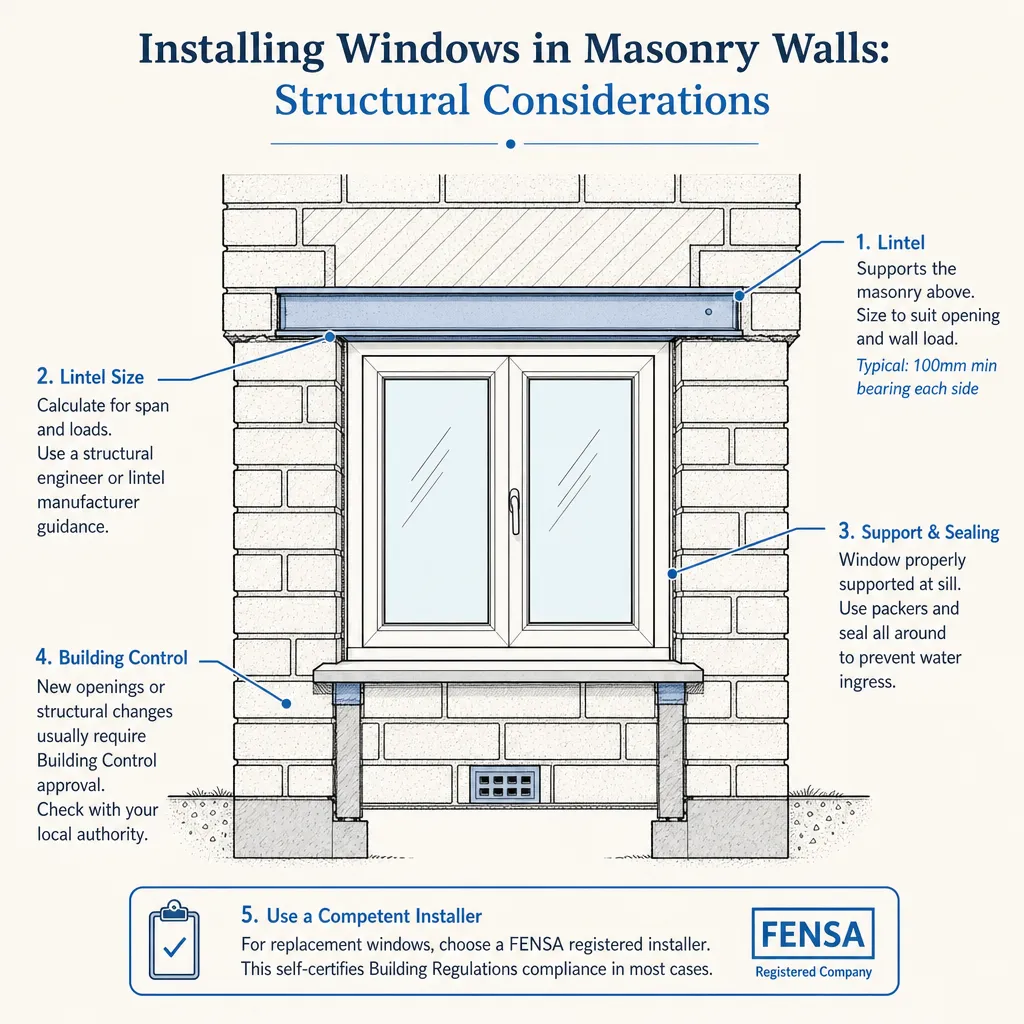
Installing Windows in Masonry Walls: Structural Considerations
Most UK homes built before the 1970s were constructed from solid or cavity brick and blockwork, and many homeowners reach a point where a wall that receives no natural light becomes the target for a new window. Whether it is converting a side return, opening up a garage wall, or simply improving a dark room, the desire to create or enlarge a window opening in masonry involves more than a masonry saw and a lintel from the builders' merchant. Load paths that have been stable for decades must be carefully managed, and regulatory obligations under the Building Regulations 2010 are clearly defined.
Key points
- Any new window opening in an external masonry wall requires a lintel specified by a structural engineer or suitably qualified designer — lintel sizing is governed by Building Regulations Approved Document A (Structure).
- New openings in external walls are notifiable under the Building Regulations 2010 in England and require either a Full Plans application or a Building Notice before work starts.
- In England and Wales, replacement windows in existing openings must be installed by a FENSA-registered company or notified separately to local building control under the Building Regulations 2010 (Schedule 3).
- Cavity walls require a cavity closer at all new openings to maintain thermal continuity and prevent moisture bridging, per Approved Document C (Site Preparation and Resistance to Contaminants and Moisture).
- If the masonry wall adjoins a neighbour's property, the Party Wall etc. Act 1996 may require a formal Party Wall Notice before structural cutting begins.
New opening vs. window replacement: what changes structurally?
The structural burden of a project depends almost entirely on whether you are creating a new opening in masonry or replacing a window in an existing opening.
Scenario | Structural work required | Building control required | FENSA applicable |
|---|---|---|---|
New opening in load-bearing masonry wall | Yes — lintel design, temporary propping, structural restraint | Yes — notifiable under Building Regs 2010 | No (new work, not replacement) |
Enlarging an existing opening | Yes — existing lintel may be inadequate; structural review needed | Yes — notifiable | No |
Like-for-like window replacement (same opening) | No structural alteration | Yes — FENSA or separate building notice | Yes — FENSA in England and Wales |
Internal non-structural partition only | Usually no — confirm wall is non-load-bearing first | Unlikely unless thermal or energy work involved | No |
For any new or enlarged opening, the recommended sequence is: appoint a structural engineer or suitably qualified designer → obtain building control approval → arrange temporary propping → cut the opening → install the lintel and window frame → arrange building control inspection.
Why lintels matter and how they are specified
A lintel bridges the opening you create, carrying the masonry load above it — including upper floors, roof structure, and the weight of brick courses — and transferring that load to the masonry piers on either side. Getting the lintel specification wrong is one of the most common causes of cracking and structural movement above window openings.
Lintels must be:
- Long enough to bear adequately onto the masonry on each side — minimum bearing is typically 150 mm per side for standard openings, but a structural engineer specifies the exact requirement for your situation.
- Strong enough to carry the load above — this depends on the span of the opening, the number of storeys, the roof type, and the floor loading.
- Correct material — steel lintels are standard in modern construction; older properties may have concrete, stone, or brick arch lintels; historic masonry (pre-1919) sometimes uses timber padstones.
A structural engineer will produce a lintel specification or structural calculation for submission to building control. Do not select a lintel solely from a merchant catalogue without professional specification for any new or enlarged opening in a load-bearing wall.
Building Regulations and building control approval
New openings are notifiable under the Building Regulations 2010. You have two main approval routes:
- Full Plans application — submit drawings and calculations to building control before work starts; receive written approval, then proceed. Recommended where structural calculations are involved.
- Building Notice — notify building control before starting, with no pre-approval of drawings; the inspector visits during the works. Less paperwork upfront but no advance confirmation of the design.
Building control will inspect the lintel installation, check cavity closers and insulation continuity, and verify that draught-proofing requirements are met. A completion certificate is issued on satisfactory inspection — this document is important for property sales and mortgage applications.
Replacement windows in existing openings fall under a separate notification route for energy performance. In England and Wales, the two compliant options are:
- Use a FENSA-registered installer — the company self-certifies and notifies building control on your behalf, and you receive a FENSA certificate within 30 days.
- Appoint a building control body to inspect the installation independently.
In Scotland, equivalent requirements apply under Section 6 of the Building Standards (Scotland) Regulations 2004. In Northern Ireland, the Building Regulations (Northern Ireland) 2012 apply. Always check with your local authority.
Cavity wall and solid wall considerations
The majority of UK homes built from the 1930s onwards use cavity wall construction — two skins of masonry with an air gap, often partially or fully filled with insulation. When a new opening is formed in a cavity wall:
- A cavity closer must be installed at all jambs and the head of the opening to seal the cavity, preventing cold bridging and moisture penetration into the building fabric.
- If the cavity contains blown bead, mineral wool, or foam insulation, the cavity closer must be installed without creating a thermal bypass.
- Approved Document C requires that window sills and reveals are detailed to resist moisture ingress.
For solid-wall properties — common in Victorian terraces and most pre-1919 construction — there is no cavity to close, but penetration through the full wall thickness must be managed carefully to avoid cold bridging and interstitial condensation risk in the reveal.
Planning permission and conservation areas
Most new window installations or replacements on houses in England are permitted development and do not require a planning application, provided:
- The window does not protrude beyond the plane of the roof slope (for roof lights).
- Any side elevation glazing above ground floor is obscure-glazed and non-opening where it overlooks a neighbour's property.
Permitted development rights do not apply if:
- Your property is in a conservation area or a World Heritage Site — some changes to external appearance require prior approval or full planning permission.
- Your property is a listed building — all works affecting the character of the building require Listed Building Consent in addition to any planning permission needed.
- Your property is subject to an Article 4 Direction — local planning authorities can remove permitted development rights in specific areas.
Always check with your local planning authority before proceeding. Historic England provides detailed guidance for listed buildings and conservation areas at historicengland.org.uk.
Which professional do you need?
Situation | Professional to appoint |
|---|---|
New opening in load-bearing external wall | Structural engineer or suitably qualified designer |
Like-for-like window replacement | FENSA-registered window and door installer |
Listed building or conservation area query | Local planning authority; possibly a conservation architect |
Party wall dispute or formal notice required | Party wall surveyor |
Non-standard construction (timber frame, steel frame, prefab concrete panels) | Structural engineer — do not assume standard lintel rules apply |
Cracking visible above an existing window or door opening | Chartered structural engineer or RICS surveyor for defect investigation |
Important limitations
This article provides general information about structural principles and regulatory requirements for window installation in masonry walls. It is not a substitute for a structural engineer's assessment of your specific property. Load paths, masonry condition, wall composition, foundation type, and local authority requirements all vary significantly between properties. Always appoint a qualified professional before cutting into any load-bearing structure — and before assuming a wall is non-load-bearing.
What to ask a qualified professional
Before appointing a structural engineer or window installer for a new opening in a masonry wall, ask:
- Is this wall load-bearing, and how will you confirm that before work begins?
- What temporary propping do you recommend during the cutting works?
- Will you provide structural calculations suitable for submission to building control?
- What lintel specification do you recommend, and on what basis?
- How will the cavity be closed and thermally insulated at the new opening?
- Which building control route are you using — Full Plans application or Building Notice?
- Will I receive a completion certificate on finishing?
- Is this property in a conservation area, and have you confirmed the planning status?
When to get professional help
Contact a structural engineer or suitably qualified designer before any work begins if:
- You are creating any opening that does not already exist in the masonry — even a small new window.
- You are enlarging an existing window or door opening, even if a lintel is already visible.
- You notice cracking above an existing opening — this may indicate an existing lintel failure or ongoing settlement.
- The property is of non-standard construction: timber frame, prefabricated concrete panels, steel frame, or large-format blockwork.
- The wall is in a terrace or semi-detached property and adjoins a neighbour's home.
- The property is listed or in a conservation area.
For straightforward like-for-like window replacements in existing openings, a FENSA-registered window and door installer is the appropriate starting point.
How Housey can help
Housey connects you with vetted structural engineering professionals who can assess your masonry wall, provide calculations for building control, and specify the correct lintel for your project. If you need window replacement rather than a new opening, our window and door installers are FENSA-registered and handle building control notification on your behalf.
Frequently asked questions
Do I need planning permission to install a new window in a masonry wall?
Most new windows on a house in England are permitted development and do not require a planning application, provided they meet position and size criteria. Exceptions apply if your property is listed, in a conservation area, or subject to an Article 4 Direction. Always check with your local planning authority before proceeding, as rules vary by location and property history.
What size lintel do I need for a window opening in a brick wall?
Lintel size depends on the span of the opening, the number of storeys above, the type of masonry, and the floor and roof loading. Only a structural engineer or suitably qualified designer can specify the correct lintel for your situation. Using an undersized or incorrectly specified lintel is a common cause of cracking and long-term settlement above window openings.
Can I cut a new window opening in a brick wall myself?
Cutting a new opening in a load-bearing external masonry wall is not safe DIY work. It requires temporary propping, a structural specification, and building control notification before work starts. Errors can result in structural movement, collapse of masonry above the opening, and invalidated home insurance. Appoint a structural engineer and a competent contractor.
Does replacing an existing window need building control approval in England?
Yes. Replacement windows in England and Wales are notifiable under the Building Regulations 2010 for energy performance compliance. You must either use a FENSA-registered installer, who self-certifies and notifies on your behalf, or notify local building control separately and arrange an inspection. Missing certification can affect your ability to sell the property.
What is FENSA and why does it matter?
FENSA (Fenestration Self-Assessment Scheme) is a government-authorised competent persons scheme allowing registered window and door installers in England and Wales to self-certify that their installations comply with Building Regulations. A FENSA certificate is required by conveyancing solicitors during property sales. Without one, you may need retrospective building control approval, which can delay or complicate a transaction.
Sources and further reading
- Building Regulations Approved Document A (Structure) — GOV.UK: structural requirements including openings in masonry walls
- Building Regulations Approved Document C — GOV.UK: cavity closure and moisture resistance at window openings
- FENSA: Fenestration Self-Assessment Scheme — FENSA: registered installer search and certificate verification
- GOV.UK: Party Wall etc. Act 1996 guidance — GOV.UK: party wall notice requirements for structural works
- Historic England: windows in listed buildings — Historic England: guidance for windows in listed buildings and conservation areas
- Planning Portal: windows — permitted development — Planning Portal: planning rules for window installation and replacement
Useful next reads
 Improvement & Build
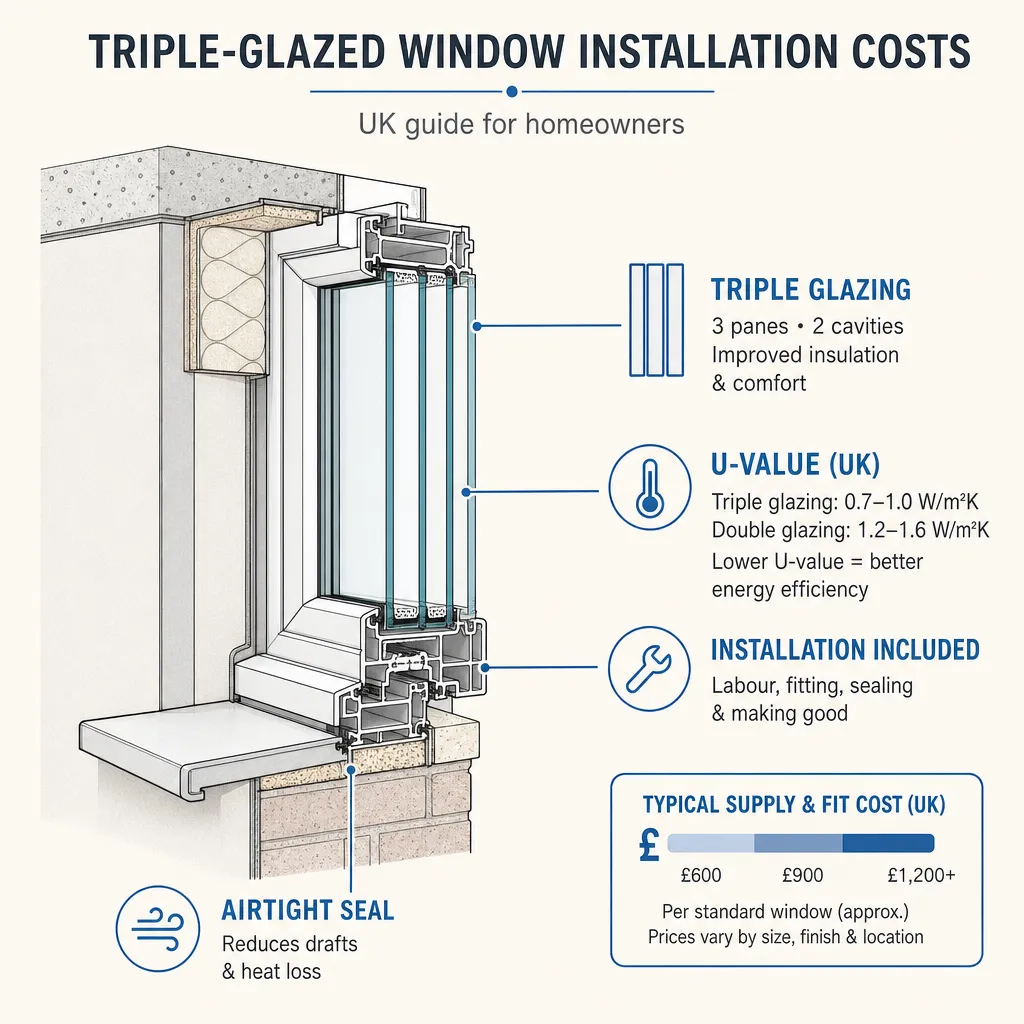
Triple-Glazed Window Installation Costs
Triple-glazed window installation in the UK typically costs £800–£1,800 per window, depending on size, frame material, and glazing specification.
 Improvement & Build
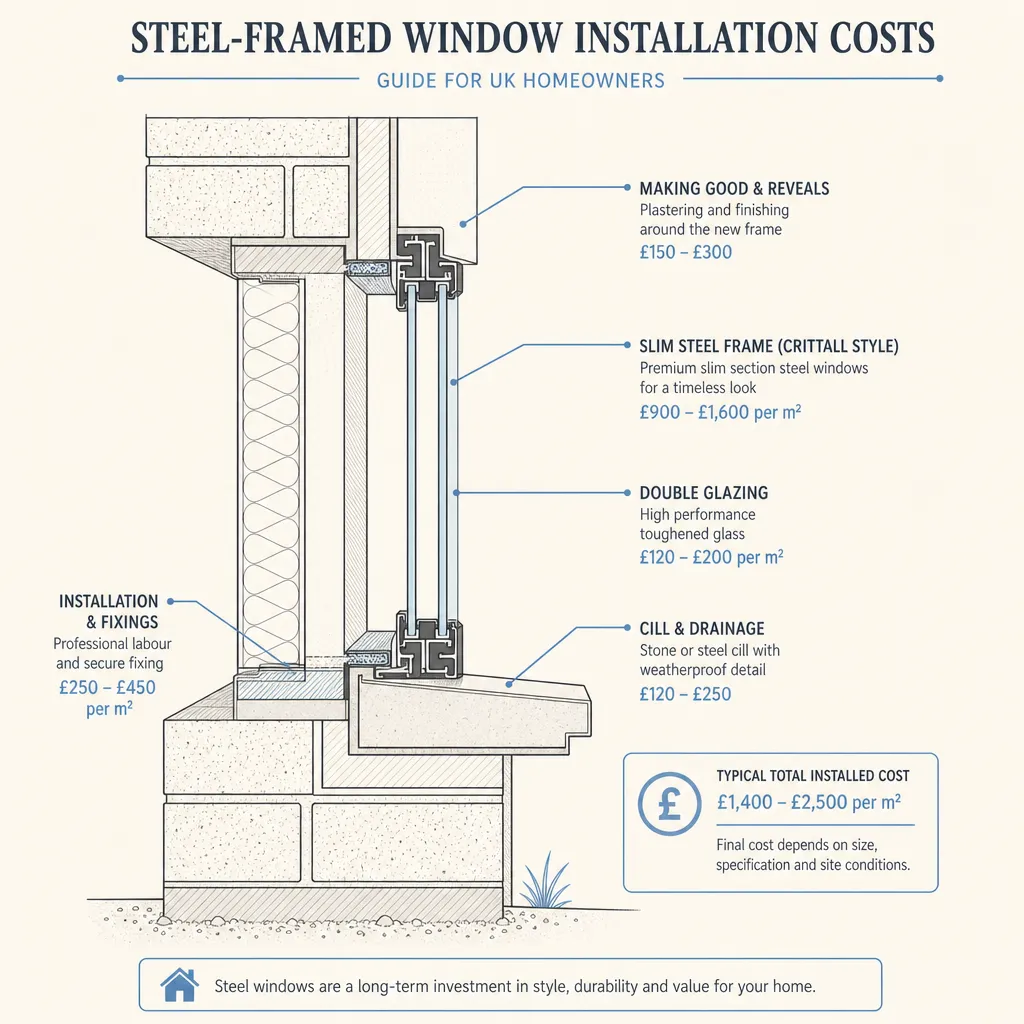
Steel-Framed Window Installation Costs
Steel-framed windows cost between £800 and £3,500 or more per window installed in the UK, depending on size, profile type, glazing specification, and whether old frames need removing.
 Improvement & Build
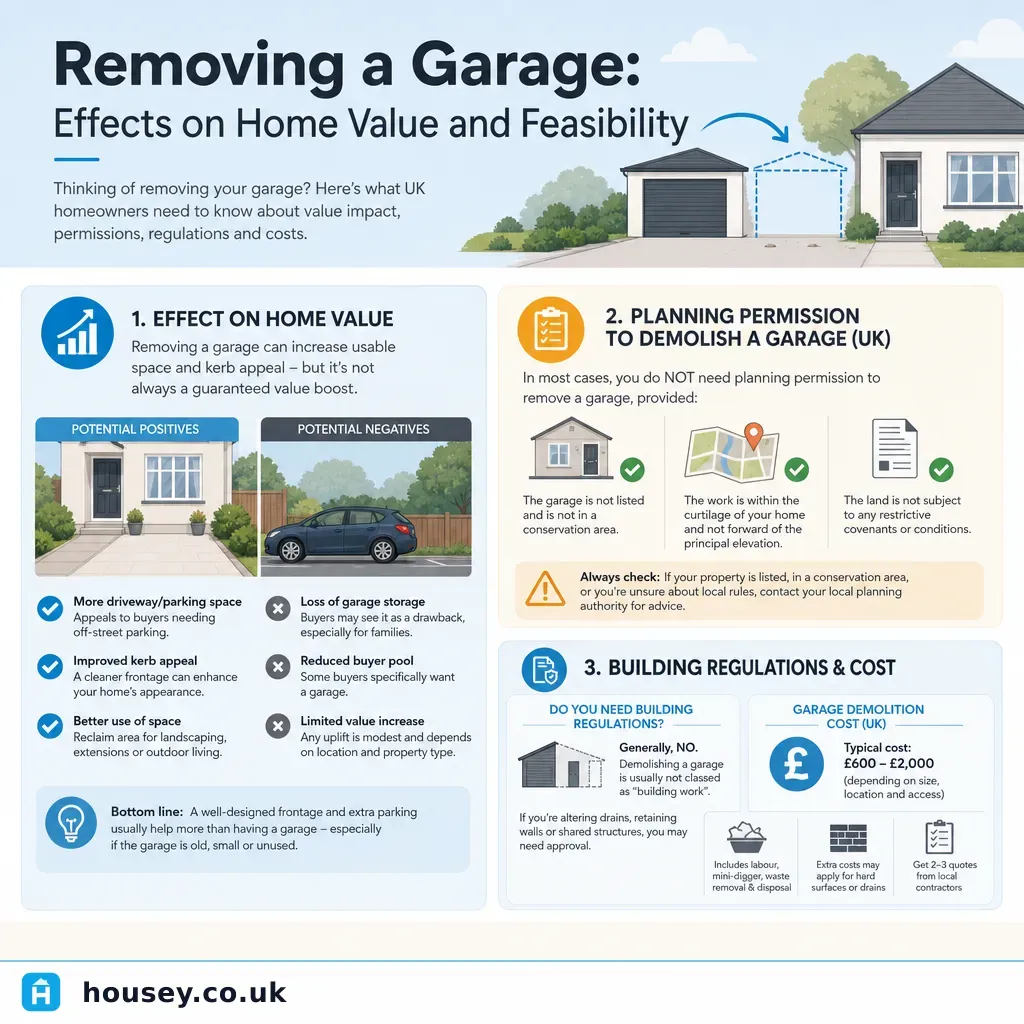
Removing a Garage: Effects on Home Value and Feasibility
Demolishing a garage in England may require prior notification to the local planning authority, and structural or building regulations assessments are often needed if the garage is attached to or integral with the house.
 Improvement & Build
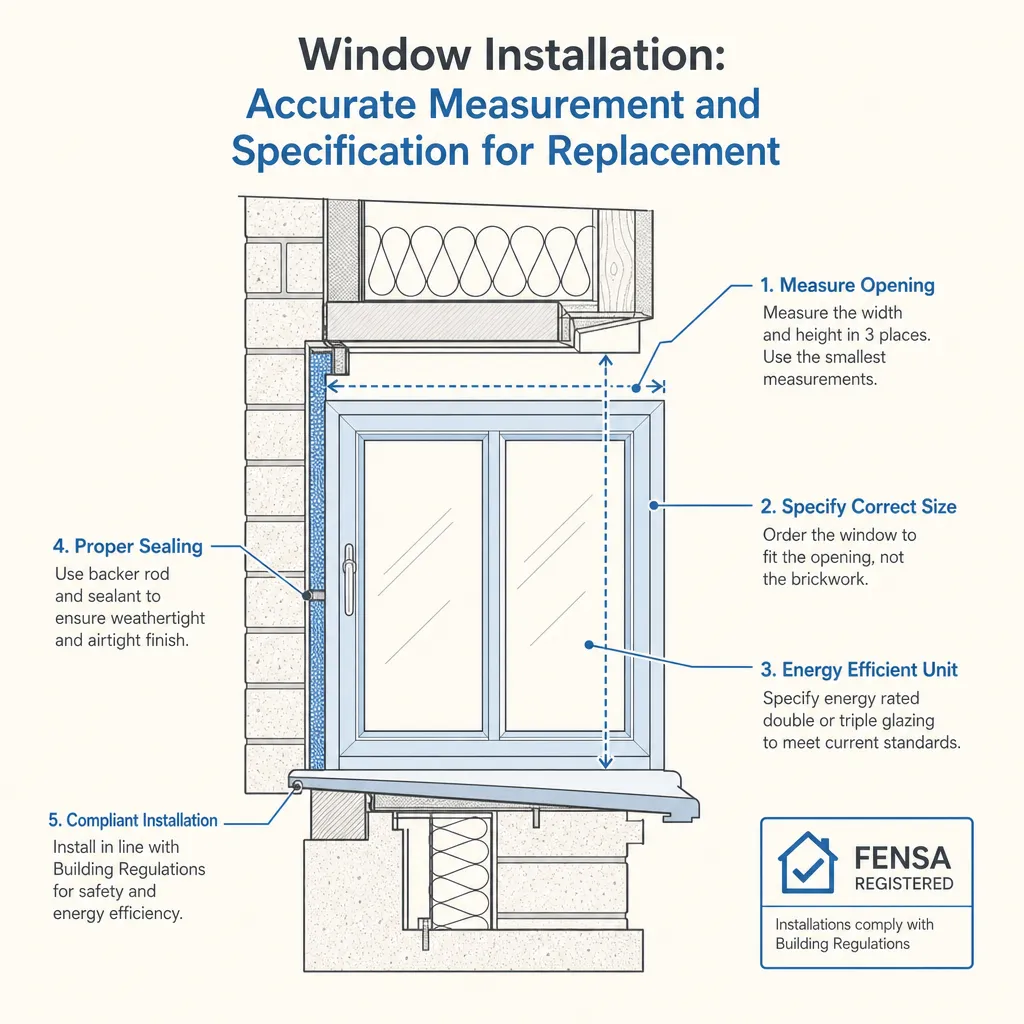
Window Installation: Accurate Measurement and Specification for Replacement
Accurate window measurement for replacement means recording the width and height of the existing frame opening in at least three places, noting the smallest dimension, and providing a full specification to your installer — including frame material, glazing type, opening style, and trickle ventilators.
 Improvement & Build
Window Replacement Planning: What to Discuss With Your Installer
Most window replacements in England fall under permitted development rights and do not require planning permission, but they must comply with Building Regulations Part L and Part K.