Insulation Installation and Assessment Services
By Housey · Last reviewed 31st of May 2026
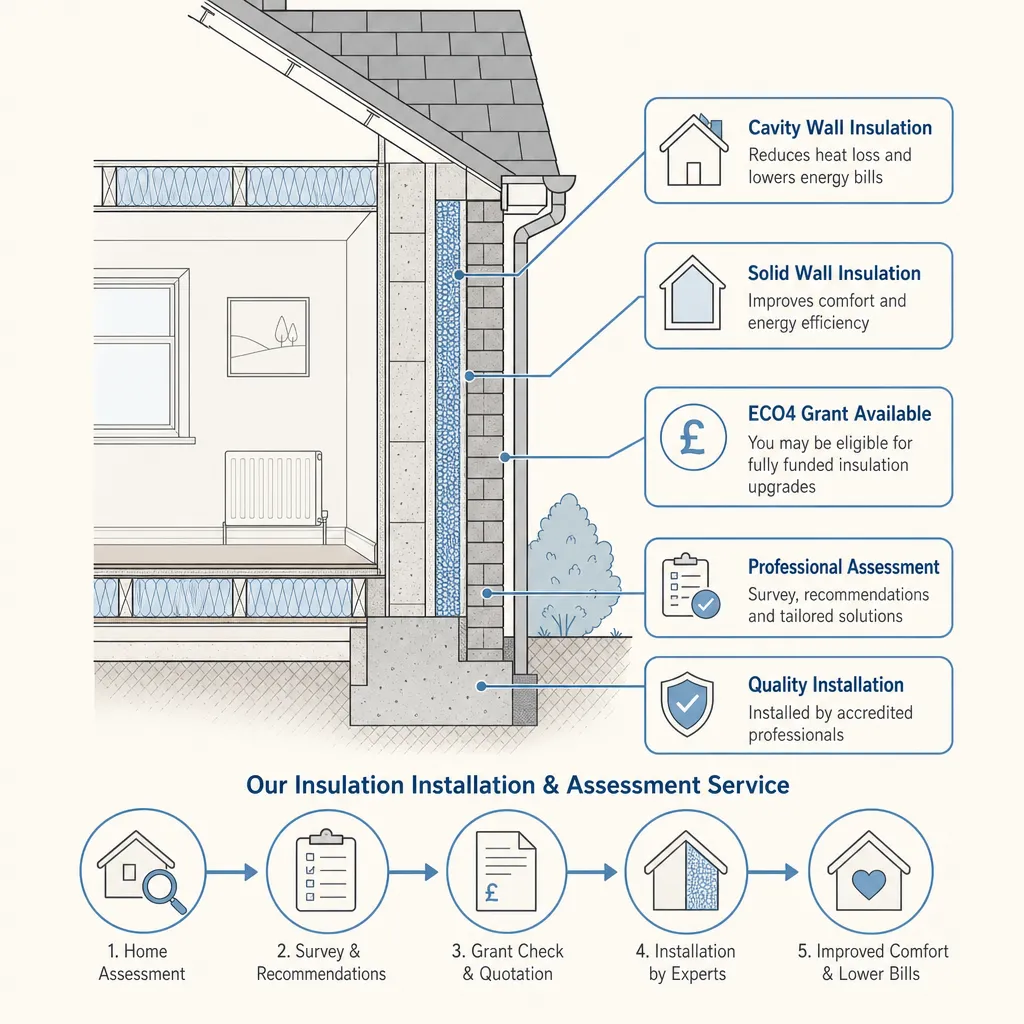
Insulation Installation and Assessment Services
Whether you are responding to a high energy bill, preparing for a retrofit grant application, or trying to bring an older property up to modern efficiency standards, choosing the right insulation — and having it properly assessed — is one of the most consequential decisions you can make. In UK homes, particularly the estimated 8.7 million solid-wall properties built before 1920, the wrong insulation type or a poorly surveyed installation can create serious moisture problems rather than solving them.
Key points
- PAS 2035:2023 is the British Standard governing whole-house retrofit assessments and must be followed for any ECO4 or Great British Insulation Scheme (GBIS) funded work.
- Cavity wall insulation (CWI) is only suitable for properties with a clear, dry, uncontaminated cavity of at least 50 mm — a pre-installation borescope survey is required.
- Solid wall insulation (internal or external) can typically reduce a wall's U-value from around 2.1 W/m²K to below 0.3 W/m²K, subject to specification and workmanship.
- ECO4 and GBIS funding is administered through energy suppliers; eligibility depends on household income, Energy Performance Certificate (EPC) rating, and property type.
- TrustMark registration — and, for grant-funded work, compliance with PAS 2030 — is required of installers; always verify credentials before instructing.
Which insulation type does your home need?
The most suitable insulation type depends on your property's construction, condition, and existing moisture performance. A professional assessment should always precede installation, particularly for older or solid-wall homes.
Insulation type | Best for | Typical U-value achieved | Main risk if wrong |
|---|---|---|---|
Cavity wall insulation (blown bead or mineral fibre) | Post-1920 cavity-wall properties with a dry, clear cavity | 0.45–0.60 W/m²K | Moisture bridging, damp ingress, structural damage |
External wall insulation (EWI) | Solid-wall homes, non-traditional construction | 0.18–0.30 W/m²K | Planning issues in conservation areas; cold bridging at junctions |
Internal wall insulation (IWI) | Solid-wall homes where external appearance must be preserved | 0.28–0.35 W/m²K | Interstitial condensation, reduced floor area, significant disruption |
Loft insulation (mineral wool or blown fibre) | Homes with accessible pitched roof loft space | 0.16 W/m²K at 270 mm mineral wool | Inadequate ventilation causing condensation in the roof void |
Floor insulation (rigid board or blown bead beneath suspended floor) | Suspended timber ground floors | 0.20–0.25 W/m²K | Blocking underfloor ventilation, leading to timber decay |
U-values are indicative; actual performance depends on specification, workmanship, and thermal bridging. Source: Building Regulations Approved Document L, 2021 edition.
What does an insulation assessment involve?
A pre-installation assessment does more than confirm whether insulation can physically be fitted — it evaluates whether doing so is appropriate for your specific property. For ECO4 and GBIS-funded measures, a Retrofit Assessment carried out by a qualified Retrofit Assessor (PAS 2030/2035 compliant) is mandatory.
A typical assessment covers:
- Wall construction type — cavity, solid brick, stone, or non-traditional (such as steel frame or prefabricated concrete)
- Existing cavity condition — a borescope inspection checks for debris, mortar snots, moisture, and whether the cavity is clear and of adequate width
- Damp and moisture baseline — existing damp problems must be resolved before insulation is installed
- Ventilation adequacy — particularly relevant for loft and solid wall insulation, where altered air permeability can affect indoor air quality and condensation risk
- EPC rating and potential — used to determine eligibility for grant schemes and to set performance targets
- Heritage and planning constraints — listed buildings and conservation area properties may require planning consent for external changes
For privately funded installations not subject to ECO4, a basic surveyor visit is the minimum; a full Retrofit Assessment is still strongly advisable for solid-wall or unusual properties.
How to access grant funding
ECO4 (Energy Company Obligation 4) covers a range of insulation measures for eligible households. Eligibility generally requires either a household income below a specified threshold, receipt of qualifying means-tested benefits, or an EPC rating of D, E, F, or G. Check the latest eligibility criteria on GOV.UK's energy efficiency guidance as thresholds are periodically updated.
Great British Insulation Scheme (GBIS) targets homes with an EPC rating of D or below and has broader income eligibility than ECO4. Check eligibility via GOV.UK's GBIS guidance.
Both schemes are administered through energy suppliers — such as British Gas, E.ON, and Octopus Energy — rather than directly through government. Contact your supplier or a TrustMark-registered assessor to begin an application.
Which professional do you need?
Role | Qualification to look for | When you need them |
|---|---|---|
Retrofit Assessor | PAS 2035 qualified, Retrofit Academy accredited | Before any ECO4/GBIS-funded installation; strongly advisable for solid-wall homes |
Insulation installer | TrustMark registered; PAS 2030 compliant for grant-funded work | For the physical installation |
Cavity wall surveyor | CIGA-registered surveyor | Before cavity wall insulation, especially on exposed or older properties |
Structural engineer | IStructE or ICE member | If there is any doubt about wall integrity or non-traditional construction |
Important limitations
This article is general information only. Insulation suitability, moisture risk, and grant eligibility vary considerably between properties, locations, and construction types. Decisions about insulation — especially for solid-wall, non-traditional, or moisture-affected properties — should be made by a qualified professional following an on-site assessment. Rules under ECO4 and GBIS change regularly; always verify current eligibility criteria directly with GOV.UK or an accredited installer before committing to any works.
When this becomes urgent
- If a previous cavity wall insulation installation is suspected of causing new or worsening damp, contact the Cavity Insulation Guarantee Agency (CIGA) and arrange a specialist inspection without delay.
- If your home has non-traditional construction (prefab, steel frame, or timber frame), do not proceed with any insulation works without a structural and moisture survey.
- If your EPC rating is F or G and you let the property, you may have legal obligations under the Minimum Energy Efficiency Standards (MEES) Regulations 2018 — seek specialist advice promptly.
What to ask a qualified professional
Before instructing an assessor or installer, ask:
- Are you TrustMark-registered and PAS 2030/2035 compliant?
- Will you carry out a pre-installation moisture and cavity survey before any work begins?
- How will you ensure adequate ventilation is maintained following installation?
- What guarantee does the installation carry, and is it registered with CIGA (for cavity wall insulation)?
- If grant-funded: which energy supplier are you working with, and what is the full process from assessment to completion?
- What happens if damp or structural issues are identified during the survey?
- Is VAT included in the quoted cost?
When to get professional help
Insulation is not a DIY task — improper installation can void product guarantees, invalidate grant funding, and cause lasting moisture damage. Seek professional advice if:
- You are unsure whether your property has a cavity or solid wall construction
- There is visible damp, efflorescence, or staining on internal or external walls
- A previous insulation installation is suspected of causing problems
- Your property is listed, in a conservation area, or of non-traditional construction
- You wish to apply for ECO4 or GBIS funding, where a professional Retrofit Assessment is mandatory
How Housey can help
Housey connects you with qualified insulation installers and independent insulation assessors who can survey your property before any work begins. If you are considering a broader whole-house approach, a retrofit assessment will help you plan measures in the right order and avoid moisture or ventilation problems down the line.
Frequently asked questions
Do I need an assessment before having insulation installed?
For ECO4 or GBIS-funded work, a PAS 2035-compliant Retrofit Assessment is mandatory. For privately funded cavity wall insulation, a pre-installation survey is strongly advisable and required by most reputable installers. For solid-wall insulation, an assessment is essential to evaluate moisture and ventilation risk — skipping it can lead to damp problems that cost more to fix than the insulation saves.
How much does home insulation cost in the UK?
Indicative UK costs, last reviewed 2026-05-31. Cavity wall insulation typically costs £400–£1,500 for a semi-detached house; loft insulation £300–£600; external wall insulation £8,000–£20,000+ depending on property size. Grant funding through ECO4 or GBIS may cover all or most of the cost for eligible households. Always obtain at least three quotes, as prices vary widely by region and property type.
What is PAS 2035 and why does it matter?
PAS 2035:2023 is the British Standard for domestic retrofit. It sets out the roles, qualifications, and processes required for energy-efficiency improvements — including who must assess, design, and install each measure and how moisture and ventilation risks must be managed. Any ECO4 or GBIS-funded installation must comply with PAS 2035. It exists because poorly specified retrofit can cause condensation and structural damage.
Can cavity wall insulation be removed if it causes damp?
Yes — extraction is possible and sometimes necessary. If cavity wall insulation has been installed incorrectly or has deteriorated, a specialist contractor can extract it using industrial vacuums. The Cavity Insulation Guarantee Agency (CIGA) administers a 25-year guarantee scheme for CWI installed by registered members — contact CIGA if you suspect a problem with an existing installation.
Sources and further reading
- Building Regulations Approved Document L (2021) — GOV.UK
- Great British Insulation Scheme — GOV.UK
- PAS 2035:2023 — BSI Group
- Cavity Insulation Guarantee Agency — CIGA
- TrustMark — TrustMark
- Minimum Energy Efficiency Standards for private landlords — GOV.UK
Useful next reads
 Energy & Retrofit
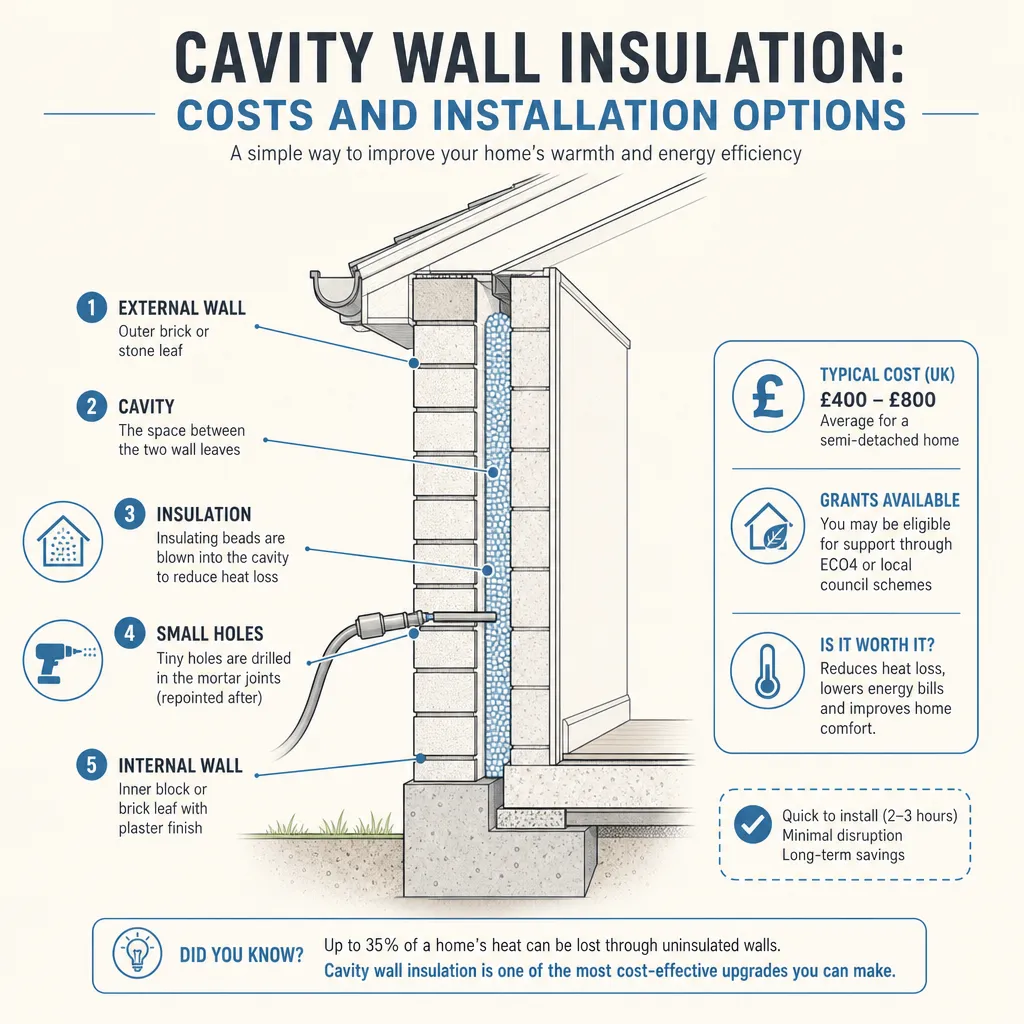
Cavity Wall Insulation: Costs and Installation Options
Cavity wall insulation typically costs £400–£1,200 for a standard UK semi-detached home, though eligible households may pay nothing under ECO4.
 Energy & Retrofit
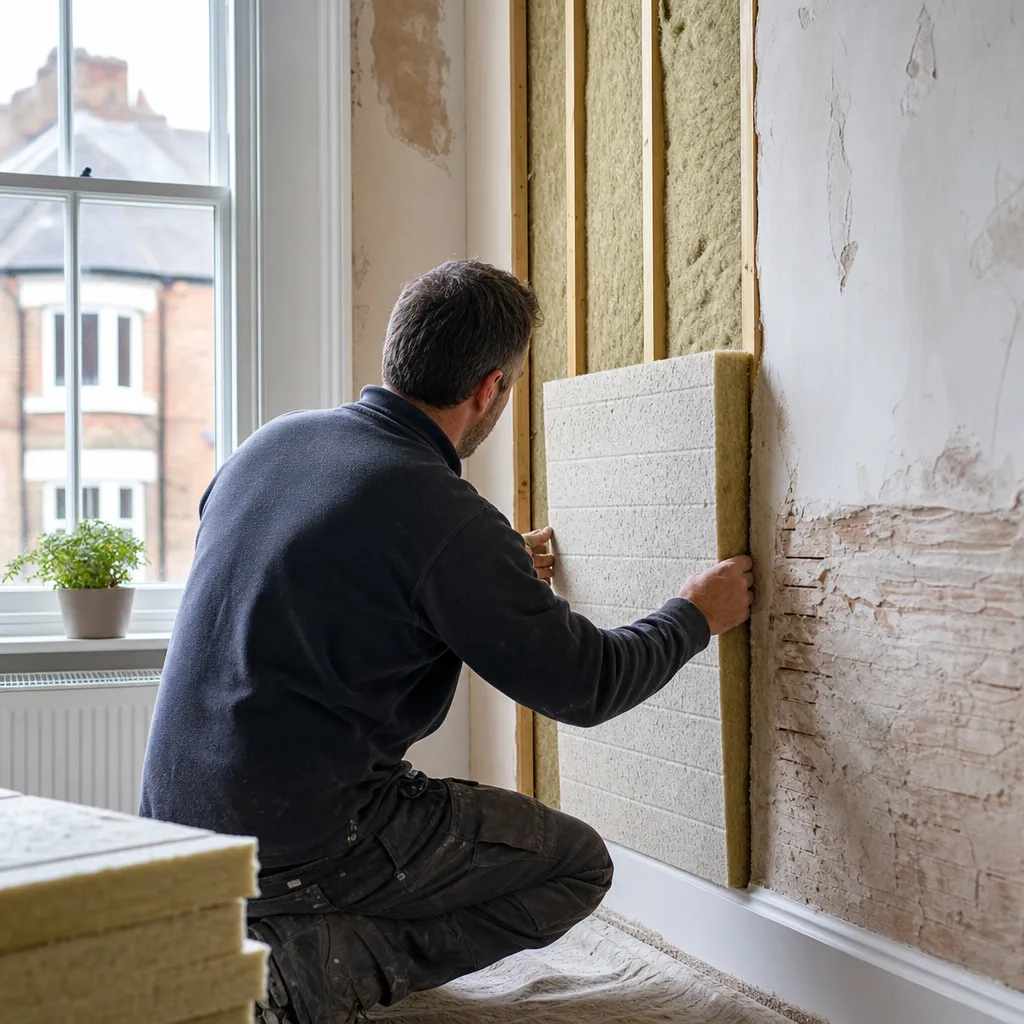
Insulating Original Plaster Walls: Methods and Considerations
Original plaster walls — particularly lime-based finishes in pre-1919 homes — require breathable insulation systems to avoid trapping moisture.
 Energy & Retrofit
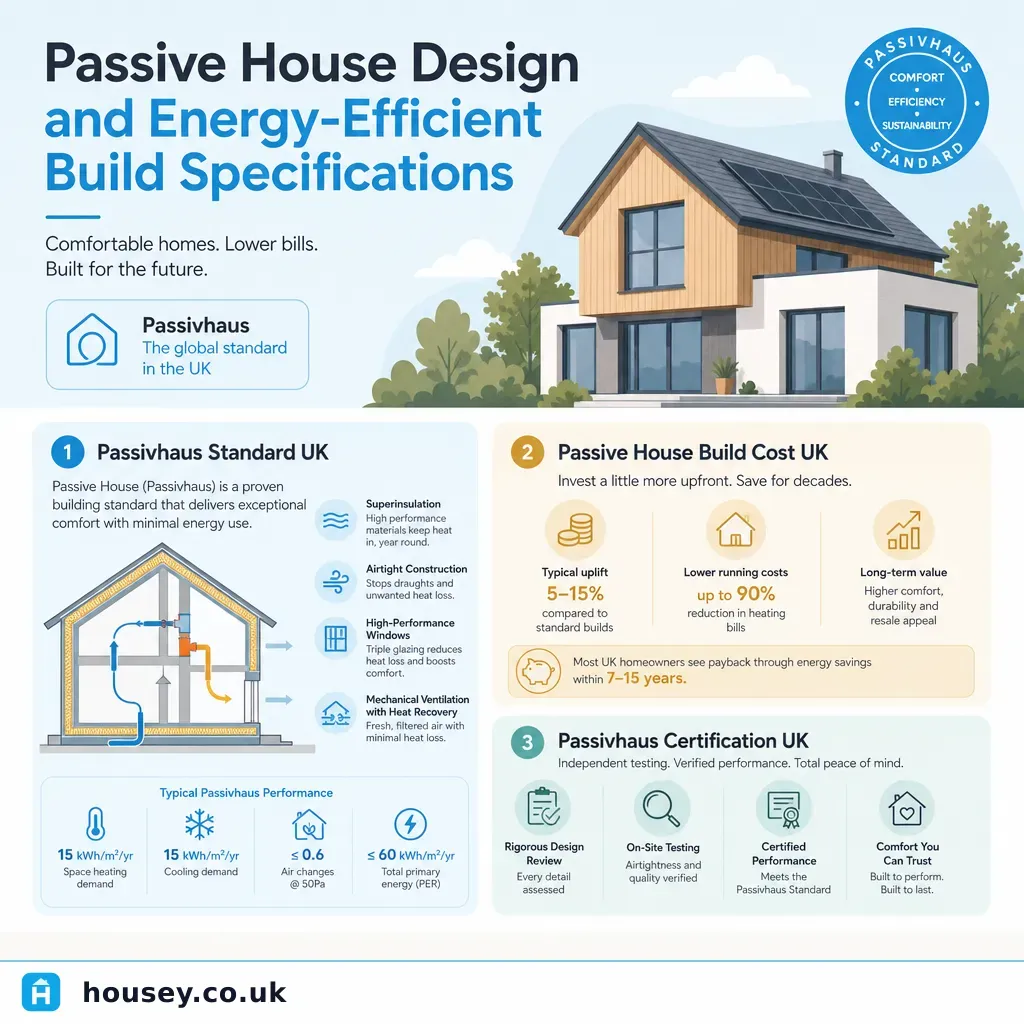
Passive House Design and Energy-Efficient Build Specifications
Passive house (Passivhaus) design limits a building's space heating demand to a maximum of 15 kWh/m² per year through super-insulation, airtight construction, triple-glazed windows, and mechanical heat-recovery ventilation.
 Energy & Retrofit
Wall Insulation: Cost, Methods, and Energy Efficiency Gains
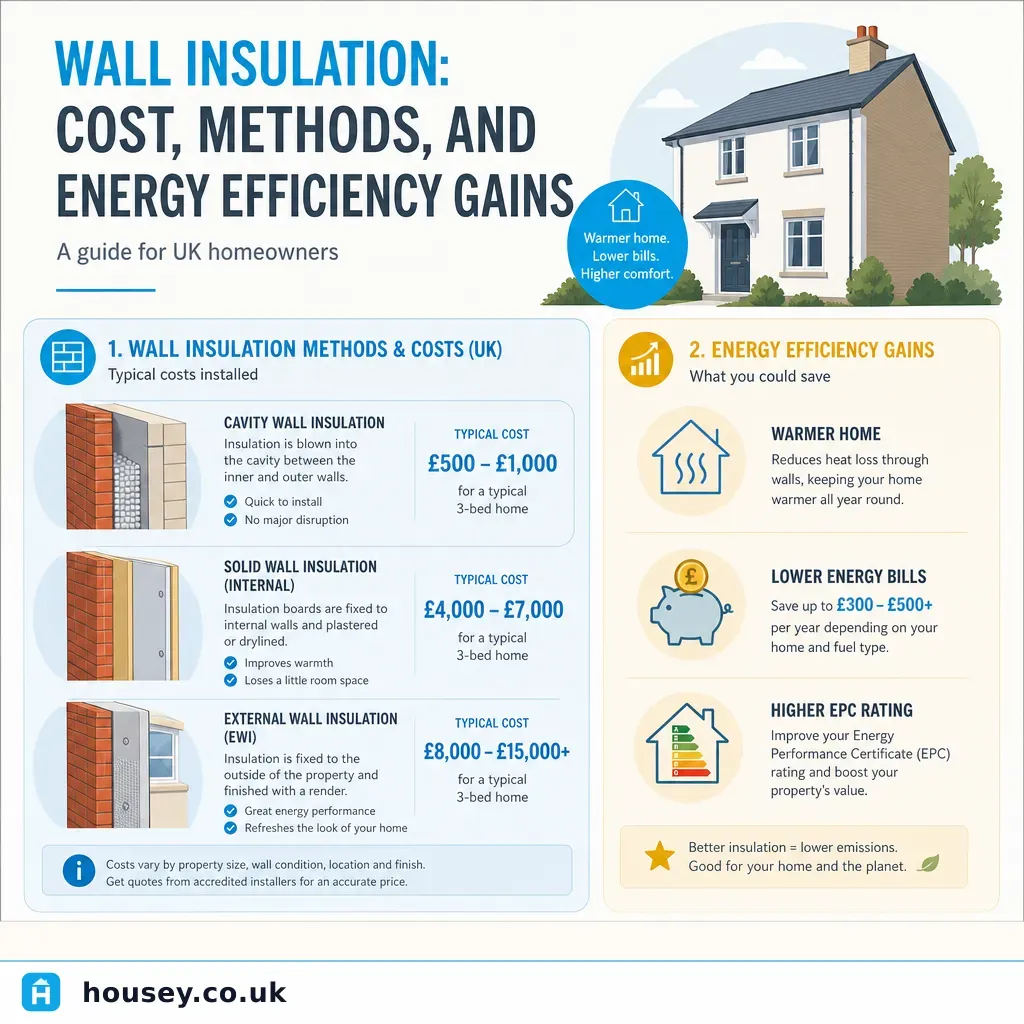
Wall insulation in UK homes uses one of three main methods: cavity wall insulation for post-1920 homes with an unfilled cavity, external wall insulation for solid-walled properties, and internal wall insulation where external changes are not permitted.
 Energy & Retrofit
Prefabricated Insulated Wall Forms: Permanent Insulation Solutions
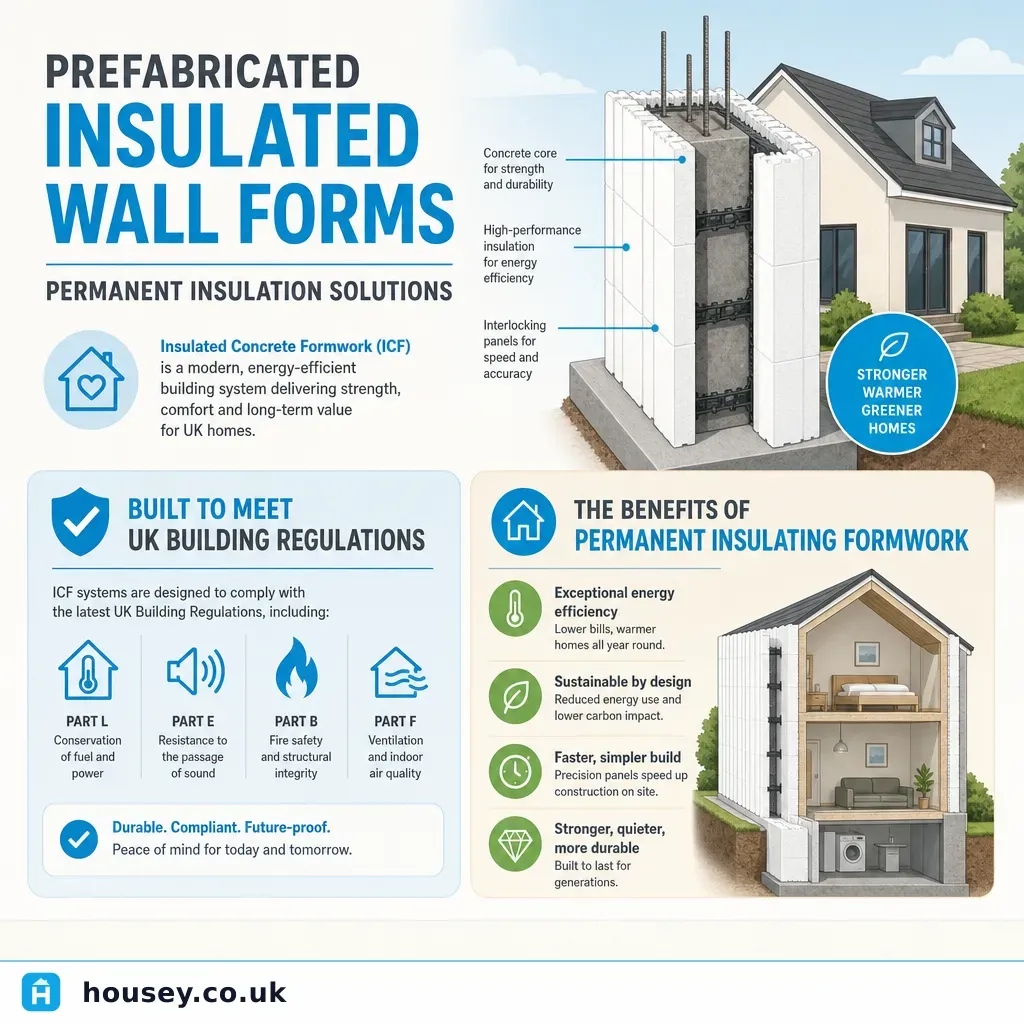
Prefabricated insulated wall forms — including ICF and SIPs systems — deliver high thermal performance by combining permanent insulation with structural concrete or timber in a single wall assembly.