Passive House Design and Energy-Efficient Build Specifications
By Housey · Last reviewed 7th of May 2026
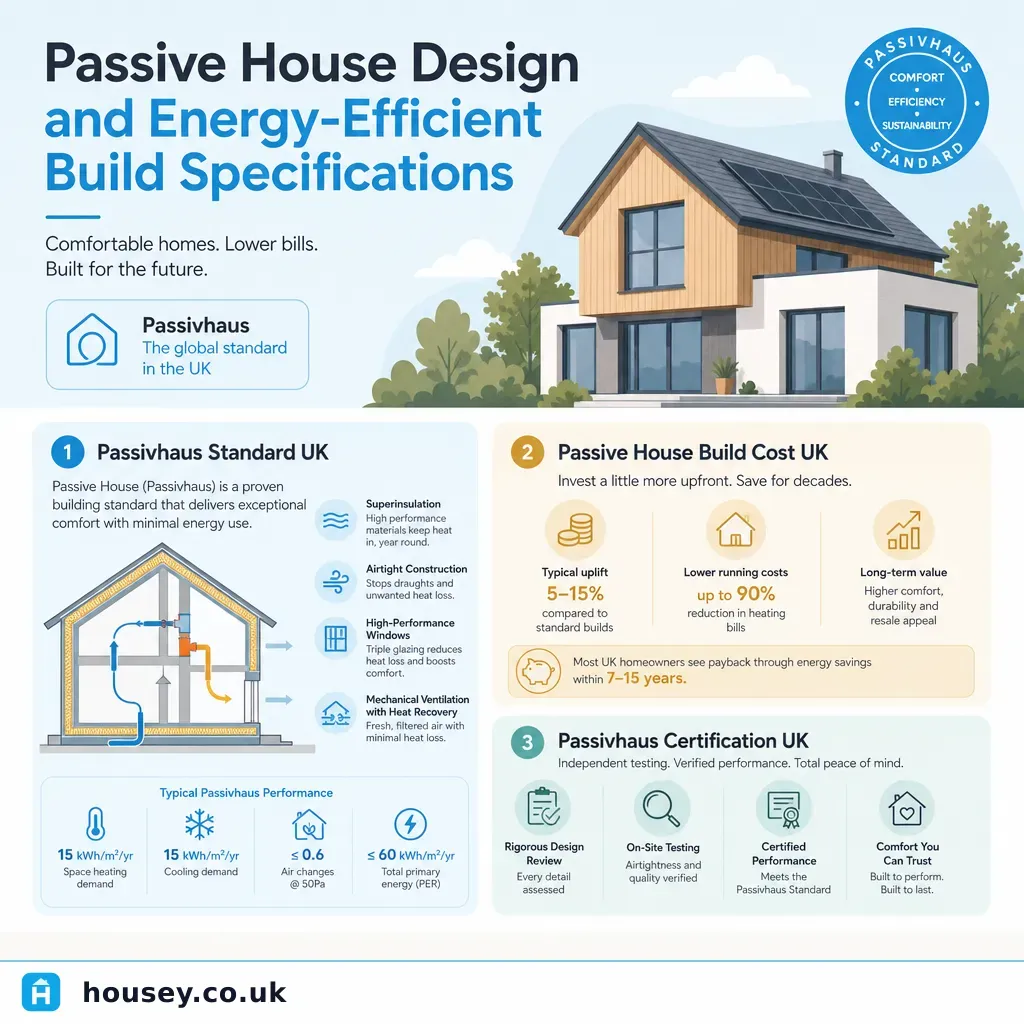
Passive House Design and Energy-Efficient Build Specifications
The Passivhaus standard originated in Germany in the early 1990s and has become the most rigorous internationally recognised framework for low-energy building design. In the UK, rising energy bills, net-zero commitments, and the forthcoming Future Homes Standard have pushed passive house principles firmly onto the agenda for self-builders, architects, and homeowners considering deep retrofit. Knowing what the standard demands — and what it costs to achieve — helps you decide whether it is the right route for your project and how to choose the right design team.
Key points
- The Passivhaus Classic standard limits space heating demand to 15 kWh/m²/year or less and peak heating load to no more than 10 W/m² — dramatically lower than what Building Regulations Part L (2021) typically achieves for a new build.
- Airtightness must be 0.6 air changes per hour (ACH) or less at 50 Pa, verified by a blower door test at practical completion — roughly ten times tighter than a typical UK new build under current Building Regulations.
- Mechanical Ventilation with Heat Recovery (MVHR) is not optional in a certified Passivhaus; it provides continuous fresh air while recovering 75–90% of heat from exhaust air.
- The Passive House Planning Package (PHPP) software, published by the Passive House Institute (PHI), is required for certification calculations; UK certification is managed by the Passivhaus Trust.
- Building to Passivhaus standard typically costs 5–15% more than an equivalent conventional new build at current UK rates, though space heating bills can fall by 60–80% compared with a Part L–compliant property.
What is Passivhaus and how does it differ from UK building regulations?
Passivhaus sets absolute energy performance thresholds that a building must achieve and verify through measured testing. Building Regulations Part L works from a notional building baseline and requires a percentage improvement — a fundamentally different approach. A Part L–compliant new build may use two to four times as much heating energy as a certified Passivhaus.
Criteria | Passivhaus Classic | UK Building Regs Part L (2021) |
|---|---|---|
Space heating demand | ≤15 kWh/m²/year | Typically 30–60 kWh/m²/year (new build) |
Airtightness | ≤0.6 ACH at 50 Pa | ≤8 m³/h/m² at 50 Pa (approx. 5–10 ACH equivalent) |
Ventilation strategy | MVHR required | Not required; natural ventilation permitted |
Primary energy | ≤120 kWh/m²/year | No fixed absolute target |
Thermal bridge-free design | Required | Recommended, not mandatory |
Certification route | PHI via Passivhaus Trust | Building Control sign-off |
A Passivhaus design must also satisfy Building Regulations — the two processes run in parallel, not as alternatives.
The five core design principles
Passivhaus design rests on five interrelated principles. Missing any one of them typically prevents certification:
- Super-insulation. Wall U-values of 0.10–0.15 W/m²K are typical, compared with 0.18–0.26 W/m²K for a compliant UK new build. Floors and roofs are insulated to similar levels.
- Thermal bridge-free construction. Junctions between elements — where walls meet floors, windows meet reveals, roofs meet walls — must be designed to eliminate cold spots that waste heat and risk interstitial condensation.
- High-performance triple-glazed windows. Whole-window U-values of 0.8 W/m²K or less are typical; a Part L–compliant double-glazed unit usually achieves 1.4–1.6 W/m²K. Orientation and solar gain are carefully modelled in PHPP.
- Airtight building envelope. A continuous air barrier is detailed on drawings and maintained through construction. A blower door test at practical completion must record ≤0.6 ACH at 50 Pa.
- Mechanical Ventilation with Heat Recovery (MVHR). Delivers constant fresh air to habitable rooms and recovers 75–90% of heat from exhaust air. Duct design, balancing, and commissioning are critical — a poorly designed MVHR system undermines both energy performance and indoor air quality.
Passivhaus certification levels
The Passive House Institute introduced tiered certification to recognise buildings that also generate renewable energy on site:
Certification level | Space heating demand | Primary energy (renewable) | On-site generation required |
|---|---|---|---|
Passivhaus Classic | ≤15 kWh/m²/year | ≤120 kWh/m²/year | None required |
Passivhaus Plus | ≤15 kWh/m²/year | ≤45 kWh/m²/year | ≥60 kWh/m²/year |
Passivhaus Premium | ≤15 kWh/m²/year | ≤30 kWh/m²/year | ≥120 kWh/m²/year |
Most UK residential projects target Classic. Plus and Premium certification are more common where rooftop solar PV is integrated from the outset of design.
Worked example: a two-bedroom self-build in Yorkshire
A self-builder in West Yorkshire commissions a 90 m² two-bedroom timber-frame house to Passivhaus Classic standard.
Specification highlights:
- 350 mm mineral wool within timber frame (wall U-value: 0.11 W/m²K)
- Triple-glazed windows (whole-window U-value: 0.85 W/m²K), south-facing glazing maximised for solar gain
- MVHR unit with 85% heat recovery efficiency; ducts fully balanced and commissioned
- Blower door result at practical completion: 0.52 ACH (passes the ≤0.6 target)
- No gas connection; supplementary heating provided by a small air-source heat pump
Indicative costs (last reviewed 2026-05-07; costs vary significantly by contractor, region, and specification):
- Comparable standard new build: approximately £180,000–£200,000
- Passivhaus premium over standard: approximately £15,000–£25,000 additional
- Estimated annual space heating cost: £200–£350 (versus £900–£1,400 for a comparable standard new build at current energy prices)
- PHI certification fee: approximately £1,500–£3,000 for a small residential project
The higher upfront cost is often recovered over time through lower energy bills, though individual outcomes vary with energy prices, occupancy patterns, and property size.
Decision tree: is Passivhaus right for your project?
- Choose Passivhaus if you are building from scratch — new build or full reconstruction — want long-term low energy bills, and can appoint a design team with Certified Passivhaus Designer (CPD) qualification.
- Consider EnerPHit (the PHI retrofit standard) if you are retrofitting an existing UK home. EnerPHit has more flexible targets — 1.0 ACH airtightness and ≤25 kWh/m²/year heating demand — to account for the structural constraints of retrofit construction.
- Consider Part L + fabric-first if certification is not a priority but you want to maximise insulation and airtightness within standard building control, without the cost of PHPP modelling or formal certification.
- Ask an energy-efficiency consultant or Passivhaus designer if you are unsure whether your site, budget, planning constraints, or programme can accommodate full certification before committing to a design brief.
Passivhaus design checklist for UK self-builders
Before appointing your design team, confirm:
When to get professional help
Passivhaus design is not a DIY exercise. PHPP modelling requires specialist training; errors in thermal bridging calculations, MVHR duct design, or airtightness detailing can result in a building that performs substantially below target or fails certification entirely.
Seek professional input if:
- You are planning a new build or full reconstruction and want to target Passivhaus or EnerPHit certification.
- You want to understand whether your existing home's structure and layout suits a deep retrofit.
- You have received conflicting advice about insulation levels, MVHR sizing, or airtightness targets.
- Your project is in a conservation area or involves a listed building, where external insulation or replacement windows may require listed building consent or conservation area approval.
How Housey can help
Housey can connect you with professionals across the passive house supply chain. If you are early in the process, an energy-efficiency consultant can assess feasibility and help you understand what the Passivhaus standard demands for your property and site. For design and technical drawings, an architectural technologist with Passivhaus experience can carry out PHPP modelling and produce certified-standard construction details. If you are considering retrofit rather than new build, a retrofit assessment will identify how close your existing home is to EnerPHit targets, while an insulation assessment can benchmark your current fabric performance before you commit to a specification.
Frequently asked questions
What is the difference between Passivhaus Classic, Plus, and Premium?
All three levels require the same space heating demand of 15 kWh/m² per year or less. They differ in primary energy consumption and on-site renewable generation requirements. Classic has no generation requirement; Plus requires at least 60 kWh/m²/year generated on site; Premium requires at least 120 kWh/m²/year. Most UK residential projects target Classic certification.
Do I need planning permission for a passive house in the UK?
Planning requirements depend on the type of works, not the energy standard. A new build requires full planning permission; some retrofit measures may or may not require consent depending on changes made to the external fabric. Passivhaus certification does not require a separate planning consent. Always check with your local planning authority, especially if the property is listed or in a conservation area.
How does passive house differ from UK building regulations?
Building Regulations Part L sets targets based on percentage improvements over a notional baseline. Passivhaus sets absolute, independently verified performance thresholds. A certified Passivhaus typically uses 60–80% less space heating energy than a Part L–compliant new build. A Passivhaus design must also satisfy Building Regulations and receive building control sign-off — the two processes run in parallel.
Can an existing UK home be retrofitted to passive house standard?
Retrofitting to full Passivhaus Classic is very difficult in most existing UK homes because achieving 0.6 ACH airtightness and eliminating thermal bridges is structurally constrained. The Passive House Institute developed the EnerPHit standard specifically for retrofit, with more achievable targets of 1.0 ACH airtightness and 25 kWh/m²/year heating demand. A retrofit assessment can identify how close your property is to either target.
How long does Passivhaus certification take?
The certification process typically runs alongside the design and construction programme. PHPP modelling starts at design stage; the certifier reviews calculations, checks site compliance, and issues certification after a successful blower door test at completion. For a straightforward new-build house, allow six to eighteen months from design to certification. The Passivhaus Trust can direct you to accredited certifiers in the UK.
Sources and further reading
- Passivhaus Trust — Passivhaus Trust; UK body, certifier directory, and UK-specific technical guidance
- Passive House Institute — PHI; PHPP software, certification criteria, and technical standards
- Approved Document L: Conservation of fuel and power — GOV.UK
- Future Homes and Buildings Standards consultation — GOV.UK
- Energy Saving Trust — insulation guidance — Energy Saving Trust
Useful next reads
 Energy & Retrofit
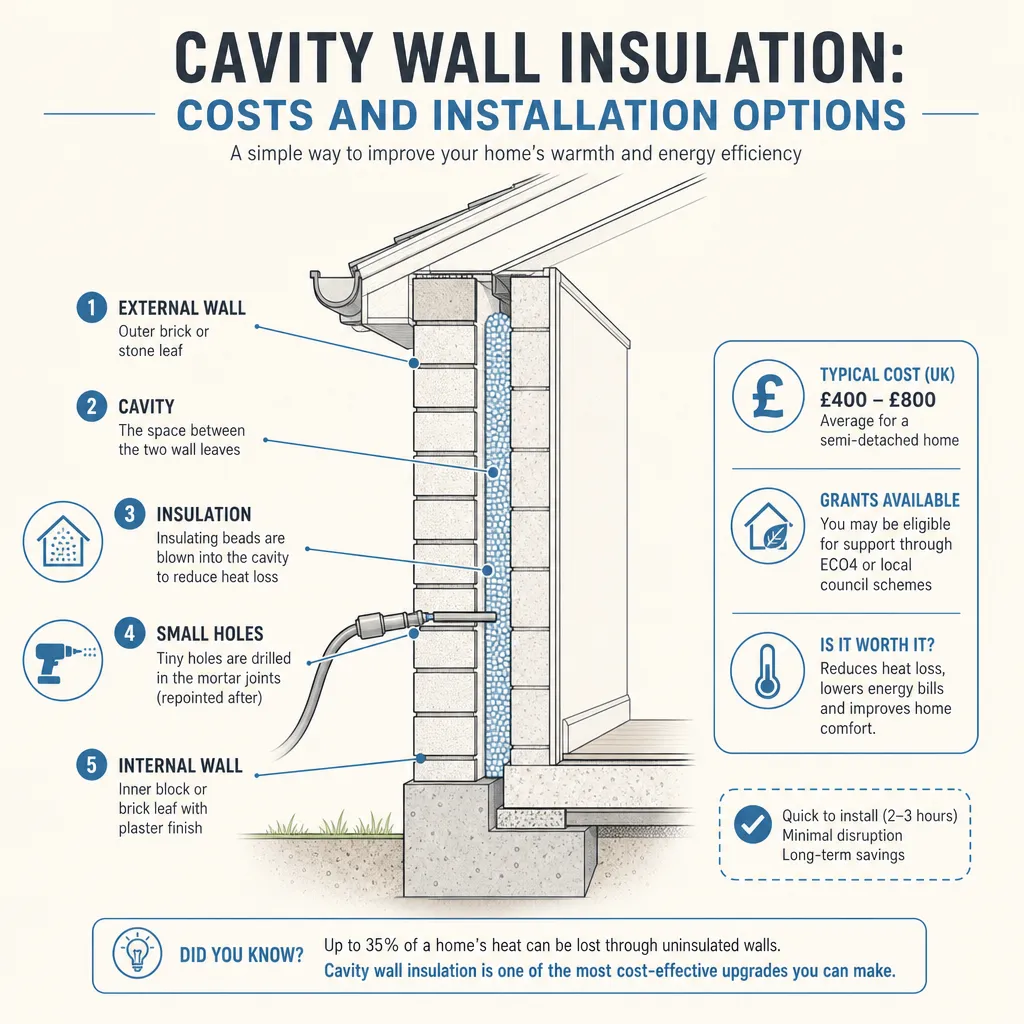
Cavity Wall Insulation: Costs and Installation Options
Cavity wall insulation typically costs £400–£1,200 for a standard UK semi-detached home, though eligible households may pay nothing under ECO4.
 Energy & Retrofit
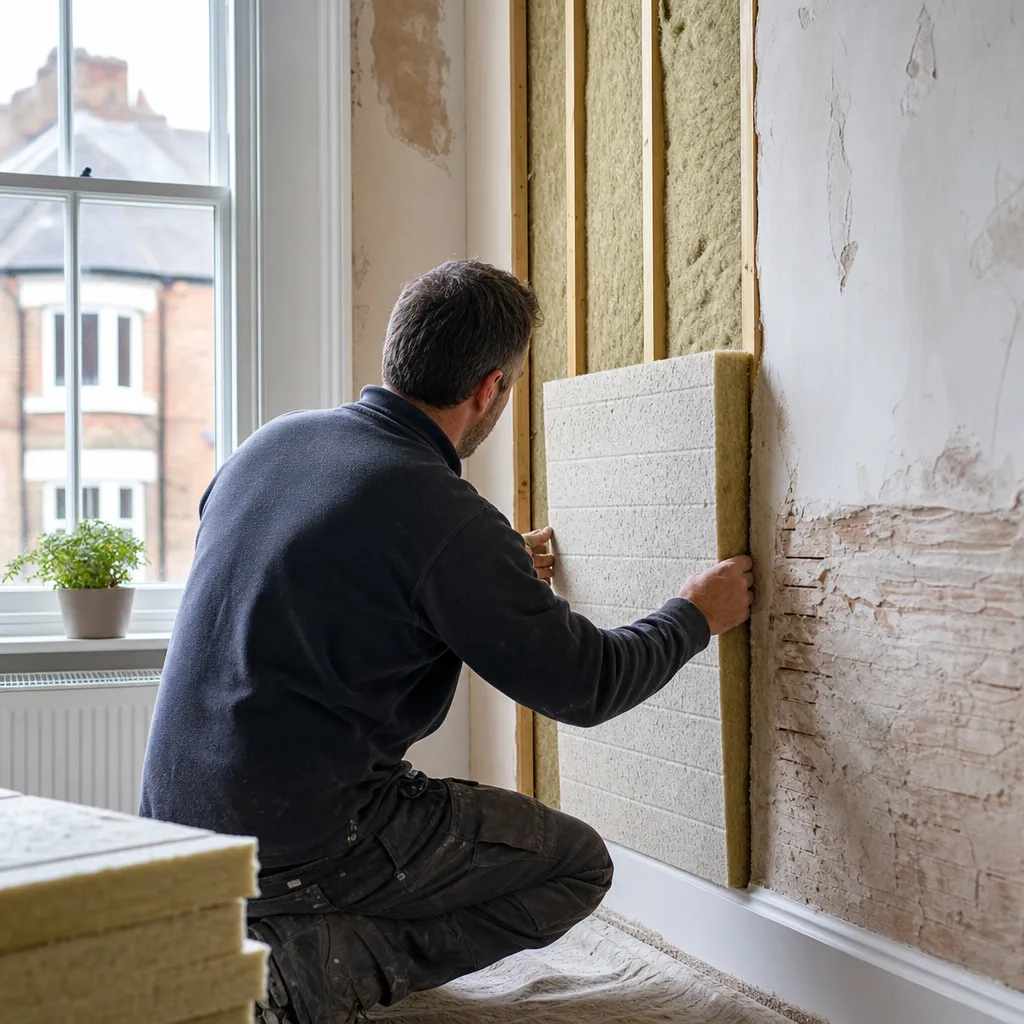
Insulating Original Plaster Walls: Methods and Considerations
Original plaster walls — particularly lime-based finishes in pre-1919 homes — require breathable insulation systems to avoid trapping moisture.
 Energy & Retrofit
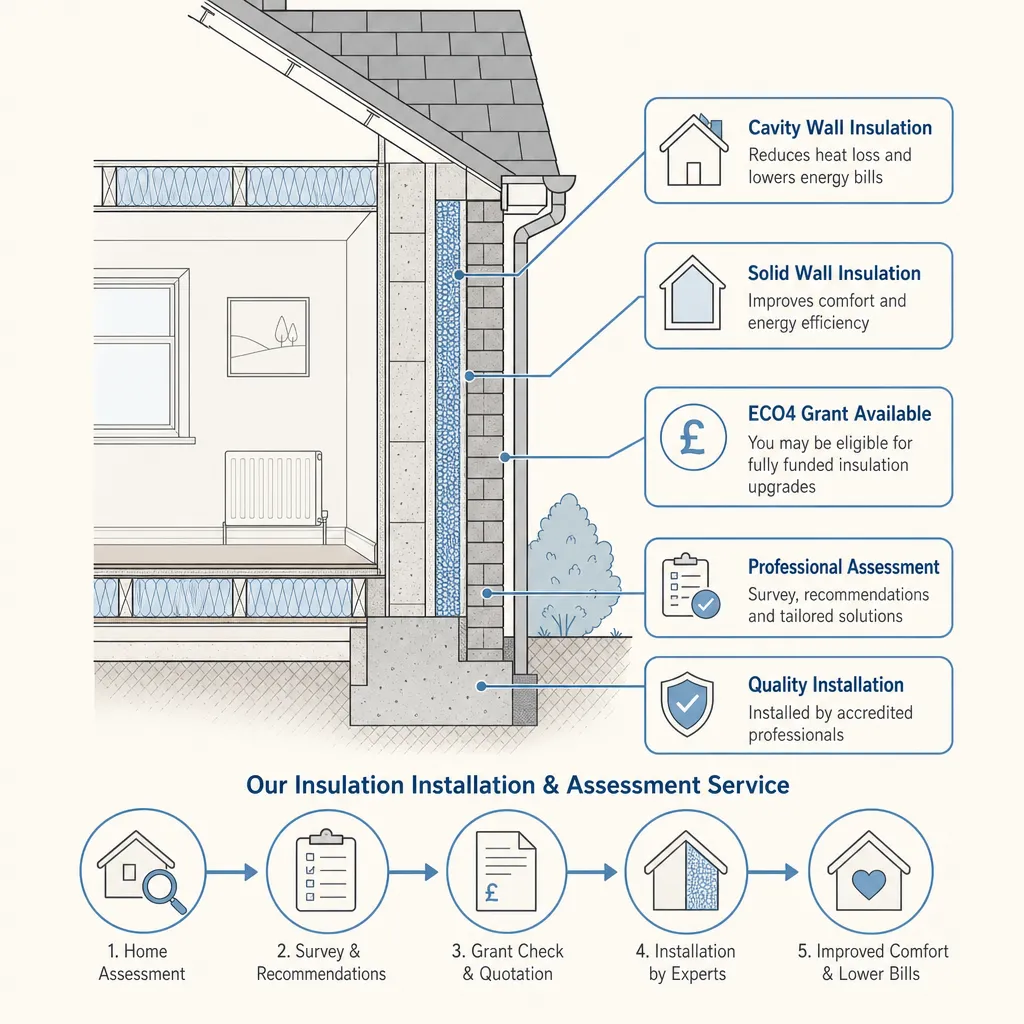
Insulation Installation and Assessment Services
A home insulation assessment identifies the most appropriate insulation type for your property and checks for moisture risk before work begins.
 Energy & Retrofit
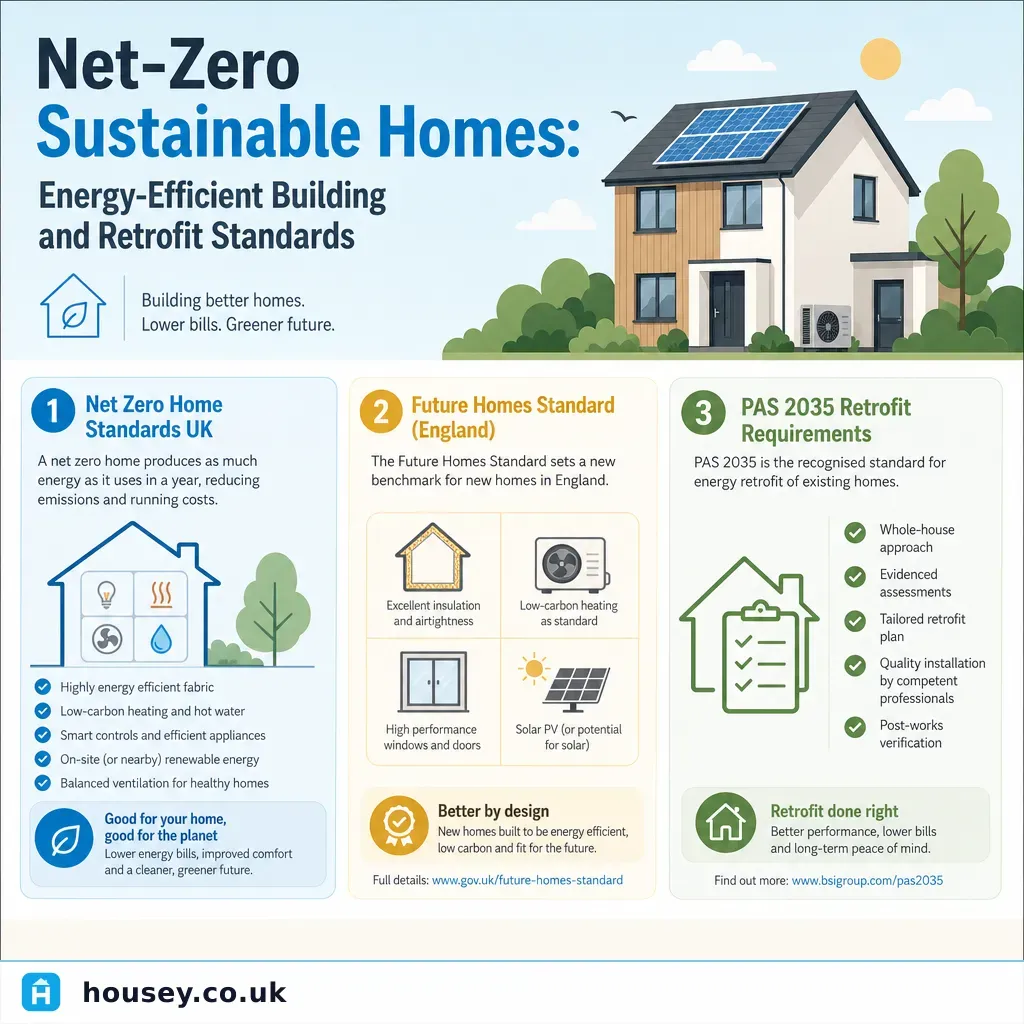
Net-Zero Sustainable Homes: Energy-Efficient Building and Retrofit Standards
Net-zero homes in the UK combine very high fabric performance, low-carbon heating — usually a heat pump — and on-site renewable generation.
 Energy & Retrofit
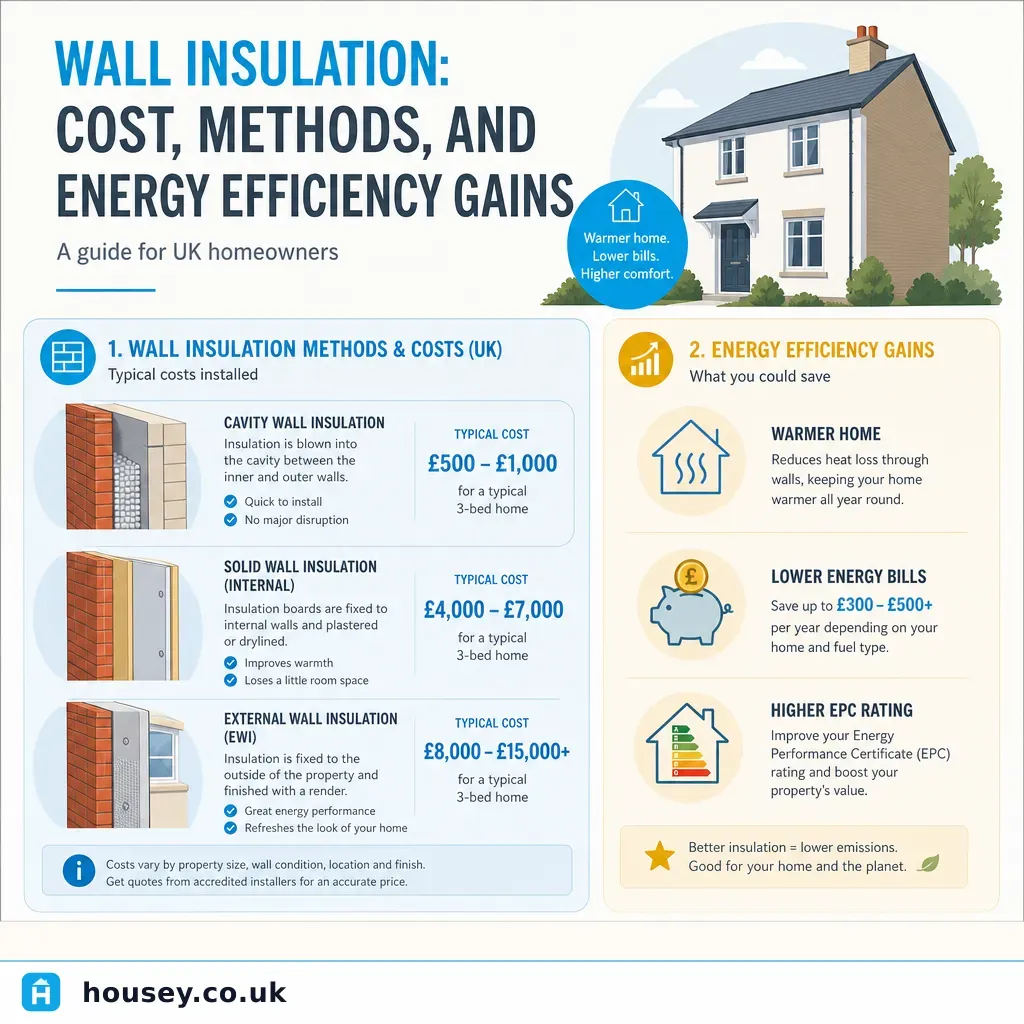
Wall Insulation: Cost, Methods, and Energy Efficiency Gains
Wall insulation in UK homes uses one of three main methods: cavity wall insulation for post-1920 homes with an unfilled cavity, external wall insulation for solid-walled properties, and internal wall insulation where external changes are not permitted.