Wall Insulation: Cost, Methods, and Energy Efficiency Gains
By Housey · Last reviewed 11th of May 2026
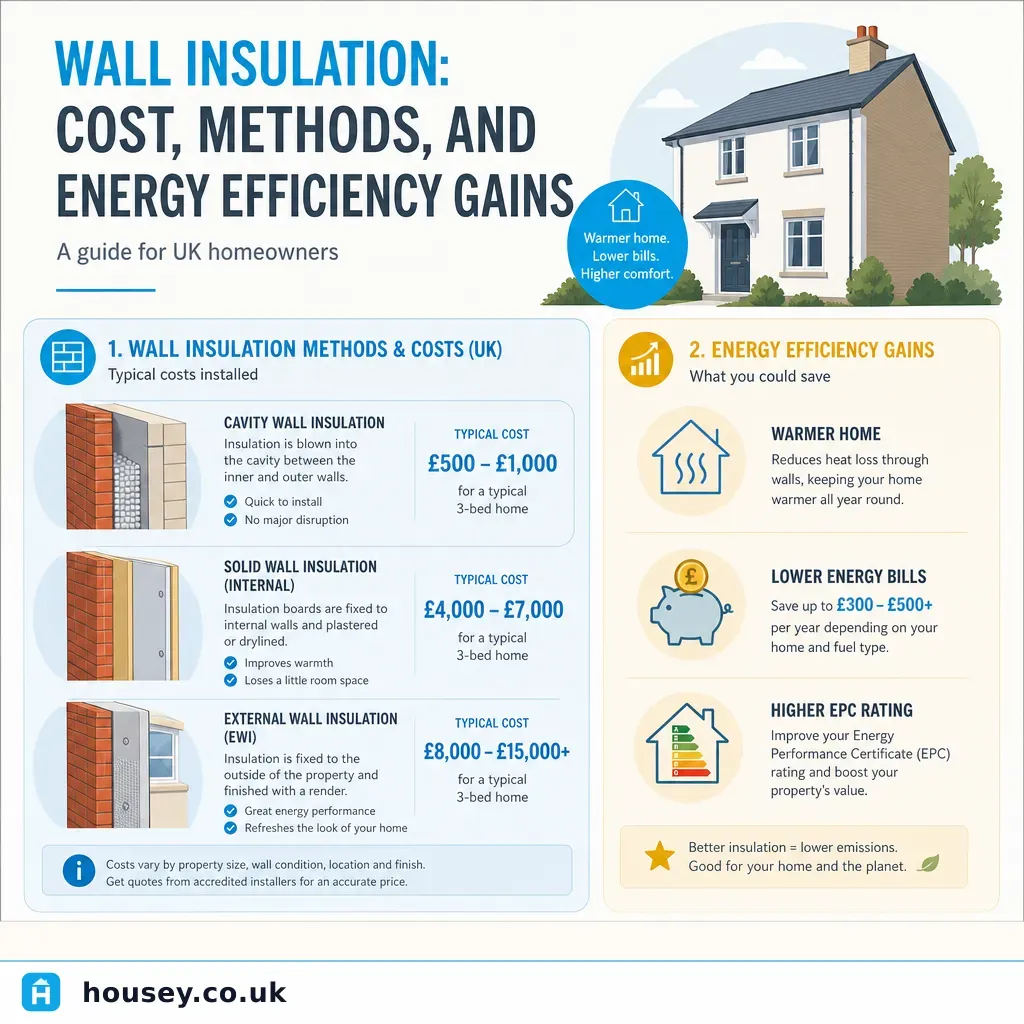
Wall Insulation: Cost, Methods, and Energy Efficiency Gains
Wall heat loss accounts for a substantial share of energy wasted in UK homes — the Energy Saving Trust estimates around 35% of heat in an uninsulated property escapes through the walls. For the estimated 8 million solid-walled properties and the many more homes with unfilled cavities, improving wall insulation can meaningfully reduce heating bills and improve thermal comfort. But insulation type, method, and cost vary considerably by construction, and the wrong intervention can introduce moisture problems that are costly to resolve. This article explains the main methods, indicative costs, energy savings, and what to check before instructing a contractor.
Key points
- Cavity wall insulation (CWI) typically costs £400–£1,500 for a semi-detached home; external wall insulation (EWI) and internal wall insulation (IWI) for solid walls can range from £8,000–£25,000+ depending on property size and material (indicative UK costs, last reviewed 2026-05-11).
- Work must comply with PAS 2030:2019 (installation standard) and, where part of a whole-house retrofit, be coordinated under PAS 2035:2019 by a TrustMark-registered Retrofit Coordinator — both are required to access ECO4 or Great British Insulation Scheme (GBIS) funding.
- The ECO4 scheme can fund full or partial insulation costs for eligible households based on EPC rating (D–G) and income or benefit status; eligibility and availability depend on your energy supplier.
- Interstitial condensation — moisture condensing inside the wall construction — is a significant risk if insulation is added without a proper hygrothermal assessment, particularly in solid masonry, stone, or non-standard walls.
- Listed buildings and conservation areas require planning permission or listed building consent for external wall insulation; permitted development rights do not apply in most such cases.
Wall insulation methods: which is right for your home?
Cavity wall insulation (CWI)
Most UK homes built between approximately 1920 and 2000 have cavity walls — two skins of brick or block separated by a gap. Where the cavity is unfilled, CWI is usually the most cost-effective insulation measure available.
Material is injected through small holes drilled in the external mortar joints, which are re-pointed afterwards. Common fill materials include:
- Mineral wool (rock or glass fibre) — most common and widely tested; suited to sheltered locations.
- Polystyrene beads (EPS beads) — bonded with adhesive; often used in exposed or moderately exposed locations.
- Polyurethane foam — injected as a liquid and expands to fill the cavity; less common and harder to remove if problems arise later.
CWI is not appropriate for all cavities. Walls in exposed locations (high wind-driven rain zones as defined in BS 8104) are at risk of moisture bridging if the wrong material is used. Cavities that are too narrow (under 50 mm), contaminated, or partially filled require specialist assessment. The Cavity Insulation Guarantee Agency (CIGA) and the British Board of Agrément (BBA) provide guidance on suitability and issue guarantees for qualifying installations.
External wall insulation (EWI)
EWI is the primary method for insulating solid walls, typically pre-1920 construction in solid brick, stone, or cob. Insulation boards are mechanically fixed and/or adhesively bonded to the external wall surface, then covered with a render or cladding system.
Advantages: does not reduce internal floor area; can address thermal bridges comprehensively; can refresh the external appearance of the property.
Disadvantages: highest cost of the three methods; requires scaffolding; affects external appearance (significant for conservation areas and listed buildings); window and door reveals must be extended to suit the additional thickness.
Internal wall insulation (IWI)
IWI is fixed to the internal face of external walls using rigid insulation boards (PIR, PUR, or woodfibre) fixed directly or on a timber batten frame with infill insulation.
Advantages: does not affect external appearance; suitable where EWI is not permitted; lower cost than EWI.
Disadvantages: reduces internal floor area by typically 80–100 mm per treated wall; significant disruption internally as skirting boards, electrical sockets, and radiators must be moved; moisture risk on the cold side of the insulation if a vapour control layer is omitted or poorly detailed.
Comparison table: cavity, external, and internal insulation
Method | Best for | Not ideal for | Typical cost (semi-detached) | Main risk |
|---|---|---|---|---|
Cavity wall insulation | Post-1920 cavity walls in sheltered or moderate locations | Exposed locations, narrow cavities, contaminated cavities | £400–£1,500 | Moisture bridging in exposed locations if wrong material used |
External wall insulation | Solid-wall homes, maximising thermal performance, whole-house retrofits | Conservation areas, listed buildings without consent, tight sites | £10,000–£25,000+ | Moisture trap at wall-render interface if not designed correctly |
Internal wall insulation | Solid-wall homes where external appearance must not change, listed properties | Small rooms where floor area is critical | £4,500–£15,000 | Interstitial condensation if vapour control layer omitted |
Indicative UK costs, last reviewed 2026-05-11. Costs vary with property size, material specification, contractor, and location. Obtain at least three quotes.
Energy savings: what to expect
The Energy Saving Trust estimates the following indicative annual savings from wall insulation for a typical gas-heated semi-detached home:
- Cavity wall insulation: approximately £145–£250 per year.
- Solid wall insulation (EWI or IWI): approximately £245–£460 per year.
These figures depend on heating system type, existing wall U-value, occupancy pattern, and current energy prices. A retrofit assessment will model savings for your specific property based on measured or estimated performance. Improving wall U-values also carries non-cost benefits: more consistent room temperatures, reduced draught sensation at wall surfaces, and lower risk of surface condensation on cold walls.
Grants and funding: ECO4 and GBIS
- ECO4 (Energy Company Obligation, 4th phase): funded by energy suppliers, targets homes rated EPC D–G occupied by households receiving qualifying benefits or below income thresholds. Both cavity and solid wall insulation are eligible; fully funded installation is possible for qualifying households.
- Great British Insulation Scheme (GBIS): targets properties in EPC bands D–G for lower-income households and E–G more broadly; provides partial or full funding for eligible insulation measures.
- Home Upgrade Grant (HUG2) and devolved equivalents — Warmer Homes Scotland and Nest (Wales) — operate their own eligibility criteria and funding levels.
Check eligibility via the GOV.UK Simple Energy Advice service or contact your energy supplier directly. Funding availability changes; the position above reflects schemes active as of 2026-05-11.
Homeowner checklist before instructing an insulation contractor
Important limitations
This article provides general guidance only. Insulation suitability, moisture risk, funding eligibility, and planning requirements vary significantly by property type, age, construction, location, and condition. The cost and grant information reflects the position as of 2026-05-11 and is subject to change. A qualified assessor should evaluate your specific property before any installation work begins. This article does not constitute building, structural, or legal advice.
When this becomes urgent
Stop and seek professional advice before proceeding if:
- Damp, mould, or moisture issues are present — insulating over damp can trap moisture and cause serious structural damage.
- The external masonry is cracked, spalling, or defective — the envelope must be sound before cavity fill is injected.
- Your property is in an exposed coastal, upland, or high wind-driven rain zone (BS 8104 exposure classification) and you are considering CWI — specialist advice on material suitability is essential.
- You are considering adding insulation to a property with a solid stone or cob construction — hygrothermal behaviour differs significantly from brick and requires specialist assessment.
What to ask a qualified professional
Before commissioning an insulation assessment or instructing a contractor:
- What assessment will be carried out to confirm suitability for my wall type, construction, and exposure zone?
- Is a PAS 2035 Retrofit Assessment required for this property or this specific measure?
- What are the moisture risks, and how will they be managed — vapour control layer, drying allowance, ventilation strategy?
- For cavity work: which fill material is specified for my exposure level, and has a BBA-approved product been selected?
- What guarantees will the completed work carry, who issues them, and for how long are they valid?
- Is VAT applicable at the standard rate, or does this installation qualify for the 5% reduced rate under HMRC energy-saving materials rules?
- What ongoing ventilation or maintenance is recommended after installation to manage moisture risk?
When to get professional help
If you are uncertain whether your walls are suitable for insulation, or if any existing damp or moisture issue is present, commission a professional insulation assessment before proceeding. A retrofit assessment under PAS 2035 will identify moisture risks, confirm the correct sequence of measures, and ensure the specification is appropriate for your property. Specialist energy-efficiency consultants can model savings and advise on the most cost-effective combination of measures for your specific home before you commit to any works.
How Housey can help
Housey connects homeowners with TrustMark-registered professionals for insulation assessments, insulation installation, retrofit assessments, and independent advice from energy-efficiency consultants. Compare quotes from qualified local specialists and get an independent assessment before committing to any insulation works.
Frequently asked questions
Do I need planning permission for wall insulation?
Cavity wall insulation and internal wall insulation generally do not require planning permission. External wall insulation that changes the external appearance of a property may require planning permission; in conservation areas and for listed buildings, consent is almost always required before any external works. Check with your local planning authority before instructing a contractor, as rules vary by area and property designation.
How long does cavity wall insulation take?
Cavity wall insulation for a standard semi-detached home is typically completed in one day. A two-person team drills small holes in the external mortar joints, injects the fill material, and re-points the holes. The work causes minimal internal disruption. External wall insulation involves scaffolding and typically takes one to three weeks depending on property size, material, and complexity.
What wall U-value should I aim for?
Building Regulations Approved Document L (2021) requires new-build walls to achieve 0.18 W/m²K. For retained walls in major refurbishments the target is typically 0.30 W/m²K or better. An uninsulated solid brick wall is approximately 2.0 W/m²K; an unfilled cavity wall averages around 1.5 W/m²K. Good insulation specification can achieve 0.15–0.30 W/m²K depending on method and material.
Is internal or external insulation better for a Victorian terrace?
This depends on planning constraints, room sizes, and budget. External wall insulation is thermally superior and avoids room-size loss, but in conservation areas — where many Victorian terraces are located — it may not be permitted without consent. Internal insulation is less disruptive externally but reduces floor area and carries higher moisture risk if not correctly detailed. A retrofit assessor can advise on the right specification for your specific terrace.
Sources and further reading
- ECO4 scheme guidance — Ofgem
- Great British Insulation Scheme — GOV.UK
- Wall insulation guidance — Energy Saving Trust
- Approved Document L: Conservation of fuel and power — GOV.UK
- Energy efficiency and traditional buildings — Historic England
- CIGA: Cavity Insulation Guarantee Agency — CIGA
Useful next reads
 Energy & Retrofit
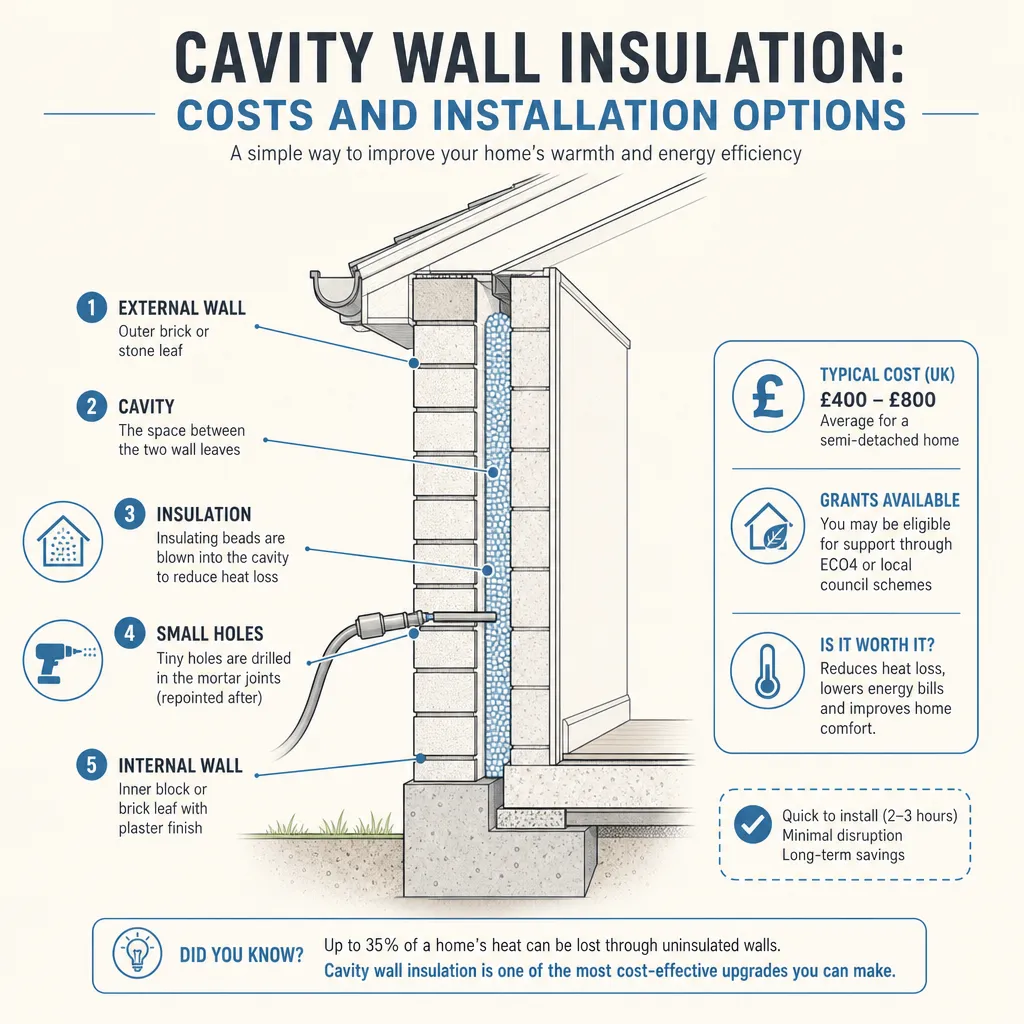
Cavity Wall Insulation: Costs and Installation Options
Cavity wall insulation typically costs £400–£1,200 for a standard UK semi-detached home, though eligible households may pay nothing under ECO4.
 Energy & Retrofit
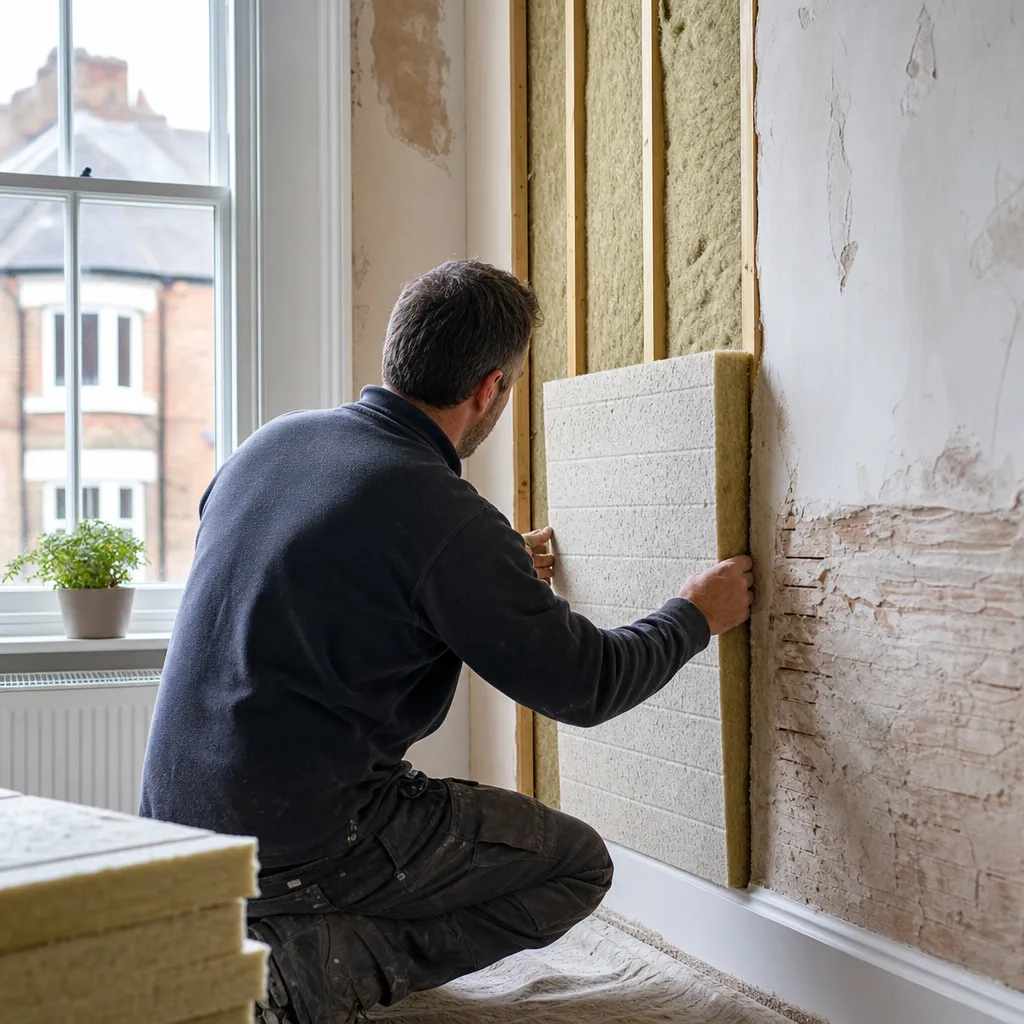
Insulating Original Plaster Walls: Methods and Considerations
Original plaster walls — particularly lime-based finishes in pre-1919 homes — require breathable insulation systems to avoid trapping moisture.
 Energy & Retrofit
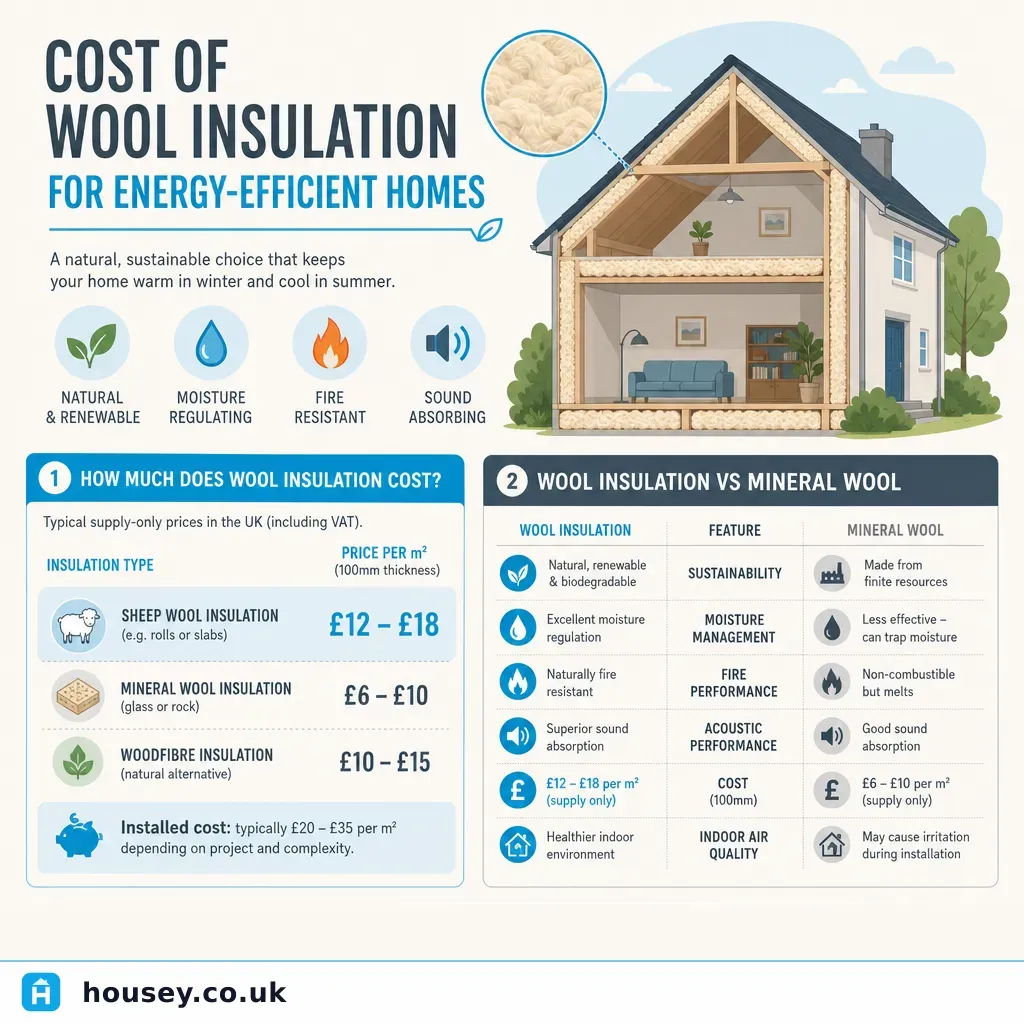
Cost of Wool Insulation for Energy-Efficient Homes
Sheep wool insulation typically costs £5–£15 per m² for materials, rising to £8–£40 per m² installed depending on application and depth.
 Energy & Retrofit
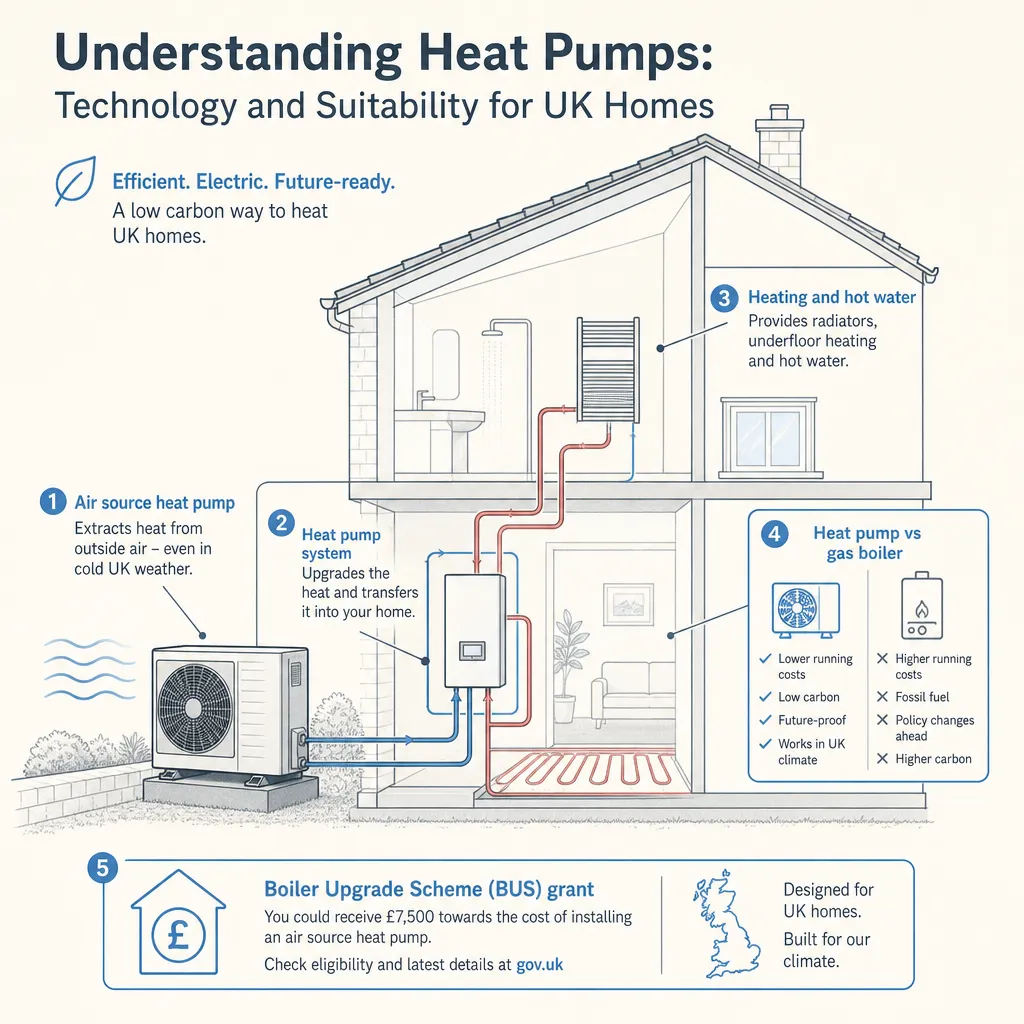
Understanding Heat Pumps: Technology and Suitability for UK Homes
Heat pumps extract heat from the air or ground and transfer it indoors, typically achieving efficiencies of 250–400% compared to a conventional boiler's near 100%.
 Energy & Retrofit
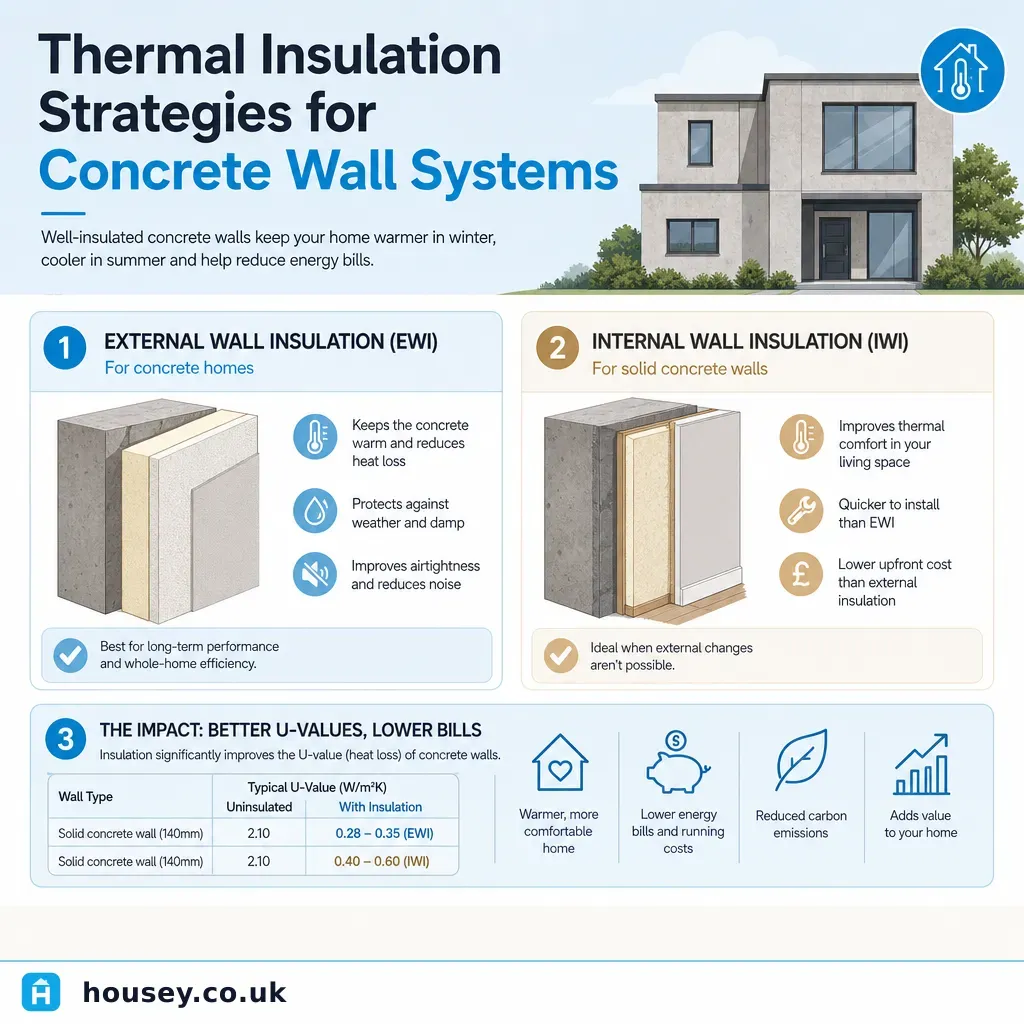
Thermal Insulation Strategies for Concrete Wall Systems
Concrete walls can be insulated using three main approaches: external wall insulation (EWI), internal wall insulation (IWI), or — where a cavity exists — cavity fill.