Insurance and Damage Reimbursement: Supporting Homeowners Through Property Recovery
By Housey · Last reviewed 31st of May 2026
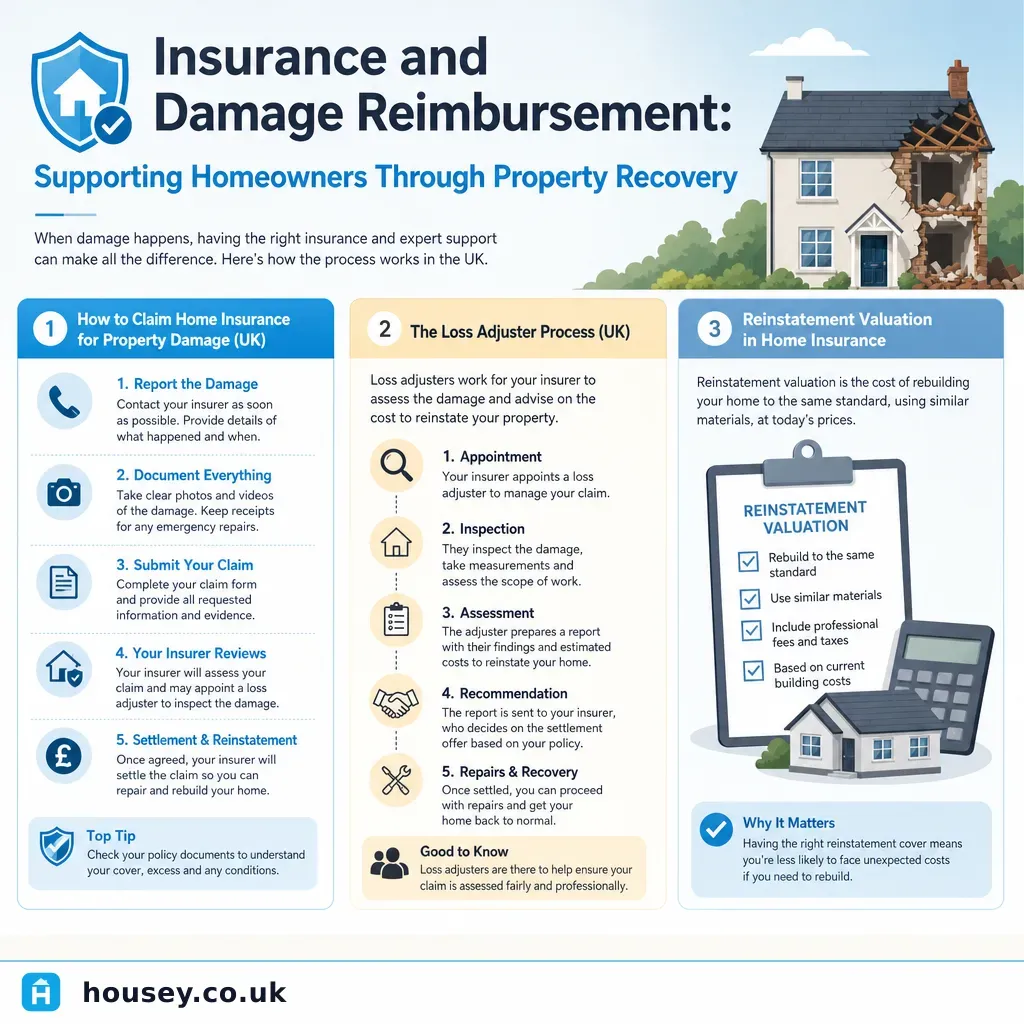
Insurance and Damage Reimbursement: Supporting Homeowners Through Property Recovery
Few situations are more unsettling for a homeowner than significant damage to the fabric of their property — whether caused by flood, fire, storm, escape of water, or subsidence. The buildings insurance claims process exists to restore your home to its pre-damage condition, but navigating loss adjusters, reinstatement valuations, and policy exclusions can be genuinely complex. Understanding how the process works, what your policy covers, and when to seek independent professional help can make the difference between a fair settlement and a costly shortfall.
Key points
- Buildings insurance must be set at reinstatement value — the cost to rebuild the property from the ground up — not market value; these figures can differ substantially, and underinsurance is widespread in UK residential property.
- Insurers typically appoint a loss adjuster regulated by the Chartered Institute of Loss Adjusters (CILA) to assess the claim; the loss adjuster works for the insurer, not for you.
- Under the Insurance Act 2015, policyholders have a duty of fair presentation — material facts about the property must be disclosed accurately at inception and renewal.
- The Financial Ombudsman Service (FOS) can adjudicate disputes between homeowners and insurers once the insurer's internal complaints process has been exhausted, usually within eight weeks.
- An independent RICS-registered surveyor can provide a reinstatement cost assessment (RCA) or a structural survey that supports your claim or challenges an undervalued loss adjustment.
How a property damage insurance claim works in the UK
1. Notify your insurer promptly
Most buildings policies require notification as soon as practicable after discovering damage. Delayed reporting can allow insurers to question whether damage pre-existed or worsened through lack of mitigation. Before any clean-up or repair work begins:
- Photograph and video all visible damage from multiple angles.
- Record the date and approximate time of the incident.
- Keep receipts for any emergency mitigation work you commission — for example, boarding broken windows or calling an emergency plumber.
2. Loss adjuster inspection
For claims above a low threshold — often around £1,000–£2,500 depending on the insurer — a loss adjuster will be appointed to inspect the property and produce a written report. That report determines the initial settlement offer. You are entitled to question the findings, provide your own evidence, and instruct an independent surveyor if you believe the assessment is inaccurate.
3. Understand the settlement basis
Your policy will settle on one of the following bases:
Settlement basis | What it covers | Key risk |
|---|---|---|
New for old (reinstatement) | Full cost to repair or rebuild to equivalent standard | Underinsurance if rebuild cost is not regularly reviewed |
Indemnity | Current value of damaged items, less depreciation | Settlement may be significantly less than actual repair cost |
Day one reinstatement | Agreed rebuild sum fixed at policy start; index-linked annually | Requires accurate RCA at outset to set the right sum |
Buildings policies typically use reinstatement. Contents policies often use indemnity unless new-for-old contents cover is selected.
4. Managing the remediation
Insurers may offer approved contractor networks or allow you to choose your own contractors. You are generally entitled to choose your own. For specialist properties — older buildings, unusual construction, listed buildings — using contractors with appropriate qualifications matters more than speed. Ensure all contractors are suitably qualified: Gas Safe engineers for gas-related damage, UKAS-accredited asbestos surveyors if asbestos-containing materials may be present, and NHBC-registered builders for structural work.
Reinstatement valuation: avoiding underinsurance
The most preventable and costly problem in UK buildings insurance is underinsurance — setting the sum insured too low. If the declared sum is materially below the true rebuild cost, the insurer may apply the averaging principle and pay only a proportionate part of any valid claim. For example, if your property is insured for £250,000 but the true reinstatement cost is £400,000, the insurer may pay only 62.5% of a valid claim.
A professional reinstatement cost assessment (RCA) from a RICS-registered surveyor establishes the correct rebuild value. RICS recommends updating RCAs every three to five years or after any significant alteration to the property. Indicative costs for a residential RCA are approximately £200–£600, depending on property size and complexity. (Indicative UK costs, last reviewed 2026-05-31.)
Red flags: when your claim may need independent support
- The loss adjuster's written report does not reflect what was discussed at the inspection visit.
- The settlement offer does not cover the cost of like-for-like reinstatement — for example, replacing original timber windows with uPVC.
- Your sum insured was based on the purchase price or market value rather than a professional rebuild cost assessment.
- The insurer proposes to use their own contractors but you have concerns about their suitability for a specialist or older property.
- The insurer has not responded within a reasonable period — typically four to eight weeks for straightforward claims.
- The loss adjuster queries whether the damage is covered without citing a specific policy exclusion.
Important limitations
This article provides general information about the property insurance claims process in the UK. Policy terms, exclusions, settlement bases, and procedures vary significantly between insurers. Nothing in this article constitutes legal, financial, or insurance advice. The correct approach for any specific claim depends on your policy wording, the nature and extent of the damage, and your insurer's procedures. Always read your policy documents carefully and seek independent professional or legal advice if a dispute arises.
When this becomes urgent
Stop relying on general guidance and contact a professional immediately if:
- The property is structurally unsafe following damage — evacuate and contact your local authority emergency housing team if necessary.
- You suspect asbestos-containing materials have been disturbed — do not disturb further and arrange a professional asbestos survey before any repair work begins.
- The insurer's eight-week complaint window is approaching and your dispute remains unresolved.
- You have evidence the loss adjuster's report contains significant factual errors about the extent or cause of the damage.
- You face displacement from your home due to damage and the insurer is delaying alternative accommodation arrangements covered by your policy.
What to ask a qualified professional
Before instructing a surveyor for an insurance valuation or structural survey:
- Are you RICS-registered and experienced in reinstatement cost assessments for residential property of this type?
- Will your report be in a format accepted by my insurer, and can you provide it within the required timeframe?
- What information will you need from me — policy schedule, existing plans, previous surveys, specialist reports?
- If structural damage is suspected, can you recommend further specialist investigation such as drain CCTV, crack monitoring, or ground investigation?
- What are your fees, and are they likely to be recoverable from my insurer as a claim cost?
When to get professional help
Many straightforward claims for accidental damage, escape of water, or storm damage resolve smoothly without independent professional input. Professional advice is strongly recommended when:
- The claim is high-value — typically above £25,000.
- The damage affects the structure, foundations, or load-bearing elements of the property.
- Your property is of non-standard construction, is listed, or involves shared building insurance complications.
- The insurer disputes whether the event is covered under the policy.
- You are uncertain whether your sum insured accurately reflects current rebuild costs.
How Housey can help
Housey connects homeowners with qualified professionals offering insurance valuations to establish accurate reinstatement sums, and with chartered building surveyors for structural surveys where damage may have affected the fabric of the property. Request quotes from up to four local specialists through the Housey platform.
Frequently asked questions
What is a loss adjuster and do they work for me?
A loss adjuster is a claims investigation professional, typically regulated by the Chartered Institute of Loss Adjusters (CILA), appointed and paid by your insurer. They assess the damage and recommend a settlement figure to the insurer. They do not act in your interests. If you believe their assessment is too low, you can instruct an independent public loss adjuster or a RICS-registered surveyor to provide an alternative assessment.
What is underinsurance and how does the averaging principle work?
Underinsurance occurs when your buildings sum insured is less than the true cost to rebuild the property. If the shortfall is significant, the insurer may apply averaging: your claim is paid proportionately to the ratio of your declared sum to the true rebuild cost. If insured for £200,000 against a true rebuild cost of £300,000, the insurer may pay only two-thirds of any valid claim. An up-to-date RICS reinstatement cost assessment prevents this situation.
How long does a home insurance claim take in the UK?
Simple claims for theft or minor accidental damage may settle in days or weeks. Complex structural claims — particularly involving subsidence, flooding, or fire — can take many months, and cases requiring full rebuilding can extend beyond a year. If your insurer has not resolved your formal complaint within eight weeks, you may refer it to the Financial Ombudsman Service at no cost to you.
Can I appoint my own contractors for insurance repairs?
In most cases, yes. You are generally entitled to choose your own suitably qualified contractors rather than use the insurer's approved network. Confirm the scope and estimated cost of works with your insurer before instructing contractors, and ensure they hold appropriate qualifications and insurance. For specialist work on listed, unusual, or heritage properties, choosing your own qualified contractor is particularly important.
Sources and further reading
- Home insurance and making a claim — Citizens Advice
- Financial Ombudsman Service: insurance complaints — Financial Ombudsman Service
- Reinstatement Cost Assessments of Buildings — RICS
- Insurance Act 2015 — legislation.gov.uk
- Chartered Institute of Loss Adjusters — CILA
Useful next reads
 Surveys & Inspections
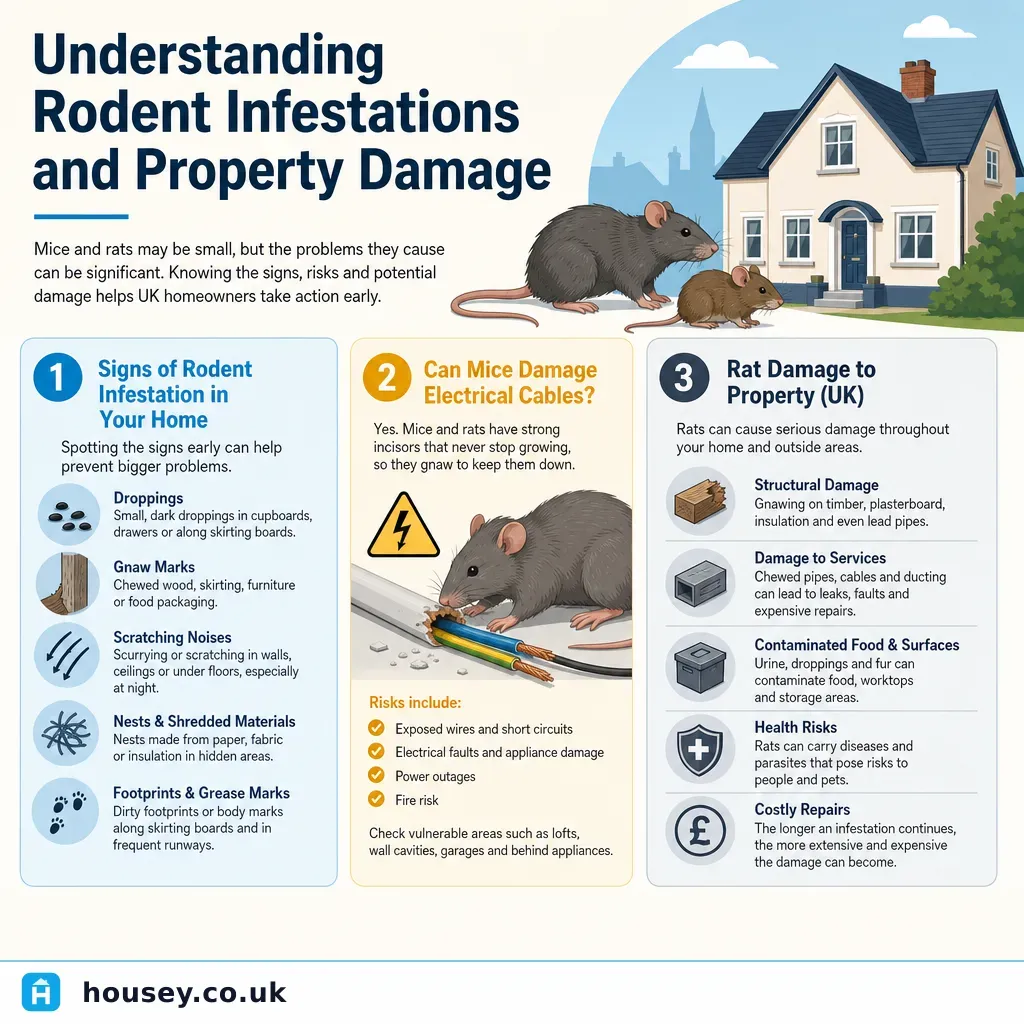
Understanding Rodent Infestations and Property Damage
Rats and mice can cause significant property damage in UK homes, including gnawed electrical cables that create fire risk, damaged pipework causing hidden leaks, and burrowing near foundations in older properties.
 Surveys & Inspections
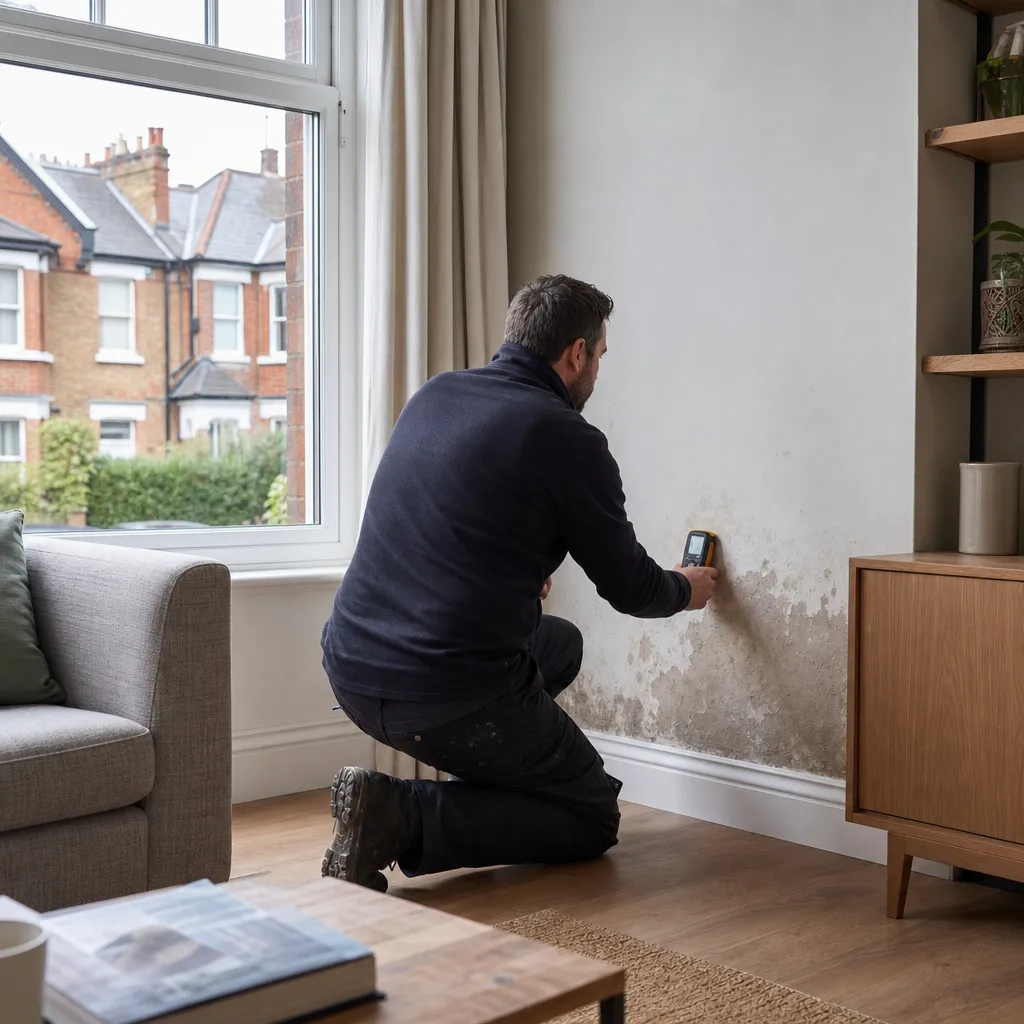
Managing Property and Contents After Damp Treatment
After damp treatment in a UK home, allow walls to dry fully before re-plastering or decorating — this typically takes six months to two years depending on construction and damp severity.
 Surveys & Inspections
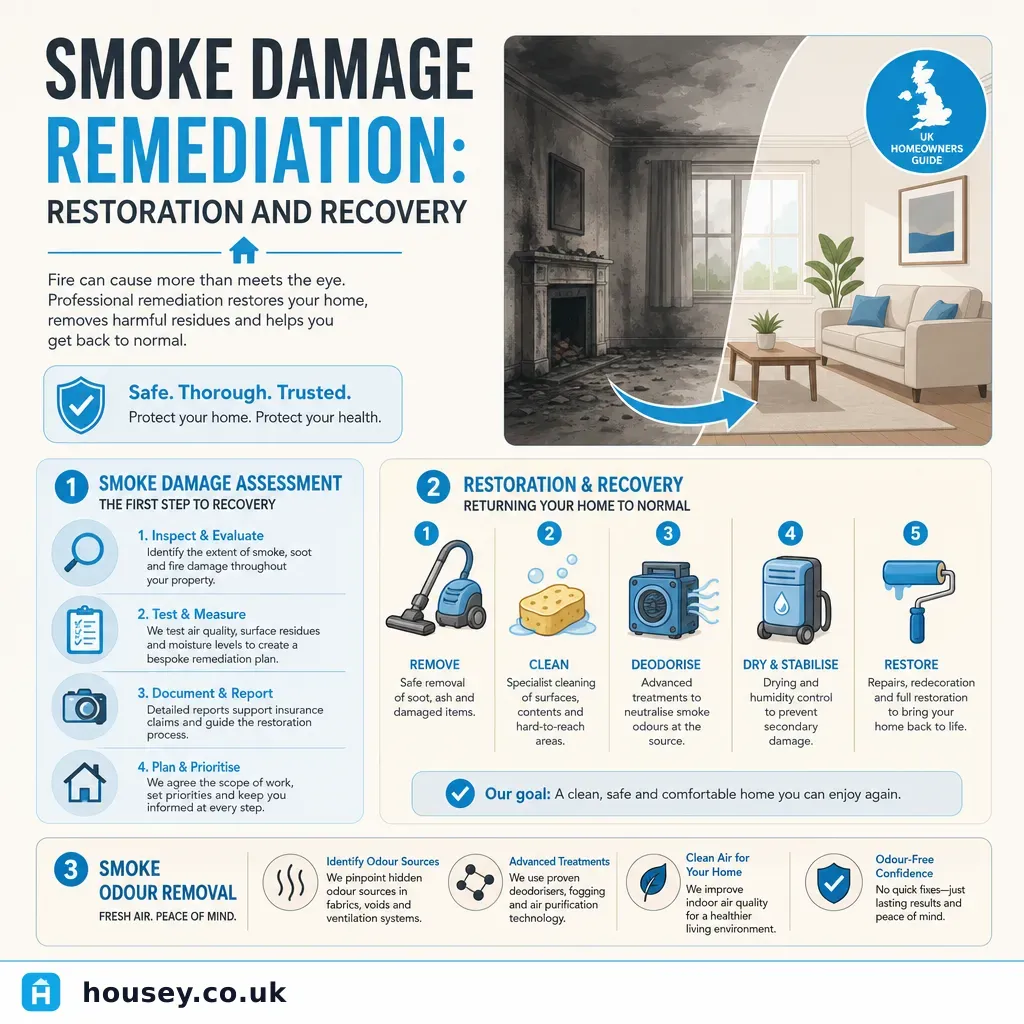
Smoke Damage Remediation: Restoration and Recovery
After a fire or smoke event, professional remediation involves safety assessment, dry cleaning to remove soot, chemical treatment, structural drying, and odour treatment.
 Surveys & Inspections
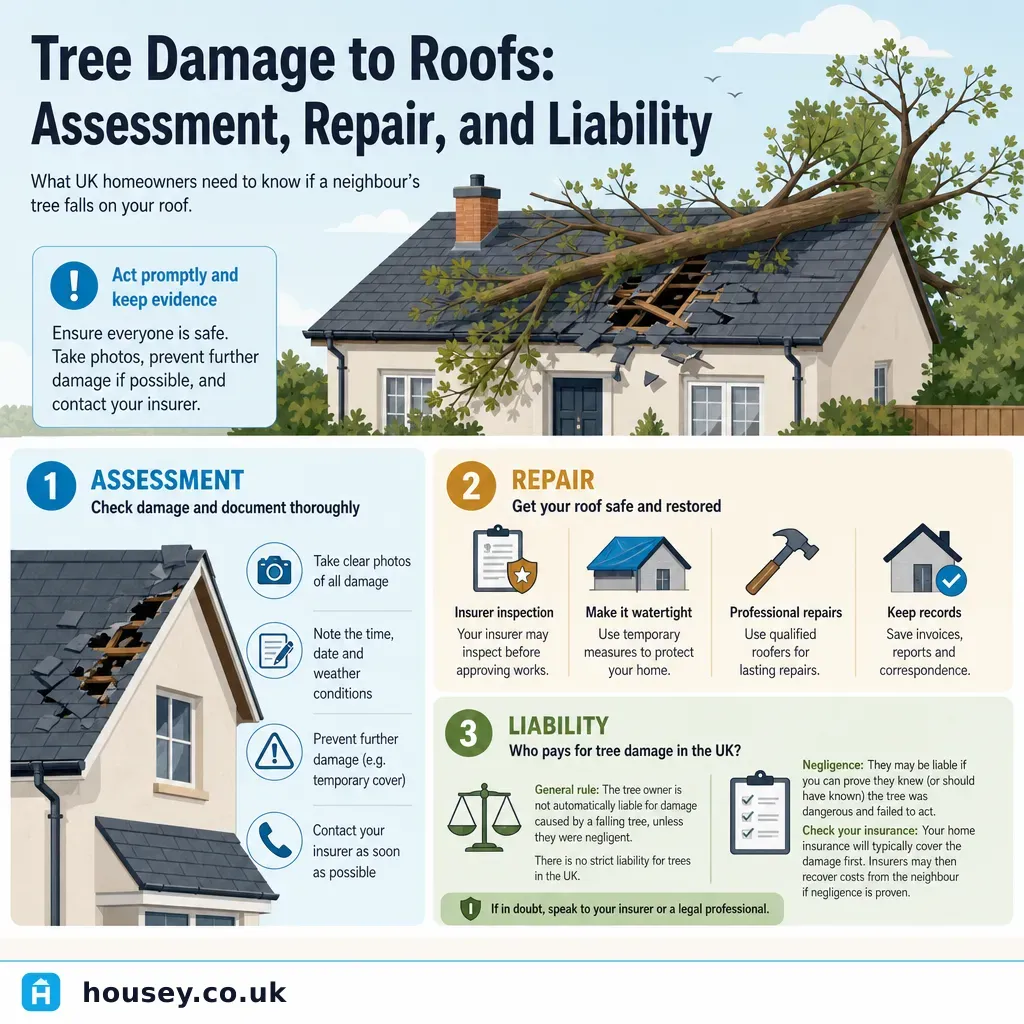
Tree Damage to Roofs: Assessment, Repair, and Liability
When a tree damages a roof in the UK, your own buildings insurance is usually the first port of call regardless of tree ownership.
 Surveys & Inspections
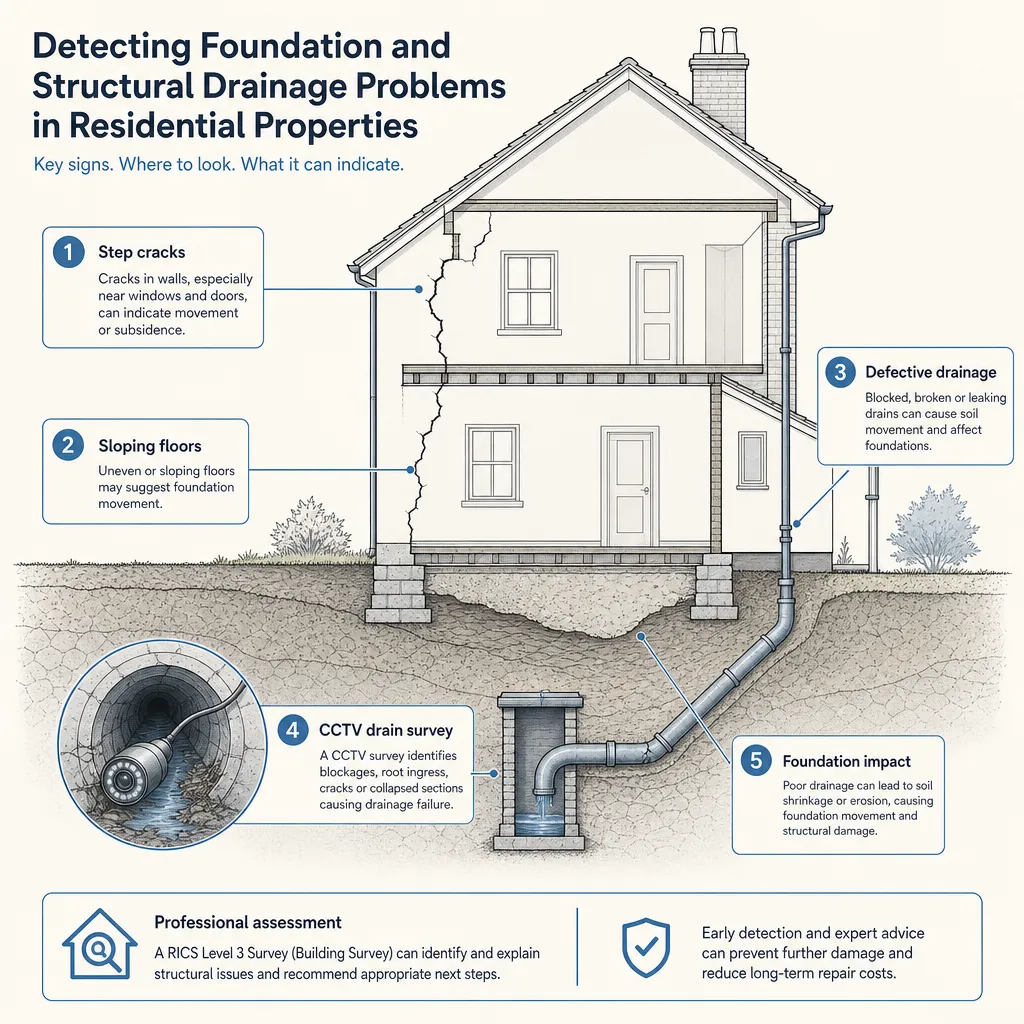
Detecting Foundation and Structural Drainage Problems in Residential Properties
Foundation and drainage problems in UK homes often appear as stepped cracks in brickwork, sticking doors, or slow-draining fixtures.