Tree Damage to Roofs: Assessment, Repair, and Liability
By Housey · Last reviewed 31st of May 2026
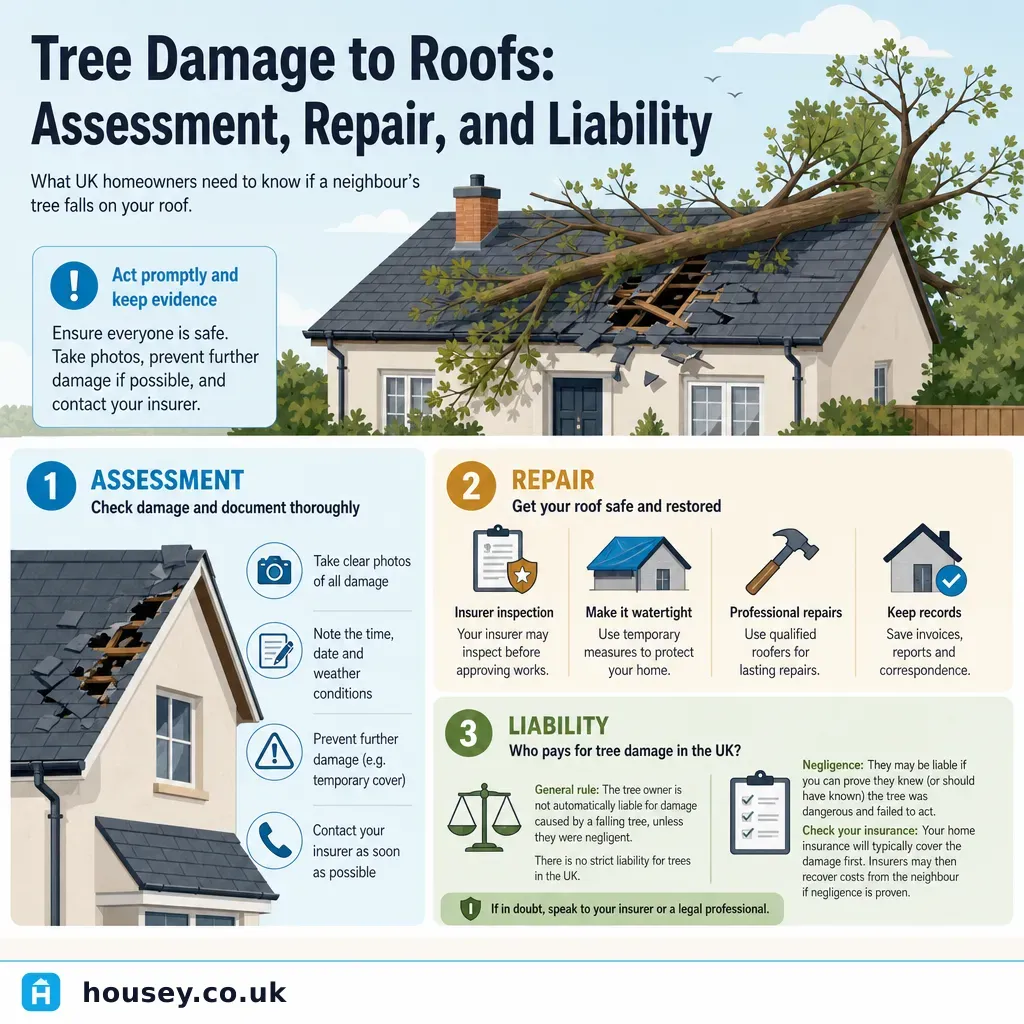
Tree Damage to Roofs: Assessment, Repair, and Liability
Tree damage to roofs is most commonly reported after storms or high winds, though branches can fail during dry spells when internal decay is present. Whether a neighbour's oak has shed a limb onto a Victorian terrace or a garden ash has come down on a garage roof, the immediate questions — who pays, who assesses the damage, and how quickly must you act — are rarely straightforward. Delays in commissioning a structural assessment or arranging weatherproofing can allow water ingress to escalate a manageable repair into a significantly costlier remediation.
Key points
- Under UK negligence principles, a neighbour is only liable for tree damage to your property if they knew (or reasonably should have known) the tree was unsafe and failed to act — not simply because the tree originated from their land.
- Standard UK buildings insurance policies typically cover storm-related tree damage under the storm and falling-objects perils, but may exclude damage where the insurer can show the policyholder was previously aware the tree was defective.
- Trees subject to a Tree Preservation Order (TPO) require prior written consent from the local planning authority before felling, even when they have caused damage; emergency works to remove an immediate risk of serious harm may proceed without consent but must be notified to the council within five days (Town and Country Planning (Tree Preservation) (England) Regulations 2012).
- The Association of British Insurers advises policyholders to arrange emergency weatherproofing immediately and retain all receipts, but not to commission permanent repairs before the insurer's loss adjuster has inspected.
- Structural damage to roof timbers — rafters, ridge boards, and purlins — requires assessment by a structural engineer or RICS Level 3 surveyor to confirm load-bearing integrity before any repair work begins.
Immediate steps after tree damage to a roof
The order in which you act matters. Water ingress can cause secondary damage to ceilings, insulation, electrical wiring, and wall plaster within 24 to 48 hours.
- Ensure personal safety first. If the tree or branches remain in contact with the roof, do not enter the building until a qualified tree surgeon has confirmed the structure is stable.
- Notify your buildings insurer. Most policies require prompt notification; delay can complicate the claim.
- Arrange emergency weatherproofing. A roofing contractor can apply a temporary tarpaulin or board-up to prevent further water ingress. Retain all receipts.
- Commission a structural assessment. Before any masonry or timber repairs begin, have a structural engineer or RICS Level 3 surveyor confirm that the roof structure is safe and identify the full scope of damage.
- Instruct a qualified tree surgeon. Safe removal of remaining debris — particularly any branches or trunk still loading the roof — should be carried out by a qualified professional.
- Document thoroughly. Photograph damage from multiple angles before clearance begins to support the insurance claim and any potential dispute.
Liability: who pays for tree damage in the UK?
A common misconception is that a tree owner is automatically liable for any damage caused by their tree. This is not the case in English law.
Your own buildings insurance is usually the first port of call. Standard policies cover storm damage regardless of where the tree originated. Consider the policy excess and any future premium impact when deciding whether to claim for minor damage.
Neighbour liability requires establishing negligence. You must show that the neighbour was notified — preferably in writing — that the tree appeared diseased, unstable, or hazardous; that they failed to act on that notification; and that a reasonable person in their position should have foreseen the risk. Written correspondence sent before the incident is material evidence.
Local authority or highway authority trees. If the tree fell from council-owned land or a highway verge, the relevant authority may be liable where they held prior documented knowledge of a defect. Such claims are often contested and usually require legal advice.
Types of damage and which professional to involve
Damage type | Assessment professional | What they provide |
|---|---|---|
Roof covering (tiles, slates, flat-roof membrane) | Roofing contractor or RICS Level 2/3 surveyor | Repair specification and reinstatement cost estimate |
Structural roof timbers (rafters, ridge board, purlins) | Structural engineer or RICS Level 3 surveyor | Structural integrity assessment and remediation design |
Masonry (chimney, parapet wall, gable) | Structural engineer | Stability assessment and rebuild specification |
Tree identity, condition, and TPO status | ARB-registered arboriculturalist | Arboricultural report, TPO confirmation, safe removal plan |
Tree debris clearance | Qualified tree surgeon | Safe removal and stump treatment |
Insurance claim scope and schedule of loss | Loss adjuster or independent RICS surveyor | Schedule of loss and reinstatement valuation |
TPOs, planning, and emergency tree works
If the tree that caused damage is subject to a TPO or is within a conservation area, specific rules govern its removal:
- Emergency works to remove an immediate risk of serious harm to persons or property may proceed without prior consent, but the local planning authority must be notified within five days.
- Non-emergency felling of a TPO tree — even one that has caused damage — still requires prior written consent from the local planning authority before works proceed.
- In a conservation area, six weeks' prior notice must normally be given to the council before felling any tree with a trunk diameter over 75 mm measured at 1.5 m above ground, unless urgently required for safety.
Check TPO status and specific local requirements via GOV.UK: tree works guidance or by contacting your local planning authority directly.
Red flags: when damage may be more serious than it appears
These signs indicate that damage extends beyond the immediately visible impact area and require prompt professional assessment:
- Bowing or cracking ceilings on the floor below — indicates loaded or displaced roof timbers, or water tracking along structural elements.
- Sticking doors or windows on the floor below — can indicate roof spread or structural movement following impact.
- Visible deflection in the ridge line or roof slope when viewed from a distance — may indicate rafter failure or displacement.
- Chimney displacement or visible lean following a strike — requires urgent structural assessment before the building is occupied.
- Damp or staining spreading well beyond the impact area within 24 to 48 hours — water is tracking through structural elements rather than dripping locally.
- Subsidence or sinking ground above the drainage run near where the tree fell — root disruption may have fractured underground pipes.
Any of these signs warrant immediate professional assessment. The affected areas should not be occupied until a structural engineer or RICS Level 3 surveyor has confirmed they are safe.
Important limitations
This article provides general guidance only. Liability, insurance policy terms, planning restrictions, and the structural implications of specific damage vary significantly by property, tree species, location, and individual circumstance. Do not rely on this article to determine whether you have a valid legal claim or insurance entitlement. Consult your insurer promptly, instruct a solicitor if a neighbour dispute arises, and engage a structural engineer or RICS-qualified surveyor for property-specific advice.
What to ask a qualified professional
Before instructing a structural engineer, surveyor, or roofing contractor following tree damage:
- Is the building structurally safe to occupy while assessments and repairs are under way?
- What is the full extent of the damage, including elements not immediately visible in the areas inspected?
- Is a temporary weatherproofing solution confirmed before permanent repair commences?
- Are you experienced in preparing reports or schedules of loss for insurance claim purposes?
- Is any tree on site subject to a TPO or in a conservation area, and what consents are required before works proceed?
- What are the repair stages, likely timescales, and circumstances that could extend them?
- Is VAT included in the quoted price, and what payment milestones apply?
When to get professional help
Commission a structural assessment and arrange emergency weatherproofing immediately after any roof impact — do not wait for insurer instructions before making the building weathertight. A structural survey establishes the full scope of damage and provides the evidence base for an insurance claim. For roof covering damage, a roof survey can quantify reinstatement costs. If the tree requires safe removal or assessment, an experienced tree surgeon should attend as soon as it is safe to do so.
How Housey can help
Housey connects you with qualified professionals for roof surveys and structural surveys to assess damage and prepare documentation that supports insurance claims. You can also find experienced tree surgeons for the safe clearance of fallen or damaged trees in your area.
Frequently asked questions
Is my neighbour liable if their tree falls on my roof?
Not automatically. UK law requires you to show that your neighbour knew — or reasonably should have known — the tree was unsafe and failed to take reasonable action. A tree falling due to an unforeseeable storm is generally not grounds for a neighbour liability claim. Your own buildings insurance policy is usually the appropriate first step, regardless of where the tree originated.
Will my buildings insurance cover tree damage to my roof?
Most standard UK buildings insurance policies include cover for storm damage and falling objects, which encompasses trees. Cover may be excluded if the insurer can show that you or the tree's owner were aware the tree was defective and failed to act. Notify your insurer promptly and retain all receipts for emergency works before permanent repairs begin.
Do I need planning permission to remove a tree that damaged my property?
Not usually for unprotected trees. However, if the tree carries a Tree Preservation Order or is in a conservation area, different rules apply. Emergency works to remove an immediate safety risk may proceed without prior consent but must be notified to the local planning authority within five days. Non-emergency removal of a TPO tree requires prior written consent from the council.
How long does a structural assessment take after tree damage?
An initial structural assessment by a structural engineer or RICS Level 3 surveyor is typically carried out within 24 to 72 hours of an emergency instruction. A full written report may take several further days. Do not wait for the written report before arranging temporary weatherproofing — commission this immediately to prevent secondary water damage to ceilings and timbers.
Sources and further reading
- GOV.UK: Tree works — permission and Tree Preservation Orders — HM Government
- Town and Country Planning (Tree Preservation) (England) Regulations 2012 — legislation.gov.uk
- Association of British Insurers: Storm and flood claims guidance — Association of British Insurers
- RICS Home Survey Standard — RICS
- Arboricultural Association: Find an arborist — Arboricultural Association
Useful next reads
 Surveys & Inspections
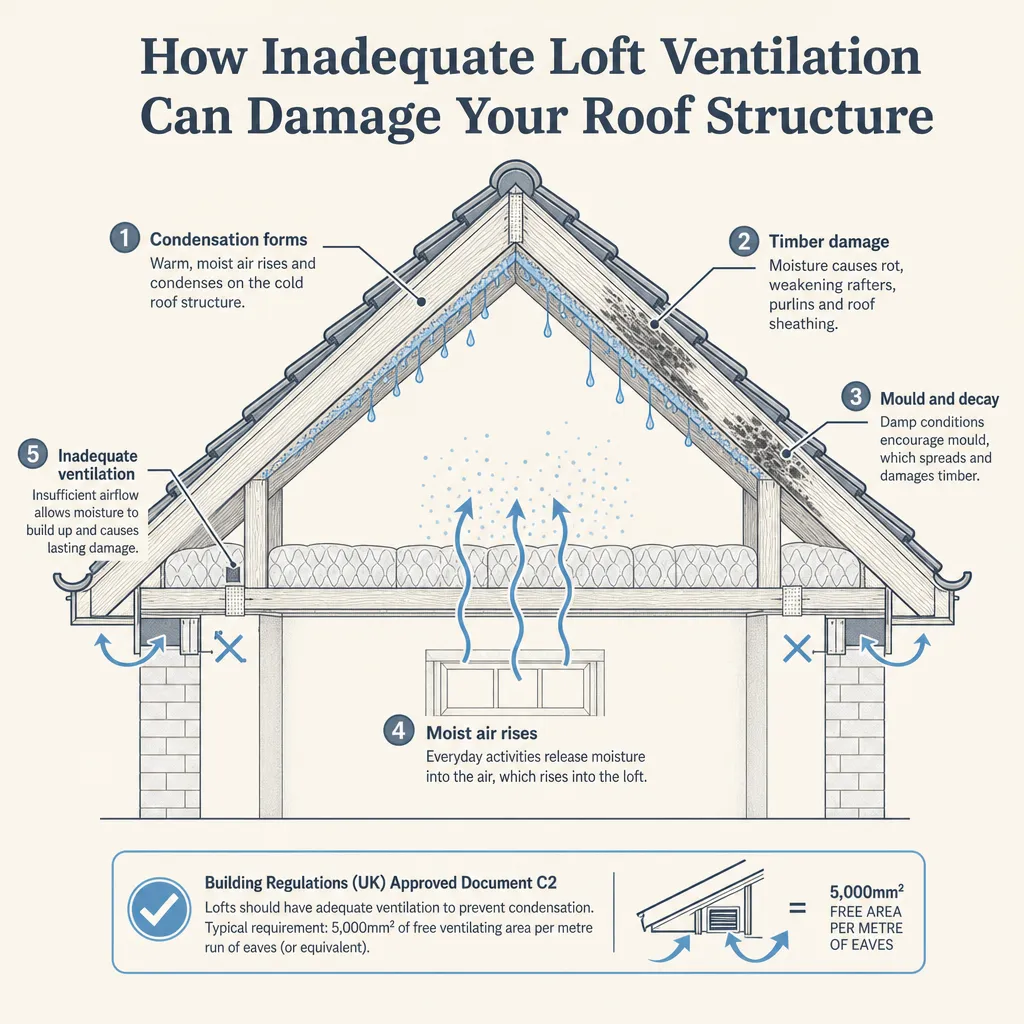
How Inadequate Loft Ventilation Can Damage Your Roof Structure
Inadequate loft ventilation allows warm, moist air to condense on cold roof timbers.
 Surveys & Inspections
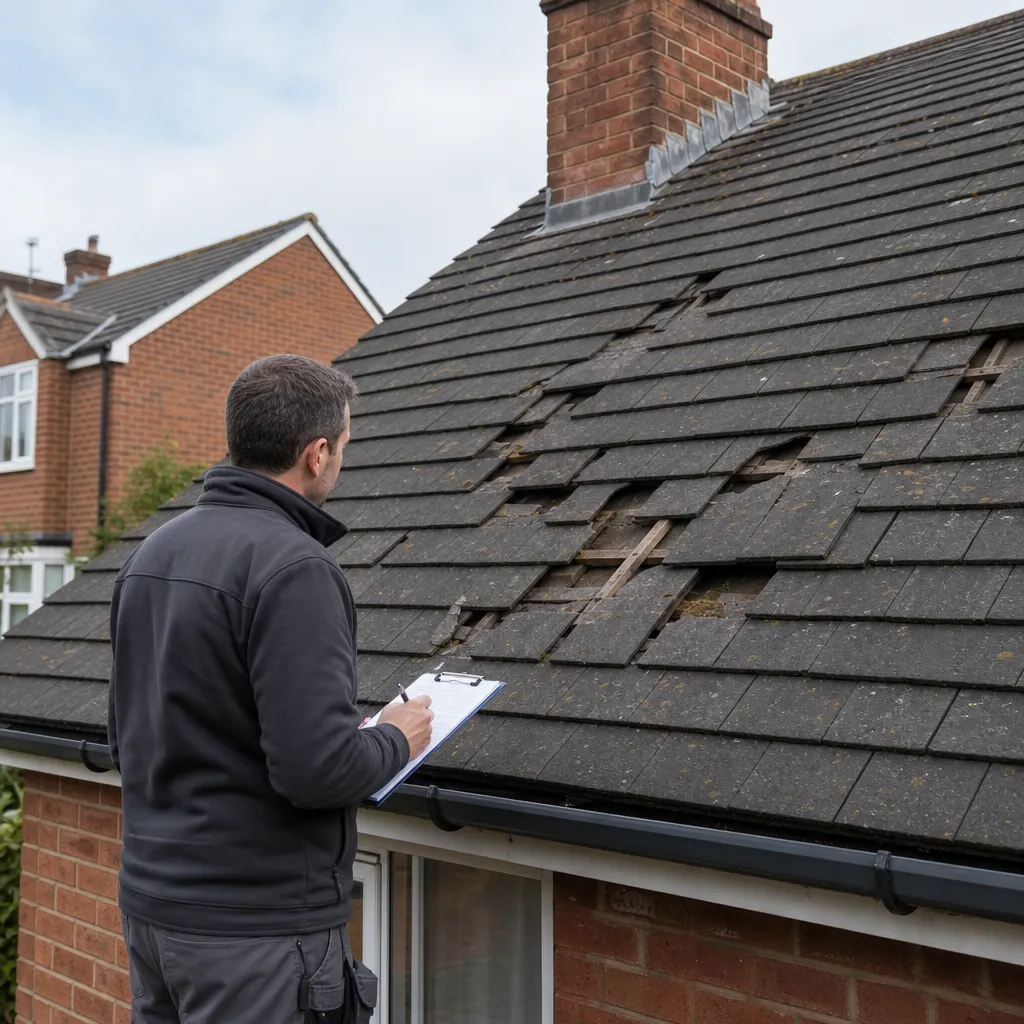
Wind Damage to Roof Tiles and Shingles: Inspection and Repair Guidance
After a storm, inspect your roof from ground level using binoculars before attempting access.
 Surveys & Inspections
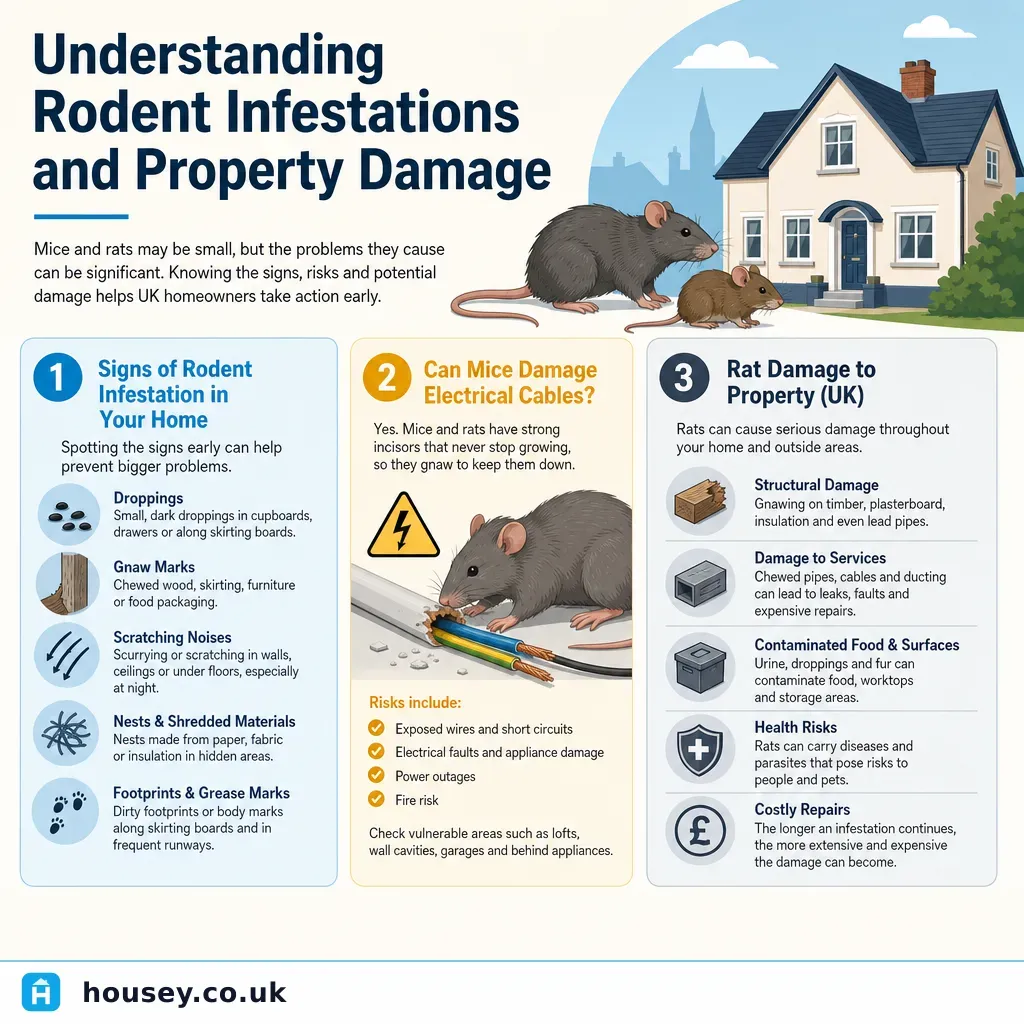
Understanding Rodent Infestations and Property Damage
Rats and mice can cause significant property damage in UK homes, including gnawed electrical cables that create fire risk, damaged pipework causing hidden leaks, and burrowing near foundations in older properties.
 Surveys & Inspections
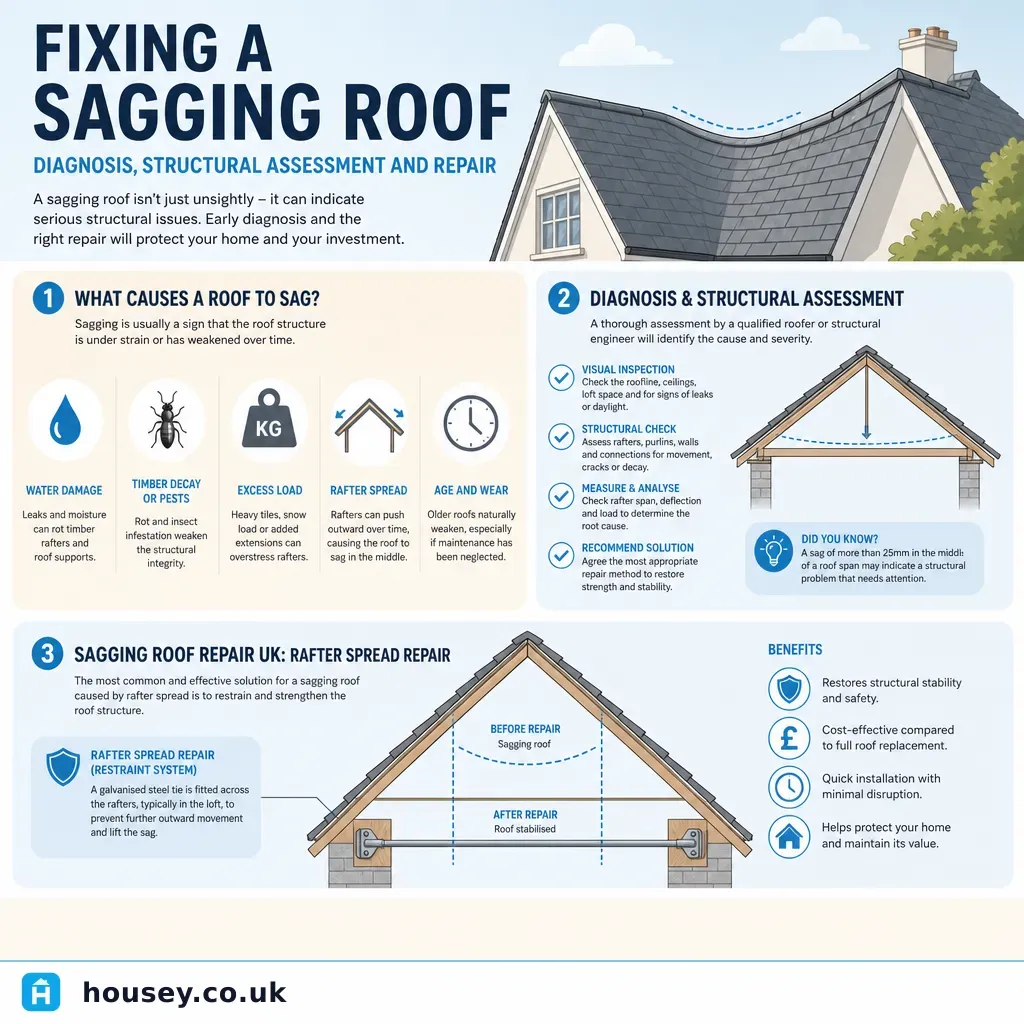
Fixing a Sagging Roof: Diagnosis, Structural Assessment and Repair
A sagging roof usually points to failed or overloaded roof timbers, rafter spread, or a compromised ridge board.
 Surveys & Inspections
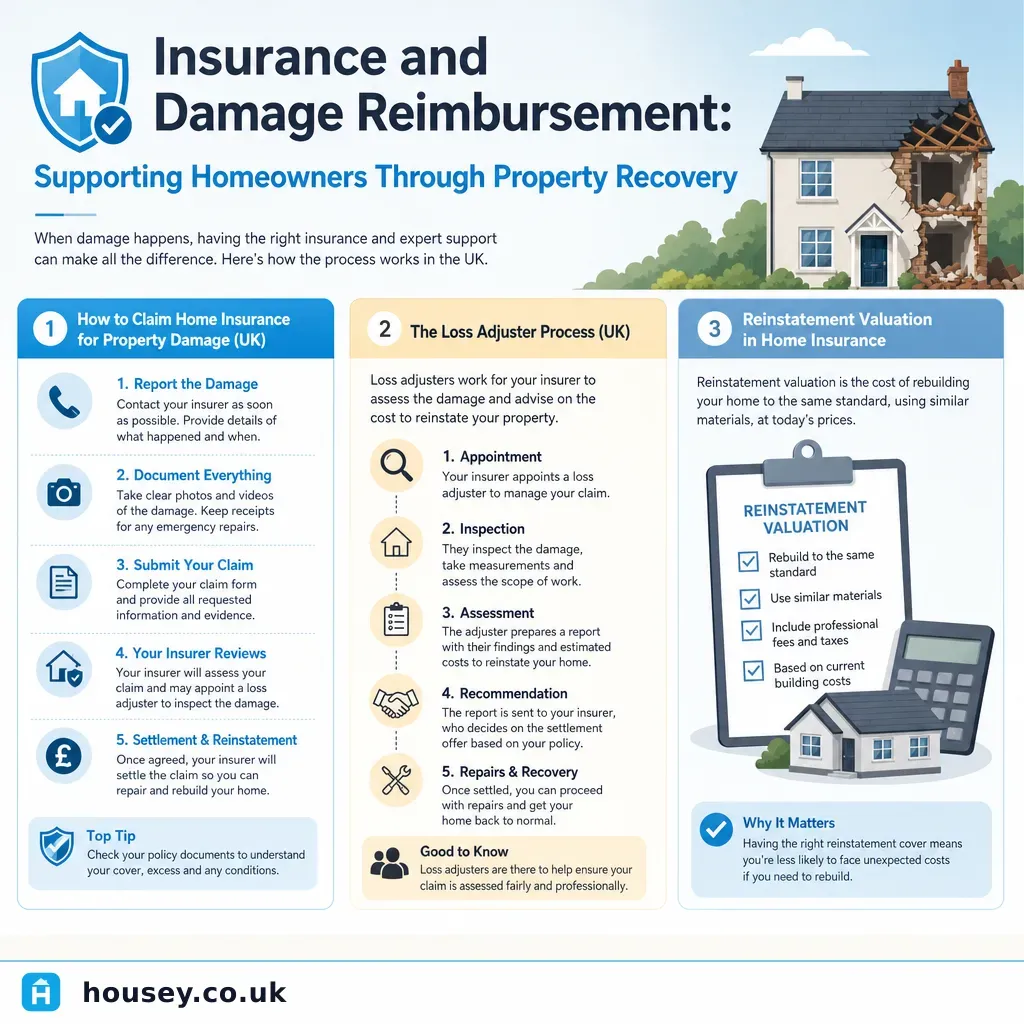
Insurance and Damage Reimbursement: Supporting Homeowners Through Property Recovery
After property damage, your insurer will typically appoint a loss adjuster to assess the claim.