Interior Limewash Wall Finish Costs
By Housey · Last reviewed 7th of May 2026
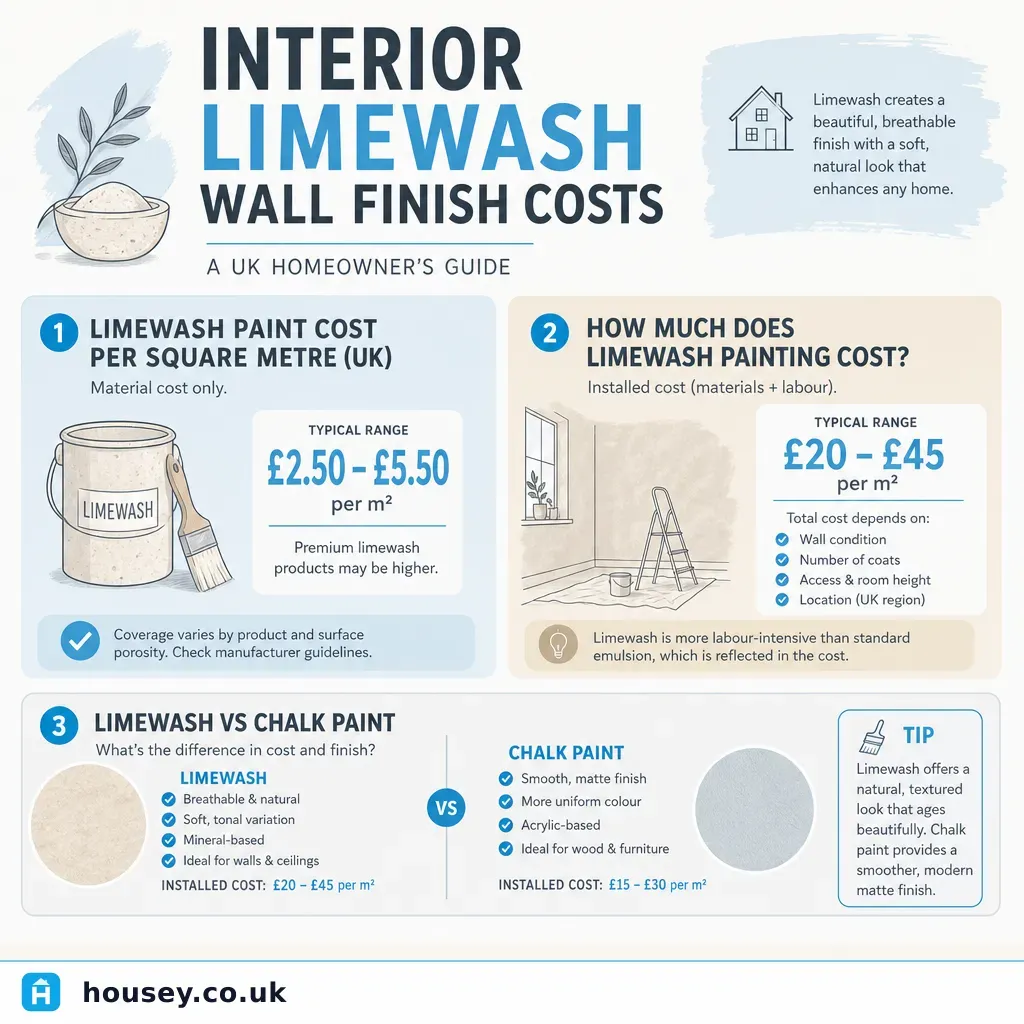
Interior Limewash Wall Finish Costs
Limewash is attracting renewed interest from UK homeowners renovating period properties, undertaking extension projects, or seeking a more textured, characterful alternative to standard emulsion. Whether you are refurbishing a Victorian terrace, updating a 1930s semi, or finishing a newly built extension with a heritage-inspired interior, understanding what limewash costs — and what drives the price — helps you plan accurately and brief decorators with confidence.
Key points
- Professional limewash application typically costs £15–£45 per square metre in the UK, covering materials and labour (Indicative UK costs, last reviewed 2026-05-07).
- Most applications require 2–3 coats, with several hours of drying time between each; rushing the process can cause peeling or uneven colour absorption.
- Historic England recommends breathable finishes, including limewash, for pre-1919 solid-wall properties where moisture management is a priority.
- Premium limewash products — such as Bauwerk, Classidur, or Earthborn — cost significantly more per litre than a basic slaked-lime mix, directly affecting overall material costs.
- Wall preparation, including filling, sanding, or stabilising primers on previously painted or very porous surfaces, is often charged separately and can add £3–£10 per m².
What does interior limewash cost in the UK?
The total cost depends on wall area, product choice, and the number of coats required. The table below shows indicative ranges for professionally applied limewash finishes, including materials and labour.
Indicative UK costs, last reviewed 2026-05-07. Quotes vary by region, wall condition, product specification, and decorator experience.
Room or area | Approximate wall area | Estimated total cost |
|---|---|---|
Small bedroom | ~20 m² | £300–£900 |
Medium living room | ~35 m² | £525–£1,575 |
Open-plan kitchen/diner | ~50 m² | £750–£2,250 |
Hallway and stairwell | ~25 m² | £375–£1,125 |
Entire two-bedroom flat | ~130 m² | £1,950–£5,850 |
Materials typically account for £5–£20 per m², depending on product tier. Basic lime putty washes sit at the lower end; branded decorative limewash products sit at the higher end.
Labour is usually charged at £150–£300 per day for an experienced decorating specialist. An average room may take one to two days across multiple visits to allow coats to dry fully between sessions.
What affects the price of a limewash finish?
Wall condition and preparation
Limewash adheres best to slightly absorbent, clean, and stable surfaces. Walls with multiple layers of vinyl emulsion, gloss paint, or wallpaper paste residue need stripping or a bonding treatment first. Some contractors charge preparation time separately; others include it in a day rate. Always confirm what the quote covers before work begins.
Number of coats
Two coats produces a lighter, more translucent effect; three or more coats — sometimes applied in opposing directions for a layered look — create deeper colour and greater consistency. More coats mean more time and a higher cost, but the decorative result is usually richer and more authentic.
Product specification
A traditional slaked-lime and pigment mix is inexpensive to prepare but requires an experienced hand to apply consistently. Branded ready-mixed limewash products cost more per litre but are more predictable and easier for decorators to work with across larger wall areas.
Decorator experience and location
Limewash is a specialist skill. Not all decorating firms offer it. A decorator experienced in traditional lime finishes may charge a premium day rate — particularly in London and the South East. Always ask to see examples of comparable previous work before instructing.
Room complexity
High ceilings, alcoves, cornices, and irregular surfaces increase labour time. A simple rectangular room costs noticeably less than a Victorian reception room with picture rails, coving, or an ornate chimney breast.
Limewash compared with other decorative wall finishes
Finish | Typical cost per m² (incl. labour) | Breathability | Durability | Best suited to |
|---|---|---|---|---|
Limewash | £15–£45 | Very high | Moderate — refresh every 5–10 years | Period homes, extensions, artisanal interiors |
Chalk paint | £12–£30 | High | Moderate | Furniture, feature walls |
Venetian plaster | £30–£80 | Moderate | High | Contemporary and luxury interiors |
Standard emulsion | £5–£15 | Low–moderate | High | Most modern homes |
Clay paint | £12–£30 | High | Moderate | Eco-conscious renovations, bedrooms |
Indicative UK costs, last reviewed 2026-05-07.
Limewash offers the highest breathability of any common decorative wall finish, which matters in pre-1919 solid-wall construction where trapping moisture can contribute to damp problems. It is less critical for modern, dry-lined walls where breathability is not a concern.
Is limewash right for your property?
Use this decision guide before briefing a decorator:
- Choose limewash if your property is pre-1919 solid-wall construction and you want a traditional finish that lets walls breathe.
- Choose limewash if you are finishing a new extension with natural or lime render and want a complementary interior treatment.
- Consider Venetian plaster or clay paint instead if your walls are modern plasterboard and breathability is not a priority.
- Ask a specialist first if your home is listed or in a conservation area and you plan to apply limewash directly to original historic plasterwork.
- Check wall condition carefully if walls are heavily contaminated with old sealants or paint — preparation costs may reduce the cost advantage of limewash over higher-end finishes.
- Get a structural damp assessment first if walls show signs of rising or penetrating damp; limewash will not cure an underlying moisture problem.
What to ask when comparing quotes
Before accepting any quote for limewash application, ask each decorator:
- What preparation work is included in the price, and what is charged separately?
- How many coats are specified, and how will drying time between visits be managed?
- What limewash product do you recommend, and can you provide a material data sheet?
- Do you have examples of comparable limewash work in similar UK properties?
- Is VAT included in the quoted price?
- What happens if old sealants or damaged plaster are uncovered once preparation begins — will there be a revised quote?
- Will you provide a written specification so I can compare this quote on a like-for-like basis with other decorators?
When to get professional help
Limewash is not a standard DIY decorating task. Achieving an even, intentional finish across large walls or on textured heritage plaster requires a decorator with specific lime experience. Seek a professional if:
- Your home is pre-1919 and you are applying limewash directly to original plaster or render.
- The walls show significant surface damage, rising damp, efflorescence, or salt deposits.
- You are aiming for consistent colour and depth across a large open-plan space.
- Your home is listed or in a conservation area and you are uncertain whether a limewash finish is appropriate for the historic fabric.
How Housey can help
If you are planning an interior limewash finish as part of a broader renovation or extension project, Housey can help you find and compare qualified build and decorating professionals. Our extension builders service connects you with vetted UK contractors who can advise on interior finishes — including lime-based treatments — as part of a complete build or refurbishment scope.
Frequently asked questions
How long does limewash last on interior walls?
Interior limewash typically lasts 5–10 years before it needs refreshing, depending on traffic, humidity, and the number of coats applied. High-traffic areas such as hallways may need touching up sooner. Unlike standard emulsion, limewash can usually be re-coated without full stripping, making maintenance relatively straightforward for most UK homeowners.
Can limewash be applied to plasterboard walls?
Yes, but plasterboard is less porous than traditional lime plaster, so the finish may not adhere or absorb colour in quite the same way. A bonding primer or skim coat can help. For the most authentic and consistent result, limewash works best on sand-and-cement render, lime plaster, or bare brick typical of older UK properties.
Does limewash come in different colours?
Yes. Natural earth pigments — ochres, umbers, raw sienna — are traditionally mixed into limewash before application. Many branded products now offer a wide range of pre-pigmented options. Because limewash is translucent, colour tends to look lighter and more varied in tone than standard emulsion, shifting noticeably with natural light throughout the day.
Is limewash suitable for a bathroom or kitchen?
Standard limewash is not water-resistant and is not recommended for areas of high humidity or regular splashing. Some manufacturers offer more durable lime-based finishes with added binders, but for bathrooms and kitchens, mineral silicate paint or Venetian plaster are usually more practical and appropriate alternatives for UK homes.
Do I need to seal limewash after application?
Traditional limewash is typically left unsealed to preserve its breathability. Applying a sealant defeats the main advantage of a lime finish and can trap moisture in older solid-wall buildings, potentially worsening damp. In lower-humidity settings, some decorators apply a light beeswax or natural oil finish for minor protection, but always check the product manufacturer's guidance first.
Sources and further reading
- Traditional Building Materials: Lime — Historic England
- Listed buildings guidance — GOV.UK
- Solid wall insulation advice — Energy Saving Trust
Useful next reads
 Improvement & Build
Painting Interior Doors: Preparation and Technique
Painting interior doors well depends on preparation rather than paint choice.
 Improvement & Build
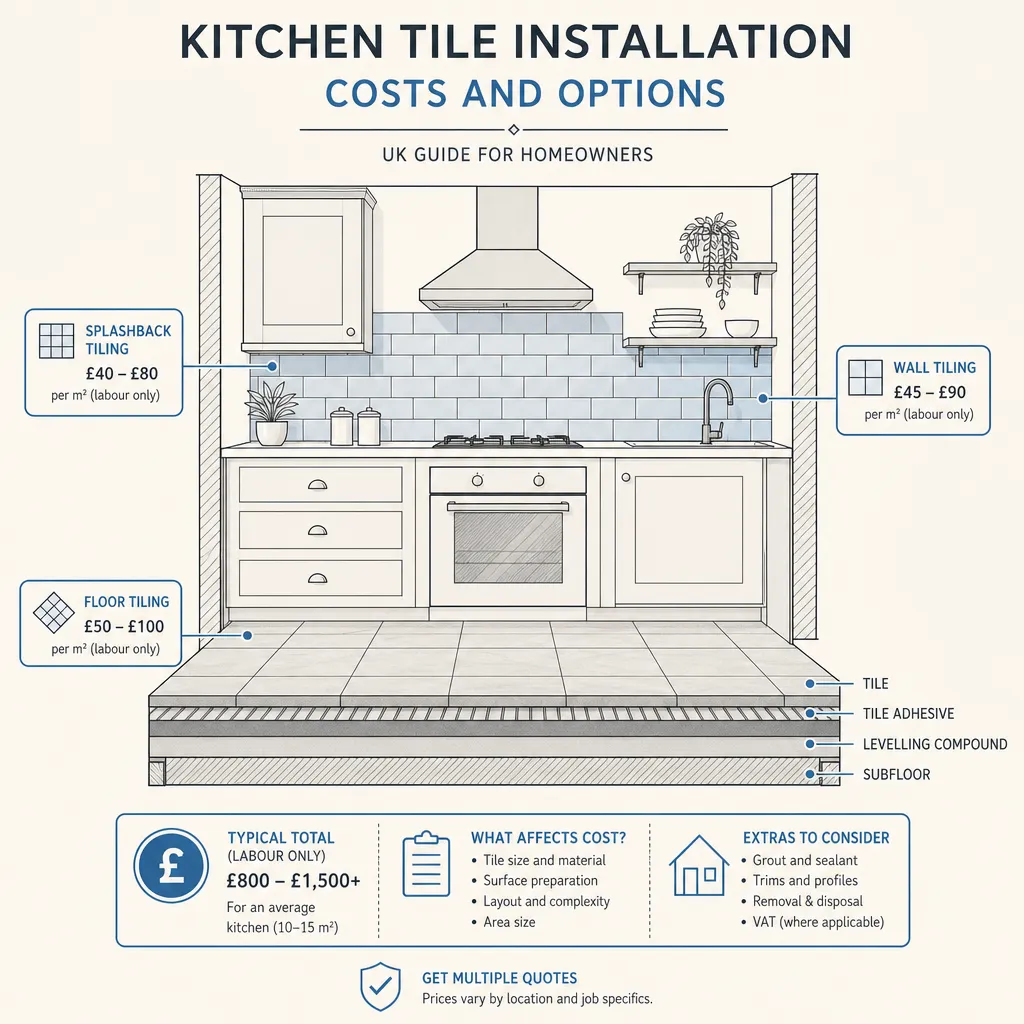
Kitchen Tile Installation Costs and Options
Kitchen tiling in the UK costs roughly £20–£40 per square metre for labour, plus £15–£80 per square metre for materials depending on tile type.
 Improvement & Build
Painting Brick Fireplaces: Preparation, Materials and Technique
Painting a brick fireplace requires thorough cleaning, a masonry-specific primer, and heat-resistant paint rated to at least 200°C for the firebox area.
 Improvement & Build
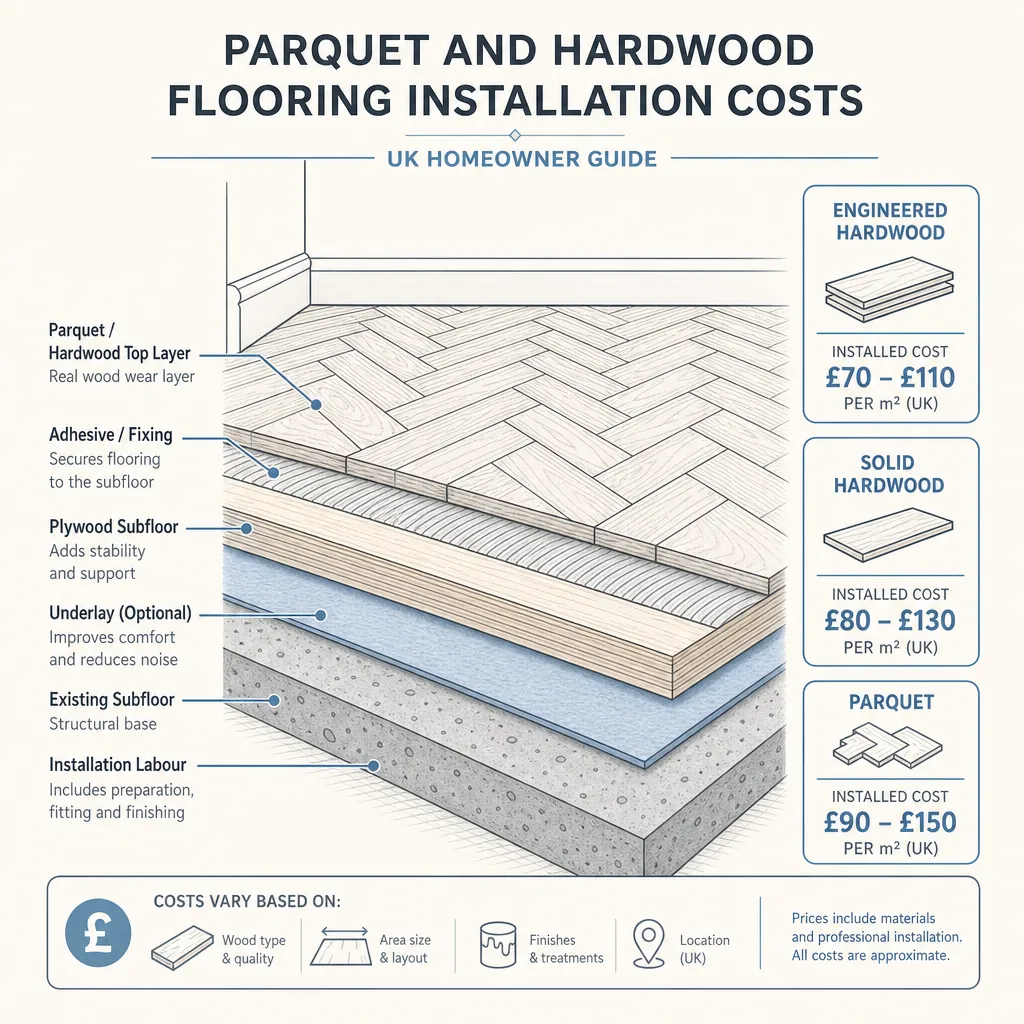
Parquet and Hardwood Flooring Installation Costs
Parquet and hardwood flooring typically costs £50–£160 per m² installed in the UK, depending on wood species, board format, and subfloor condition.
 Improvement & Build
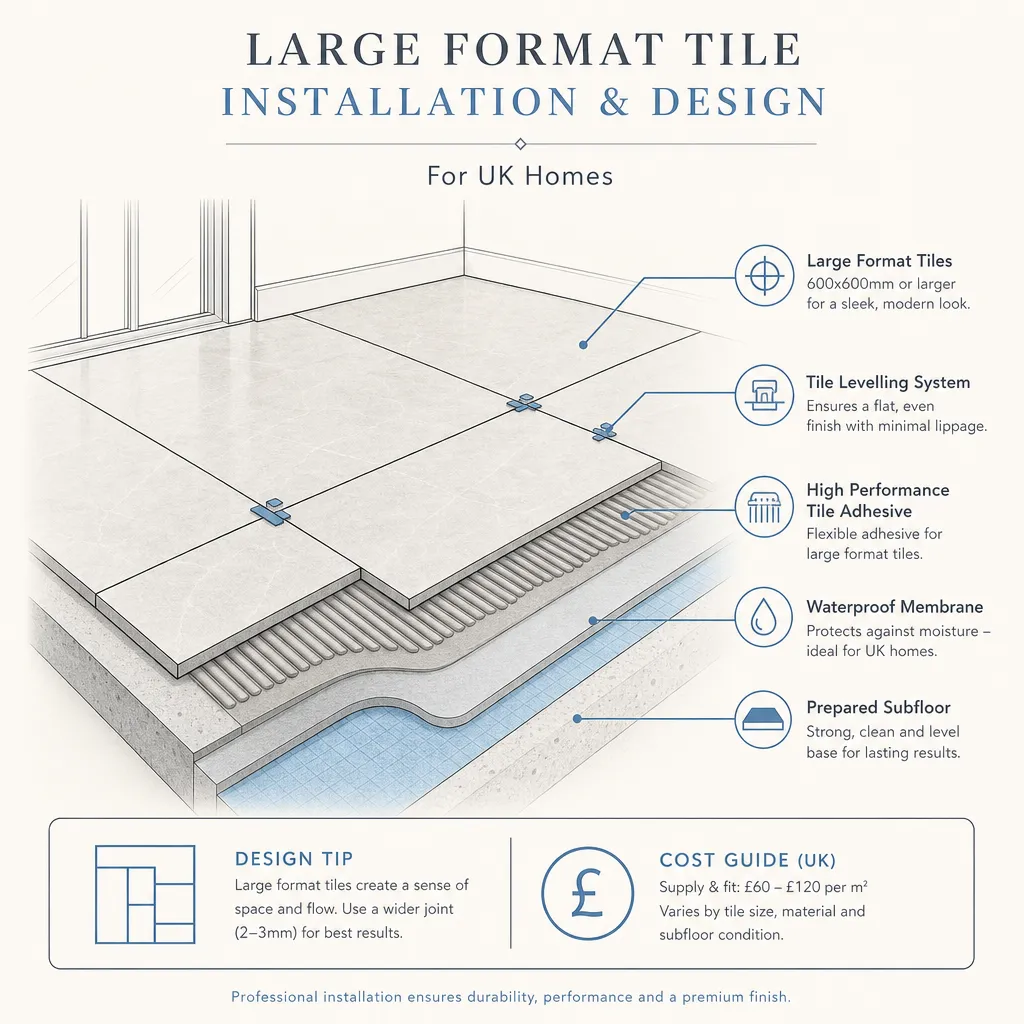
Large Format Tile Installation and Design
Large format tiles (600mm × 600mm or larger) need a substrate flat to within 3mm under a 2m straightedge, a C2-rated flexible adhesive, and a minimum 2mm grout joint.