Parquet and Hardwood Flooring Installation Costs
By Housey · Last reviewed 7th of May 2026
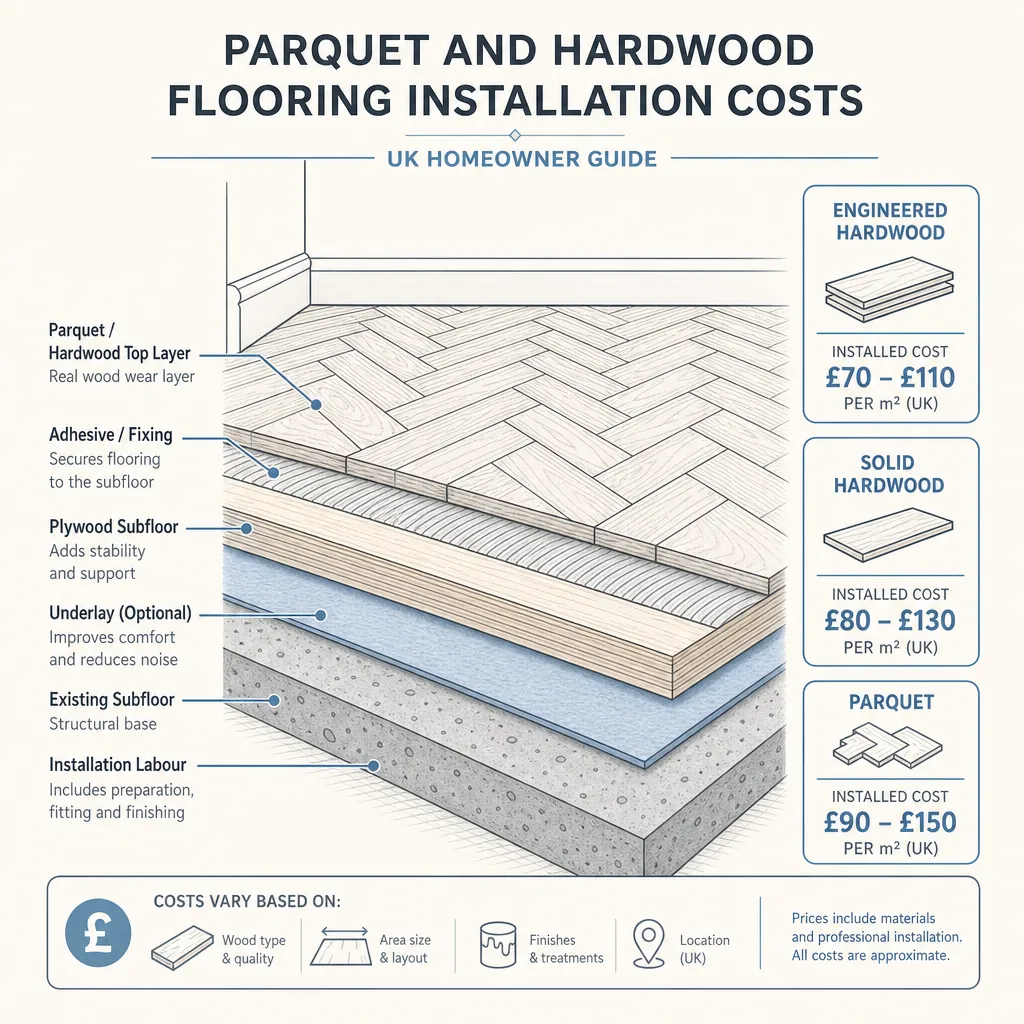
Parquet and Hardwood Flooring Installation Costs
Hardwood and parquet floors remain one of the most sought-after finishes in UK homes — from Victorian terrace restorations to contemporary open-plan extensions. Choosing the right product and understanding what drives the price are essential before you commit to a fitter or accept a quote. Getting this wrong can mean boards that buckle, a voided warranty, or a significant cost overrun when subfloor problems emerge mid-project.
Key points
- Engineered hardwood typically costs £20–£80 per m² for materials; solid hardwood runs £40–£120+ per m² depending on species and grade.
- Parquet in a herringbone or chevron pattern carries a labour premium of 20–40% over straight-lay boards due to additional cutting and fitting time.
- Installation labour in the UK typically ranges from £15–£40 per m², rising for complex patterns, subfloor levelling, or underfloor heating systems.
- Subfloor preparation — including moisture testing, levelling compound, and ply overlay — can add £5–£20 per m² and is rarely optional in older UK homes.
- All costs are indicative and vary by region, wood species, pattern, and contractor; always obtain at least three itemised quotes.
What types of hardwood and parquet flooring are available?
Hardwood flooring in the UK broadly divides into three categories: solid hardwood, engineered hardwood, and parquet — which can be produced in either format. Understanding the differences affects both material cost and the installation method your fitter will use.
Solid hardwood is milled from a single piece of timber. It is durable and can be sanded and refinished multiple times, but expands and contracts with humidity. It is not suitable above underfloor heating, or in rooms with high moisture variation, without careful acclimatisation and specialist adhesive.
Engineered hardwood bonds a real-wood veneer (typically 3–6 mm thick) to a plywood or HDF core. It is dimensionally more stable than solid wood and is compatible with most underfloor heating systems. The thicker the veneer, the more refinishing passes it can withstand.
Parquet describes flooring arranged in geometric patterns — most commonly herringbone, chevron, or brick bond — using short blocks or strips. The visual effect carries a premium in both materials and labour.
Solid vs engineered vs parquet: comparison (indicative UK costs, last reviewed 2026-05-07)
Type | Typical material cost (per m²) | Typical labour cost (per m²) | Compatible with UFH? | Refinishable? |
|---|---|---|---|---|
Solid hardwood (straight lay) | £40–£120 | £20–£40 | Limited — specialist advice needed | Yes (multiple times) |
Engineered hardwood (straight lay) | £20–£80 | £15–£30 | Usually yes | Yes (1–3 times, veneer dependent) |
Engineered parquet (herringbone/chevron) | £30–£100 | £25–£50 | Usually yes | Yes |
Solid parquet (herringbone/chevron) | £50–£130+ | £30–£55 | Not recommended | Yes (multiple times) |
Figures are indicative ranges based on UK market conditions. Exotic species, wide boards, and bespoke finishes push costs higher.
What are the main cost drivers?
Wood species and grade: Oak is the most common and affordable hardwood in the UK. Walnut, ash, and exotic species such as Iroko or Jatoba carry a premium. Flooring is graded as prime, select, or rustic — with prime (fewest knots, most uniform colour) costing more per m².
Board width and length: Wide-plank boards (150 mm+) require more precise subfloor preparation and are typically more expensive per m² than standard widths. Longer boards also command a premium.
Pattern: Straight lay is the most economical installation. Herringbone and chevron require more cutting, a higher waste allowance (typically 10–15% extra material), and more skilled labour time on site.
Subfloor condition: Most hardwood fitters expect a clean, dry, level subfloor. If your floor needs levelling compound, a moisture barrier, or a ply overlay — common in older UK homes with suspended timber floors — this adds cost and time that may not be included in an initial quote.
Finish: Pre-finished boards are quicker to lay but give less control over the final appearance. Site-finished floors (sanded and oiled or lacquered after fitting) cost more in labour but produce a seamless, customisable result.
Region: London and the South East typically attract higher day rates than the Midlands, North, or Scotland. Indicative UK costs, last reviewed 2026-05-07.
How much does installation cost in total?
For a 25 m² living room, the following worked example illustrates typical mid-range pricing.
Worked example: 25 m² living room, engineered oak herringbone, London
Item | Indicative cost |
|---|---|
Engineered oak herringbone boards (28 m² inc. 10% waste) | £1,540–£2,240 |
Subfloor moisture test and ply overlay | £300–£450 |
Installation labour (herringbone pattern) | £750–£1,250 |
Skirting removal and refitting | £150–£250 |
Finishing (site-applied oil or lacquer) | £200–£400 |
Total estimate | £2,940–£4,590 |
For the same room in straight-lay engineered boards outside London, total costs might fall to £1,500–£2,800. These are illustrative figures only. Indicative UK costs, last reviewed 2026-05-07. Always obtain itemised quotes from at least three qualified fitters before committing.
Pre-installation checklist for homeowners
Before your fitter arrives, work through this list to avoid delays and unexpected charges.
What a professional quote should include
A proper hardwood or parquet flooring quote should specify:
- Material cost per m², including species, grade, board width, and finish type
- Waste allowance percentage
- Subfloor preparation scope and any exclusions
- Labour rate — per m² or day rate — and estimated days on site
- Any additional work: skirting, thresholds, door undercutting
- VAT status
- Payment schedule and any retention terms
Avoid quotes that provide a single lump-sum figure with no breakdown; these make fair comparison and dispute resolution difficult if the scope shifts.
When to get professional help
A qualified flooring contractor should always carry out solid or engineered hardwood installation — improper fitting voids most manufacturer warranties and can cause boards to buckle, cup, or gap prematurely.
Seek specialist advice if:
- The subfloor shows signs of damp, or the building pre-dates 1920 (solid floors without a damp-proof membrane are common in pre-war UK homes)
- You have underfloor heating — not all wood and UFH combinations are compatible; check the manufacturer's technical guidance before selecting a product
- The room is a bathroom, utility room, or kitchen — solid hardwood is generally not suitable; engineered hardwood requires careful humidity management in these spaces
- You are fitting as part of a larger extension or renovation — coordination with other trades affects the correct installation sequence
How Housey can help
If you are installing hardwood or parquet as part of a larger renovation or new build, extension builders on Housey can coordinate flooring alongside structural and fit-out work. Design-and-build firms can help specify the right product for your project from the outset, reducing the risk of costly mismatches between the floor type, subfloor condition, and heating system.
Frequently asked questions
Is engineered hardwood as good as solid hardwood?
For most UK homes, engineered hardwood performs as well as solid hardwood and is more forgiving of the humidity fluctuations common in British properties. The veneer is real wood, and mid-range boards can typically be sanded and refinished at least once. Solid hardwood lasts longer under very heavy use, but requires more controlled conditions and is rarely suitable above underfloor heating.
How long does hardwood floor installation take?
A typical 20–30 m² room usually takes one to two days for a straight-lay engineered floor, including subfloor preparation. A herringbone or chevron pattern in the same room may take two to three days. Allow time for acclimatisation before fitting and for any site-applied finish to cure — usually 24–48 hours for oil finishes, up to 72 hours for lacquer.
Do I need planning permission to install hardwood flooring?
In most cases, no. Internal flooring is not subject to planning permission. However, if your property is a listed building, you may need listed building consent before altering original or historic flooring. Check with your local planning authority if in any doubt.
Can hardwood flooring be installed on top of existing tiles or vinyl?
Sometimes, but the existing surface must be fully adhered, level, and structurally sound. Many fitters prefer to remove existing hard floor coverings first. The increase in floor height also needs to be factored into door clearance and thresholds. Ask your fitter to assess the existing floor before confirming the installation approach.
How do I find a reliable hardwood flooring fitter?
Look for fitters who are members of the Contract Flooring Association (CFA) or who can provide references for comparable projects. Ask for a written specification before signing a contract, and check that their quote includes a subfloor assessment rather than assuming the floor is in acceptable condition.
Sources and further reading
- Contract Flooring Association (CFA) — Contract Flooring Association
- Wood Campus UK — specifying wood floors — Wood Campus UK
- GOV.UK — Listed buildings guidance — GOV.UK
- Energy Saving Trust — Underfloor heating — Energy Saving Trust
Useful next reads
 Improvement & Build
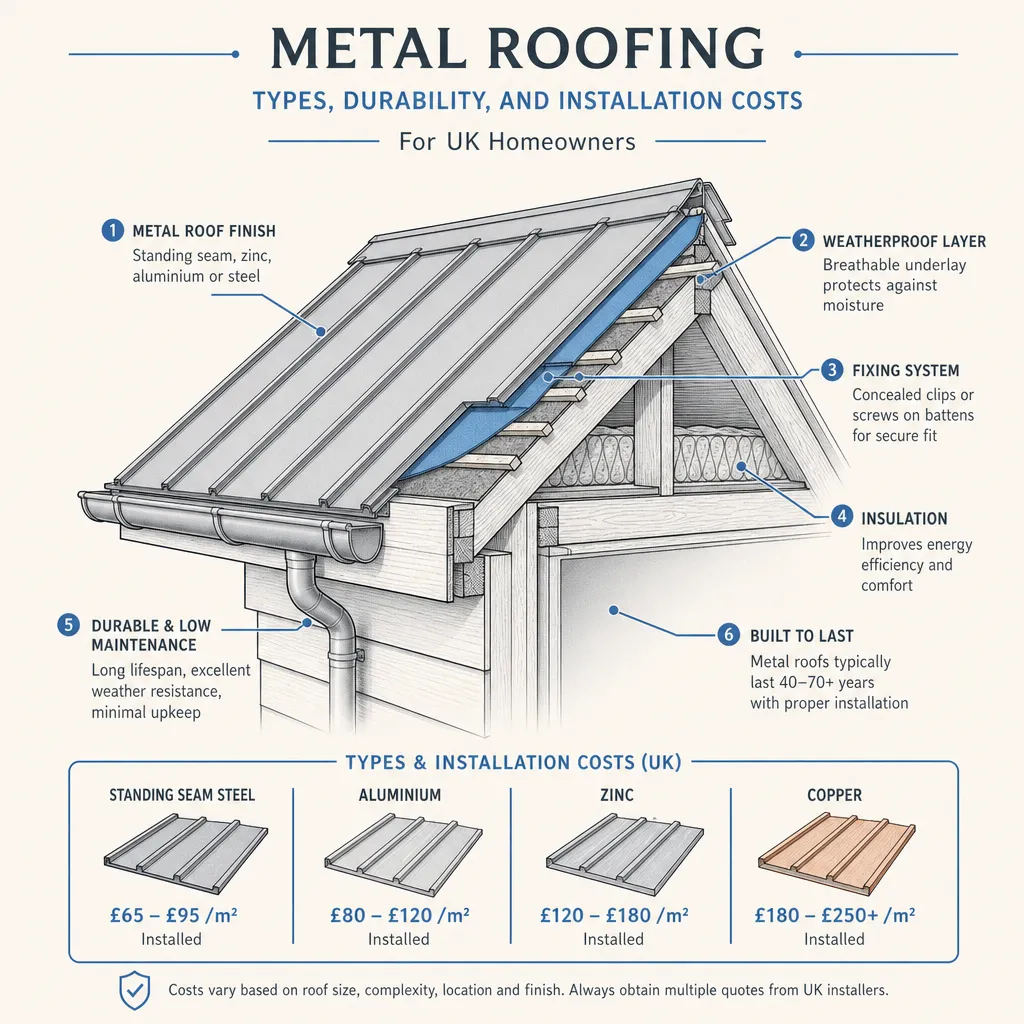
Metal Roofing: Types, Durability, and Installation Costs
Metal roofing in the UK includes standing seam, corrugated sheet, and metal tile systems in steel, aluminium, zinc, or copper.
 Improvement & Build
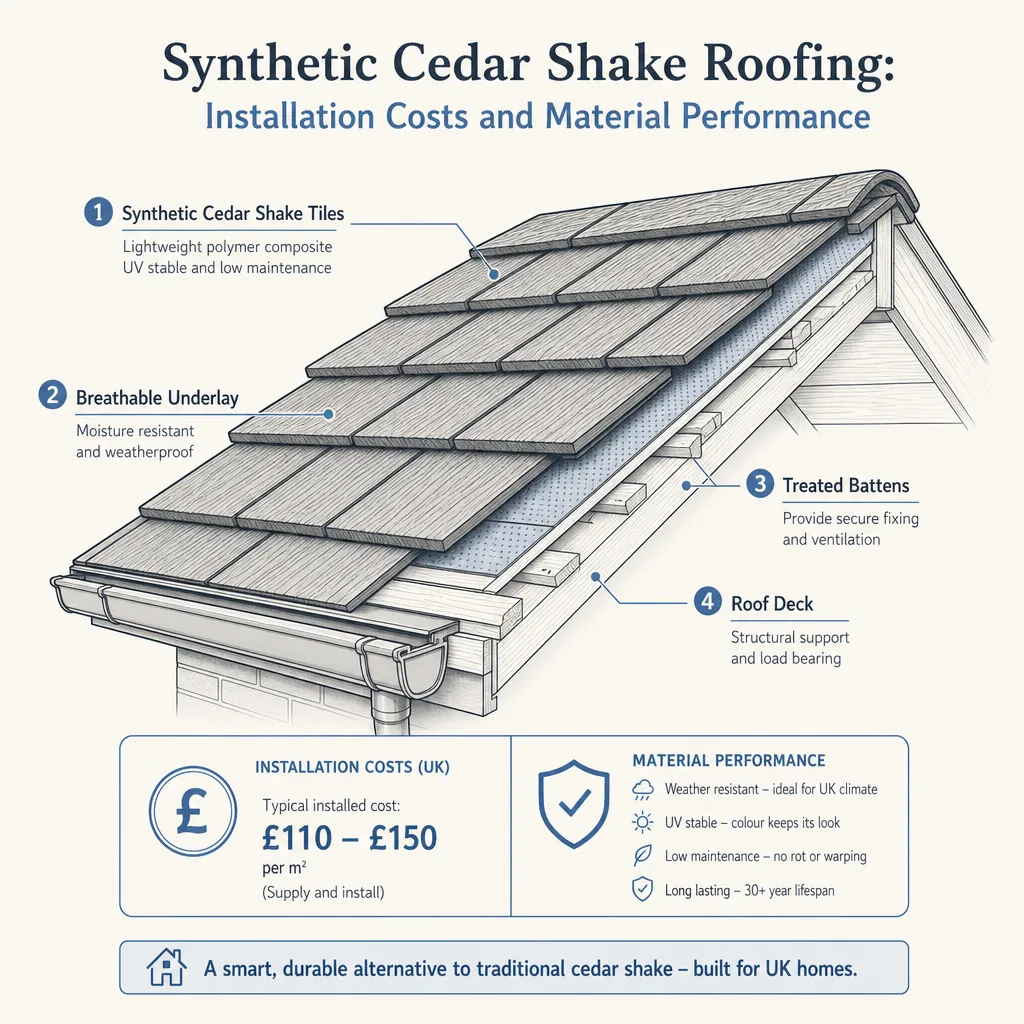
Synthetic Cedar Shake Roofing: Installation Costs and Material Performance
Synthetic cedar shake roofing uses polymer composite, rubber, or fibre-cement tiles to replicate the look of natural cedar wood shingles.
 Improvement & Build
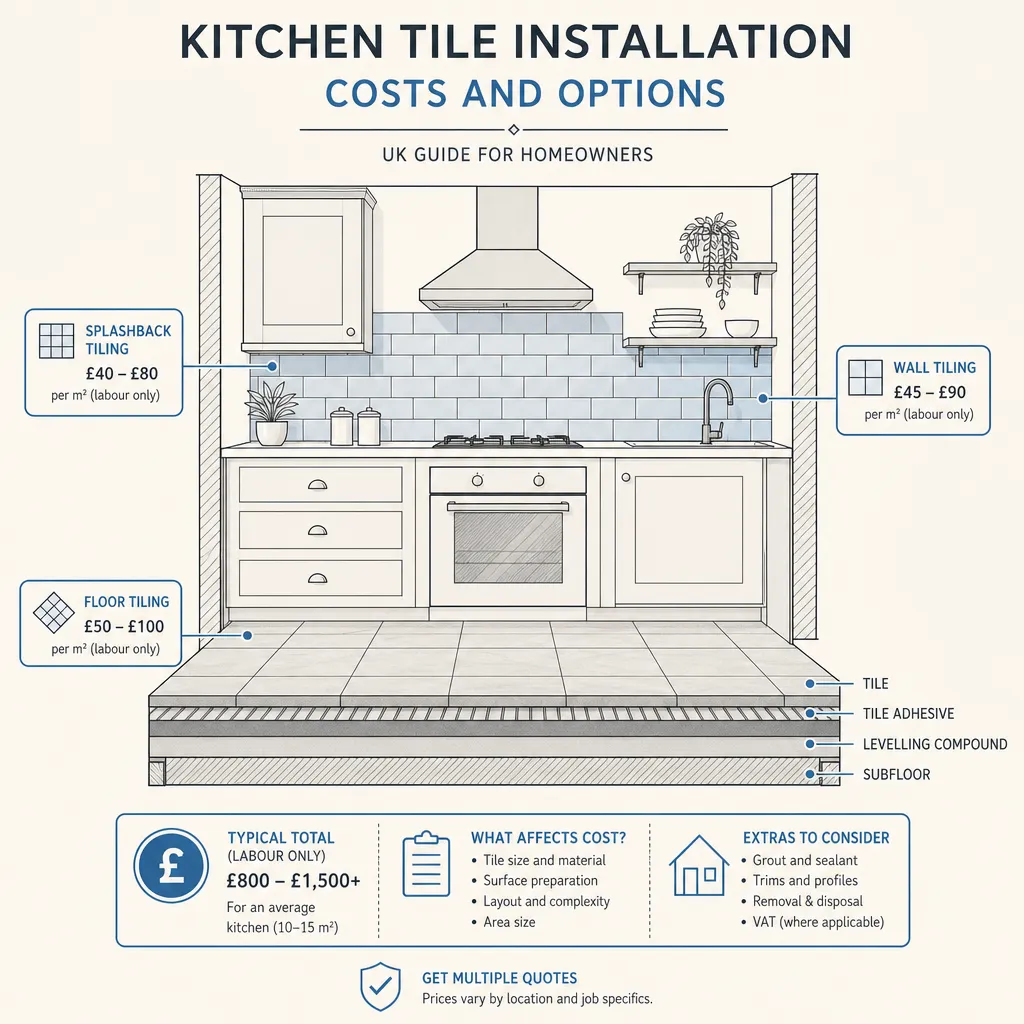
Kitchen Tile Installation Costs and Options
Kitchen tiling in the UK costs roughly £20–£40 per square metre for labour, plus £15–£80 per square metre for materials depending on tile type.
 Improvement & Build
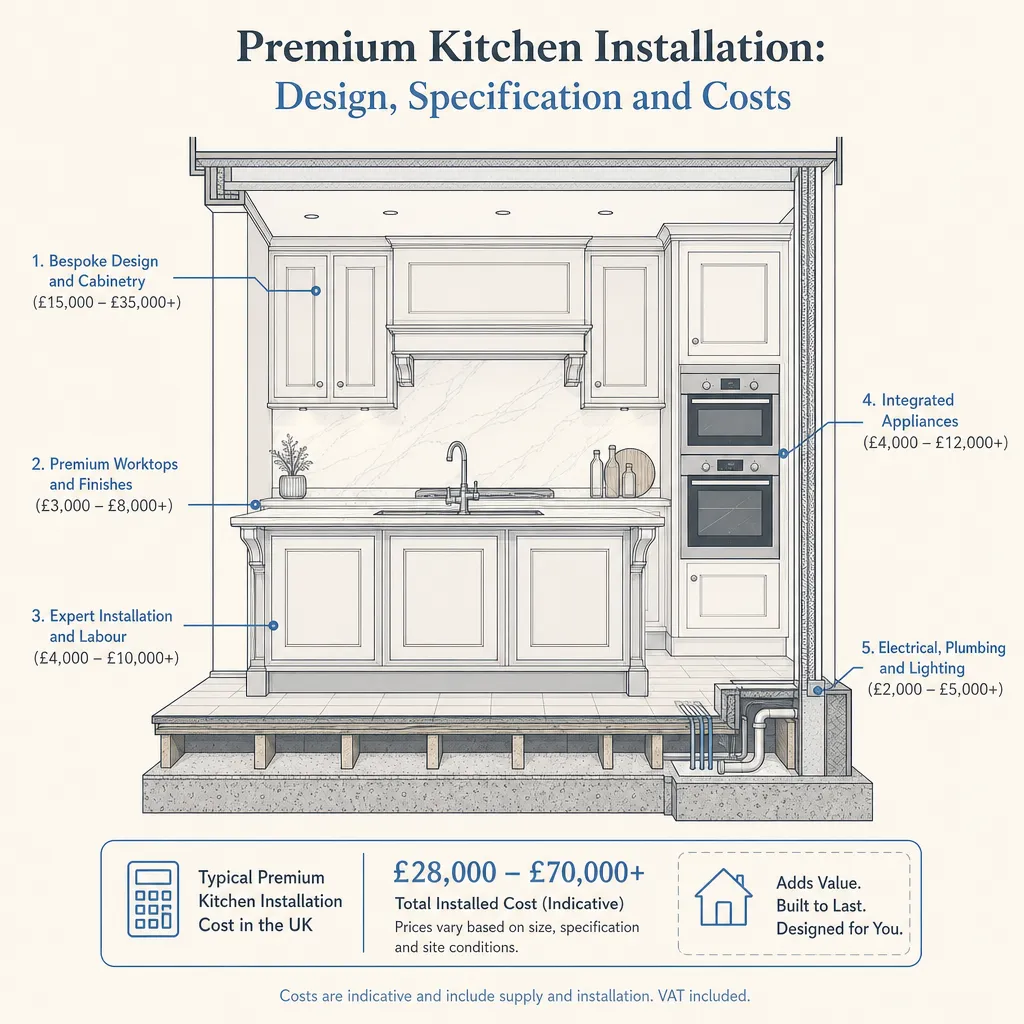
Premium Kitchen Installation: Design, Specification and Costs
A premium kitchen in the UK typically costs £20,000–£80,000 or more installed, depending on cabinetry specification, worktop material, appliance brands, and whether structural changes are needed.
 Improvement & Build
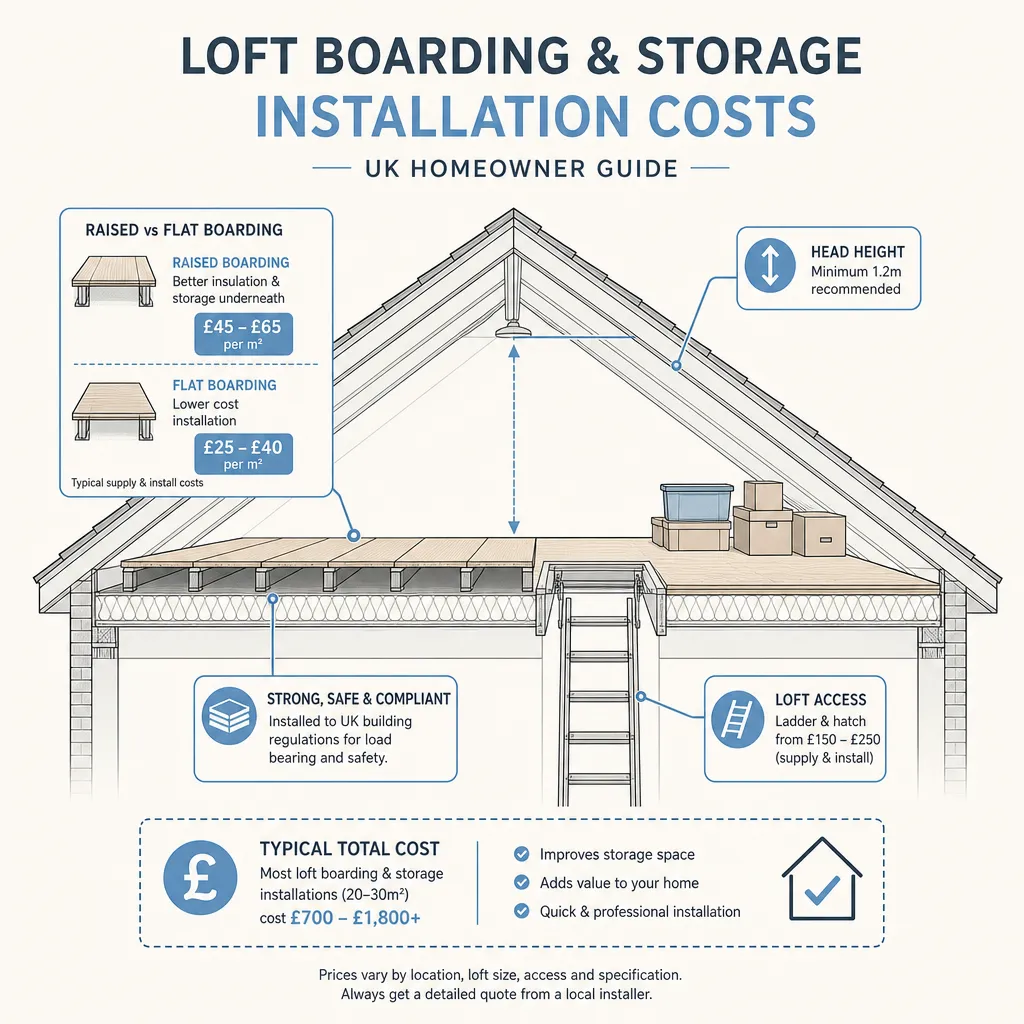
Loft Boarding and Storage Installation Costs
Basic loft boarding for an average semi-detached home costs £500–£1,500; a raised system that preserves insulation runs £800–£2,500.