Large Format Tile Installation and Design
By Housey · Last reviewed 7th of May 2026
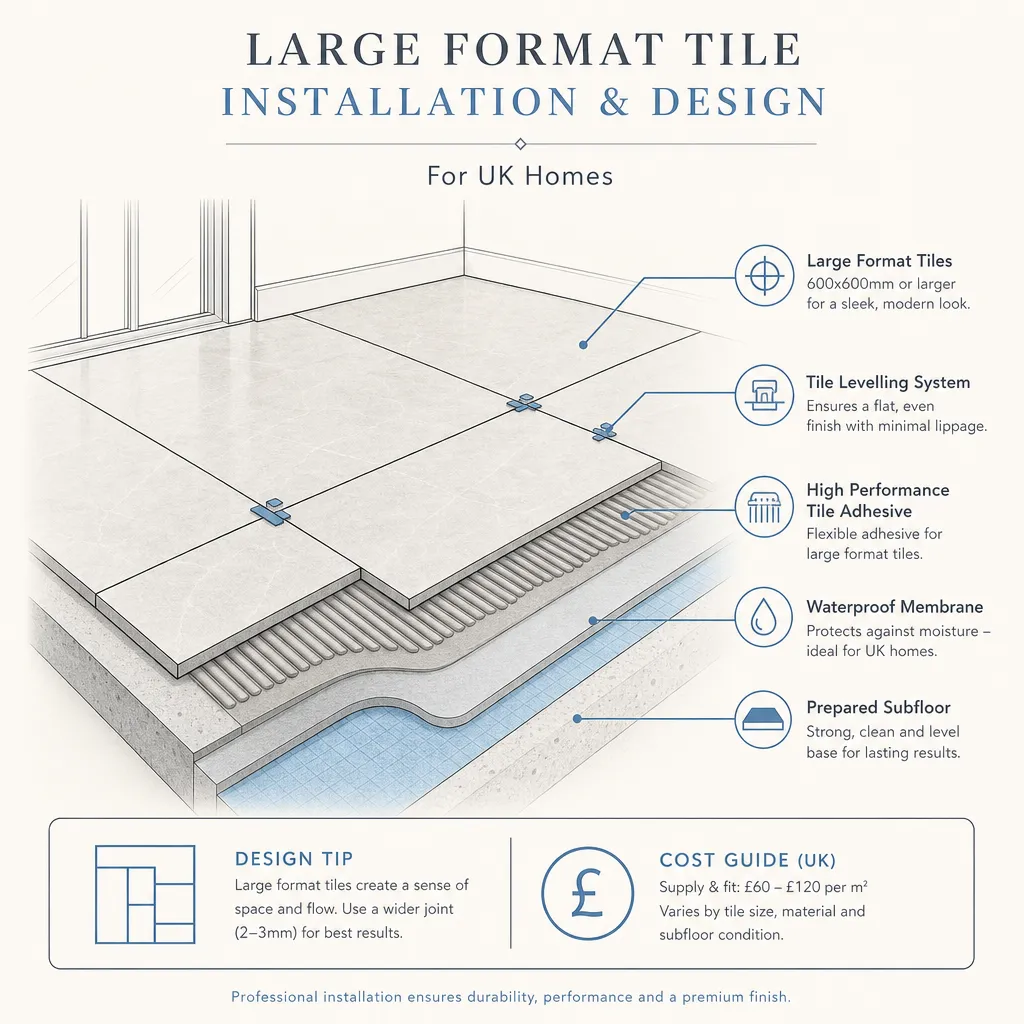
Large Format Tile Installation and Design
Large format tiles are increasingly chosen for UK kitchen extensions, bathrooms, and open-plan floors. Their clean, minimal look appeals to many homeowners — but the installation demands far more precision than standard tiling. A poorly prepared substrate or the wrong adhesive can cause cracking, hollow spots, or lippage that requires expensive removal and re-laying.
Key points
- Tiles 600mm × 600mm or larger are generally classed as large format; porcelain slabs of 1,200mm × 2,400mm and above require specialist lifting and handling equipment on site.
- BS 5385 (British Standard for wall and floor tiling) requires substrate flatness of no more than 3mm deviation under a 2m straightedge for large format installations.
- Large format tiles require a C2-rated flexible adhesive classified under EN 12004 — standard C1 adhesives are not suitable.
- Grout joints below 1.5mm risk cracking and may void adhesive manufacturer guarantees; 2–3mm minimum is widely recommended.
- Labour-only fitting costs typically run £40–£80 per m² in the UK (indicative UK costs, last reviewed 2026-05-07); substrate preparation and complex cuts add to this figure.
Large format tile sizes compared
Format | Typical use | Key installation consideration |
|---|---|---|
600 × 600mm | Kitchen floors, hallways, bathrooms | C2 adhesive essential; flat substrate critical |
800 × 800mm | Open-plan floors, extensions | Back-buttering required; 3mm minimum joint |
600 × 1,200mm (rectified) | Modern bathrooms, large kitchens | Tighter substrate tolerance; higher lippage risk |
1,200 × 2,400mm slab | Feature walls, luxury bathrooms | Specialist handling tools; structural floor check advised |
1,600 × 3,200mm slab | Commercial-grade; rare in residential | Full engineering assessment often needed |
Substrate preparation: the make-or-break step
Inadequate substrate preparation is the most common cause of large format tile failure in UK homes. Because large tiles bridge wider spans, flatness deviations that would hide under small tiles become visible lippage.
For floor tiles:
- New concrete screeds must cure for approximately 28 days before tiling begins.
- Hollows, cracks, or soft spots must be made good with a self-levelling compound before laying.
- Timber subfloors (common in Victorian and Edwardian terraced houses) require a rigid backer board such as Hardiebacker fixed over them; even so, significant flex can crack tiles above 800mm × 800mm unless the structure below is sound.
- Underfloor heating must be switched off 24–48 hours before tiling and reintroduced gradually over several days after completion to avoid thermal shock.
For wall tiles:
- Standard 12.5mm plasterboard may need upgrading to a tile backer board or cement board for tiles above 600mm × 600mm.
- Check wall fixings and framing can carry the additional weight of large slabs before proceeding.
Choosing the right adhesive and grout
Large format tiles must be bedded on a C2-classified adhesive under EN 12004. Full coverage is non-negotiable — the target is 95%+ for floor tiles and 100% in wet areas. Back-buttering (a thin skim of adhesive on the tile back as well as the substrate) is strongly recommended for tiles 800mm × 800mm and above.
For grout joints, rectified tiles allow as narrow as 1.5mm, but 2–3mm is more practical and less likely to crack as the building moves seasonally. Movement joints at walls and across large areas are required by BS 5385 and must not be omitted.
Worked UK property scenario: extension floor in a 1970s semi
A homeowner in the East Midlands tiles a 20m² rear extension with 800 × 800mm porcelain. A straightedge reveals a 5mm deviation on the new concrete slab — above the 3mm limit — so self-levelling compound is applied first. The tiler advises against 1,200 × 600mm tiles after calculating that cutting waste around the bifold door threshold and a central floor drain would significantly inflate material costs. The 800 × 800mm format delivers the same aesthetic with less waste.
- Materials (tiles, adhesive, grout, levelling compound): approximately £900
- Labour at £55/m²: approximately £1,100
- Total: around £2,000 for the extension floor
Indicative UK costs, last reviewed 2026-05-07. Quotes vary by region and project complexity.
What to ask before accepting a quote
- What substrate preparation is included in the price, and what would trigger additional costs?
- What adhesive classification (C1, C2, C2TE) will be used, and why is it appropriate for this tile format and substrate?
- What grout joint width do you recommend for these specific tiles?
- Will you back-butter tiles above 800mm × 800mm?
- Are you a Tile Association (TTA) member or NVQ Level 2 qualified in wall and floor tiling?
- What workmanship warranty do you offer?
- Is VAT included?
Common mistakes and red flags
- Using C1 adhesive on large format tiles — a frequent cause of premature failure in bathrooms with temperature variation.
- Tiling over existing tiles — added weight and hollow voids beneath make this inadvisable for tiles above 600mm × 600mm.
- No dry layout planned — cuts at opposite walls should be balanced and drains checked before the first tile is laid.
- Movement joints omitted — BS 5385 requires them at walls and across large areas; skipping them invites cracking as the building moves.
- Tiling too soon after a new screed — forced drying with underfloor heating before 21 days risks surface shrinkage and adhesion failure.
When to get professional help
Large format tile installation is skilled work and errors are expensive to fix — full removal and re-laying is often the only remedy. Seek a qualified tiler — ideally TTA-accredited or holding NVQ Level 2 in wall and floor tiling — for any tile above 600mm × 600mm in wet or heated areas, for porcelain slab installation, or where the subfloor condition is uncertain. If you are unsure whether a floor can carry the weight of large slabs, consult a structural engineer before work begins.
How Housey can help
If your large format tiling is part of a wider extension or renovation project, Housey can connect you with qualified local builders and tradespeople. Request quotes from extension builders near you to coordinate groundworks, screeding, and fit-out alongside your tiling work.
Frequently asked questions
Can large format tiles be laid on a timber floor?
Timber subfloors flex, which can cause large format tiles to crack over time. It is generally possible if the structure is sound and a rigid tile backer board is fixed over the timber, but a tiler should assess floor deflection before committing. Tiles above 800mm × 800mm on timber floors carry a materially higher failure risk and are not generally recommended without specialist advice.
What is lippage and how is it avoided?
Lippage is where one tile edge sits higher than its neighbour. It is avoided by preparing the substrate to within 3mm flatness under a 2m straightedge, using full-coverage adhesive bedding, maintaining grout joints of at least 2mm, and specifying rectified tiles where tight alignment is needed.
Do I need building regulations approval for tiling?
Tiling alone does not generally require building regulations consent in England and Wales. If the work forms part of a wet room with new drainage, an extension, or structural alterations, the wider project may need approval. Check with your local authority building control if unsure.
How long does large format tile installation take?
A 20m² room in 800 × 800mm porcelain typically takes 2–4 days for an experienced tiler, plus at least one day for grouting after the adhesive has cured. Slab formats take longer due to handling requirements and curing intervals.
Is large format tiling more expensive than standard tiling?
Yes. Higher tile costs per m², greater adhesive volume, increased cutting waste, and possible specialist equipment all add to the price. Expect £40–£80/m² for labour on straightforward layouts versus £25–£50/m² for standard tile formats. Indicative UK costs, last reviewed 2026-05-07.
Sources and further reading
- BS 5385: Wall and Floor Tiling — BSI Group — substrate and installation standards
- The Tile Association — Installation Guidance — UK industry body for tiling standards and contractor accreditation
- Building Regulations Approved Document A — Structure — GOV.UK guidance on structural loading
Useful next reads
 Improvement & Build
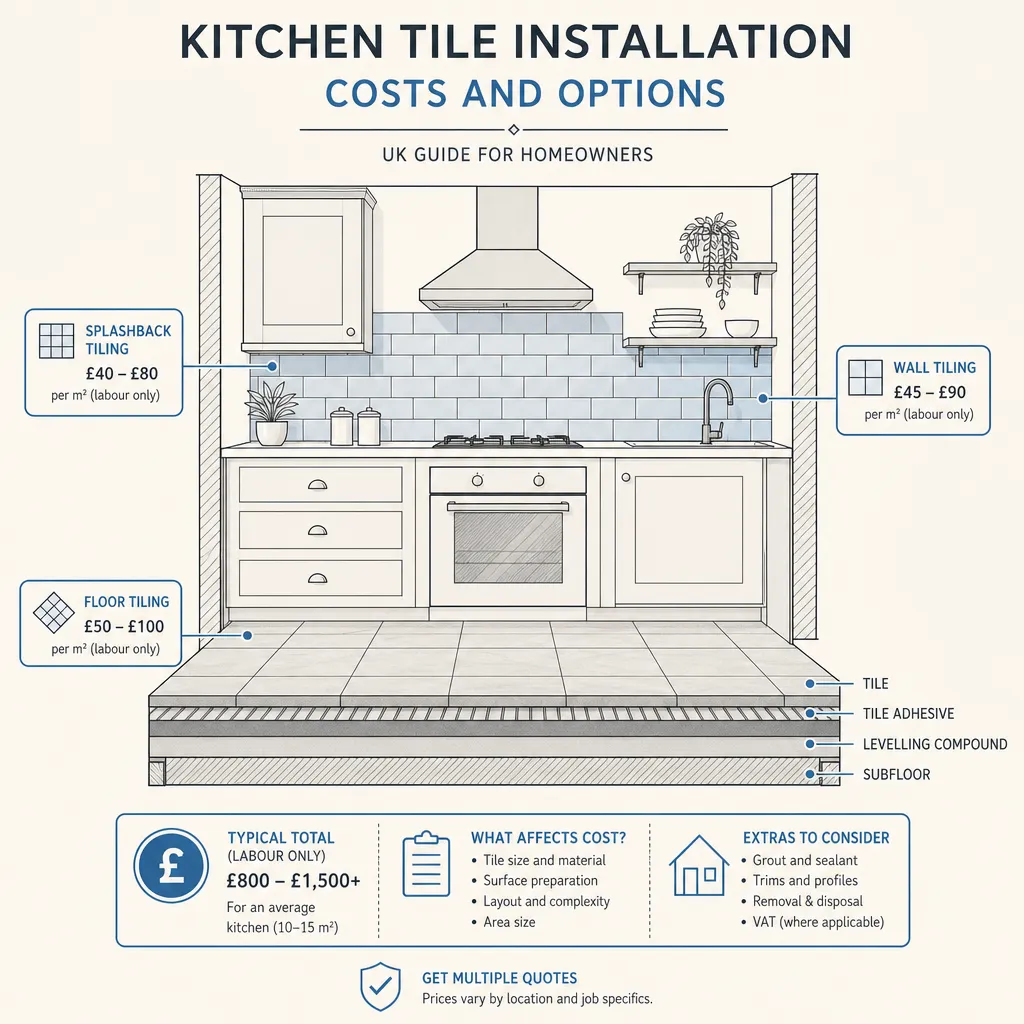
Kitchen Tile Installation Costs and Options
Kitchen tiling in the UK costs roughly £20–£40 per square metre for labour, plus £15–£80 per square metre for materials depending on tile type.
 Improvement & Build
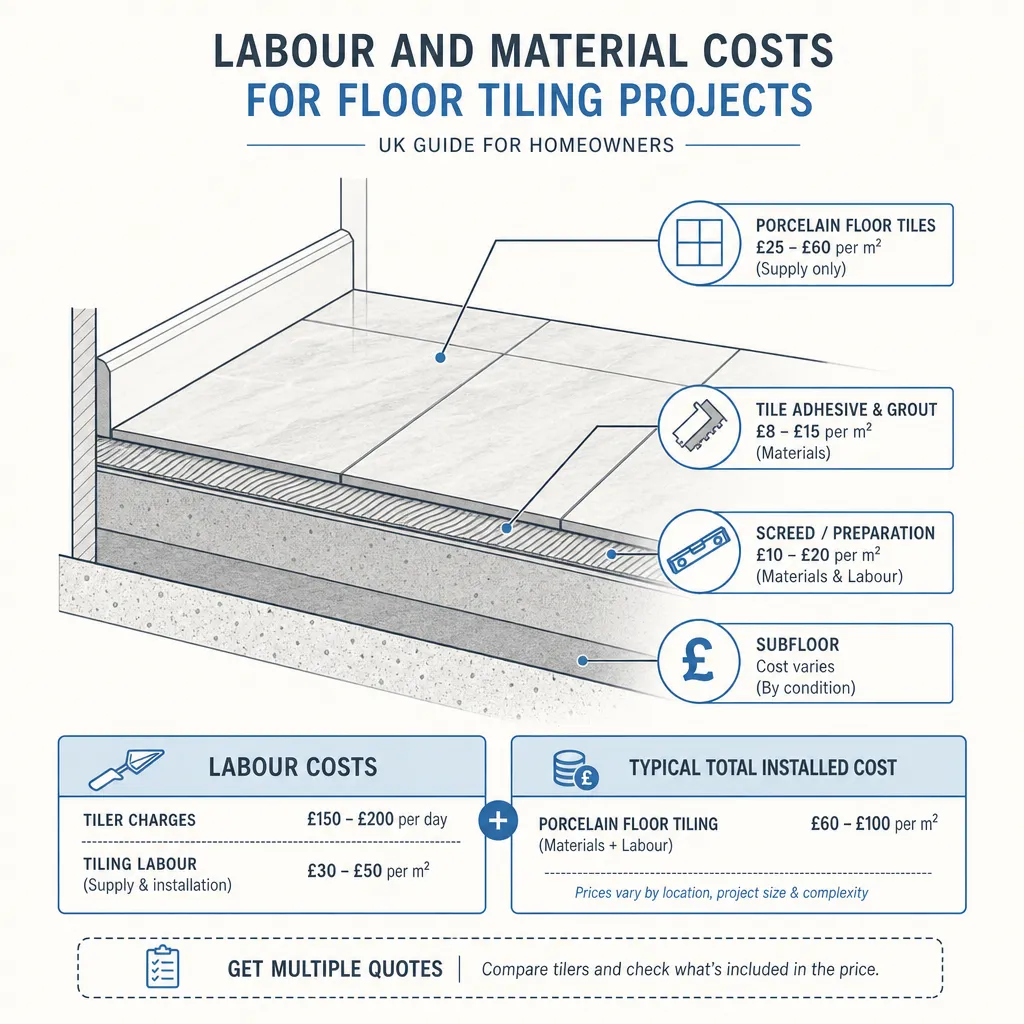
Labour and material costs for floor tiling projects
Floor tiling in the UK typically costs £30–£60 per m² in labour, plus materials ranging from £10–£40/m² for ceramic to £50–£150+/m² for natural stone.
 Improvement & Build
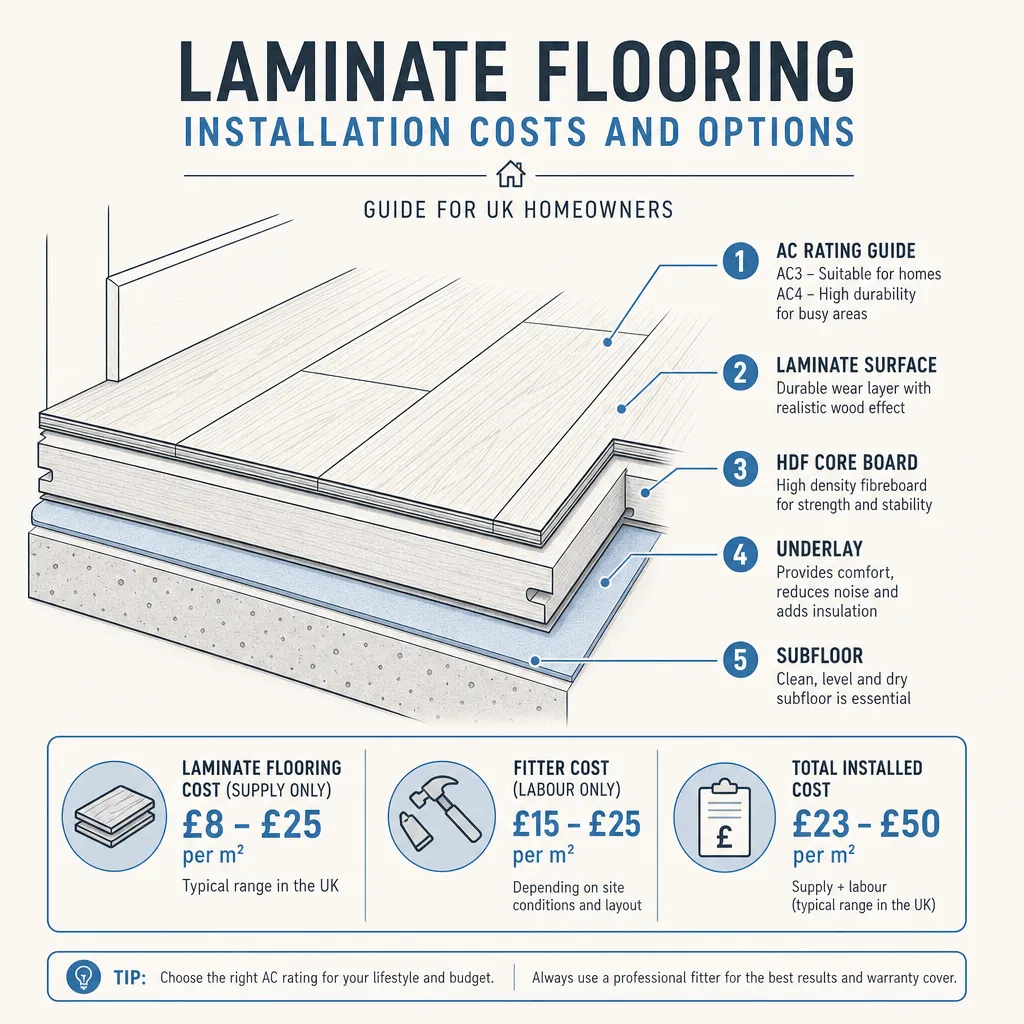
Laminate Flooring Installation Costs and Options
Laminate flooring typically costs £20–55 per square metre fully installed in the UK, including materials, underlay, and professional fitting.
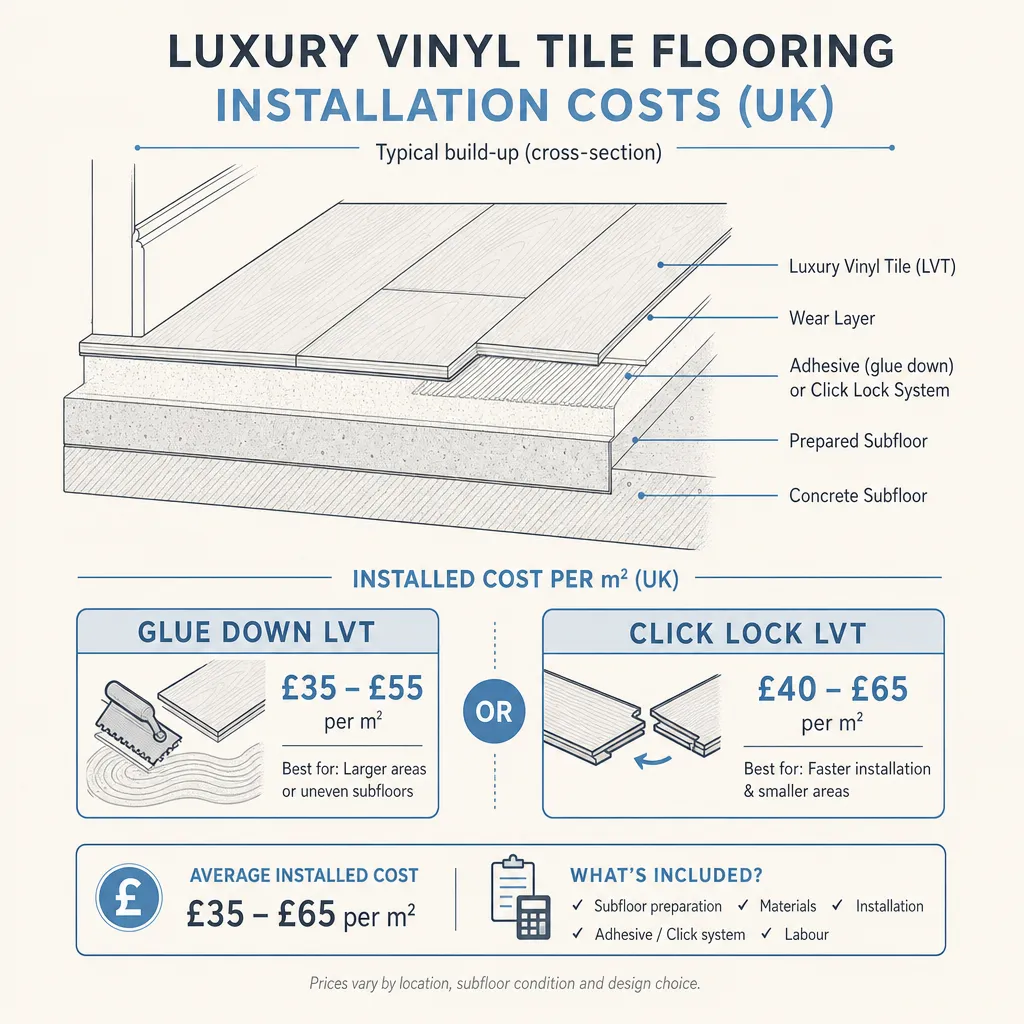 Improvement & Build
Luxury Vinyl Tile Flooring Installation Costs
Luxury vinyl tile (LVT) flooring typically costs £20–£60 per m² for materials and £10–£25 per m² for professional installation in the UK, giving a total supply-and-fit price of roughly £30–£85 per m².
 Improvement & Build
Double-Glazed Window Blind Systems Cost
Integral blinds factory-sealed inside double-glazed units cost £150–£400 per unit in the UK.