Interior staircase redesign and renovation options
By Housey · Last reviewed 12th of May 2026
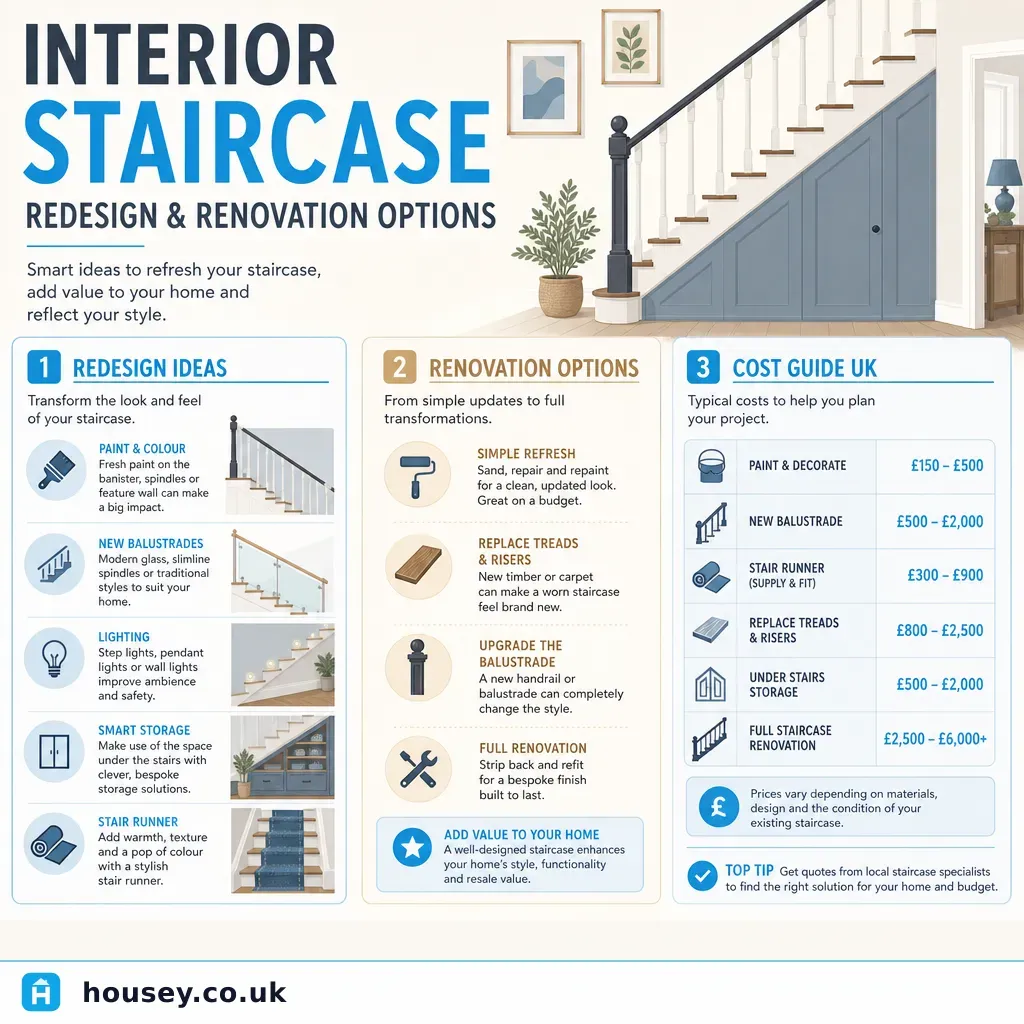
Interior staircase redesign and renovation options
A staircase is one of the most frequently used — and most visible — structural elements in any UK home, yet it is often overlooked in renovation planning. Whether you live in a Victorian terrace with a steep, narrow flight or a 1990s new-build with a dated pine balustrade, the staircase sets the tone for the interior from the moment you open the front door. The range of options is wider than many homeowners realise, from a weekend cosmetic refresh to a full bespoke redesign, but so are the regulatory obligations that govern structural changes.
Key points
- Building Regulations Approved Document K sets legal requirements for stair pitch (maximum 42°), riser height (maximum 220 mm), going (minimum 220 mm), and balustrade height (minimum 900 mm from the pitch line) for any structural alteration to a domestic staircase.
- Cosmetic updates — painting or staining treads, replacing individual balusters, or fitting a carpet — do not normally require building regulations approval; replacing the entire staircase structure does.
- Open-plan staircase designs that remove or significantly alter a load-bearing wall require a structural engineer's input and building regulations sign-off before work begins.
- Open-riser (open-tread) staircases must not allow a 100 mm sphere to pass through the gap between treads — a child-safety requirement under Approved Document K.
- Indicative costs range from approximately £200–£800 for cosmetic refurbishment to £5,000–£20,000+ for a full bespoke staircase replacement, depending on design, materials, and region (Indicative UK costs, last reviewed 2026-05-12).
What renovation options are available?
Staircase renovation sits on a spectrum from purely cosmetic to fully structural.
Cosmetic upgrades — building regulations approval not normally required
- Sanding and staining or painting existing treads and risers
- Fitting a new carpet or stair runner
- Replacing individual balusters (spindles) with metal, glass, or turned timber alternatives
- Fitting a new handrail or newel post cap
- Adding a wall-mounted handrail on a bracket system
These are manageable projects for a competent joiner or a confident, experienced DIYer. The essential constraint is that the work must not weaken the existing structure.
Partial replacement or refurbishment — building regulations may apply
- Replacing treads and risers while retaining the existing carriage strings
- Introducing an open-riser design by removing risers (the 100 mm sphere rule must be satisfied)
- Fitting glass or cable balustrade panels in place of timber balusters
- Converting a closed-string staircase to an open-string design
This level of work often engages building regulations and should be carried out by a qualified joiner or staircase specialist.
Full structural replacement — building regulations always apply
A completely new staircase — new strings, treads, risers, and balustrade — must comply with Approved Document K and will require a building regulations application to your local authority building control (LABC) or an approved inspector. If the work also involves removing or altering a wall adjacent to the staircase, a structural engineer's calculations are needed.
Open-plan and floating staircase designs
Cantilevered, floating, or open-plan staircases have become popular in UK homes but are structurally demanding: each tread is typically fixed into a steel spine or directly into the structural wall. A structural engineer must be engaged from the outset, not as an afterthought.
Staircase renovation options: comparison
Option | Building regs required? | Structural risk | Approx. indicative cost |
|---|---|---|---|
Paint, stain, and carpet | No | None | £200–£800 |
New balusters and handrail | Usually no | Low | £500–£2,000 |
New treads and risers (same strings) | Usually yes | Low–medium | £1,500–£5,000 |
Full staircase replacement | Yes | Medium | £5,000–£15,000+ |
Floating or cantilevered design | Yes — engineer required | High | £10,000–£25,000+ |
Open-plan layout with wall removal | Yes — engineer required | High | £8,000–£20,000+ |
Indicative UK costs, last reviewed 2026-05-12. Costs vary significantly by design, materials, region, and contractor.
Material and design choices
Timber remains the most common material for UK staircases. Oak is the premium choice — it machines cleanly, accepts stain well, and ages gracefully. Pine is standard in pre-1990 properties and easier to work but softer underfoot. Ash, beech, and walnut are used in bespoke work.
Glass balustrade panels suit modern and open-plan interiors. They must be toughened or laminated safety glass to BS EN 12150 or BS EN ISO 12543, and the fixing system must withstand the horizontal loading requirements in Approved Document K (0.36 kN/m at handrail height for domestic use).
Metal — mild steel, stainless steel, or wrought iron — suits industrial, contemporary, and heritage schemes. Metal spindles or full metal balustrades typically require specialist fabrication and certification of the fixing method.
Mixed-material staircases — timber treads with metal spindles or glass panels, for example — are widely used and can be designed to comply with building regulations, provided the individual elements meet the relevant British Standards.
Decision tree: which approach suits your situation?
- Choose cosmetic refurbishment if the staircase structure is sound and you want to refresh the look without major disruption — paint, stain, carpet, and new spindles can make a significant visual difference at low cost and without building regulations involvement.
- Choose partial replacement if individual components are worn, damaged, or non-compliant (for example, baluster gaps wider than 100 mm), and the overall staircase geometry already satisfies the pitch and dimension requirements of Approved Document K.
- Choose full replacement if the staircase is too steep (above 42°), structurally unsound, or you want a fundamentally different configuration.
- Consult a structural engineer first if you are planning an open-plan design, removing any wall adjacent to the staircase, or installing a floating or cantilevered flight.
- Check with your local authority building control body before committing to any structural change — requirements can vary, and heritage properties may attract additional constraints.
- Contact your local planning authority if the property is listed or in a conservation area, as even internal alterations may require listed building consent.
Important limitations
This article provides general guidance on staircase renovation options and the regulatory framework applying in England. Building regulations requirements, structural constraints, and planning rules vary by property type, age, location, and construction method. Nothing here constitutes professional advice. Any structural alteration should be assessed by a qualified structural engineer and submitted for building regulations approval through your LABC or an approved inspector. Do not assume that because an existing staircase was installed without visible defects it currently complies with Approved Document K — standards have been updated over time and older staircases may not meet current requirements.
When this becomes urgent
Seek professional input without delay if:
- The staircase moves, flexes noticeably, or has components that are cracked, broken, or visibly detached from the structure.
- Balusters are missing or gaps between them are wide enough for a small child to pass through — this is a falls hazard that should be rectified immediately.
- The staircase pitch appears to exceed 42° — this is a significant falls risk and non-compliant for any structural replacement.
- A wall you are considering removing appears to support the staircase or an upper floor — do not start this work without a structural engineer's assessment.
- The property is listed and any staircase work, however cosmetic it appeared, has already started without consent.
What to ask a qualified professional
Before instructing a joiner, staircase specialist, or contractor for structural staircase work:
- Will this project require a building regulations application, and will you manage that process on my behalf?
- Is the existing staircase structure sound enough to support the planned changes, or does it need reinforcement before any new elements are installed?
- If a wall is being removed or altered, has a structural engineer reviewed the proposal and provided written calculations?
- What materials and fixings will be used, and do they meet the relevant British Standards for safety glass or structural metalwork?
- What guarantees or warranties apply to the completed installation?
- Will I receive a building regulations completion certificate, and how long does that process typically take?
- Is VAT included in the quoted price, and what are the payment stages linked to?
How Housey can help
Staircase redesign is often part of a wider interior renovation or structural project. Our design-and-build firms can manage the full scope — from joinery specification and structural engineering to building regulations sign-off — while our extension builders are well placed for projects where a staircase redesign sits within a larger structural programme of work. Find vetted local professionals through Housey and compare detailed quotes before committing.
Frequently asked questions
Do I need building regulations approval to replace my staircase?
Yes, in most cases. A full structural staircase replacement is building work and must comply with Building Regulations Approved Document K. You should submit a building regulations application to your local authority building control or an approved inspector before work begins. Cosmetic work — painting, carpet, replacing individual balusters — typically does not require approval.
Can I remove the risers to create an open-tread staircase?
Open-riser staircases are permitted under UK building regulations, but Approved Document K requires that the gap between treads does not allow a 100 mm sphere to pass through — a child-safety requirement. A closed-riser staircase can be converted, but the resulting geometry must be checked against this rule before any work begins.
Does a staircase renovation add value to a UK home?
A quality staircase renovation can improve the appearance and saleability of a property, particularly where the original staircase has been poorly maintained or unsympathetically altered. However, no renovation guarantees a measurable increase in market value — this depends on the local market, quality of execution, and buyer preferences.
How long does a full staircase replacement take?
A straightforward like-for-like staircase replacement typically takes three to five days. A bespoke design with glass panels, floating treads, or a changed layout can take two to four weeks, partly because bespoke components are fabricated off-site and then brought in for the installation visit.
Sources and further reading
Useful next reads
 Improvement & Build
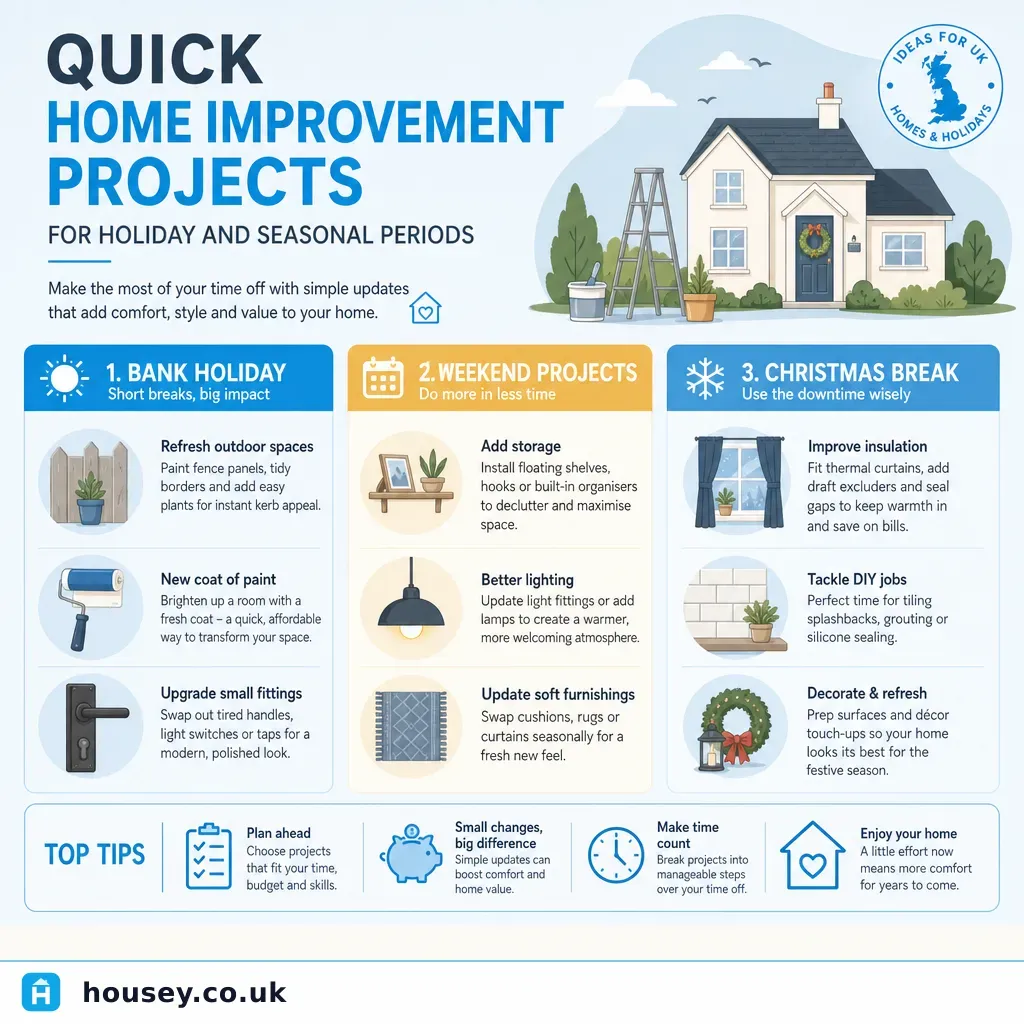
Quick Home Improvement Projects for Holiday and Seasonal Periods
Most decorating and cosmetic improvements do not require planning permission or Building Regulations approval and can be undertaken by a competent DIYer.
 Improvement & Build
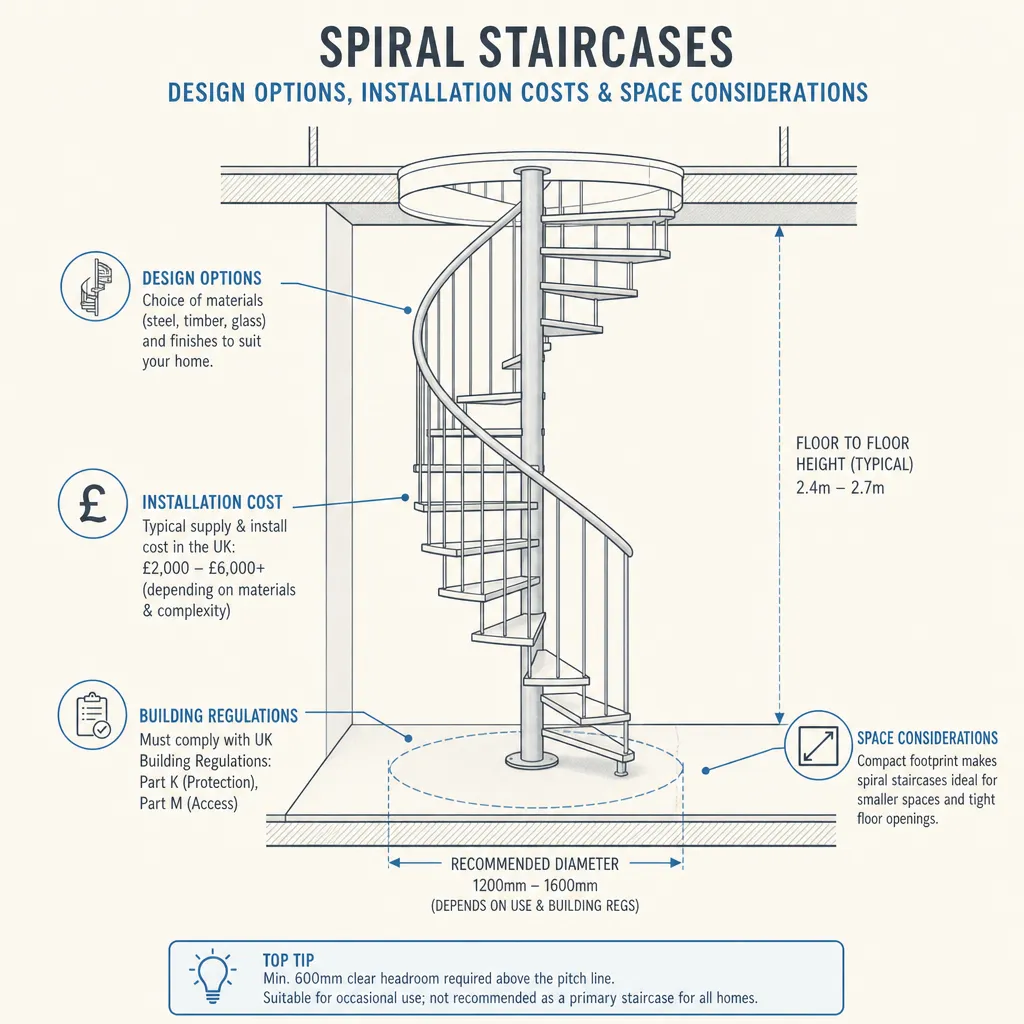
Spiral staircases: design options, installation costs and space considerations
A spiral staircase typically costs between £800 for a basic mild steel kit and £15,000 or more for a bespoke timber or glass design, fully installed.
 Improvement & Build
Small kitchen renovation: budgeting for costs and planning your project
A small kitchen renovation in the UK typically costs £5,000–£15,000 for a full refresh including new units, worktops, tiling, and appliances, though costs vary widely by specification, region, and whether structural changes or rewiring are involved.
 Improvement & Build
Conservatories and Garden Extensions: Design and Building Guide
Most conservatories qualify as permitted development in England if they are single-storey, within 50% of original curtilage, and meet dimensional limits.
 Improvement & Build
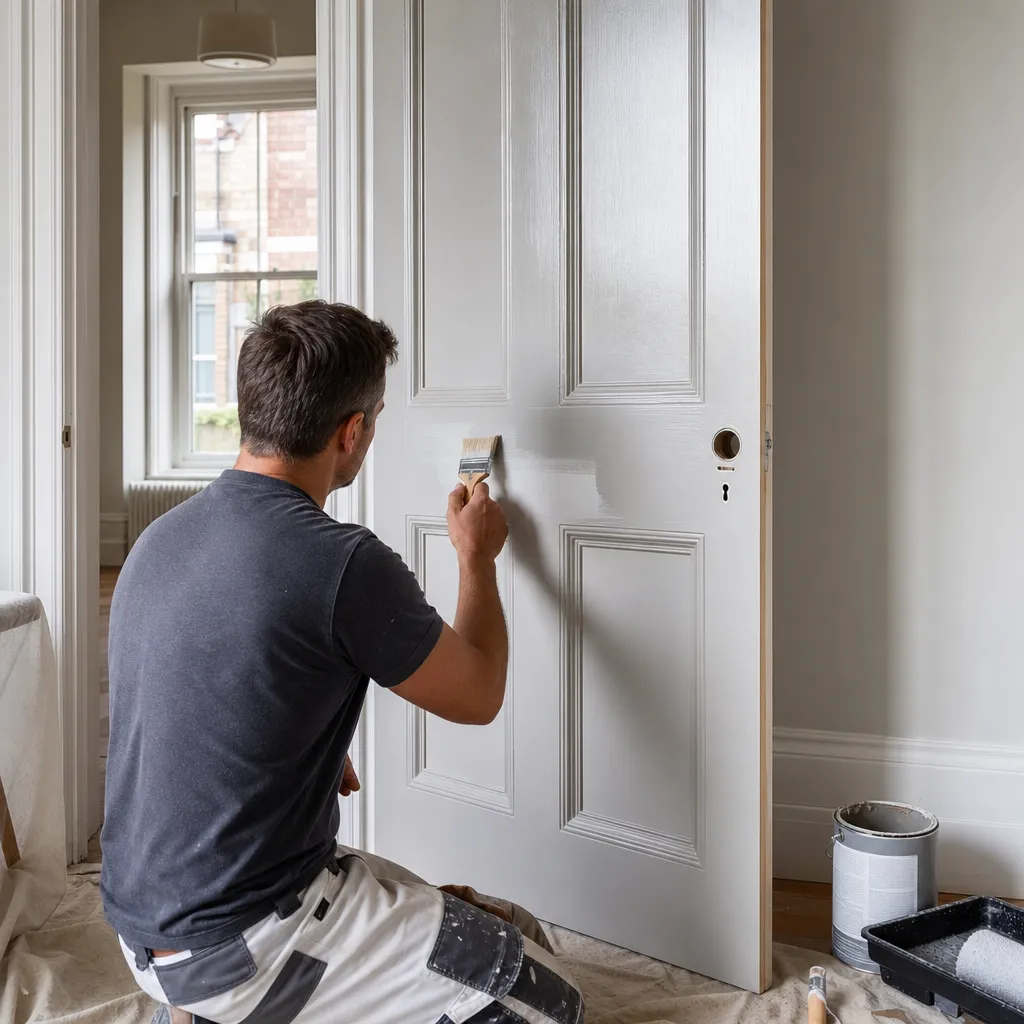
Painting Interior Doors: Preparation and Technique
Painting interior doors well depends on preparation rather than paint choice.