Quick Home Improvement Projects for Holiday and Seasonal Periods
By Housey · Last reviewed 24th of May 2026
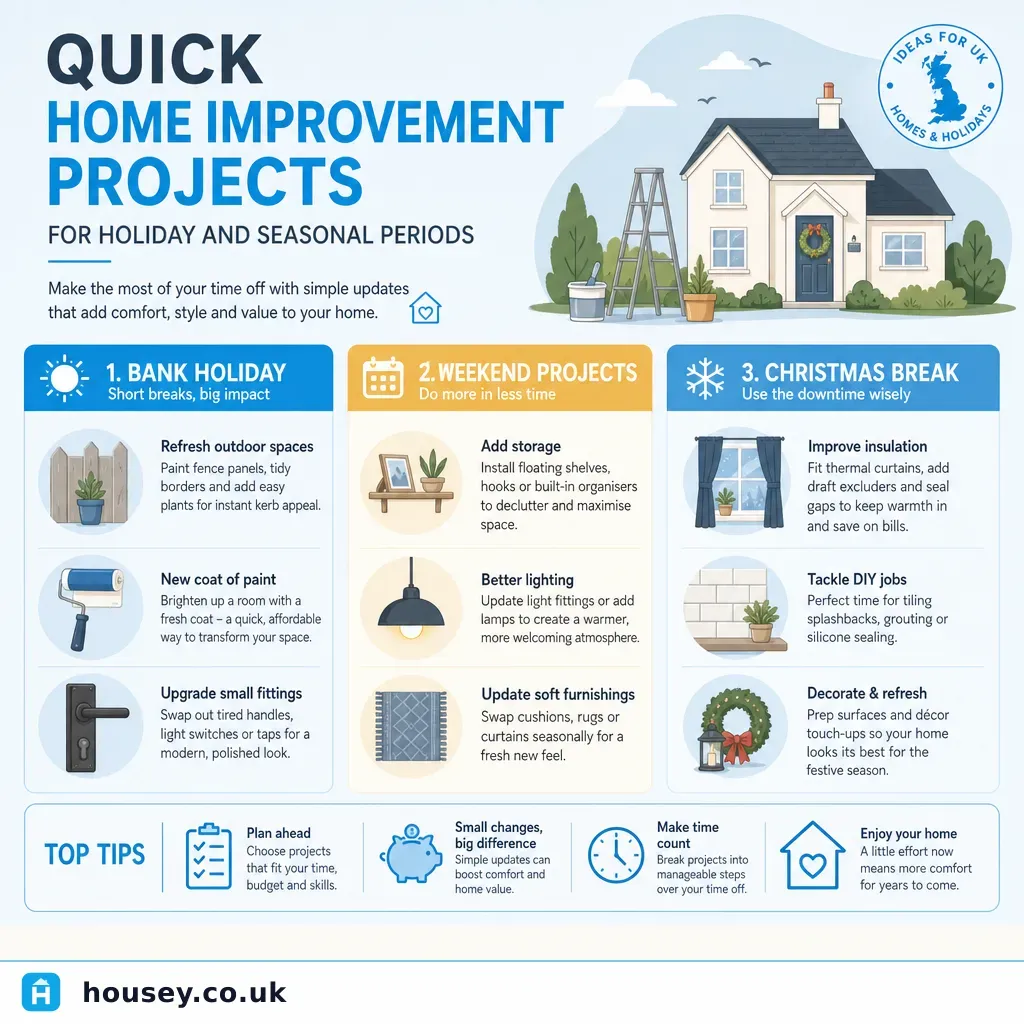
Quick Home Improvement Projects for Holiday and Seasonal Periods
Extended breaks — whether a bank holiday weekend, the school summer holidays, or the Christmas and New Year period — prompt many UK homeowners to tackle improvements that have accumulated on a to-do list. The practical challenge is matching project scope to time actually available, choosing tasks suited to the season, and being clear about which work you can legally carry out yourself and which requires a registered tradesperson regardless of the time of year.
Key points
- Decorating — painting, wallpapering, and tiling — typically does not require planning permission or Building Regulations approval and is suitable for self-completion by a competent DIYer.
- Gas and central heating work always requires a Gas Safe registered engineer; attempting it yourself is unsafe and may contravene the Gas Safety (Installation and Use) Regulations 1998.
- Exterior painting and timber treatments need temperatures consistently above 10°C and low humidity for reliable adhesion — generally April to September in most parts of the UK.
- Electrical work beyond like-for-like fitting replacement is notifiable under Part P of the Building Regulations in England; a registered electrician must carry it out or notify building control.
- Draught-proofing and loft insulation top-ups are achievable DIY tasks that may qualify for support under the Great British Insulation Scheme (GBIS) or ECO4 depending on household eligibility.
Matching project to time available
The single most common mistake in holiday home improvement is underestimating how long a task takes — particularly when surfaces need preparation, adhesive needs to cure, or multiple coats are required. Use this table to match project scope to realistic available time and season before committing to a start date.
Project | Minimum realistic time | Best season | DIY-suitable? | Registered trade required? |
|---|---|---|---|---|
Interior painting (1–2 rooms) | 2–3 days | Any (ventilate well) | Yes | No |
Wallpaper hanging | 2–4 days | Any | Yes, with practice | No |
Tiling (bathroom or kitchen splashback) | 2–3 days | Any | Yes | No |
Draught-proofing (doors, windows, letterbox) | Half to 1 day | Autumn or winter | Yes | No |
Loft insulation top-up (mineral wool) | 1 day | Any | Yes | No |
Exterior painting (timber or masonry) | 3–5 days | April to September | Yes | No |
Fitting shelving and storage | 1–2 days | Any | Yes | No |
Replacing internal doors | 2–3 days | Any | Yes (basic carpentry) | No |
Replacing bathroom taps or shower head | Half day | Any | Possible | No (unless re-piping) |
Garden hard landscaping (patio, path) | 3–7 days | Spring or autumn | Moderate | No |
New boiler installation | 1–2 days (allow lead time) | Any | No | Gas Safe engineer |
New electrical circuits | 1–2 days | Any | No | Part P electrician |
Kitchen installation | 5–10 days | Any | Partly | Electrician and plumber for services |
Bank holiday weekend projects (3 days)
Bank holiday weekends — including the May Day, Spring, and August bank holidays — provide three consecutive days. For a competent DIYer, this is enough for a cosmetic refresh but rarely enough for structural or multi-trade work. Realistic 3-day projects include:
Interior refresh checklist
None of these tasks requires specialist trade or planning permission. Allow adequate time for surface preparation — the quality of the finish depends on it far more than the quality of the paint.
Christmas and New Year break projects (7–10 days)
The Christmas and New Year period typically gives 7 to 10 consecutive days. This is adequate for:
- A full room redecoration: Strip wallpaper, patch and sand walls, prime and paint, rehang curtains, update soft furnishings. Allow one day per coat plus drying time and do not rush this — skipping the primer coat is the most common cause of poor coverage.
- A bathroom refresh: Regrout or re-silicone tiles, replace a bathroom cabinet or mirror, fit a new light in the same fitting position (like-for-like replacement only — new circuits require a Part P electrician).
- Garden clearing and winter prep: Clear beds, prune dormant deciduous shrubs, plan hard landscaping for spring, apply a winter lawn feed if temperatures allow.
What to avoid starting at Christmas: Projects that depend on tradespeople attending during the break — availability is limited and emergency call-out rates are often considerably higher. Projects requiring positive temperatures (exterior painting, render, repointing) are rarely appropriate for December or January across most of the UK.
Summer holiday projects (up to 6 weeks)
School summer holidays offer the longest available window — up to six weeks for households with children, or a substantial block of annual leave for others. This period is particularly well suited to:
- Exterior decorating: Painting timber cladding, fascias, soffits, and window frames, or applying masonry paint to brick or render, is most reliable in warm dry weather above 10°C. Check the paint manufacturer's data sheet for minimum application temperatures and recoating intervals.
- Garden hard landscaping: Laying a patio, path, or raised bed is most comfortable in summer. Allow adequate curing time for concrete — light foot traffic after 24 to 72 hours, full structural strength at 28 days.
- Sequential multi-trade projects: A kitchen or bathroom replacement can be planned across a six-week period with trades booked for specific days. Map the sequence in advance — plumber first, then tiler, then electrician for finishing — and build in float days for drying and curing between each stage.
What you can legally do yourself
UK Building Regulations and sector-specific legislation determine which improvements require a qualified tradesperson. This is not optional: regulated work carried out by an unqualified person can invalidate home insurance and create liability at the point of sale.
No registered trade required for most standard projects:
- Interior decorating (painting, wallpaper, tiling)
- Draught-proofing and loft insulation top-up (mineral wool rolls)
- Fitting shelving, storage, and flat-pack furniture
- Replacing like-for-like light fittings with the circuit turned off at the consumer unit
- Fitting external door furniture, letterboxes, and locks
Registered trade legally required:
- Any gas work — Gas Safe registered engineer (Gas Safety (Installation and Use) Regulations 1998)
- New or relocated electrical circuits, consumer unit work — Part P registered electrician in England
- Replacement of windows and external doors — FENSA-registered installer or local authority building control notification
- Structural alterations — structural engineer assessment and Building Regulations approval
What not to assume
- Permitted development is not the same as Building Regulations approval. Permitted development relates only to planning permission. A project can require Building Regulations approval even if no planning permission is needed — electrical circuits and structural work are common examples.
- Leasehold flats have additional restrictions. Many leases require freeholder or managing agent consent before alterations. Check your lease before drilling into walls, changing windows, or making structural changes — the obligation applies regardless of how minor the work appears.
- Online tutorials may not be UK-compliant. Many DIY guides originate from the United States, Australia, or other markets. UK electrical wiring colours, safety standards, and regulations differ significantly. Always cross-check with UK-specific guidance from sources such as NICEIC or the IET.
- A holiday break does not suspend legal obligations. If a project is notifiable under Building Regulations or requires a registered tradesperson, that requirement applies regardless of when the work takes place.
When to get professional help
Even on short projects, instruct a qualified professional when:
- Any gas appliance, pipe, boiler, or associated pipework is involved
- Electrical work goes beyond like-for-like replacement of a fitting at the same position
- Opening up a wall or ceiling reveals damp, mould, or signs of structural movement
- Pre-2000 floor or ceiling tiles are being removed and asbestos has not been professionally ruled out
- Windows or external doors are being replaced (FENSA registration or building control notification applies)
How Housey can help
If a holiday project grows in scope or you need a qualified professional for the regulated elements, Housey can connect you with vetted extension builders and other local tradespeople. Describe your project and receive comparable quotes from professionals in your area.
Frequently asked questions
Do I need planning permission for interior home improvements?
Interior alterations — painting, new flooring, kitchen and bathroom refits in the same footprint — generally do not require planning permission, which primarily governs changes to a building's exterior or its use. However, some interior works still require Building Regulations approval, notably electrical circuits, gas appliance installation, and structural alterations. If in doubt, check with your local planning authority before starting.
Can I tile my own bathroom?
Yes, bathroom tiling does not require a registered tradesperson and is achievable for a competent DIYer. Use a tile adhesive and grout specified for wet areas, ensure the substrate is sound and appropriately waterproofed, and allow the adhesive to cure fully before grouting. If the project involves moving or adding plumbing supply points, those elements require a qualified plumber.
Is there a best time of year for exterior painting?
Exterior painting is most reliable when temperatures are consistently above 10°C with low humidity and no rain forecast for at least 24 hours after application. For most of the UK this means April to September. Painting in cold or damp conditions risks poor adhesion and early paint film failure. Check the specific product's data sheet for minimum application temperatures and recoating intervals.
Do I need to inform my insurer about home improvements?
Some improvements may affect your buildings or contents insurance. Structural work, extensions, loft conversions, and new outbuildings should be declared to your insurer before and after completion. Cosmetic improvements such as redecorating generally do not affect cover. If you are uncertain, check with your insurer before starting — failing to declare a material change can affect your ability to make a successful claim.
Sources and further reading
- Building regulations approval — GOV.UK
- Permitted development rights for householders — Planning Portal
- Gas Safe Register: consumer guidance — Gas Safe Register
- FENSA: consumer guidance on window replacement — FENSA
- Home insulation: Energy Saving Trust advice — Energy Saving Trust
Useful next reads
 Improvement & Build
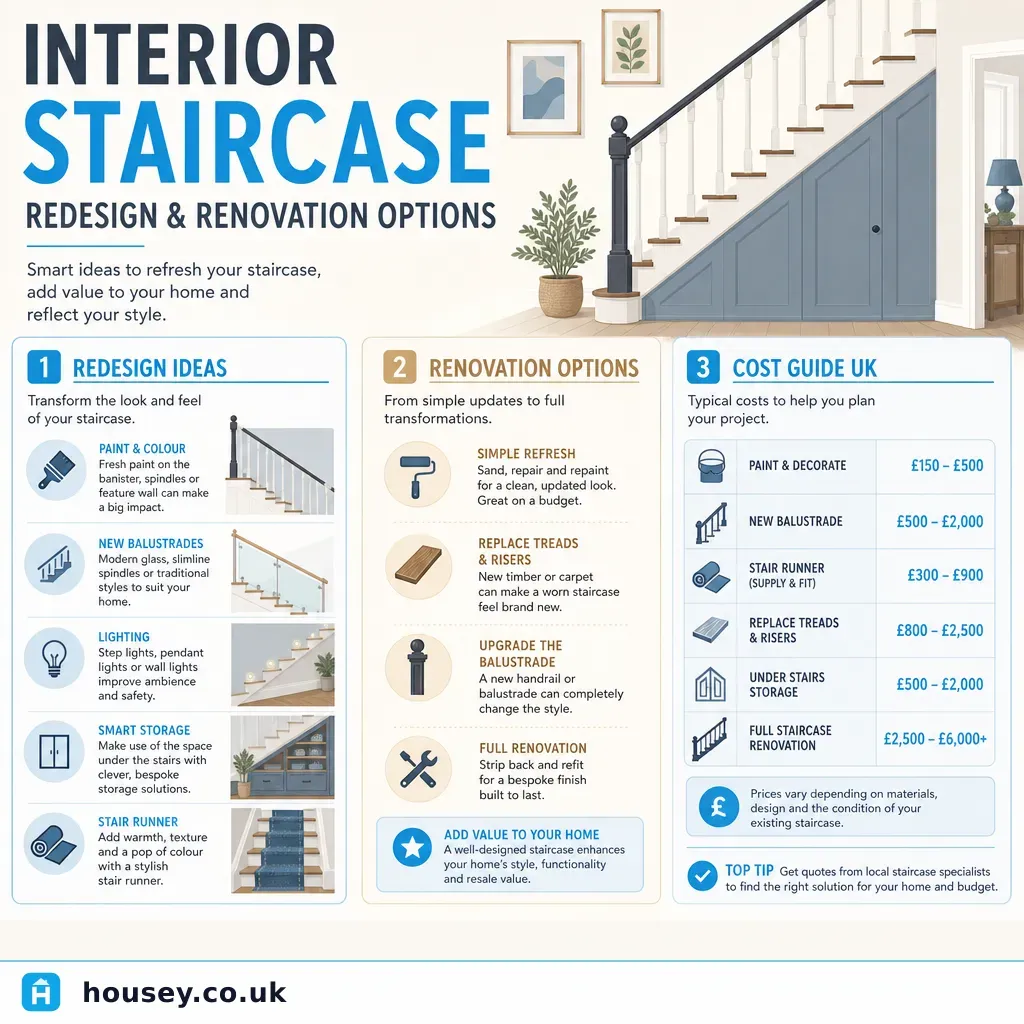
Interior staircase redesign and renovation options
Staircase renovation ranges from cosmetic updates — repainting treads, replacing balusters, or fitting a stair runner — to full structural redesigns with new flights and open-plan layouts.
 Improvement & Build
Small kitchen renovation: budgeting for costs and planning your project
A small kitchen renovation in the UK typically costs £5,000–£15,000 for a full refresh including new units, worktops, tiling, and appliances, though costs vary widely by specification, region, and whether structural changes or rewiring are involved.
 Improvement & Build
Conservatories and Garden Extensions: Design and Building Guide
Most conservatories qualify as permitted development in England if they are single-storey, within 50% of original curtilage, and meet dimensional limits.
 Improvement & Build
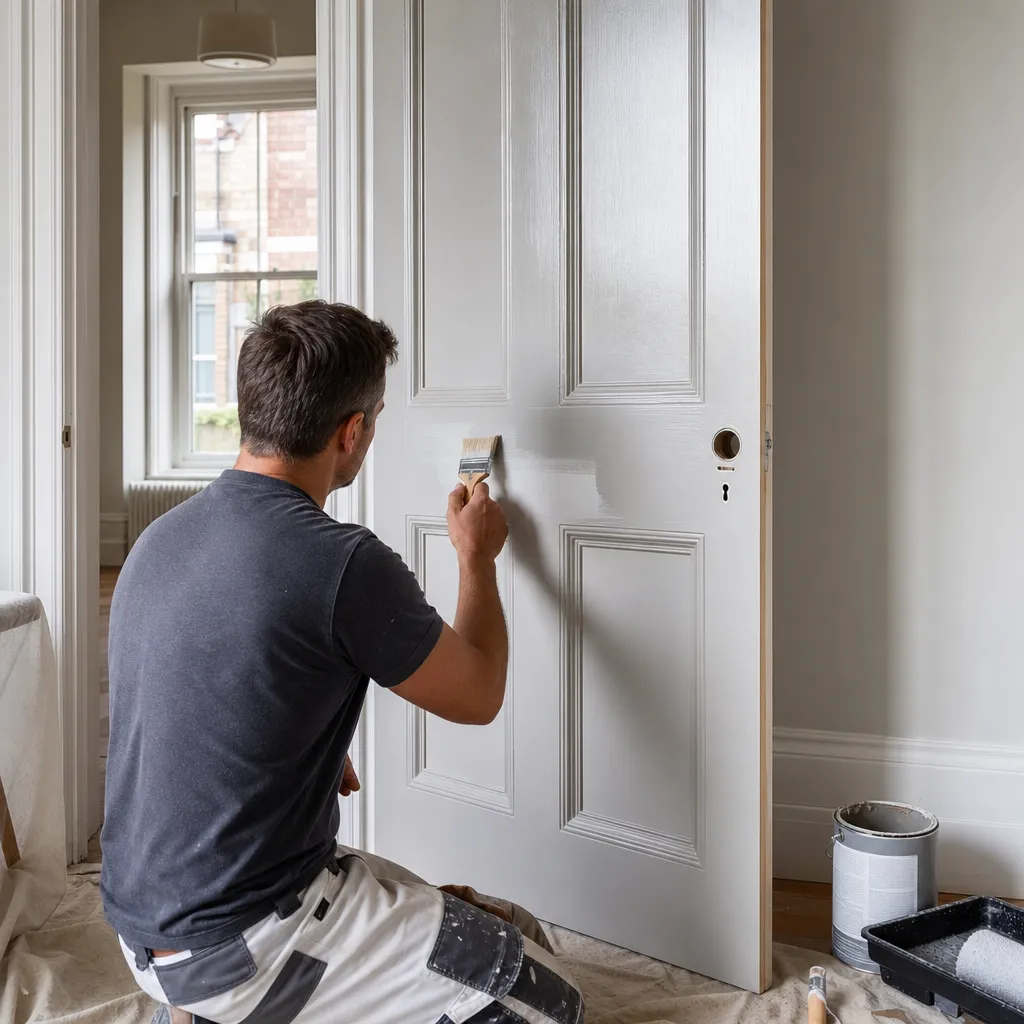
Painting Interior Doors: Preparation and Technique
Painting interior doors well depends on preparation rather than paint choice.
 Improvement & Build
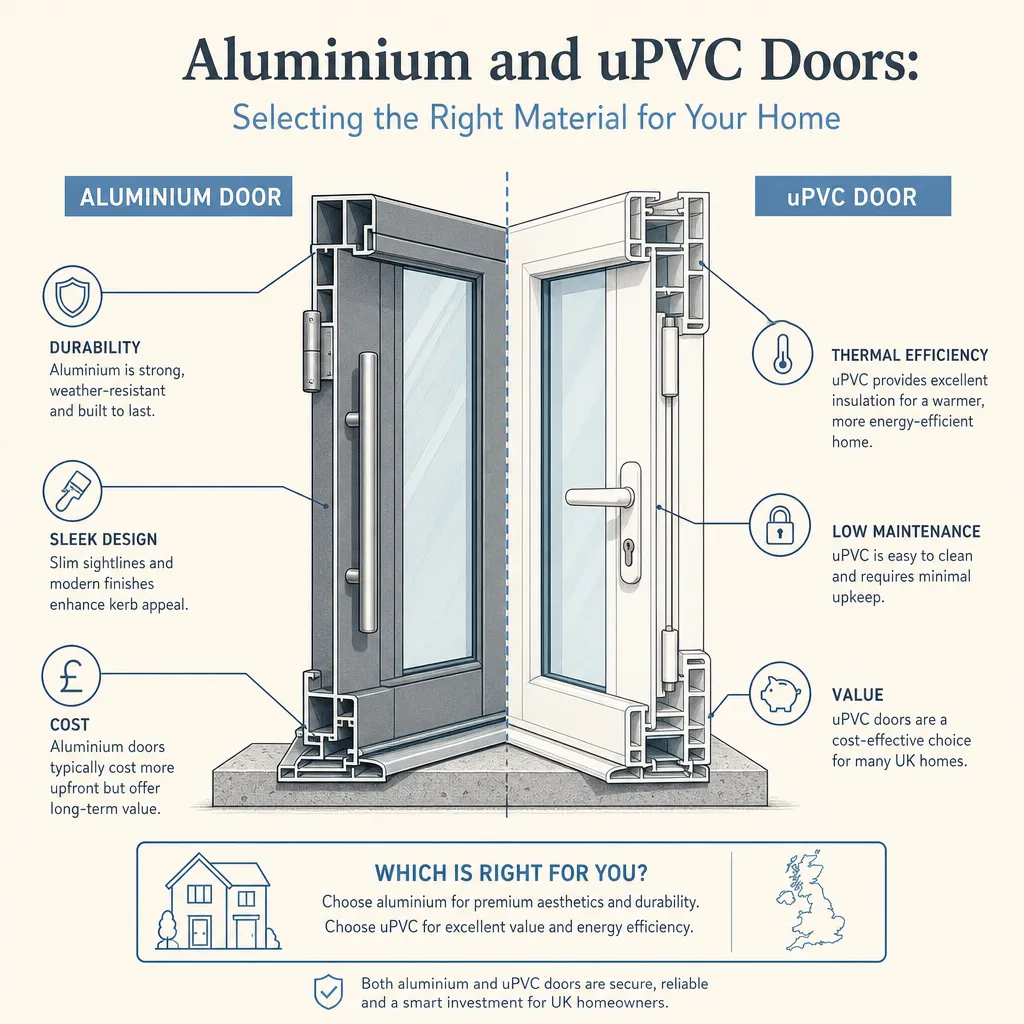
Aluminium and uPVC Doors: Selecting the Right Material for Your Home
uPVC doors are lower-cost and low-maintenance, making them a practical choice for most UK homes.