Interior Wall Finishes: Alternatives to Plasterboard
By Housey · Last reviewed 30th of May 2026
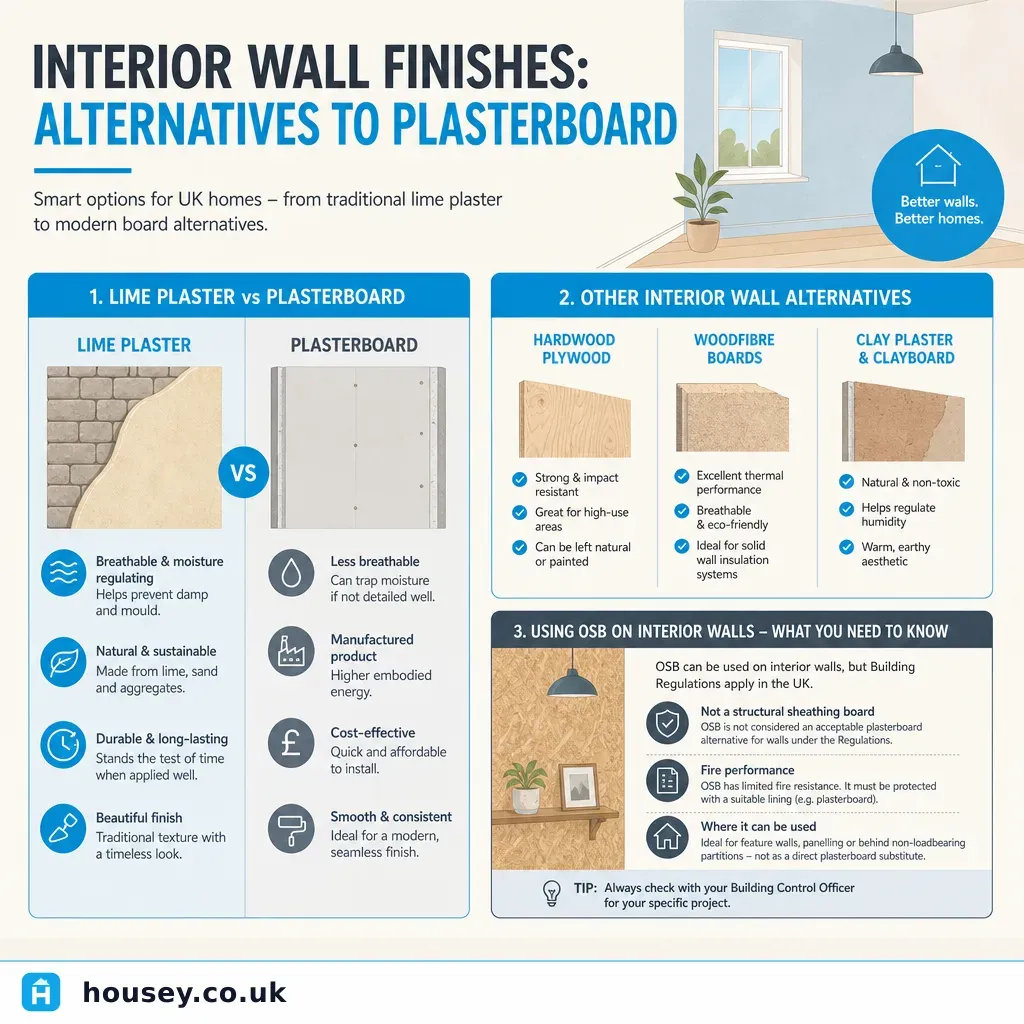
Interior Wall Finishes: Alternatives to Plasterboard
The choice of wall finish affects acoustics, moisture behaviour, thermal performance, and aesthetics — and it influences how much work subsequent trades need to do. Alternatives to standard plasterboard arise most often during renovations of older properties, self-build projects with specific technical requirements, and design-led schemes where the surface itself becomes a feature.
Key points
- Lime plaster is the appropriate wall finish for most pre-1919 solid-wall properties; standard plasterboard and gypsum-based finishes can trap moisture and accelerate decay in traditional breathable construction.
- Oriented Strand Board (OSB) used as an interior wall finish requires fire-performance treatment in escape routes under Building Regulations Approved Document B — standard OSB 3 does not achieve Class C spread of flame without a rated treatment or coating.
- Solid two- or three-coat lime plaster typically costs £45–80/m² installed, compared with £15–30/m² for plasterboard and skim (Indicative UK costs, last reviewed 2026-05-30).
- Brick slips can weigh 30–50 kg/m² when fully bedded; upper-floor applications require a structural check before installation.
- Timber panelling used in stairwells and hallways must meet Class C surface spread of flame under Approved Document B unless the material is inherently rated or has received an appropriate fire-retardant treatment.
Why look beyond plasterboard?
Plasterboard — typically 12.5 mm or 15 mm gypsum board — is the dominant UK interior wall finish because it is fast, affordable, and well understood by most builders. But it has real limitations in certain contexts.
Moisture management: In solid-wall properties built before approximately 1900 using lime mortars and traditional masonry, gypsum board with vapour-impermeable coatings can restrict the breathability that the construction relies on. Trapping moisture risks interstitial condensation, timber joist-end rot, and persistent damp problems that are easily — and expensively — misdiagnosed.
Acoustic performance: Standard plasterboard offers limited sound reduction without additional layers, resilient bars, or acoustic membranes. Alternatives such as solid lime plaster or double-leaf systems can offer better performance.
Character and appropriateness: In period renovation projects, raw brick, lime render, or timber panelling may be more in keeping with a building's character — and for listed buildings, may be a condition of consent.
Specific environments: In utility rooms, basements, and outbuildings, some alternatives cope better with intermittent moisture or temperature swings than standard gypsum board.
Comparison of interior wall finish alternatives
Finish | Best for | Not ideal for | Breathable? | Approx. installed cost/m² | Fire considerations |
|---|---|---|---|---|---|
Two/three-coat lime plaster | Pre-1919 solid-wall and listed buildings | Fast-moving renovations; modern moisture-free construction | Yes | £45–80 | Standard — low risk |
Oriented Strand Board (OSB) | Self-build studios, workshops, utility rooms | Escape routes without rated treatment; habitable rooms needing smooth finish | No | £20–40 | Class C required in escape routes (Approved Document B) |
Brick slips | Feature walls, kitchen/dining, commercial-residential | Upper floors without structural assessment; large areas on uneven substrate | No | £70–130 | Low risk if non-combustible adhesive used |
Timber cladding (T&G/shiplap) | Hallways, bedrooms, bathrooms (moisture-rated boards) | Stairwells/escape routes without fire-retardant treatment | Partially | £40–80 | Must achieve Class C spread of flame in escape routes |
Magnesium oxide (MgO) board | Wet rooms, bathrooms, underfloor heating build-ups | Direct plaster finish without skim coat | Partially | £25–50 | Good fire performance; non-combustible |
Exposed original brick | Victorian/Edwardian renovations, industrial conversions | Cold external walls without insulation | Partially | £15–35 (sealing/repointing) | Standard |
Cork panels | Feature accent walls, sound absorption | High-traffic or impact-prone areas | Yes | £30–60 | Check fire classification — Class C–E depending on product |
Indicative UK costs, last reviewed 2026-05-30. Costs vary significantly by region, substrate condition, and specification.
Lime plaster: the right choice for traditional buildings
In any property built before approximately 1919 using solid masonry — Victorian terraces, Edwardian semis, stone farmhouses, Georgian townhouses — lime plaster was the original finish and often remains the most technically sound option.
Lime is vapour-permeable. Moisture from the wall structure and from everyday occupation can move through the finish and evaporate, rather than accumulating behind an impermeable modern lining. Where solid walls are re-lined with gypsum board and foil-backed insulation without adequate provision for moisture movement, problems including rising damp misdiagnosis, timber decay, and persistent mould growth are well documented by the Building Research Establishment.
Historic England's guidance on traditional building materials and the Society for the Protection of Ancient Buildings (SPAB) both recommend lime-based finishes for traditional solid-wall construction. For listed buildings, lime plaster is frequently a condition of listed building consent.
What to expect from a lime plaster job:
- Two-coat work (scratch coat plus finishing coat) is most common for repairs and straightforward re-plastering.
- Three-coat work (render, float, and set) provides a superior finish on very uneven substrates.
- Drying time is slow — weeks to months, not days — and humidity-dependent; lime cannot be rushed.
- Specialist plasterers with demonstrated lime experience are required; standard dry-liners rarely have the relevant skills.
OSB and sheet materials as interior wall finishes
Oriented Strand Board is popular in self-build projects, garden studios, and utility spaces where a raw or industrial finish is acceptable. It is also used as a substrate for tiling in modern construction.
Key considerations:
- OSB is not breathable and must not be the sole interior finish on solid-wall properties where moisture management is critical.
- In any escape route — hallways, stairwells, corridors serving more than one room — Approved Document B requires wall and ceiling surfaces to achieve at least Class C (European classification) surface spread of flame. Standard OSB 3 does not meet this threshold without a fire-retardant treatment or intumescent coating.
- Always check with your Building Control body or Approved Inspector before specifying OSB in habitable or escape-route locations.
Timber cladding and panelling
Tongue-and-groove timber cladding and MDF-based panelling systems — including shaker-style and Scandi-inspired designs — have become a common feature in UK renovation projects, particularly in hallways, bathrooms, and bedrooms.
Decision guide:
- Choose moisture-resistant MDF or PVC-based boards for bathrooms and kitchens where humidity is high; standard MDF will swell and deteriorate.
- Choose natural hardwood or softwood cladding where the grain and texture are integral to the design intent — budget for periodic maintenance (oiling or painting).
- Use fire-retardant-treated boards or rated materials in stairwells and escape routes as required by Approved Document B.
- Ask an architect if the cladding forms part of a new extension or structural alteration requiring Building Regulations sign-off.
- Ask an extension builder or design-and-build firm if the wall finish is part of a wider build project and you want a single point of responsibility.
Which professional do I need?
Situation | Professional to contact |
|---|---|
Listed building or pre-1919 property needing lime plaster | Specialist lime plasterer; conservation architect if listed building consent is required |
Self-build or extension needing alternative wall finish specification | |
Extension or renovation with wall finishes as part of a wider build | |
Design-led interior scheme with feature finishes | Interior designer, often working alongside a design-and-build firm |
Heavy finishes (brick slips) on upper floors | Structural engineer to confirm floor load capacity before installation |
When to get professional help
Consult a qualified professional when:
- The property is listed or in a conservation area — many finish choices require listed building consent or must satisfy local authority conditions, and original plasterwork may be protected.
- You are unsure about fire compliance of a proposed finish in an escape route — this is a life-safety matter, and a Building Control body or Approved Inspector should confirm the specification before work begins.
- Brick slips or stone finishes are planned on an upper-floor wall — a structural engineer should confirm that the floor and wall construction can carry the additional load.
- The wall shows signs of active damp or structural movement — the finish choice alone will not resolve underlying problems, and a specialist investigation should precede any re-lining.
How Housey can help
Whether you are specifying a lime plaster renovation in a Victorian terrace or selecting wall finishes for a new extension, Housey connects you with local extension builders, design-and-build firms, and architectural practices who understand the technical and regulatory requirements. Compare up to four quotes in one place.
Frequently asked questions
Do I need planning permission to change interior wall finishes?
Not usually for standard interior alterations. However, if the property is listed, you may need listed building consent even for internal changes such as removing original plasterwork or introducing modern sheet materials. Always check with your local planning authority before altering fabric in a listed building — consent requirements can extend to internal surfaces.
Is lime plaster more expensive than plasterboard?
Yes — typically two to three times the cost of plasterboard and skim, reflecting the skill required and the slower drying process. For pre-1919 solid-wall properties it is often the technically correct choice, however, avoiding more costly moisture-related remediation — damp misdiagnosis, joist-end rot — that can follow inappropriate modern linings.
Can I use OSB as a wall finish in a bedroom?
OSB can be used in a bedroom provided the room does not form part of an escape route and adequate ventilation is in place. Landings and stairwells are usually escape routes and have stricter fire performance requirements under Approved Document B. Check with your Building Control body before using untreated OSB in any circulation space.
What is magnesium oxide board and when should I use it?
MgO board is a non-combustible, moisture-resistant sheet material used as an alternative to plasterboard in wet rooms, bathrooms, and underfloor heating build-ups. It has good fire performance and does not swell when wet. A skim coat is typically needed for a smooth painted finish, adding slightly to cost compared with standard plasterboard.
Sources and further reading
- Historic England: Practical Building Conservation — Historic England
- SPAB: Lime plaster guidance — Society for the Protection of Ancient Buildings
- GOV.UK: Approved Document B — Fire Safety — MHCLG
- BRE: Moisture in buildings — Building Research Establishment
Useful next reads
 Improvement & Build
Understanding Wood Trim and Moulding Options for Interior Design
Interior wood trim in UK properties includes skirting boards, architrave, coving, dado rails, and picture rails.
 Improvement & Build
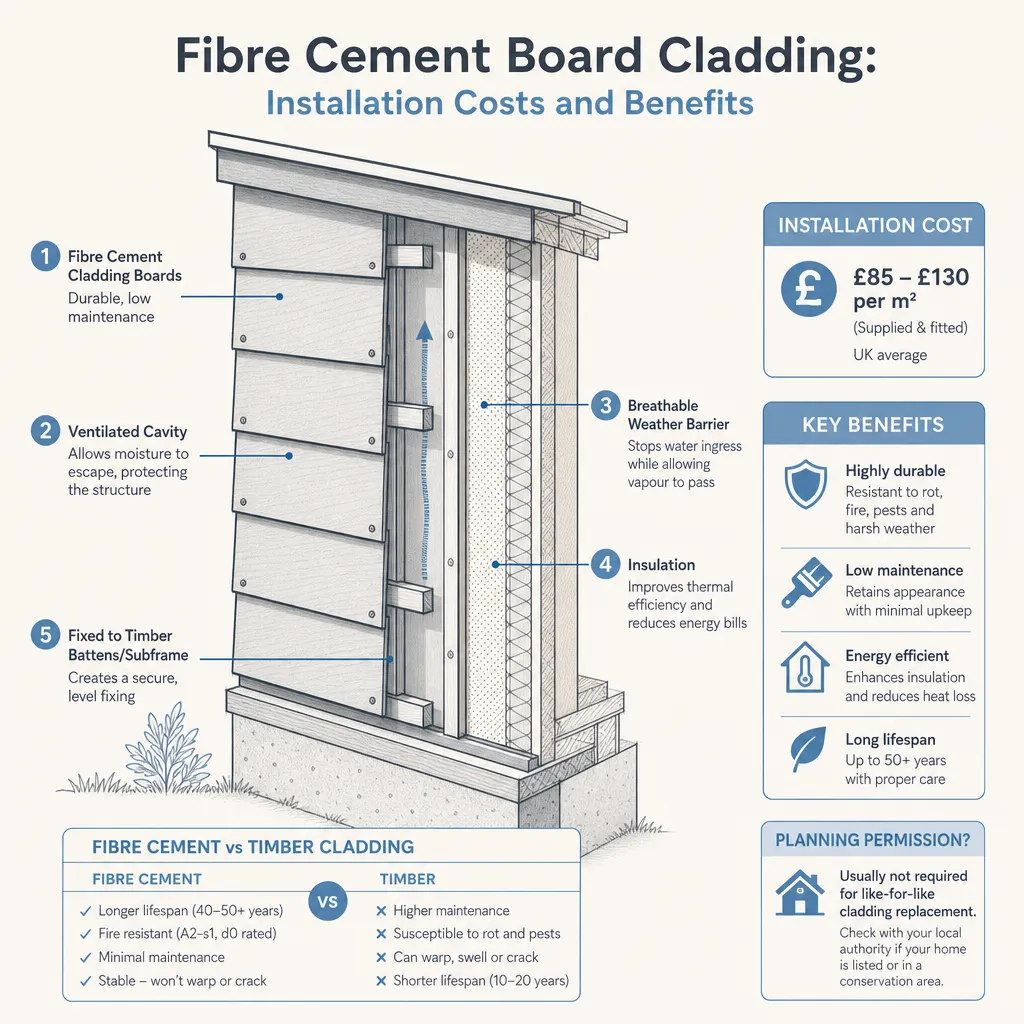
Fibre Cement Board Cladding: Installation Costs and Benefits
Fibre cement board cladding typically costs £80–£180 per m² installed in the UK, including boards, battens, breather membrane, and labour.
 Improvement & Build
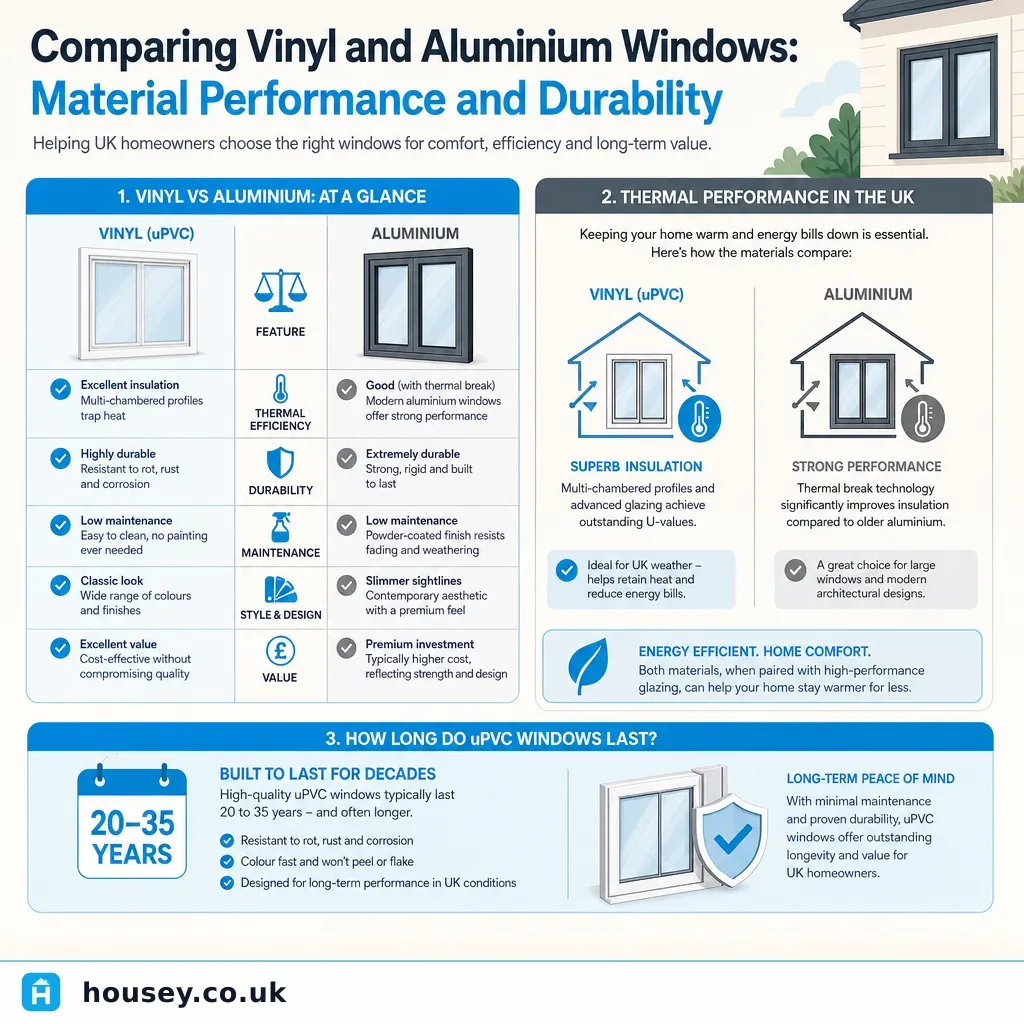
Comparing Vinyl and Aluminium Windows: Material Performance and Durability
uPVC (vinyl) and aluminium windows both meet UK Building Regulations Part L when properly specified.
 Improvement & Build
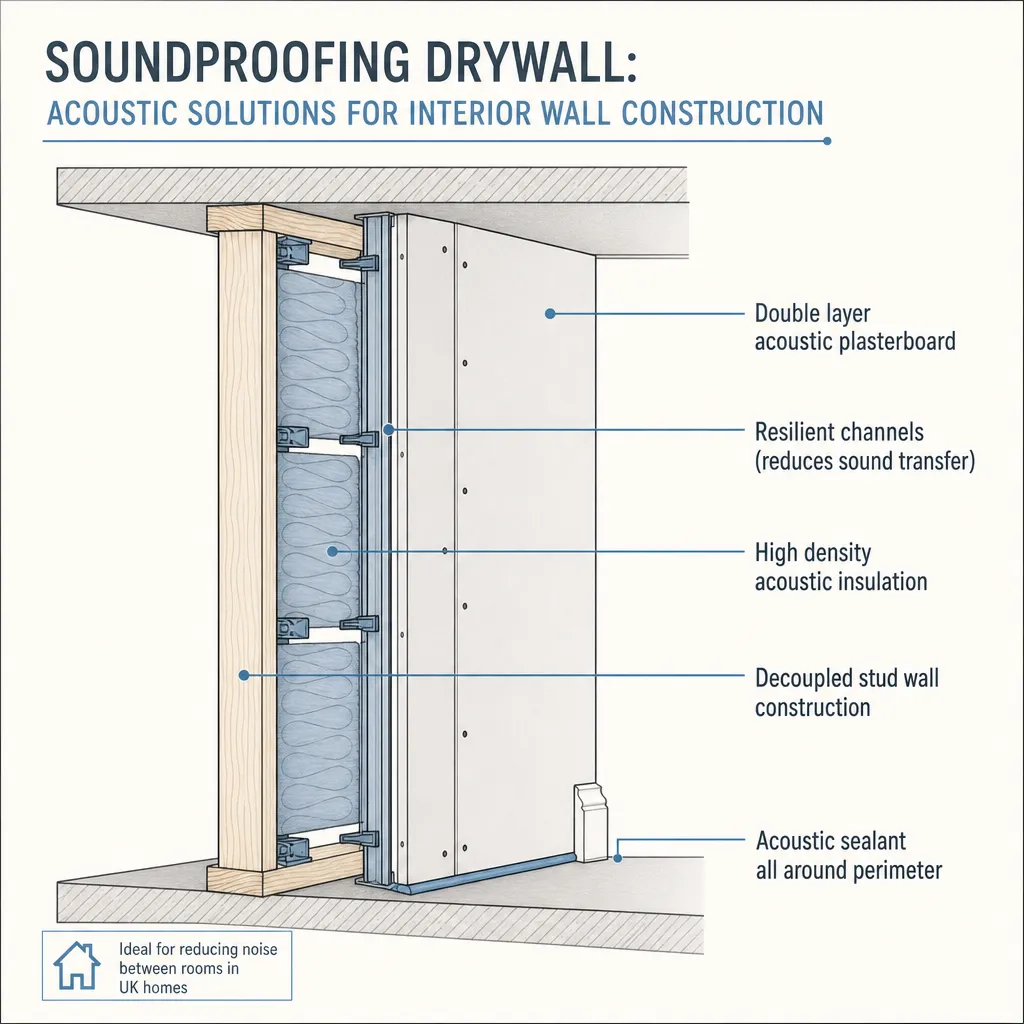
Soundproofing drywall: acoustic solutions for interior wall construction
Soundproofing drywall in UK homes typically combines acoustic plasterboard, resilient bar fixings, and mineral wool cavity fill to reduce airborne and structure-borne noise.
 Improvement & Build
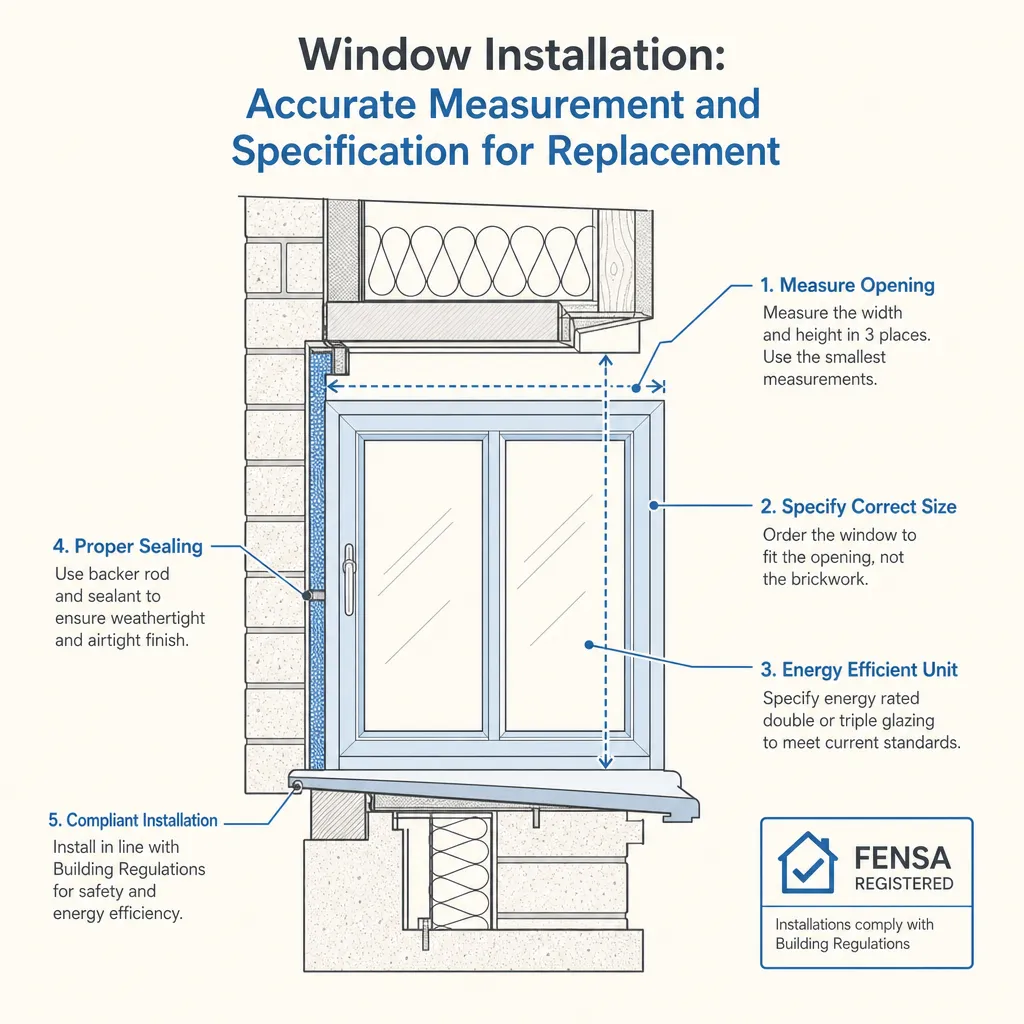
Window Installation: Accurate Measurement and Specification for Replacement
Accurate window measurement for replacement means recording the width and height of the existing frame opening in at least three places, noting the smallest dimension, and providing a full specification to your installer — including frame material, glazing type, opening style, and trickle ventilators.