International Properties and Overseas Property Investment Guide
By Housey · Last reviewed 8th of May 2026

International Properties and Overseas Property Investment Guide
Buying property abroad attracts UK residents for many reasons — a holiday home in southern Europe, a retirement plan, or a foothold in a different property market. But an overseas purchase operates under entirely different legal, tax, and financial frameworks from a UK transaction, and mistakes can be costly and difficult to reverse once contracts are exchanged in another jurisdiction.
Key points
- UK tax residents must declare overseas rental income to HMRC via Self Assessment each year, regardless of whether tax has already been paid in the country where the property is located.
- Many countries restrict foreign ownership of residential or agricultural land — confirming the local legal position before any purchase is essential, not optional.
- Most UK high-street lenders will not lend against overseas property; international mortgages typically require deposits of 30–40% and carry different documentation standards and levels of consumer protection.
- Capital gains on overseas property disposed of by UK residents are subject to UK Capital Gains Tax (CGT), as well as potentially local CGT in the destination country — double taxation treaties may reduce the total liability but do not eliminate it.
- Currency exchange rate movements between sterling and the local currency can significantly affect the real purchase cost, ongoing mortgage repayments, and eventual sale proceeds.
Important limitations
This article provides general background information for UK residents considering overseas property. Laws, taxes, ownership restrictions, and mortgage rules vary significantly by country, property type, and individual circumstances. Nothing in this article constitutes financial, legal, or tax advice. You should consult a solicitor qualified in the relevant jurisdiction's property law, an independent financial adviser authorised by the Financial Conduct Authority (FCA), and a qualified tax adviser with experience of both UK and the destination country's rules before committing to any overseas property transaction.
How overseas legal systems differ from England and Wales
England and Wales operates a centralised Land Registry where legal title is transparent and clearly recorded. Many popular overseas property markets work very differently, and buyers who do not understand local systems face significant risks.
Country or region | Title and transaction system | Key risks for UK buyers |
|---|---|---|
Spain | Notarial system; registered at Registro de la Propiedad | Illegal builds, outstanding community debts, NIE number required before purchase |
France | Notaire manages the transaction; central land registry | Compulsory purchase rights (droit de préemption), forced heirship rules (réserve héréditaire) |
Portugal | Notarial system; Conservatória do Registo Predial | Habitation licence requirements, urban rehabilitation zone restrictions |
Turkey | Tapu title deed registry | Military zone restrictions, earthquake zone disclosure obligations |
UAE (Dubai) | Dubai Land Department title registration | Freehold ownership only in designated areas; financing restrictions for short-term visa holders |
USA | State-level variation; title insurance standard practice | Homeowners association rules, county-level property tax rates vary significantly |
Non-EU and emerging markets | Wide variation; some countries restrict or prohibit foreign freehold | Leasehold or nominee ownership structures may offer weaker legal protection |
This table is a general overview only. Legal positions change. Always instruct independent local legal counsel qualified in the destination country.
Tax implications for UK residents
Income tax on overseas rental income
UK tax residents who receive rental income from overseas property must report it on a UK Self Assessment tax return each year. Income is taxed after allowable deductions, which typically include mortgage interest on a commercial let, maintenance costs, managing agent fees, and insurance. Tax already paid in the destination country may be credited against UK tax liability under a relevant double taxation treaty, where one exists.
HMRC publishes detailed guidance on foreign income at GOV.UK.
Capital Gains Tax on disposal
When a UK resident sells an overseas property at a profit, the gain above the annual exempt amount is subject to UK CGT. From April 2024, the CGT rate on residential property is 18% for basic-rate taxpayers and 24% for higher or additional-rate taxpayers. Where the destination country also charges CGT or an equivalent gains tax, a double taxation treaty (if one exists) usually provides credit relief — but the calculations are complex and professional tax advice is strongly recommended before any disposal.
Inheritance tax
UK inheritance tax applies to the worldwide assets of UK-domiciled individuals, including overseas property. For estates where an overseas property represents a significant share of total value, this is an important consideration in estate planning. Seek specialist advice on whether a trust or company structure is appropriate for your circumstances.
Financing an overseas property purchase
Most mainstream UK lenders will not lend against overseas property. Those that do typically restrict lending to a small number of countries and impose stricter affordability criteria than on a domestic purchase.
Feature | UK residential mortgage | Overseas mortgage (typical) |
|---|---|---|
Minimum deposit | 5–10% (owner-occupier) | 30–40% |
Income assessment | UK income, UK credit history | May require local income evidence or international credit checks |
Documentation | Standard UK payslips or accounts | May require notarised and translated documents |
Currency | Sterling | Local currency — exchange rate risk applies throughout the mortgage term |
Regulatory protection | FCA-regulated lender | Local regulation varies; may provide less consumer protection than the UK |
Currency risk
If the purchase price, mortgage, or ongoing costs are in a foreign currency, exchange rate movements can meaningfully increase the real cost. As an illustration: a purchase priced at €230,000 costs approximately £200,000 at an exchange rate of €1.15 to £1. If the rate moves to €1.05 before completion, the same purchase costs approximately £219,000 — an increase of nearly £19,000 in sterling terms. Currency specialists regulated by the FCA can arrange forward contracts to fix an exchange rate for a future payment, reducing uncertainty around the transaction itself.
Document preparation list
Gather the following before instructing a lawyer or making any formal offer on an overseas property.
Red flags when buying overseas property
Be cautious — and consider seeking additional independent legal advice — if any of the following apply:
- The seller, developer, or agent discourages you from using your own independent lawyer, or strongly recommends a specific notary or solicitor with whom they appear to have a relationship.
- The property does not have a valid habitation licence (for example, licencia de primera ocupación in Spain, or a habitation certificate in Portugal).
- Planning permission for the building or any extension cannot be produced in writing by the seller.
- The asking price is significantly below comparable local properties without a clear and verifiable explanation.
- The estate agent or developer is not licenced or regulated in the destination country.
- You are asked to sign any document before your independent lawyer has reviewed it — in some countries a preliminary contract is legally binding on signature with no standard cooling-off period.
- There are outstanding community fees, local property taxes, or utility arrears that the seller claims will be resolved at completion.
- The property is marketed as a short-term rental investment without evidence that local planning rules permit this — several Spanish cities and Portuguese municipalities have restricted or banned new short-term let licences in recent years.
What to ask a qualified professional
Before instructing any professional for an overseas purchase, ask the following.
Your property lawyer (must be qualified in the destination country's property law):
- Are you regulated by the relevant national or regional bar association or law society?
- Have you acted in property transactions for UK buyers in this country before?
- What searches, title checks, and due diligence will you carry out, and what is included in your quoted fee?
- How will you manage the transaction if I cannot travel to the country in person — do you accept a power of attorney?
- What happens if planning irregularities or encumbrances are discovered during due diligence?
Your mortgage broker or financial adviser:
- Are you authorised and regulated by the FCA for mortgage and/or investment advice?
- Do you have specific experience arranging international mortgage products for buyers in this country?
- What currency management options do you recommend, and what are the costs and risks of each?
Your UK tax adviser:
- Are you a qualified chartered accountant or tax adviser with experience of overseas property for UK residents?
- Does a double taxation treaty exist between the UK and the destination country, and how will it apply to my rental income and any future disposal gain?
- What are the inheritance tax implications of holding this property in my personal name compared with a trust or company structure?
When to get professional help
Do not proceed beyond initial research without professional advice if any of the following apply:
- The destination country has a language you do not speak fluently — legal documents must be fully understood before they are signed.
- The purchase involves an off-plan scheme from a developer — these carry additional risks including developer insolvency, build delays, and misrepresentation that require careful legal due diligence.
- You intend to let the property — UK tax reporting obligations begin from the first year of rental income.
- There is no double taxation treaty between the UK and the destination country.
- You are considering remortgaging a UK property to release funds — instruct a UK conveyancing solicitor to advise on the UK legal aspects before proceeding.
How Housey can help
Housey primarily connects UK homeowners with UK-based professionals. If you are remortgaging or selling a UK property to fund an overseas purchase, a UK conveyancing solicitor found through Housey can advise on the UK legal aspects of the transaction. If you also need a valuation survey on a UK property as part of the process, Housey can help you request quotes from qualified local surveyors.
Frequently asked questions
Do I have to pay UK stamp duty on an overseas property?
Stamp Duty Land Tax applies only to land and property transactions in England. Buying property abroad does not trigger SDLT. However, the destination country will typically charge its own purchase taxes — often 6–12% of the purchase price in popular European markets. These local taxes can be substantial and should be factored into your total budget before making any offer.
Can I use my UK pension to buy overseas property?
A Self-Invested Personal Pension (SIPP) cannot directly hold overseas residential property. HMRC treats this as an unauthorised payment and the tax penalties are severe. You can draw down pension funds and use the cash, subject to normal pension rules and income tax, but the implications are significant. Take independent financial advice before connecting pension assets with an overseas property purchase.
Is overseas property a good investment for UK buyers?
This depends on the destination country, local market conditions, currency movements, rental yield potential, and your personal financial position. Overseas property carries additional risks compared with UK investment property — legal complexity, currency exposure, and less familiar regulatory environments. It is not inherently better or worse than other investments; those differences need to be understood and accepted before committing.
What happens to an overseas property when I die?
This involves both UK inheritance law and the succession law of the country where the property is located. Many countries apply local succession law to immovable property regardless of the owner's nationality. EU member states are subject to EU Succession Regulation 650/2012, which post-Brexit may affect UK nationals differently. Specialist legal and tax advice is essential for any overseas property owner reviewing their will.
Do I need to declare an overseas property purchase to HMRC?
You do not need to notify HMRC of the purchase itself. However, if the property generates rental income, you must register for Self Assessment and declare that income in the relevant UK tax year. If you later sell the property at a gain, you must report the disposal via Self Assessment in the tax year it occurs.
Sources and further reading
- Foreign income: overview — GOV.UK
- Capital Gains Tax: what you pay it on, rates and allowances — GOV.UK
- Tax on foreign income — GOV.UK
- Inheritance Tax overview — GOV.UK
- UK double taxation treaties — HMRC via GOV.UK
- Buying property abroad — Citizens Advice
- Mortgages: consumer guidance — Financial Conduct Authority
Useful next reads
 Buying & Moving
Buying Property Overseas: A UK Buyer's Guide to International Property Investment
UK buyers can purchase property in most countries, but the legal process, tax obligations, and financing differ significantly from buying in the UK.
 Buying & Moving
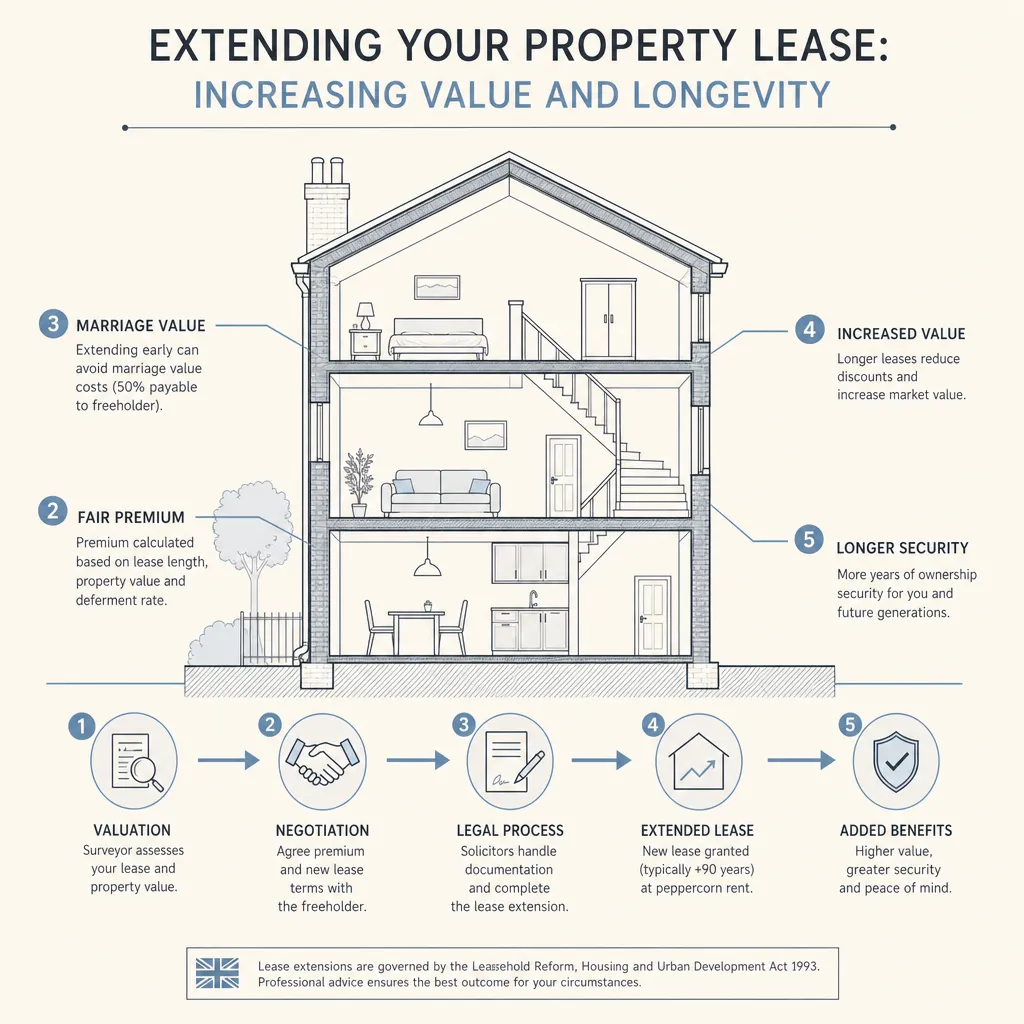
Extending Your Property Lease: Increasing Value and Longevity
Qualifying leaseholders in England and Wales can extend their lease by 90 years at a peppercorn ground rent under the Leasehold Reform, Housing and Urban Development Act 1993.
 Buying & Moving
Buy-to-Let Property Investment: Essential Guidance for Landlords
Buy-to-let investment in the UK requires careful financial planning.
 Buying & Moving
Property Investment Sentiment: Understanding Market Appetite for UK Real Estate
UK property investment sentiment is shaped by interest rates, rental yields, regional supply and demand, and policy changes such as stamp duty surcharges and landlord tax rules.
 Buying & Moving
First-Time Buyer vs Established Homeowner: Property Purchase Considerations
First-time buyers in England pay no stamp duty on the first £300,000 of a property worth up to £500,000 and may access specific mortgage products.