Property Investment Sentiment: Understanding Market Appetite for UK Real Estate
By Housey · Last reviewed 31st of May 2026
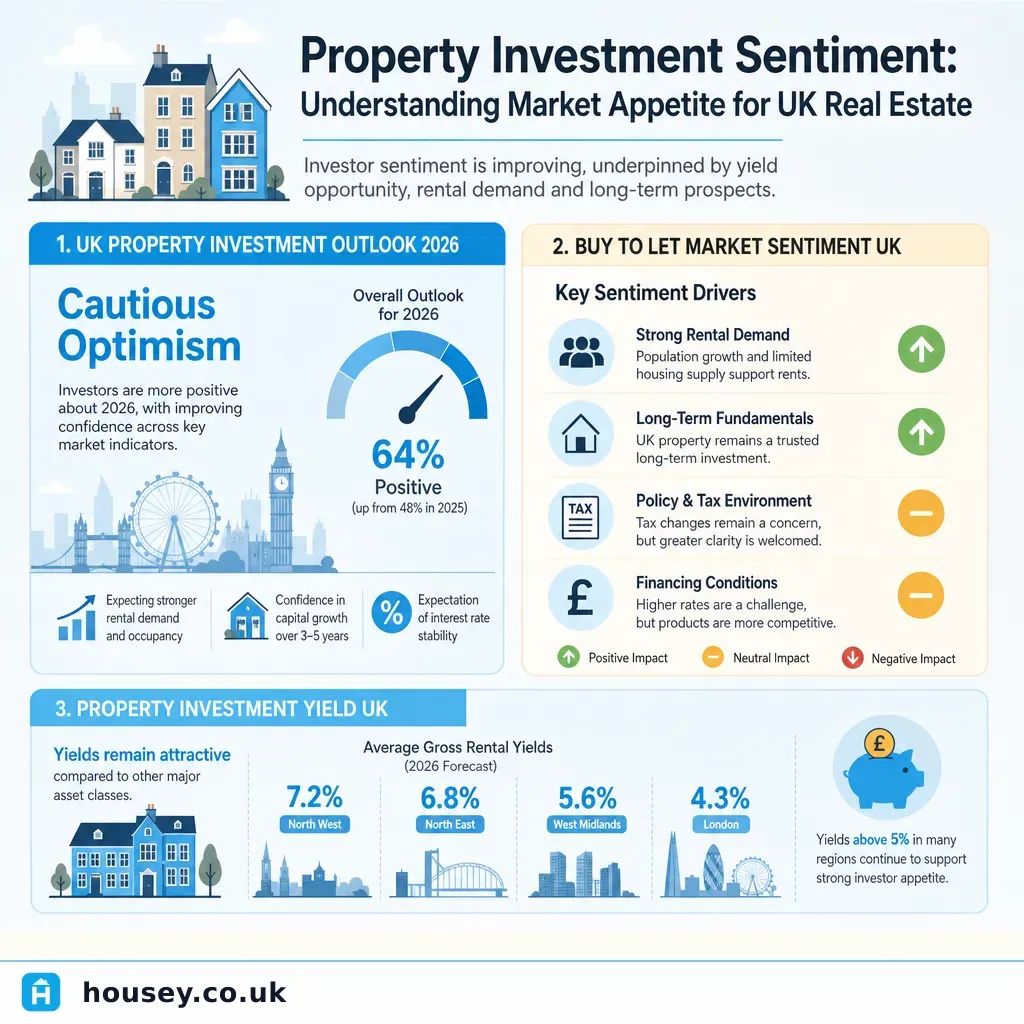
Property Investment Sentiment: Understanding Market Appetite for UK Real Estate
Investors approaching UK residential property in 2026 face a more complex picture than at any point in the previous decade. Regulatory change, interest rate adjustments, shifting rental market rules, and regional supply-demand imbalances all influence whether the numbers stack up for a new purchase or a portfolio review. Understanding the signals that drive investment appetite — and the assumptions that can mislead — helps both new and experienced investors make better-grounded decisions.
Key points
- The Bank of England base rate directly sets the floor for buy-to-let mortgage pricing; many five-year fixed BTL products were priced in the 4.5–5.5% range in early 2026, materially compressing net yields compared with the low-rate period of the 2010s.
- Buyers of additional residential properties in England pay a 5% SDLT surcharge on top of standard rates — increased from 3% in October 2024 per HMRC — which affects investment return calculations from day one.
- RICS Residential Market Survey data provides a monthly leading indicator of buyer enquiries, agreed sales, and price expectations, widely used by analysts to gauge near-term sentiment.
- The Renters' Rights Bill (introduced 2024, progressing through Parliament as at last review) proposes to abolish Section 21 no-fault evictions and fixed-term ASTs, changing how landlords manage occupancy risk.
- Section 24 of the Finance (No.2) Act 2015, fully in effect since 2021, restricts mortgage interest relief for individual landlords to the basic rate only — materially altering BTL profitability for higher-rate taxpayers.
What shapes UK property investment sentiment?
Interest rates and financing costs
The Bank of England base rate is the dominant short-term driver of BTL investor sentiment. When rates rise, the spread between gross rental yield and mortgage cost narrows — and for investors with high loan-to-value ratios, cash flow can turn negative. Most lenders apply interest coverage ratio (ICR) stress tests, requiring rental income to cover 125–145% of mortgage interest at a stressed rate. Falling rates tend to revive sentiment quickly; rising rates suppress it.
Rental yields and capital growth expectations
Investors typically weigh two return streams: rental yield (annual rent as a percentage of purchase price) and capital growth. In a higher-rate environment, yield becomes relatively more important, favouring regional cities and commuter towns over prime London, where yields are more compressed.
Region | Indicative gross yield range (2025–2026) | Capital growth trend | Notes |
|---|---|---|---|
Prime Central London | 2.5–4.0% | Flat to modest | Prime buyer market; institutional interest |
Greater Manchester | 5.5–7.5% | Positive | Active BTL and HMO; regeneration areas |
Leeds / West Yorkshire | 5.0–7.0% | Positive | Strong student and professional demand |
Birmingham | 5.0–6.5% | Positive | Large graduate population; HS2 uncertainty |
South East commuter belt | 3.5–5.0% | Modest | Higher price points; yield compression |
Edinburgh / Glasgow | 5.0–7.0% | Positive | Scottish legal framework (ARTB) applies |
Indicative figures only, last reviewed 2026-05-31. Yields vary significantly by property type, condition, and management costs. Not a basis for investment decisions without independent professional advice.
Regulatory and policy risk
Regulatory headwinds have been a consistent feature of UK BTL investment since 2016. Key policy changes affecting sentiment include: the Section 24 mortgage interest restriction (basic rate relief only for individual landlords), the SDLT additional property surcharge (now 5%), the proposed abolition of Section 21, anticipated EPC Band C requirements for rental properties by 2030, and expanding local authority landlord licensing schemes. Investors must price these operational and capital costs into their returns analysis before acquiring.
What not to assume
Do not assume gross yield equals net yield. Gross yield ignores letting agent fees (typically 8–15% of rent), void periods, maintenance and repair budgets, landlord licensing costs, buildings and contents insurance, ground rent and service charges on leasehold flats, and management time. Net yields for a typical BTL property are often 1.5–3 percentage points below headline gross figures.
Do not assume national house price data applies to your target property. ONS, Nationwide, and Halifax indices are averages across millions of transactions. A specific street, postcode, or property type can perform significantly differently from regional or national averages — both positively and negatively.
Do not assume current sentiment predicts near-term performance. Investor sentiment surveys reflect prevailing mood, not guaranteed outcomes. UK property has experienced sharp corrections (2007–2009, 2023 rate shock) and extended growth phases. Sentiment is a useful input; it is not a forecast.
Do not assume any agent, broker, or seller is giving you independent advice. Each party has an interest in a transaction completing. An FCA-regulated independent financial adviser (IFA) is the appropriate source of regulated investment advice for decisions involving significant capital.
Decision tree: buy now, wait, or review your portfolio?
- Buy now if rental demand in your target market is demonstrably strong, your stress-tested ICR works at current rates, you have an adequate deposit (typically 20–25% for BTL), and your investment horizon is five or more years.
- Wait if financing costs are currently eroding your target net yield, you are relying primarily on near-term capital growth to make the returns work, or significant regulatory changes — particularly EPC requirements — may force costly upgrades on your target property type.
- Review your existing portfolio if rising rates have moved properties into negative cash flow, if local authority licensing requirements have changed in your area, or if you hold properties at EPC Band D or below that may face mandatory upgrade costs before 2030.
- Seek professional advice if you are a higher-rate taxpayer considering a first BTL purchase (a limited company structure may be more tax-efficient), if your portfolio exceeds four properties, or if you are making decisions involving substantial capital or inheritance tax implications.
Important limitations
This article provides general information about factors influencing UK property investment sentiment. It does not constitute investment advice, financial advice, tax advice, or legal advice. Property investment carries risk, including the risk of capital loss. UK tax treatment, regulatory requirements, and market conditions depend on individual circumstances and change over time. Before making any investment decision, consult an FCA-regulated independent financial adviser, a qualified solicitor familiar with property investment, and a RICS-registered surveyor for independent property valuations.
When this becomes urgent
Contact a qualified professional promptly if:
- You are considering restructuring existing property holdings — selling, transferring to a limited company, or gifting — as there may be significant CGT and SDLT implications with tight timing windows.
- Your lender requires a formal RICS Red Book revaluation of your portfolio following changes in market conditions.
- You need a valuation for tax purposes — inheritance tax, CGT disposal, divorce settlement, or probate.
- You have received a Section 13 rent increase challenge or are navigating the new grounds of possession framework under the Renters' Rights Act.
What to ask a qualified professional
Before instructing a professional or committing to a purchase:
- Can you provide an independent RICS Red Book valuation for this property?
- What is the realistic net yield after all running costs, not just the headline gross figure?
- What EPC rating does this property hold, and what would it cost to achieve Band C?
- Are there local authority licensing requirements — selective licensing, HMO licensing — affecting this property or area?
- What are the tax implications of purchasing as an individual versus via a limited company?
- What are the current and likely future rental demand drivers in this specific postcode area?
When to get professional help
Market sentiment data provides useful context, but individual investment decisions require professional input from the outset. Engage a qualified professional when:
- Commissioning a formal valuation survey before purchase, remortgage, or portfolio review.
- Assessing EPC compliance costs for a target property or existing portfolio.
- Seeking RICS-qualified advice on acquisition or disposal decisions at significant value.
- Structuring a property company or considering portfolio incorporation with SDLT and CGT implications.
How Housey can help
Housey connects property investors and homeowners with qualified professionals for valuation surveys — providing an independent, RICS-standard view of current market value essential for informed acquisition decisions, refinancing, and portfolio reviews.
Frequently asked questions
Is UK property still a good investment in 2026?
Whether UK property represents a sound investment depends on the specific property, location, purchase price, financing structure, tax position, and time horizon. Markets with strong rental demand and acceptable net yields relative to current financing costs can still offer attractive returns. However, higher interest rates, increased regulatory burdens, and potential EPC upgrade requirements have made the analysis more demanding than before 2022. Independent professional advice is essential before committing significant capital.
What is the SDLT surcharge on additional residential properties?
As of October 2024, buyers of additional residential properties in England pay a 5% SDLT surcharge on top of the standard residential rates. This applies to buy-to-let purchases, second homes, and additional portfolio properties. Different rules apply in Scotland (LBTT plus Additional Dwelling Supplement) and Wales (LTT). Always verify current rates with HMRC or your solicitor before exchanging contracts.
How do I calculate rental yield on an investment property?
Gross yield is annual rent divided by purchase price, expressed as a percentage. Net yield deducts all running costs: letting agent fees, buildings insurance, maintenance reserve, void periods, and licensing fees. Many experienced investors budget 8–12% of gross rent as a combined maintenance and void allowance. A RICS-registered surveyor can provide a market rent assessment as part of a wider valuation, giving a more grounded starting point for analysis.
What is the Renters' Rights Bill and how does it affect buy-to-let investors?
The Renters' Rights Bill, introduced in Parliament in 2024, proposes to abolish Section 21 no-fault evictions and end fixed-term assured shorthold tenancies, moving all tenancies onto rolling periodic agreements. It also proposes restrictions on advance rent demands and a new property portal for landlords. These changes affect occupancy risk management, grounds for possession, and overall operational complexity. Investors should monitor the Bill's progress and consult the National Residential Landlords Association (NRLA) or a specialist lettings solicitor for current guidance.
Sources and further reading
- Stamp Duty Land Tax: residential property rates — GOV.UK / HMRC
- RICS UK Residential Market Survey — RICS
- UK Property Transactions Statistics — HMRC / GOV.UK
- Renters' Rights Bill — GOV.UK
- Bank of England base rate decisions — Bank of England
Useful next reads
 Buying & Moving
Extending Your Property Lease: Increasing Value and Longevity
Qualifying leaseholders in England and Wales can extend their lease by 90 years at a peppercorn ground rent under the Leasehold Reform, Housing and Urban Development Act 1993.
 Buying & Moving
Buy-to-Let Property Investment: Essential Guidance for Landlords
Buy-to-let investment in the UK requires careful financial planning.
 Buying & Moving
First-Time Buyer vs Established Homeowner: Property Purchase Considerations
First-time buyers in England pay no stamp duty on the first £300,000 of a property worth up to £500,000 and may access specific mortgage products.
 Buying & Moving
International Properties and Overseas Property Investment Guide
UK residents buying property abroad face different legal systems, local purchase taxes, and UK income and capital gains tax obligations on any rental income or eventual sale.
 Buying & Moving
Buying Property Overseas: A UK Buyer's Guide to International Property Investment
UK buyers can purchase property in most countries, but the legal process, tax obligations, and financing differ significantly from buying in the UK.