Ivy Removal from Properties: Methods and Cost Considerations
By Housey · Last reviewed 18th of May 2026
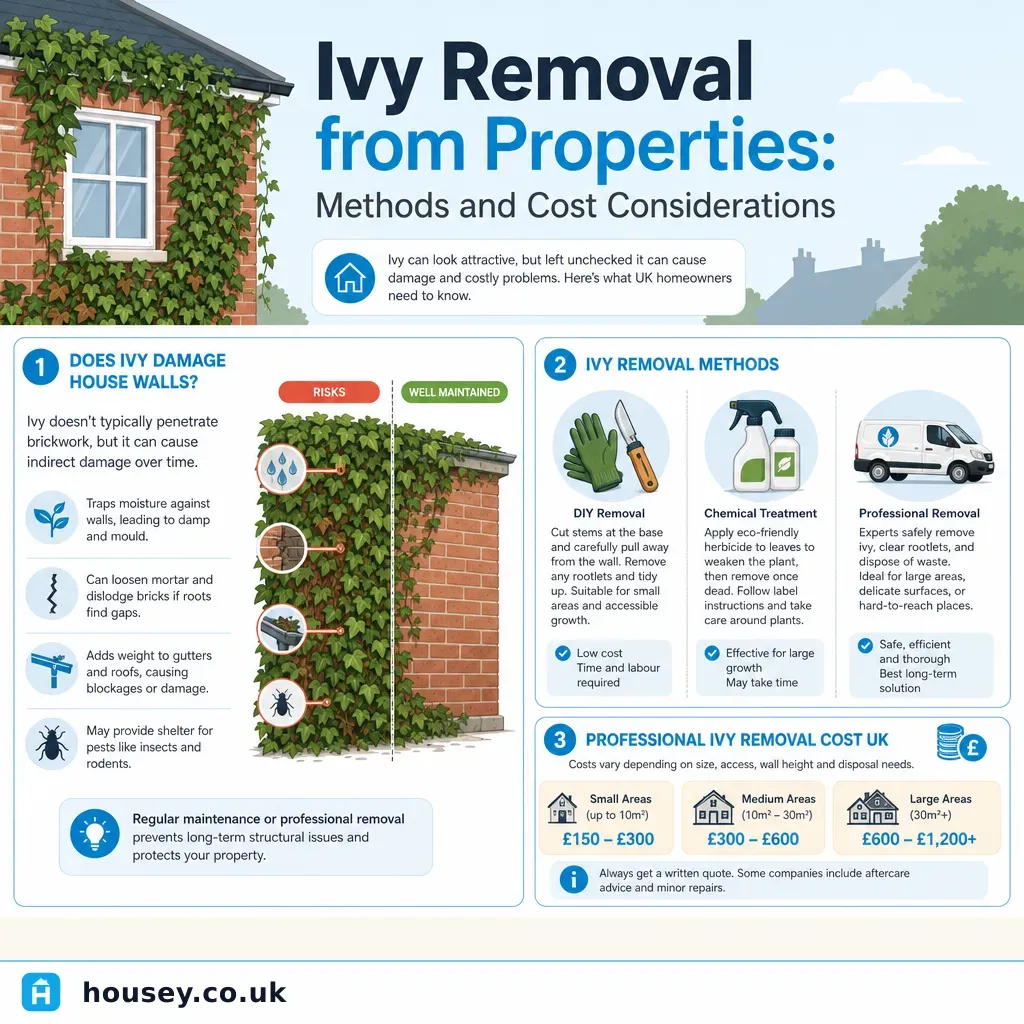
Ivy Removal from Properties: Methods and Cost Considerations
Ivy growing on or around a UK home can divide opinion sharply. Left unchecked for decades, established stems can work their way into mortar joints, lift roof tiles, and block gutters; removed carelessly or at the wrong time of year, the same growth can strip mortar from older brickwork or disturb nesting birds protected by law. Questions about removal most often arise when ivy has reached the gutterline, when external repairs are planned, or when a surveyor flags it during a property transaction. Knowing the right method — and when to call in a professional — protects both the building and the homeowner.
Key points
- Cut ivy stems at the base and leave the dead growth in place for at least two to four weeks before removing it from the wall — this minimises damage to mortar and surface finishes.
- English ivy (Hedera helix) is not classified as an invasive species requiring legal control under the Wildlife and Countryside Act 1981 in England and Wales, unlike Japanese knotweed.
- Deliberately damaging or destroying an active bird nest is a criminal offence under the Wildlife and Countryside Act 1981; avoid removing significant vegetation between March and August without checking for nesting birds.
- Indicative professional removal costs range from approximately £150 to £800 for typical domestic coverage, depending on height, area, and whether stump treatment and waste disposal are included.
- Ivy on lime mortar — common in pre-1919 properties — carries a higher risk of joint damage on removal than ivy on modern cement mortar.
Should you remove ivy at all?
Ivy is not inherently harmful. Established ivy on sound, well-pointed brickwork can act as an insulating layer, protect walls from freeze-thaw cycles, and provide habitat for insects and nesting birds. Historic England has noted that ivy on sound masonry may offer some protective benefit in certain circumstances.
Removal becomes advisable when:
- Stems are entering gaps in mortar joints, brickwork cracks, or under roof tiles or lead flashings.
- Growth is blocking gutters, downpipes, or air bricks essential for sub-floor ventilation.
- You suspect ivy is concealing existing damp, cracking, or mortar problems that need inspection.
- You want to carry out external pointing, painting, or rendering.
- Ivy is growing into tree canopies or competing with structural planting.
Methods for removing ivy from buildings
Cut and let die (recommended for wall-mounted ivy)
This is the most widely recommended approach for ivy on masonry walls:
- Using secateurs or loppers, cut the main stems cleanly at ground level or at the base of the wall.
- Leave the severed stems in place for two to four weeks. Without water from the roots, the stems and leaves die, lose moisture, and release much of their grip on the surface.
- Once dead and dry, pull stems away from the wall working downwards. Use a stiff brush to remove smaller stems and holdfasts — the adhesive pads ivy produces to grip masonry.
- Treat cut stumps in the ground with an appropriate herbicide (glyphosate is commonly used) or excavate the root ball to prevent regrowth.
Avoid pulling live, green ivy from walls. Active growth means holdfasts grip the surface more firmly under tension, and aggressive removal is more likely to dislodge mortar or brick fragments.
Herbicide treatment
Applying a systemic herbicide such as glyphosate to cut stems or foliage kills the root system and makes subsequent physical removal easier. This approach is useful for large areas or where physical removal alone would be very laborious. Always follow the manufacturer's instructions precisely, observe required buffer distances from watercourses and drainage, and check the label for restrictions near trees or specific surfaces.
Professional removal
For extensive coverage, heights above 2m, or ivy affecting roofs, gutters, or trees, a professional contractor will have the access equipment, experience, and insurance to complete the work safely and effectively.
DIY versus professional removal
Scenario | DIY suitable? | Professional recommended? | Notes |
|---|---|---|---|
Small patch on sound cement-mortar brickwork, below 2m | Yes | Optional | Use cut-and-wait method; check for active nests |
Large wall coverage (over 5m²) | Possible | Recommended | High physical effort; risk of missing embedded stems |
Any work above 2m or near gutters or roof | No | Yes | Working at height above 2m requires appropriate equipment and risk planning |
Pre-1919 property with lime mortar | Proceed with caution | Recommended | Higher risk of joint damage; consider a surveyor's view beforehand |
Ivy growing into or around trees | No | Yes — tree surgeon | Incorrect removal can damage tree bark and structural roots |
Listed building or conservation area | Seek advice first | Professional advised | Check whether listed building consent or local authority agreement is required |
Pre-removal assessment checklist
Before starting or commissioning ivy removal from your property:
Red flags: seek advice before starting
Get professional input before removal if:
- Ivy stems are thicker than 5cm in diameter at the base — the plant may be decades old and its holdfasts significantly embedded in the masonry.
- There is visible cracking, bulging, or staining on the wall behind the ivy coverage — this could indicate structural movement or water ingress that removal will expose.
- Ivy is growing under, lifting, or entering the roof structure — a roofing inspection may be needed before and after removal.
- The property is listed — check with your local planning authority whether listed building consent is required for significant external work.
- The property is leasehold — check your lease for obligations regarding the external envelope before proceeding.
What does professional ivy removal cost?
Costs depend on coverage area, access difficulty, property height, and whether stump treatment and waste disposal are included. Always request itemised quotes.
Indicative UK costs, last reviewed 2026-05-18:
- Small patch (up to 5m², ground level): £100–£250
- Medium coverage (5–20m², single storey): £250–£500
- Large coverage (20m²+, multi-storey or difficult access): £500–£1,200+
- Tree ivy removal by a tree surgeon: £200–£800 depending on tree size and access
Obtain at least two or three written quotes. Ensure each specifies what is included: stump treatment, debris removal, and confirmation of access arrangements.
When to get professional help
Use a professional when:
- Work involves heights above 2m or access to the roof level.
- The property has lime mortar or pre-existing mortar deterioration that could be worsened by removal.
- Ivy has penetrated gutters, roof edges, or the tree canopy.
- You want the root system properly treated to prevent rapid regrowth.
A tree surgeon is the right specialist when ivy is growing into or around trees. For wall coverage and general garden clearance, a landscaper or specialist vegetation removal contractor will typically carry out the work.
How Housey can help
Housey connects you with vetted local professionals for ivy removal and garden clearance across the UK. Find trusted landscapers and tree surgeons in your area, compare quotes, and read reviews from verified UK homeowners who have had similar work completed.
Frequently asked questions
Does ivy damage house walls?
On sound, well-pointed modern masonry, ivy's main risks are blocking gutters and creating persistently damp surface conditions. On older properties with lime mortar or crumbling joints, ivy holdfasts and roots can penetrate and enlarge existing gaps over decades, accelerating deterioration. Risk increases significantly with the age and scale of the plant.
Can I remove ivy during the bird nesting season?
It is a criminal offence under the Wildlife and Countryside Act 1981 to intentionally damage or destroy an active bird nest. If you find an active nest, defer work until confirmed empty — typically by late August or September. The RSPB advises checking vegetation carefully before disturbing it during spring and summer.
Will ivy grow back after removal?
Yes, in most cases, if stumps are not treated. Ivy regrows vigorously from its root system. Either apply glyphosate-based herbicide to cut stumps immediately after cutting, or excavate the root ball completely. Monitor the area for at least one full growing season and treat any regrowth promptly.
Do I need planning permission to remove ivy from my house?
In most cases, no — removing plants from your own property does not require planning permission. If the property is listed, however, significant external works may require listed building consent. If uncertain, check with your local planning authority or use the Planning Portal on GOV.UK.
Sources and further reading
- Wildlife and Countryside Act 1981 — legislation.gov.uk — legislation.gov.uk
- RSPB — nesting birds and the law — RSPB
- Historic England — caring for historic buildings — Historic England
- RHS — ivy growing guide — Royal Horticultural Society
- Planning Portal — listed buildings — Planning Portal
Useful next reads
 Improvement & Build
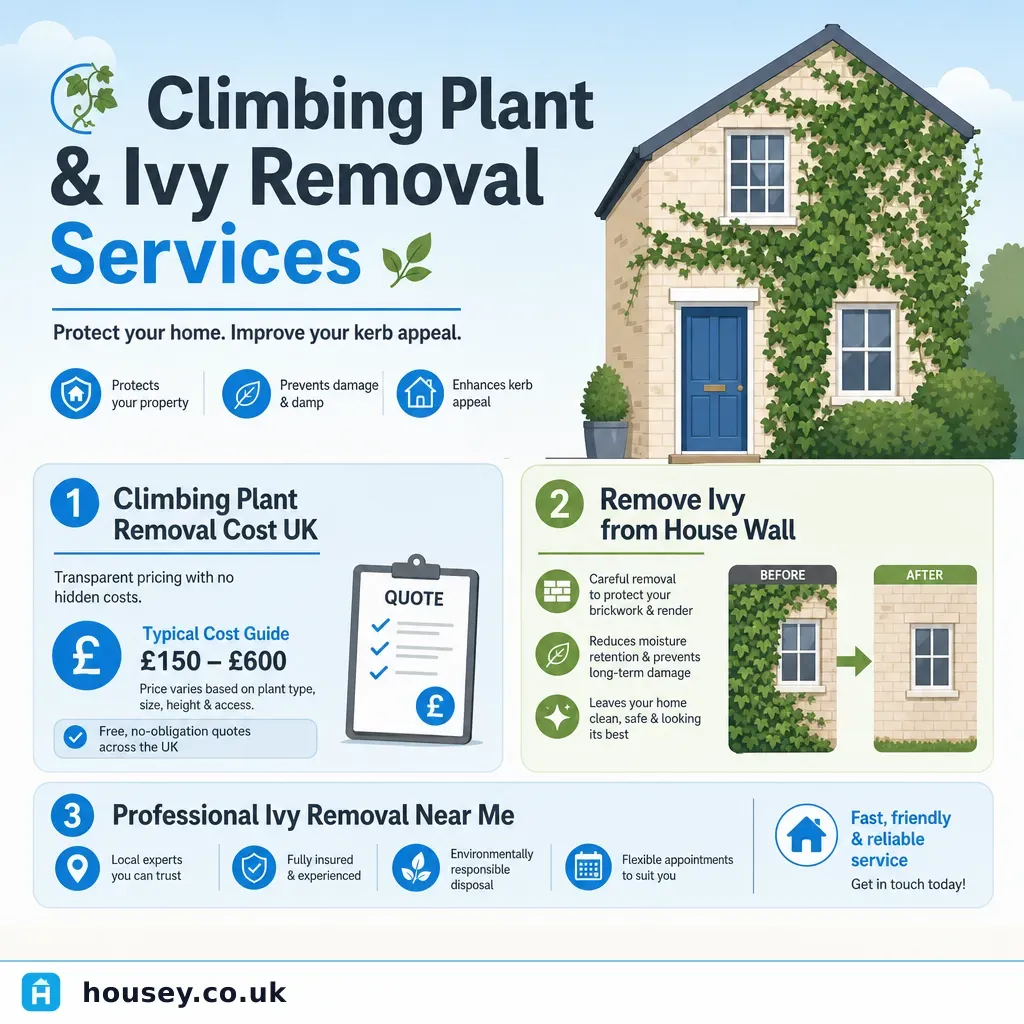
Climbing Plant and Ivy Removal Services
Professional ivy and climbing plant removal typically costs £150–£700 for a standard UK semi-detached, depending on coverage, plant type, and access requirements.
 Improvement & Build
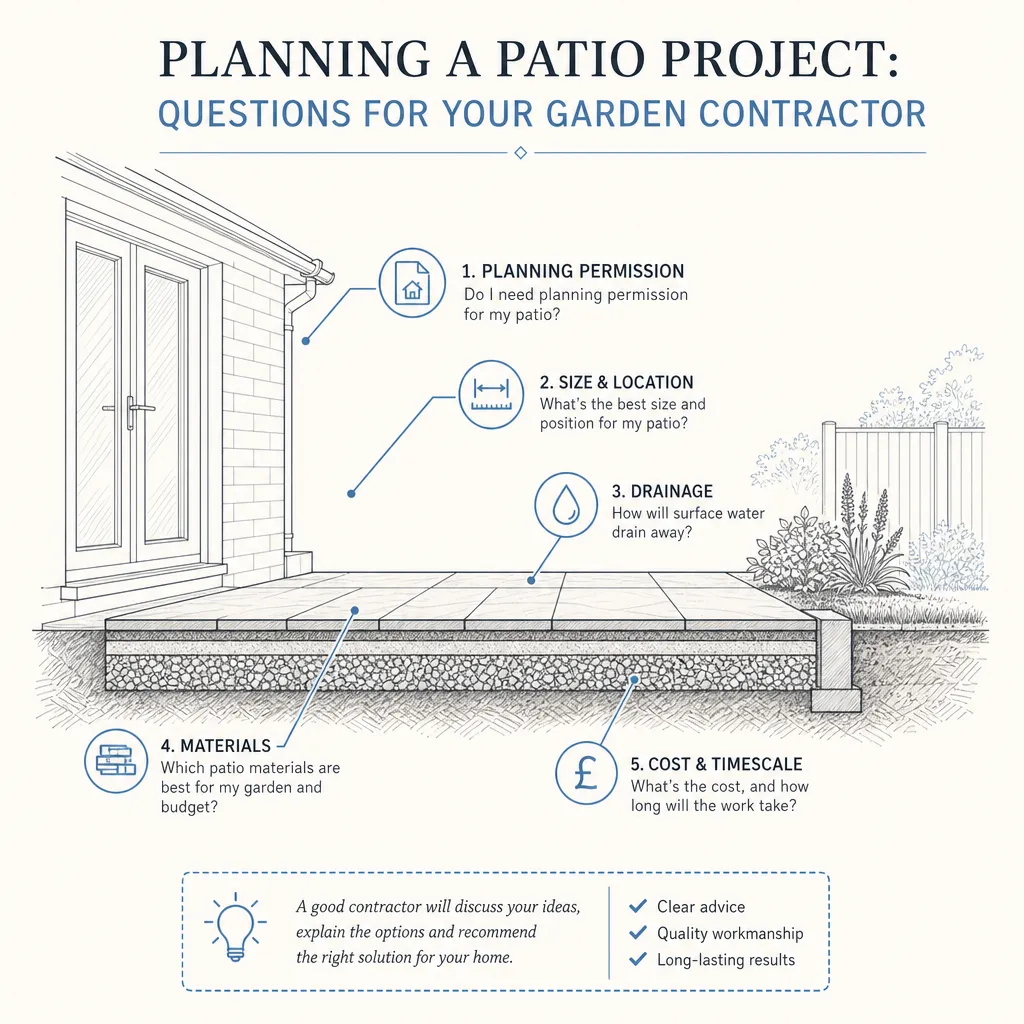
Planning a Patio Project: Questions for Your Garden Contractor
When planning a patio, ask your contractor about sub-base depth, bedding method, drainage gradient (typically 1:60 away from the house), and the frost-resistance rating of the paving.
 Improvement & Build
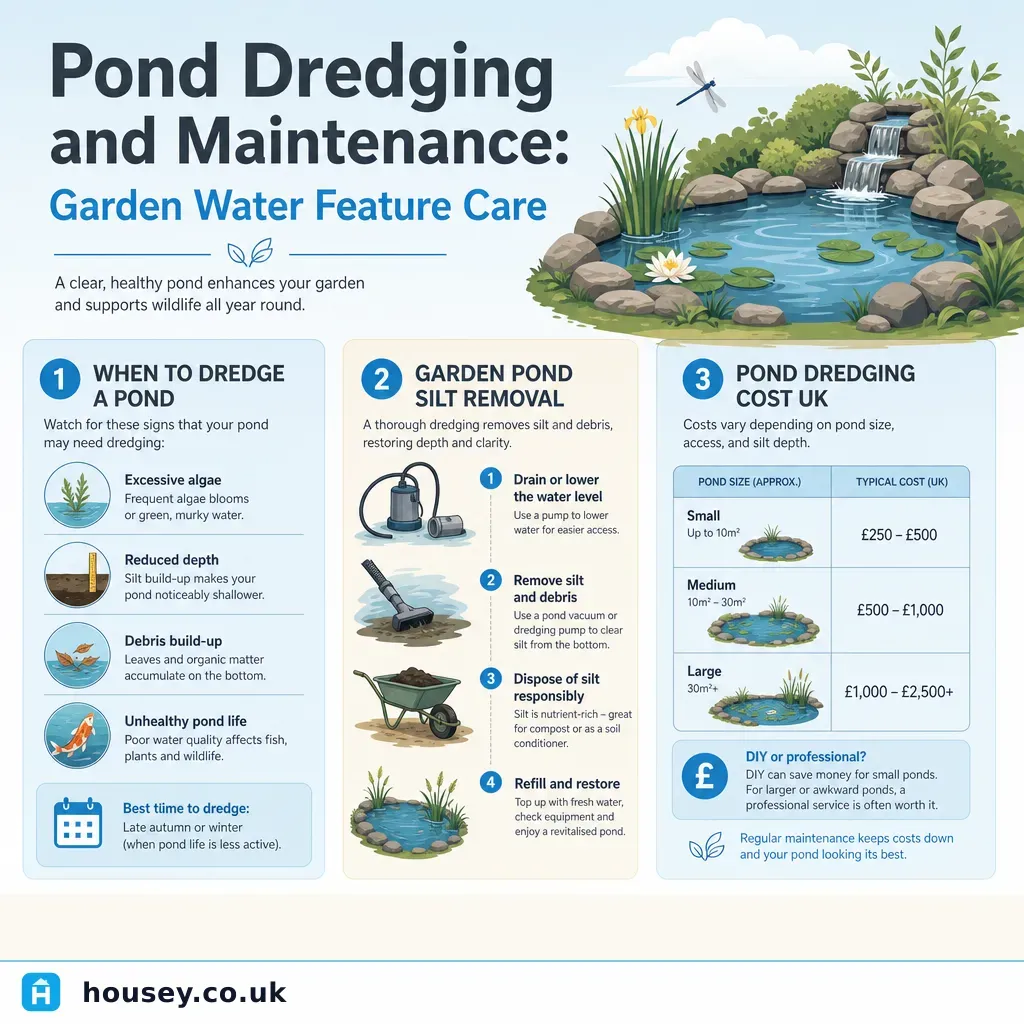
Pond Dredging and Maintenance: Garden Water Feature Care
Pond dredging involves removing accumulated silt, sediment, and decaying vegetation to restore water depth and quality.
 Improvement & Build
New Homeowner's Guide to Property Maintenance and Care
New UK homeowners should run seasonal checks on gutters, the boiler, roof, and damp at least twice a year and arrange an annual boiler service.
 Improvement & Build
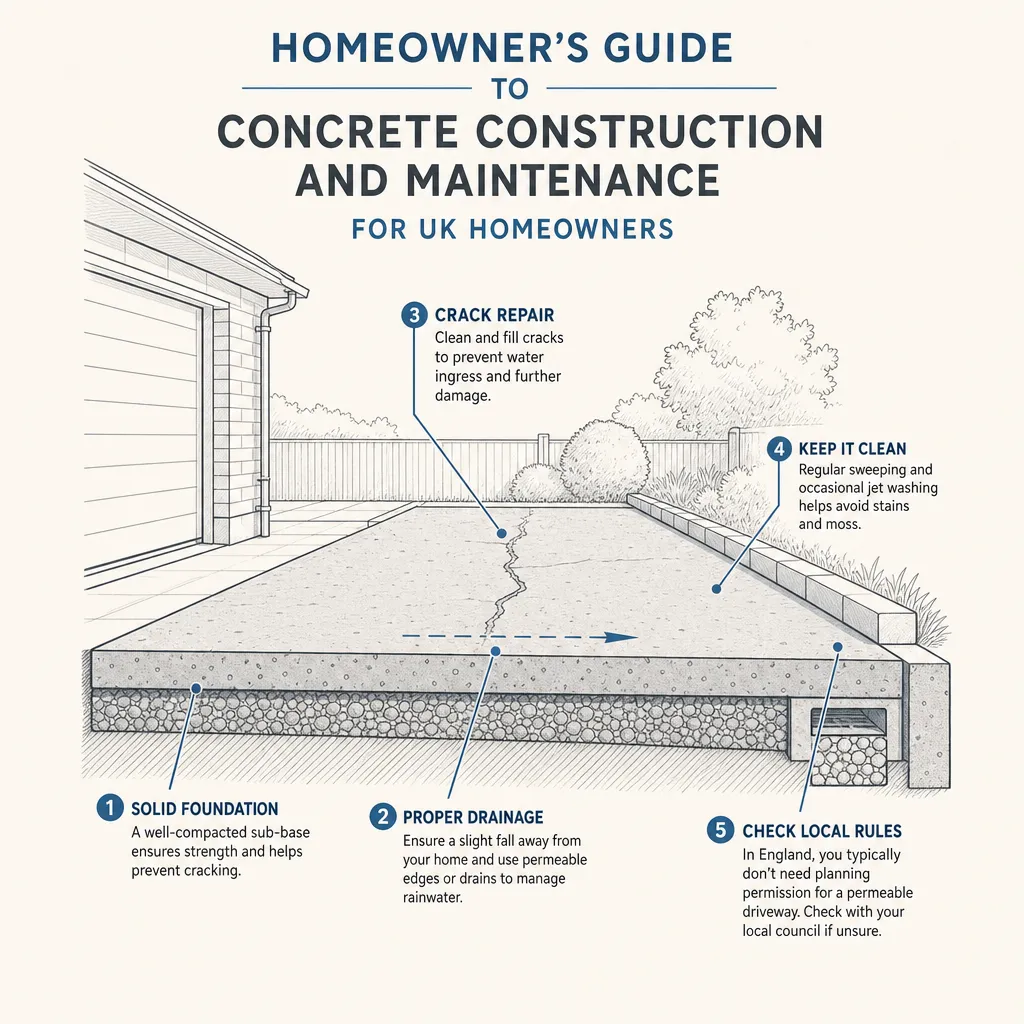
Homeowner's Guide to Concrete Construction and Maintenance
Concrete for residential driveways and paths should be specified to C25/30 grade, laid at least 100 mm thick over a compacted sub-base, and sealed every 3–5 years to resist freeze-thaw and oil damage.