Tree Planting and Landscaping Costs
By Housey · Last reviewed 11th of May 2026
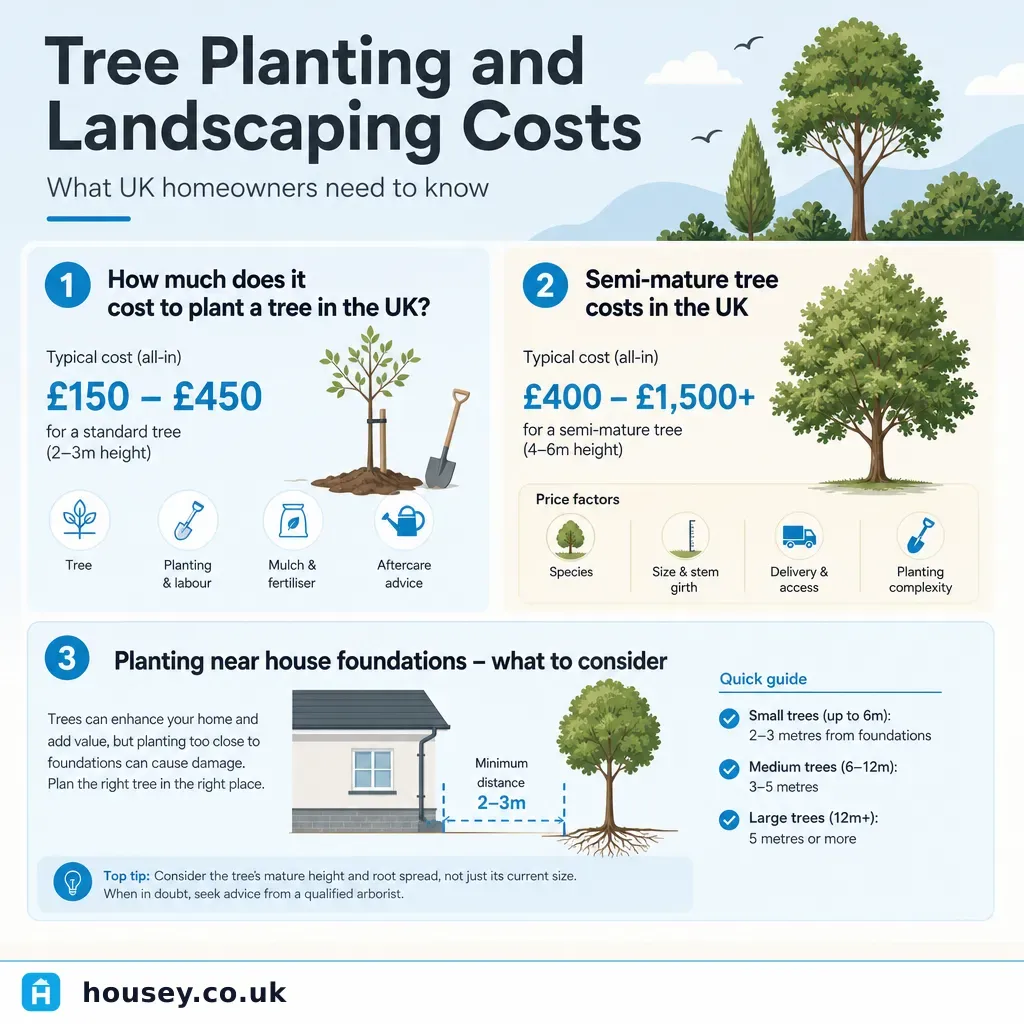
Tree Planting and Landscaping Costs
Planting trees is one of the highest-impact changes a homeowner or landscaper can make to a garden or outdoor space — affecting shade, privacy, biodiversity, drainage, and long-term property value. The challenge is matching species, size, and position to the constraints of a UK garden: soil type, proximity to buildings and drains, covenants, and sometimes planning conditions. The gap between an informed planting decision and an ill-considered one can manifest years later in subsidence claims, enforcement notices, or costly tree removal — all avoidable with the right preparation from the outset.
Key points
- The Woodland Trust offers free native trees for UK householders through its Free Trees programme — eligible individuals with adequate outdoor space can receive up to 18 trees, subject to seasonal availability.
- NHBC Standards and BRE guidance recommend minimum planting distances from foundations that vary by species and soil type; on shrinkable clay, high-water-demand species such as oak or poplar should typically be planted no closer to a building than their expected mature height.
- Trees planted to fulfil a planning condition must usually meet the species and size specified in the condition — substitutions require LPA approval.
- A newly planted tree can be made subject to a Tree Preservation Order (TPO) by the local planning authority at any time, so species choice matters from the outset in visible or ecologically sensitive settings.
- Indicative UK costs range from approximately £5–£30 for a bare-root whip to £500–£5,000+ for a semi-mature or heavy standard tree, plus soil preparation, staking, and professional planting fees. Indicative UK costs, last reviewed 2026-05-11.
Which type of tree do you need?
The size and form of tree you buy largely determines cost, establishment time, and suitability for your situation. Smaller stock is cheaper and often establishes more vigorously than large transplanted specimens, but takes longer to deliver visual impact.
Tree form | Typical height at purchase | Establishment time | Best for | Approx. cost (supply only) |
|---|---|---|---|---|
Bare-root whip | 0.5–1.2 m | 3–5 years | Mass planting, hedgerows, wildlife gardens | £5–£15 |
Feathered maiden | 1.5–2.5 m | 2–4 years | Garden trees, boundary planting | £20–£80 |
Light standard | 1.8–2.5 m clear stem | 2–3 years | Parkways, lawns | £60–£150 |
Standard | 2.5–3.5 m clear stem | 1–3 years | Street trees, formal gardens | £80–£250 |
Heavy standard | 3.5–4.5 m clear stem | 1–2 years | Instant impact, screen planting | £200–£600 |
Semi-mature / extra-heavy standard | 4.5–6 m+ | Months to 1 year | Immediate screening, high-value landscaping | £500–£5,000+ |
Indicative UK costs, last reviewed 2026-05-11. Installation, soil preparation, staking, irrigation, and professional fees are additional.
How to choose the right tree for your garden
- Choose a native or small-garden species (rowan, crab apple, field maple, ornamental cherry) if your garden is under 150 m², your soil is heavy clay, or you are planting within 10 m of a building.
- Choose a medium-sized species (silver birch, amelanchier, hornbeam, hazel multi-stem) if you have space for a canopy of 5–10 m at maturity and want to support wildlife habitat.
- Choose a large or long-lived species (oak, lime, beech, sweet chestnut) only where there is substantial space away from buildings, boundaries, and drains, and where you have the long-term management capacity to maintain it.
- Ask a qualified arborist or landscaper if you are unsure about proximity to foundations, drains, or neighbouring property — getting this wrong can cause subsidence, drain damage, or boundary disputes.
- Check your local planning authority if your property has any planning conditions specifying replacement planting — species, size, and location may be prescribed and substitutions require LPA approval.
Trees near buildings and drains: what not to assume
This is the area where homeowners most often make costly mistakes, and where professional advice before planting pays for itself many times over.
Do not assume all trees are safe near buildings. On shrinkable clay soils — common across much of southern and eastern England — tree roots extract moisture from the ground, causing clay to shrink and soil to subside beneath foundations. Subsidence caused by trees is one of the leading causes of household insurance claims in the UK.
Do not assume small species are always safe near buildings. Even a modest ornamental tree can cause problems if planted in clay soil within a few metres of a shallow foundation. Willows and poplars are particularly high-risk due to their aggressive root systems and very high water demand.
Do not assume roots only spread to the edge of the canopy. Tree roots commonly extend to 1.5–3 times the crown radius, and sometimes much further on permeable soils. Underground drainage, water mains, and old clay pipes are especially vulnerable to root intrusion.
Do not assume planting never requires permission. Planting itself does not usually need planning permission, but if you are satisfying a planning condition, the condition terms bind you to the specified species and size. Any tree you plant can subsequently receive a TPO, restricting future management without LPA consent.
Do not assume all newly planted trees establish without aftercare. Even mature specimens typically require watering for at least two growing seasons and may need stake adjustments, mulching, and protection from rabbits or deer in rural gardens.
Typical UK costs for tree planting
The cost of planting a tree depends on species, size, soil condition, site access, and whether professional planting and aftercare are included.
Indicative UK costs, last reviewed 2026-05-11:
Item | Approx. cost |
|---|---|
Bare-root whip (supply only) | £5–£15 per tree |
Standard tree (supply only) | £80–£300 |
Heavy standard (supply only) | £200–£800 |
Semi-mature tree (supply and crane delivery) | £1,000–£8,000+ |
Professional planting per tree (simple access) | £50–£200 |
Soil preparation per tree | £30–£100 |
Staking and ties | £15–£50 per tree |
Tree guard or rabbit protection | £5–£25 per tree |
Irrigation sleeve installation | £20–£60 per tree |
For multi-tree schemes, a landscape architect or qualified arborist can produce a planting plan that optimises species selection, spacing, and layout. A residential planting scheme typically costs £300–£1,500 for a professional plan and can prevent expensive remedial work further down the line.
Free and subsidised tree schemes in the UK
Several national and local programmes offer free or low-cost trees for UK households:
- Woodland Trust Free Trees: eligible householders and community groups can apply for free native trees. Applications typically open in early autumn for winter or spring delivery. Check the Woodland Trust website for current availability and eligibility criteria.
- Trees for Streets: a matched-funding scheme enabling residents to sponsor street trees, with many councils contributing towards planting costs.
- Local authority planting schemes: many councils run neighbourhood planting programmes — check your local council website for current availability in your area.
- England Woodland Creation Offer (EWCO): available to landowners and farmers for larger-scale tree planting through the Forestry Commission.
When to get professional help
Seek advice from a qualified arborist (Arboricultural Association accredited) or landscape architect before planting if:
- Your garden is on shrinkable clay soil and you are considering trees within 10 m of a building or drain.
- You are planting a semi-mature or heavy standard tree that requires crane delivery and specialist planting.
- Your site has a planning condition specifying replacement planting.
- You are unsure whether existing adjacent trees have root systems that could affect your planting area.
- You are uncertain whether deed restrictions or covenants limit tree planting on your plot.
How Housey can help
Whether you need help with a new planting scheme, site assessment, or aftercare advice, Housey connects you with qualified tree surgeons and experienced landscapers in your area. Compare quotes from local professionals who can recommend the most suitable species and planting approach for your garden.
Frequently asked questions
Do I need planning permission to plant a tree in my garden?
In most cases, planting a tree in your own garden does not require planning permission. However, if your property has a planning condition specifying replacement planting, the condition terms will apply to species and size. Any tree you plant can subsequently be made subject to a Tree Preservation Order by your local planning authority.
How far from a house should I plant a tree?
There is no single universal answer — it depends on species, mature height, and your soil type. On shrinkable clay soils, NHBC guidance recommends a minimum planting distance roughly equal to the mature height for high-water-demand species. Always consult a qualified arborist before planting large species near buildings, drains, or boundaries.
What is the cheapest way to establish trees in a garden?
Bare-root whips planted in autumn or winter are the most cost-effective option, typically £5–£15 per tree. They establish quickly because they are not container-grown and experience less root disturbance during planting. Bare-root planting season typically runs from November to March, when trees are dormant.
How long does a newly planted tree take to establish?
Small bare-root whips can take three to five years to become properly established. Larger standards establish faster in visible growth terms but are vulnerable to wind-rock in the first one to two years and require regular watering. Semi-mature trees with well-prepared root balls can show good establishment within one growing season if aftercare is maintained.
Can my neighbour remove a tree I plant near the boundary?
Your neighbour is entitled to cut back any branches or roots that encroach over or under the boundary line, but they must return the cuttings to you and cannot enter your land. If the tree causes a nuisance or hazard to a neighbouring property, you may have a legal duty to manage it.
Sources and further reading
- Woodland Trust Free Trees for Householders — Woodland Trust
- Trees for Streets matched-funding scheme — Trees for Streets / Groundwork
- Tree Preservation Orders and trees in conservation areas — GOV.UK
- NHBC Standards Chapter 4.2: Building near trees — NHBC
- England Woodland Creation Offer (EWCO) — GOV.UK / Forestry Commission
Useful next reads
 Improvement & Build
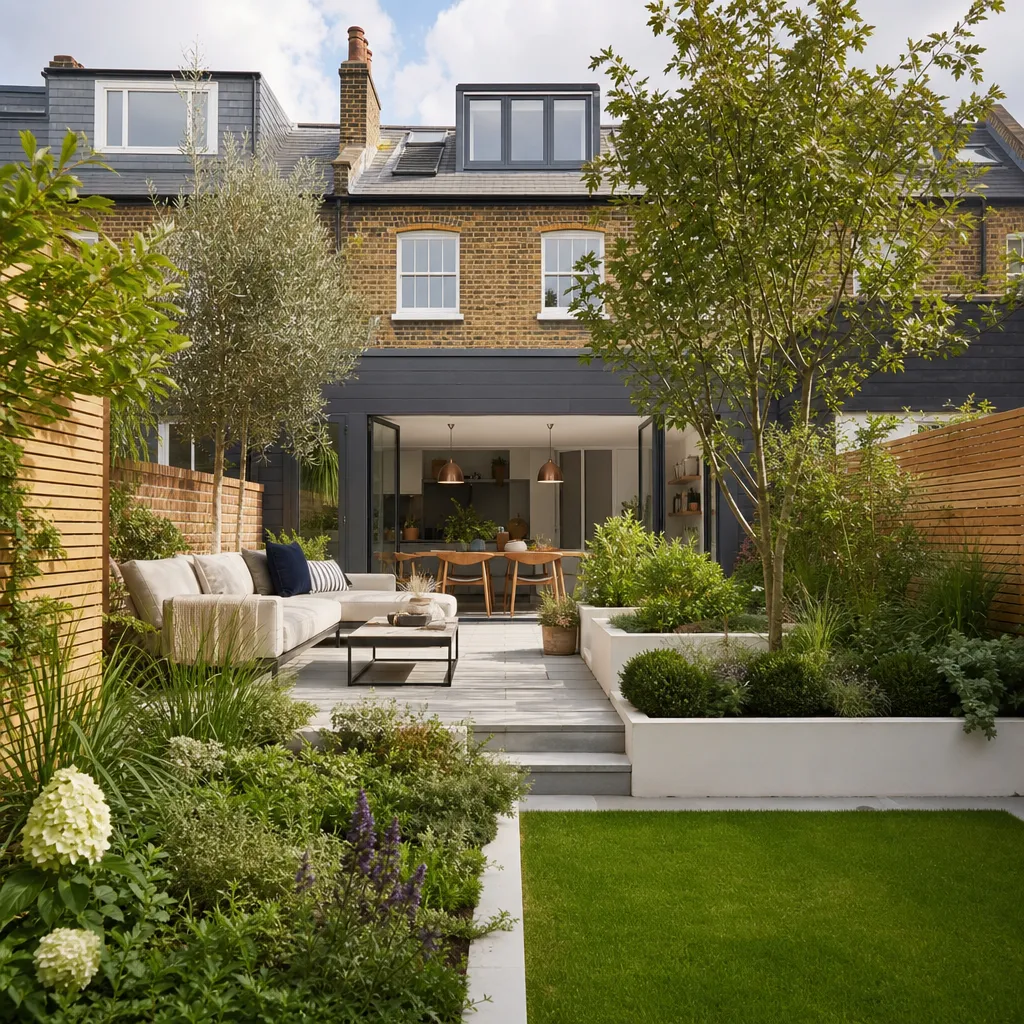
Seasonal Garden Transformations and Outdoor Design Ideas
A successful garden transformation in the UK works with the seasons rather than against them — establishing structure and hard landscaping in autumn or winter, planting in spring, and enjoying the results through summer.
 Improvement & Build
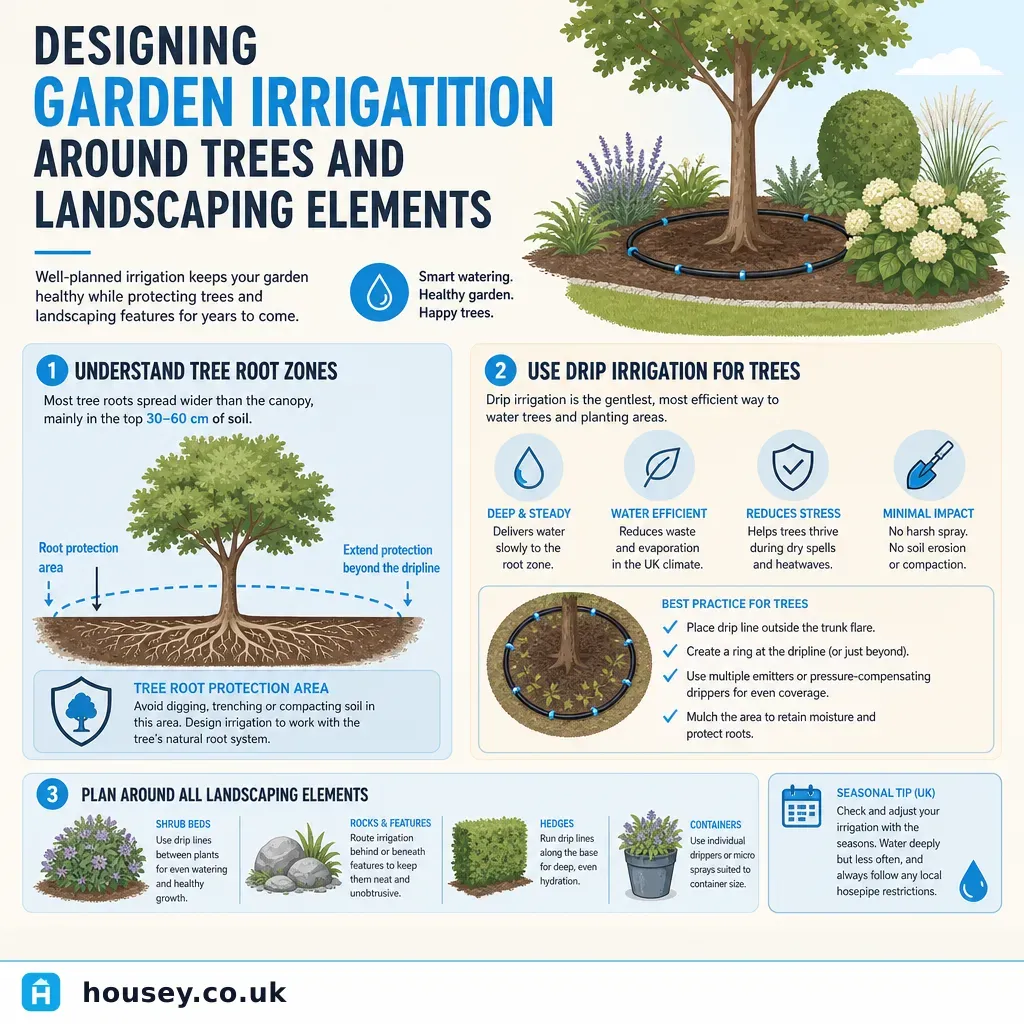
Designing Garden Irrigation Around Trees and Landscaping Elements
Design irrigation around trees by respecting the root protection area defined under BS 5837:2012, using drip or leaky pipe delivery rather than spray heads, and putting the tree zone on its own circuit.
 Improvement & Build
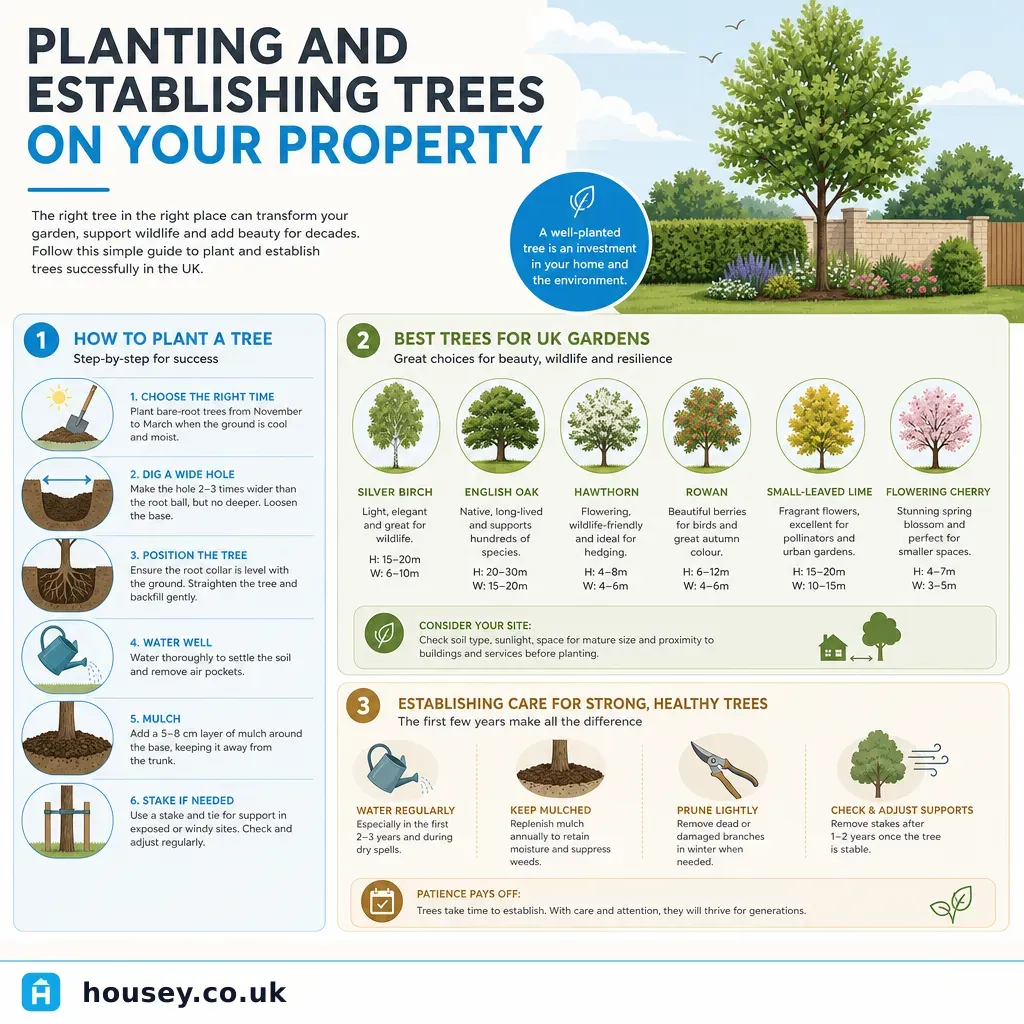
Planting and Establishing Trees on Your Property
Trees planted in the right season (October to March for bare-root stock), in well-prepared ground, and with appropriate staking and aftercare will establish most successfully.
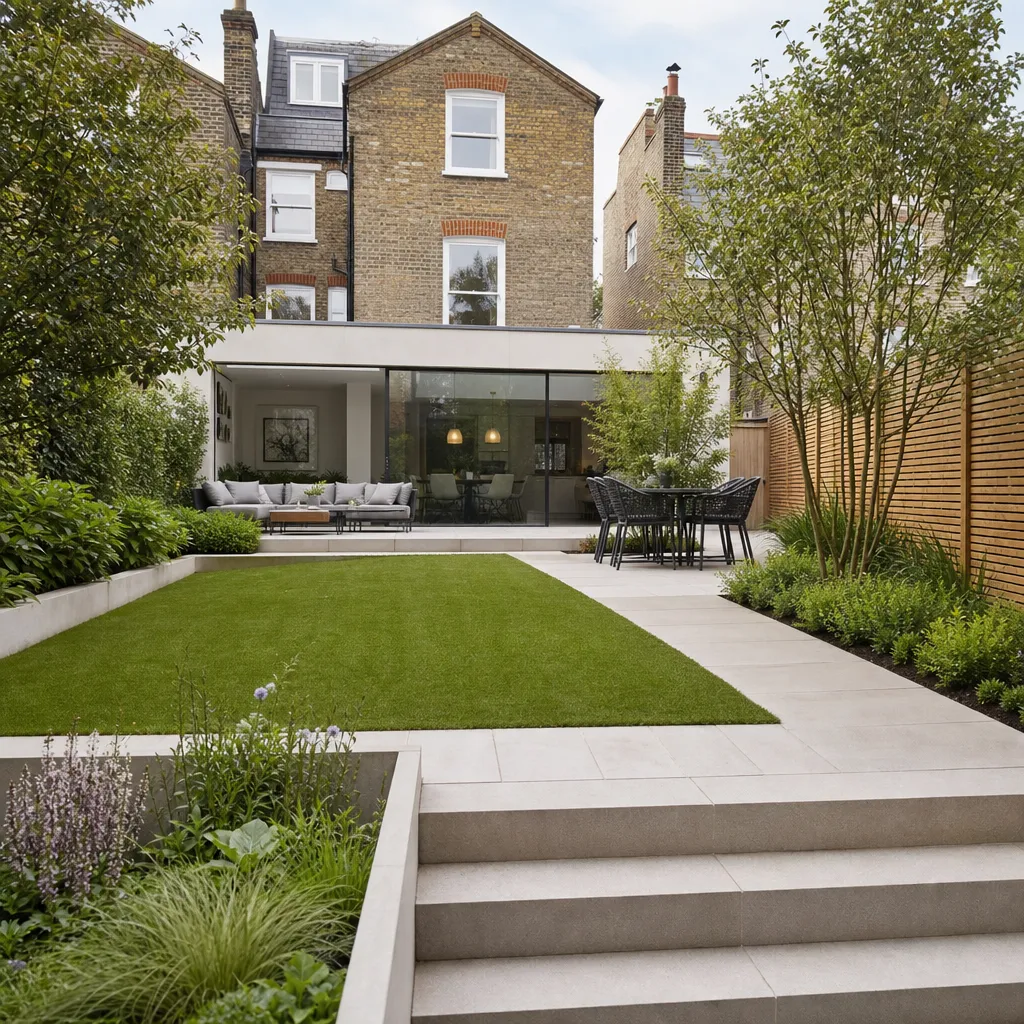 Improvement & Build
Garden Design Trends and Contemporary Landscaping Ideas
Contemporary UK garden design centres on low-maintenance naturalistic planting, multi-functional outdoor spaces, sustainable hard landscaping materials, and wildlife-friendly rewilded areas.
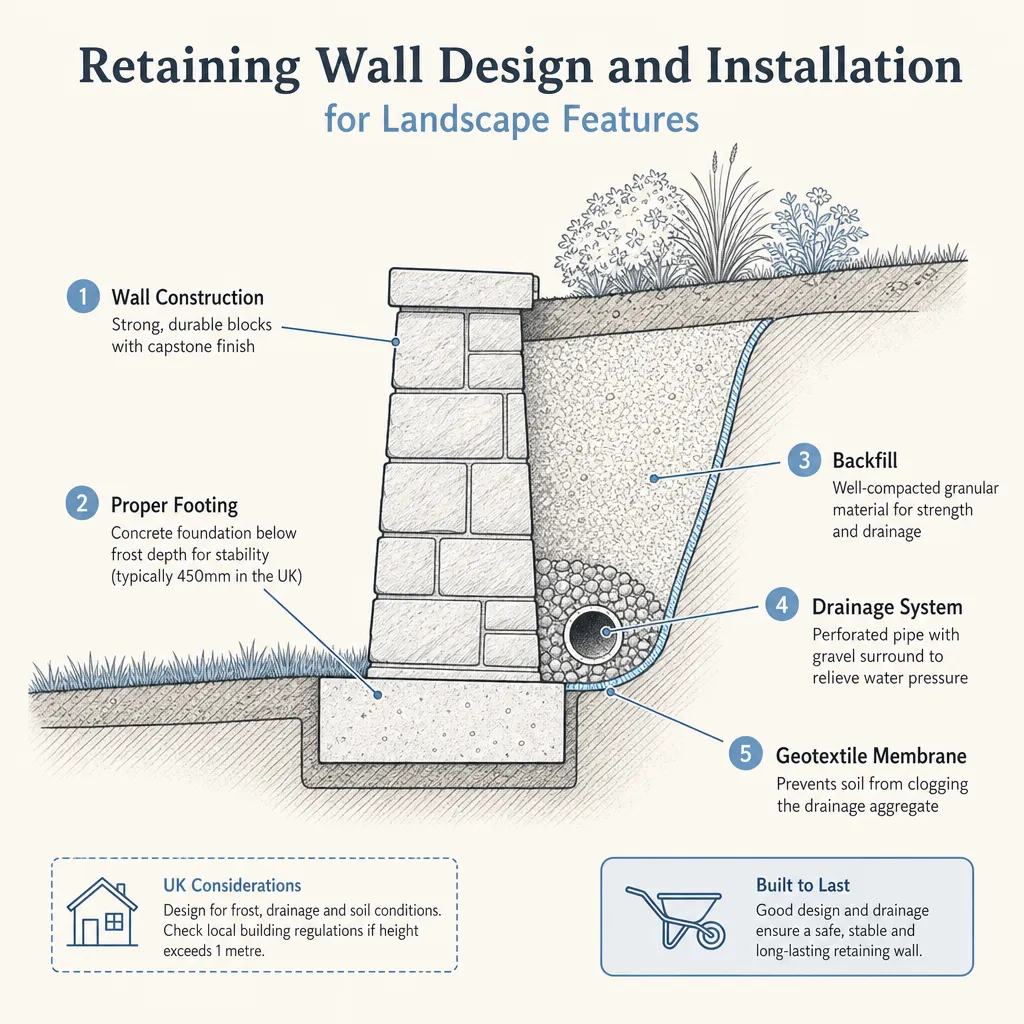 Improvement & Build
Retaining Wall Design and Installation for Landscape Features
A garden retaining wall holds back soil on a sloped plot using concrete blocks, stone, or timber.