Kitchen Diner Extension: Costs and Considerations
By Housey · Last reviewed 7th of May 2026
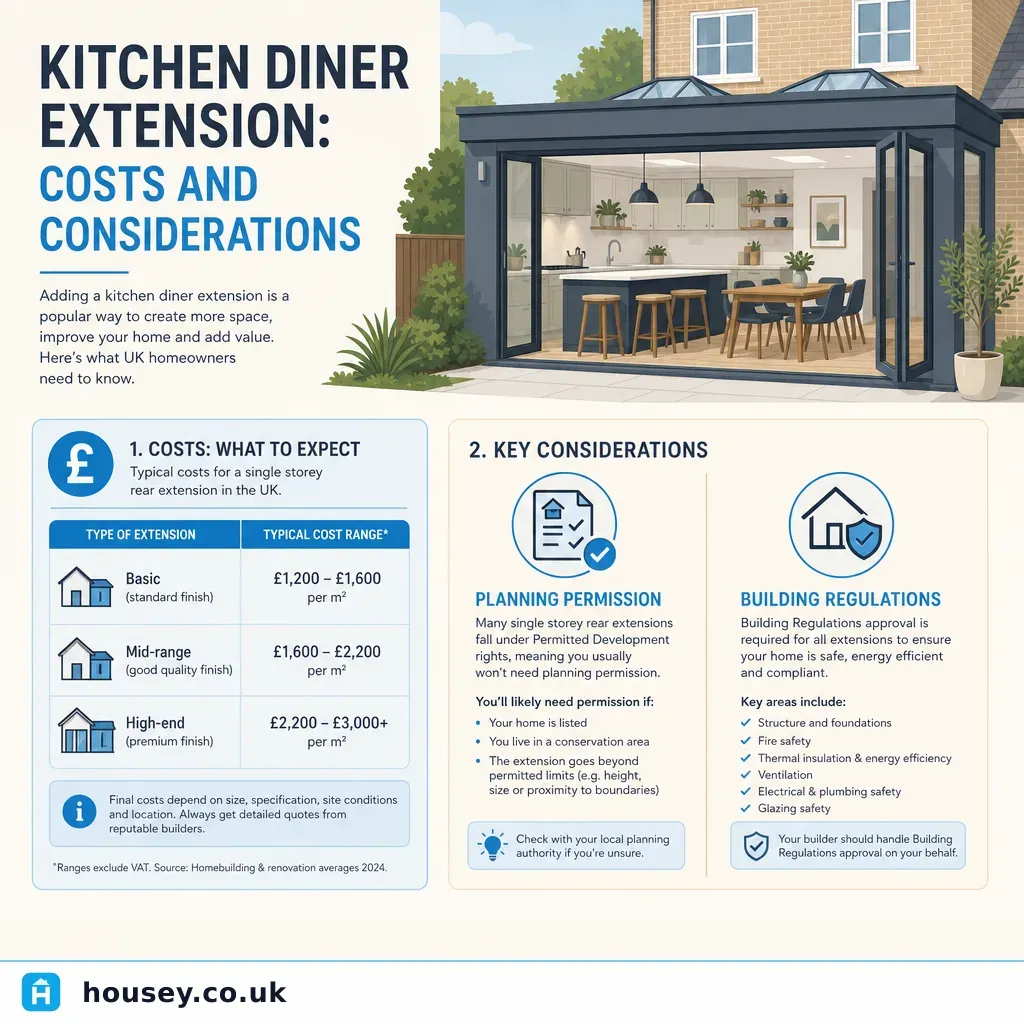
Kitchen Diner Extension: Costs and Considerations
Adding a kitchen diner to the back of a UK home is one of the most popular home improvement projects undertaken each year, typically to create open-plan living space that connects the kitchen to the garden. The decision usually arises when an existing kitchen feels cramped, when a growing family needs a combined cooking and eating area, or when owners are preparing a property for sale. Because the project involves structural work, building regulations compliance, and often a complete kitchen fit-out, the total cost and the professional decisions involved can quickly become substantial.
Key points
- A single-storey rear extension in England often falls under permitted development rights, but a building regulations application is always required regardless of planning status — these are two entirely separate legal processes.
- Structural calculations are required whenever a load-bearing wall is opened up for a wide beam or bifold aperture; a chartered structural engineer's approval is needed before building control will sign off the work.
- Indicative UK build costs for a single-storey extension range from approximately £1,800 to £3,000+ per m² depending on specification and region (Indicative UK costs, last reviewed 2026-05-07).
- Party wall notices may be required under the Party Wall etc. Act 1996 if your extension is within 3 metres of a neighbour's foundation or involves work on a shared boundary wall.
- Kitchen fit-out costs — units, worktops, appliances, and installation — are entirely separate from the structural build cost and typically add £5,000 to £30,000+ to the project total.
How much does a kitchen diner extension cost?
The total cost depends on floor area, specification, your location in the UK, and the scope of kitchen you choose. Build cost alone does not cover kitchen units, appliances, or finishes.
Indicative UK build costs for a single-storey extension (last reviewed 2026-05-07):
Size | Basic specification | Mid-range | High specification |
|---|---|---|---|
12 m² (3m × 4m) | £22,000–£28,000 | £28,000–£36,000 | £36,000–£48,000 |
20 m² (4m × 5m) | £36,000–£46,000 | £46,000–£60,000 | £60,000–£80,000 |
30 m² (5m × 6m) | £54,000–£68,000 | £68,000–£90,000 | £90,000–£120,000+ |
Indicative UK costs only. Prices vary significantly by region, contractor, and site conditions. Always obtain at least three itemised quotes.
Additional cost items to budget for:
- Structural engineer: £600–£1,500
- Architect or architectural technologist (drawings and specification): £2,000–£6,000
- Building regulations application (full plans): approximately £200–£500 depending on local authority
- Planning application in England, if permitted development does not apply: £258 for a householder application
- Kitchen units, worktops, and appliances: £5,000–£30,000+
- Structural opening such as a steel beam for bifold doors: £1,500–£4,000 including supply and padstone
London and the South East typically attract a 15–25% cost premium over the Midlands or Northern England.
What planning and building regulations apply?
Planning permission and building regulations are different processes; both may apply to your project.
Planning permission determines whether you may build the extension at all, based on its impact on neighbours and the local area. Building regulations govern how it must be constructed — structure, insulation, drainage, fire safety, energy efficiency, and ventilation.
Permitted development for rear extensions (England)
Under England's permitted development rights, a single-storey rear extension may not need planning permission if:
- It does not exceed 4 metres depth from the original rear wall for a detached house, or 3 metres for a semi-detached or terraced house
- It does not project beyond the side wall of the original house
- Its eaves and ridge heights do not exceed 3 and 4 metres respectively
- Materials match the original dwelling as closely as practicable
- The property is not in a conservation area, Area of Outstanding Natural Beauty, National Park, or listed building setting
Under the Prior Approval Neighbour Consultation Scheme, extensions of up to 8 metres (detached) or 6 metres (semi-detached or terraced) may also be permissible subject to a 42-day consultation process with adjoining owners. Always confirm with your local planning authority before relying on this route.
Building regulations approval is always required, regardless of permitted development status. Builders and architects typically submit either a Full Plans application (preferred for larger projects) or a Building Notice. Work is inspected by building control at key stages.
For Scotland, Wales, and Northern Ireland, permitted development rules differ — always check with your devolved planning authority.
Part L energy efficiency requirements
Extensions must meet Building Regulations Approved Document Part L (conservation of fuel and power). External walls typically need to achieve a U-value of 0.28 W/m²K or better, roofs 0.18 W/m²K, and all new glazing must meet minimum thermal performance standards. Your architect or building control officer will advise on how to achieve compliance for your specific design.
Worked UK property scenario
Property: 1960s semi-detached house in the East Midlands with a small galley kitchen and a separate dining room
Goal: Create a 20 m² open-plan kitchen diner by removing the wall between the kitchen and dining room and extending 4 metres into the garden
Indicative project cost breakdown (last reviewed 2026-05-07):
Item | Indicative cost |
|---|---|
Structural engineer (calculations and inspection) | £900 |
Architectural drawings (planning and building regs) | £3,200 |
Building regulations application | £350 |
Extension build (20 m², mid-range specification) | £50,000 |
Steel beam and structural opening | £2,800 |
Bifold doors (supply and fit, 3.6m aperture) | £4,500 |
Kitchen units, worktops, and appliances | £12,000 |
Contingency (10%) | £7,375 |
Estimated total | ~£81,125 |
Indicative figures only. Actual costs depend on contractor, specification, and local market. Obtain multiple itemised quotes before committing.
Which professionals do you need?
Professional | What they do | When to instruct |
|---|---|---|
Architect or architectural technologist | Designs the extension; produces planning and building regulations drawings | At project outset, before approaching builders |
Structural engineer | Calculates beam sizes, foundation loads, and structural openings | After design is agreed, before building regs submission |
Extension builder or main contractor | Manages and carries out the construction | Once drawings are complete and quotes obtained |
Party wall surveyor | Serves and responds to party wall notices | If the extension is within 3m of a neighbour's foundation |
Project manager | Coordinates trades; manages programme and cost | Optional but valuable on larger or complex projects |
Decision tree: do you need planning permission?
- Choose permitted development (no planning application) if the extension is single-storey, rear-facing, within the permitted depth and height limits, materials match, and the property is not in a designated area.
- Use the Prior Approval route if the extension exceeds standard PD limits but falls within the extended householder scheme (up to 8m detached, 6m semi or terrace). Your local planning authority manages the 42-day consultation.
- Apply for full planning permission if the property is listed, in a conservation area, or the extension exceeds all permitted development limits.
- Consult a planning consultant if the property has had prior extensions, carries an Article 4 direction, or if any planning condition on the title is unclear.
Red flags to watch for
- A quote that makes no mention of building regulations — any legitimate extension builder will include this in their scope
- A builder who wants to start work before building regulations drawings are approved or a Building Notice has been submitted
- No structural engineer involvement where the project removes a chimney breast, widens an opening beyond 1.5m, or builds on a sloping or potentially unstable site
- A lump-sum quote with no itemised breakdown, making it difficult to manage variations or disputes
- A very low quote that excludes groundworks, drainage connections, or making good to the existing structure
When to get professional help
An extension project always requires professional input. Instruct an architect or architectural technologist before approaching builders so that drawings are in place for accurate quoting and regulatory submission.
Seek professional advice urgently if:
- Your neighbour objects to the proposed works — the party wall process must be followed correctly
- Your local planning authority contacts you about unauthorised works under construction
- Cracks appear in the existing structure during or after construction
- Building control fails an inspection and requires remedial work
- Unexpected drainage runs or utilities are encountered during groundworks
How Housey can help
Housey connects you with vetted UK professionals for every stage of a kitchen diner extension. Find and compare quotes from experienced extension builders, instruct a structural engineer for load calculations and beam sizing, or bring in a project manager to coordinate the full build programme.
Frequently asked questions
Does a kitchen diner extension always need planning permission?
Not always. In England, many single-storey rear extensions fall under permitted development rights and do not need a planning application. However, all extensions require building regulations approval regardless of planning status. Properties in conservation areas, listed buildings, or those that exceed permitted development limits will need a full householder planning application to the local planning authority.
How long does a kitchen diner extension take to build?
Once design, planning, and building regulations approvals are in place, a typical 15–25 m² single-storey extension takes 10–16 weeks to construct. The pre-build stage — drawings, applications, and finding a contractor — often adds a further 8–16 weeks. Programmes vary by contractor, weather, and site conditions.
Can I stay at home during the extension build?
Usually, yes. Most families remain in the property during a rear extension, though kitchen access may be limited for several weeks while the new structure is connected to the existing building. Your builder should provide a programme identifying which phases affect habitable areas.
What is the difference between a Building Notice and Full Plans approval?
A Building Notice allows work to begin quickly, with building control inspections at each stage. Full Plans approval involves submitting detailed drawings for technical review before work starts. Full Plans is generally preferred for larger or more complex projects, as it reduces the risk of having to alter completed work to achieve compliance.
Will a kitchen diner extension add value to my home?
A well-executed extension in a desirable location typically adds value. Estate agents often cite returns of 5–15% of property value, though results depend on the local market, build quality, and whether the extension is proportionate to the property. No specific uplift is guaranteed; an RICS-registered valuer can give an informed view before you commit.
Sources and further reading
Useful next reads
 Improvement & Build
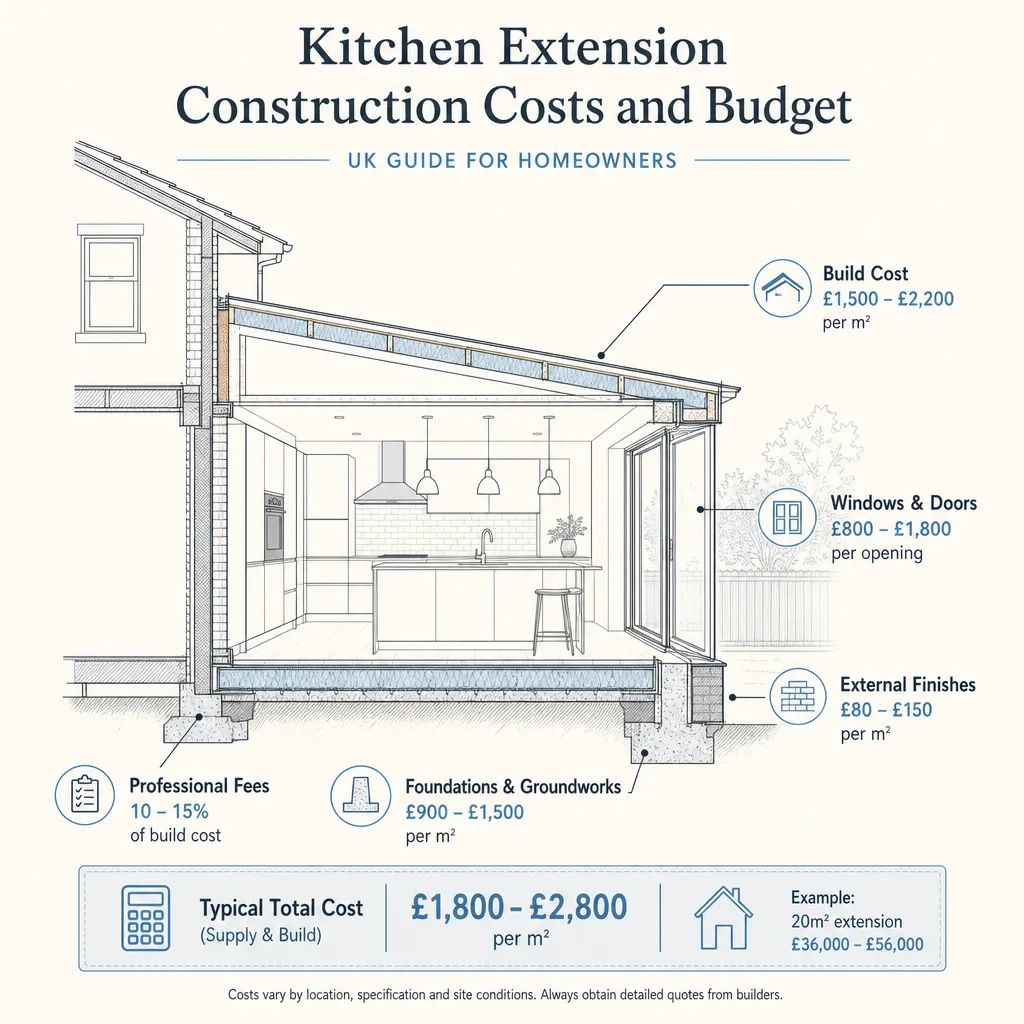
Kitchen Extension Construction Costs and Budget
A single-storey kitchen extension in the UK typically costs £25,000–£60,000 for build work, rising to £80,000+ for a large rear extension in London or the South East.
 Improvement & Build
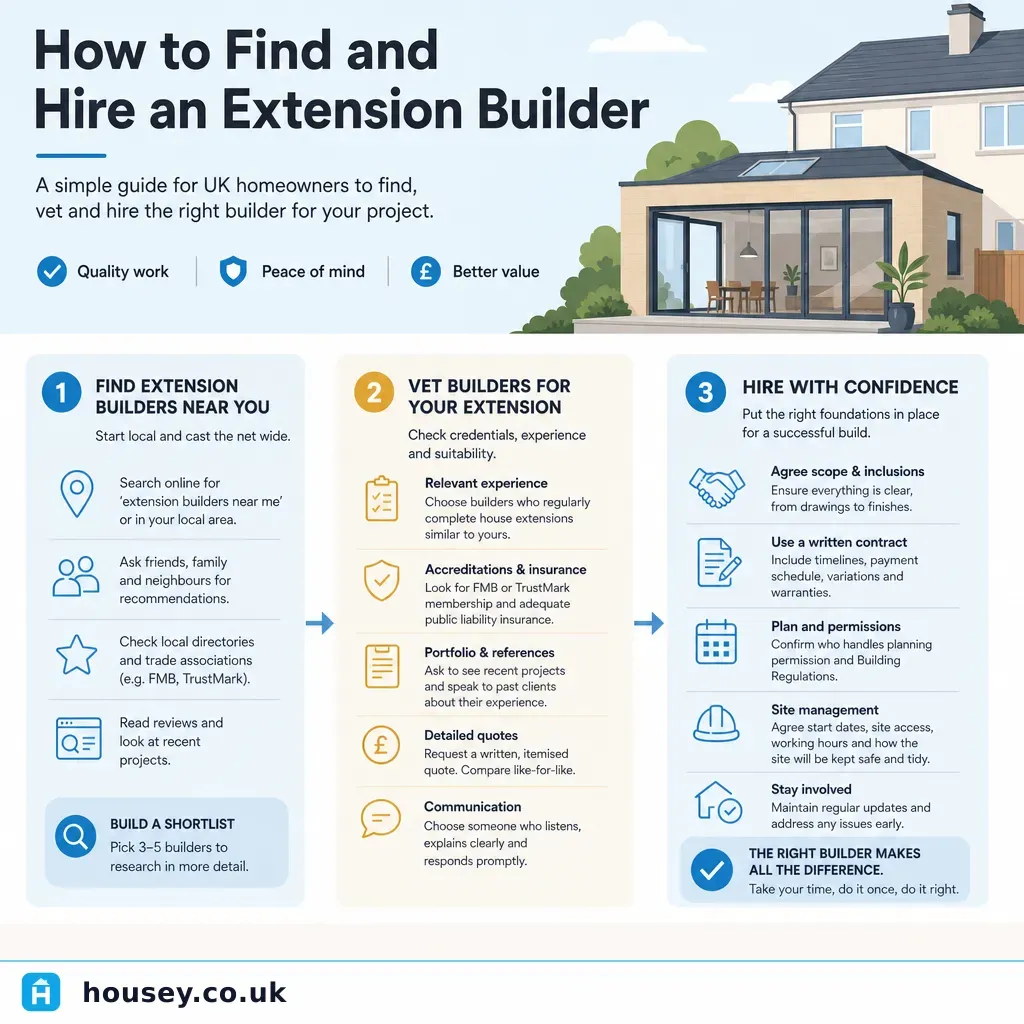
How to Find and Hire an Extension Builder
To hire a reliable extension builder, get at least three detailed written quotes from contractors with documented experience of similar projects.
 Improvement & Build
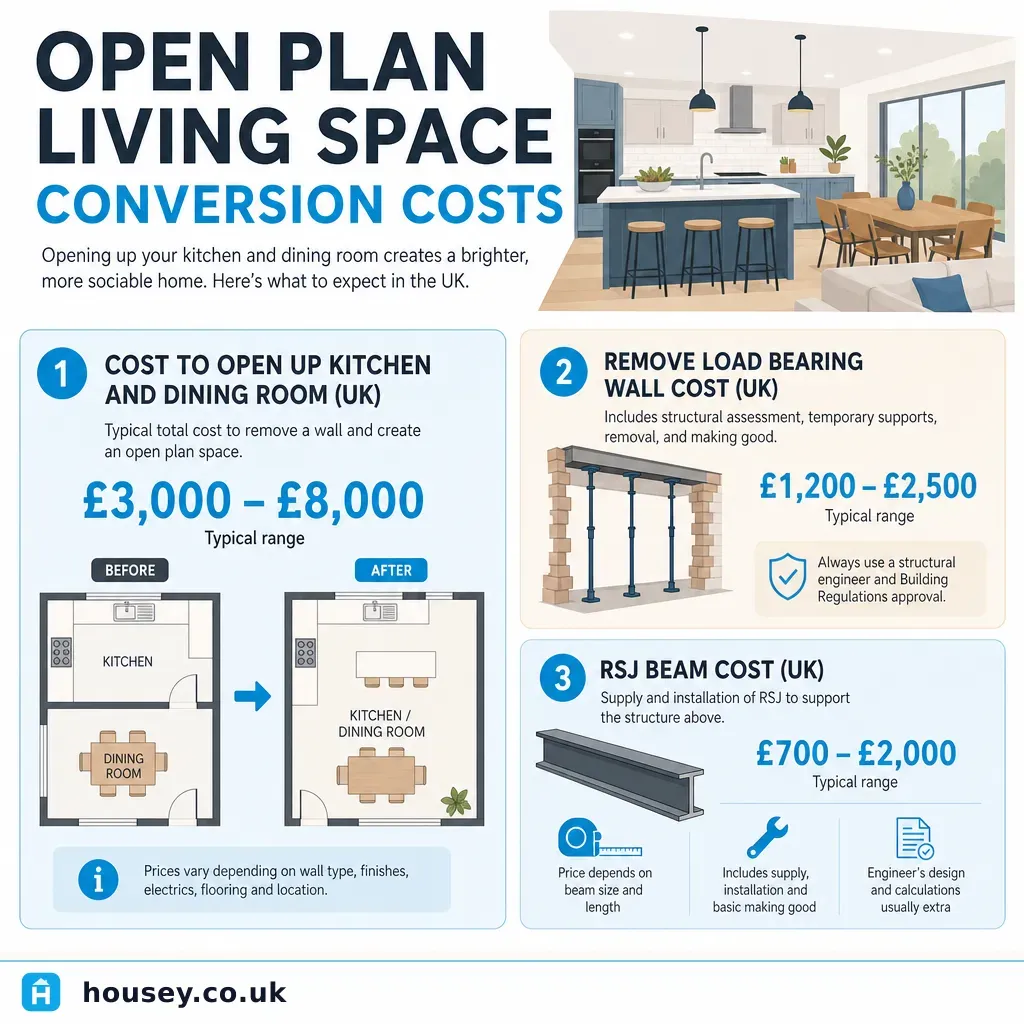
Open Plan Living Space Conversion Costs
Opening up a living space in the UK typically costs £3,000–£15,000+ depending on whether walls are load-bearing, the beam specification required, and the extent of remodelling.
 Improvement & Build
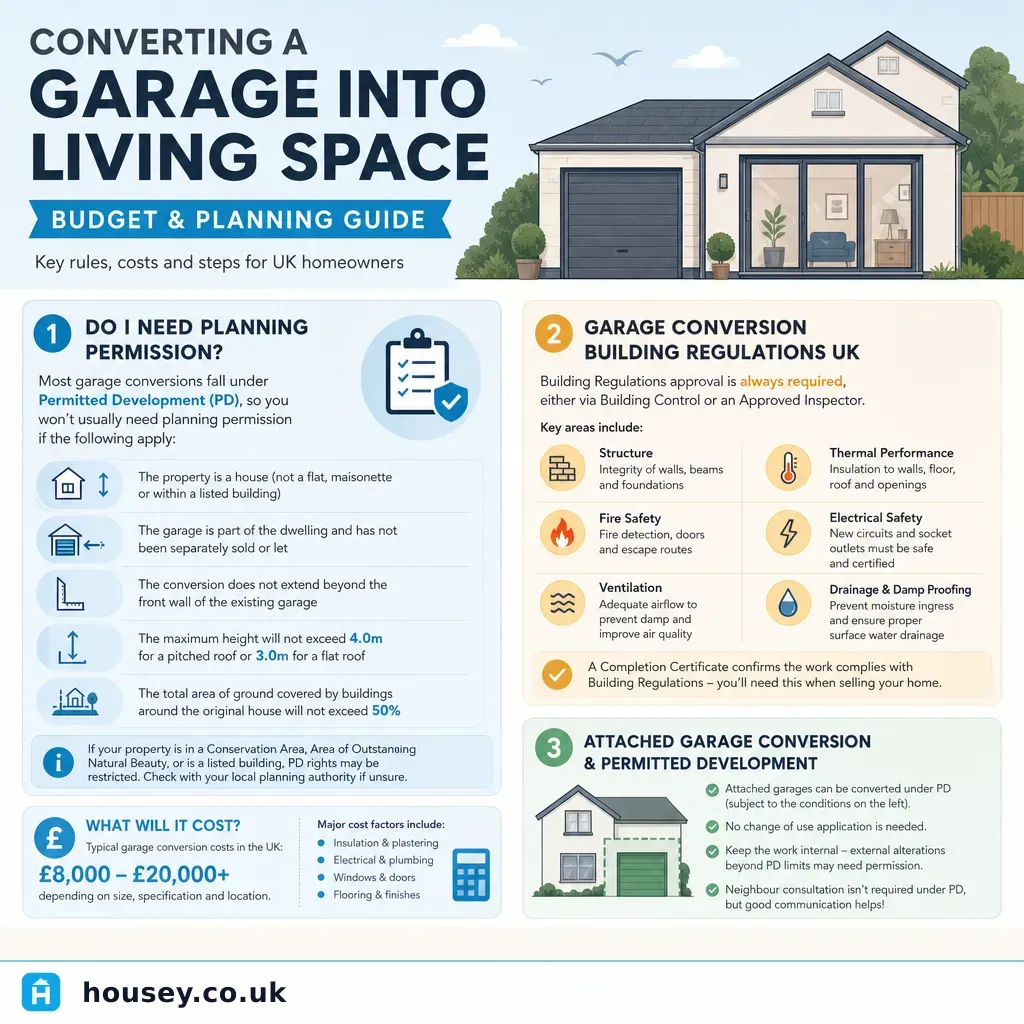
Converting a Garage into Living Space: Budget and Planning Guide
A single-garage conversion typically costs £8,000–£20,000 in the UK.
 Improvement & Build
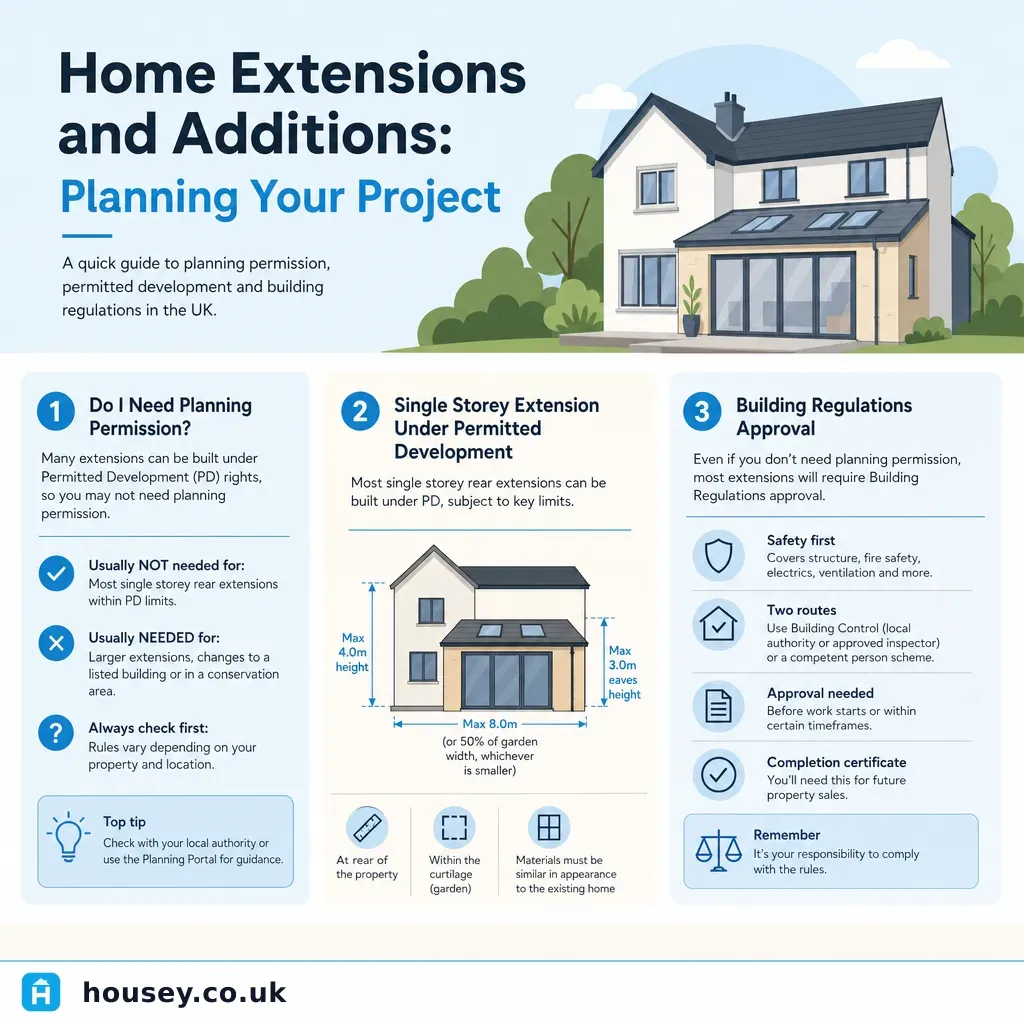
Home Extensions and Additions: Planning Your Project
Most single-storey rear extensions can be built under permitted development without a full planning application, provided they stay within depth limits of 4 m for detached or 3 m for semi-detached and terraced properties.