Vinyl Flooring Installation for Kitchens
By Housey · Last reviewed 7th of May 2026
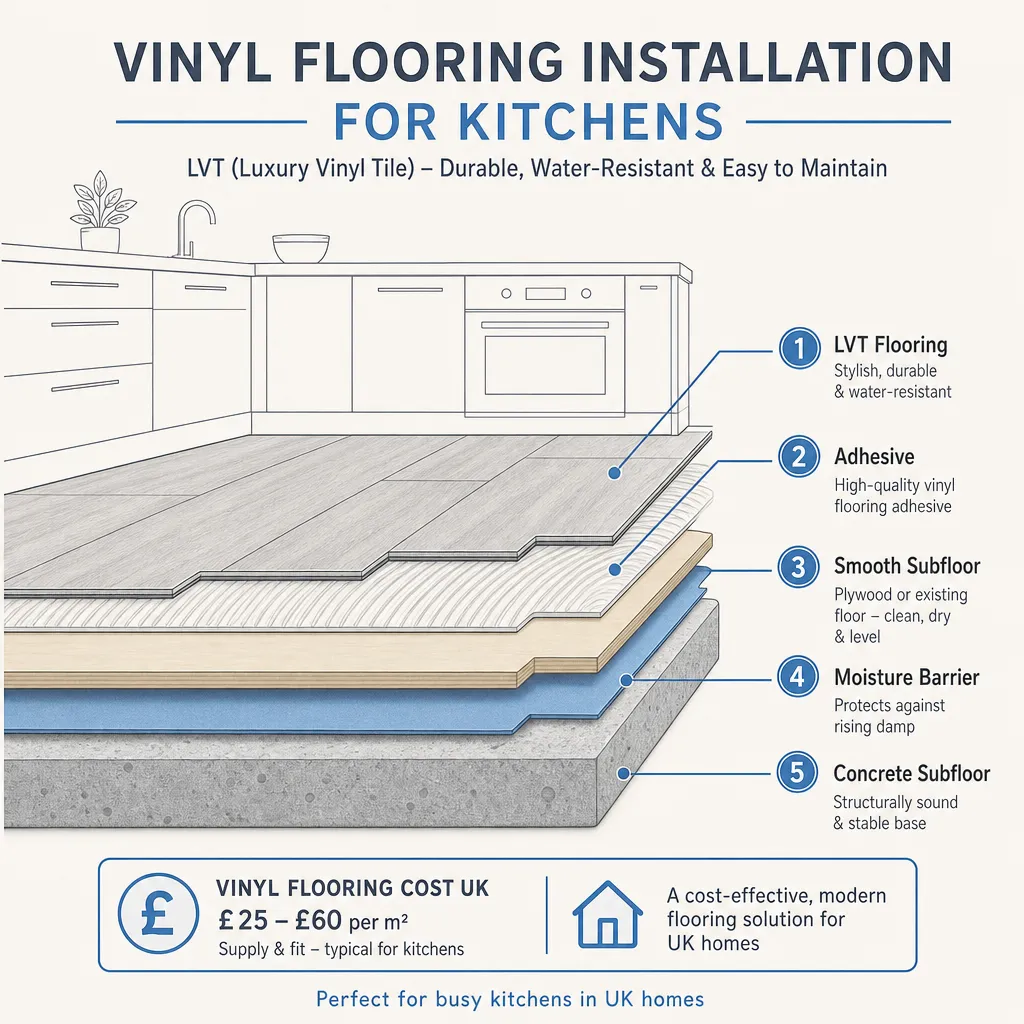
Vinyl Flooring Installation for Kitchens
Kitchen floors in UK homes must withstand daily spills, heavy foot traffic, and the thermal movement that comes with underfloor heating — making the choice of material and installation method genuinely consequential. Whether you are replacing a worn subfloor in a 1930s semi or specifying the finish for a new kitchen extension, the options within the vinyl category alone are wider than many homeowners expect. The difference between a floor that lasts twenty years and one that lifts within two often comes down to subfloor preparation and product specification, not simply the price per square metre.
Key points
- Luxury vinyl tile (LVT) typically costs £15–45 per m² for materials; sheet vinyl starts from around £5–15 per m².
- Professional fitting adds roughly £10–25 per m² for labour; subfloor preparation is the most commonly overlooked additional cost.
- Subfloor preparation should follow BS 8203 — unevenness greater than 3 mm under a 2 m straightedge requires levelling compound before laying.
- An expansion gap of 5–10 mm at all perimeter edges is required for most vinyl products to accommodate thermal movement.
- Vinyl wear layers are graded by thickness: 0.3 mm suits standard residential use; 0.55 mm or above is recommended for heavy domestic traffic.
LVT, sheet vinyl, or vinyl tiles — which is right for your kitchen?
Vinyl covers loose-lay planks, click-lock LVT, glue-down tiles, and traditional sheet vinyl. Each suits different kitchens, budgets, and installation circumstances.
Type | Best for | Not ideal for | Typical installed cost (materials + labour) | Main risk if wrong choice |
|---|---|---|---|---|
Sheet vinyl | Budget kitchens, rental properties, quick turnaround | Large open-plan rooms where seams are unavoidable | £15–35/m² | Seams or poor edge finishing create water ingress points |
Glue-down LVT | High-traffic kitchens, underfloor heating, uneven subfloors | Renters who may want to re-use tiles | £25–50/m² | Adhesive failure if subfloor is contaminated or damp |
Click-lock LVT (floating) | Renovation projects, rentals | Rooms needing a very precise flat subfloor | £20–45/m² | Movement and noise if subfloor is insufficiently level |
Vinyl mosaic/tile sheets | Decorative feature areas | Main family kitchen floor | £20–40/m² | Grout-line effect traps debris if not sealed regularly |
Indicative UK costs, last reviewed 2026-05-07. Costs vary by region and specification — obtain at least three written quotes.
What vinyl flooring installation involves
A competent installer follows a consistent process. Understanding each stage helps you assess whether a quote is complete.
1. Subfloor assessment The installer inspects for flex, unevenness, damp, and loose boards. Any deviation greater than 3 mm under a 2 m straightedge, as specified in BS 8203, requires levelling compound. Skipping this step causes premature failure.
2. Subfloor preparation Old adhesive, screeds, or floorboards may need grinding, priming, or overlaying with 6 mm plywood — particularly on timber subfloors — to create a stable, smooth surface.
3. Acclimatisation Most vinyl products should be stored in the room above 18 °C for 24–48 hours before installation. Check the manufacturer's datasheet.
4. Layout planning The installer plans plank or tile direction, usually starting from the room's focal point. Seams in sheet vinyl should avoid high-traffic paths.
5. Laying and cutting Click-lock products float without adhesive; glue-down tiles use a pressure-sensitive or hard-set adhesive. An expansion gap is maintained at all edges and under kickboards.
6. Finishing Threshold strips connect to adjacent rooms. Skirting or beading covers the expansion gap. Silicone sealant may be applied where vinyl meets appliance plinths.
How much does vinyl kitchen floor installation cost in the UK?
Costs vary with product choice, subfloor condition, room size, and location. Labour rates are generally higher in London and the South East.
Cost component | Typical range (UK, 2026) |
|---|---|
Sheet vinyl (materials only) | £5–15/m² |
LVT materials (residential grade) | £15–45/m² |
Subfloor levelling compound (if needed) | £3–8/m² |
Professional fitting (labour) | £10–25/m² |
Threshold strips and edging | £8–20 per doorway |
Plywood overlay (if required) | £8–15/m² |
Indicative UK costs, last reviewed 2026-05-07. Always obtain at least three written quotes.
Preparing your kitchen — homeowner checklist
Use this before the installer arrives to avoid delays and additional charges:
Red flags when getting quotes
These signs suggest a quote may be underpriced or incomplete:
- No mention of subfloor preparation — the most commonly omitted cost element
- No site visit before pricing (subfloor condition cannot be assessed remotely)
- Unusually low-grade adhesive or underlay specified without explanation
- No reference to BS 8203 or the manufacturer's installation guidelines
- Quote does not include disposal of old flooring where discussed
- Implausibly short installation time for a large or complex room
When to get professional help
Professional fitting is strongly recommended when:
- The subfloor requires levelling, grinding, or plywood overlay
- You are installing over underfloor heating (adhesive compatibility and expansion must be managed carefully)
- The kitchen is in a newly built extension where screed may still be curing
- You are fitting large-format tiles where precise alignment is critical
If you notice damp below the existing floor — lifting sheet vinyl, swollen boards, or a damp smell — do not proceed until a damp specialist has assessed the cause.
How Housey can help
If your vinyl flooring project forms part of a larger kitchen renovation or new build, Housey can help you find and compare quotes from vetted local tradespeople. Browse extension builders to find professionals who can manage subfloor preparation and finishing as part of a complete project.
Frequently asked questions
Can I lay vinyl flooring over existing kitchen tiles?
You can lay vinyl over existing ceramic or porcelain tiles if they are firmly fixed, the surface is flat, and the added floor height is acceptable. Any loose, cracked, or uneven tiles should be repaired or removed first. Check that the height gain will not create a trip hazard at door thresholds or prevent doors from opening.
How long does vinyl kitchen floor installation take?
Most standard kitchens under 15 m² can be completed in one day by a professional fitter. Larger rooms or those requiring significant subfloor levelling or plywood overlay may take two days. Simple sheet vinyl replacement over an existing flat floor can sometimes be fitted in half a day, though acclimatisation time should still be observed.
Is underlay needed under LVT?
Click-lock LVT is usually supplied with a pre-attached underlay layer. Additional underlay is generally not recommended and may void the manufacturer's warranty. For glue-down LVT, no separate underlay is used — the tile adheres directly to the prepared subfloor. Always check the product datasheet before purchasing separate underlay.
Does vinyl flooring add value to a house?
Vinyl flooring does not significantly increase property value on its own, but a well-finished kitchen floor improves saleability and buyer perception. Estate agents and RICS surveyors generally regard kitchen and bathroom condition as meaningful at the point of viewing. Replacing a visibly worn floor before marketing is often considered cost-effective preparation.
How do I maintain vinyl kitchen flooring?
Sweep or vacuum regularly to remove grit, which scratches the wear layer over time. Clean with a pH-neutral floor cleaner and a damp — not wet — mop. Avoid steam cleaners on click-lock floating floors, as prolonged moisture can affect the locking joints and cause planks to lift or buckle at the edges.
Sources and further reading
- BS 8203: Installation of resilient floor coverings — BSI Group
- Technical guidance for flooring installers — Contract Flooring Association
- Flooring buying guide — Which?
- Building regulations: when you need approval — GOV.UK
Useful next reads
 Improvement & Build
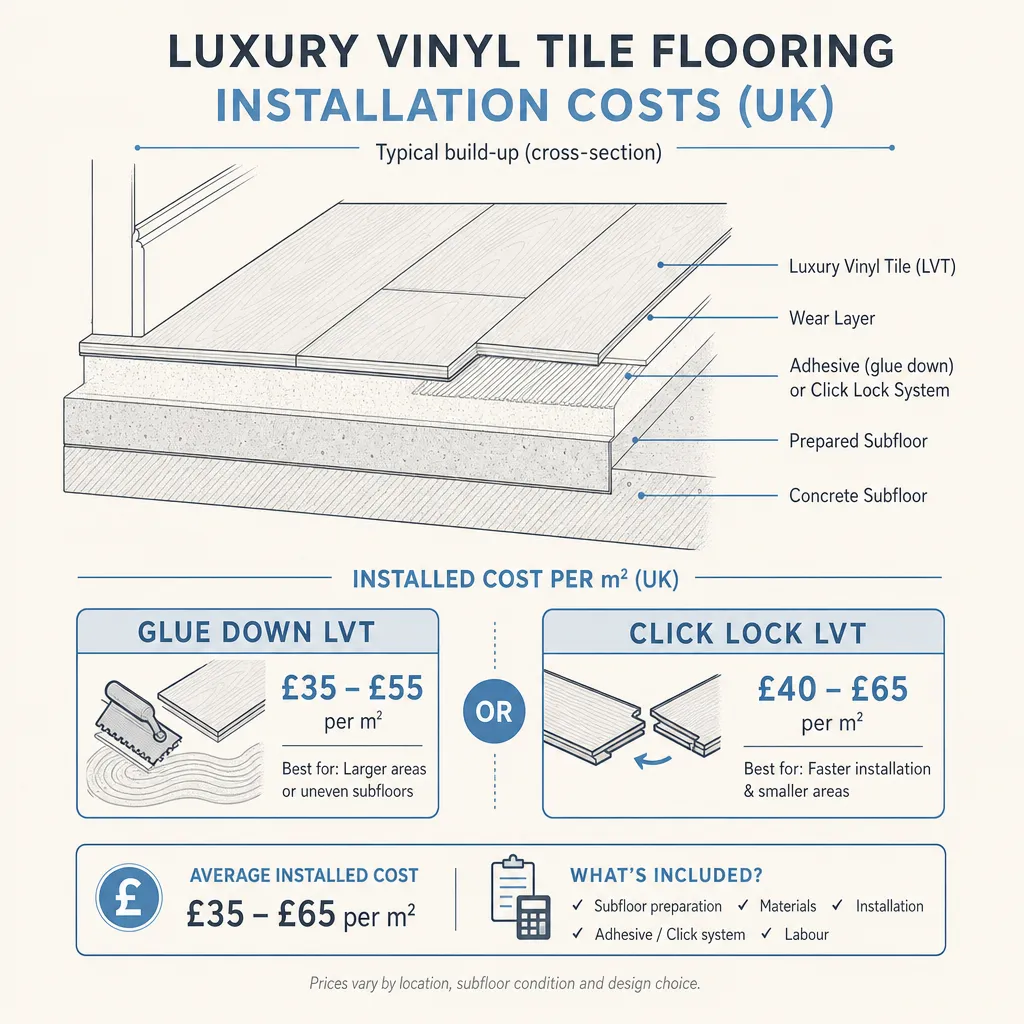
Luxury Vinyl Tile Flooring Installation Costs
Luxury vinyl tile (LVT) flooring typically costs £20–£60 per m² for materials and £10–£25 per m² for professional installation in the UK, giving a total supply-and-fit price of roughly £30–£85 per m².
 Improvement & Build
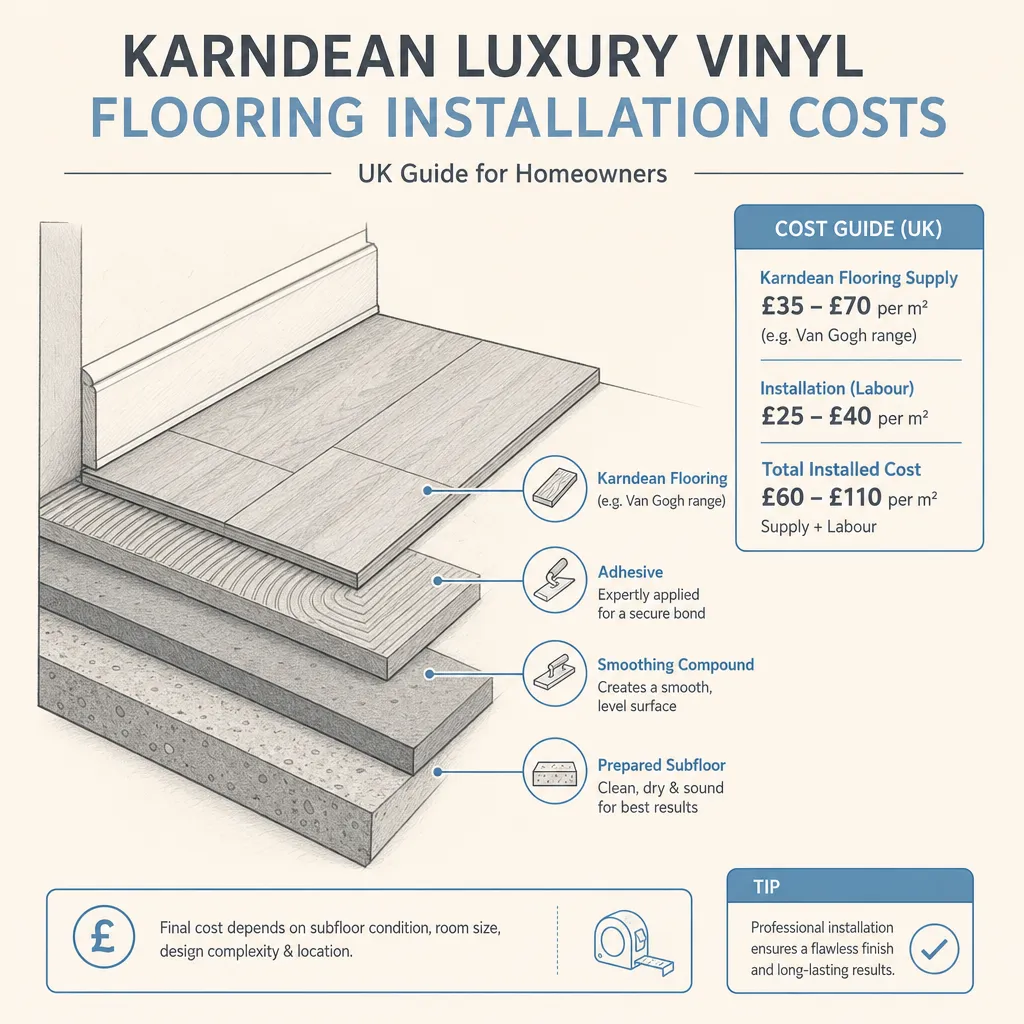
Karndean Luxury Vinyl Flooring Installation Costs
Karndean luxury vinyl flooring costs roughly £30–£75 per m² for materials depending on the range, plus £15–£35 per m² for professional installation.
 Improvement & Build
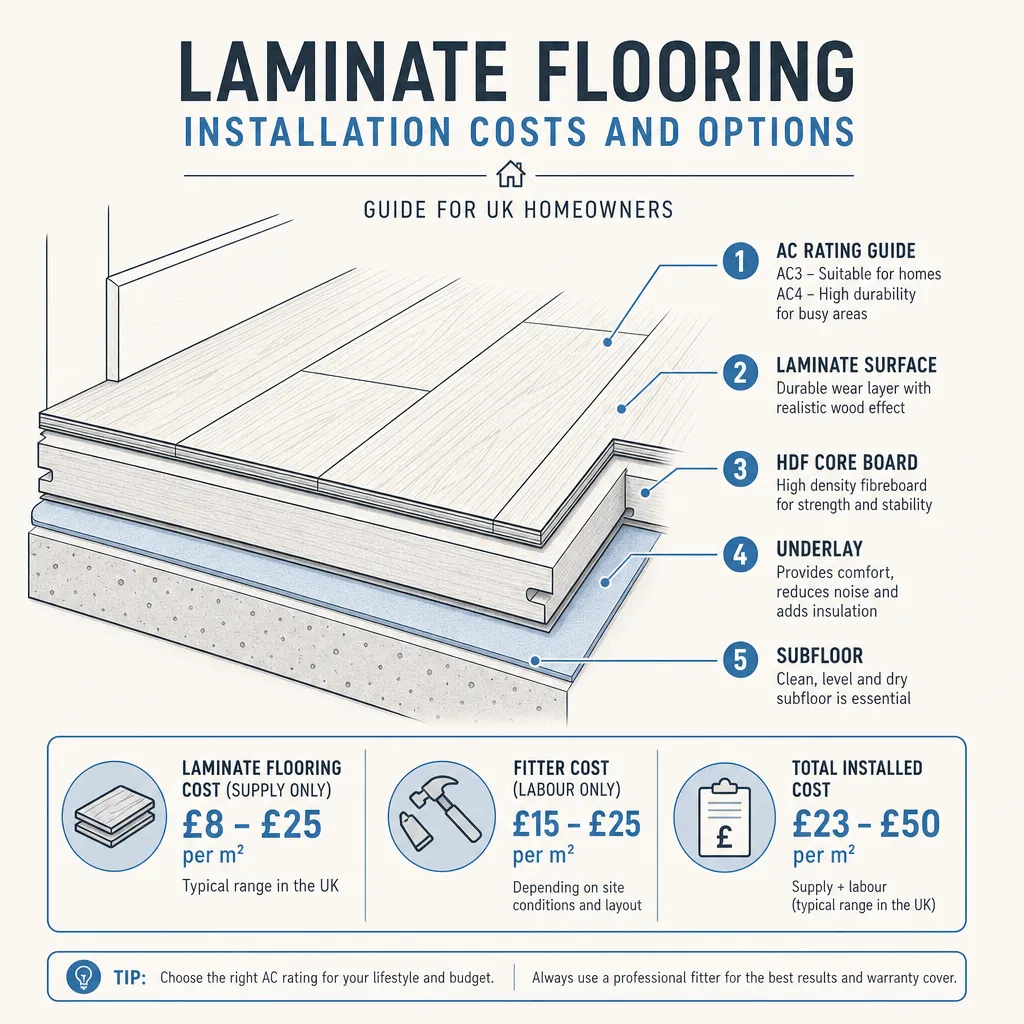
Laminate Flooring Installation Costs and Options
Laminate flooring typically costs £20–55 per square metre fully installed in the UK, including materials, underlay, and professional fitting.
 Improvement & Build
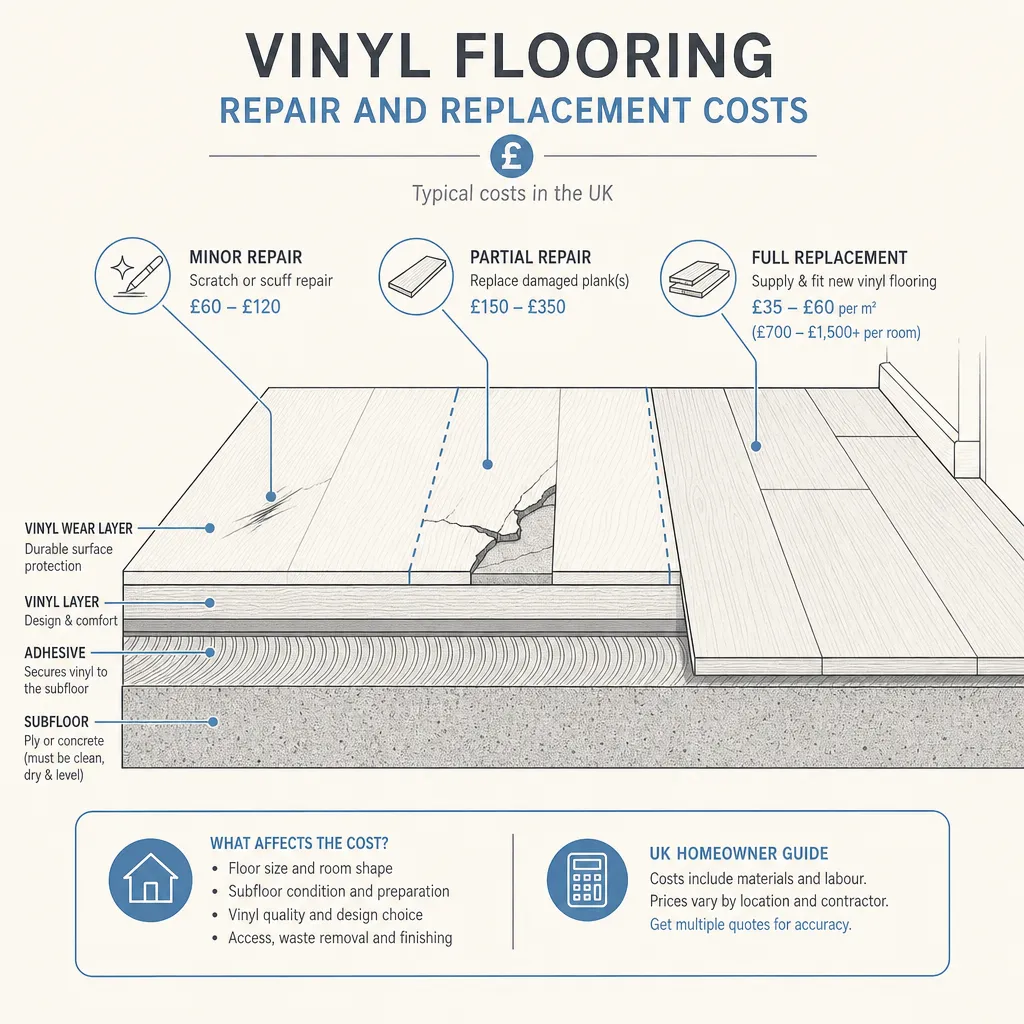
Vinyl Flooring Repair and Replacement Costs
Repairing a small area of vinyl flooring typically costs £50–£200 in the UK, while full replacement runs from £15–£35 per m² for luxury vinyl tile (LVT) plus labour of £10–£25 per m².
 Improvement & Build
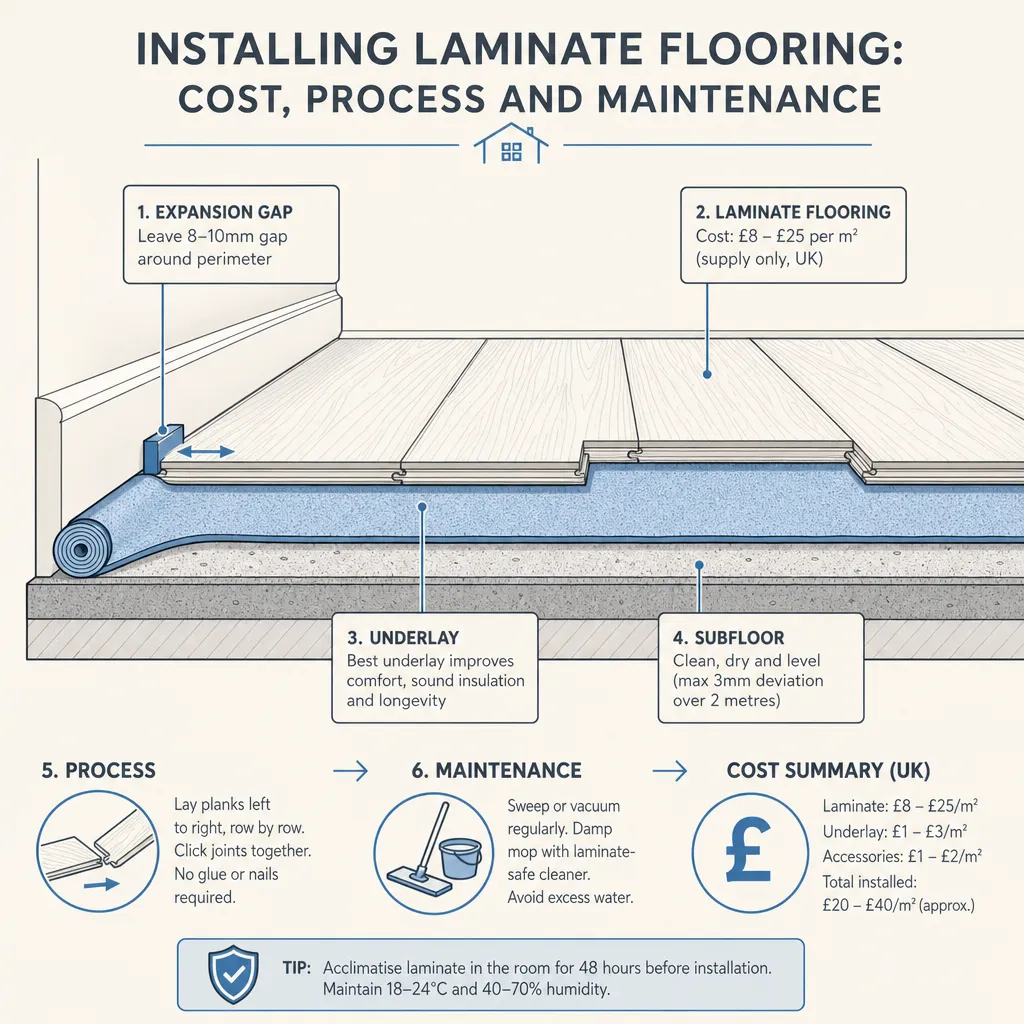
Installing Laminate Flooring: Cost, Process and Maintenance
Laminate flooring in the UK typically costs £15–40 per square metre for materials, plus £8–15 per square metre for professional fitting.