Luxury Vinyl Tile Flooring Installation Costs
By Housey · Last reviewed 7th of May 2026
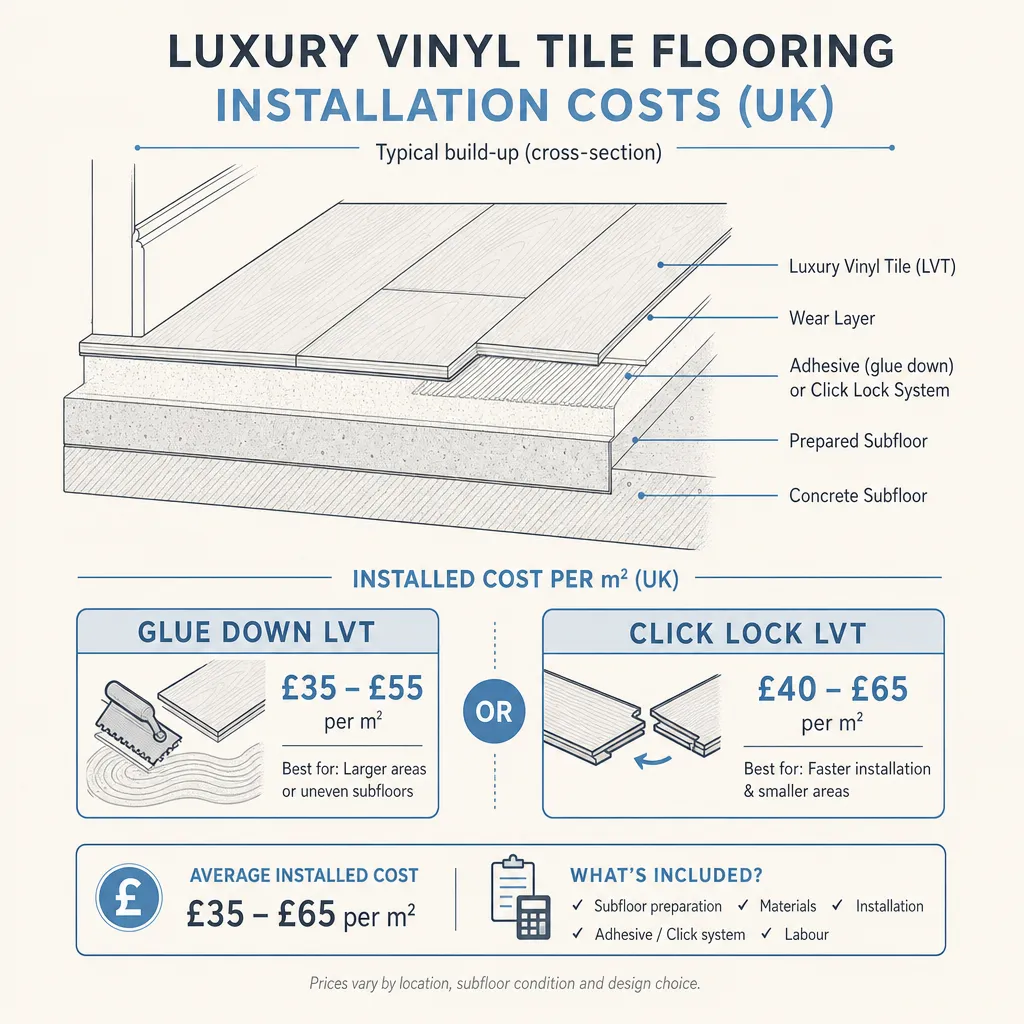
Luxury Vinyl Tile Flooring Installation Costs
LVT flooring has become one of the most popular choices for UK homeowners carrying out renovations, extensions, and kitchen or bathroom upgrades. With dozens of product formats, installation methods, and price points on the market, understanding what drives the cost is essential before requesting quotes or setting a project budget. Prices vary considerably depending on the LVT type, subfloor condition, room layout, and the installer's experience — and a quote that looks competitive at first glance may not include subfloor preparation, which is often where costs escalate.
Key points
- LVT materials typically cost £20–£60 per m², with professional installation adding £10–£25 per m²; total supply-and-fit prices usually fall between £30 and £85 per m² (Indicative UK costs, last reviewed 2026-05-07).
- Click-lock (floating) LVT can often be laid over an existing level subfloor; glue-down LVT requires the subfloor to meet moisture and flatness tolerances set out in BS 8203.
- BS 8203:2017 recommends a relative humidity (RH) of no more than 75% at the subfloor surface before adhesive-fixed LVT is installed — subfloor moisture testing is a professional responsibility.
- Herringbone and chevron patterns generate more cut waste and take longer to lay, adding roughly 10–20% to the installation cost compared with a standard straight-run layout.
- LVT specified for use over underfloor heating (UFH) should carry a thermal resistance of ≤0.15 m²K/W — check the product datasheet before purchasing to confirm compatibility.
What affects LVT installation costs?
Several factors push the price up or down. Understanding them helps you compare quotes on a like-for-like basis.
Material grade and wear layer: LVT is categorised partly by wear layer thickness, measured in millimetres. Domestic products typically have 0.3 mm–0.5 mm wear layers; commercial-grade products run to 0.55 mm or above. Thicker wear layers resist heavy traffic and scratching better but cost more. A 0.5 mm wear layer is a practical choice for busy family homes.
Installation method: Click-lock LVT floats above the subfloor and is generally quicker to lay, reducing labour time and cost. Glue-down LVT is adhered directly and provides a firmer, quieter underfoot feel, but requires more preparation and adhesive, increasing both material and labour costs.
Subfloor preparation: If the subfloor is uneven, damp, or contaminated with old adhesive residue, it must be remediated before LVT is laid. Self-levelling compound application and old floor removal can add £5–£15 per m² and are often the most variable element of a quote.
Room size and shape: Installers usually charge less per m² for larger, straightforward rooms. Small rooms, alcoves, and complex shapes increase cutting time and material waste.
Pattern and plank direction: Standard straight-run installation is the simplest. Herringbone, chevron, or diagonal layouts require more cuts and planning, increasing labour time and waste allowance.
Location and access: Installer day rates in London and the South East are typically higher than in the Midlands or North. Difficult access — such as a narrow hallway or a room requiring substantial furniture removal — may carry a surcharge.
LVT product types compared
LVT format | Best for | Not ideal for | Typical material cost (per m²) | Key installation note |
|---|---|---|---|---|
Click-lock planks (floating) | Living rooms, bedrooms, open-plan spaces | Rooms with heavy fixed furniture or persistent moisture | £20–£45 | Needs level subfloor; underlay often pre-attached |
Glue-down tiles or planks | Kitchens, hallways, commercial areas | DIY installation without professional subfloor prep | £25–£55 | Must meet BS 8203 RH and flatness tolerances |
Loose-lay (heavy backing) | Rental properties, temporary installations | Areas with heavy long-term foot traffic | £20–£40 | Fastest installation; not suitable for all subfloors |
SPC (stone polymer composite) | Wet rooms, utility rooms, high-traffic areas | UFH setups without manufacturer UFH approval | £30–£60 | Rigid core; stable but less forgiving on uneven subfloors |
Indicative UK material costs, last reviewed 2026-05-07. Prices exclude VAT and installation labour.
Subfloor preparation: the cost you may not see coming
Many LVT quotes are provided on the assumption of a clean, level subfloor. In practice, older UK homes — particularly Victorian and Edwardian terraces and 1930s semis — often have timber suspended floors that flex underfoot, or concrete subfloors with residual damp.
Floating click-lock LVT tolerates minor subfloor movement better than glue-down products, but the surface must still fall within the manufacturer's flatness tolerance — commonly no more than 3 mm variance under a 1.8 m straightedge.
If a subfloor inspection reveals problems, additional work may be needed:
- RH above 75%: A damp-proof membrane (DPM) or DPM additive is typically required before installation proceeds.
- Significant unevenness: A self-levelling compound application is standard practice before laying any format of LVT.
- Old adhesive residue: This usually needs grinding back before a new adhesive-fixed floor can go down cleanly.
Always ask whether a quote includes a subfloor assessment and what happens to the price if problems are found after work begins.
What to ask before accepting a quote
Use this checklist when comparing installation quotes:
When to get professional help
LVT installation may appear straightforward, but professional installation is strongly recommended in the following situations:
- Glue-down LVT in any room: Adhesive selection, subfloor preparation, and ambient temperature all affect the outcome, and errors are difficult to reverse without full removal.
- Rooms with suspected damp or moisture issues: A professional can assess RH levels using a calibrated hygrometer before specifying a suitable product and adhesive system.
- Over underfloor heating: Incorrect thermal resistance can void UFH warranties and cause the floor covering to delaminate over time.
- Large open-plan areas: Expansion gaps, seam placement, and plank orientation all affect long-term performance and appearance.
- Historic properties with original floorboards: Removal decisions, levelling requirements, and any membrane specification should be assessed by an experienced installer familiar with older construction types.
How Housey can help
If you are renovating, building an extension, or carrying out a whole-home fit-out, LVT flooring is often one of the final stages of a wider project. Housey can help you find and compare quotes from qualified extension builders and other improvement tradespeople who can advise on flooring specification as part of a broader refurbishment — so you are not sourcing each trade in isolation.
Frequently asked questions
How long does LVT flooring last in a UK home?
A domestic LVT product with a 0.3 mm wear layer typically lasts 10–15 years under normal family use. Products with a 0.5 mm or thicker wear layer can last 20 years or more. Longevity depends on correct installation, adequate subfloor preparation, and maintenance such as avoiding abrasive cleaning products and using felt pads under furniture legs.
Can LVT be installed over existing tiles?
In many cases, yes — provided the existing tiles are firmly fixed, level, and within the manufacturer's flatness tolerance. Loose, cracked, or highly textured tiles should be removed first. Always check the LVT manufacturer's datasheet for surface preparation requirements, as laying over unsuitable surfaces can void the product warranty.
Does LVT flooring add value to a property?
LVT can improve the presentation and saleability of a property, particularly in kitchens, hallways, and open-plan living areas. However, it is unlikely to add measurable value in a formal RICS valuation. Buyers tend to factor flooring condition into negotiation rather than treating it as a standalone value driver.
Is LVT suitable for bathrooms and wet rooms?
Most LVT products are water-resistant, but not all are fully waterproof at the seams. Glue-down LVT is generally more appropriate in bathrooms and wet rooms than click-lock systems, which can allow moisture ingress at joints over time. Check that the product is specifically rated for wet-area use before purchasing.
Do I need underlay for LVT flooring?
Click-lock LVT often includes a pre-attached underlay layer. Where it does not, a thin acoustic underlay of around 1–1.5 mm is commonly recommended. Glue-down LVT is adhered directly to the subfloor and does not use underlay — adding underlay beneath a glue-down product will void most manufacturer warranties.
Sources and further reading
- BS 8203:2017 — Code of practice for installation of resilient floor coverings — BSI Group
- Flooring Industry Training Association (FITA) — FITA
- Flooring buying guide — Which?
- Vinyl and LVT flooring guide — Homebuilding & Renovating
Useful next reads
 Improvement & Build
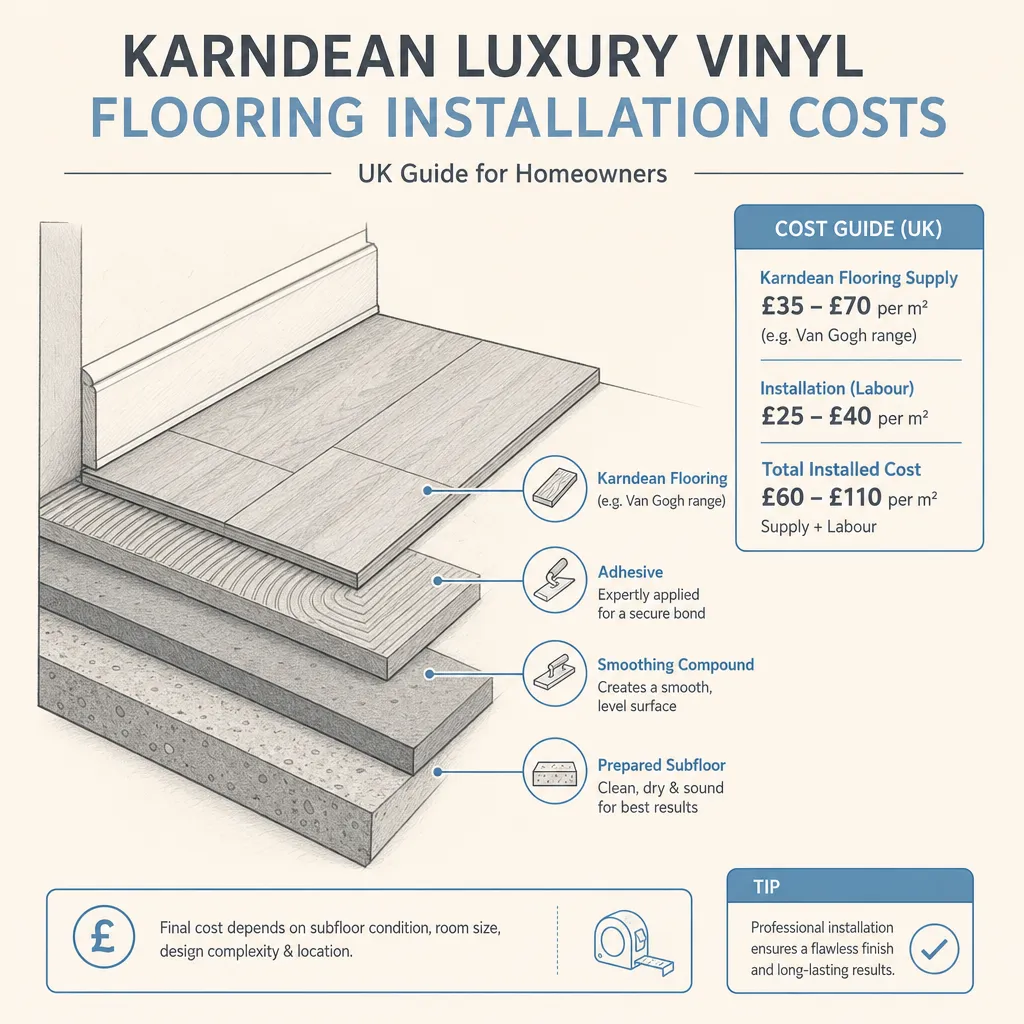
Karndean Luxury Vinyl Flooring Installation Costs
Karndean luxury vinyl flooring costs roughly £30–£75 per m² for materials depending on the range, plus £15–£35 per m² for professional installation.
 Improvement & Build
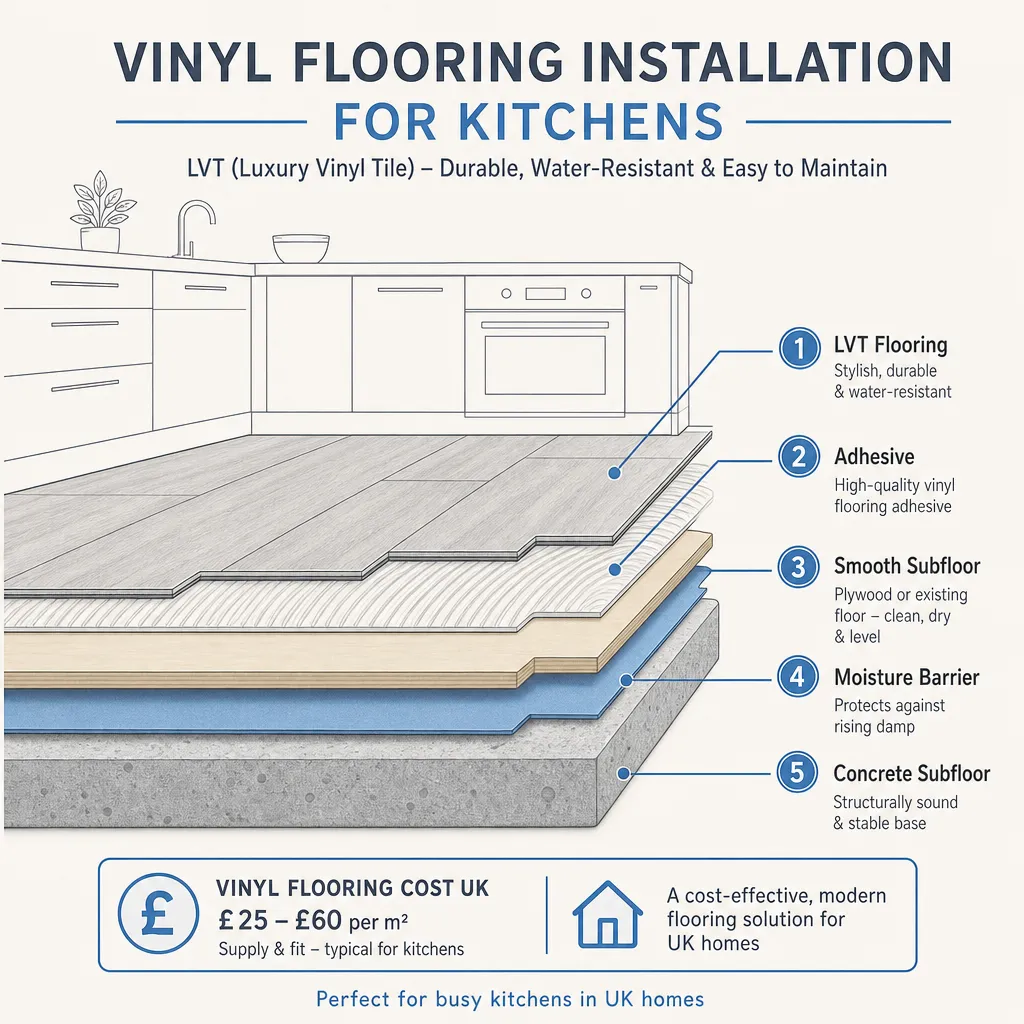
Vinyl Flooring Installation for Kitchens
Luxury vinyl tile (LVT) and sheet vinyl are the most popular choices for UK kitchen floors, offering waterproof performance and competitive costs.
 Improvement & Build
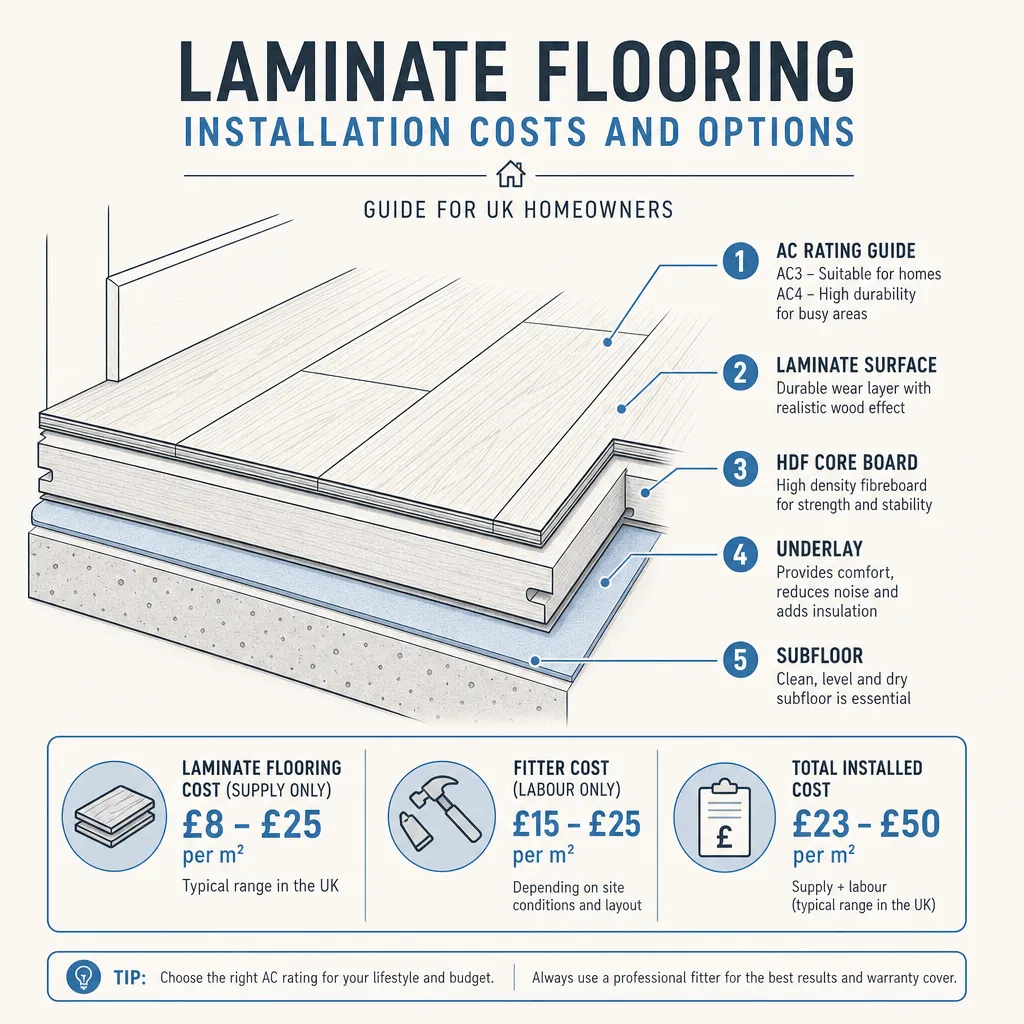
Laminate Flooring Installation Costs and Options
Laminate flooring typically costs £20–55 per square metre fully installed in the UK, including materials, underlay, and professional fitting.
 Improvement & Build
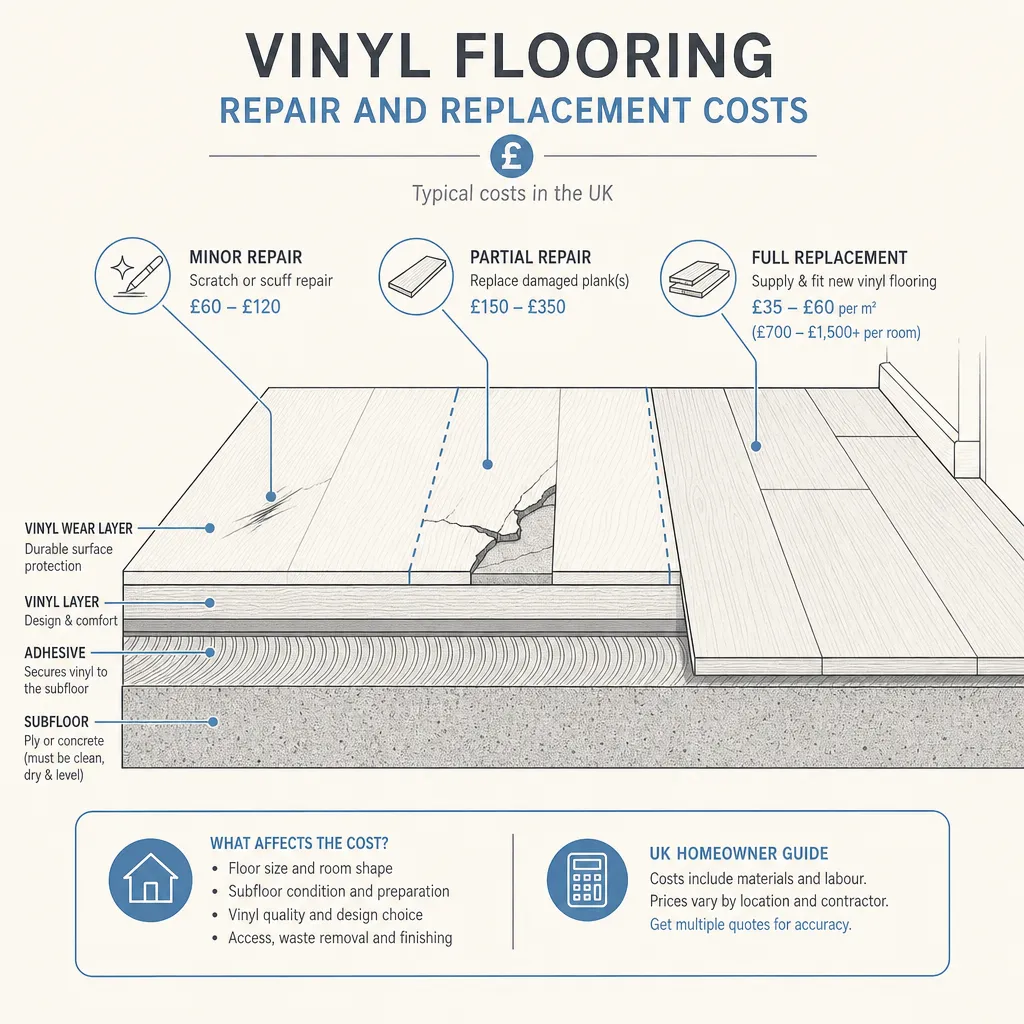
Vinyl Flooring Repair and Replacement Costs
Repairing a small area of vinyl flooring typically costs £50–£200 in the UK, while full replacement runs from £15–£35 per m² for luxury vinyl tile (LVT) plus labour of £10–£25 per m².
 Improvement & Build
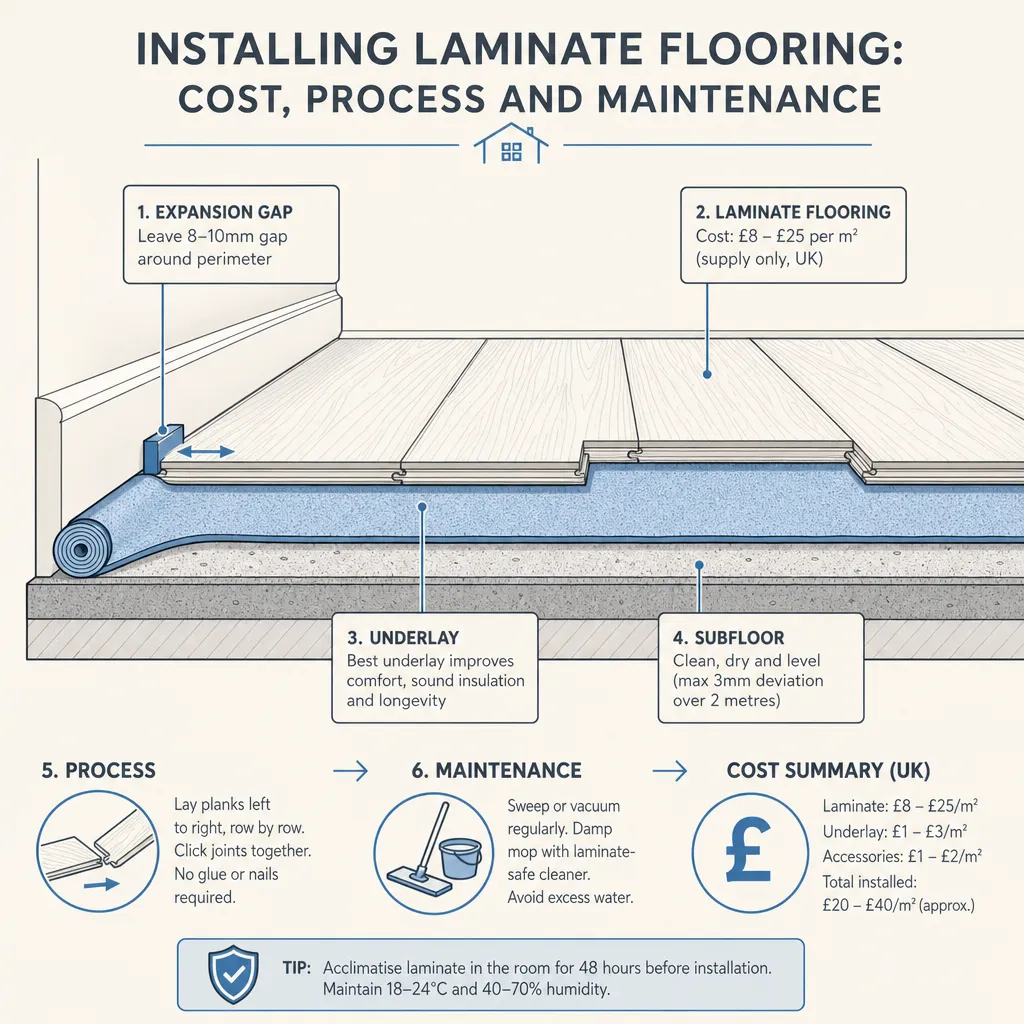
Installing Laminate Flooring: Cost, Process and Maintenance
Laminate flooring in the UK typically costs £15–40 per square metre for materials, plus £8–15 per square metre for professional fitting.