Lawful Development Certificate: Planning Documentation Costs
By Housey · Last reviewed 7th of May 2026
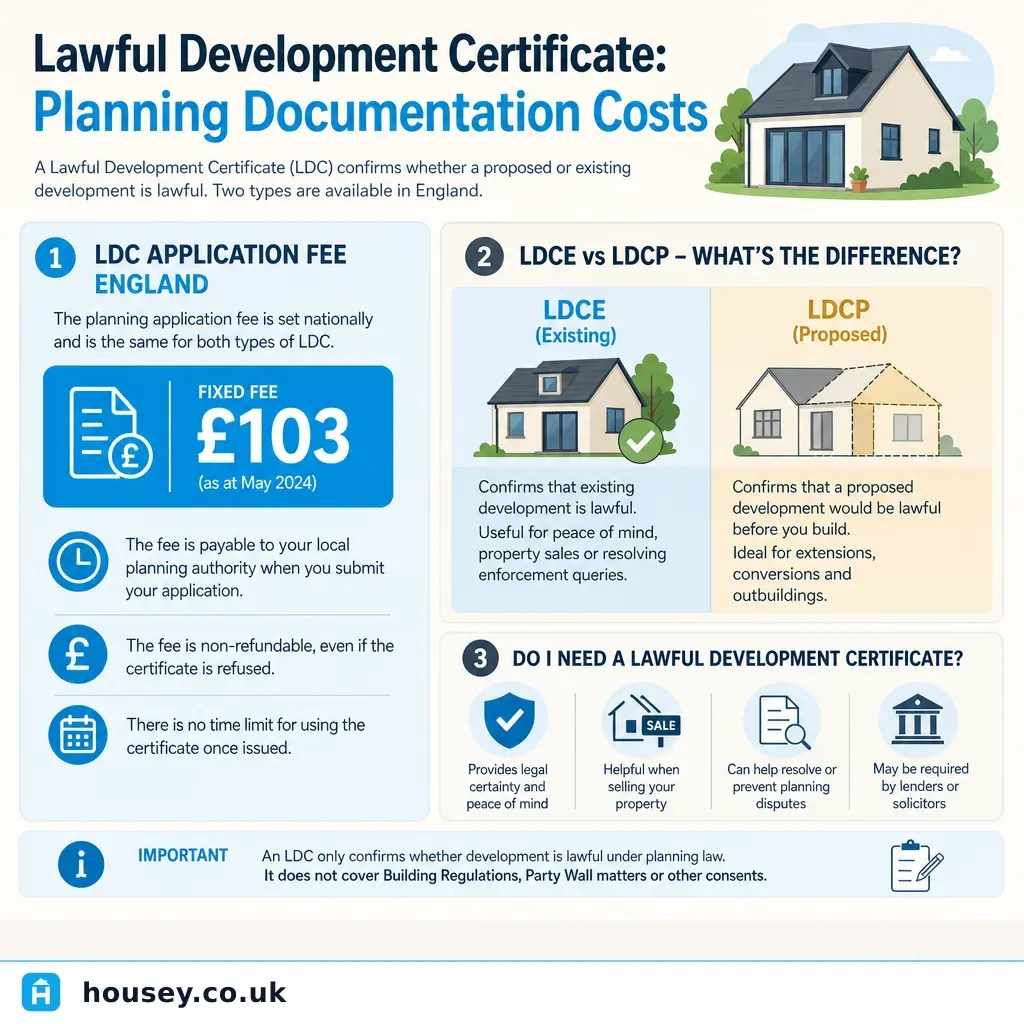
Lawful Development Certificate: Planning Documentation Costs
Homeowners and developers in England often need a Lawful Development Certificate (LDC) to confirm that a completed or proposed project is lawful under planning legislation — typically before selling, refinancing, or starting work that sits at the edge of permitted development rights. Getting this wrong can mean enforcement notices, abortive build costs, or complications at conveyancing. Understanding what an LDC costs and what it involves helps you budget accurately and act before critical deadlines pass.
Key points
- From 6 December 2023, the application fee for a householder LDC (proposed works) in England is £258 — the same as the equivalent householder planning application fee under the Town and Country Planning (Fees for Applications) (England) (Amendment) Regulations 2023.
- Two certificate types exist: LDCE (certificate of lawful existing use or development) and LDCP (certificate of proposed lawful use or development) — choosing the wrong type is the most common reason applications fail.
- From 25 April 2024, the Levelling-up and Regeneration Act 2023 replaced the old 4-year rule with a single 10-year enforcement limitation period for most breaches occurring after that date.
- Professional preparation fees — planning consultant or architect — typically range from £500 to £2,000 depending on complexity and the volume of evidence required.
- Most local planning authorities (LPAs) determine LDC applications within the statutory 8-week period, though complex LDCE cases can take longer if further information is requested.
What is a Lawful Development Certificate?
An LDC is a formal decision from your local planning authority confirming that a use, operation, or activity is lawful under the Town and Country Planning Act 1990 (as amended). It is not planning permission — it confirms either that permission was not needed, or that an existing breach has become immune from enforcement through the passage of time.
There are two main types:
Certificate type | What it covers | When you typically need it |
|---|---|---|
LDCE (Existing) | Completed works or an established use | Before a property sale, after retrospective works, or to confirm an existing use is lawful |
LDCP (Proposed) | Works or changes of use not yet started | Before instructing builders or refinancing where you believe the works fall within permitted development |
Choosing the wrong type — or submitting insufficient evidence — is the most common reason applications are refused or delayed.
How much does a Lawful Development Certificate cost in England?
Application fees
From 6 December 2023, LDC fees in England align with the equivalent planning application fee:
- Householder LDC (proposed extensions, outbuildings, etc.): £258
- Change of use LDC: varies by floor area and use class, following the same fee schedule as full planning applications
- Certificate for existing works: the same fee as the equivalent planning application would cost
In Wales, Scotland, and Northern Ireland, different fee schedules apply — check the relevant national planning portal before applying.
Professional preparation fees
Most homeowners engage a planning consultant or architect to prepare the LDC application. Typical professional costs depend on the complexity of the case and the volume of evidence required:
- Straightforward householder LDCP (e.g., a rear extension within permitted development limits): £500–£900
- More complex LDCE (requiring historical evidence, statutory declarations, or title deeds): £800–£2,000+
- Appeals or resubmissions after refusal: additional costs vary by agent and complexity
Indicative UK costs, last reviewed 2026-05-07. Costs vary significantly by provider and location — always obtain itemised quotes from at least two professionals.
What is and is not usually included in professional fees
A planning consultant's fee typically covers:
- Reviewing drawings and confirming permitted development compliance
- Preparing and submitting the application form
- Collating evidence (for LDCE applications)
- Liaising with the LPA during determination
It usually does not include:
- Architectural drawings if not already available
- Statutory declarations or solicitor fees
- Planning appeal costs if the certificate is refused
The 4-year rule and the 10-year rule: what changed
This matters most for LDCE applications where the intention is to show an existing breach has become immune from enforcement through the passage of time.
Before 25 April 2024, two separate time limits applied in England:
- 4 years for operational development and change of use to a single dwellinghouse
- 10 years for all other material changes of use and breaches of planning condition
From 25 April 2024, the Levelling-up and Regeneration Act 2023 abolished the 4-year rule. A single 10-year enforcement limitation period now applies to most breaches occurring on or after that date. For breaches that occurred before 25 April 2024, transitional provisions preserve the old time limits — meaning the 4-year rule may still apply for pre-existing breaches. If you are relying on time-limitation immunity, take professional advice specific to the date the breach occurred.
Decision tree: LDCE or LDCP?
- Choose LDCP if you want to confirm that proposed works — not yet started — fall within permitted development, useful before instructing a builder or arranging a mortgage drawdown.
- Choose LDCE if works have already been completed without permission and you want to confirm they are now time-barred from enforcement, or if you need to confirm an existing use is lawful before a property sale.
- Ask a planning consultant if your proposal involves a change of use, a listed building, a conservation area, an Article 4 direction, or any prior approvals from the LPA.
- Check with your local planning authority before applying if you are unsure whether permitted development rights have been removed by a previous planning condition or a local restriction.
Evidence required for an LDCE application
For an LDCE, the evidential standard is the balance of probabilities. The LPA must grant the certificate if the evidence is sufficient. Typical supporting documents include:
- Dated photographs with clear metadata showing subject matter and context
- Planning history, previous correspondence with the LPA, and search results
- Statutory declarations from witnesses such as neighbours or tradespeople
- Building regulations completion certificates relating to the works
- Utility bills, bank statements, or electoral roll entries demonstrating continuous use
- Title documents and conveyancing records
The stronger and more corroborated the evidence, the less likely the LPA is to request further information or refuse the application.
Important limitations
This article is general information only. Planning law is complex and varies by property, local authority, and the specific history of a site. The rules around permitted development, enforcement time limits, Article 4 directions, and the correct certificate type require professional assessment for each case. An incorrectly prepared or unnecessary application wastes money; missing the opportunity to apply before enforcement action begins can be far more costly. Nothing in this article constitutes legal or planning advice — always seek guidance from a qualified professional for your specific situation.
What to ask a qualified professional
Before instructing a planning consultant or architect to prepare an LDC application, ask:
- Which certificate type is appropriate for my situation, and why?
- What evidence will I need to gather, and how long will that take to assemble?
- Does this property or area have any restrictions on permitted development — Article 4 direction, conservation area consent, or listed building status?
- What are the likely grounds for refusal, and how strong is my case on current evidence?
- What happens if the LPA refuses the certificate — do you include appeal representation?
- Are your fees fixed, or could they increase if the LPA requests further information?
- What is included in your fee, and what will I need to pay separately (statutory declarations, architectural drawings, VAT)?
When to get professional help
An LDC application involves planning law, evidential standards, and procedural rules that change over time. Get professional advice if:
- You are unsure whether completed or proposed works actually fall within permitted development
- The property is in a conservation area, is listed, or is subject to an Article 4 direction
- You are relying on time-limitation immunity and the breach date is close to a relevant threshold
- A buyer's solicitor or mortgage lender has flagged an undisclosed planning issue
- You have previously received a planning enforcement notice relating to the property
- The application involves a change of use, not just householder works
How Housey can help
If you need a qualified professional to advise on or prepare an LDC application, Housey can help you request quotes from experienced planning consultancy providers across the UK. For applications where building regulations compliance may also be relevant — particularly for extensions or structural alterations — building control consultants can advise on overlapping requirements.
Frequently asked questions
Do I need a solicitor for a Lawful Development Certificate application?
Not always. Most applications are prepared by planning consultants or architects. Solicitors are most useful when a statutory declaration is needed as part of an LDCE submission, or if the application relates to a conveyancing issue such as an undisclosed planning breach. Your planning consultant can usually advise whether legal involvement is necessary.
Can a Lawful Development Certificate be refused?
Yes. An LPA can refuse if insufficient evidence is provided for an LDCE, or if proposed works do not comply with permitted development rules for an LDCP. Applicants have a right of appeal to the Planning Inspectorate within 6 months of refusal. A refusal is not the same as receiving a formal enforcement notice.
Is a Lawful Development Certificate the same as planning permission?
No. An LDC confirms that planning permission was not required, or that a breach is immune from enforcement — it does not grant new rights. Works must also comply with building regulations, which are a separate legal regime. If your proposal does require planning permission, you must apply for that separately.
How long does a Lawful Development Certificate last?
An LDCP (for proposed works) remains valid provided works begin within three years of the certificate date and precisely match the described development. An LDCE (for existing use or completed works) is permanent — it records the planning position as at the date of application and does not expire.
Can I sell my property without an LDC for completed works?
Technically yes, but buyers' solicitors will flag planning discrepancies discovered during searches. Without an LDC, buyers may request indemnity insurance, typically costing £200–£500. Indemnity insurance does not resolve the underlying planning position and is not accepted by all mortgage lenders.
Sources and further reading
- Fees for planning applications — Ministry of Housing, Communities & Local Government
- Apply for a lawful development certificate — Planning Portal
- Levelling-up and Regeneration Act 2023 — legislation.gov.uk
- Permitted development rights for householders: technical guidance — GOV.UK
- Town and Country Planning Act 1990 — legislation.gov.uk
Useful next reads
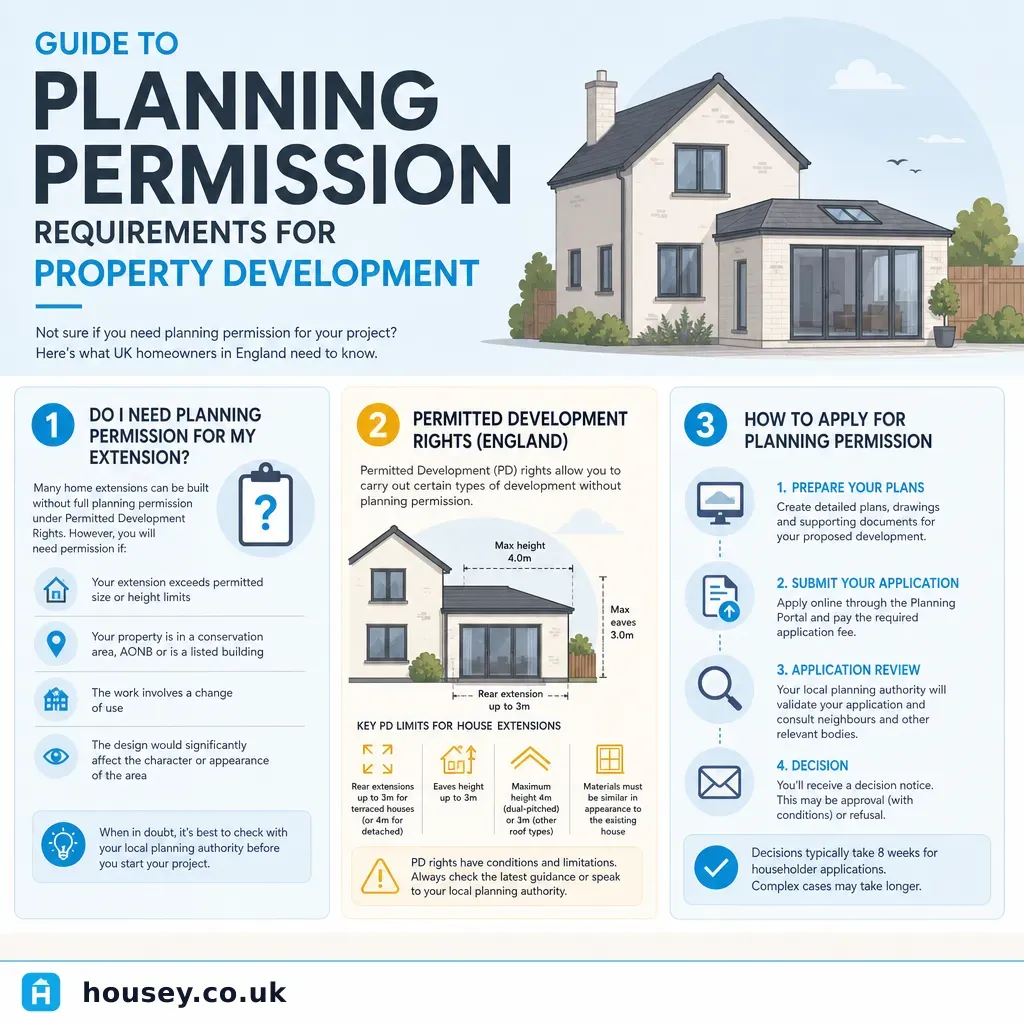 Planning & Pre-Build
Guide to Planning Permission Requirements for Property Development
Most home improvements in England fall within permitted development rights and do not need a planning application.
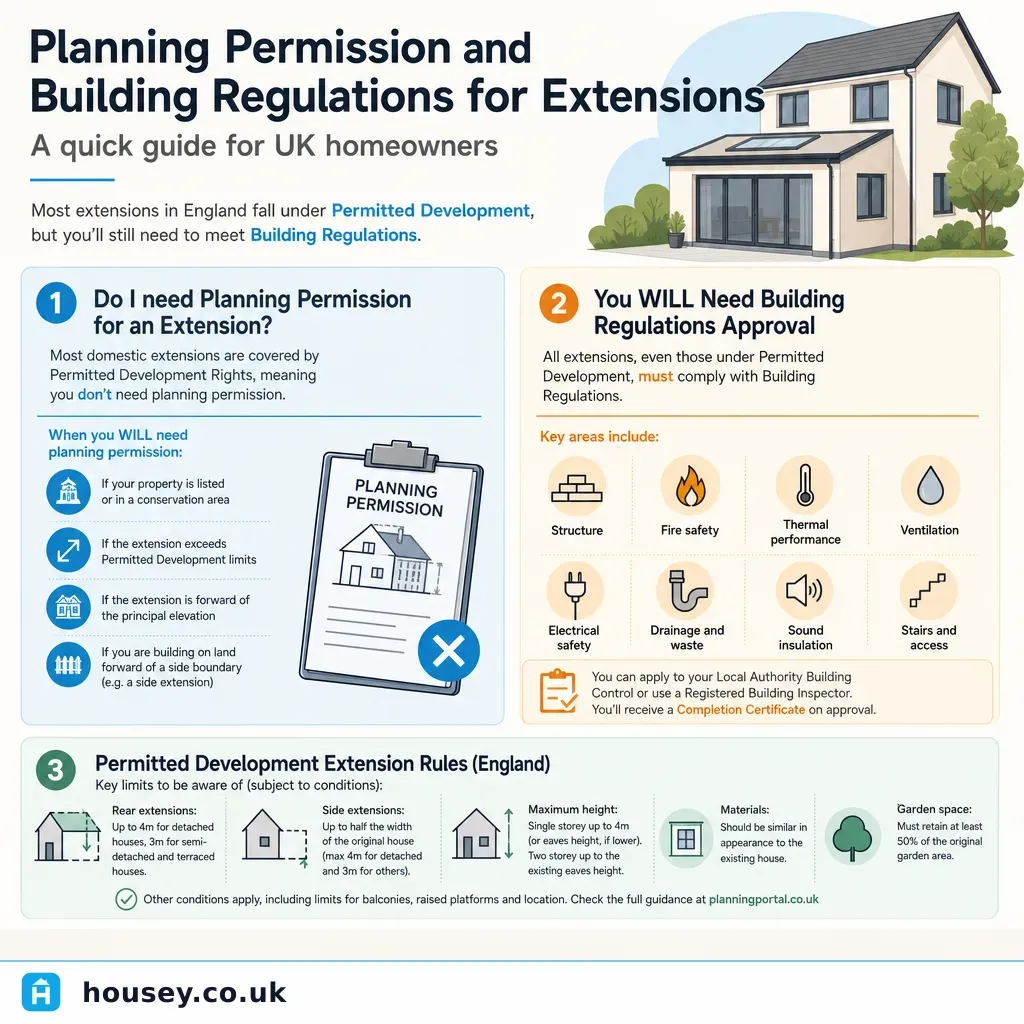 Planning & Pre-Build
Planning Permission and Building Regulations for Extensions
UK home extensions usually require both planning permission and Building Regulations approval, though most smaller rear extensions qualify as Permitted Development under the GPDO 2015 and need no planning application.
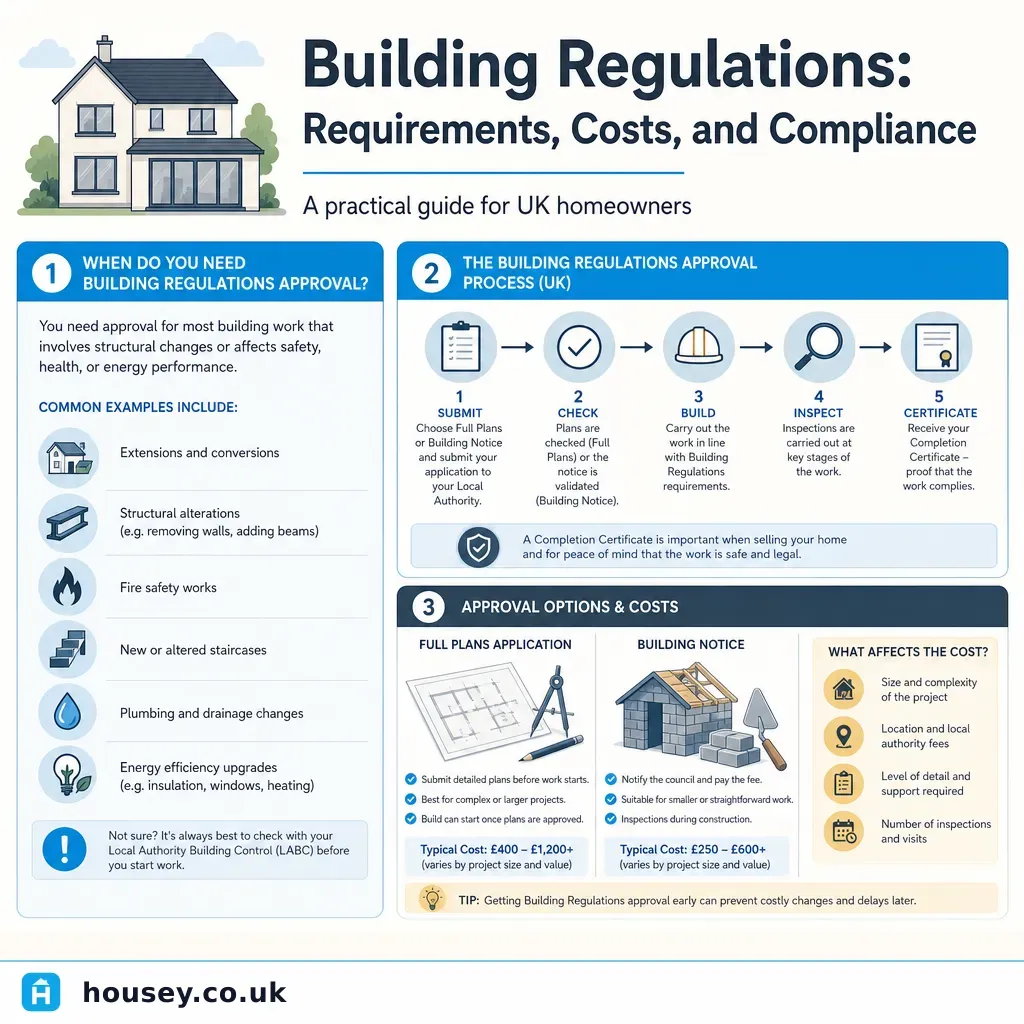 Planning & Pre-Build
Building Regulations: Requirements, Costs, and Compliance
Building regulations set minimum standards for how construction work is carried out in the UK, covering structural stability, fire safety, energy efficiency, and ventilation.
 Planning & Pre-Build
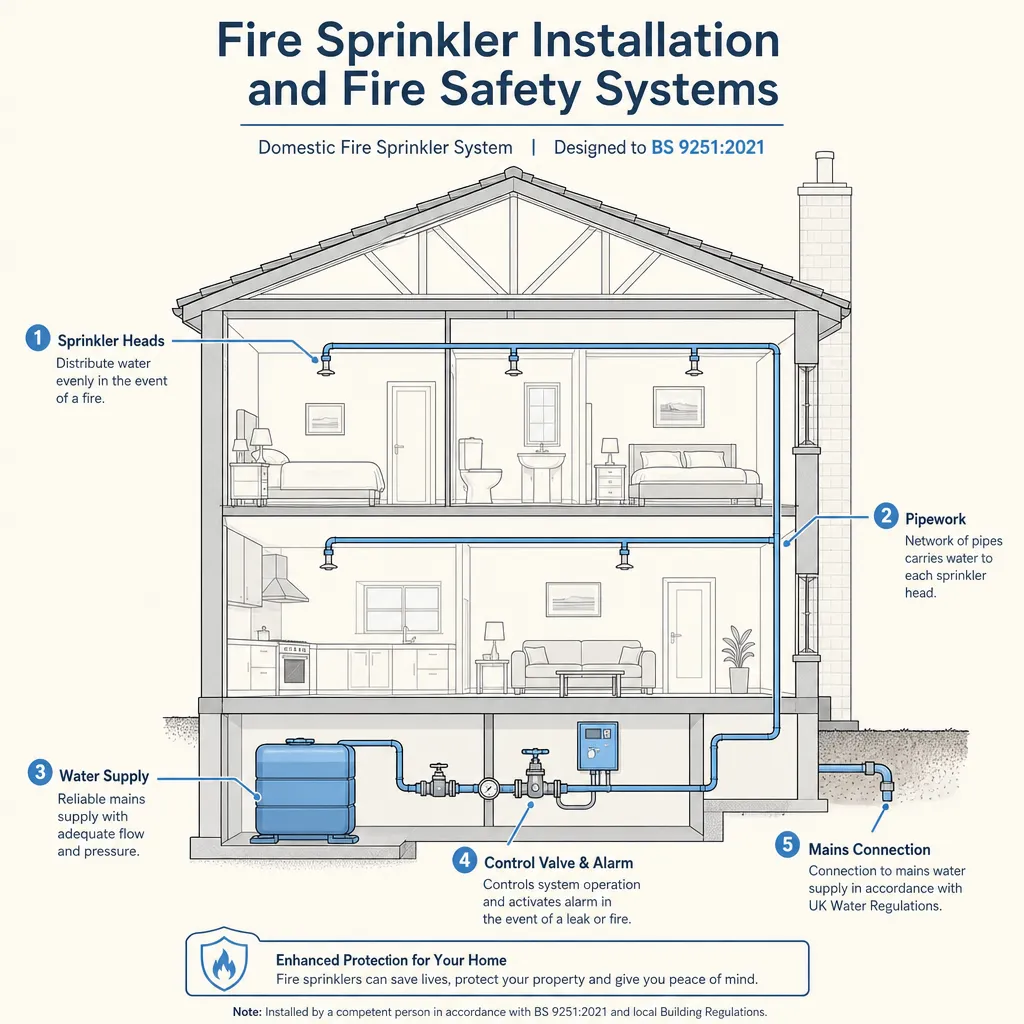
Fire Sprinkler Installation and Fire Safety Systems
Residential fire sprinkler systems in the UK must comply with BS 9251:2021.
 Planning & Pre-Build
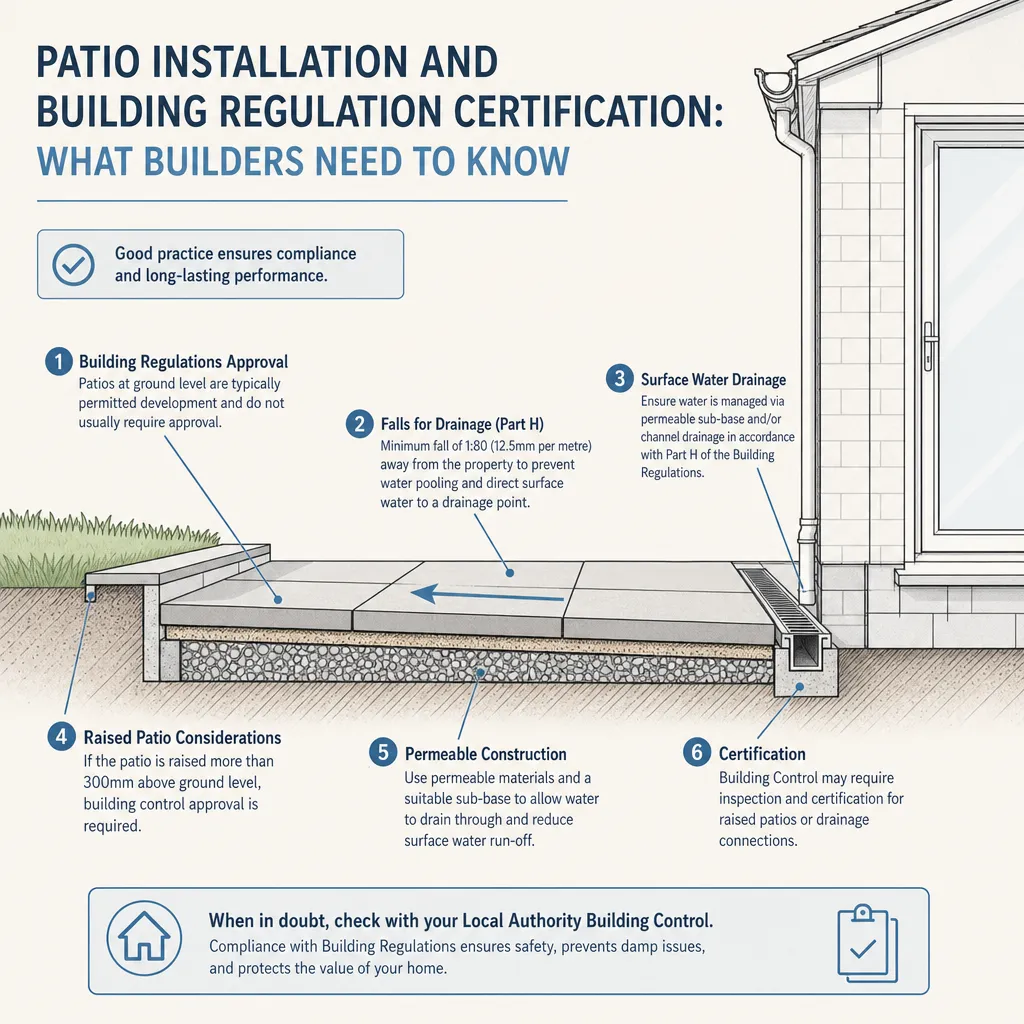
Patio Installation and Building Regulation Certification: What Builders Need to Know
Most ground-level patios in England do not require building regulations approval.