Lawn Removal and Garden Reconfiguration: Options and Costs
By Housey · Last reviewed 10th of May 2026
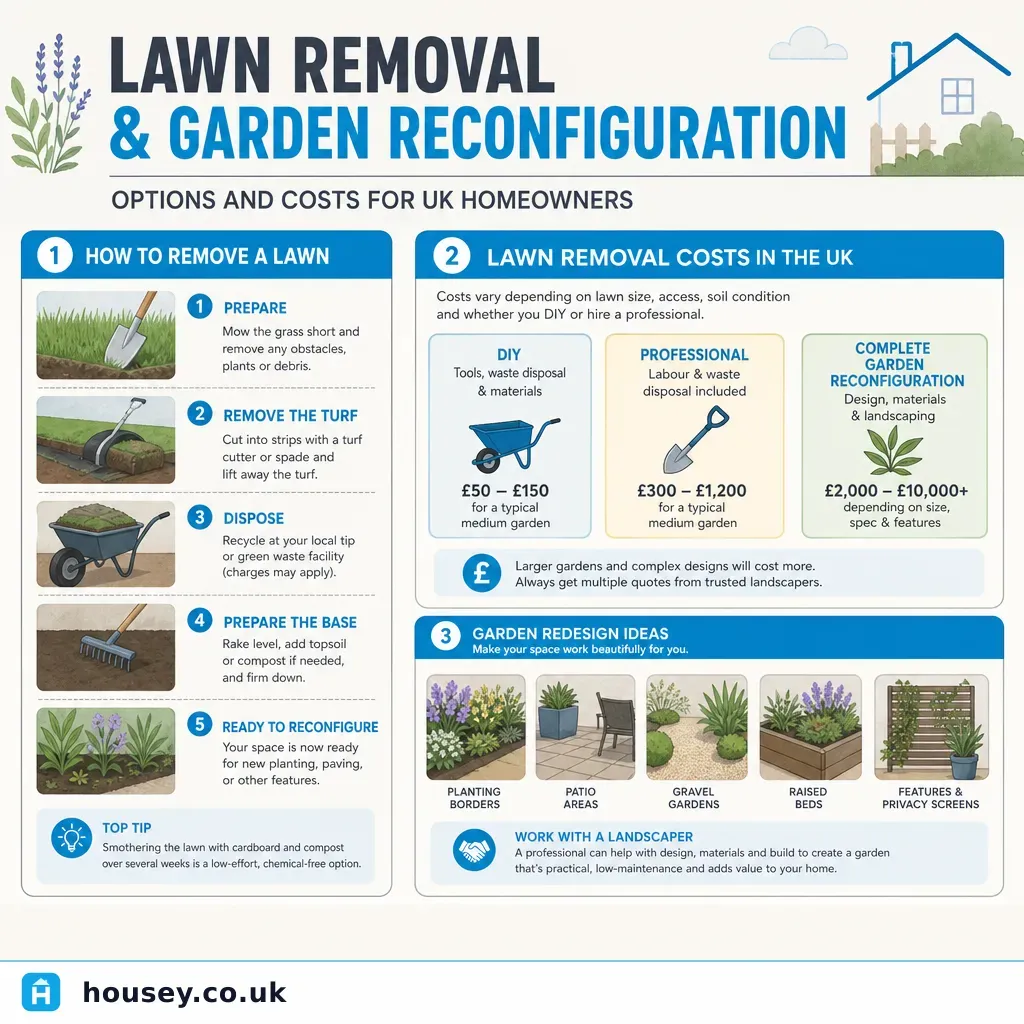
Lawn Removal and Garden Reconfiguration: Options and Costs
Lawn removal and garden reconfiguration arise at many points in a homeowner's journey — after buying a property with an overgrown or impractical garden, ahead of a larger landscaping project, or when an ageing lawn has become more maintenance than it is worth. The scope of work can range from stripping a small patch of turf to a complete overhaul involving changes to levels, drainage, hard landscaping, and new planting schemes. Getting the right professional for the job depends heavily on scale: a simple lawn strip is landscaping work, while drainage infrastructure or significant changes to ground levels will typically require a groundworker.
Key points
- Manual turf stripping produces approximately 1 tonne of waste per 30 m² of lawn removed — all garden waste must be disposed of legally under the Environmental Protection Act 1990, with unlimited fines for fly-tipping.
- Hard surfaces over 5 m² in front gardens require planning permission unless the material is permeable, under amendments to permitted development introduced in England in 2008 via the Town and Country Planning Act 1990.
- The Royal Horticultural Society (RHS) recommends the "no-dig" method — covering lawn with cardboard and a deep organic mulch layer — as a low-disruption alternative that preserves soil structure and earthworm activity.
- Rotavating an existing lawn without first removing turf can cause persistent regrowth from rhizomes, particularly where couch grass or creeping buttercup is established.
- Skip hire for garden waste in the UK typically costs £150–£350 depending on skip size and location (indicative UK costs, last reviewed 2026-05-10).
What are my options for removing a lawn?
Several methods are available, each with different cost, disruption, and timing implications. The right choice depends on your soil type, the presence of perennial weeds, your timeline, and what you intend to do with the space once the lawn is gone.
Method | Best for | Not ideal for | Typical timeframe | Approximate cost (30 m²) |
|---|---|---|---|---|
Manual stripping (turf cutter) | Clean removal, replanting soon | Very large areas | 1–2 days | £300–£700 incl. skip |
Rotavation | Breaking up before raised beds | Perennial weed problems | Half a day | £200–£400 |
Smothering (no-dig / cardboard) | Low budget, minimal disruption | Immediate replanting | 3–6 months | £50–£150 materials |
Herbicide treatment (e.g. glyphosate) | Killing grass before renovation | Organic gardens, clay soils | 2–4 weeks + recovery | £100–£300 incl. materials |
Full excavation and topsoil replacement | Major garden reconfiguration | Simple lawn replacement | 2–5 days | £1,000–£3,000+ |
Indicative UK costs, last reviewed 2026-05-10. Costs vary significantly by region, site access, waste disposal charges, and contractor.
What does a full garden reconfiguration involve?
Beyond simply removing turf, a full garden reconfiguration may involve several distinct categories of work:
- Levelling or re-grading: Correcting slopes, removing humps, or creating terraced areas — usually requires a groundworker and may involve retaining structures.
- Drainage improvement: Installing French drains, soakaways, or surface water channels, particularly on clay soils or sloping sites where waterlogging is a persistent issue.
- Hard landscaping: Patios, paths, edging, raised beds, or driveway areas — each with their own planning and surface water drainage implications.
- Soft landscaping: Planting schemes, new turf or seeding, wildflower meadow establishment, or hedging.
- Irrigation and lighting: Optional additions that add cost and may require electrical or plumbing connections by appropriately qualified tradespeople.
For most domestic projects a landscaper handles the full scope. Where significant earthmoving, drainage infrastructure, or changes to ground levels close to the house foundations are involved, a groundworker — and in some cases a structural engineer — may also be needed.
Does garden reconfiguration need planning permission?
Most garden landscaping falls under householder permitted development rights and does not require a planning application. However, there are important exceptions:
- Paving front gardens: Any hard surface over 5 m² in a front garden requires planning permission unless made from a permeable material such as gravel, block paving with open joints, or permeable resin-bound aggregate, under rules introduced in England in 2008.
- Walls and raised structures: Walls above 1 metre adjacent to a highway, or above 2 metres elsewhere in the garden, generally require planning permission.
- Listed buildings and conservation areas: Works to a listed property or within its curtilage may require Listed Building Consent; conservation area policies vary by local authority.
- Connecting new drainage to an existing system: Building regulations may apply — check with your local authority building control department before work begins.
Always confirm with your local planning authority before laying large areas of impermeable surfacing or constructing walls above the permitted heights.
A worked example: Victorian terrace back garden, London
A homeowner with a 50 m² back garden — predominantly struggling lawn, poor drainage, overgrown borders, and a crumbling concrete patio — decided to reconfigure it entirely. The agreed scope involved:
- Stripping the existing lawn using a hired turf cutter; turf removed to a 40-yard skip over two loads.
- A groundworker installing a linear channel drain along the rear boundary, connecting to an existing soakaway.
- A landscaper laying 20 m² of natural sandstone paving, two raised beds constructed from reclaimed railway sleepers, and a seeded wildflower strip along the rear fence line.
- Final topsoil dressing and site clearance.
Approximate total cost: £6,500–£9,500 including all labour, materials, skip hire, and drainage connection (indicative, last reviewed 2026-05-10). The project required two separate contractors — a groundworker for the drainage and a landscaper for planting and paving. Coordinating quotes from both disciplines at the same time allowed scope to be agreed once rather than twice.
Homeowner checklist: before work begins
Which professional do you need?
- Choose a landscaper if the project is primarily about planting, turf removal and replacement, patio laying, raised beds, or aesthetic garden design and planting schemes.
- Choose a groundworker if the project involves significant earthmoving, drainage installation, retaining wall construction, or works close to the house foundations.
- Choose both for larger projects that combine soft landscaping, hard landscaping, and drainage work — agree scope clearly at the outset to avoid gaps between trades.
- Consult your local planning authority before laying impermeable surfaces in a front garden or constructing walls above the permitted development height thresholds.
When to get professional help
Most lawn removal can be managed by a capable landscaper, but professional input is particularly important when:
- The garden is large (above 100 m²) and machinery is required — tracked mini excavators and commercial turf cutters require competent, often insured, operators.
- The ground shows signs of significant waterlogging, subsidence, or contamination — for example, a former garage base, underground fuel tank, or area with unexplained disturbed ground.
- Roots from large or potentially protected trees are present — removing or severing them incorrectly can breach Tree Preservation Order conditions or undermine adjacent structures and fences.
- Works are planned close to the house's foundations — changing drainage patterns or ground levels can affect building stability and may not be immediately visible.
- You intend to connect new drainage to the public sewer — this requires prior approval from your water and sewerage authority.
How Housey can help
Whether you need turf stripped and a garden replanted or a full outdoor reconfiguration, Housey can connect you with qualified landscapers for planting, paving, and garden design work, or with experienced groundworkers if your project involves earthmoving, drainage installation, or retaining structures. Describe your project and receive quotes from local professionals.
Frequently asked questions
How much does lawn removal cost in the UK?
Indicative UK costs, last reviewed 2026-05-10. Manual stripping of a typical suburban lawn (50–80 m²) typically costs £400–£900 including skip hire, though costs vary by region and access. Machine stripping reduces labour time but adds hire costs. Always obtain at least three quotes and confirm whether waste disposal is included in the price.
Can I compost removed turf on site?
Yes. Stripped turf can be composted by stacking it upside-down in a sheltered corner and leaving it for 12–18 months to break down into loam. This avoids skip costs and creates useful garden compost. The method works best for turf free from persistent perennial weeds such as couch grass or bindweed.
Will I need to replace the topsoil after lawn removal?
Not always. If existing topsoil is in reasonable condition, aeration and amendment may be sufficient. Where the lawn was on compacted, poor-quality, or contaminated ground, fresh topsoil — typically £30–£60 per tonne plus delivery (indicative, last reviewed 2026-05-10) — may improve long-term planting results. Your landscaper can advise after assessing the site.
Do I need a permit if I place a skip on a public road?
Yes. A skip placed on a public highway — including the pavement — requires a permit from the local council. Skip hire companies typically arrange and include this in their quoted price. Confirm that a permit is in place before delivery, as placing an unpermitted skip on the highway is a criminal offence.
Is artificial grass a good alternative to a natural lawn?
Artificial grass removes the maintenance burden of mowing and feeding, but has environmental drawbacks: it generates plastic waste at end of life, reduces habitat for pollinators and wildlife, and can increase surface water run-off. The RHS and environmental groups generally recommend alternatives such as low-maintenance native planting, gravel with planting pockets, or wildflower areas.
Sources and further reading
- Permeable paving and front gardens — GOV.UK
- No-dig gardening — Royal Horticultural Society
- Duty of care for waste management — GOV.UK / Environment Agency
- Tree Preservation Orders and trees in conservation areas — GOV.UK
Useful next reads
 Improvement & Build
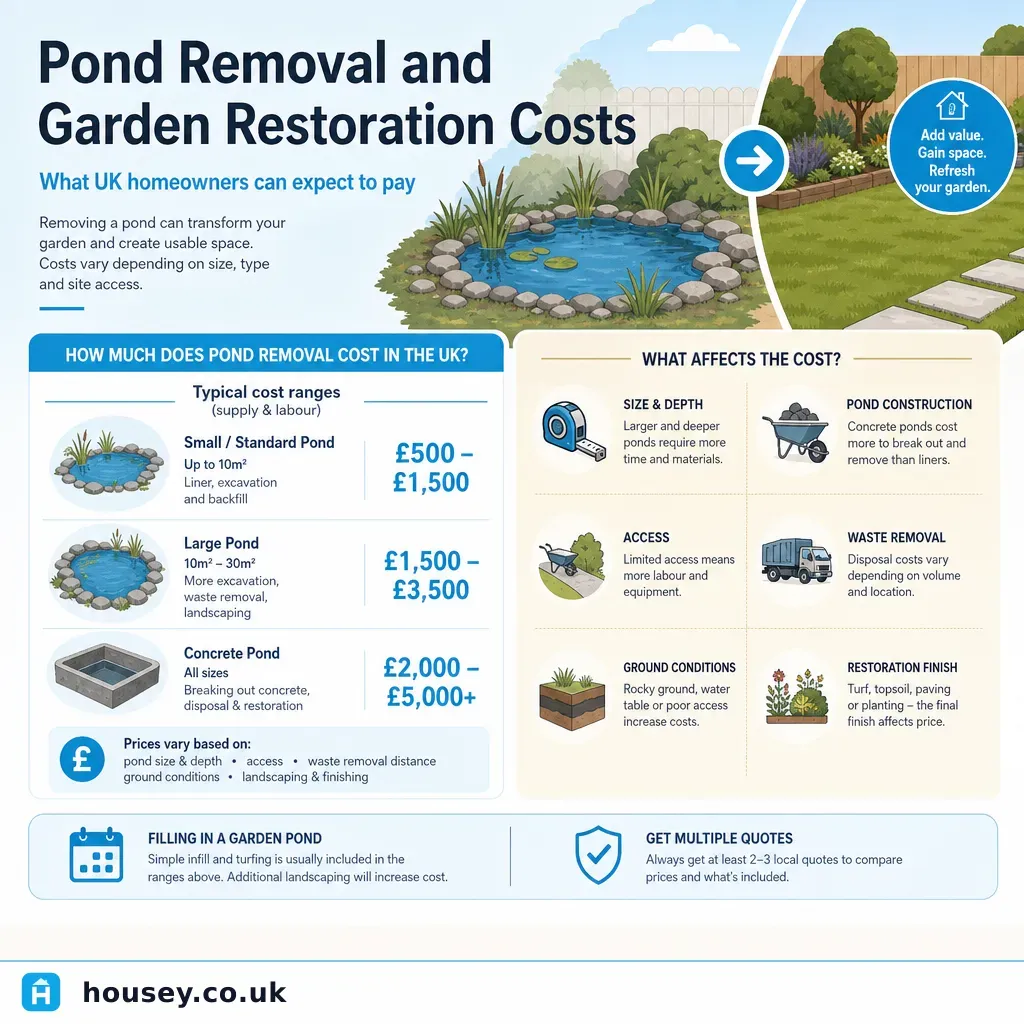
Pond Removal and Garden Restoration Costs
Removing a garden pond in the UK typically costs £300–£700 for a small liner pond, rising to £1,800–£4,000 for a concrete or brick-built structure.
 Improvement & Build
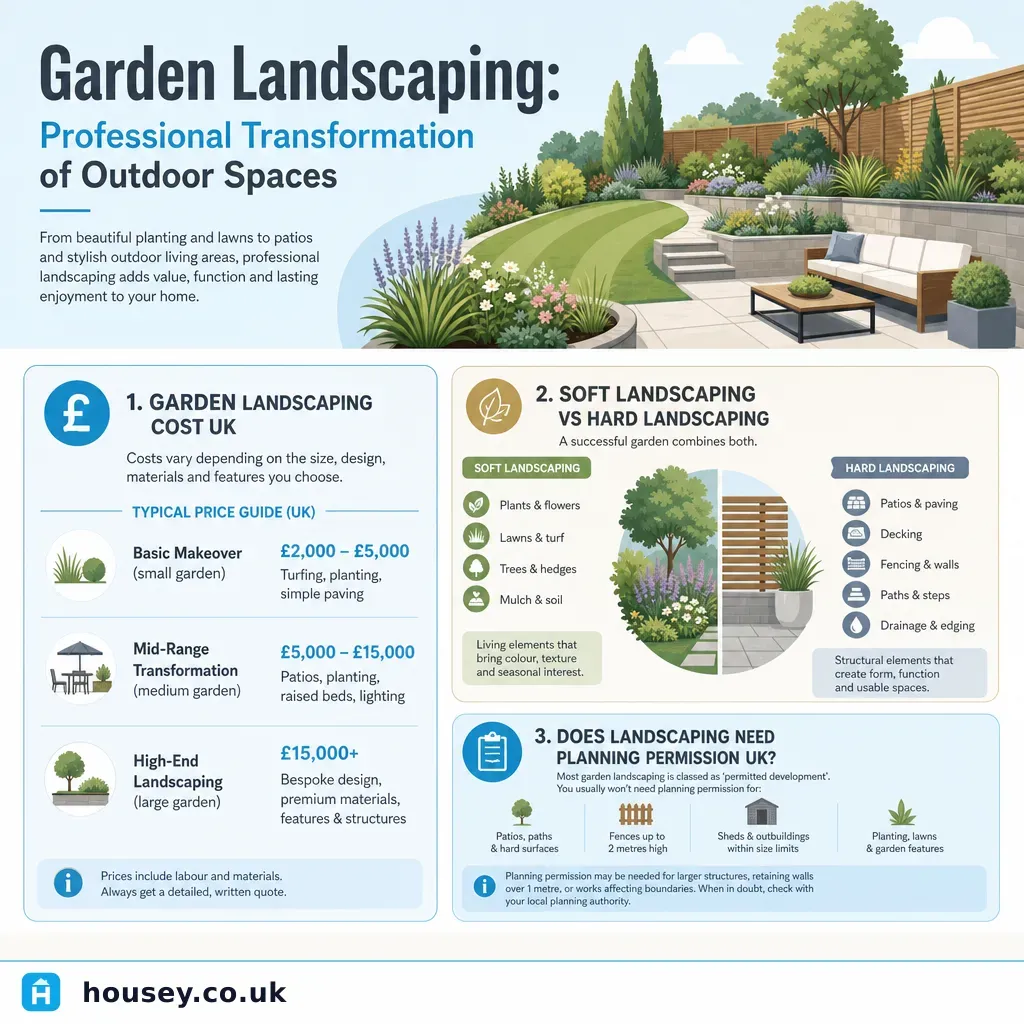
Garden Landscaping: Professional Transformation of Outdoor Spaces
Garden landscaping covers all physical works to reshape and improve an outdoor space, from earthworks and hard landscaping such as patios, paths, and walls, to planting, drainage, and lawn installation.
 Improvement & Build
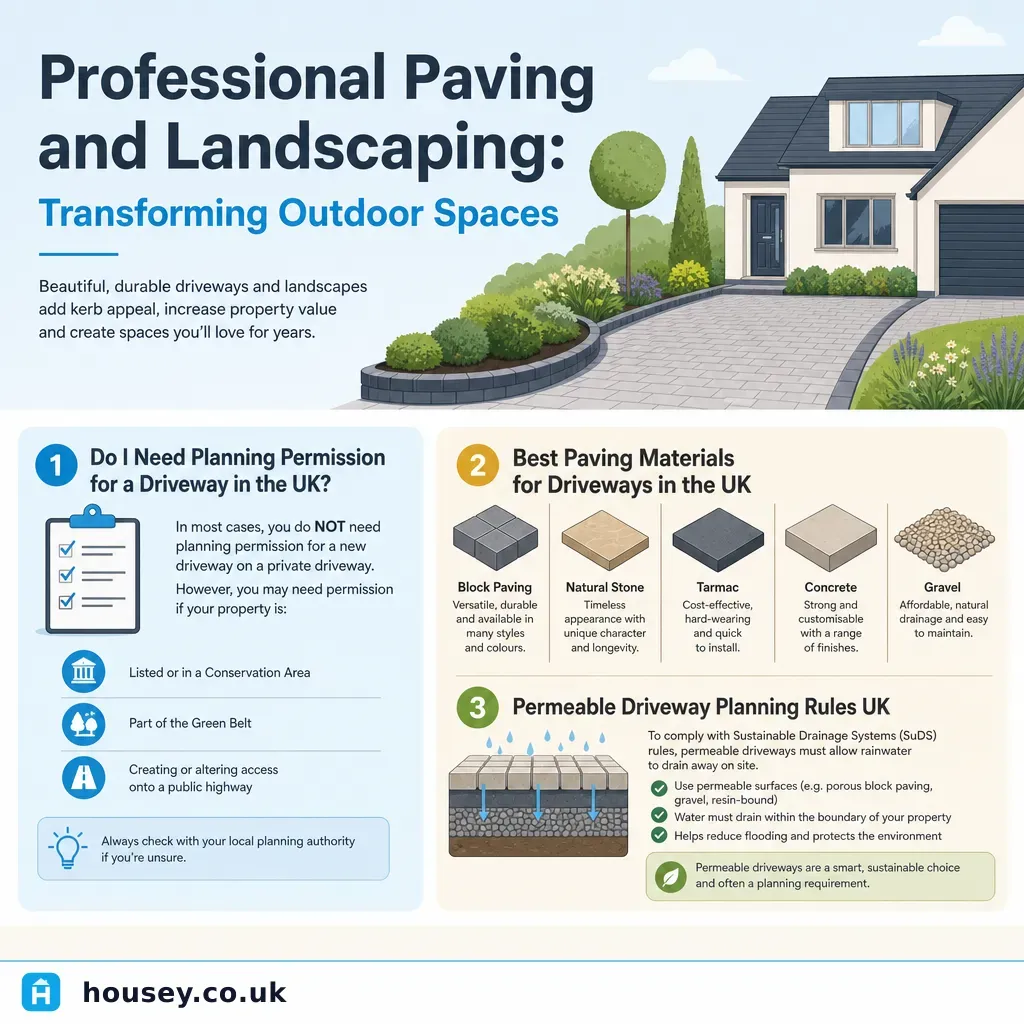
Professional Paving and Landscaping: Transforming Outdoor Spaces
Professional paving and landscaping can transform a garden or driveway, improving kerb appeal and adding usable outdoor space.
 Improvement & Build
Garden and Landscape Services for Your Property
Garden designers and landscapers both improve outdoor spaces but offer different services.
 Improvement & Build
Landscaping and Garden Design for Property Enhancement
Landscaping and garden design involve planning and building outdoor spaces — from patios and raised beds to planting schemes and drainage.