Living Through Major Renovation: Stay or Relocate During Building Work
By Housey · Last reviewed 30th of May 2026
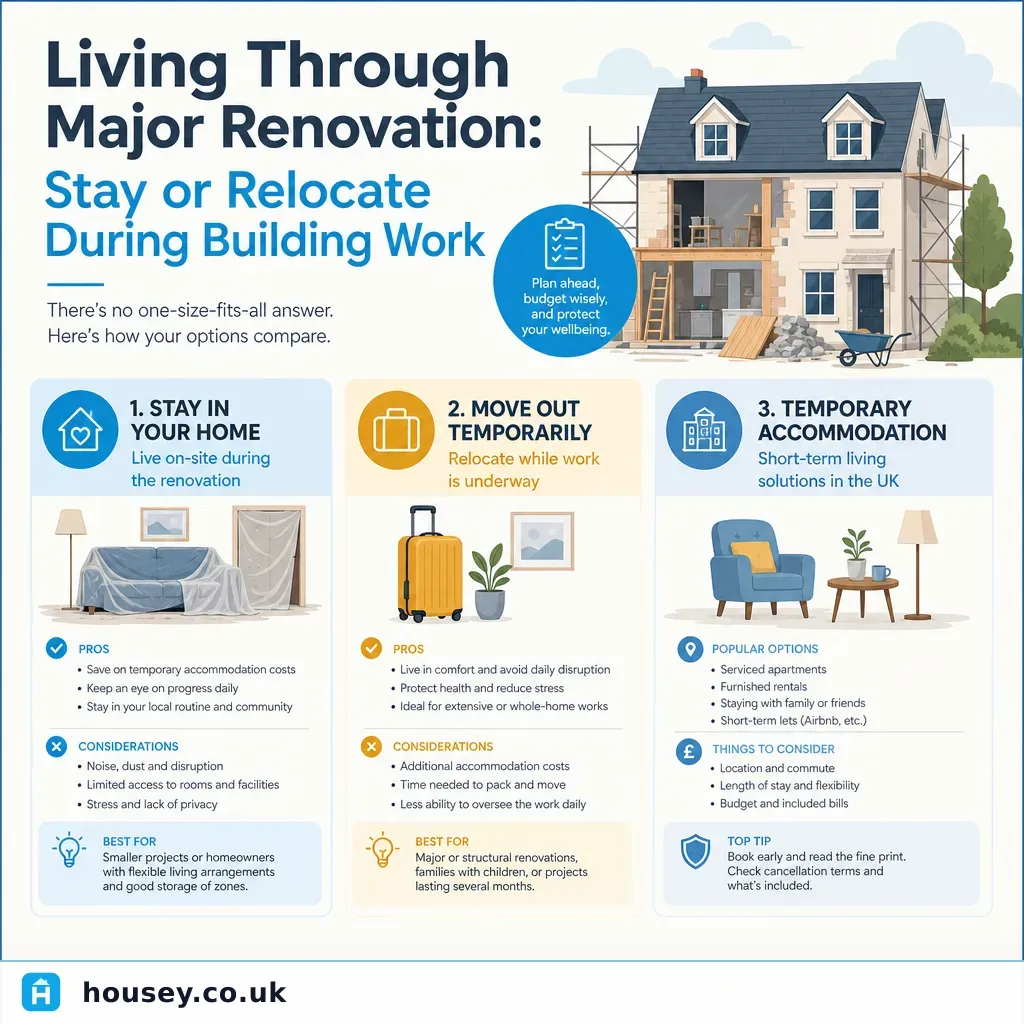
Living Through Major Renovation: Stay or Relocate During Building Work
Deciding whether to remain in your home or move out during major building work is one of the most consequential practical decisions of any renovation project. The right choice depends on factors that are rarely obvious at the planning stage — the scope of work, the contractor's programme, your household circumstances, and costs that only become apparent once work begins. Getting this decision wrong can affect your health, your working relationship with the build team, and your project budget in ways that are difficult to reverse once work is under way.
Key points
- Living on-site during active demolition or structural work typically slows the build by 10–20% compared to a vacant site, as contractors observe restricted working hours — usually 08:00–18:00 Monday–Friday and 08:00–13:00 Saturday under standard Environmental Health guidance.
- Temporary accommodation in the UK costs roughly £800–£3,000/month for a furnished rental, depending on region and property size; short-let serviced apartments often carry a 20–40% premium over equivalent long-let rates.
- Most standard home insurance policies reduce cover or void accidental damage protection if the property is unoccupied for 30 or more consecutive days — notify your insurer before you move out and request a specific endorsement.
- Party wall works, structural alterations, and full kitchen or bathroom strip-outs are typically the most disruptive phases, each lasting 2–8 weeks depending on scope.
- Some residential mortgage conditions require you to notify your lender of major structural works or extended absence — check your mortgage deed before committing to a plan.
When staying is viable
Remaining in your home during a renovation is usually workable when:
- Work is confined to one zone — a single-storey rear extension, for example — while the main house remains habitable.
- At least one working kitchen and one working bathroom are accessible at all times.
- Structural works are complete and the building is weathertight before wet trades (plastering, screed) begin.
- No vulnerable occupants — young children, elderly relatives, or anyone with asthma or a respiratory condition — are present during demolition or dusty cutting phases.
Staying becomes genuinely difficult when:
- The entire ground floor is being reconfigured at once.
- The roof is open or the building is not weathertight.
- Mains water, heating, or electricity will be interrupted for more than 24–48 hours at a stretch.
- The scope involves notifiable asbestos removal, which requires professional management and site controls under the Control of Asbestos Regulations 2012.
Comparing your options
Factor | Staying in the property | Relocating temporarily |
|---|---|---|
Daily oversight of build | Easy — you are on-site | Requires planned site visits or a project manager |
Build speed | Typically slower — contractors work around occupants | Faster — vacant site, fewer working-hour constraints |
Direct cost | Minimal (normal running costs) | £800–£3,000+/month rental plus possible storage costs |
Stress for occupants | High during demolition and structural phases | Lower daily disruption, though distance from site brings its own concern |
Insurance position | Standard policy generally continues | Must notify insurer; may need unoccupied endorsement |
Contractor communication | Natural daily contact | Requires disciplined check-ins; project management recommended |
Child, pet, or elder welfare | Challenging during dusty or noisy phases | Usually better — normal household environment maintained elsewhere |
Security | Higher (occupied premises) | Confirm site-security provisions with contractor and insurer |
Decision tree: should you stay or go?
- Stay if work is restricted to one zone, the remainder of the house is fully habitable, and no vulnerable occupants are present during the most disruptive phases.
- Stay with a phased plan if the project has clearly distinct phases — agree with your contractor which weeks require a temporary absence and which can be managed in situ.
- Relocate for specific phases only if a full move-out is unaffordable — many homeowners remain for the majority of the project and vacate only for the 2–4 weeks of structural works or the kitchen and bathroom strip-out.
- Relocate fully if the project is a whole-house renovation (rewire, replumb, new kitchen, new bathroom, roof works), lasts longer than three months, or your household includes young children, elderly occupants, or anyone with a respiratory condition.
- Ask your principal contractor or project manager if the scope or timeline is unclear — a reputable contractor should provide a week-by-week programme before work starts so you can plan your living arrangements accordingly.
Planning your temporary accommodation
If you relocate — even for a short phase — plan logistics before the build begins.
Accommodation options:
- Short-let furnished flat or house: flexible; typically available month-by-month; costs 20–40% more than equivalent long-let rates.
- Serviced apartment: suits shorter stays; includes utilities and cleaning; can be expensive for extended periods.
- Family or friends: low cost, but be realistic about the strain a build overrun places on the relationship.
- Static caravan or cabin on-site: practical for rural or large-plot properties; may require a temporary planning application if the stay exceeds 28 days, and needs connection to services.
What to budget for (indicative UK costs, last reviewed 2026-05-30; quotes will vary by region):
- Rental accommodation: £800–£3,000/month (London and the South East at the higher end).
- Furniture storage: £50–£200/month for a standard unit.
- Additional pet boarding, childcare, or travel costs if the temporary home is less convenient.
- A contingency for overrun — residential projects regularly extend beyond their original programme.
Managing the build from a distance
If you relocate, maintaining oversight is your biggest practical challenge.
- Engage a project manager: a professional residential PM typically costs 5–15% of the total build cost and is often worth it for projects above £75,000 where you cannot be on-site daily.
- Schedule regular site visits: agree a weekly or twice-weekly slot with your contractor and document progress with dated photographs.
- Use a stage-payment schedule: tie payments to programme milestones rather than calendar dates alone, and confirm each milestone is genuinely complete before releasing funds.
- Ask about progress-reporting tools: many builders use apps (Buildertrend, CoConstruct, or similar) that provide photo updates and programme tracking — ask whether this is part of the service before appointing.
What to ask before starting
- Can you provide a week-by-week programme showing the most disruptive phases?
- At what stage will the property be weathertight?
- When will we have a working kitchen and bathroom back?
- How will you manage dust containment during demolition?
- What are your daily working hours, and do they comply with council noise restrictions?
- Do you carry adequate public liability insurance (minimum £2 million), and can I see the certificate?
- Do you have experience managing renovations in occupied properties?
Protecting your finances and your home
Before the build begins, confirm three things in writing:
Home insurance: call your insurer, explain the scope and duration of works, and ask about unoccupied-property conditions. Request a written endorsement or ask whether a specialist renovation policy covering the structure and works in progress is more appropriate.
Mortgage conditions: most residential mortgage terms allow temporary absence for renovation, but major structural works may require lender notification. Check your specific mortgage deed.
Contractor insurance: ask to see the public liability certificate (minimum £2 million; £5 million preferable for larger projects) and employers' liability insurance before work starts.
When to get professional help
Projects above £50,000, full-house renovations, or any scheme involving multiple subcontractors benefit from formal project management. Red flags that suggest the build needs closer oversight:
- The contractor cannot provide a phased programme before work starts.
- There is no single named site manager responsible for day-to-day coordination.
- You are relocating and cannot visit the site more than once per week.
- The project involves party wall works and the adjoining owner has appointed their own surveyor.
How Housey can help
Housey can connect you with experienced project managers who specialise in occupied-site residential renovations, and design-and-build firms that include end-to-end management as part of their service. If you are planning an extension or structural addition, our network of extension builders can advise on phasing to minimise disruption. A build cost estimate before you commit to a programme helps you plan your relocation budget with confidence.
Frequently asked questions
Do I need to tell my mortgage lender if I move out during renovation?
Most residential mortgage conditions require the property to be used as your principal residence; temporarily vacating for renovation is generally accepted. However, major structural works or an extended absence may need to be disclosed to avoid a technical breach of your mortgage terms. Check your mortgage deed and contact your lender if the works are significant or you will be away for more than a few months.
Will my home insurance still cover me if I move out during building work?
Most standard policies include an unoccupancy clause that reduces or voids accidental damage cover after 30 consecutive days. Notify your insurer before you move out, confirm your cover in writing, and ask whether a renovation endorsement or specialist renovation policy is appropriate. Do not assume standard cover continues unchanged.
How long does a full-house renovation typically take?
A whole-house renovation on a 3–4 bedroom UK property — covering a new kitchen, bathrooms, rewire, replumb, loft conversion, and extension — typically takes 4–9 months from start to practical completion, depending on scope, planning requirements, and contractor availability. Most projects extend beyond their original programme; build a contingency of 4–8 weeks into your temporary accommodation budget.
Can I live in a caravan in my garden during renovation?
You can generally use a static caravan or motorhome on your land for short periods under permitted development rights. Living in one as a primary residence for an extended period may require a temporary planning application. Check with your local planning authority if you anticipate staying in the caravan for more than 28 days — some councils apply specific rules for habitation on residential plots.
Sources and further reading
- GOV.UK: Planning permission — when you need it — Planning Portal / GOV.UK
- HSE: Construction dust — health risks — Health and Safety Executive
- HMRC VAT Notice 708: Buildings and construction — HMRC
- Control of Asbestos Regulations 2012 — legislation.gov.uk
- Citizens Advice: Private renting guidance — Citizens Advice
Useful next reads
 Improvement & Build
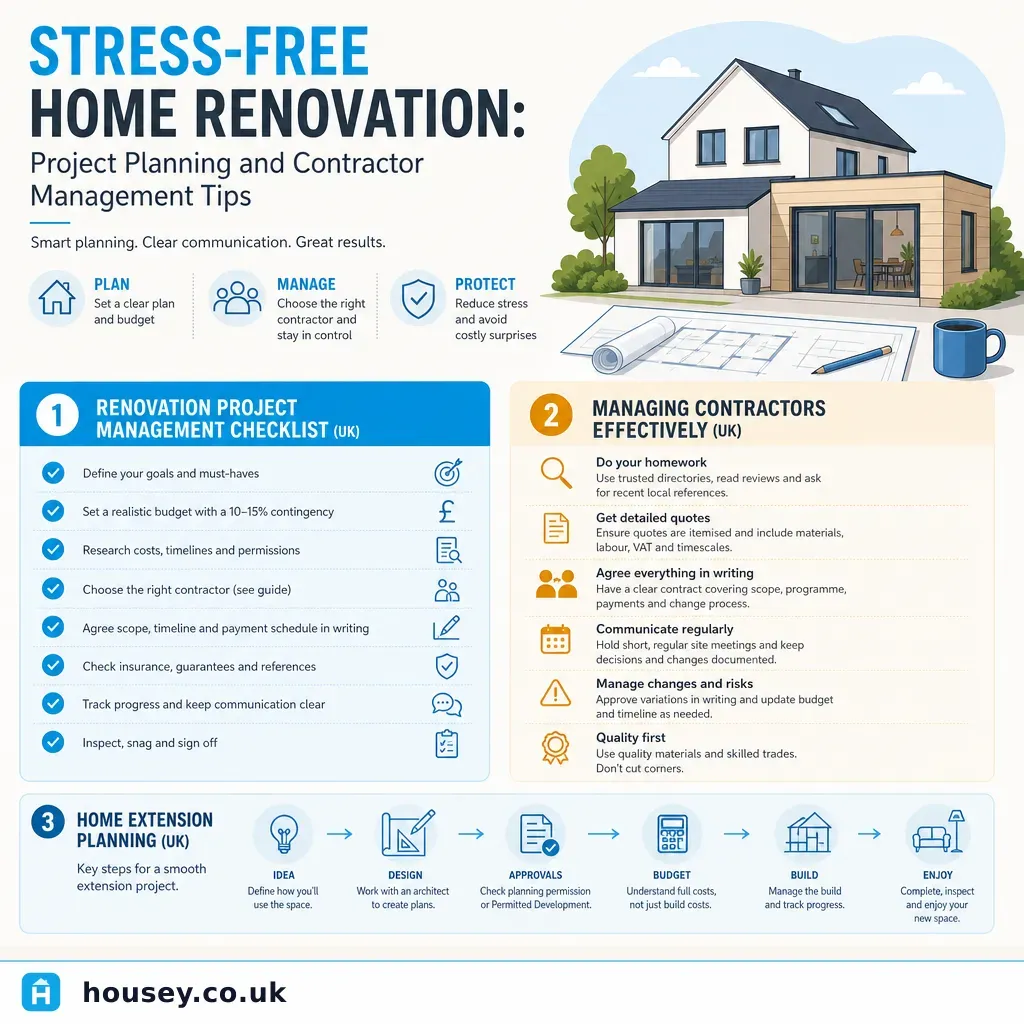
Stress-Free Home Renovation: Project Planning and Contractor Management Tips
The home renovations that stay on budget and on time share one characteristic: clear upfront planning.
 Improvement & Build
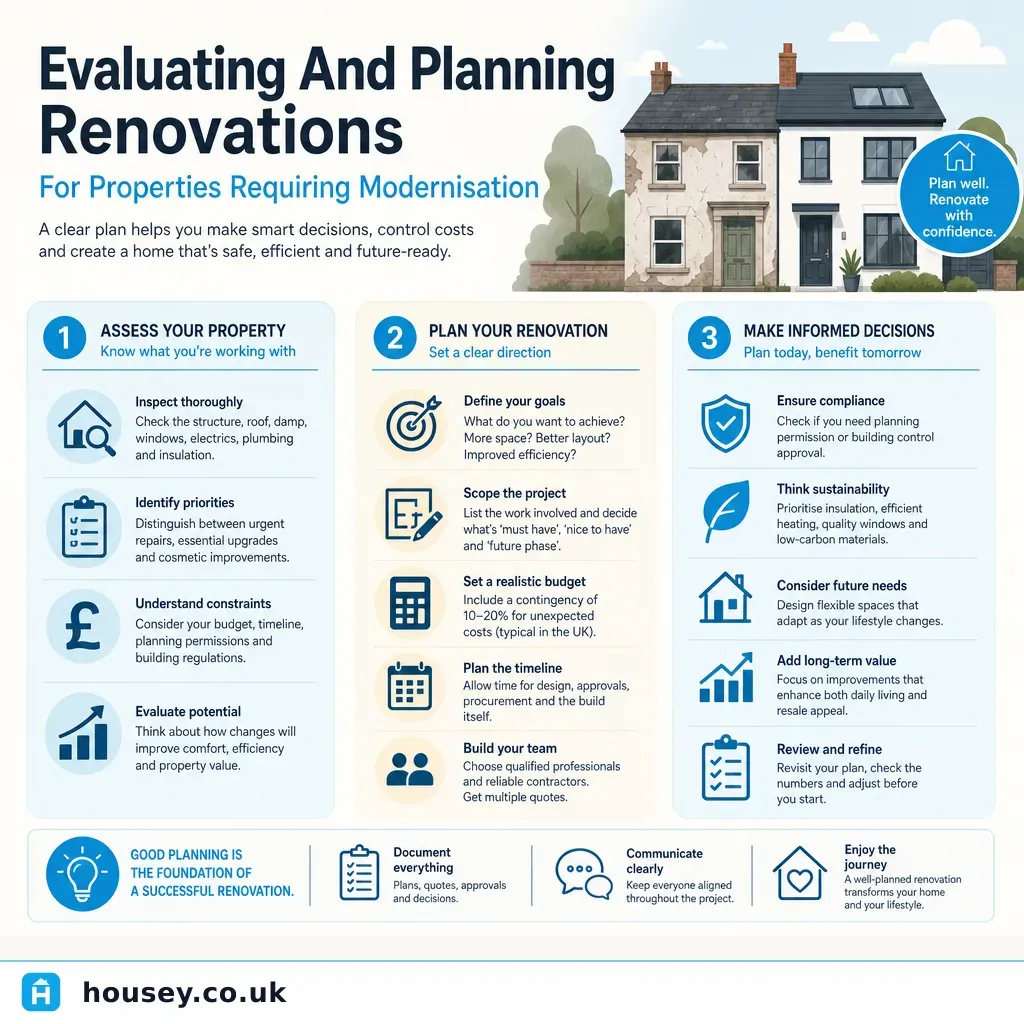
Evaluating And Planning Renovations For Properties Requiring Modernisation
Start by commissioning a condition survey — RICS Level 3 for pre-1919 properties — to identify structural defects, damp, and services issues before finalising a budget.
 Improvement & Build
Patio Door Types and Styles for Home Extensions
For most UK home extensions, sliding doors suit openings up to 3.
 Improvement & Build
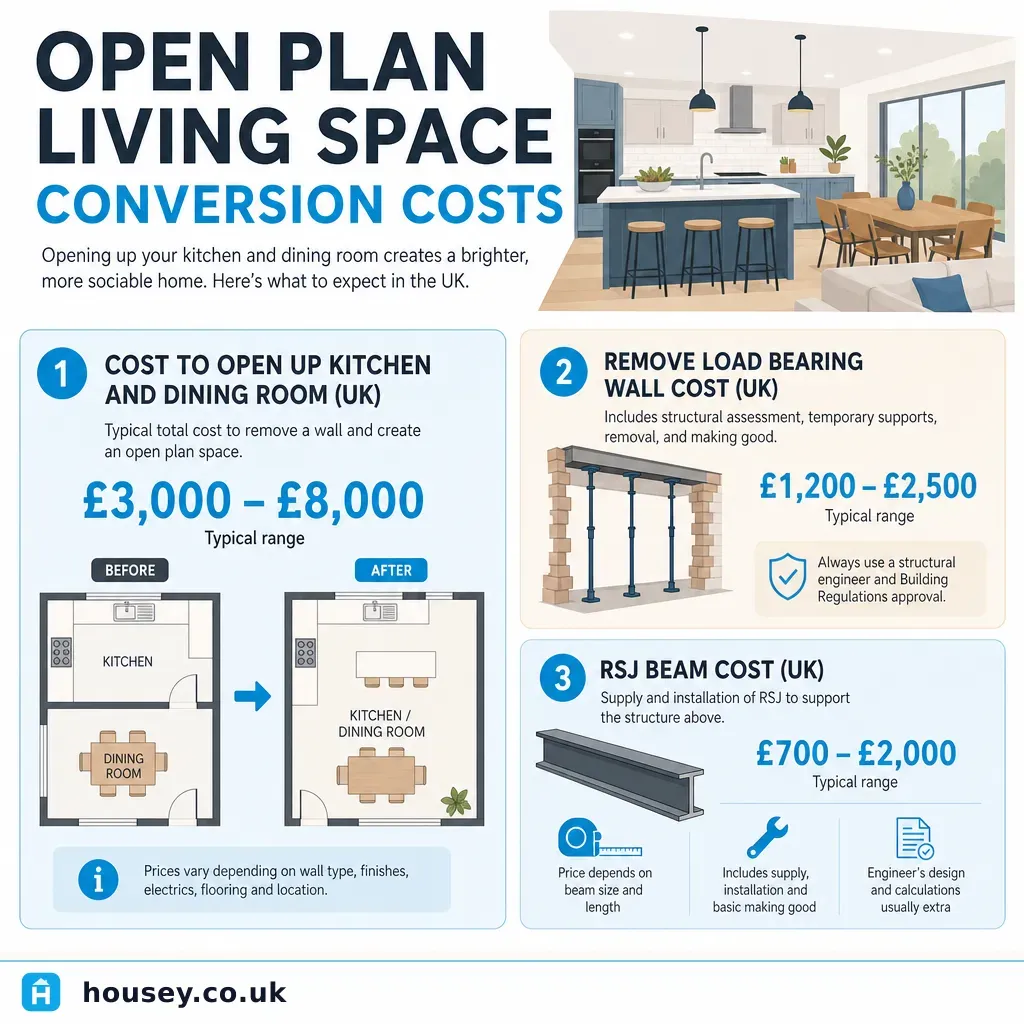
Open Plan Living Space Conversion Costs
Opening up a living space in the UK typically costs £3,000–£15,000+ depending on whether walls are load-bearing, the beam specification required, and the extent of remodelling.
 Improvement & Build
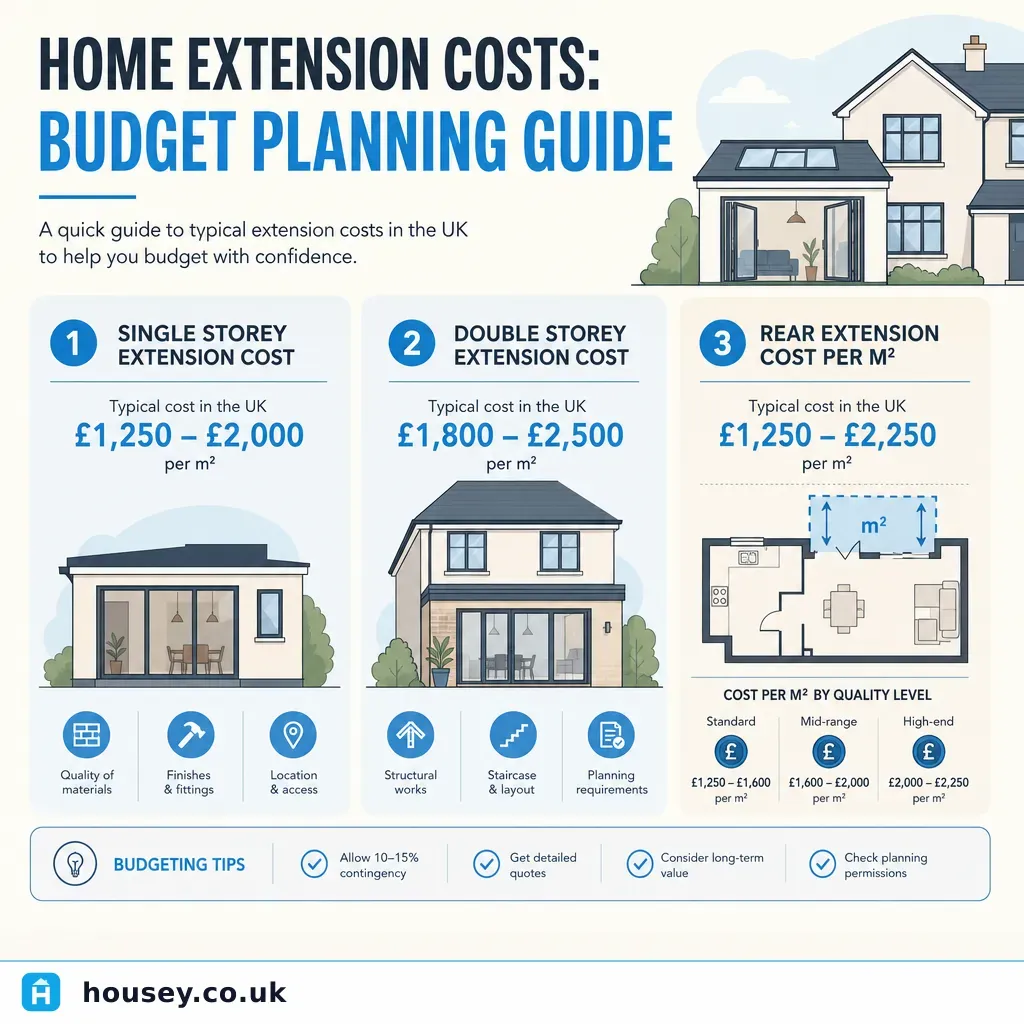
Home Extension Costs: Budget Planning Guide
A single-storey rear extension in the UK typically costs £1,500–£2,500 per square metre to build.