Loft Hatch Installation and Access Solutions
By Housey · Last reviewed 7th of May 2026
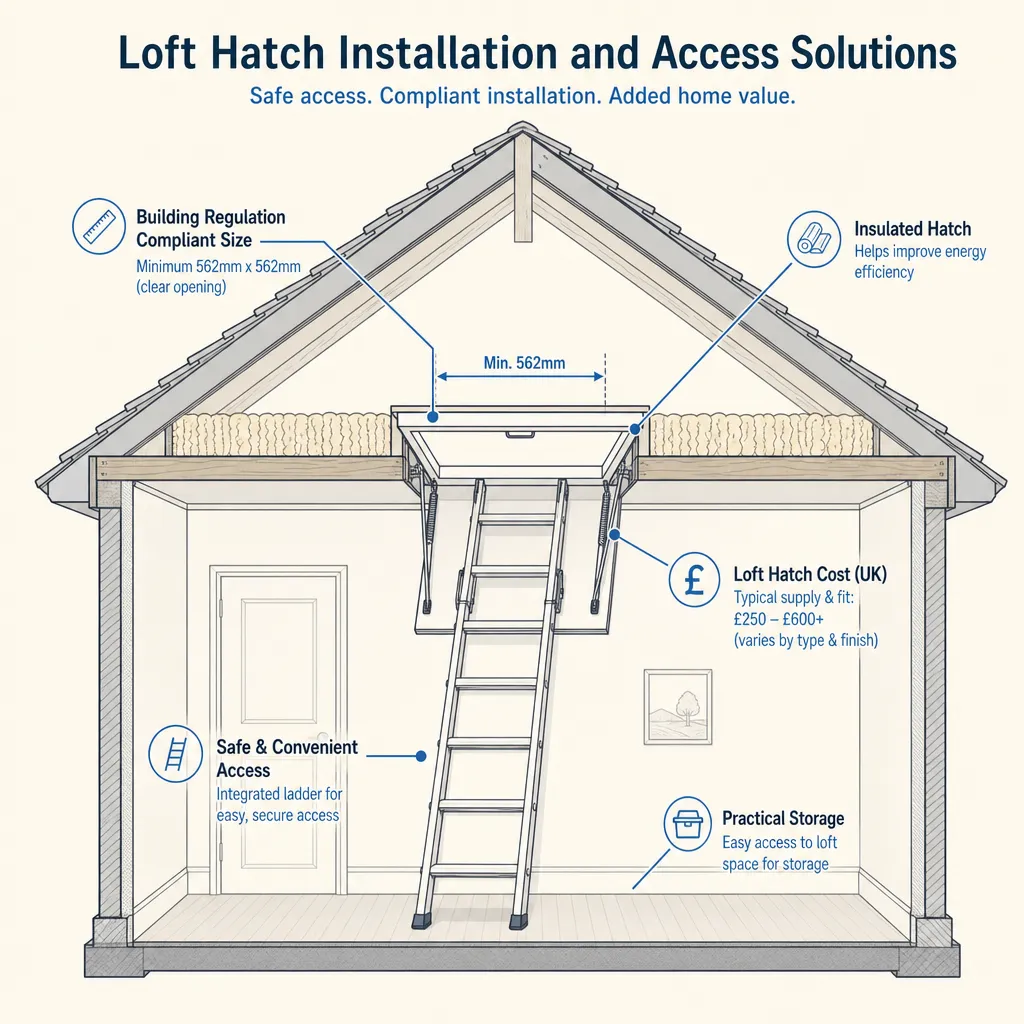
Loft Hatch Installation and Access Solutions
A loft hatch is often the most overlooked element of a home's fabric — until someone needs to check the insulation, access a cold-water tank, or begin a loft conversion project. Whether you are adding a first hatch to a property that has never had formal access, upgrading a poorly insulated or ill-fitting opening, or choosing the right access solution ahead of a full conversion, the range of products and installation requirements is broader than most homeowners expect.
Key points
- Building Regulations Approved Document K sets minimum headroom (2 m at the pitch line) and stair width requirements for fixed loft staircases; for storage-only hatches there is no statutory minimum opening size, but 600 mm × 600 mm is widely recommended as the practical minimum for safe adult access.
- Insulated loft hatches are important for Part L (conservation of fuel and power) compliance — an uninsulated hatch can account for disproportionate heat loss equivalent to leaving a small window permanently open.
- For a habitable loft conversion, a fixed staircase is required under Approved Document K; a hatch-and-ladder solution alone will not satisfy building control sign-off.
- Fire-rated hatches to FD30 specification are required where the loft forms part of a fire escape route or where a habitable loft room sits above the uppermost storey of a two-storey house.
- The Work at Height Regulations 2005 apply to contractors working during installation; engaging a qualified joiner or carpenter for any new hatch installation is advisable wherever work exceeds 2 m height.
Types of loft hatch and access solution
Basic loft hatch (hatch only)
A simple timber-framed opening in the ceiling with a hinged or push-up cover. Suitable for occasional storage access. Costs are relatively low but ergonomically inconvenient without a separate freestanding ladder. Most modern hatches include a compression draught seal and a basic insulation panel.
Loft hatch with folding ladder
The most common domestic solution. A spring-loaded or cord-operated timber or aluminium ladder folds into the hatch frame and is pulled down when needed. Timber folding ladders are generally less expensive; aluminium models are lighter and often rated for higher load capacities.
Sliding or telescoping loft ladder
Requires more ceiling height to deploy fully, but tends to feel more stable underfoot than a folding design. The ladder sections telescope or slide rather than fold, making them suitable where the ceiling void depth is limited — less space is needed to store the retracted ladder.
Electric loft ladder
Motorised systems allow hands-free operation, which is particularly useful for frequent access or for household members with mobility considerations. Higher installation cost, but increasingly chosen where the loft is used as a regular workspace or home office.
Loft stairs (for habitable conversions)
Where the loft is to be used as a habitable room, Building Regulations require a fixed staircase meeting the requirements of Approved Document K, including minimum 2 m headroom at the pitch line and minimum stair width. This is a distinct product from a loft ladder and normally forms part of a wider loft conversion project.
Loft hatch and access solution comparison
Type | Typical installed cost | Best for | Not ideal for | Key consideration |
|---|---|---|---|---|
Basic hatch only | £150–£350 | Infrequent storage access; existing separate ladder | Frequent use; limited mobility | Ensure draught seal and insulation panel are included |
Hatch + timber folding ladder | £350–£650 | Regular storage access; cost-conscious budget | Very frequent use; heavy loads | Check load rating — usually 125–150 kg |
Hatch + aluminium folding ladder | £450–£900 | Lighter weight; longer service life | Where aesthetics are a priority | More compact folded profile than timber |
Hatch + sliding/telescoping ladder | £500–£950 | Lower ceiling voids; awkward roof spaces | Standard voids with ample depth | Confirm available void depth before specifying |
Electric loft ladder | £800–£2,000 | Frequent access; mobility considerations | Simple occasional storage | Requires power supply near hatch position |
Loft stairs (conversion) | Part of full conversion cost | Habitable loft room; building control sign-off | Storage-only lofts | Building Regulations approval required |
Indicative UK costs, last reviewed 2026-05-07. Quotes will vary by location and contractor.
Which access solution do you need?
- Choose a basic hatch if loft access is infrequent (once or twice a year) and you already have a suitable freestanding ladder.
- Choose a folding loft ladder if you access the loft several times per year for storage and need hands-free descent.
- Choose an aluminium or telescoping ladder if you want a longer-lasting product, a lighter weight, or have a constrained ceiling void depth.
- Choose an electric ladder if access is frequent, or if a household member has limited mobility.
- Choose a fixed staircase if the loft will be used as a habitable room — a ladder-only solution will not pass building control inspection.
- Ask a joiner or structural engineer if cutting the opening requires modifying or trimming a ceiling joist; joist alteration should not proceed without a proper structural assessment.
- Ask a loft conversion specialist if you are planning a full conversion in future — the hatch may be a temporary measure during the build phase and its sizing should allow for later staircase installation.
What size should a loft hatch be?
There is no single statutory minimum size for a storage-only loft hatch, but 600 mm × 600 mm is widely cited as the practical minimum to allow a typical adult to pass through safely carrying light items. For habitable loft conversions, staircase and landing dimensions are governed by Approved Document K.
If you are installing a new hatch, consider:
- Joist spacing: standard joist centres in UK homes are often 400 mm or 600 mm. A 600 mm × 600 mm hatch can usually be cut between two joists without needing a trimmer beam, but always check the structural layout first.
- Future-proofing: if a loft conversion is possible in future, sizing the opening at 700 mm × 900 mm or larger now avoids costly enlargement later.
- Insulation depth: modern insulated hatches with a U-value of around 0.25 W/m²K or better help meet Part L requirements. The insulation depth should be comparable to the surrounding ceiling insulation.
Insulation and energy efficiency
An uninsulated loft hatch is one of the most common causes of concentrated heat loss at ceiling level. Building Regulations Part L requires new or replacement hatches to achieve a U-value equivalent to the surrounding ceiling construction. In practice this means a well-sealed hatch frame with a mineral wool or rigid foam insulation panel of at least 100–150 mm depth.
When assessing an existing or new hatch, check:
- Does the hatch frame include a compression draught seal around the full perimeter?
- Is the insulation panel rated for thermal performance, or is it a thin decorative board with negligible resistance?
- If a folding ladder is fitted, does the retracted ladder compress against the insulation panel when closed, or leave a gap?
Upgrading an uninsulated hatch in an otherwise well-insulated ceiling can make a meaningful difference to heat retention, particularly in older properties where hatches were installed without any thermal layer.
Fire safety considerations
In two-storey houses where a loft conversion creates a habitable top-storey room, Building Regulations Approved Document B requires a protected fire escape route from the new room down to the final exit. This typically requires:
- Fire-rated ceilings and walls forming the escape stairwell.
- FD30 (30-minute fire-resistant) doors to rooms opening off the stairwell.
- A fire-rated hatch or door at the top of the stair in certain configurations.
For a storage-only loft — not a habitable room — a standard (non-fire-rated) hatch is generally acceptable. However, if the loft is directly above a garage or other fire-risk area, check requirements with your local authority building control before specifying a hatch type.
What to ask before accepting a quote for hatch installation
- What size opening will be cut, and has the joist layout been checked prior to quoting?
- Will trimmer joists be added if required, and is this included in the price?
- What is the load rating of the ladder, and what material is it constructed from?
- Does the hatch include a draught seal and a rated insulation panel?
- Will the surrounding plasterwork and ceiling be made good after installation, and to what standard?
- Is building control notification included or excluded from the price?
- Is VAT included in the quoted figure?
Red flags when getting loft hatch quotes
Be cautious if a contractor:
- Proposes cutting through a joist without first checking whether it is structural or load-bearing.
- Does not mention a draught seal or insulation panel — these are standard components on all modern hatches.
- Fails to specify the ladder load rating or confirm the hatch opening size in writing before quoting.
- Provides a price that excludes making good the plasterwork and ceiling finish around the frame.
- Cannot confirm whether building control notification is required for the specific installation.
When to get professional help
Most standard hatch replacements and folding-ladder installations are within the capability of a competent joiner or carpenter. However, seek qualified professional input if:
- Cutting the opening requires modifying a ceiling joist — a structural engineer or experienced builder should assess the joist layout first.
- The hatch will form part of a fire escape route — fire-rating requirements must be verified with building control or a fire safety professional.
- The work forms part of a broader loft conversion — instruct a RIBA-chartered architect or specialist contractor to co-ordinate the access solution with the overall scheme.
- You are uncertain whether the loft floor structure can safely carry the additional loading from a fitted ladder system.
How Housey can help
If you need a qualified joiner or specialist to install or upgrade your loft access, Housey connects you with vetted local professionals. Request quotes from loft conversion companies — many offer hatch and ladder installation as a standalone service alongside full conversion projects.
Frequently asked questions
Do I need planning permission to install a loft hatch?
No. Installing or replacing a loft hatch does not require planning permission. If the installation is part of a broader loft conversion that alters the roof structure, planning permission rules for the conversion itself apply, but the hatch in isolation is not a controlled alteration and falls outside the scope of the Town and Country Planning Act.
Do I need building regulations approval for a loft hatch?
A like-for-like replacement of an existing hatch in a storage-only loft generally does not require building regulations notification. However, if cutting a new opening affects a load-bearing ceiling joist, or if the hatch forms part of an approved loft conversion scheme, building control involvement is required. If in doubt, contact your local authority building control (LABC) or an approved inspector.
How long does loft hatch installation take?
A standard hatch and folding-ladder installation typically takes half a day to a full day for a competent joiner, assuming a straightforward ceiling structure. Cutting a new opening into lath-and-plaster ceilings and making good the surrounding plasterwork can add time. An electric loft ladder installation takes longer due to the electrical connection required.
Can I install a loft hatch myself?
Fitting a replacement hatch in an existing opening of the same size is within the range of competent DIY if no structural work is involved. Cutting a new opening carries risk of joist damage and requires careful planning. Work at height must always be carried out from a stable platform. If the ceiling is lath-and-plaster (common in pre-1950s homes), the surrounding structure may benefit from professional handling.
What is the best position for a loft hatch?
Position the hatch where there is at least 900 mm of clear floor space below for the ladder to land, and where the extended ladder does not obstruct doors or the head of a staircase. A central landing position is often practical. Avoid positioning directly over an open stairwell, which creates a fall risk during use.
Sources and further reading
- Building Regulations Approved Document K (Protection from falling, collision and impact) — GOV.UK
- Building Regulations Approved Document B (Fire safety) — GOV.UK
- Building Regulations Approved Document L (Conservation of fuel and power) — GOV.UK
- Work at Height Regulations 2005 — HSE guidance — HSE
- Planning Portal — Loft conversions — Planning Portal
Useful next reads
 Improvement & Build
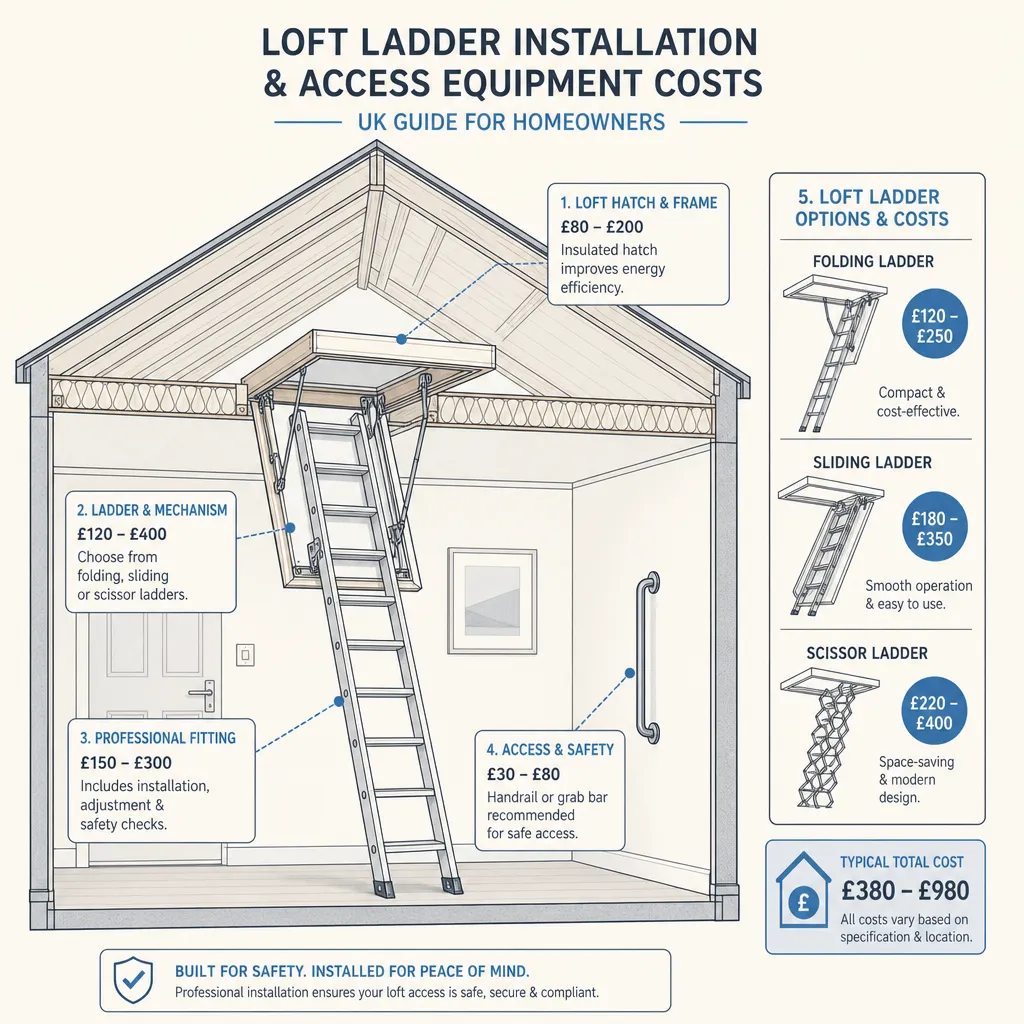
Loft Ladder Installation and Access Equipment Costs
Loft ladder installation typically costs £150–£450 supply and fit in the UK, depending on ladder type and whether the hatch needs enlarging.
 Improvement & Build
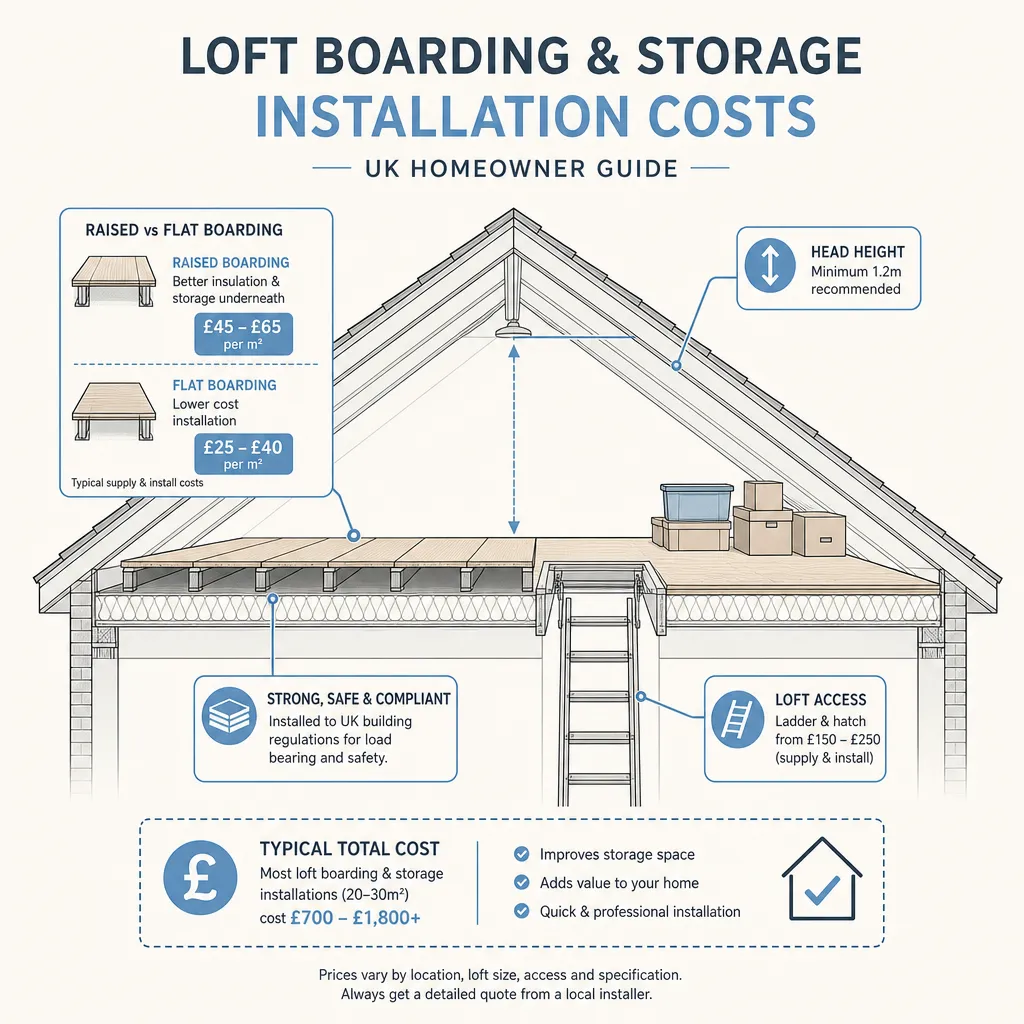
Loft Boarding and Storage Installation Costs
Basic loft boarding for an average semi-detached home costs £500–£1,500; a raised system that preserves insulation runs £800–£2,500.
 Improvement & Build
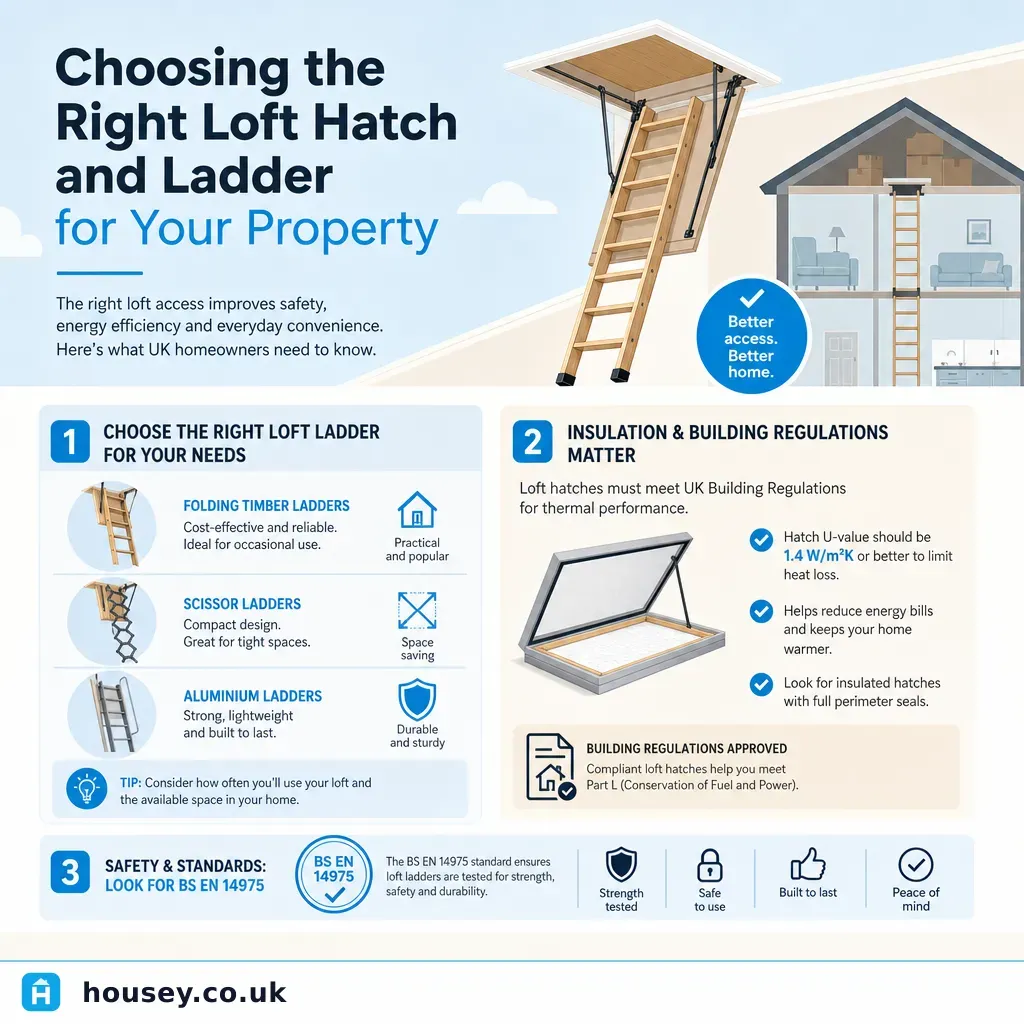
Choosing the Right Loft Hatch and Ladder for Your Property
The right loft hatch and ladder depends on ceiling height, how often you need access, and whether the loft will become a habitable room.
 Improvement & Build
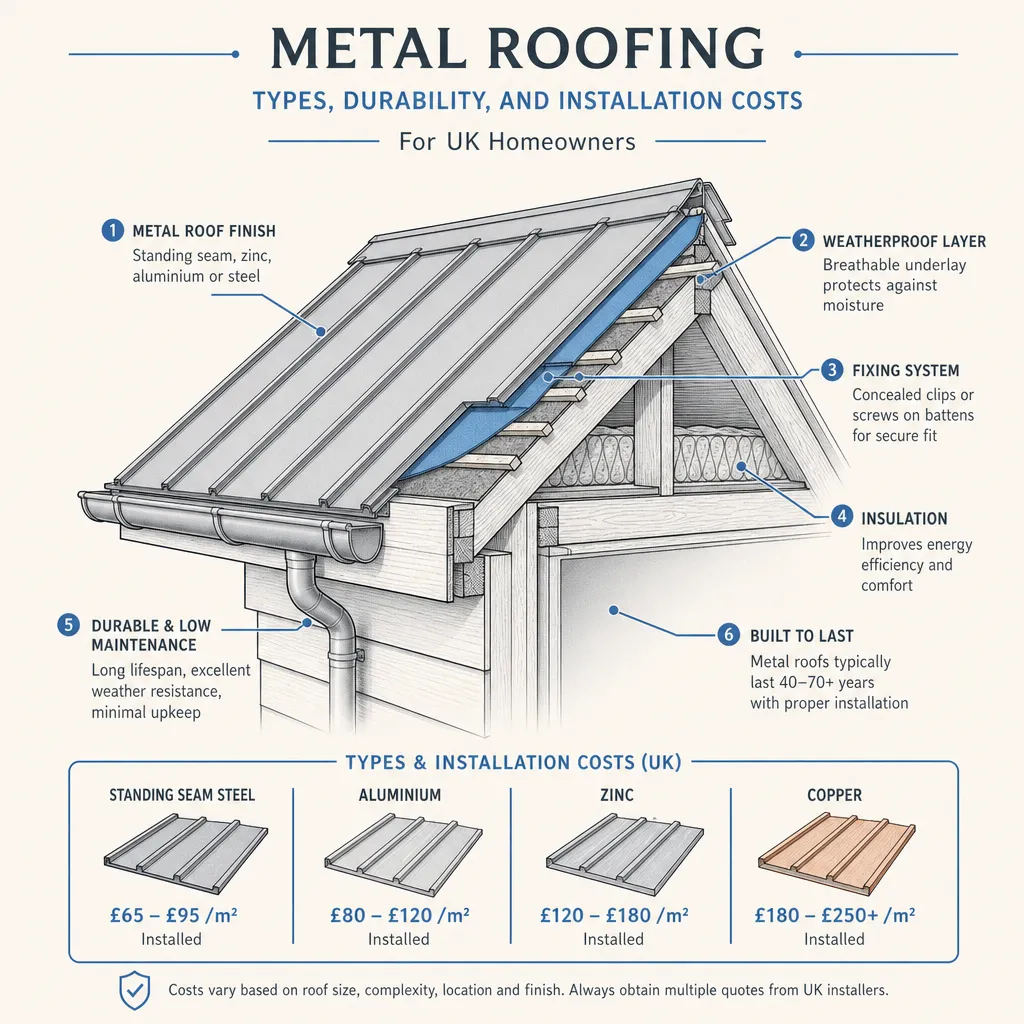
Metal Roofing: Types, Durability, and Installation Costs
Metal roofing in the UK includes standing seam, corrugated sheet, and metal tile systems in steel, aluminium, zinc, or copper.
 Improvement & Build
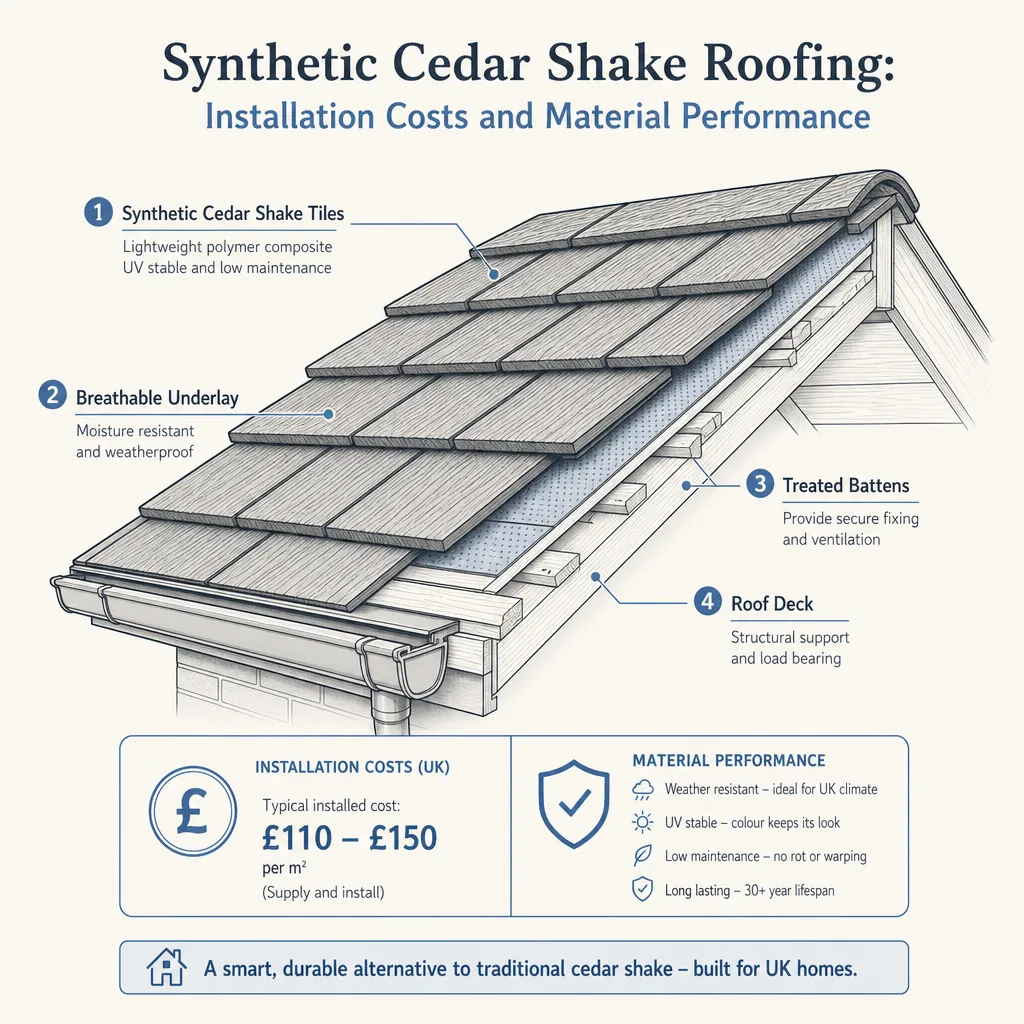
Synthetic Cedar Shake Roofing: Installation Costs and Material Performance
Synthetic cedar shake roofing uses polymer composite, rubber, or fibre-cement tiles to replicate the look of natural cedar wood shingles.