London Property Renovation: Complete Modernisation Case Study
By Housey · Last reviewed 5th of May 2026

London Property Renovation: Complete Modernisation Case Study
London's housing stock spans more than three centuries of construction — Georgian townhouses in Kensington, Victorian terraces in Hackney, Edwardian semis in Ealing, and post-war flats across inner and outer boroughs. Homeowners tackling renovation projects in the capital face a denser set of planning constraints, party wall obligations, and cost pressures than almost anywhere else in England. Whether you are extending a Victorian terrace in Lewisham or refurbishing an inter-war semi in Harrow, the decisions you make in the first few weeks — about consents, professional appointments, and programme — shape the entire project.
Key points
- Approximately 1,000 conservation area designations exist across London boroughs; external changes in these zones often require planning permission even where permitted development rights would otherwise apply nationally.
- The Party Wall etc. Act 1996 requires formal notice — and usually a written Agreement — before work on shared walls, boundary structures, or excavations within 3–6 metres of a neighbour's foundations.
- Building Regulations approval is required for structural alterations, loft conversions, extensions, new bathrooms, and changes to drainage, insulation, or electrical consumer units.
- London labour and logistics costs are typically 20–40% above UK national averages, driven by higher trade wages, congestion charges, parking restrictions, and tight site access on terrace streets.
- Listed Building Consent from the local planning authority is required for any works to Grade I, II* or Grade II listed buildings — including internal changes — irrespective of permitted development rights.
What makes London renovation different
Most UK renovation rules apply nationally — Building Regulations, the Party Wall etc. Act 1996, and the requirement for Gas Safe-registered engineers are the same in Bristol as in Bromley. What differs in London is the density of additional constraints layered on top.
London boroughs contain significant concentrations of conservation areas. Camden, Westminster, Kensington and Chelsea, Richmond, and Southwark all have large designated zones, meaning that even modest external changes — replacing windows with a different profile, adding a roof lantern, or painting over original render — can require planning consent that would not be needed elsewhere. Check your property address against your borough's planning portal before assuming permitted development rights apply.
London's terrace and semi-detached housing also means that the majority of renovation projects trigger the Party Wall etc. Act 1996. If you share a wall, floor/ceiling, or boundary with a neighbour and your work touches it — including through loft conversions, rear extensions, or basement excavations — formal notice is required. This process typically takes one to two months before a binding agreement is in place, and professional fees for party wall surveyors should be budgeted from the outset.
Finally, contractor availability, permit-to-work requirements on restricted streets, and limited delivery windows mean that programme management in London demands more forward planning than in less constrained parts of the country.
Planning permission and permitted development in London
In most of England, householders can carry out certain works — single-storey rear extensions up to 4 metres on detached houses (or 6 metres under the neighbour consultation scheme), internal alterations, and some roof works — without full planning permission under permitted development (PD) rights. In London, these rights remain available for many properties, but several factors commonly curtail them:
- Conservation areas: External cladding changes, roof alterations visible from a highway, and side extensions typically lose PD rights.
- Article 4 Directions: Many London boroughs have issued Article 4 Directions removing specific PD rights in defined streets or zones — check your local planning authority's website.
- Listed buildings: No PD rights apply to changes that affect the character of a listed building; Listed Building Consent is always required in addition to (or instead of) planning permission.
- Flats and maisonettes: PD rights do not apply to flats at all — every alteration requires either planning permission or a Lawful Development Certificate.
Building Regulations are separate from planning permission. They govern technical construction standards — structural stability, fire safety, thermal performance, drainage, and electrical safety — and apply to most substantive renovation work regardless of whether planning permission is needed. A Building Regulations completion certificate issued at the end of the project is required for conveyancing; projects that cannot produce one can cause delays or price reductions at sale.
Worked case study: Victorian terrace modernisation in South East London
The scenario below illustrates how a typical London renovation unfolds from first ideas to handover. This is a constructed example for illustration; costs and timescales are indicative only.
Property: Three-bedroom mid-terrace, circa 1895, South East London. Conservation area designation. Freehold.
Scope: Single-storey rear kitchen extension, loft conversion to bedroom with en suite, full rewire, replacement gas boiler, and two bathroom refurbishments.
Stage 1 — Feasibility and professional appointments (weeks 1–4) The owner engaged an architect and a planning consultant. The property sits within a conservation area but outside an Article 4 Direction zone. The proposed rear extension (4-metre depth, flat roof with glazed lantern) would require full planning permission despite being below the PD size limit, because of the conservation area designation.
Stage 2 — Party wall notices (weeks 3–8, overlapping) The loft conversion and rear extension both triggered the Party Wall etc. Act 1996. Both adjoining neighbours required engagement: one agreed to use a single agreed surveyor; the other appointed their own surveyor. Party wall awards were finalised before any structural work was permitted to commence.
Stage 3 — Consents (weeks 4–16) Planning permission for the rear extension was granted in 10 weeks. A Building Regulations Full Plans application was submitted simultaneously for both the extension and loft. Structural calculations were prepared by a chartered structural engineer.
Stage 4 — Procurement (weeks 12–20) Three itemised quotes were obtained from main contractors with experience in Victorian terrace work in London. Prices ranged from £148,000 to £196,000 for the full scope (indicative UK costs, last reviewed 2026-05-05; figures vary by specification, contractor, and borough). The owner selected a mid-range contractor holding CHAS accreditation and current public liability insurance of £5 million.
Stage 5 — Construction (weeks 20–48) Build programme: approximately 28 weeks. Key milestones included structural steelwork installation through the party wall, dormer framing, first-fix electrics and plumbing, plastering, and finishes. Building control officers inspected at required stages.
Stage 6 — Completion (weeks 48–52) Documents received: Building Regulations completion certificate, Gas Safe certificate for the new boiler, FENSA certificate for new rooflights, and an Electrical Installation Condition Report (EICR) for the rewire.
Outcome: The project ran approximately three weeks over programme due to a structural steel supply delay. Final cost came in at £164,000 (indicative, see above).
London renovation costs: what to budget
The table below provides indicative cost ranges for common renovation works in London, last reviewed 2026-05-05. These are illustrative only — obtain at least three written, itemised quotes before committing.
Work type | Indicative London cost range | Key cost drivers |
|---|---|---|
Single-storey rear extension (30–40m²) | £60,000–£110,000 | Specification, glazing, structural complexity, finishes |
Loft conversion (dormer, with en suite) | £55,000–£90,000 | Dormer size, en suite plumbing, stair access |
Full rewire (3-bed terrace) | £5,000–£9,000 | Cable runs, consumer unit, access difficulty |
Full bathroom refurbishment | £6,000–£14,000 | Specification, tiling, layout changes |
Kitchen refurbishment (no structural work) | £12,000–£35,000 | Units, worktops, appliances, layout |
Architect fees (design + planning) | £4,000–£12,000 | Complexity, number of revisions, construction monitoring |
Party wall surveyor (per award) | £700–£2,000 | Number of neighbours, complexity, whether agreed surveyor used |
Indicative UK costs, last reviewed 2026-05-05. Prices vary significantly by borough, specification, access constraints, and market conditions. Always obtain itemised written quotes.
Homeowner checklist before appointing a contractor
Before signing a building contract on a London renovation, confirm the following:
Red flags to watch for
The following should prompt closer scrutiny during procurement and on site:
- A contractor who quotes a fixed price before seeing the property or reviewing structural drawings.
- Requests for upfront payments exceeding 10–15% of contract value before work starts.
- No evidence of public liability or employers' liability insurance.
- Party wall notices not served when work clearly affects a shared structure.
- Structural work proceeding before Building Regulations approval is in place.
- Reluctance or inability to confirm which trades will hold which accreditations.
- A building programme with no allowance for building control inspection hold points.
When to get professional help
For any London renovation involving structural changes, planning applications, or listed buildings, engage qualified professionals before work begins — not after a problem arises. Specifically, seek professional advice if:
- The property is listed (any grade), as Listed Building Consent is legally required for virtually all changes.
- The property is in a conservation area and you are planning any external alterations.
- You share a wall, floor, or boundary with neighbours and structural work is planned.
- Cracks, active damp, or signs of movement are visible — a RICS Level 3 Building Survey or structural engineer's inspection should inform the scope of works before a contractor is appointed.
- The project involves basement or sub-basement excavation, which is among the most heavily regulated and neighbour-sensitive work types in London.
- You are a leaseholder — your lease will almost certainly require the freeholder's written consent before structural works begin, and this process can take several months.
How Housey can help
Housey connects UK homeowners with qualified local professionals across the full spectrum of renovation services — from architects and structural engineers to contractors, party wall surveyors, and planning consultants. If you are planning a London renovation, Housey can help you request quotes and compare professionals with relevant experience in your borough and property type.
Frequently asked questions
Do I always need planning permission for a rear extension in London?
Not always, but more often than elsewhere in England. If your property is in a conservation area, is listed, or is a flat, permitted development rights are restricted or removed. For houses outside these designations, single-storey rear extensions may be possible under permitted development, subject to size limits. Check with your borough's planning department or use the Planning Portal before assuming you can proceed without consent.
What is the Party Wall etc. Act 1996 and does it apply to my renovation?
The Party Wall etc. Act 1996 applies in England and Wales when you carry out work on or near a wall or structure shared with a neighbour, or excavate within 3–6 metres of their building. You must serve written notice before work begins. If the neighbour agrees, work can proceed; if they dissent, a party wall award must be drawn up first. Party wall surveyors manage this process on your behalf.
How long does a London house renovation typically take?
It depends on scope. A kitchen refurbishment alone might take 4–8 weeks on site. A combined rear extension and loft conversion — once planning and Building Regulations approvals are secured — typically takes 24–36 weeks in London. Pre-construction stages including design, planning applications, and party wall agreements can add a further 4–6 months before work begins.
What completion certificates should I receive after renovation work?
Depending on scope, you should receive a Building Regulations completion certificate, a Gas Safe certificate for gas work, an Electrical Installation Condition Report for electrical works, a FENSA certificate for replacement windows and doors, and confirmation that any planning conditions have been discharged. Keep all certificates safely — they will be requested during conveyancing when you come to sell or remortgage.
Sources and further reading
- Planning Permission: Extensions — Planning Portal
- Party Wall etc. Act 1996: guidance — GOV.UK
- Building Regulations approval — GOV.UK
- Listed buildings and permitted development — Historic England
- Conservation areas: guidance for homeowners — Historic England
Useful next reads
 Improvement & Build
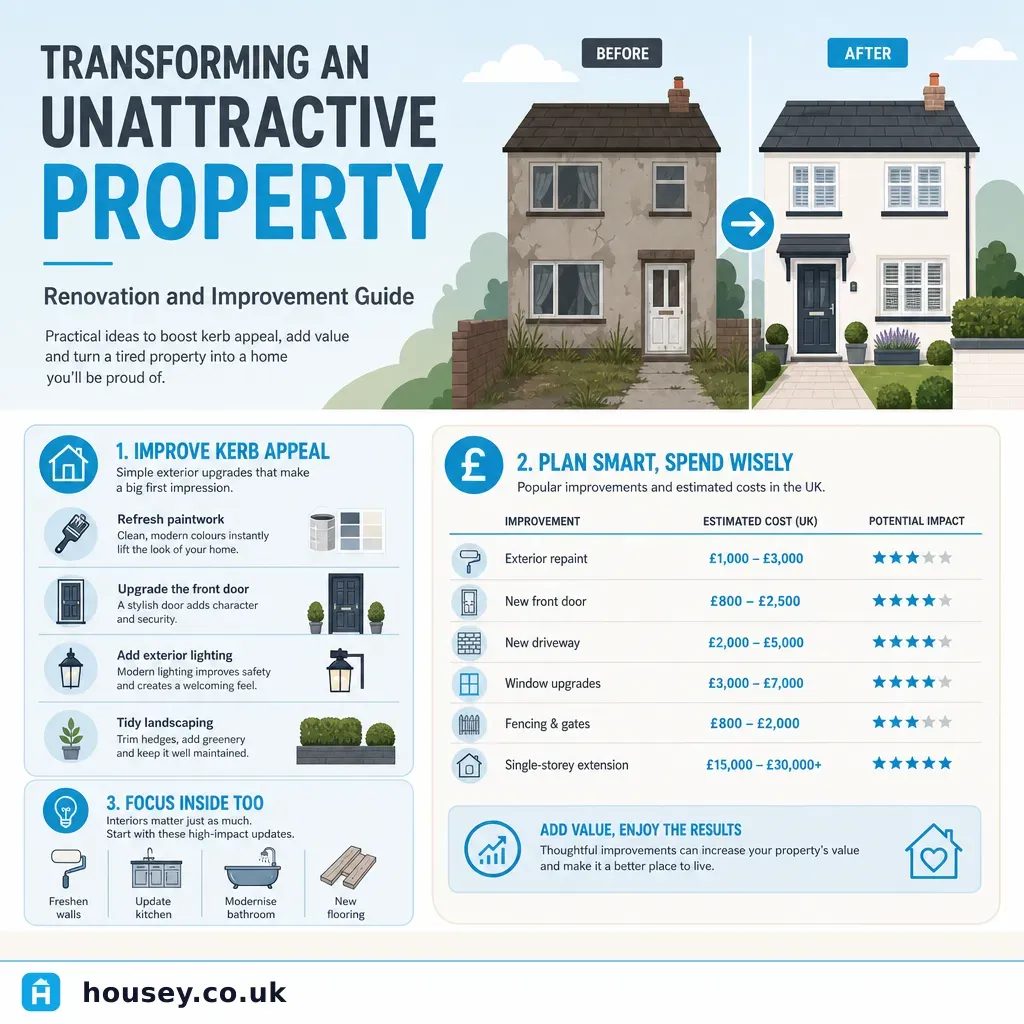
Transforming an Unattractive Property: Renovation and Improvement Guide
Transforming an unattractive UK property usually starts with surface-level improvements — render, windows, doors, and front landscaping — before tackling structural changes like extensions.
 Improvement & Build
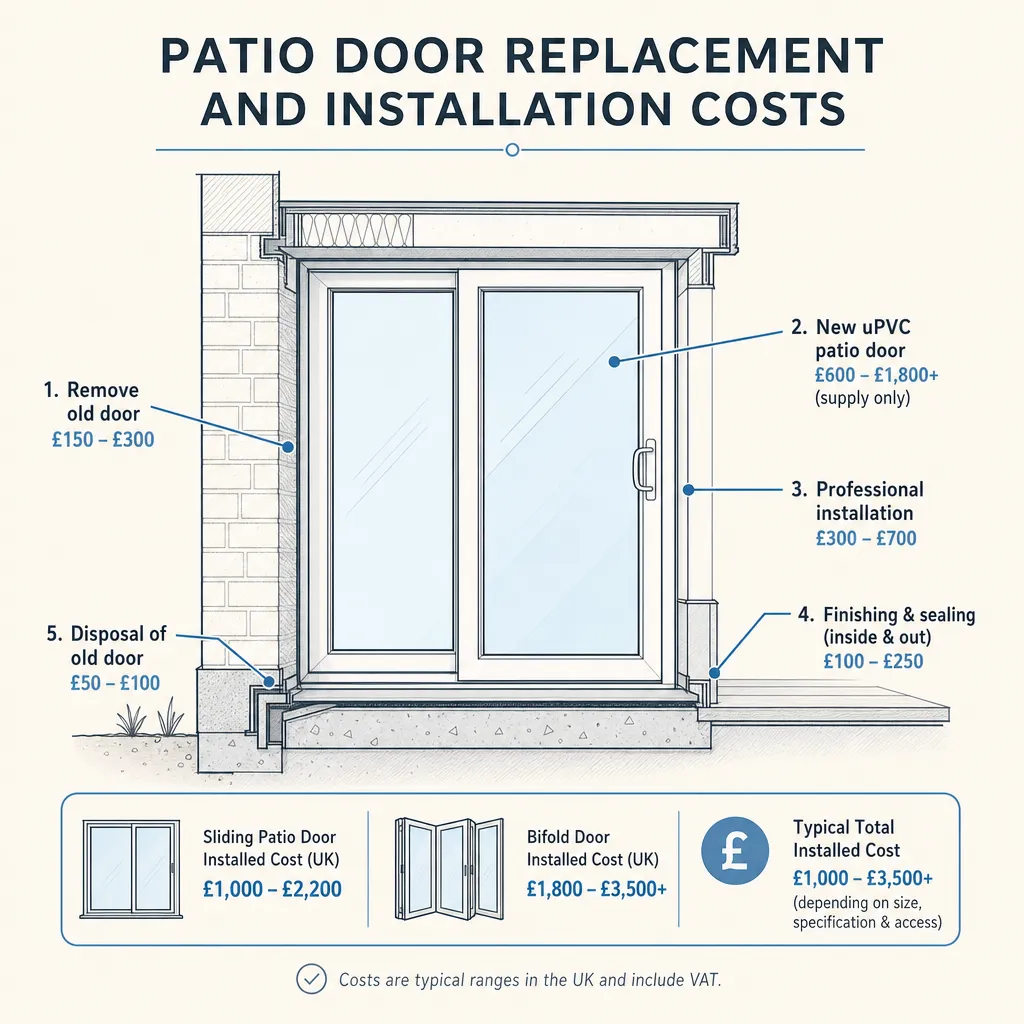
Patio Door Replacement and Installation Costs
Replacing patio doors in the UK typically costs £800–£2,000 installed for a standard uPVC sliding unit, rising to £3,000–£8,000 or more for aluminium bifold doors.
 Improvement & Build
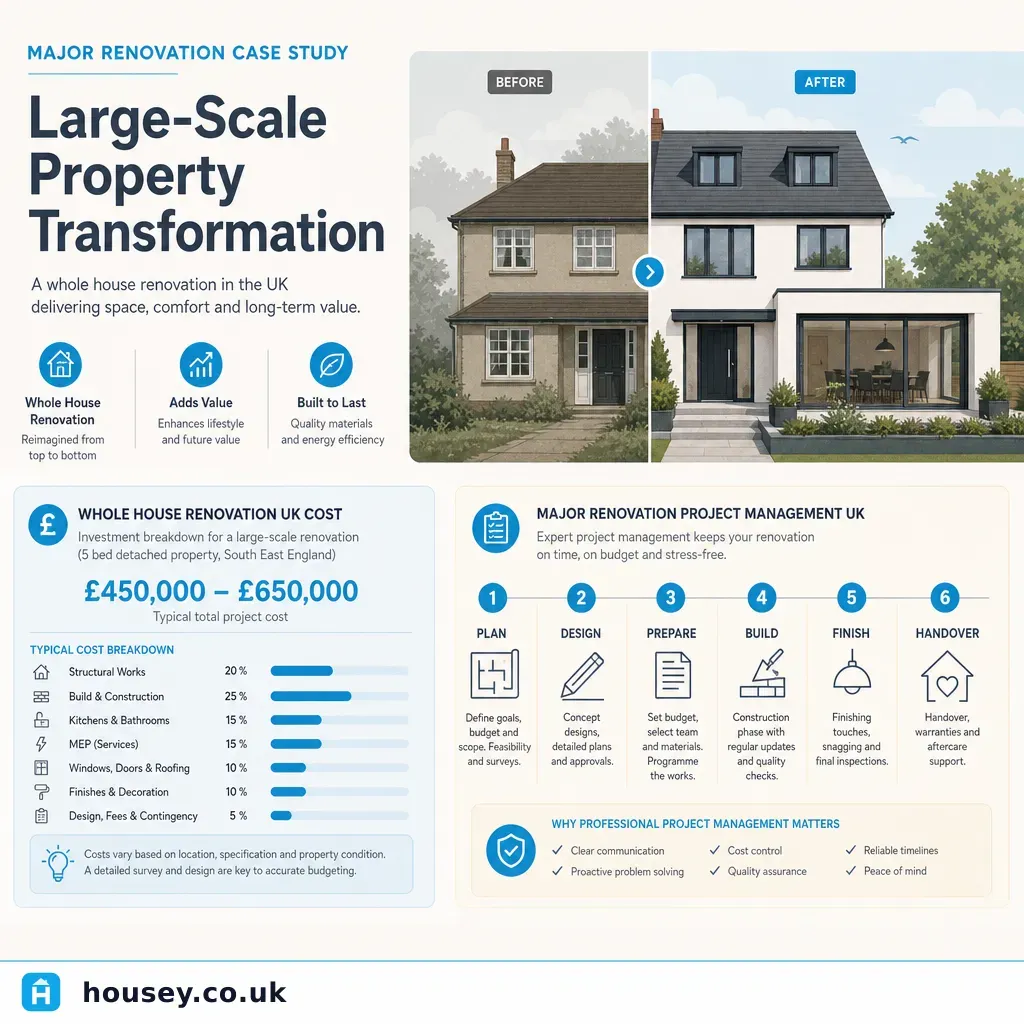
Major Renovation Case Study: Large-Scale Property Transformation
A large-scale UK home renovation typically involves an architect or design-and-build firm, Building Regulations approval, a main contractor, and a contingency budget of 15–20%.
 Improvement & Build
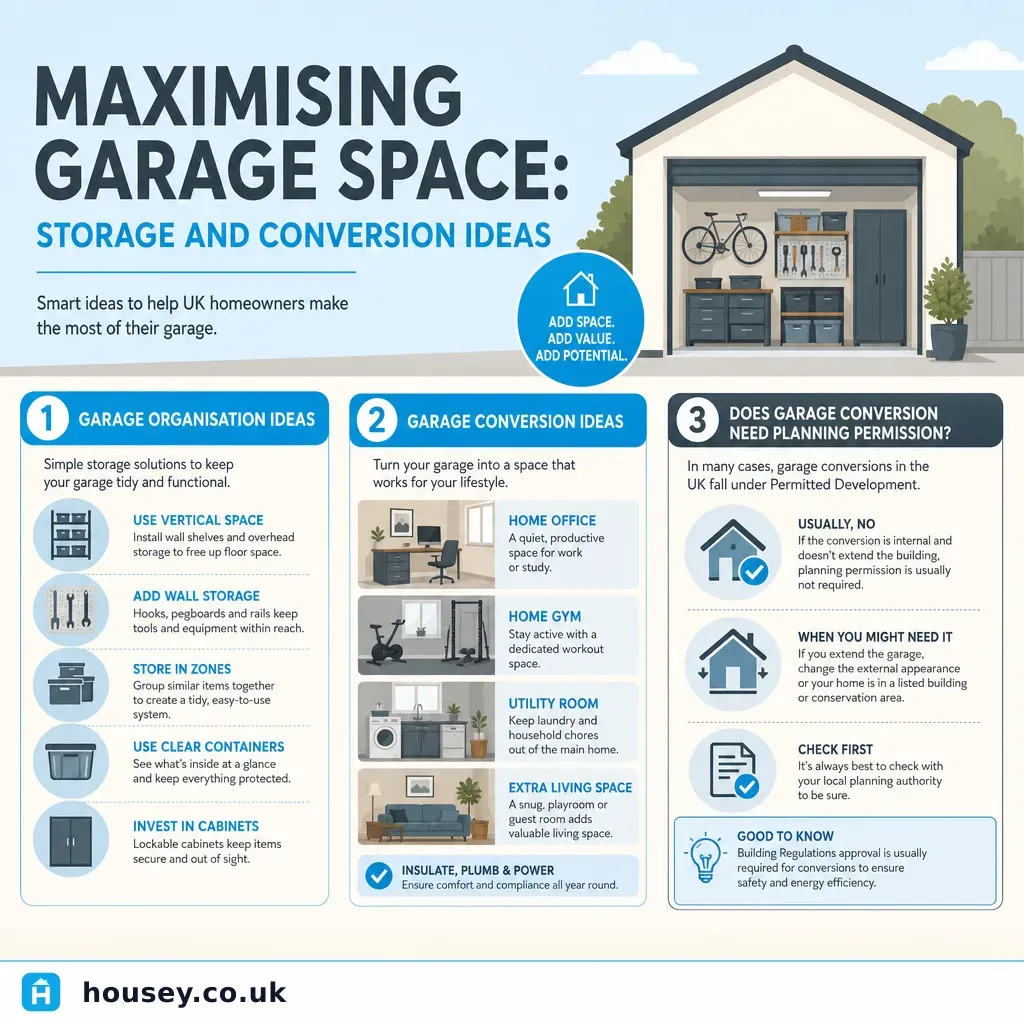
Maximising garage space: storage and conversion ideas
Garages can be transformed with wall-mounted racking, overhead storage, and mezzanine shelving without planning permission or building regulations approval.
 Improvement & Build
Small kitchen renovation: budgeting for costs and planning your project
A small kitchen renovation in the UK typically costs £5,000–£15,000 for a full refresh including new units, worktops, tiling, and appliances, though costs vary widely by specification, region, and whether structural changes or rewiring are involved.