Major Renovation Case Study: Large-Scale Property Transformation
By Housey · Last reviewed 8th of May 2026
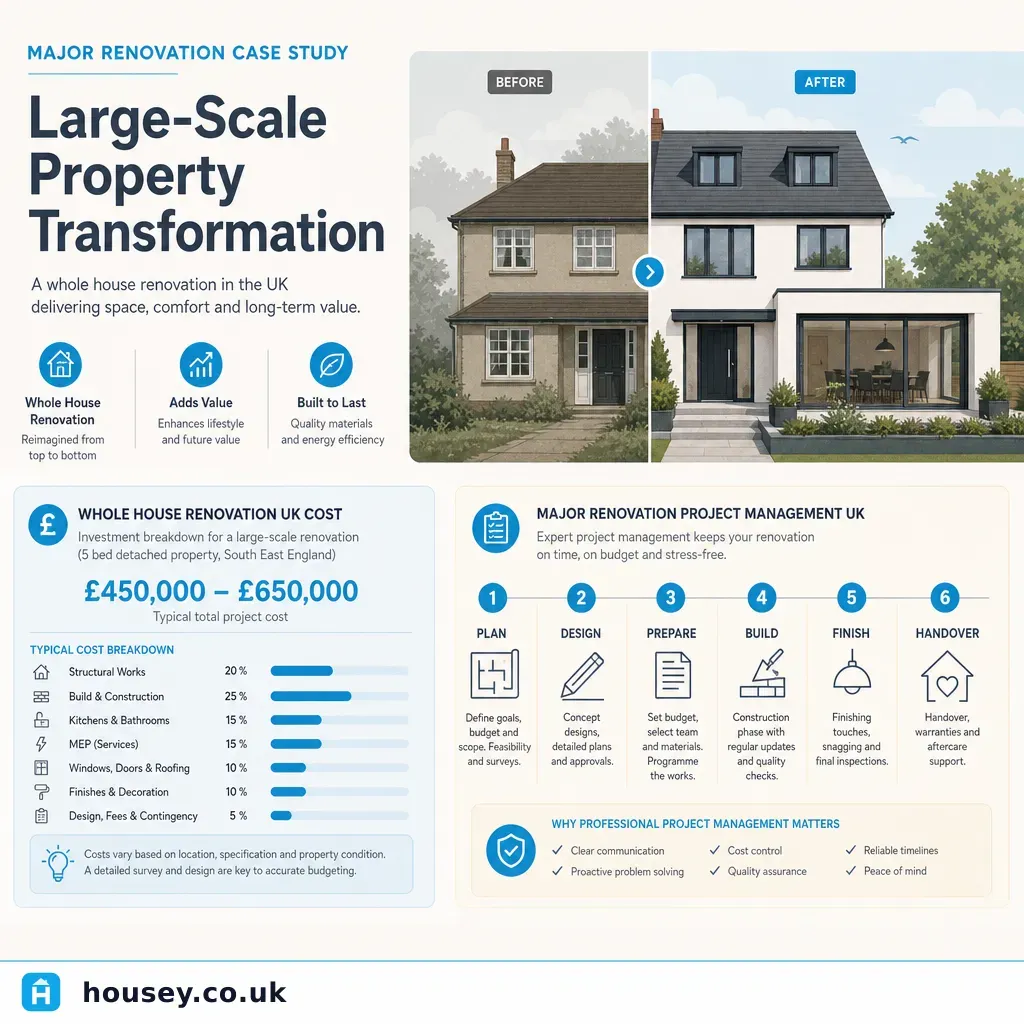
Major Renovation Case Study: Large-Scale Property Transformation
For many UK homeowners, a large-scale renovation — extending, reconfiguring, upgrading building systems, and improving energy performance in a single project — is the largest financial undertaking after buying the property itself. Projects of this scale routinely cost £150,000–£500,000+ and take 12–24 months to complete, yet most homeowners begin with limited experience of managing a multi-trade construction programme. The decisions made in the first few months — about professional appointments, procurement strategy, phasing, and contract structure — often determine whether the outcome is satisfying or severely disrupted.
Key points
- Building Regulations approval is legally required for most structural, thermal, electrical, plumbing, and extension work; failure to obtain approval can create serious difficulties when remortgaging or selling the property.
- A contingency budget of 15–20% of total build cost is standard professional guidance for major renovations, particularly in Victorian and Edwardian housing stock where hidden defects are common.
- The JCT Minor Works Building Contract (and similar recognised forms) is recommended by RICS for domestic projects over approximately £50,000 — it sets out clear payment terms, variation procedures, and dispute resolution mechanisms.
- VAT at 20% applies to most residential renovation works on occupied properties; a 5% reduced rate may apply if the property has been empty for two or more years, and a zero rate applies to certain qualifying energy-saving materials under HMRC Notice 708/6.
- Architects offering planning and Building Regulations design services must be registered with the Architects Registration Board (ARB); architectural technologists should hold CIAT membership.
Worked UK property scenario: Victorian terrace, South London
Property type: End-of-terrace Victorian house, circa 1895, solid brick walls, three storeys plus lower ground floor, approximately 130m² existing floor area. Freehold. Located in an Article 4 Direction area but not a conservation area.
Owner's brief: Single-storey rear kitchen extension (approximately 18m²), lower ground floor conversion from storage to habitable use (study and utility room), full bathroom refurbishment across three floors, boiler replacement, full electrical rewire, wall and loft insulation upgrade, and full internal redecoration.
Projected programme: 16 months from first architect appointment to snagging completion.
Indicative project cost breakdown (last reviewed 2026-05-08):
Item | Indicative cost range | Notes |
|---|---|---|
Architect fees (RIBA stages 1–5) | £12,000–£22,000 | Typically 8–12% of build cost |
Planning application fee | £258 | Householder application; GOV.UK fee schedule |
Building Regulations (full plans route) | £900–£1,800 | Local authority building control or Approved Inspector |
Structural engineering | £2,500–£5,000 | Beam design, basement slab specification |
Party wall surveyor (if applicable) | £1,500–£3,500 | Per adjoining owner under Party Wall etc. Act 1996 |
Main contractor (all trades) | £180,000–£250,000 | Extension, lower ground, rewire, plumbing, insulation, decoration |
Project manager (if separate) | £10,000–£20,000 | Often included within a full-service architect fee |
Contingency (15–20%) | £30,000–£60,000 | Essential for older housing stock |
Indicative total | £237,000–£362,000 | Costs vary; obtain itemised quotes |
Indicative UK costs, last reviewed 2026-05-08. Costs vary significantly by location, specification, contractor, and site conditions. Obtain at least three comparable itemised quotes.
What went well: Appointing an architect from the outset — who coordinated with the structural engineer before contractor procurement — meant all consents were in place before the build contract was signed. Choosing the full-plans Building Regulations route required more upfront detail but produced clear documentation and reduced the risk of costly variations mid-build.
What caused delay: Excavation for the lower ground floor conversion revealed an undocumented drainage run beneath the slab, adding approximately three weeks and £6,500 to the programme. This is precisely the type of unforeseen cost a contingency budget is designed to absorb.
Key lesson: The undocumented drainage run was not visible from a pre-purchase survey or existing drawings. A CCTV drain survey before signing the building contract would likely have identified it and allowed it to be priced into the original works.
Procurement routes compared
Procurement route | Best for | Not ideal for | Accountability | Cost certainty |
|---|---|---|---|---|
Main contractor (single contract) | Most large renovations; single point of contact for programme and quality | When specialist trades need a direct client relationship | High — one firm responsible throughout | Good if lump-sum contract; poor if many provisional sums |
Design-and-build firm | Speed, simpler management, integrated responsibility | When independent design oversight is important | High — one firm responsible for design and build | Often fixed-price; less scope for design iteration |
Self-managed direct trades | Experienced clients with construction knowledge and sufficient time on site | Those without site access, time, or construction experience | Low — client coordinates all trades and the programme | Poor — scope creep and programme slippage are common |
Architect-led JCT contract | Quality-focused projects; architect administers contract and certifies payments | Where budget is tight and architect fees feel disproportionate | Medium-high — architect acts as contract administrator | Good when architect manages valuations and variations formally |
Homeowner checklist: before the project begins
Managing the project in practice
Large renovations generate a high volume of decisions — material selections, variation requests, programme changes, and snagging items — that can quickly overwhelm homeowners who are working full-time or living offsite during the build.
Architect as contract administrator: For projects using a JCT-form contract, an architect can certify interim payments, assess variation costs, and formally issue instructions. This creates a structured decision record and reduces the risk of disputed variations at final account.
Independent project manager: On complex projects of £200,000+, a dedicated project manager with Chartered Institute of Building (CIOB) membership or equivalent experience can manage the programme, coordinate consultants, and represent the client's interests on site. Fees typically range from 5–8% of build cost for a full service.
Regular site meetings: For any project lasting over eight weeks, weekly or fortnightly site meetings — minuted and distributed to all parties — significantly reduce scope disagreement and create a useful paper trail.
Snagging: Allow a formal snagging period of 2–4 weeks at practical completion before releasing the final retention payment. An independent snagging specialist or your architect should inspect before retention is released.
VAT and financial considerations
VAT at 20% applies to most residential renovation works on occupied properties. There are important exceptions worth checking with a VAT specialist:
- Empty properties (2+ years): a 5% reduced rate may apply to renovation and conversion works. Seek confirmation from HMRC or a VAT adviser before assuming eligibility.
- Energy-saving materials: insulation, heat pumps, solar panels, and certain boiler controls may qualify for the zero rate introduced from April 2022 under HMRC Notice 708/6. Check current eligibility criteria with HMRC guidance.
- Grants: review the current status of ECO4 (Energy Company Obligation), the Great British Insulation Scheme (GBIS), and any local authority retrofit schemes before finalising the works specification.
When to get professional help
A project of this scale requires qualified professionals for several elements:
- Structural work: a chartered structural engineer must design or check any structural changes — beam sizing, foundation details, slab specifications. Do not rely on a contractor's informal structural assessment.
- Electrical: a full rewire must be carried out by a registered electrician (NICEIC or NAPIT), who will issue an Electrical Installation Certificate (EIC) required under Building Regulations Part P.
- Gas: any gas work must be carried out by a Gas Safe registered engineer.
- Party wall: if the Party Wall etc. Act 1996 applies, appoint a qualified party wall surveyor — preferably a member of the Faculty of Party Wall Surveyors or RICS.
- Planning: an ARB-registered architect or planning consultant should advise on permitted development limits and planning risk before any work is designed that requires consent.
How Housey can help
Housey connects homeowners with qualified professionals for every stage of a large renovation. Whether you need an extension builder for the construction phase, a design-and-build firm for an integrated approach, or a dedicated project manager to keep a complex programme on track, Housey helps you request and compare quotes from vetted local providers.
Frequently asked questions
Do I need planning permission for a large house renovation?
Internal works rarely require planning permission, but extensions, loft conversions, and changes to external appearance may. Permitted Development rights allow certain extensions without a formal application, but thresholds depend on property type, location, and prior extensions already built. Always confirm with your local planning authority or submit a pre-application enquiry before committing to a design that relies on permitted development.
How long does a major renovation take?
For a whole-house refurbishment with an extension, expect 12–24 months from first professional appointment to snagging completion. This includes 8–16 weeks for design and planning, 4–8 weeks for contractor procurement, and typically 6–14 months of active construction. Complex structural work, specialist material lead times, or planning delays can extend this significantly.
Should I move out during a major renovation?
For large-scale projects involving full rewires, structural works, or significant replumbing, living on site is usually impractical and potentially unsafe. Renting alternative accommodation typically costs £800–£2,500+ per month depending on location, but is often cheaper than the programme delays and disruption caused by trying to occupy a live construction site.
How do I choose between a main contractor and a design-and-build firm?
A main contractor works to drawings produced by your architect, maintaining independent design oversight. A design-and-build firm manages both, which is simpler but means the same party controls quality and cost. Where design quality matters, separating design and build with an architect administering a JCT contract is often preferable. For speed and simplicity on a well-defined brief, design-and-build can work well.
What is a JCT contract and do I need one?
JCT (Joint Contracts Tribunal) publishes standard building contracts used across the UK construction industry. The JCT Minor Works Building Contract is commonly recommended by RICS for domestic projects over approximately £50,000. It sets out clear payment terms, variation procedures, and dispute resolution mechanisms. Using a recognised contract form protects both parties and creates a clear record if disagreements arise during or after the build.
Sources and further reading
- GOV.UK: Building regulations approval — GOV.UK
- GOV.UK: Planning permission — GOV.UK
- HMRC: VAT Notice 708 — buildings and construction — HMRC
- Party Wall etc. Act 1996 explanatory booklet — GOV.UK
- JCT Minor Works Building Contract — Joint Contracts Tribunal
- Architects Registration Board: Verify a registered architect — ARB
- RICS: Guidance for homeowners on construction contracts — RICS
Useful next reads
 Improvement & Build
London Property Renovation: Complete Modernisation Case Study
Modernising a London property means navigating conservation area restrictions, party wall obligations, and Building Regulations alongside the build work itself.
 Improvement & Build
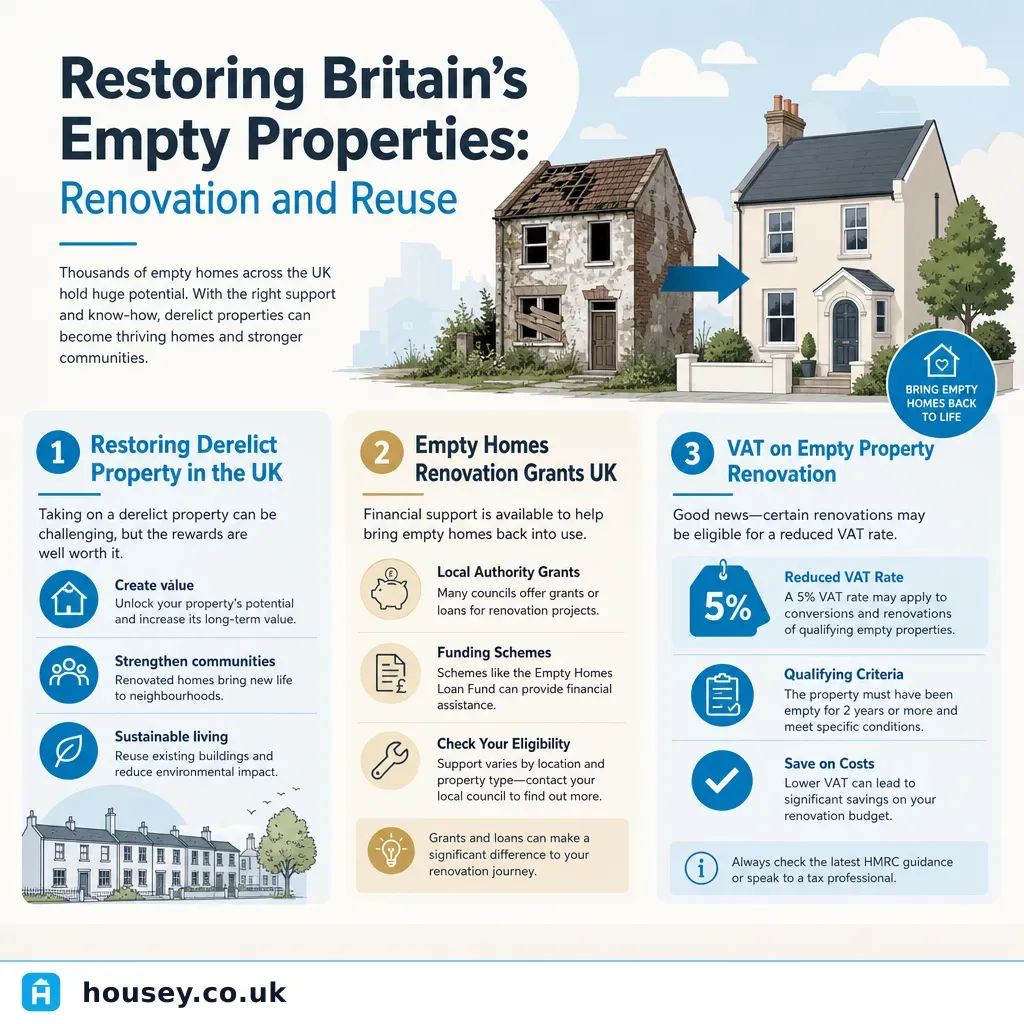
Restoring Britain's Empty Properties: Renovation and Reuse
Renovating an empty UK property requires a structural condition survey, building regulations approval, and a full programme of work covering roof, damp, services, and finishes.
 Improvement & Build
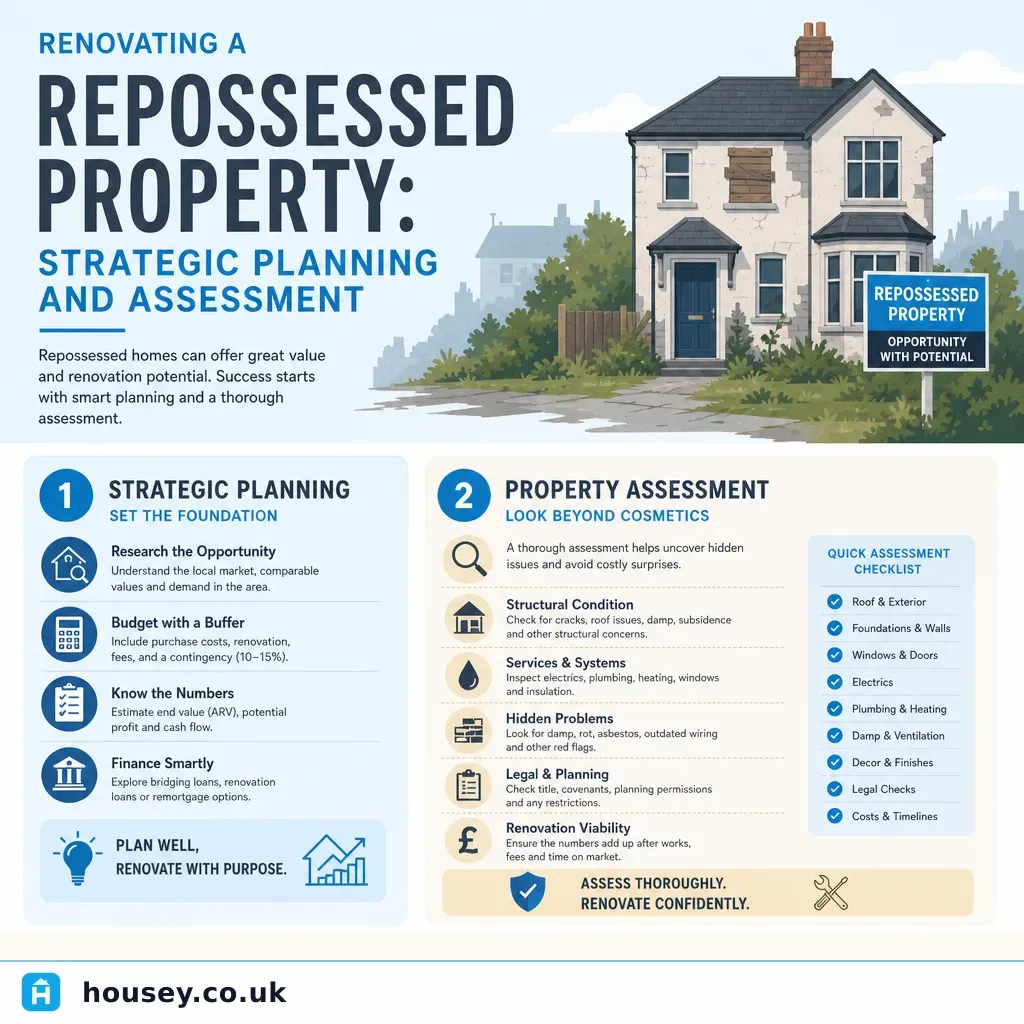
Renovating a Repossessed Property: Strategic Planning and Assessment
Repossessed properties are sold by the lender with no obligation to provide seller disclosure or property information forms.
 Improvement & Build
Stone Cladding Installation: Material Options, Durability and Property Value
Stone cladding adds texture and character to a UK property's exterior and can improve weather protection, but installation quality is critical — poorly fixed cladding can trap moisture and cause structural damage.
 Improvement & Build
Quality Home Improvement Workmanship: What Good Looks Like
Quality home improvement workmanship shows from the first day on site: clean material storage, accurate setting-out, level and plumb finishes, and correct sequencing of trades.