Understanding Crawl Spaces: Inspection, Maintenance, and Common Issues
By Housey · Last reviewed 10th of May 2026
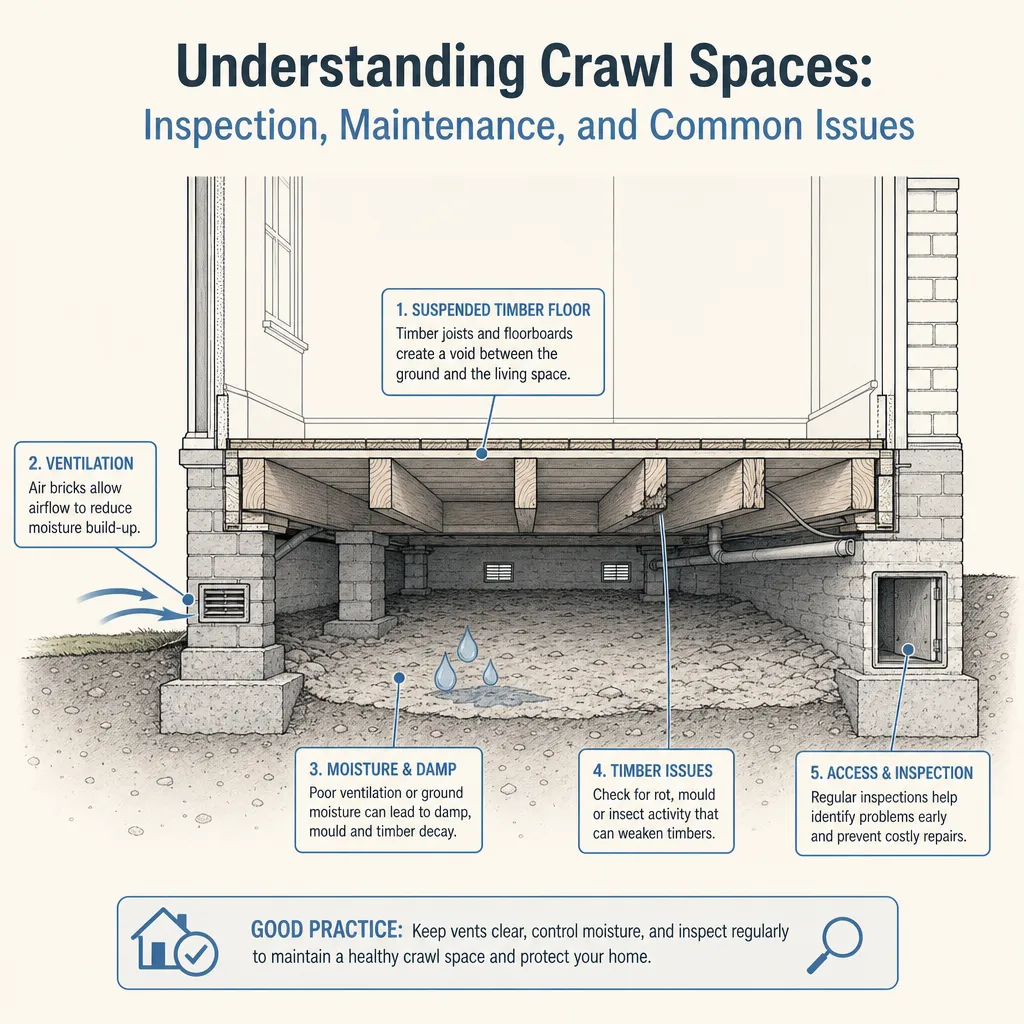
Understanding Crawl Spaces: Inspection, Maintenance, and Common Issues
In the UK, sub-floor voids — the accessible spaces beneath suspended timber ground floors — are most common in Victorian, Edwardian, and interwar housing. When you're buying an older property or investigating unexplained damp, soft flooring, or a persistent musty smell, understanding the condition of this concealed space is critical. Problems here are often slow-developing and invisible to the naked eye until they become expensive to address.
Key points
- Sub-floor voids beneath suspended timber floors should be cross-ventilated at a minimum of 1,500 mm² of free ventilation per metre run on opposite sides of the building, as required by Building Regulations Approved Document C.
- Dry rot (Serpula lacrymans) can destroy floor timbers in months once established; adequate ventilation and moisture control are the primary prevention measures.
- A RICS Level 3 Building Survey typically includes inspection of accessible sub-floor voids; a RICS Level 2 Home Survey may not if access is restricted or the space is too confined.
- Bridged or blocked airbricks — often buried by raised external ground levels or sealed when extensions are added — are the single most common cause of sub-floor ventilation failure in older UK homes.
- If signs of timber decay or elevated moisture levels are found before exchange, a specialist damp and timber survey is recommended before proceeding.
What is a sub-floor void?
A sub-floor void is the space between the ground surface and the underside of a suspended timber floor. It exists because, in most pre-1960 UK housing, ground floors were built on timber joists supported by low sleeper walls rather than a solid concrete slab. This construction requires ventilation to remove moisture evaporating from the earth below — moisture that would otherwise condense on cold timbers and trigger decay.
The term "crawl space" is sometimes used in the UK, borrowed from North American usage, but the standard UK term is sub-floor void or underfloor space. Void depths vary considerably: in some Victorian terraces the space may be barely 300 mm deep; in others it may reach 600 mm or more.
Since the 1960s, most new-build homes have used solid concrete or beam-and-block ground floors, eliminating the sub-floor void. But millions of pre-1960 UK properties — including the majority of Victorian and Edwardian terraced and semi-detached houses — retain suspended timber ground floors with voids below that require ongoing maintenance.
Why sub-floor voids fail and what goes wrong
Ventilation failure
Adequate cross-ventilation is essential. Air should enter through airbricks on one side of the building, circulate beneath the floor, and exit through airbricks on the opposite side, removing moisture-laden air before it can condense on cold timbers.
Ventilation commonly fails because:
- Airbricks are buried — external ground levels have risen over decades through landscaping and path resurfacing, and airbricks end up at or below damp-proof course level.
- Airbricks are blocked — by garden soil, debris, render, or climbing plants.
- Extensions have covered original airbricks — a common finding in houses where a kitchen or bathroom extension has been added without re-routing sub-floor ventilation through the new structure.
- Too few airbricks — particularly in houses extended or altered without attention to ventilation requirements.
Moisture ingress
High groundwater after prolonged wet weather, poor site drainage, broken drains, and leaking pipes within or adjacent to the void can raise humidity to levels where timber decay fungi become active. A sub-floor void that remains damp throughout the winter months is at significant risk.
Timber decay
Two main decay types affect sub-floor timbers in UK homes:
- Dry rot (Serpula lacrymans): Despite the name, requires some initial moisture to establish. Once active, it spreads aggressively — through non-timber materials including brickwork and plaster. It produces distinctive bracket-shaped fruiting bodies and white or grey mycelium mats. Dry rot remediation is specialist work and should not be deferred.
- Wet rot: Usually localised to the immediately damp area. Less aggressive than dry rot but still causes structural weakness in affected timbers. Addressing the moisture source typically stops its spread.
Pest infestation
Sub-floor voids in older UK properties are occasionally affected by wood-boring insects, particularly common furniture beetle (Anobium punctatum) — recognisable by the 1–2 mm circular exit holes in timber surfaces. Fresh bore dust below the holes indicates an active infestation. Most infestations are treatable, but active decay in structurally significant timbers requires specialist assessment before treatment begins.
How to inspect a sub-floor void
A proper inspection involves:
- Locating access hatches. Access is usually through a hatch in the hall floor, under-stairs cupboard, or a ground-floor room. If no hatch exists, one may need to be cut — a builder or groundworker can do this.
- Visual check of airbricks externally. Before entering the void, check all accessible airbricks for blockage, damage, or burial. Photograph their positions relative to external ground level.
- Torch inspection of the void. Look for signs of decay, fungal growth, standing water, and pest activity. A damp meter reading on accessible joists provides useful data.
- Checking sleeper walls. Internal honeycomb-pattern sleeper walls should not be mortared solid — any blockage reduces cross-ventilation and can create dead pockets of moist air.
- Checking joist ends. The most vulnerable part of the floor structure — where joists are built into external walls — is often inaccessible without specialist camera equipment and may need targeted investigation.
Limitation: A visual inspection from a hatch gives only partial information. Proper timber condition assessment and identification of decay fungi require a qualified timber specialist or chartered building surveyor with appropriate access.
Homeowner maintenance checklist for sub-floor voids
Red flags that warrant immediate investigation
- A persistent musty, earthy, or fungal smell at ground-floor level, particularly in wet weather
- Springy, soft, or noticeably uneven sections of ground-floor boards
- Skirting boards or floor edges that are discoloured, distorted, or pulling away from the wall
- Visible fungal growth — bracket-shaped fruiting bodies or white mycelium — near floor or skirting level
- A damp meter reading above 20% moisture content on accessible floor timbers
- External airbricks that are buried below ground level, cracked, or missing entirely
- New paving, render, or landscaping that has recently covered airbrick positions
Any of these signs — particularly springy floors or visible fungal growth — should be investigated before exchange, before starting renovation work, and before laying new floor coverings over the affected area.
Important limitations
This article provides general guidance on sub-floor voids in residential UK properties. The condition, accessibility, and structural significance of any given sub-floor space depends on the specific property, its age, construction type, ground conditions, and history of maintenance and alteration. The presence or absence of timber decay can only be reliably determined by a qualified timber specialist or chartered building surveyor with appropriate access and equipment. Nothing in this article constitutes a structural or damp assessment.
What to ask a qualified professional
- Can the sub-floor void be accessed and inspected as part of this survey, and if access is restricted, what additional steps would you recommend?
- Are there any signs of dry rot, wet rot, or active insect infestation in the timbers you can reach?
- Are the existing airbricks adequate in number, size, and position for the void area beneath this building?
- Is there evidence of moisture ingress from the ground, from drainage, or from external sources?
- If decay is found, how extensive is it likely to be in areas that cannot be directly inspected?
- Would you recommend a specialist damp and timber survey before I proceed with the purchase or renovation?
- Are there any structural implications from the timber condition in the void that affect my purchase decision?
When to get professional help
Commission a professional survey or inspection if:
- You are buying a pre-1960 property with a suspended timber ground floor
- There is any sign of damp, musty smells, soft flooring, or skirting decay
- A surveyor notes a sub-floor void that was inaccessible or only partially inspected during a standard survey
- You are planning ground-floor works that will affect the position or routing of ventilation airbricks
- You are fitting underfloor insulation beneath a suspended timber floor, which can affect ventilation airflow if not carefully designed
Dry rot in particular requires urgent professional attention. Do not apply decorative treatments, seal floorboards, or lay new flooring over potentially affected areas before a specialist has assessed the extent of the problem.
How Housey can help
Housey connects you with experienced surveyors and specialists who can properly assess sub-floor voids. If you're buying an older home, a RICS Level 3 survey is the most thorough starting point for a pre-purchase inspection. Where damp or timber decay is suspected, a dedicated damp and timber survey provides specialist diagnosis. For concerns about structural integrity, a structural survey may also be appropriate.
Frequently asked questions
Are sub-floor voids common in UK homes?
Sub-floor voids are common in pre-1960 UK housing — particularly Victorian and Edwardian terraced and semi-detached houses with suspended timber ground floors. Post-1960 homes generally use solid concrete ground floors and have no void. Properties with later extensions may have a mixture of floor construction types beneath different rooms.
Does a RICS Level 2 survey inspect the sub-floor void?
A RICS Level 2 Home Survey should note whether a sub-floor void exists and whether access was possible, but detailed inspection may be limited by hatch size or restricted space. A RICS Level 3 Building Survey typically involves a more thorough investigation of accessible sub-floor areas. Discuss this with your surveyor before instructing if void condition is a concern.
Can I add extra airbricks to improve sub-floor ventilation?
Yes. Additional airbricks can be installed into external walls by a builder or groundworker, positioned above the finished external ground level and preferably above the damp-proof course. If a new extension has blocked original airbricks, a ventilation duct through the extension wall can restore airflow. A groundworker can advise on the most practical approach for your property.
How much does it cost to treat dry rot in a UK home?
Dry rot treatment costs vary significantly with the extent of affected timber and masonry. Indicative UK costs range from around £1,500 for small localised treatments to £10,000 or more for extensive remediation involving multiple floor joists, masonry sterilisation, and plasterwork reinstatement. Indicative costs only, last reviewed 2026-05-10; always obtain multiple quotes from specialist timber treatment companies.
Sources and further reading
- Building Regulations Approved Document C: Site preparation and resistance to contaminants and moisture — GOV.UK
- Historic England: Timber decay in historic buildings — Historic England
- Property Care Association: Dry rot and wood rot guidance — Property Care Association
- RICS Home Survey Standard — RICS
- HSE: Wood preservation and timber treatment — Health and Safety Executive
Useful next reads
 Surveys & Inspections
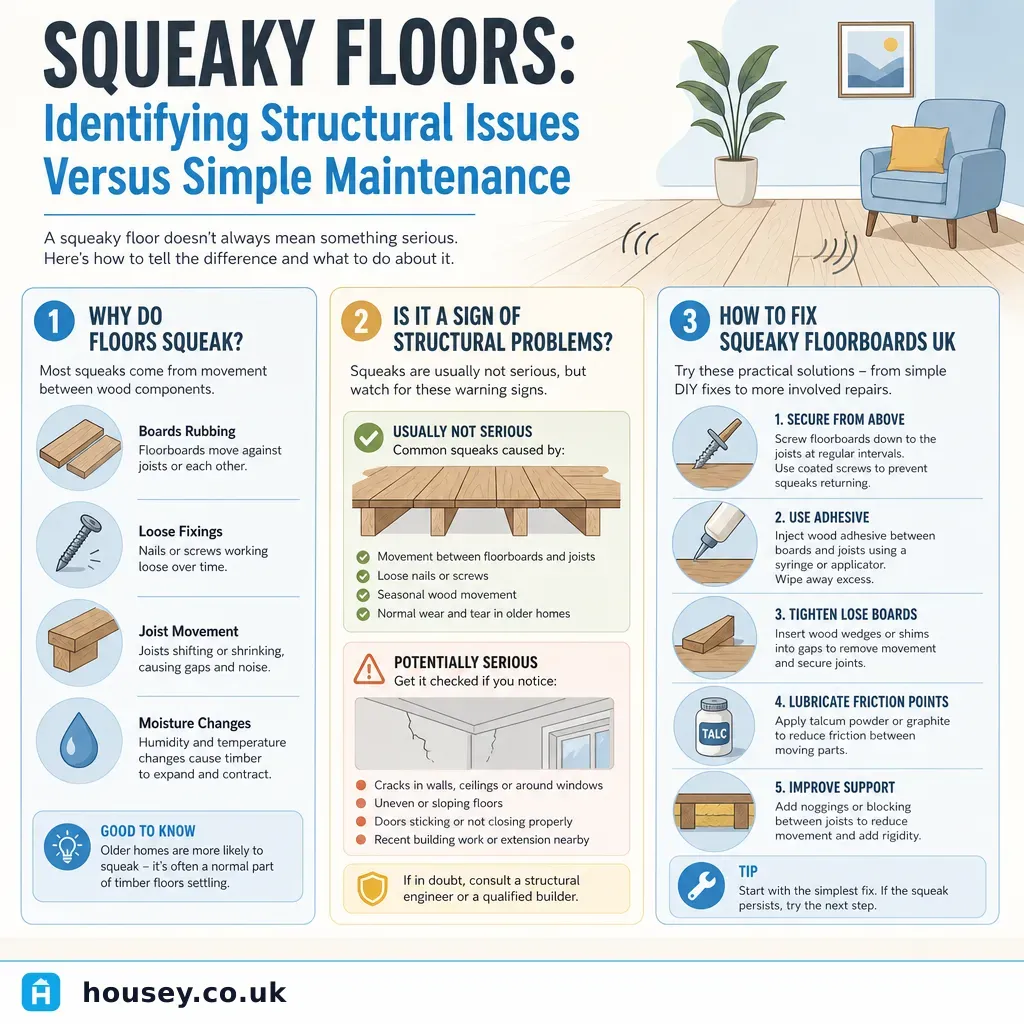
Squeaky Floors: Identifying Structural Issues Versus Simple Maintenance
Most squeaky floors in UK homes are caused by floorboards rubbing against each other or against fixings as they expand and contract — a maintenance issue rather than a structural one.
 Surveys & Inspections
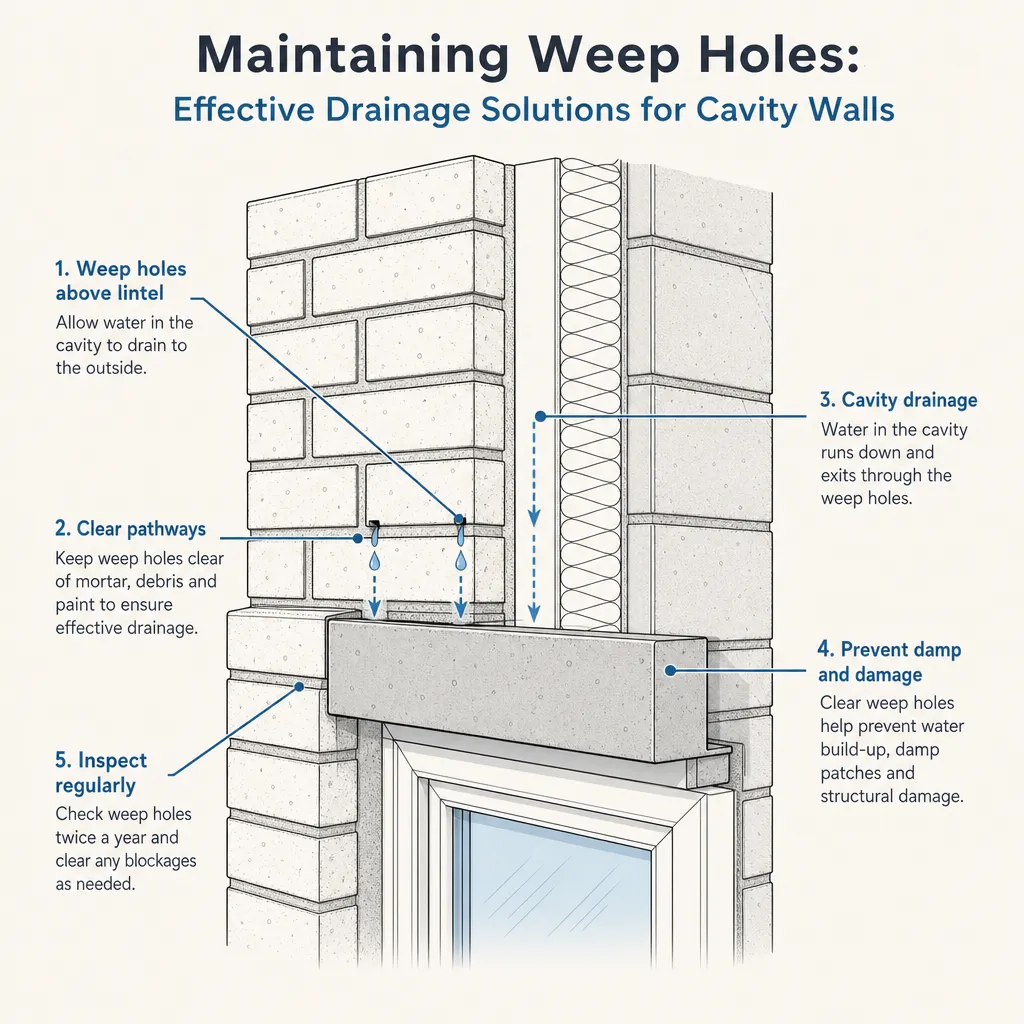
Maintaining Weep Holes: Effective Drainage Solutions for Cavity Walls
Weep holes are unmortered perpend joints in the outer leaf of a cavity wall, positioned at DPC level and above lintels, allowing moisture that enters the cavity to drain outward.
 Surveys & Inspections
Annual Home Maintenance Checklist and Schedule
A structured annual maintenance schedule helps UK homeowners catch small problems before they become costly repairs.
 Surveys & Inspections
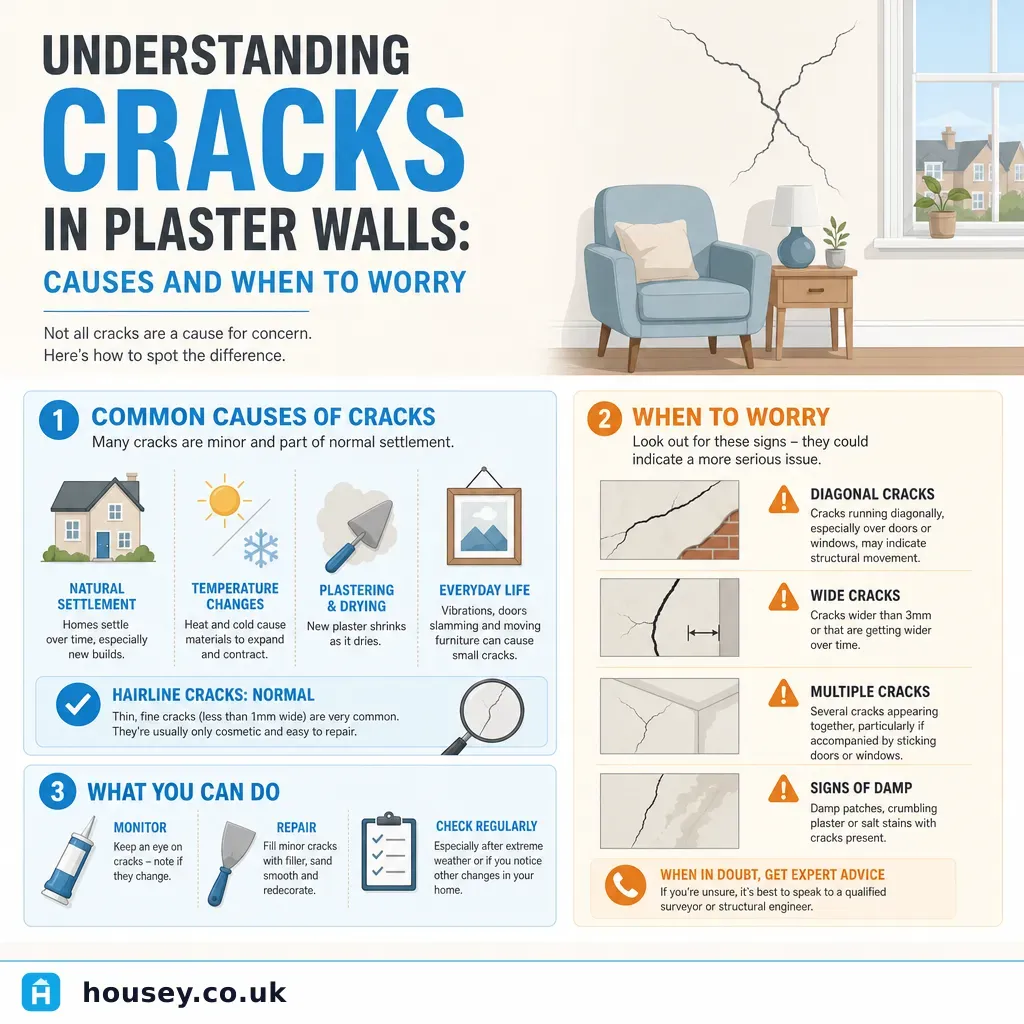
Understanding Cracks in Plaster Walls: Causes and When to Worry
Most hairline plaster cracks are cosmetic, caused by seasonal shrinkage or minor settlement.
 Surveys & Inspections
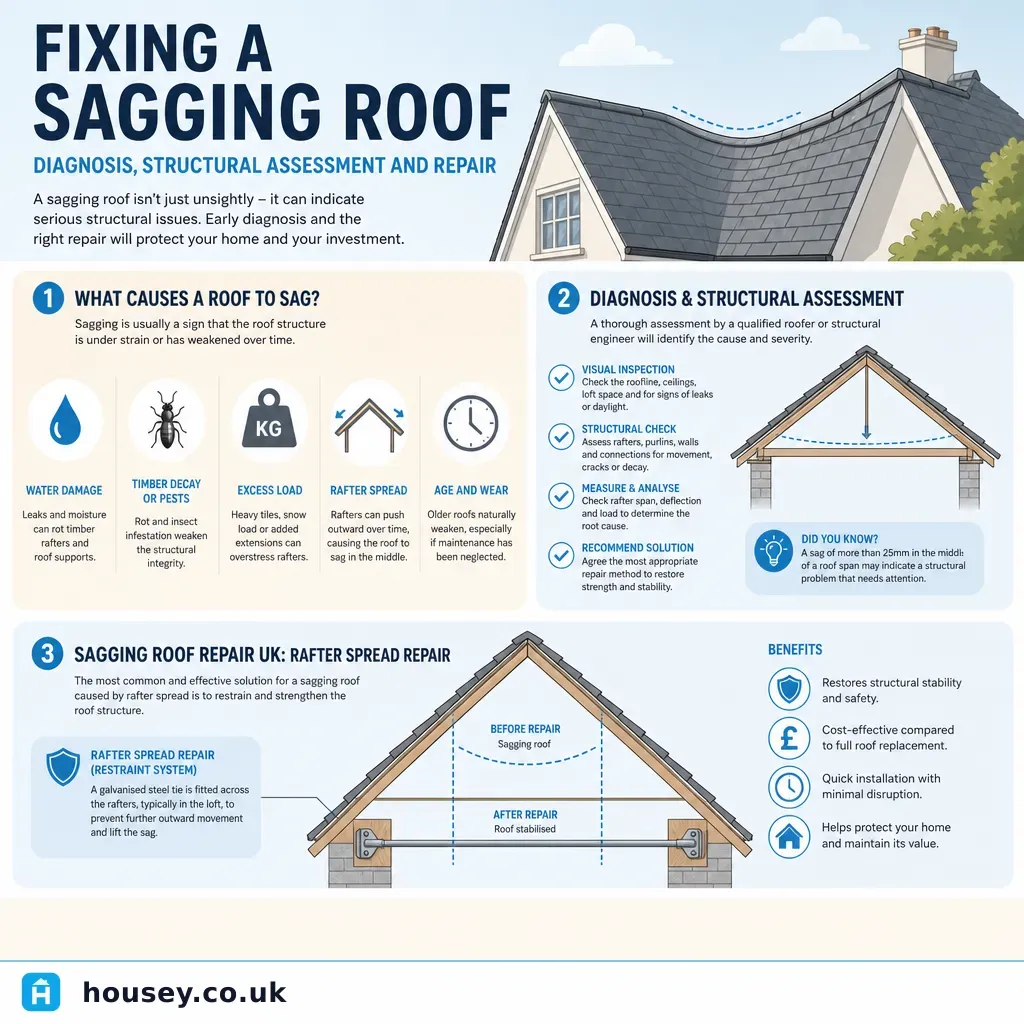
Fixing a Sagging Roof: Diagnosis, Structural Assessment and Repair
A sagging roof usually points to failed or overloaded roof timbers, rafter spread, or a compromised ridge board.