Managing Garden Tasks Through Winter Weather: Practical Strategies
By Housey · Last reviewed 11th of May 2026
Managing Garden Tasks Through Winter Weather: Practical Strategies
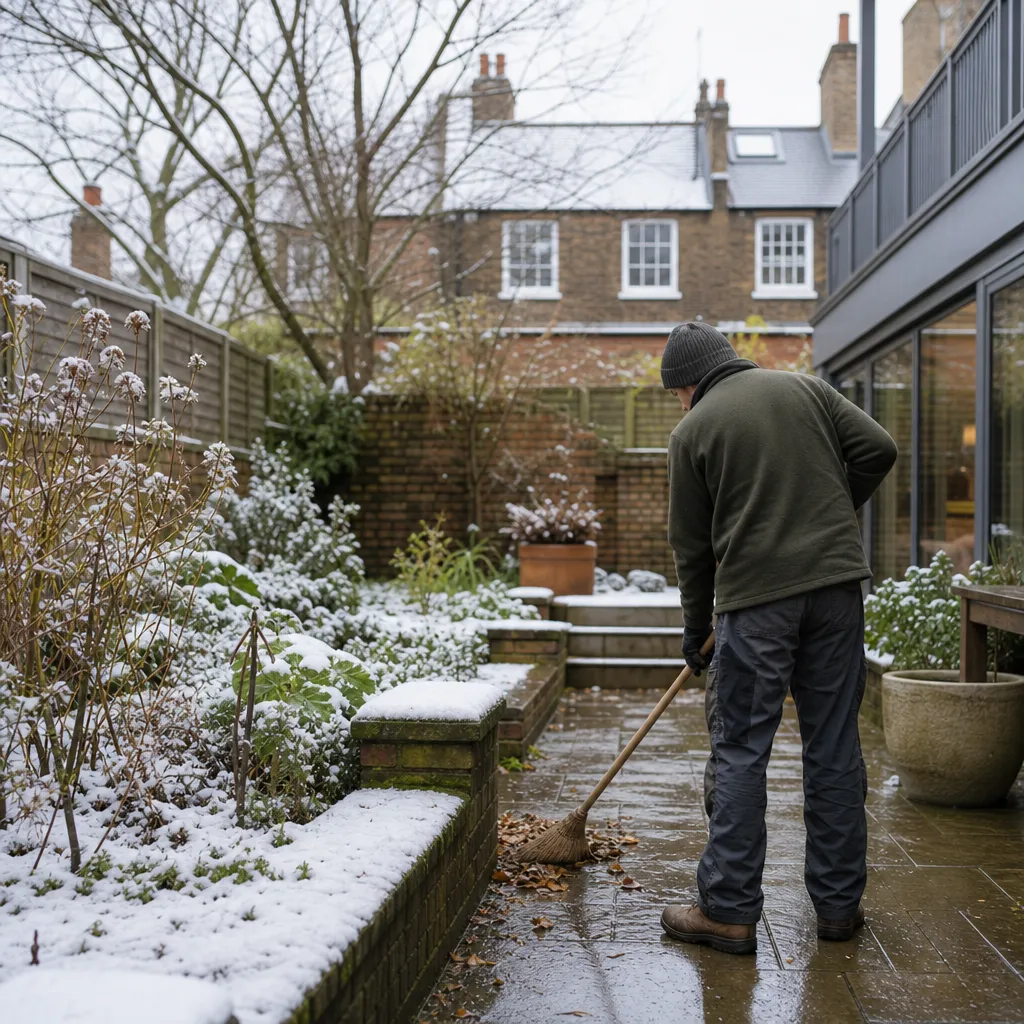
Winter in the UK rarely delivers weeks of clean frost — more often it offers a patchwork of mild damp days, sharp overnight freezes, and occasional prolonged wet spells. For homeowners trying to keep on top of their gardens between October and March, knowing which tasks can proceed in which conditions — and which are best postponed — prevents both wasted effort and avoidable damage to plants, tools, and soil structure.
Key points
- Ground frost to a depth of more than 5 cm makes planting and bare-root transplanting inadvisable, as root establishment is severely compromised in frozen soil.
- Working on a saturated lawn causes soil compaction and structural damage to the turf that can take months to repair.
- Dormant-season pruning of most deciduous shrubs and fruit trees is best carried out between leaf fall and bud break — typically November to late February — provided no hard frost is forecast within 24 hours.
- The RHS recommends checking forecasts for a minimum of three consecutive dry days before undertaking soil improvement or mulching work in winter.
- Hard landscaping tasks such as pointing, rendering, and laying paving should not proceed below 5 °C, as mortar and cement cure poorly in cold conditions and may fail.
Which garden tasks are suitable in winter?
Most maintenance work on dormant plants proceeds perfectly well during dry, mild spells. Deciduous hedges, shrubs, roses, and fruit trees can be pruned once fully dormant. Clearing fallen leaves, cutting back dead perennial stems, and tidying borders are low-risk tasks that can be tackled on most dry days regardless of temperature. Digging over empty beds and incorporating compost or grit is best done during a mild spell when the soil is neither frozen nor waterlogged.
Tasks that remain viable throughout winter:
- Pruning dormant roses, wisteria, and deciduous shrubs (not in frost)
- Cutting back dead perennial stems and ornamental grasses
- Planting bare-root trees, hedging, and shrubs (when ground is not frozen)
- Repairing paths, edging, and hard landscaping (above 5 °C)
- Applying mulch to insulate roots (when soil is not waterlogged)
- Cleaning, sharpening, and oiling tools
Which tasks should be avoided or paused?
Some garden tasks cause more harm than good in certain winter conditions. Walking on a frozen or waterlogged lawn compresses the soil and can kill grass roots; laying turf in frozen or very wet conditions will almost certainly fail. Sowing seed outdoors is ineffective below around 7 °C soil temperature. Chemical treatments — including weedkillers and foliar feeds — are largely ineffective in cold weather and may cause plant damage if applied during frost.
Avoid in winter unless conditions are favourable:
- Mowing (if ground is frozen, frost-covered, or waterlogged)
- Laying turf (below 5 °C or in saturated conditions)
- Sowing seed outdoors (before soil temperatures reach approximately 7 °C in spring)
- Applying fertiliser to dormant plants
- Spraying foliar treatments in frost or heavy rain
Decision tree: should you proceed today?
- Choose to proceed if conditions are mild (above 5 °C), the ground is workable, and no hard frost is forecast overnight.
- Postpone planting and digging if a finger pushed 5 cm into the soil meets frozen ground.
- Avoid all foot traffic and machine work on the lawn if water wells up in your footprint.
- Postpone hard landscaping if mortar, paint, or chemical products are involved and temperatures are below 5 °C.
- Postpone pruning tender plants if hard frost is forecast within the next 24–48 hours.
- Check the Met Office hourly forecast before committing to a half-day of outdoor work — conditions in the UK can change quickly.
Planning your winter garden schedule
Rather than tackling tasks reactively, a simple priority list matched to likely weather windows makes winter progress much more manageable. Identify which jobs require dry, mild spells — pruning, planting, soil work — and which can be done in any weather: tool maintenance, planning, ordering seeds, and composting kitchen waste.
Winter garden task checklist
Protecting plants and structures during prolonged cold
During extended frost or snow, a few precautions protect both plants and hard landscaping. Horticultural fleece — typically sold in weights from 17 g/m² to 30 g/m² — provides meaningful protection for borderline-hardy plants. Bubble wrap around terracotta pots prevents frost cracking. Remove heavy snow from conifer branches promptly to prevent permanent distortion. Lag outdoor taps and exposed pipework if hard frost below -3 °C is forecast.
Avoid using ordinary plastic sheeting for frost protection — it traps moisture and can encourage fungal problems.
When to get professional help
Most domestic winter gardening is manageable without professional assistance, but some situations benefit from specialist input:
- If a major landscaping project — paving, raised beds, new planting schemes, or drainage works — needs completing before spring, a professional landscaper can assess whether conditions are suitable and manage scheduling risk.
- If you are uncertain which trees or shrubs to prune, when, or to what degree, a garden designer can provide a tailored seasonal maintenance plan.
- Structural garden features such as retaining walls and drainage systems should not be attempted as DIY in challenging winter ground conditions.
How Housey can help
If your winter to-do list has grown beyond what you can manage alone, find a landscaper through Housey for one-off tidy-ups, planting, or hard landscaping projects. If you want a considered planting scheme ready to implement as conditions improve in spring, browse Housey's garden designers for local specialists.
Frequently asked questions
Can I plant bare-root trees and hedging in winter?
Bare-root plants are lifted and sold between November and March when they are dormant. This is generally the best time to plant them — provided the ground is not frozen solid or waterlogged. Check your local forecast and plant during a mild, dry spell for the best chance of establishment.
Is it safe to mow the lawn in winter?
Mowing in winter is usually inadvisable. Grass growth is minimal below 5 °C, and cutting frozen or frost-covered grass causes physical damage to the blades. If a dry, mild spell sees grass actively growing, a light cut on the highest setting is acceptable but not essential.
When should I apply mulch?
Apply mulch in late autumn or early winter before hard frost sets in, when the soil still carries some warmth. Avoid mulching waterlogged soil. A layer of 5–8 cm of well-rotted bark or compost insulates roots and suppresses winter weeds effectively.
Can I do hard landscaping work in winter?
Most hard landscaping is feasible in mild, dry conditions above 5 °C. Mortar, pointing, and concrete should not be laid in frost, as they cure poorly and may fail. Check the product data sheet for the manufacturer's minimum application temperature before proceeding.
Sources and further reading
- RHS: Gardening in winter — Royal Horticultural Society
- Met Office: UK weather forecasts — Met Office
- RHS: Mulching — Royal Horticultural Society
Useful next reads
 Improvement & Build
UK Garden Planting Calendar and Seasonal Timing
In the UK, most vegetables are sown under cover from February to April and transplanted outdoors after the last frost — mid-May in most of England, later in Scotland and upland areas.
 Improvement & Build
Heated Driveways: Is the Investment Worth Considering?
A heated driveway uses electric resistance cables or hydronic water pipes beneath the surface to prevent ice and snow build-up.
 Improvement & Build
Creating Functional and Attractive Outdoor Entertainment Areas
A well-planned outdoor entertainment area combines a level surface — patio, decking, or gravel — shelter or shade, appropriate lighting, and power access if needed.
 Improvement & Build
Creating and Maintaining Shaded Garden Spaces: Design and Planting
In UK shaded gardens, success depends on identifying your shade type — deep, partial, dappled, or dry — then matching plants and soil preparation to those conditions.
 Improvement & Build
Creating a New Garden Design for Your Property
Creating a new garden design involves assessing your space, setting a realistic budget, deciding on hard and soft landscaping, and choosing a planting scheme suited to your soil and aspect.