Managing Humidity in the Home: Dehumidification Solutions
By Housey · Last reviewed 30th of May 2026
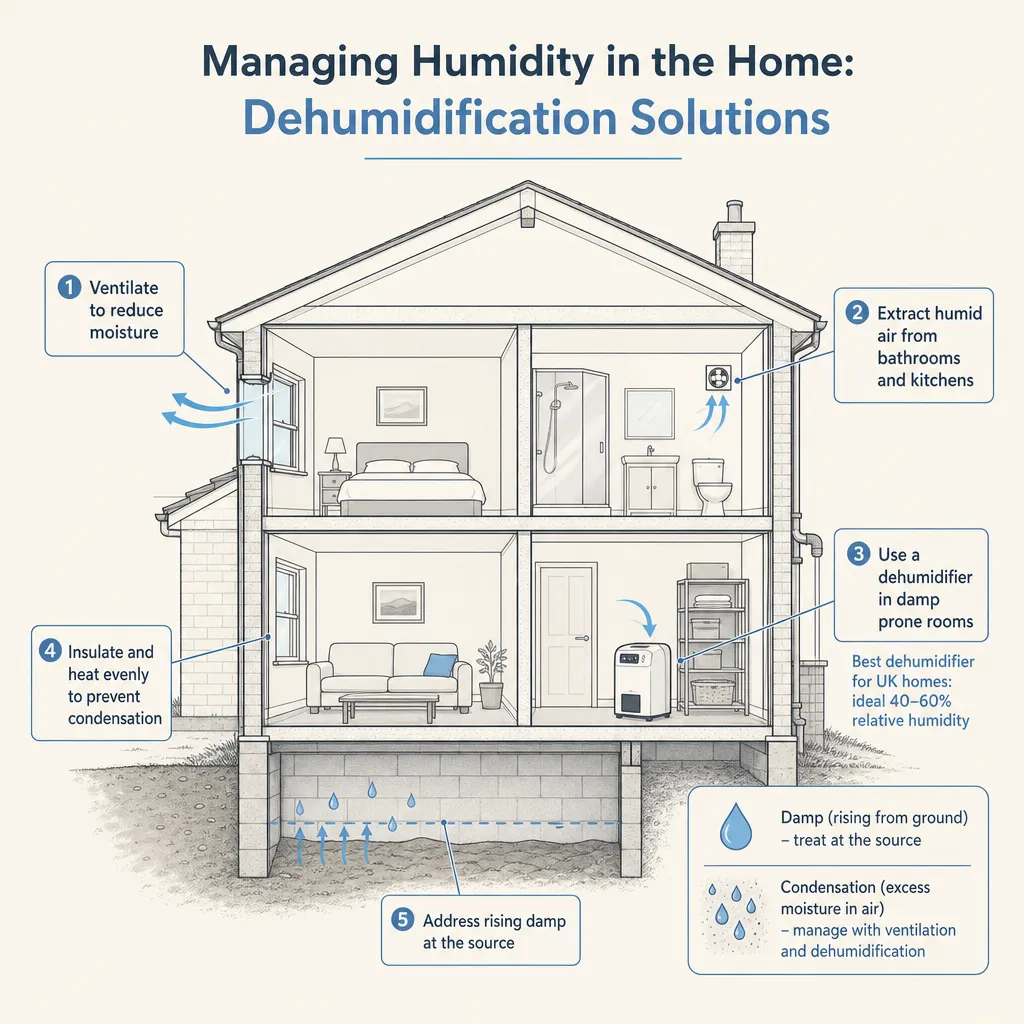
Managing Humidity in the Home: Dehumidification Solutions
Excessive moisture in the air is one of the most common complaints in UK homes, particularly in older properties with limited mechanical ventilation and solid masonry walls. High relative humidity (RH) leads to condensation on cold surfaces, black mould growth, and deterioration of plasterwork and timber — problems that can worsen quickly if left unaddressed. Understanding whether a dehumidifier is the right solution, or whether a more fundamental ventilation or structural issue needs investigating, is the key question most homeowners face.
Key points
- World Health Organisation (WHO) guidelines recommend indoor relative humidity between 40% and 60%; sustained levels above 70% actively support mould growth on building surfaces.
- Condensation — not rising damp or penetrating damp — accounts for the majority of dampness complaints in UK dwellings, according to BRE research.
- Building Regulations Approved Document F sets minimum ventilation standards for new-build and notifiable refurbishment work in England and Wales.
- PAS 2035:2023, the UK standard for domestic retrofit, specifically identifies moisture risk as a factor retrofit assessors must evaluate before specifying insulation or airtightness measures.
- Portable refrigerant dehumidifiers perform well at room temperatures above 15°C, but desiccant models are more effective in cold unheated spaces such as garages, basements, and unheated extensions.
Why humidity matters in UK homes
UK housing stock is among the oldest in Europe, with a significant proportion of homes built before cavity-wall construction became standard (pre-1920s). Solid masonry walls, original single-glazed windows, and limited mechanical ventilation create conditions where warm moist air generated by cooking, bathing, and everyday occupation has nowhere to escape. When this air contacts cold wall or window surfaces, moisture condenses.
Modern draught-proofing and double or triple glazing — while beneficial for energy efficiency — can significantly reduce background ventilation rates. This is particularly relevant under PAS 2035:2023 retrofit assessments, where moisture risk must be evaluated before installing insulation or airtightness measures that could trap moisture and cause interstitial condensation within the building fabric.
A basic hygrometer (available from most hardware retailers for under £15) is a useful first step: take readings in affected rooms at different times of day. Consistent readings above 70% RH, or visible condensation on windows first thing in the morning, indicate that moisture levels are exceeding the current ventilation's capacity to remove them.
Dehumidifier types: which is right for your situation?
Type | How it works | Best for | Limitations | Indicative running cost |
|---|---|---|---|---|
Refrigerant (compressor) | Cools air over a refrigerant coil; moisture condenses into a collection tank | Living rooms, bedrooms, kitchens above 15°C | Ineffective in cold rooms; noisier than desiccant models | ~£0.06–£0.12/hr at current rates |
Desiccant | Passes air over a silica-gel rotor that absorbs moisture | Unheated garages, basements, extensions, cold stores | Higher energy use than refrigerant at warm temperatures | ~£0.10–£0.18/hr |
Whole-house MVHR | Continuously extracts moist air; supplies filtered fresh air | New-build, deep retrofit, highly airtight homes | High installation cost; requires commissioning to Approved Document F | Lower running cost once installed; seek installer figures |
Positive input ventilation (PIV) | Introduces filtered air from loft or outside to dilute internal moisture | Most UK housing stock; retrofit-compatible | Less effective in very leaky or poorly insulated homes | ~£0.01–£0.03/hr |
Indicative UK running costs, last reviewed 2026-05-30. Costs depend on unit efficiency, room size, and electricity tariff.
Which solution should you choose?
- Choose a portable refrigerant dehumidifier if you have localised condensation in a heated room (above 15°C) and want a low-cost immediate measure.
- Choose a desiccant dehumidifier if the affected space is unheated or frequently drops below 15°C — such as a garage, utility room, or basement.
- Consider positive input ventilation (PIV) if condensation is widespread across multiple rooms and the loft space is accessible; PIV is a well-established, relatively low-cost retrofit ventilation solution for most UK housing stock.
- Consider MVHR if you are undertaking a deep retrofit or new-build where a whole-house ventilation strategy is within budget and scope.
- Commission a professional damp or ventilation survey if the source of moisture is unclear, if damp patches appear on walls or ceilings rather than just window glass, if mould growth cannot be controlled by a dehumidifier alone, or if the property is being prepared for retrofit under PAS 2035.
Dehumidifier sizing and placement
A dehumidifier's extraction capacity is rated in litres per day at a standard temperature and humidity. For most UK rooms:
- Bedrooms and small living rooms up to 30 sq m: 10–16 litres/day capacity is usually adequate.
- Open-plan spaces and larger rooms from 30–60 sq m: 20–25 litres/day.
- Basements, utility rooms, or spaces with severe damp: 25–50 litres/day, or a commercial-grade model.
Placement matters: position the unit away from walls to allow air circulation, keep doors and windows closed while it operates, and empty the collection tank regularly — or connect a drain hose for continuous drainage. Running a dehumidifier with a full tank wastes electricity, as the unit cycles off rather than extracting moisture.
Red flags that suggest a deeper problem
A dehumidifier addresses the symptom, not the cause. The following signs indicate the underlying moisture problem may require professional assessment rather than a domestic appliance:
- Damp patches at skirting-board level or at the base of external walls — may indicate rising damp rather than condensation.
- Damp appearing on an external wall specifically after heavy rain — suggests penetrating damp from defective render, mortar pointing, or flashing.
- Musty smell persisting even when relative humidity is well-controlled by a dehumidifier.
- Black mould growth returning within weeks of being cleaned with appropriate biocidal products.
- Wet or springy floorboards, particularly on ground floors of older properties.
- A damp-proof course (DPC) that is visibly absent or bridged by external ground levels or render.
- Increased dampness following new insulation, secondary glazing, or draught-proofing works — a potential sign of interstitial condensation within the building fabric.
Important limitations
The guidance in this article is general information only. Dampness, condensation, and moisture problems in UK homes vary considerably depending on construction type, age, local climate, property condition, and occupancy patterns. This article does not constitute a damp survey, a structural assessment, or professional advice specific to any individual property. Standards for retrofit measures, ventilation requirements, and grant eligibility can change; always check current guidance from GOV.UK, your local authority, and qualified professionals before acting.
When this becomes urgent
Seek professional assessment promptly if:
- Visible mould is extensive, returning rapidly after cleaning, or affecting the health of occupants — particularly those with respiratory conditions, young children, or elderly residents.
- Structural timber elements (floor joists, roof timbers, door frames, window sills) show signs of softness, discolouration, or suspected wet or dry rot.
- A rental property shows signs of significant dampness or mould; under the Homes (Fitness for Human Habitation) Act 2018, landlords have a legal duty to ensure properties are free from conditions that pose a risk to health.
- A home is being prepared for retrofit under ECO4, the Home Upgrade Grant (HUG), or the Great British Insulation Scheme — PAS 2035 requires moisture risk assessment before insulation or airtightness work is installed.
What to ask a qualified professional
Before instructing a damp surveyor or ventilation specialist:
- Are you a member of the Property Care Association (PCA) or do you hold a RICS qualification relevant to damp and moisture assessment?
- Will the survey distinguish between condensation, rising damp, and penetrating damp — and what methodology and equipment will you use?
- Are you independent, or do you also sell damp-proofing products or treatments? (Conflicts of interest are common in this sector and should be declared upfront.)
- If a ventilation system is recommended, will it be specified to comply with Building Regulations Approved Document F?
- If the property is being retrofitted, will the assessment be carried out by a PAS 2035-qualified Retrofit Assessor?
- What warranty or guarantee comes with any recommended treatment or installation?
When to get professional help
Improved ventilation habits — using extractor fans when cooking and bathing, drying laundry outdoors where possible, and keeping trickle vents open — can reduce condensation in many UK homes. A correctly sized dehumidifier can provide further support. Beyond this, professional assessment by a qualified surveyor is strongly advisable when dampness is persistent, the cause is unclear, mould is affecting occupant health, or insulation and airtightness works are planned.
How Housey can help
Housey connects homeowners with qualified professionals offering damp and timber surveys who can identify the root cause of moisture problems, and with specialists providing ventilation and condensation assessments where a broader moisture management strategy is needed. Submit your details to compare quotes from vetted local professionals.
Frequently asked questions
What is the ideal indoor humidity level in a UK home?
Most guidance — including WHO recommendations and British Standard BS EN ISO 13788 — suggests maintaining indoor relative humidity between 40% and 60%. Below 40%, air can feel dry and may irritate airways. Above 60–65%, the risk of condensation and mould growth on surfaces increases significantly. Aim for 50–55% RH in bedrooms and living rooms where possible.
Will a dehumidifier cure black mould?
A dehumidifier can help prevent new mould growth by reducing relative humidity below the threshold at which mould spores germinate (generally below 70% at surface temperature). It will not remove existing mould. Clean existing mould with an appropriate biocidal product. If mould returns rapidly, the underlying cause — inadequate ventilation or a structural damp issue — needs professional investigation.
Is condensation the landlord's or tenant's responsibility?
Responsibility depends on the cause. Under the Homes (Fitness for Human Habitation) Act 2018, landlords must ensure a property is free from damp and mould that poses a health risk. Where condensation arises from structural defects or inadequate ventilation provision, it is typically the landlord's responsibility. Professional assessment establishing the root cause is often the clearest way to resolve disputes. Citizens Advice provides further guidance on tenant rights.
How long does a dehumidifier take to work?
In a room with moderate condensation, a correctly sized dehumidifier should bring relative humidity down to 50–60% within 24–48 hours under normal conditions. In a severely damp basement or following a flood, the process may take several days or weeks of continuous operation. Use a hygrometer to monitor progress rather than relying on the unit's built-in indicator alone.
Sources and further reading
- Building Regulations Approved Document F: Ventilation — GOV.UK
- PAS 2035:2023 — Retrofitting Dwellings for Improved Energy Efficiency — BSI Group
- Property Care Association: Find a Specialist — Property Care Association
- Homes (Fitness for Human Habitation) Act 2018 — legislation.gov.uk
- Energy Saving Trust: Ventilation and Condensation — Energy Saving Trust
- BRE: Dampness in Buildings — Building Research Establishment
Useful next reads
 Surveys & Inspections
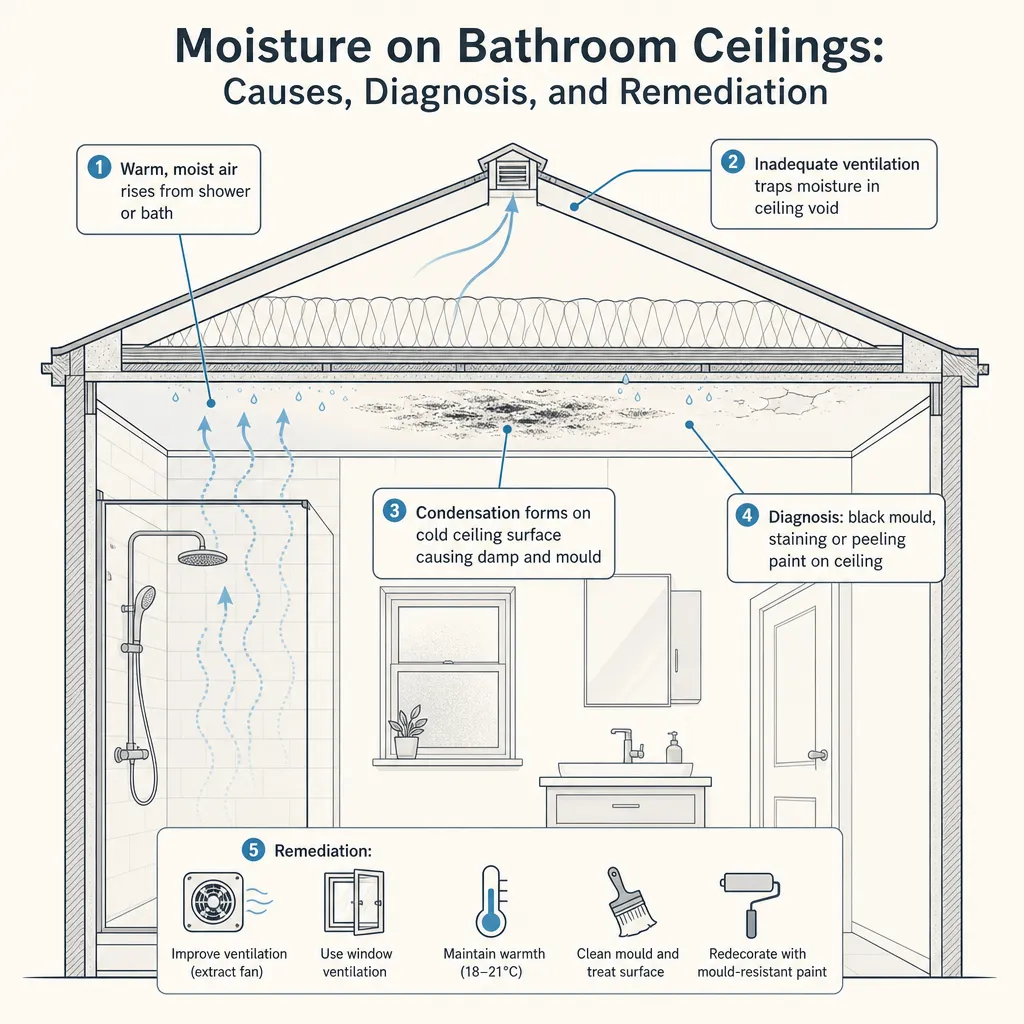
Moisture on Bathroom Ceilings: Causes, Diagnosis, and Remediation
Moisture on a bathroom ceiling is most often caused by condensation from poor ventilation, but can also indicate a leak from above or penetrating damp.
 Surveys & Inspections
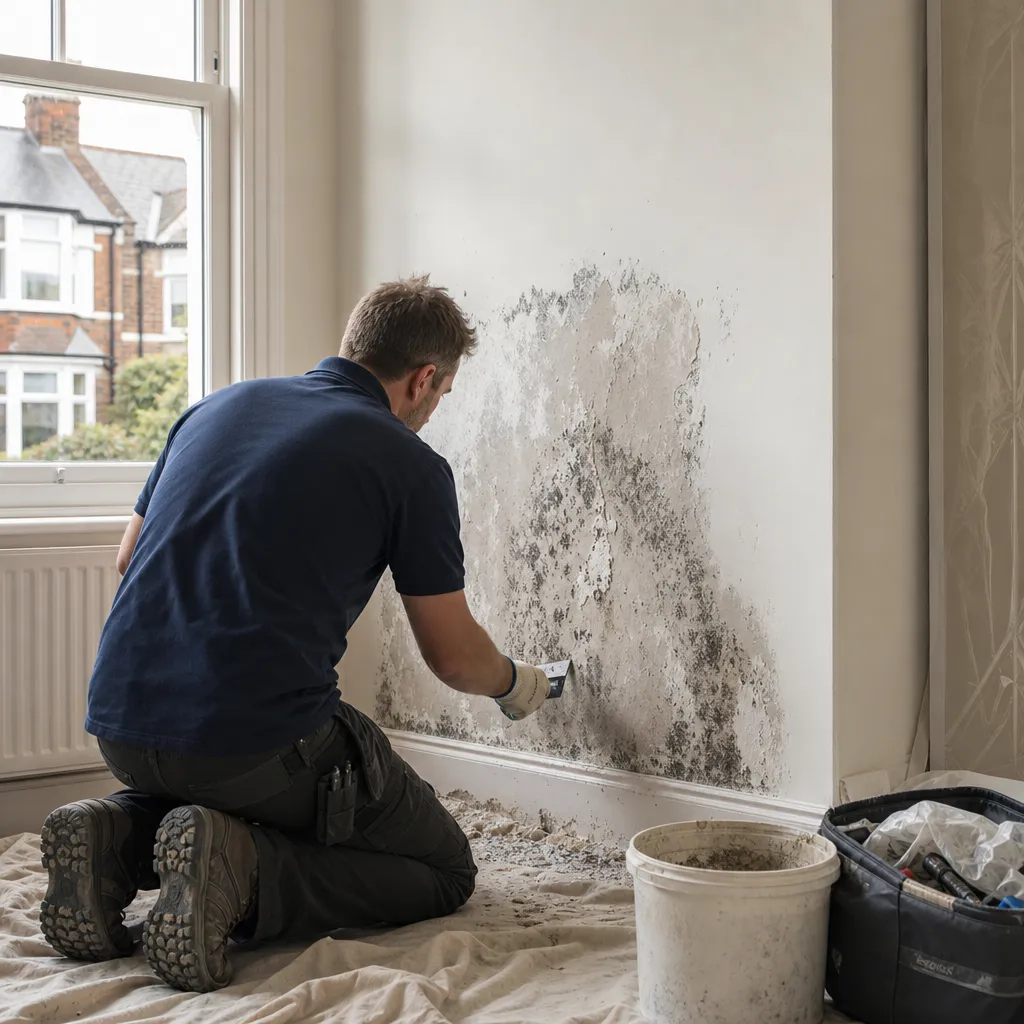
Treating Mould Contamination in Interior Walls
Mould on interior walls is caused by excess moisture — from condensation, penetrating damp, rising damp, or a plumbing leak.
 Surveys & Inspections
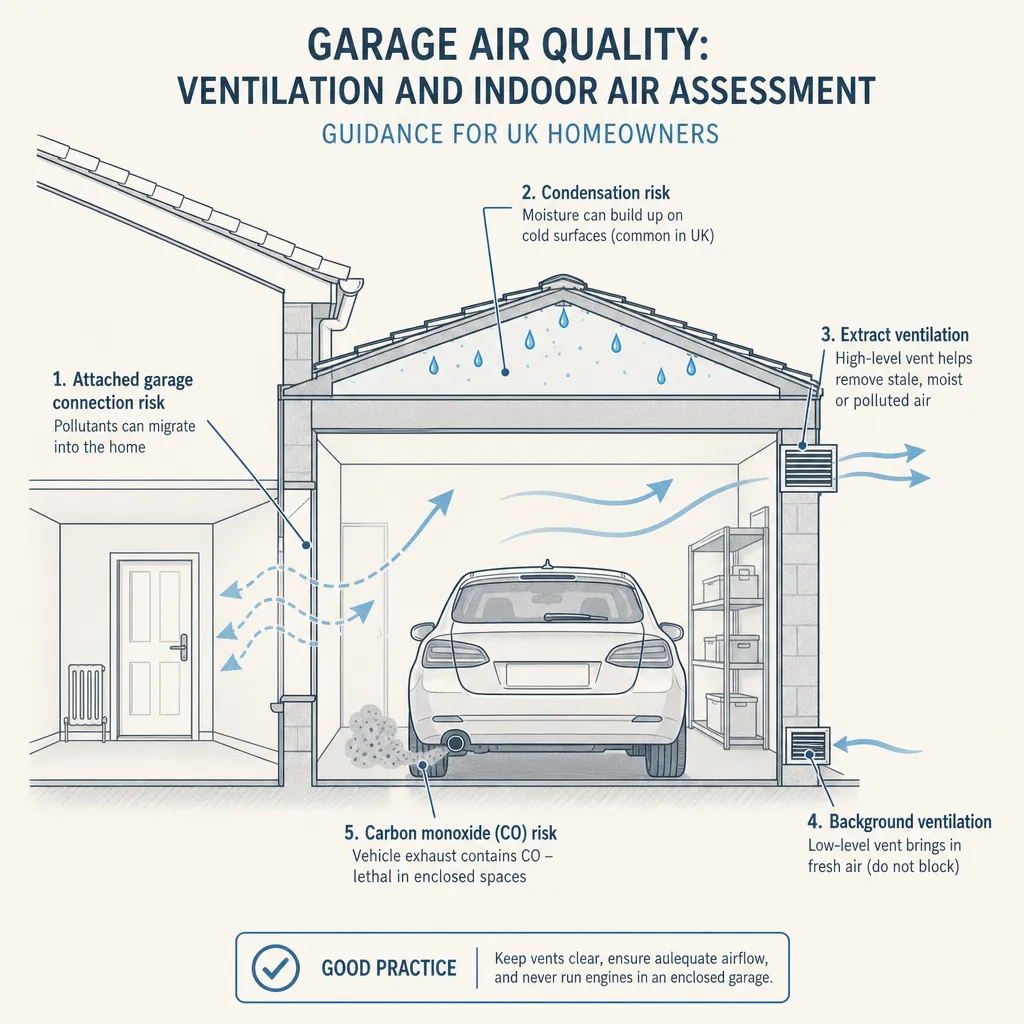
Garage Air Quality: Ventilation and Indoor Air Assessment
Poor garage ventilation can allow carbon monoxide from vehicles, VOC fumes from stored chemicals, and moisture to migrate into adjacent living spaces.
 Surveys & Inspections
Treatment and Prevention of Damp Problems in Homes
Damp in UK homes usually falls into three categories: rising damp (moisture drawn up through walls), penetrating damp (water entering through building defects), and condensation — the most common cause, particularly in post-war housing.
 Surveys & Inspections
Cold and Damp Walls: Diagnosing Condensation and Moisture Issues
Cold, damp walls in UK homes most commonly result from surface condensation, penetrating damp, or rising damp.