Managing invasive tree roots and preventing drainage damage to property
By Housey · Last reviewed 1st of June 2026
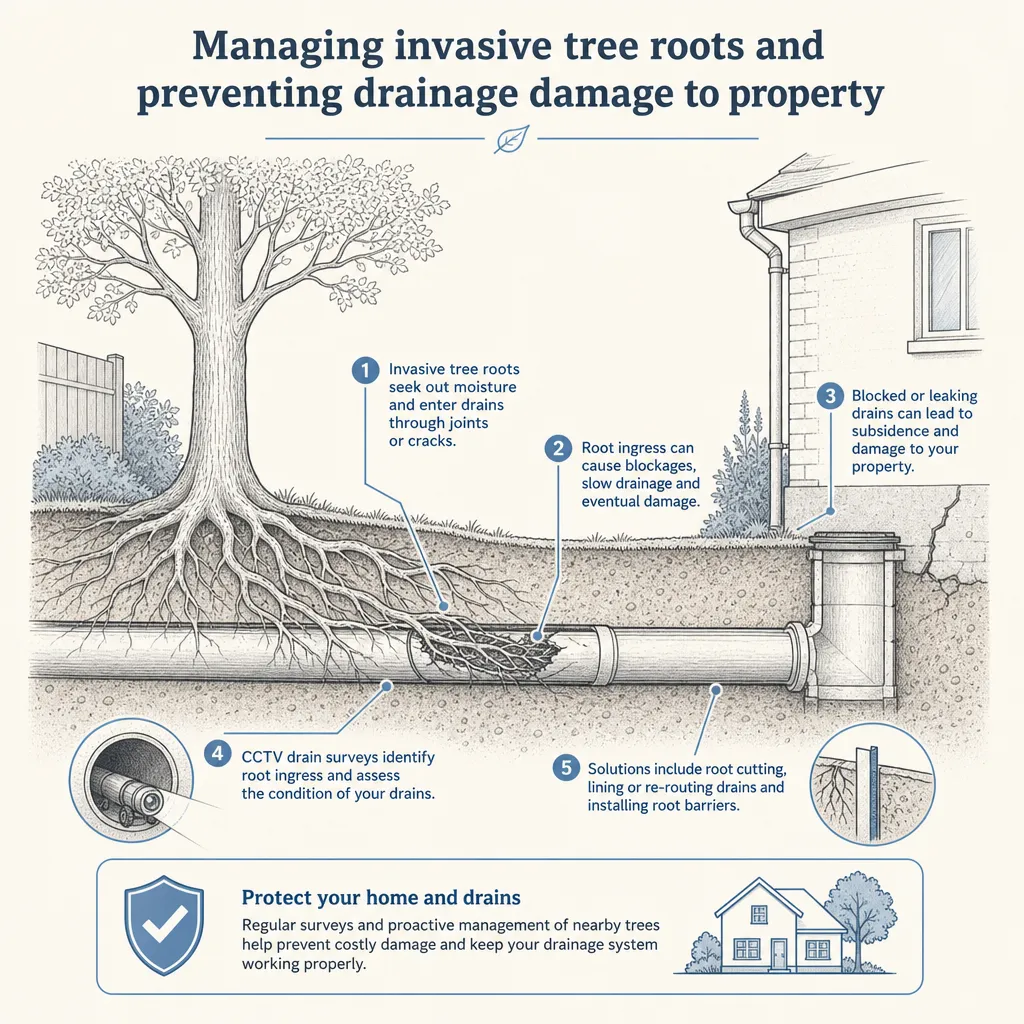
Managing invasive tree roots and preventing drainage damage to property
Tree roots and drainage problems often emerge together — a slow-draining sink, a recurring blocked gully, or an unexplained crack in a garden path can each be early signs of root intrusion. UK homeowners with mature trees nearby, or those buying older properties with established gardens, frequently encounter this issue without realising the scale until damage has progressed significantly. Understanding the risk early — and knowing which professional to call — can make the difference between a straightforward drain repair and a costly structural investigation.
Key points
- Tree roots follow water and oxygen; clay drainage pipes — common in UK properties built before the 1980s — are particularly vulnerable to root ingress at joints and hairline cracks.
- The Building Research Establishment (BRE) classifies tree species by water demand and provides safe planting distance guidance relative to property foundations on shrinkable clay soils (BRE Digest 298).
- A Tree Preservation Order (TPO) or conservation area designation can restrict or prohibit removal, felling, or significant pruning without Local Planning Authority (LPA) consent — carrying out unauthorised work is a criminal offence under the Town and Country Planning Act 1990.
- CCTV drain surveys are the most reliable diagnostic tool for confirming root intrusion before committing to excavation or drain repair.
- Tree-related subsidence and heave are distinct problems: felling a large tree on shrinkable clay without professional advice can cause the ground to heave upward, potentially causing as much structural damage as the original subsidence.
Which tree species pose the greatest root risk?
Not all trees carry the same risk to drains and foundations. Root spread, water demand, and soil type interact — the same species can be harmless on sandy soil but cause significant damage on shrinkable London clay.
Species | Water demand | Indicative safe distance from property on clay soil | Risk to clay drains |
|---|---|---|---|
Willow (Salix spp.) | High | 15–20 m | Very high — actively seeks water sources |
Poplar (Populus spp.) | High | 15 m | Very high — wide-spreading, fast-growing root network |
Oak (Quercus spp.) | High | 10–15 m | High — slow-growing but large eventual spread |
Ash (Fraxinus spp.) | Moderate–high | 10 m | High |
Lime (Tilia spp.) | Moderate | 8 m | Moderate |
Cherry/plum (Prunus spp.) | Moderate | 6–8 m | Moderate |
Birch (Betula spp.) | Moderate | 7 m | Low–moderate |
Apple/pear | Low–moderate | 5 m | Low |
Distances are indicative guidelines based on BRE Digest 298. Actual risk depends on soil type, foundation depth, and tree age. If you are buying a property with mature trees within 15 metres of the building on clay soil, raise this with your surveyor and conveyancer before exchange.
How tree roots damage drains and foundations
Root intrusion into drainage systems
Most underground drainage in UK properties built before the 1980s uses vitrified clay pipes with push-fit or cement-jointed connections. Over time, joints can loosen or develop hairline cracks — enough for fine root hairs to enter. Once inside, roots proliferate rapidly in the warm, nutrient-rich environment. Early intrusion causes partial blockages; left unaddressed, roots can fracture the pipe entirely.
Common signs of root intrusion include:
- Slow drainage from multiple fixtures simultaneously
- Recurring blockages despite rodding or jetting
- Gurgling sounds from waste pipes or soil stacks
- Unexplained wet patches or lush vegetation above buried drain runs
Subsidence and foundation heave
Tree-related subsidence occurs when roots extract water from shrinkable clay soils, causing the ground to contract and foundations to settle unevenly. It is most common in the south and east of England where clay soils predominate. Conversely, if a large tree is felled without managed root treatment, the clay can re-absorb moisture and heave upwards — potentially causing damage comparable to the original subsidence. Foundation effects are distinct from drain damage and require a chartered building surveyor or structural engineer to assess and diagnose correctly.
Assessing the problem: a homeowner decision tree
Use this to decide your next step before spending money on repairs.
- Suspect drain blockage only (slow drainage, gurgling), no wall cracks → Book a CCTV drain survey with a drainage contractor to confirm whether roots are present and assess the extent of pipe damage.
- Drain blockage confirmed and tree is within 5 m of the drain run → Arrange root-cutting (hydro-jetting or mechanical cutter), followed by pipe lining or repair if the pipe is cracked or fractured.
- Cracks in external walls, sticking doors or windows, uneven floors — tree within 10–15 m on clay soil → Instruct a chartered building surveyor or structural engineer before any tree work. Felling without professional advice can trigger heave.
- Tree is subject to a TPO or sits in a conservation area → Apply for LPA consent before felling, major pruning, or root barrier installation. Work without consent can attract an unlimited fine.
- Neighbour's tree, shared drain, or boundary dispute involved → Seek legal advice before taking any action affecting the neighbour's property. Do not cut roots or branches on a neighbour's land without agreement.
- Active subsidence suspected or a drain has collapsed → Contact your buildings insurer immediately. Most policies require notification at the earliest reasonable opportunity.
Options for managing invasive roots
CCTV drain surveys
A CCTV drain survey passes a camera through the drainage system and produces a recorded report showing root intrusion, pipe condition, joint alignment, and any cracked or broken sections. This is the essential first step before any repair decision is made — and is often required by insurers before they agree to a claim.
Root-cutting and pipe lining
Where roots have entered but have not catastrophically damaged the pipe, high-pressure water jetting combined with a mechanical root-cutter can clear the blockage. Pipe relining — inserting a cured-in-place resin liner without excavation — can then seal joints and prevent future intrusion. Relining is often cheaper and less disruptive than full drain excavation and replacement.
Root barriers
Physical root barriers — dense polyethylene sheet or metal plate installed vertically in the ground — redirect root growth away from pipes and foundations. They are most effective at planting stage; retrofitting near established trees requires careful positioning to avoid destabilising the root system.
Tree management and removal
In many cases, managing rather than removing the tree is the right approach. Crown reduction reduces the tree's water demand and therefore its root activity. Full removal may sometimes be necessary, but on clay soils this must be planned carefully to manage heave risk over the following years. Always use an ARB-approved arborist (search the Arboricultural Association's contractor register) and check for TPOs before instructing any tree work.
Tree Preservation Orders and conservation areas
A Tree Preservation Order (TPO) is made by a Local Planning Authority and protects specific trees of public amenity value. In a conservation area, all trees with a stem diameter of 75 mm or more at 1.5 m height are subject to notification requirements — you must give the LPA at least six weeks' notice before carrying out any work, allowing time to consider making a TPO.
Carrying out unauthorised work on a protected tree is a criminal offence under the Town and Country Planning Act 1990, with penalties including an unlimited fine. Check the Planning Portal or contact your LPA's tree officer before instructing any contractor.
When to get professional help
Most root-related drainage problems eventually require at least one specialist. The question is which one, and when.
Red flags that require immediate professional attention:
- Diagonal, stepped, or widening cracks in external brickwork or render
- Doors or windows sticking without an obvious cause
- Floors that have become noticeably uneven
- A drain that cannot be cleared by rodding
- A sinkhole or depression visible in the garden above a drain run
Call a drainage contractor when you have recurring blockages and suspect root intrusion, need a CCTV survey for insurers or a conveyancer, or require drain repair or relining.
Call a qualified, ARB-approved arborist when you need a tree assessed for root spread, health, or risk; want pruning or crown reduction carried out; need a tree report for planning or insurance purposes; or are considering felling.
Call a chartered building surveyor or structural engineer when you see wall cracks, suspect subsidence or heave, or are buying a property with mature trees nearby on clay soil.
Contact your LPA tree officer if you are unsure whether a tree is protected or want to apply for TPO consent before starting work.
How Housey can help
Housey connects you with qualified local professionals for both sides of this problem. Use our tree surgeons service to find ARB-approved arborists who can assess, manage, or safely remove trees while navigating TPO requirements. For drain investigations and repairs, our drainage contractors service can match you with specialists who carry out CCTV surveys, root-cutting, and no-dig pipe lining.
Frequently asked questions
Can my neighbour's tree roots damage my drains, and who is responsible?
Tree roots do not respect boundaries. If a neighbour's tree causes damage to your drains or foundations, you may have a claim under common law nuisance. In practice, documenting the damage with a professional CCTV or structural report, then involving insurers on both sides, is usually the most practical route before any legal action is considered.
Will my buildings insurance cover tree root drain damage?
Cover depends on policy wording. Many standard buildings policies cover sudden or unforeseen damage but exclude gradually developing problems. Root intrusion is often treated as a gradual defect, so cover is not guaranteed. Notify your insurer early and obtain a CCTV drain report to establish when damage arose — this can be important evidence when pursuing a claim.
Do I need planning permission to remove a tree in my garden?
Not unless the tree is protected by a Tree Preservation Order or sits in a conservation area. If either applies, you must obtain LPA consent or give at least six weeks' written notice before any work. For unprotected trees, no planning permission is required, though a qualified arborist should carry out any significant felling or major pruning.
How much does a CCTV drain survey cost?
Indicative UK costs, last reviewed 2026-06-01. A residential CCTV drain survey typically costs £150–£400 depending on property size, drain length, and access. A written report with footage for insurance or conveyancing purposes may cost more. Always confirm whether a written report and recorded footage are included before accepting a quote.
Can roots grow back after drain jetting?
Yes. Jetting removes the immediate blockage but does not seal the entry point. Pipe relining after jetting is the most reliable way to prevent re-entry, sealing joints with a cured-in-place resin liner. Where relining is not practical, regular jetting on an annual or biennial cycle is an alternative management approach.
Sources and further reading
- Tree Preservation Orders and protected trees — GOV.UK
- Town and Country Planning Act 1990 — legislation.gov.uk
- Find an ARB-approved arboricultural contractor — Arboricultural Association
- BRE Digest 298: The influence of trees on house foundations in clay soils — Building Research Establishment
- RICS guidance on subsidence — RICS
Useful next reads
 Improvement & Build
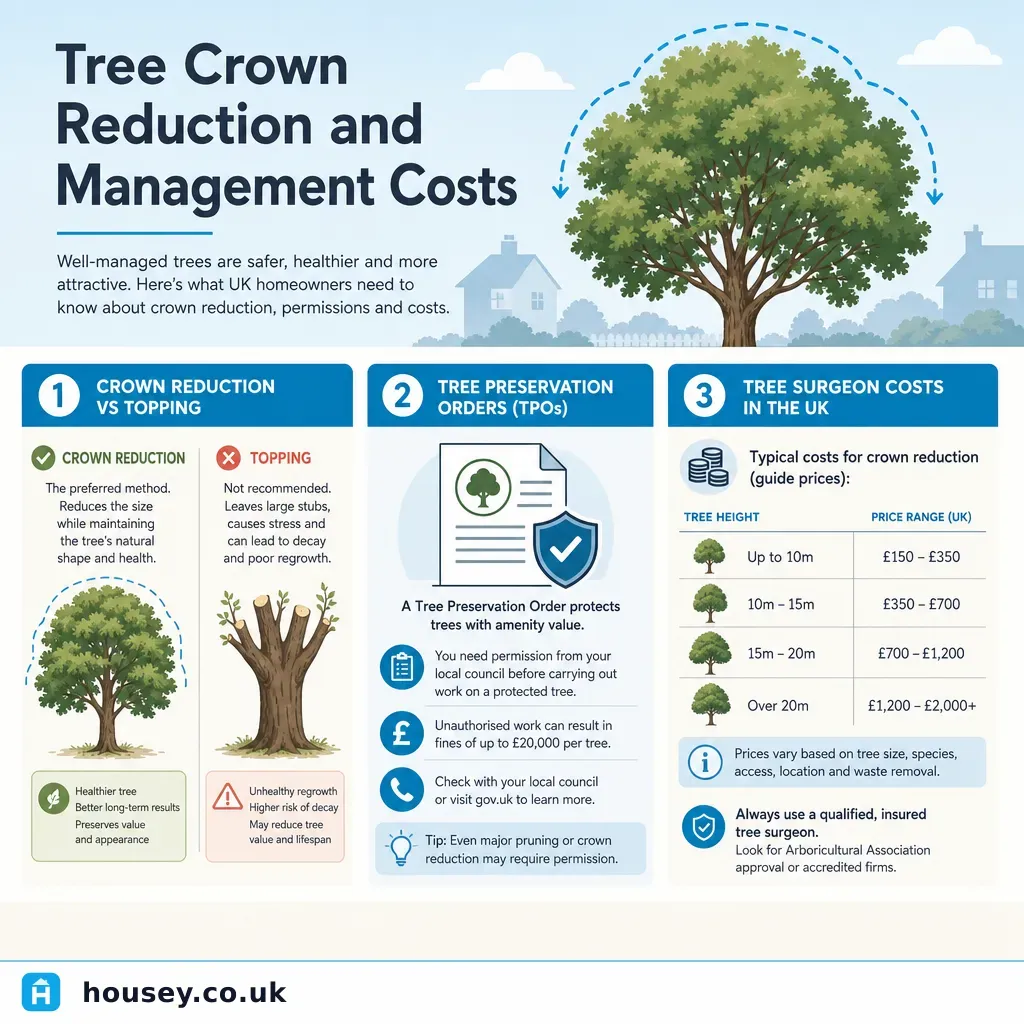
Tree Crown Reduction and Management Costs
Crown reduction reduces a tree's overall size by 15–30% while preserving its natural shape, and must follow BS 3998:2010.
 Improvement & Build
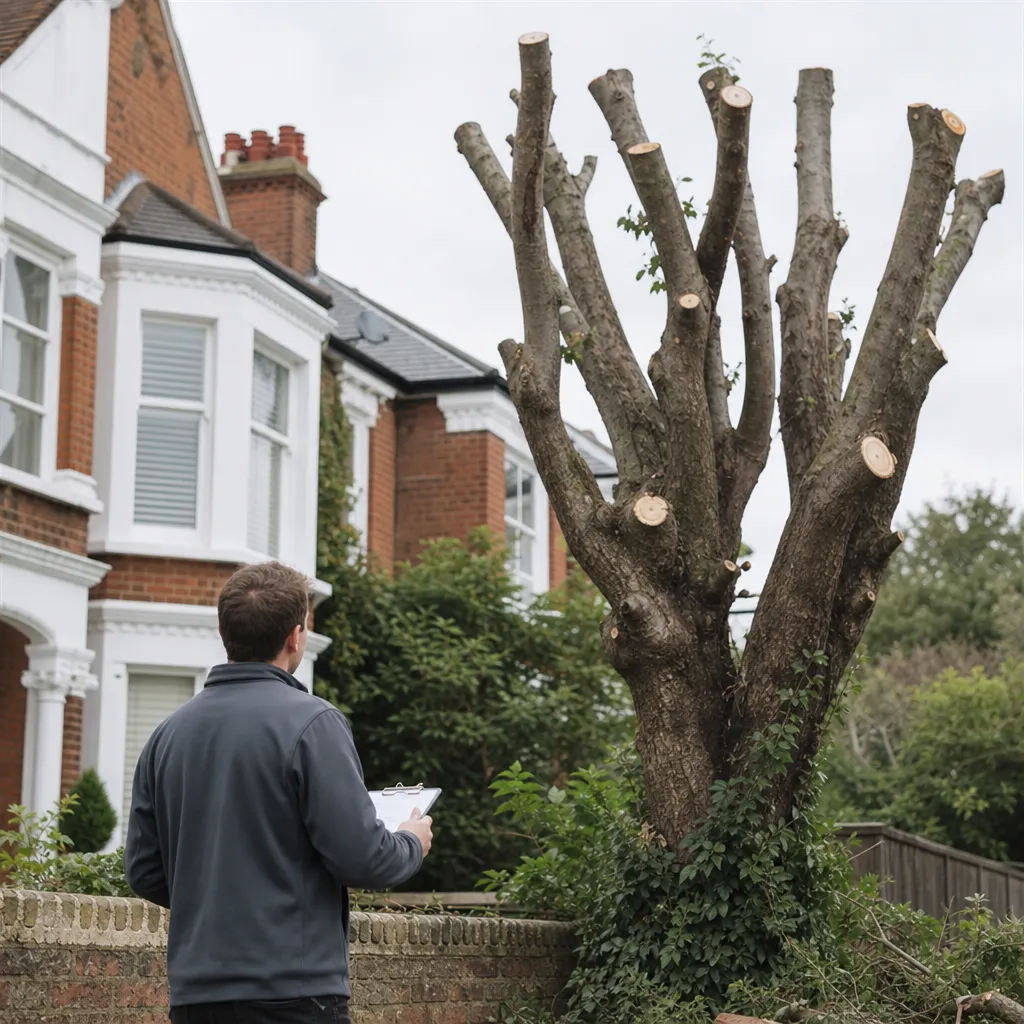
Tree Topping: Why It's Harmful and Better Alternatives for Tree Care
Tree topping — removing large sections of a tree's crown through indiscriminate cuts — causes serious structural weakness, fungal decay, and vigorous but poorly attached regrowth.
 Improvement & Build
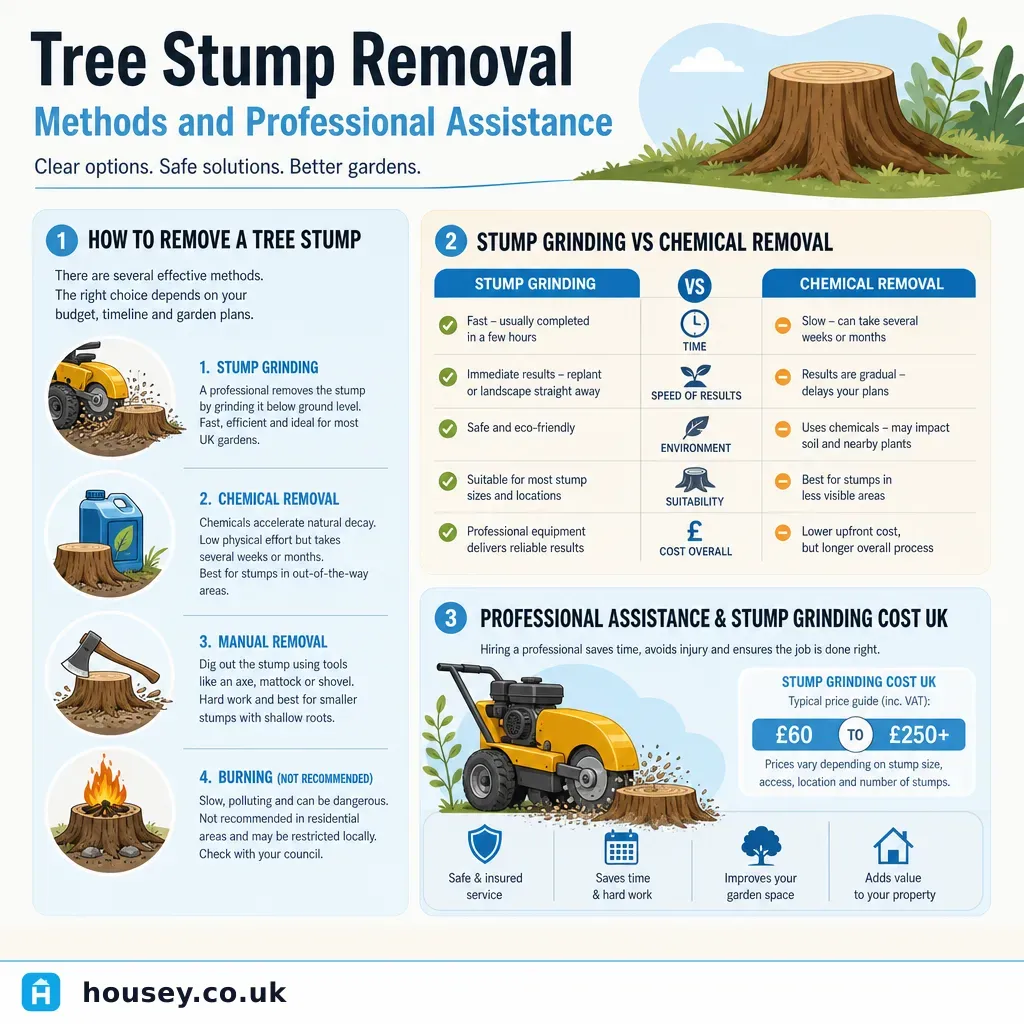
Tree Stump Removal Methods and Professional Assistance
Tree stump removal is most commonly done by stump grinding, which reduces the stump to wood chips 150–300 mm below ground level within a few hours.
 Improvement & Build
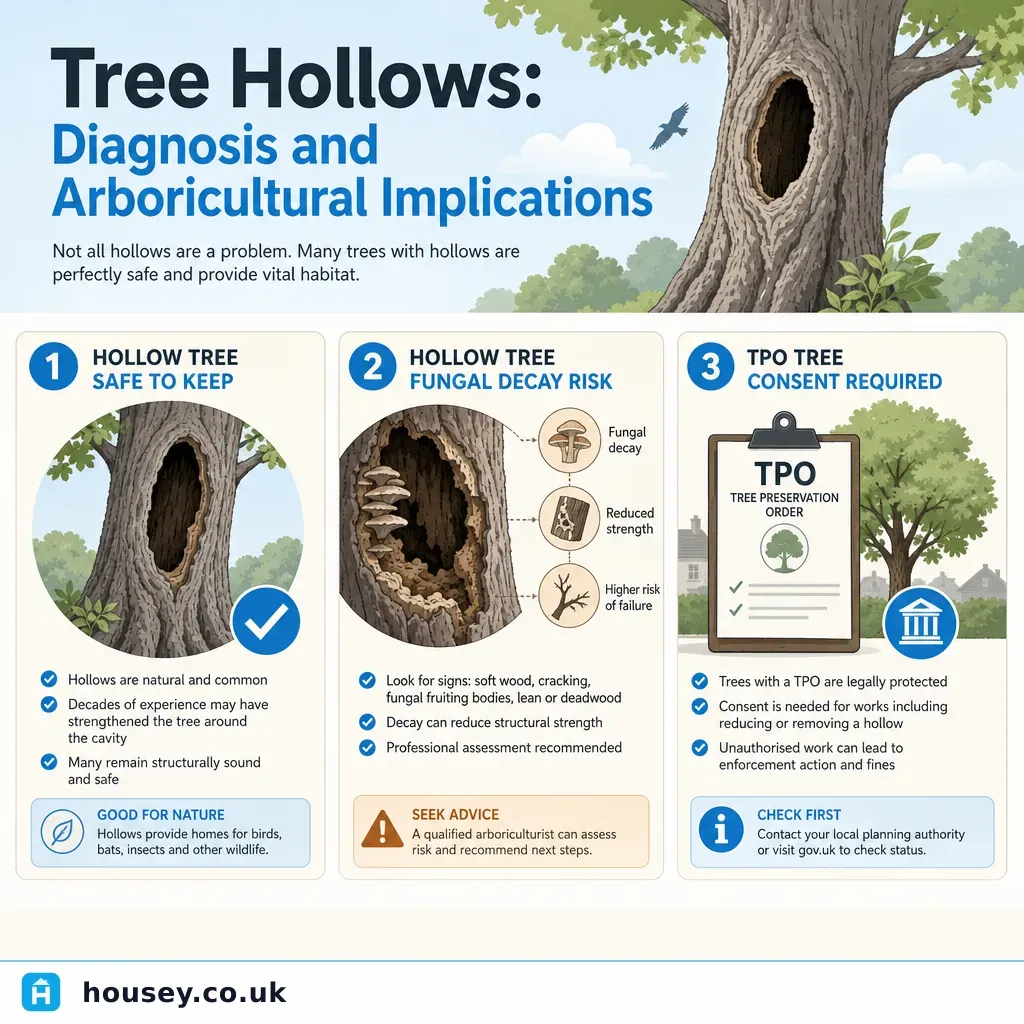
Tree Hollows: Diagnosis and Arboricultural Implications
A hollow in a tree trunk usually indicates internal fungal decay or bacterial wetwood, but does not automatically mean the tree is dangerous or should be felled.
 Improvement & Build
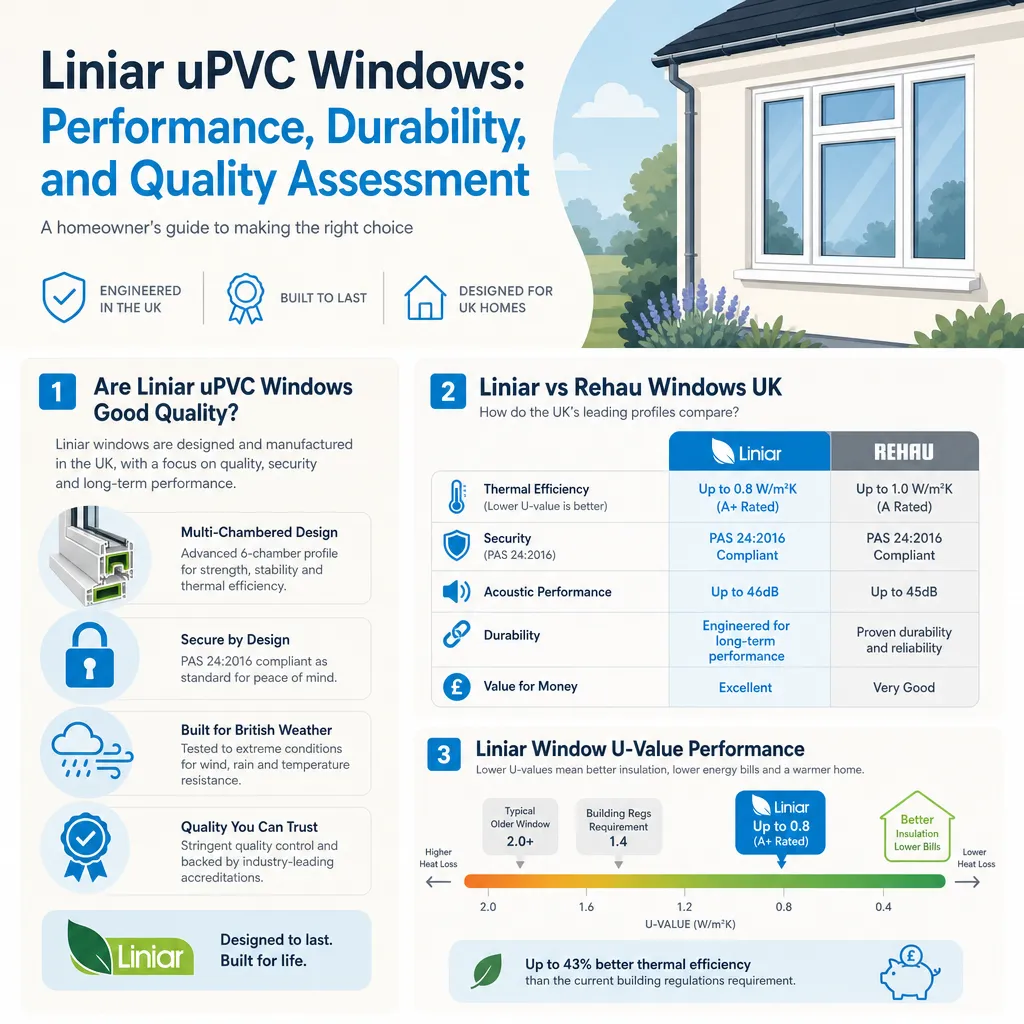
Liniar uPVC Windows: Performance, Durability, and Quality Assessment
Liniar uPVC window profiles are manufactured in the UK using multi-chambered, foamed frames.