Tree Hollows: Diagnosis and Arboricultural Implications
By Housey · Last reviewed 31st of May 2026
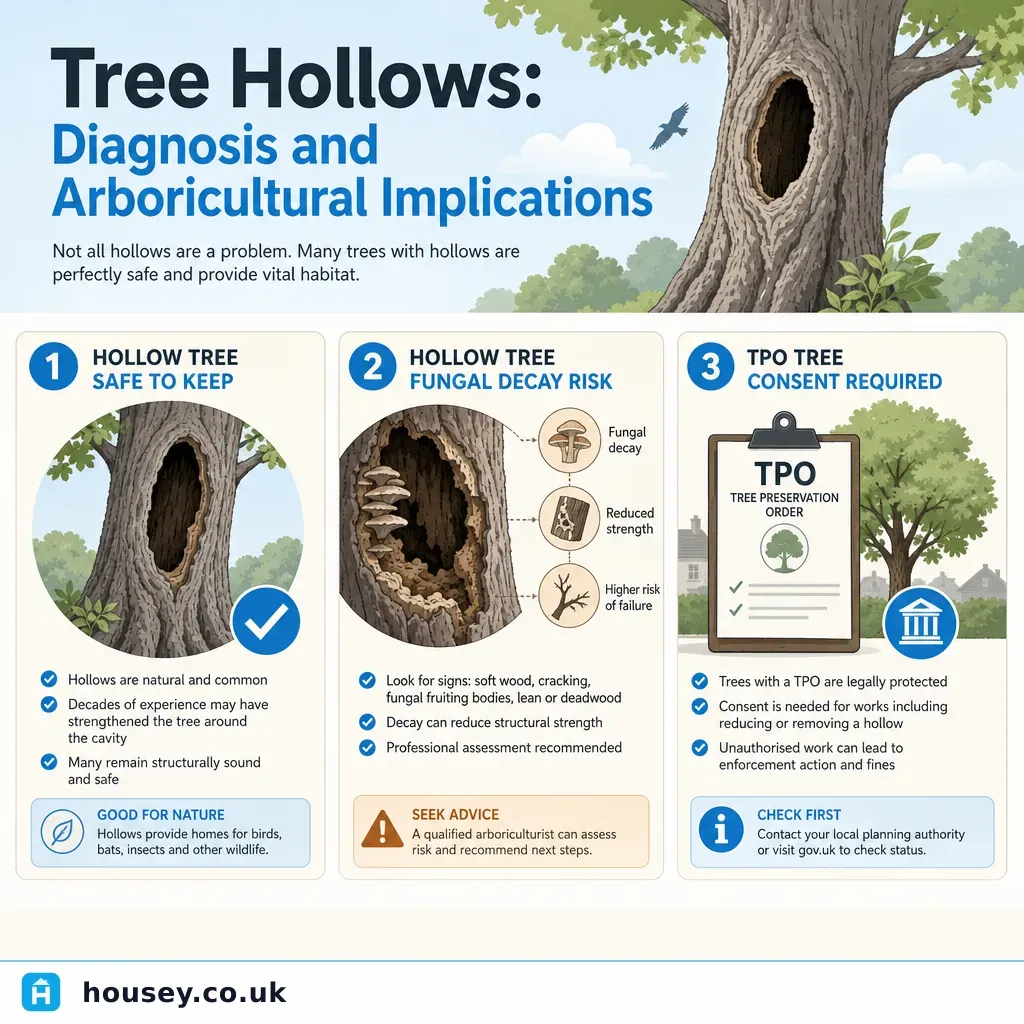
Tree Hollows: Diagnosis and Arboricultural Implications
A hollow in a tree trunk is one of the more visible signals that something has changed inside the structure of the tree — but what that change means for safety, management, and legal obligations is rarely straightforward. For UK homeowners, hollow trees raise practical questions about structural risk, protected wildlife, and planning constraints, all of which vary significantly depending on the tree's location and protection status. Answering them reliably requires professional arboricultural assessment under BS 3998:2010, not visual inspection alone.
Key points
- Hollowing in trees is most commonly caused by internal fungal decay or bacterial wetwood, which can progress significantly before showing external signs other than the hollow itself.
- BS 3998:2010 (Tree Work: Recommendations) is the British Standard governing arboricultural practice in the UK; assessment and management of hollow or potentially hazardous trees should follow this standard.
- A hollow trunk does not automatically indicate a dangerous tree — residual wall thickness relative to trunk diameter is a key structural measure, and many veteran trees with substantial hollows remain sound for decades.
- Trees subject to a Tree Preservation Order (TPO) cannot be pruned, felled, or significantly altered without written consent from the local planning authority; unauthorised works are a criminal offence with an unlimited fine.
- Trees in a conservation area with a trunk diameter exceeding 75 mm at 1.5 m above ground require at least six weeks' written notice to the local planning authority before felling or major pruning, even where no TPO applies.
What causes tree hollows?
Internal decay leading to hollowing typically begins when a wound — from branch failure, pruning, storm damage, or physical injury — allows fungal spores or bacteria to penetrate the heartwood. The most common pathways are:
Fungal decay: Species such as Ganoderma (bracket fungi), Meripilus giganteus (giant polypore), and Inonotus hispidus (shaggy bracket) indicate active wood-rotting processes. Visible fruiting bodies on the trunk or at the base are important diagnostic indicators.
Bacterial wetwood: Causes internal soft rot and distinctive oozing sap staining on bark; common in elms, oaks, and poplars.
Old pruning wounds: Large wounds on mature trees — particularly flat cuts that do not follow the branch collar — are a common entry point for decay in older UK street and garden trees.
Natural veteran features: Ancient and veteran trees, particularly oak, beech, and sweet chestnut, often develop hollows as a natural part of their lifecycle. These are ecologically valuable habitats and are not inherently dangerous.
Assessing structural risk: methods and tools
Whether a hollow tree poses a structural risk depends largely on how much sound wood remains in the trunk wall. A commonly cited guide suggests that when the ratio of sound shell thickness to overall trunk radius falls below approximately 0.3, the risk of stem failure may increase significantly. This is a rule of thumb to be applied by a qualified arborist, not a definitive threshold.
More detailed assessments may use specialised equipment:
Assessment method | What it measures | When it is used |
|---|---|---|
Visual tree assessment (VTA) | External symptoms — cracks, decay, lean, root issues, wound response | First-line assessment for all trees |
Resistograph drilling | Internal wood density via resistance measurement through the stem | Confirms suspected internal decay |
Picus sonic tomography | 2D cross-section image of internal wood density | High-value or high-risk trees requiring detailed diagnosis |
Fungi identification | Decay species and likely extent of colonisation | Where fruiting bodies are present on or near the trunk |
Legal constraints: TPOs, conservation areas, and wildlife
Before any work is carried out on a hollow tree, establish whether any of the following apply.
Tree Preservation Orders
A TPO protects individual trees, groups, or woodlands. To confirm whether your tree is covered, search your local planning authority's TPO register — most councils publish this online or will respond to an enquiry within a few days. Works to a TPO tree without consent may constitute a breach of planning law, with unlimited fines under section 206 of the Town and Country Planning Act 1990.
Conservation area notification
In a designated conservation area, you must submit a Section 211 Notice to the local planning authority at least six weeks before felling or carrying out works that could be refused under a TPO. The council may make a TPO, let the notice period expire, or raise no objection.
Protected wildlife
Hollow trees are primary habitat for bats — all UK bat species are strictly protected under the Wildlife and Countryside Act 1981 and the Conservation of Habitats and Species Regulations 2017. They may also support nesting birds during the breeding season (broadly March to August). Before any tree works:
- Arrange a preliminary ecological appraisal or bat roost assessment if bats are suspected
- Avoid felling or heavy pruning during the bird nesting season unless works are essential and appropriately surveyed
- A Natural England bat mitigation licence may be required if active bat roosts are confirmed
Which professional do you need?
- Choose a qualified arborist for an initial visual assessment, routine management, crown reduction, or deadwood removal on a hollow tree.
- Choose an arborist with specialist diagnostic equipment — resistograph or sonic tomography — if you need a detailed structural assessment of a high-value or high-risk specimen.
- Engage a qualified ecologist before any works if the hollow may support bats, nesting birds, or other protected species.
- Contact your local planning authority tree officer before instructing any works on a tree that may be protected by a TPO or is in a conservation area.
- Check the Arboricultural Association's approved contractor register at trees.org.uk to find qualified and insured professionals in your area.
Red flags: signs a hollow tree needs urgent assessment
Arrange a professional assessment promptly if you notice:
- Visible bracket fungi at the base of the trunk or growing directly from the trunk
- Unexplained sudden leaning or a recent change in the tree's posture
- Vertical cracks running along the trunk, especially near or below the hollow
- Seeping, discoloured, or foul-smelling sap around a wound or cavity
- Recent large branch failure from the tree, particularly from the upper crown
- The hollow opening is at or near the base of the trunk — base decay is more structurally critical than upper-trunk decay
- Root damage, soil upheaval, or fungal growth at the base
- The tree is within striking distance of a building, road, or area regularly used by people
What not to assume
A common misconception is that a hollow tree must be felled. In many cases the opposite holds for veteran trees: ancient oak, beech, and sweet chestnut specimens with large hollows are often of significant ecological and landscape value, and local planning authorities may resist or refuse felling consent on ecological grounds. A good arborist will explore management options — crown reduction, deadwood removal, or a structured monitoring programme — before recommending removal.
A second common misconception is that filling the cavity with concrete or expanding foam will stabilise the tree. Modern arboricultural practice does not support cavity filling for structural purposes. It can trap moisture, accelerate decay, and make future professional assessment significantly harder. BS 3998:2010 does not recommend cavity filling as a standard treatment for hollow trees.
When to get professional help
Always seek a professional arboricultural assessment before deciding on action for a hollow tree — particularly if the tree is near a building, path, vehicle, or area regularly used by people. Seek advice promptly if you suspect bracket fungi or base decay, if the tree may be covered by a TPO or is in a conservation area, or if you have any concern about bats or nesting birds. Do not probe, hollow out, or treat a cavity without professional guidance. Disturbing a confirmed bat roost without appropriate surveys and, where required, a mitigation licence is an offence under UK law.
How Housey can help
Housey can connect you with qualified, insured professionals who can carry out visual assessments, advise on structural risk and management options, and complete necessary works in line with BS 3998:2010 and applicable planning and wildlife law. Find local specialists through our tree surgeons service.
Frequently asked questions
Can I fill a hollow in a tree myself?
Modern arboricultural practice does not recommend cavity filling as a structural or management treatment. Filling can trap moisture and accelerate the decay you are trying to address, and may interfere with future professional assessments. If a cavity is causing concern, have it assessed by a qualified arborist who can advise on appropriate management — which is usually monitoring or controlled pruning, not filling.
How do I check if my tree has a TPO?
Most local planning authorities maintain a public register of TPOs, often searchable online through the council's planning portal. You can also contact the council's tree officer directly. When in doubt, enquire before instructing any work: the penalty for breaching a TPO is an unlimited fine under section 206 of the Town and Country Planning Act 1990.
Is a hollow tree always dangerous?
Not necessarily. Many mature and veteran trees with substantial hollows remain structurally sound because the outer shell of sound wood provides most of the structural strength. The key variables are residual shell thickness, the location of the decay — base decay is more critical — and the tree's overall condition. A qualified arborist can carry out a visual assessment and recommend instrument-based testing if needed.
Do I need planning permission to fell a hollow tree?
It depends. If the tree has a TPO, written consent from the local planning authority is required before felling, even if you believe it poses a risk. In a conservation area, a Section 211 Notice giving six weeks' notice is required. For unprotected trees, felling is generally at the owner's discretion, subject to wildlife law. Document any emergency works carefully and notify the council promptly.
Sources and further reading
- BS 3998:2010 Tree Work: Recommendations — BSI Group
- Planning Portal: Trees and planning — Planning Portal
- Ancient Tree Forum: Veteran trees — Ancient Tree Forum
- Arboricultural Association: Find an approved contractor — Arboricultural Association
- GOV.UK: Bats, surveys and development — GOV.UK / Natural England
- Wildlife and Countryside Act 1981 — legislation.gov.uk
Useful next reads
 Improvement & Build
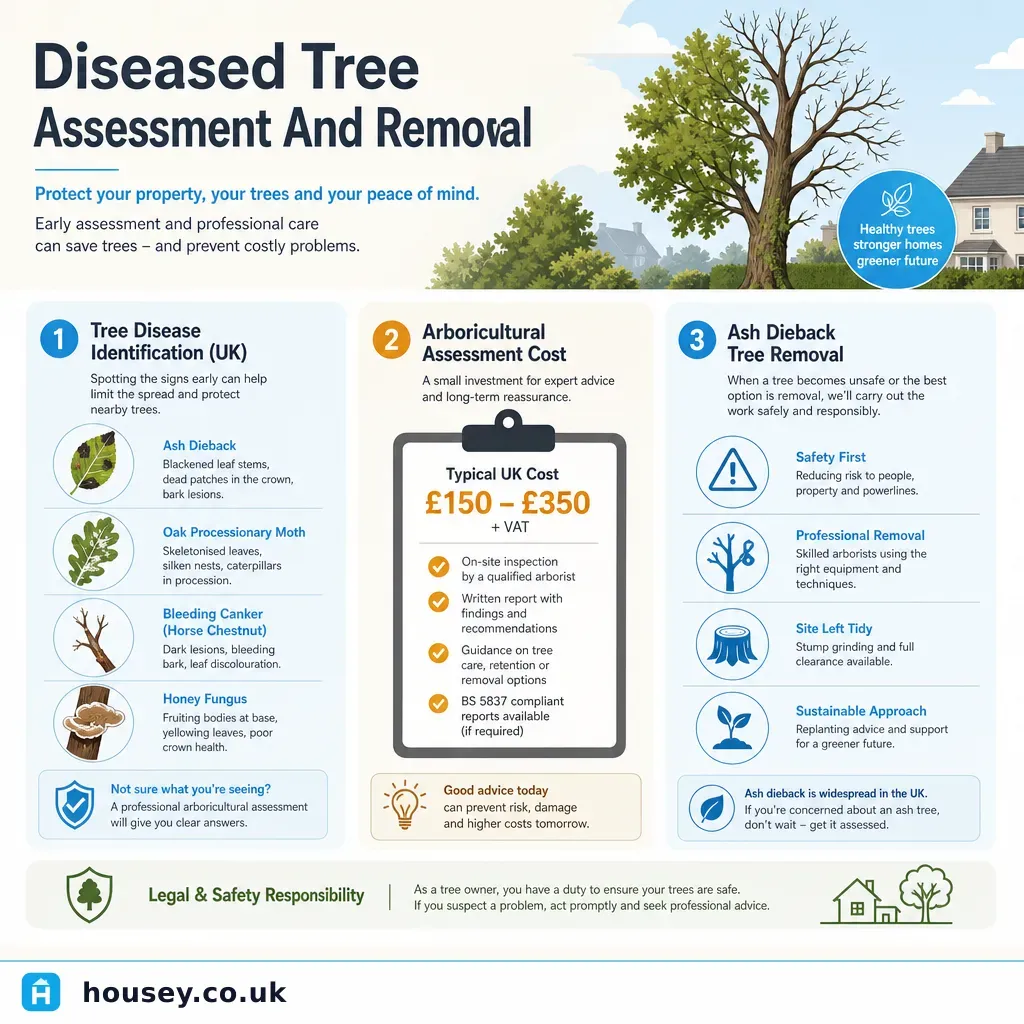
Diseased Tree Assessment And Removal
A diseased or structurally compromised tree can pose a serious safety risk, but not every unhealthy-looking specimen needs to come down.
 Improvement & Build
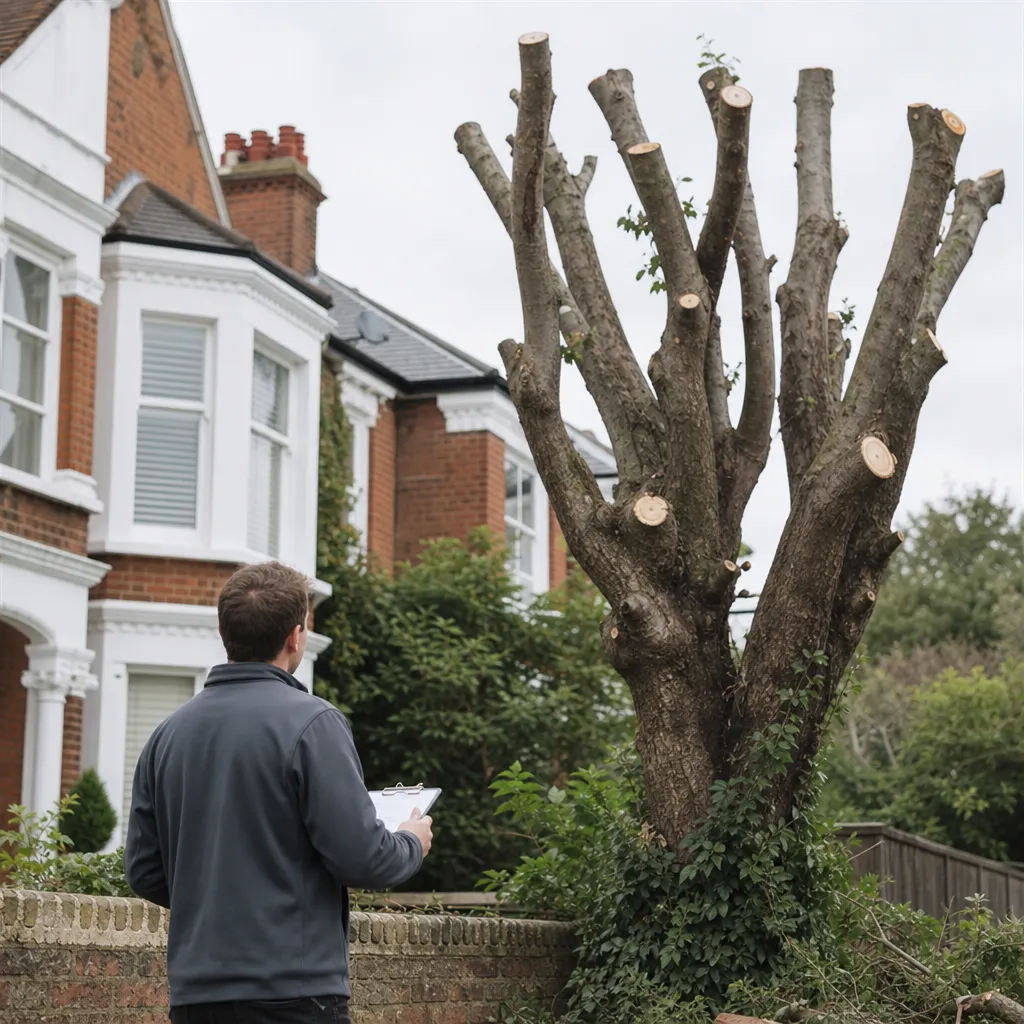
Tree Topping: Why It's Harmful and Better Alternatives for Tree Care
Tree topping — removing large sections of a tree's crown through indiscriminate cuts — causes serious structural weakness, fungal decay, and vigorous but poorly attached regrowth.
 Improvement & Build
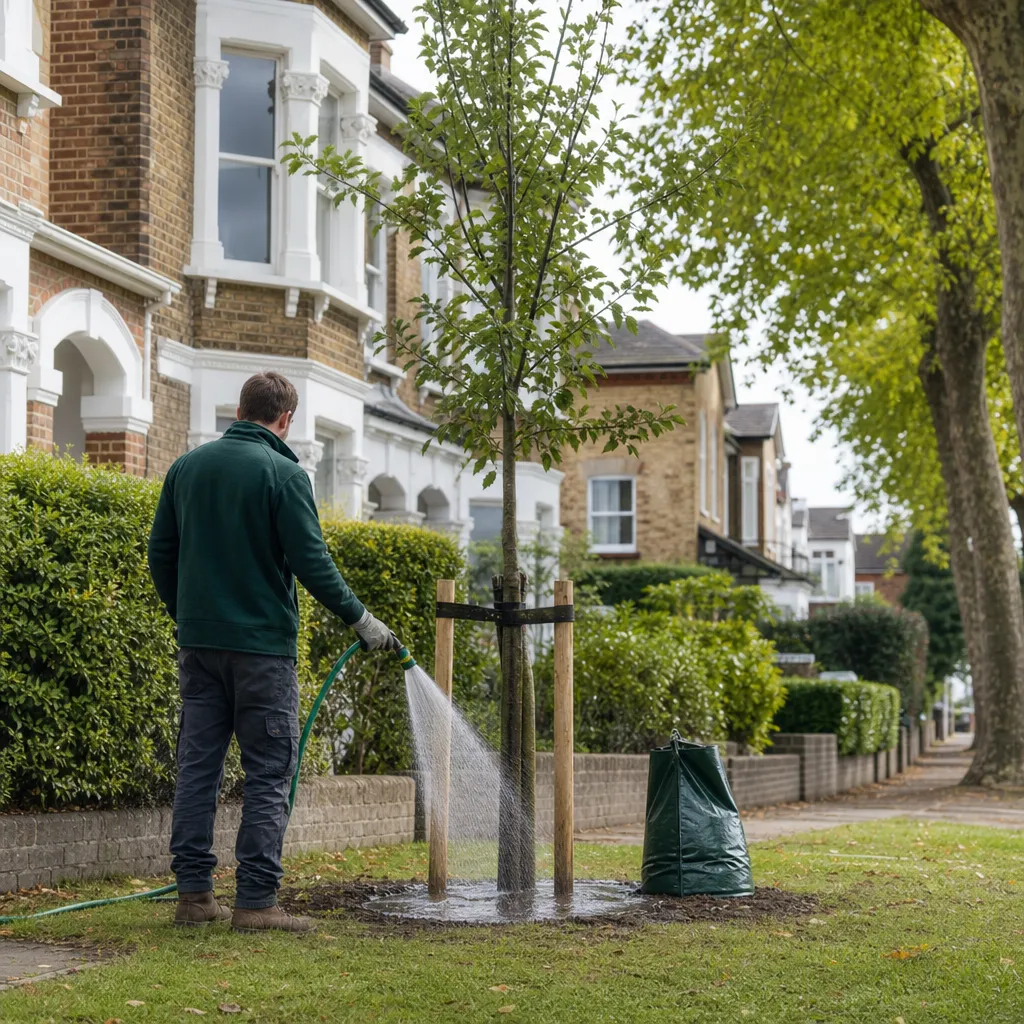
Watering Large Trees: Techniques and Frequency for Establishment
Newly planted large trees typically need 50–90 litres of water per week during the growing season for the first two to three years.
 Improvement & Build
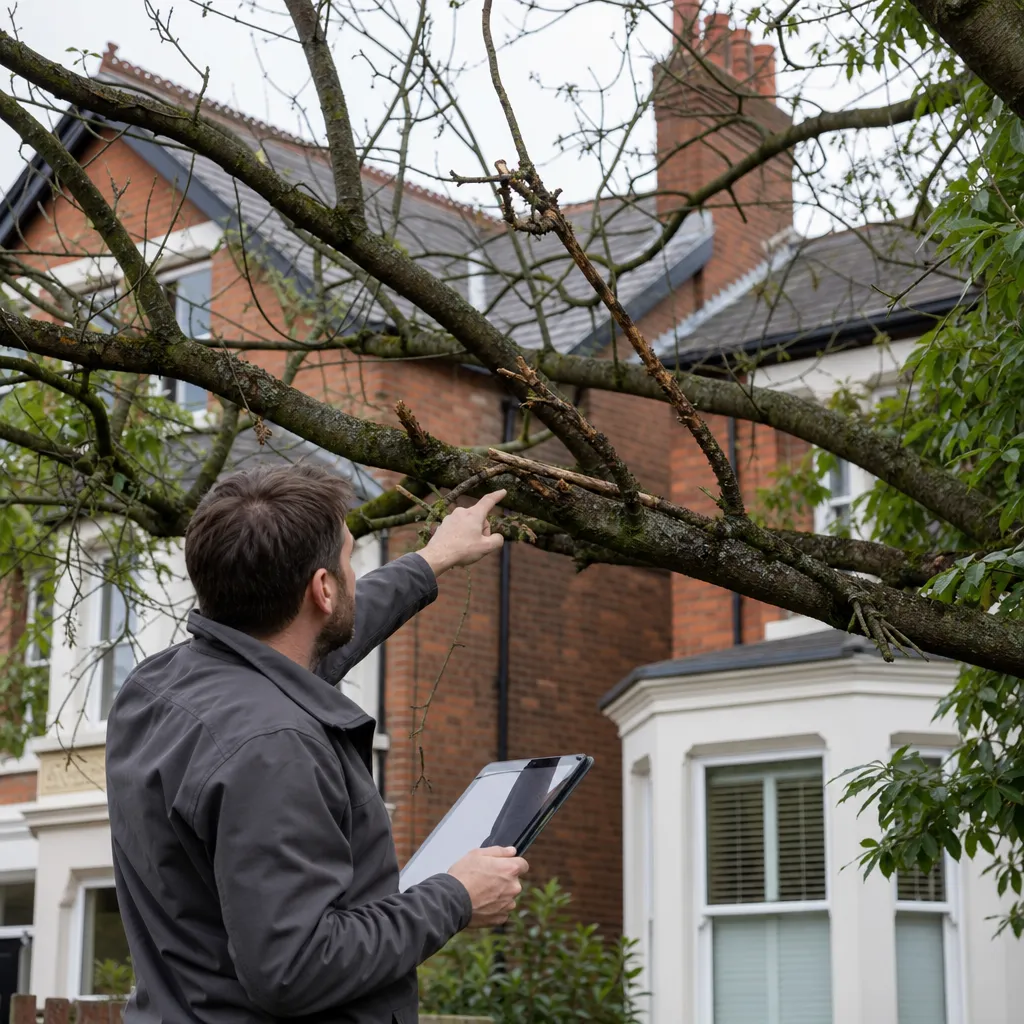
Identifying and Addressing Dying Tree Branches: Common Causes
Dying branches on UK garden trees can result from fungal diseases such as ash dieback or honey fungus, pest damage, drought stress, physical injury, or root problems.
 Improvement & Build
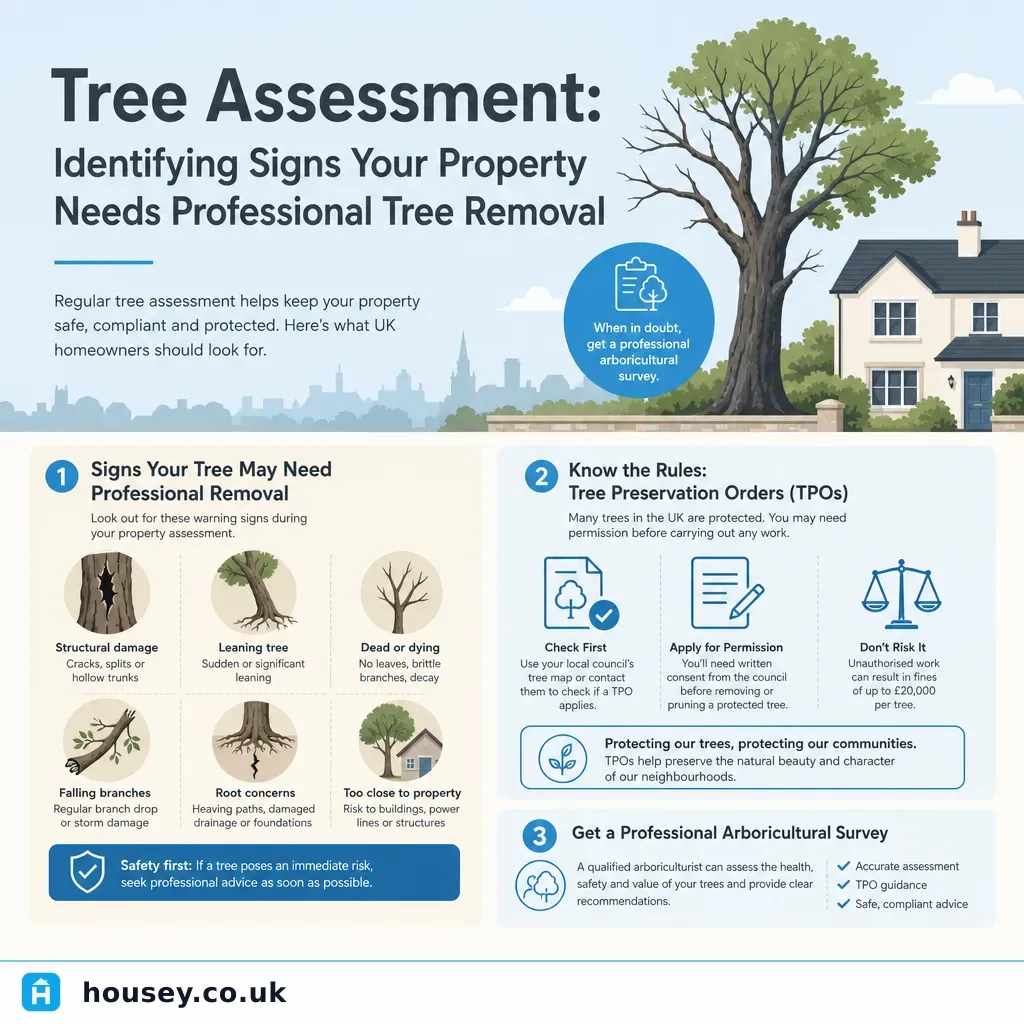
Tree Assessment: Identifying Signs Your Property Needs Professional Tree Removal
Key signs a tree may need professional removal include fungal brackets on the trunk, a sudden change in lean, dead or hanging branches, root heave, and visible cavities or decay.