Tree Topping: Why It's Harmful and Better Alternatives for Tree Care
By Housey · Last reviewed 19th of May 2026
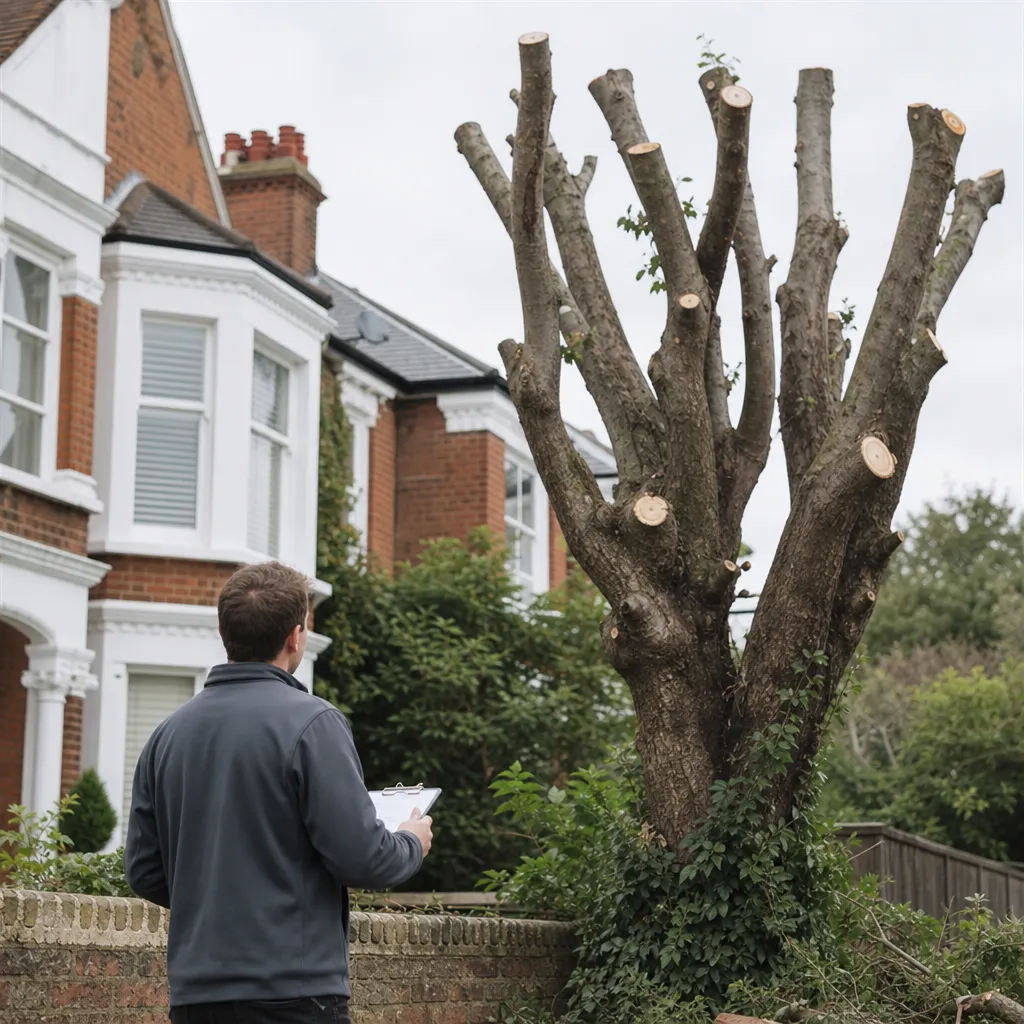
Tree Topping: Why It's Harmful and Better Alternatives for Tree Care
Tree topping comes up regularly for UK homeowners whose gardens contain established trees that have grown larger than expected, are casting too much shade, or are thought to pose a safety risk after a period of high winds. It is also commonly requested when a large tree close to a house or boundary has made buyers or insurers nervous. Understanding why topping causes harm — and what professionally recognised alternatives are available — can save money, protect your trees, and keep you on the right side of planning law.
Key points
- Tree topping is condemned as unacceptable practice by the Arboricultural Association and does not comply with BS 3998:2010 Tree Work — Recommendations, the British Standard governing arboricultural operations.
- Large indiscriminate cuts made during topping create open wounds that trees struggle to seal, providing entry points for fungal decay in structural limbs that may not become visible for years.
- Epicormic regrowth — fast-sprouting shoots from topping cuts — is structurally weak and often grows back larger than the original canopy within five to ten years.
- Trees with a Tree Preservation Order (TPO) or within a conservation area cannot be pruned significantly without prior notification to or consent from the local planning authority; fines for unlawful works can be unlimited under section 210 of the Town and Country Planning Act 1990.
- Crown reduction, carried out to BS 3998:2010 by a qualified arborist and generally limited to no more than 25–30% of the canopy in a single operation, is the accepted alternative for reducing tree size while preserving structural integrity.
Why tree topping causes lasting damage
When a tree is topped — its upper crown removed through large, indiscriminate cuts across main stems — it loses a significant proportion of its leaf area and its ability to photosynthesise effectively. The tree responds by producing multiple vigorous epicormic shoots from latent buds near each wound. These shoots look dense and may appear reassuringly full within a season or two, but they attach to the remaining stem tissue rather than being structurally integrated into the branch architecture, making them prone to failure in high winds.
At the same time, large topping wounds are slow to compartmentalise. Fungi including Ganoderma and Phlebia species — common causes of wood decay in UK woodland and garden trees — can colonise these wounds and progress silently into structural wood. Decay of this kind is often invisible from ground level until a branch or limb fails.
The Arboricultural Association's approved contractor scheme requires members to work in accordance with BS 3998:2010, which does not recognise topping as a legitimate pruning technique.
What not to assume
A widespread assumption is that a shorter tree is automatically safer. This is often incorrect. A topped tree with multiple epicormic growths attached to decaying wound sites may present a higher risk of sudden branch failure than a well-maintained, unpruned tree of the same species. Apparent visual reduction in size does not equal a reduction in structural hazard.
A second common assumption is that topping will slow a tree's growth permanently. In most species, topped trees regrow vigorously and often reach their previous height within five to eight years — frequently with a denser, weakly attached canopy that presents greater long-term risk than existed before the works.
Better alternatives to tree topping
Crown reduction
Crown reduction is the professionally accepted method for reducing a tree's overall height and spread. Cuts are made back to substantial lateral branches, maintaining the tree's natural form and retaining sufficient foliage for healthy photosynthesis. BS 3998:2010 recommends limiting reductions to no more than 25–30% of the canopy in a single operation to avoid undue stress. Crown reduction is appropriate when a tree has genuinely outgrown its setting or is affecting neighbouring properties, but should always be planned by a qualified arborist who can assess the tree's condition and determine the appropriate extent.
Crown thinning
Crown thinning selectively removes branches from within the canopy to improve light penetration and airflow without altering the overall size or shape of the tree. It reduces wind resistance and improves growing conditions beneath the canopy without significantly changing the tree's height or spread.
Crown lifting
Crown lifting removes the lowest branches to increase clearance beneath the canopy — useful for pedestrian access, improving sightlines, or reducing shade over a specific border or lawn. It does not reduce the overall size or height of the tree.
Pollarding
Pollarding is a traditional UK woodland and urban management technique where the crown is cut back to a permanent framework of main branches on a recurring cycle. Unlike topping, pollarding is:
- Started on young trees before large-diameter branches develop
- Repeated on a regular cycle, typically every three to seven years depending on species
- Appropriate for specific species including willows, limes, planes, and some poplars
Applying pollarding retrospectively to a large, unpollarded mature tree is generally inadvisable and can cause similar structural and health problems to topping. If a pollarded tree is the long-term goal, it should be planned from the outset.
Comparison: topping versus recognised alternatives
Approach | Reduces size | Maintains natural form | Long-term health impact | Accepted by qualified arborists | Likely to gain TPO consent |
|---|---|---|---|---|---|
Tree topping | Yes | No | Severely negative | No | Unlikely |
Crown reduction (BS 3998) | Yes | Yes | Minimal if proportionate | Yes | Yes |
Crown thinning (BS 3998) | No | Yes | Neutral to positive | Yes | Yes |
Crown lifting (BS 3998) | No (height) | Yes | Neutral | Yes | Yes |
Pollarding (managed cycle) | Yes (on cycle) | Managed form | Acceptable for suitable species | Yes (with caveats) | Yes |
Legal protections: TPOs and conservation areas
Before commissioning any tree work, check the tree's legal status:
- Tree Preservation Order (TPO): Any pruning or removal requires prior written consent from the local planning authority (LPA). Working without consent is a criminal offence under section 210 of the Town and Country Planning Act 1990 and carries an unlimited fine.
- Conservation area: Trees with a trunk diameter exceeding 75mm (measured at 1.5m above ground level) require at least six weeks' written notice to the LPA before any significant pruning or felling, allowing time for the LPA to consider whether to impose a TPO.
- Felling licence: Larger-scale felling may require a Forestry Commission felling licence regardless of TPO status. Check with the Forestry Commission if significant volumes of timber are involved.
Check your tree's status via your local planning authority's online planning portal or the GOV.UK guidance on Tree Preservation Orders before instructing any contractor.
Red flags: when to seek professional advice urgently
Do not commission general pruning works if any of the following are present — arrange an arboricultural inspection first:
- Fungal brackets or mushrooms growing on the trunk or at the base of the tree
- Cracks, splits, or seeping wounds on main stems or large branches
- Root heave or soil lifting around the tree's base, particularly after recent high winds
- A noticeable and unexplained increase in lean since last observed
- Unexplained deadwood in the upper canopy, particularly branches exceeding 50mm in diameter
- Limbs that have dropped without obvious cause such as storm damage
These signs may indicate a structural failure risk that a standard pruning programme cannot address. A qualified arborist should carry out a risk assessment before any further works are planned.
When to get professional help
All significant tree work at height is governed by the Work at Height Regulations 2005 and requires specialist training, equipment, and insurance. Only instruct contractors who are Arboricultural Association Approved Contractors or hold recognised qualifications such as NPTC/City & Guilds certificates in chainsaw operations and aerial tree work. Consult a qualified arborist before any works if you are unsure of the tree's TPO status, if the tree shows signs of structural weakness, or if work requires climbing, rigging, or powered cutting equipment near buildings or overhead cables.
How Housey can help
Housey connects you with vetted qualified tree surgeons who work to BS 3998:2010 and can carry out crown reduction, thinning, lifting, and other recognised management operations safely and lawfully. If you are unsure about a tree's condition or legal status, an arboricultural survey provides a formal written assessment covering risk rating, TPO status, and recommended works. For whole-garden planning that selects appropriate species from the outset, a garden designer can help you avoid oversized-tree problems in future.
Frequently asked questions
Is tree topping illegal in the UK?
Tree topping is not explicitly prohibited by statute in all circumstances, but for trees with a Tree Preservation Order it is a criminal offence to carry out significant pruning without local planning authority consent, with an unlimited fine on conviction. For trees in conservation areas, six weeks' prior notification is required before significant works. Most reputable arborists will decline to top trees regardless of legal status.
What is the difference between crown reduction and tree topping?
Crown reduction reduces a tree's height and spread by cutting back to substantial lateral branches, maintaining natural form and structural integrity in line with BS 3998:2010. Topping cuts indiscriminately across main stems without regard to structure or health, causing fungal decay and weakly attached regrowth. Crown reduction is the professionally accepted technique; topping is not recognised as legitimate arboricultural practice.
How much does crown reduction cost in the UK?
Indicative UK costs, last reviewed 2026-05-19. Crown reduction by a qualified arborist typically costs between £200 and £1,500 depending on tree size, species, access, and scope. Obtain at least three quotes from Arboricultural Association Approved Contractors and confirm they carry public liability insurance and have checked the tree's TPO status before any work begins.
What happens if I top a tree with a Tree Preservation Order?
Topping or significantly pruning a TPO tree without prior consent from your local planning authority is a criminal offence under the Town and Country Planning Act 1990, carrying an unlimited fine on conviction. The authority may also require you to plant a replacement tree of equivalent species and size at your own expense. Always verify TPO status before instructing any tree contractor.
Sources and further reading
- GOV.UK: Tree Preservation Orders and trees in conservation areas — GOV.UK
- Arboricultural Association: Find an approved contractor — Arboricultural Association
- BS 3998:2010 Tree Work — Recommendations — BSI Group
- Town and Country Planning Act 1990 — legislation.gov.uk
- Work at Height Regulations 2005 — HSE / legislation.gov.uk
Useful next reads
 Improvement & Build
Watering Large Trees: Techniques and Frequency for Establishment
Newly planted large trees typically need 50–90 litres of water per week during the growing season for the first two to three years.
 Improvement & Build
Professional Tree Care and Maintenance Guide
Professional tree care covers pruning, crown reduction, felling, and health assessments carried out by qualified arborists.
 Improvement & Build
Tree Care Specialists: Professional Arboricultural Services for Urban Properties
Professional arboricultural services cover tree surgery, pruning, crown reduction, felling, and health assessments.
 Improvement & Build
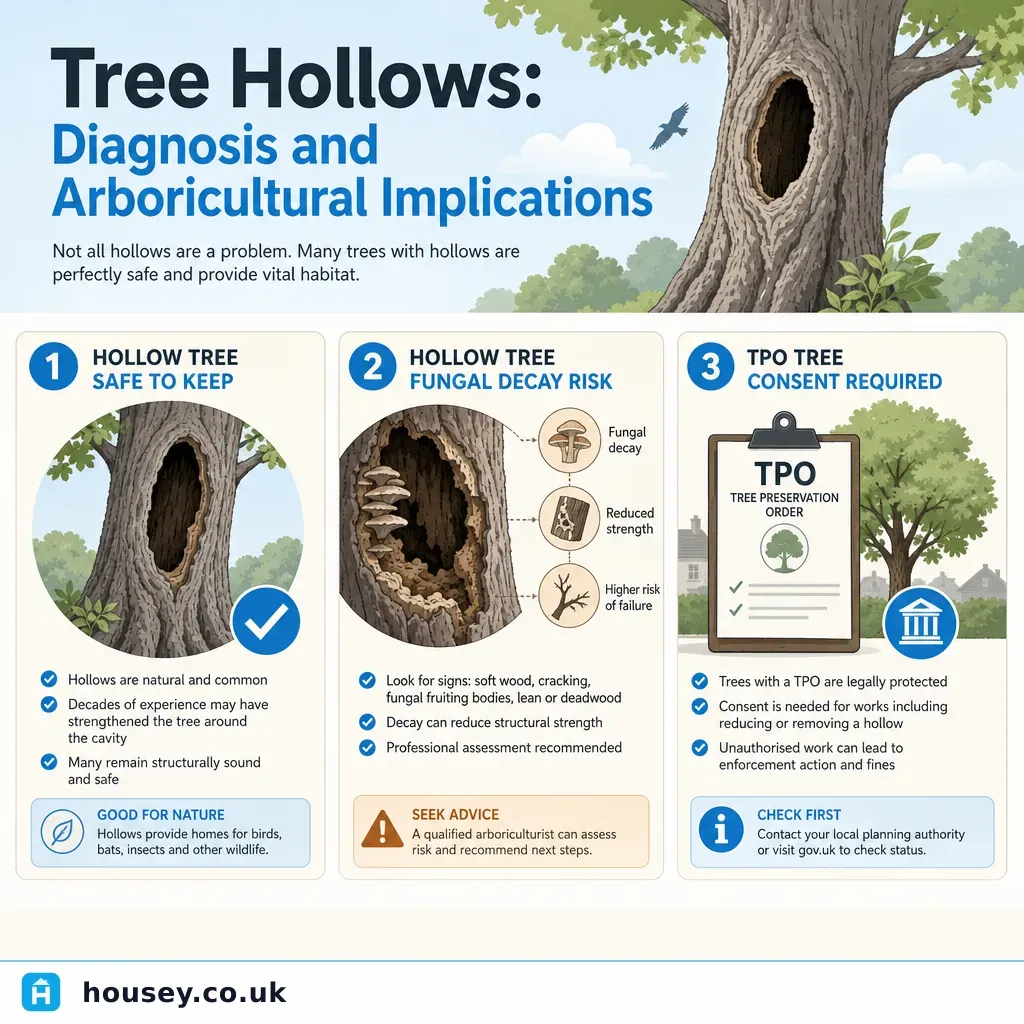
Tree Hollows: Diagnosis and Arboricultural Implications
A hollow in a tree trunk usually indicates internal fungal decay or bacterial wetwood, but does not automatically mean the tree is dangerous or should be felled.
 Improvement & Build
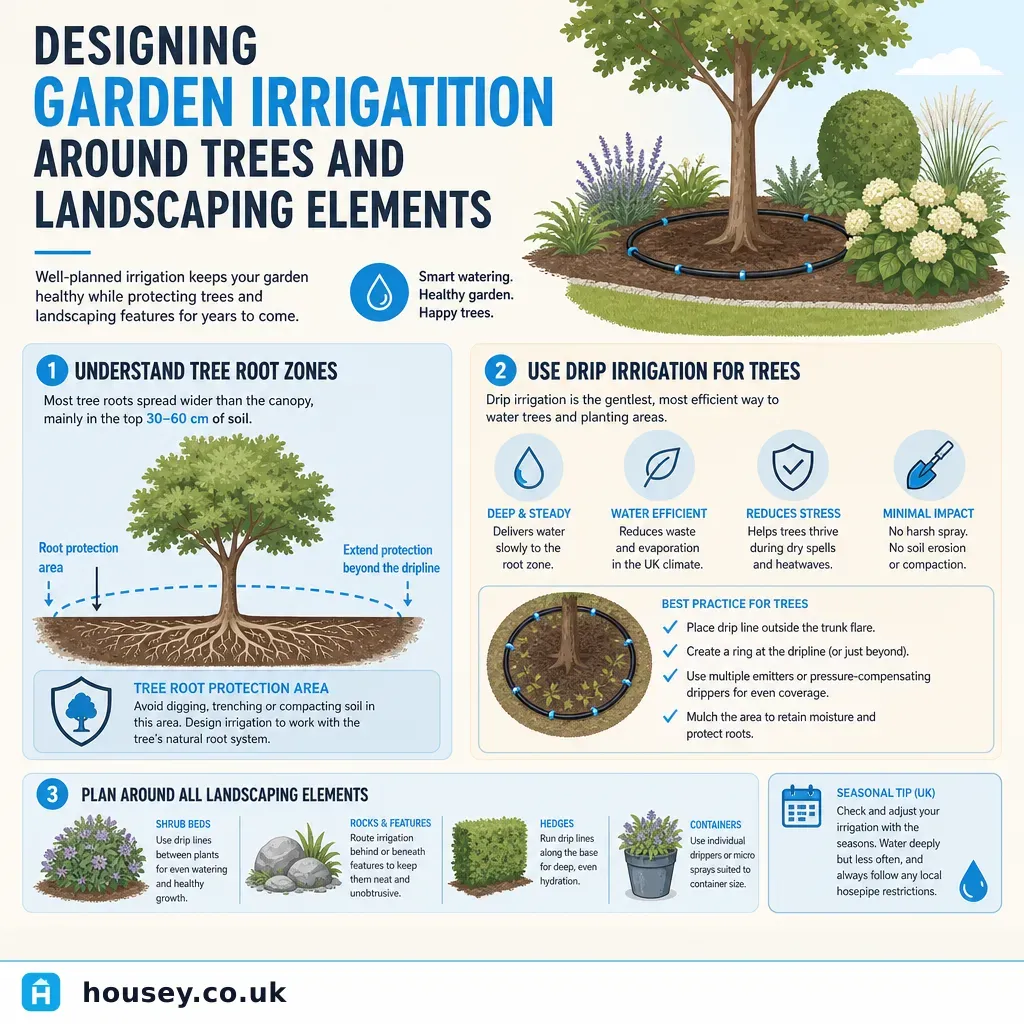
Designing Garden Irrigation Around Trees and Landscaping Elements
Design irrigation around trees by respecting the root protection area defined under BS 5837:2012, using drip or leaky pipe delivery rather than spray heads, and putting the tree zone on its own circuit.