What Causes Rising Damp and How Is It Identified?
By Housey · Last reviewed 11th of May 2026
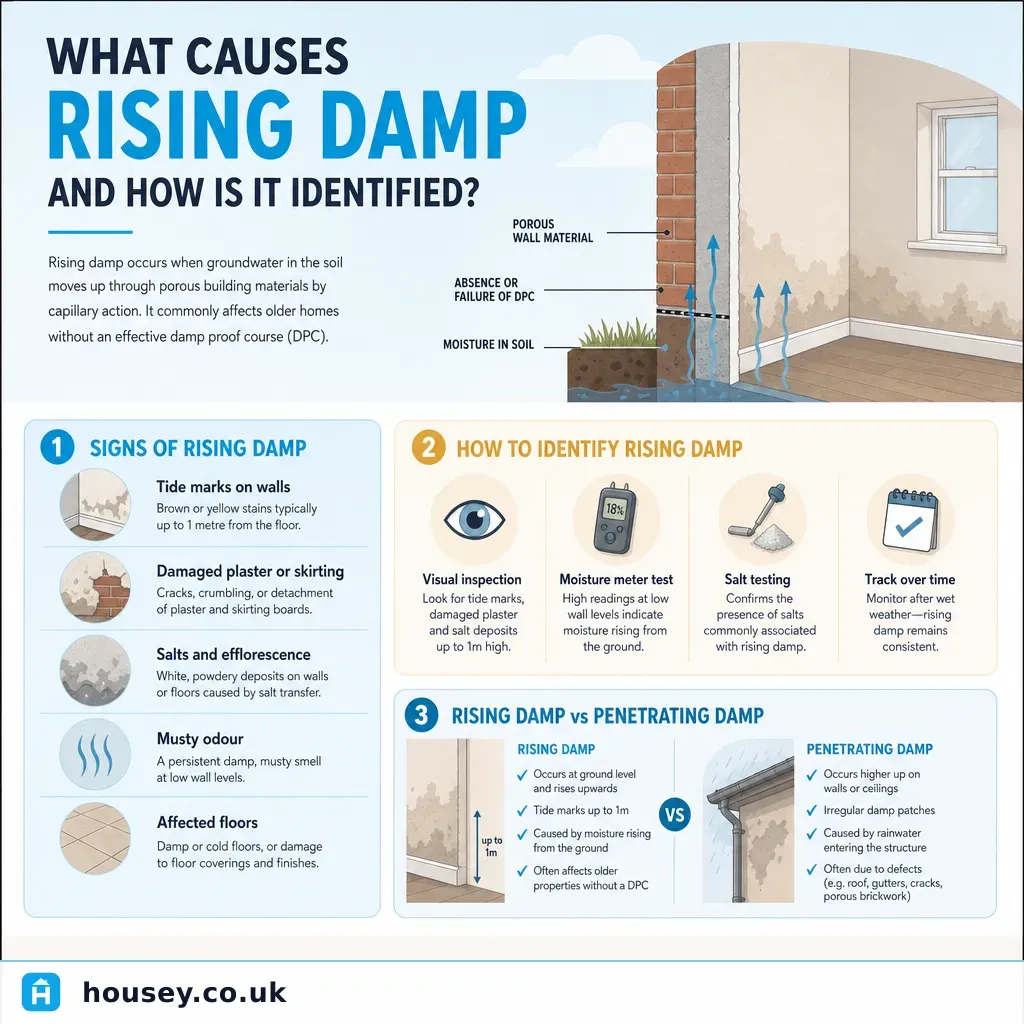
What Causes Rising Damp and How Is It Identified?
Rising damp is one of the most commonly misdiagnosed moisture problems in UK properties, and the cost of misidentifying it — either missing genuine rising damp or treating another moisture source as though it were rising damp — can run into thousands of pounds. The question typically arises during a property survey, after redecoration reveals persistent tide marks on lower ground-floor walls, or when a homeowner notices plaster deteriorating at skirting board level. Getting the diagnosis right matters because each damp type requires a fundamentally different remedy.
Key points
- Rising damp is caused by groundwater moving upward through masonry via capillary action, usually when the damp-proof course (DPC) has failed, is absent (common in properties built before the 1880s), or has been bridged by raised external ground levels or internal floor screeds.
- The characteristic tide mark appears at around 0.5–1 m above floor level; staining consistently higher than this is more likely to indicate penetrating damp or condensation.
- White crystalline deposits (efflorescence) on plasterwork are a hallmark of rising damp; the salts are left behind as moisture evaporates from the wall surface.
- A RICS-registered or PCA (Property Care Association)-qualified damp surveyor uses a calibrated moisture meter and, ideally, a carbide (speedy) moisture test on extracted wall samples — a surface-reading pin meter alone is insufficient for a reliable diagnosis.
- Left untreated, rising damp degrades lime and gypsum plaster, rots timber ground floors and skirting boards, and can cause long-term structural deterioration of masonry.
What actually causes rising damp?
Masonry materials — brick, stone, mortar — are porous, and groundwater will travel upward through them by capillary action unless a physical or chemical barrier is present. That barrier is the damp-proof course.
In properties built from around the 1880s onwards, a DPC was typically inserted as a layer of slate, lead, or (from the mid-20th century) bituminous felt or polythene at around 150 mm above external ground level. In older buildings — many Georgian terraces, Victorian workers' cottages, some rural stone properties — a DPC may never have been installed.
The main failure routes are:
- DPC absent or deteriorated — Slate DPCs eventually crack; bituminous felt can fail after decades of thermal movement. Very old properties may have no DPC at all.
- DPC bridged externally — Raised garden beds, tarmac resurfacing, or paving that covers the DPC level allows moisture to bypass the barrier. External render applied across the DPC line does the same.
- DPC bridged internally — Floor screeds, new internal insulation, or floor finishes built up above the DPC level create a moisture pathway that bypasses the waterproof layer.
- Cavity bridging — In cavity-wall properties, mortar droppings or debris in the cavity can bridge the two wall leaves and carry moisture to the inner leaf.
How rising damp is identified — and misidentified
Accurate diagnosis requires more than pointing a moisture meter at a wall. The table below summarises the key differences between rising damp, penetrating damp, and condensation — the three most common moisture problems in UK homes.
Characteristic | Rising damp | Penetrating damp | Condensation |
|---|---|---|---|
Typical location | Ground-floor internal walls, at base | Any wall or ceiling adjacent to external fabric | Cold surfaces: external corners, around windows, north-facing walls |
Tide mark height | Usually 0.5–1 m | No consistent tide mark | No tide mark |
Pattern | Horizontal band at wall base | Follows water ingress route; patchy or vertical | Diffuse patches; often fuzzy mould growth |
Salt staining | Yes — white efflorescence common | Unlikely (no ground salts) | None |
Seasonality | Less seasonal; often worse in wet periods | Follows rainfall and wind direction | Worst in cold months |
Common causes | Failed or bridged DPC | Defective pointing, cracked render, blocked gutters | Inadequate ventilation, poor insulation, lifestyle factors |
Diagnostic test | Carbide moisture test on drilled core samples | Trace source; inspect external fabric | Psychrometric or RH/temperature logging |
A surface-reading pin moisture meter registers high in damp masonry regardless of cause. Many disputed claims about extensive rising damp arise from over-reliance on such meters by contractors with a commercial interest in remediation.
What a damp and timber survey covers
A professional damp and timber survey typically includes:
- Visual inspection of internal and external ground levels relative to the DPC
- Calibrated moisture meter readings at set heights up the wall
- Carbide (speedy) test or calcium carbide pressure test on drilled wall samples where rising damp is suspected — this measures free moisture rather than absorbed salts
- Inspection of ground floor construction (solid vs suspended timber; screed levels)
- Assessment of roof, gutters, and external wall condition for penetrating damp sources
- Timber inspection for woodworm, wet rot, or dry rot
- A written report with diagnosis, recommended works, and indicative specification
Expect a standalone survey to take 2–4 hours for a typical semi-detached property. Reports should clearly distinguish between confirmed rising damp and suspected alternative causes.
Red flags that suggest rising damp needs urgent attention
- Visible tide marks with associated plaster damage at ground-floor wall base
- Skirting boards that sound hollow, feel soft, or have dark staining at their base
- Ground-floor suspended timber floor showing signs of movement or a persistent damp smell
- External ground level visibly above the DPC line or lowest visible brick courses
- White powdery salt deposits (efflorescence) on internal plaster at low level
- Newly applied plaster blistering within months of application on ground-floor walls
What not to assume
- Do not assume all ground-floor damp is rising damp. Condensation is far more common in UK housing stock, and an incorrect diagnosis leads to expensive remediation that does not solve the problem.
- Do not assume a chemical injection DPC alone will fix the problem. If the DPC is being bridged by raised external levels or an internal floor build-up, the bridge must also be removed.
- Do not assume rising damp means immediate structural danger. While long-term moisture causes masonry and timber degradation, a properly specified remedy normally resolves the issue before structural risk arises.
- Do not assume a surface damp-proof cream is equivalent to a chemical injection DPC. Surface treatments do not stop rising moisture from within the wall.
- Do not proceed with remediation based solely on a free survey tied to a remediation quote. The PCA and RICS both advise against this approach due to the obvious conflict of interest.
Important limitations
This article provides general educational information about rising damp, its causes, and how it is typically diagnosed. Rising damp shares symptoms with several other moisture problems, and misdiagnosis is common. The correct diagnosis and specification for any remediation works must be made by a qualified professional who has physically inspected the property. This guide does not constitute a survey, specialist report, or professional advice.
What to ask a qualified professional
Before commissioning a survey or remediation works, ask:
- Are you a member of the PCA or do you hold a RICS qualification? May I see your accreditation details?
- Will you carry out carbide tests or other quantitative moisture tests, rather than relying solely on a pin meter?
- Will the survey report clearly distinguish between rising damp, penetrating damp, and condensation?
- If rising damp is confirmed, will you provide a written specification for remediation, including the replastering specification and any external works required?
- Is this a paid-for independent survey, or a free survey that leads directly to a quote for remediation?
- What guarantee period applies to the remediation works, and is it backed by an insurance-backed warranty?
When to get professional help
Any of the following should prompt you to commission a professional damp and timber survey rather than relying on visual inspection alone:
- A home survey has flagged damp on a ground-floor wall prior to exchange of contracts
- Damp patches, tide marks, or salt staining appear on any ground-floor internal wall
- Skirting boards or ground-floor joists show signs of softness, rot, or unusual movement
- Your mortgage lender or insurer requires a specialist damp report before proceeding
- Remediation works have been carried out previously and moisture is returning
How Housey can help
Housey connects homeowners with qualified, accredited professionals for a damp and timber survey. Submit your details once and receive quotes from surveyors who will carry out a proper, independent diagnosis — not a free survey that doubles as a sales pitch.
Frequently asked questions
How high does rising damp typically travel?
Rising damp normally reaches 0.5 m to 1 m above floor level in standard brick or stone masonry, though this varies with wall material, salt content, and evaporation conditions. If dampness extends consistently above 1 m on an internal wall, the cause is more likely penetrating damp from a defect in the external fabric, or condensation, and a surveyor should investigate those possibilities first.
Can I treat rising damp myself?
Professional specification and installation is strongly recommended. Chemical injection DPC systems require professional-grade equipment to ensure correct depth, spacing, and fluid coverage; DIY products are available but results are inconsistent. New plaster must usually be salt-resistant and properly isolated from the wall surface. Treating symptoms such as repainting or applying surface sealants without addressing the underlying cause will not resolve the problem.
What is the difference between a chemical DPC and a physical DPC?
A physical DPC is a layer of impermeable material such as slate, lead, bituminous felt, or polythene, installed during original construction. A chemical DPC involves drilling holes at DPC level and injecting a silane or siliconate solution that lines masonry capillaries with a water-repellent coating. Chemical DPCs are the standard remedial approach in existing buildings. Both prevent capillary water movement when correctly installed, but neither eliminates the need to address any external or internal DPC bridge.
How much does rising damp remediation cost in the UK?
Indicative UK costs, last reviewed 2026-05-11. A professional damp and timber survey typically costs £200–£500. Remedial treatment for a single affected ground-floor wall — chemical DPC injection, salt-resistant replaster, and skirting board replacement — can range from £500 to £2,000 or more. Full-property remediation runs considerably higher. Obtain at least three written quotes from PCA-registered contractors.
Sources and further reading
- Housing health and safety rating system (HHSRS) guidance — GOV.UK / MHCLG
- Rising damp: causes and treatment — Property Care Association (PCA)
- BRE Good Repair Guide 6: Treating rising damp — Building Research Establishment (BRE)
- Surveying for dampness in buildings — RICS
- Dampness in buildings — Health and Safety Executive (HSE)
Useful next reads
 Surveys & Inspections
Identifying Asbestos Insulation: What You Need to Know for Your Property
Asbestos insulation was widely used in UK properties built before 2000, commonly found in pipe lagging, ceiling tiles, loose-fill loft insulation, and around boilers.
 Surveys & Inspections
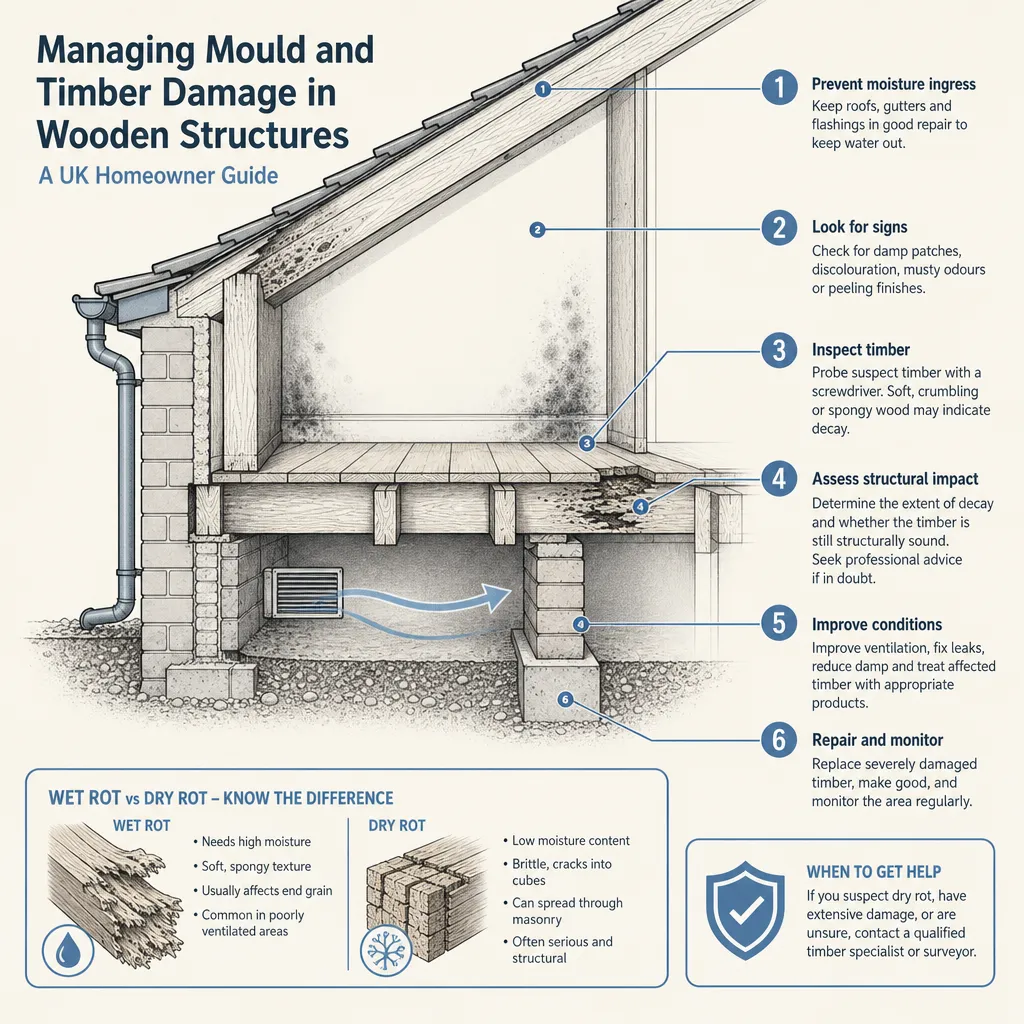
Managing Mould and Timber Damage in Wooden Structures
Mould and timber decay in wooden structures are usually symptoms of excess moisture rather than standalone problems.
 Surveys & Inspections
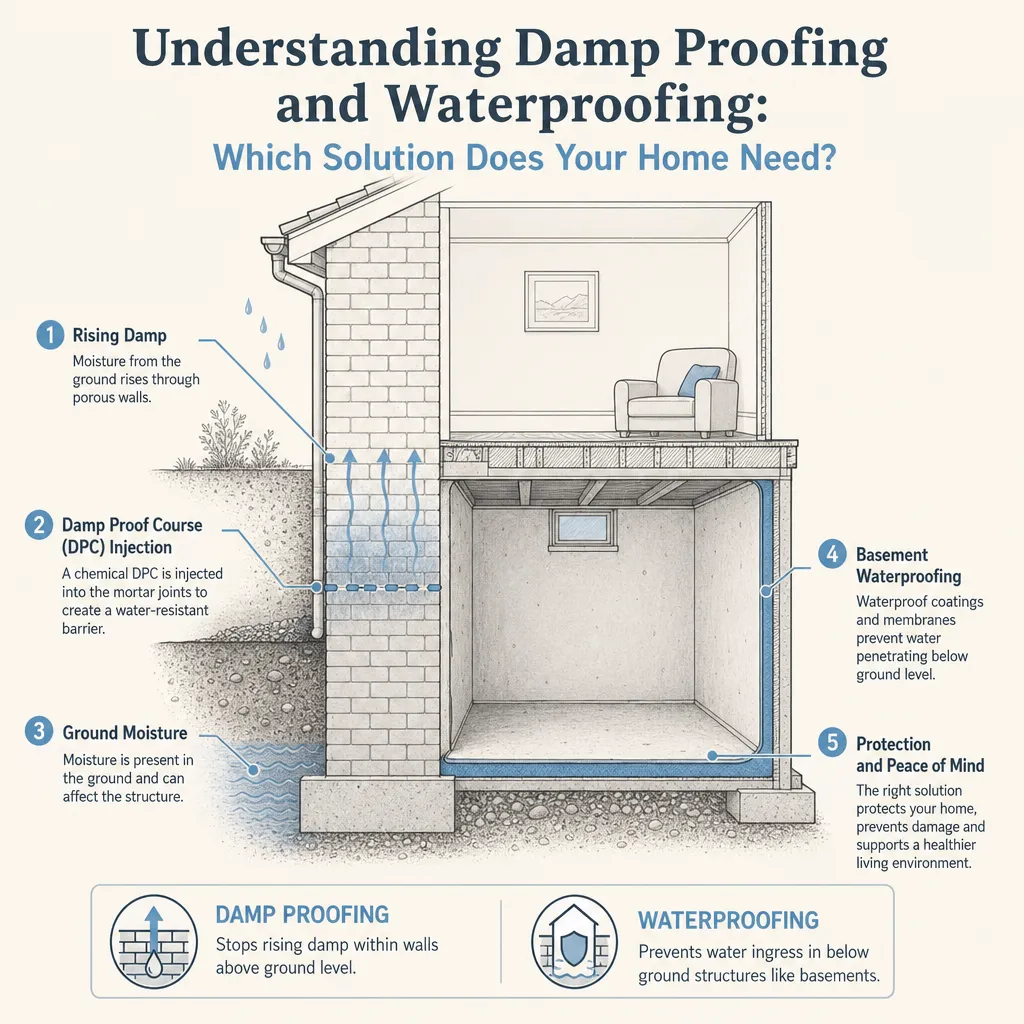
Understanding Damp Proofing and Waterproofing: Which Solution Does Your Home Need?
Damp proofing controls moisture movement through above-ground walls, while waterproofing excludes groundwater from below-ground structures.
 Surveys & Inspections
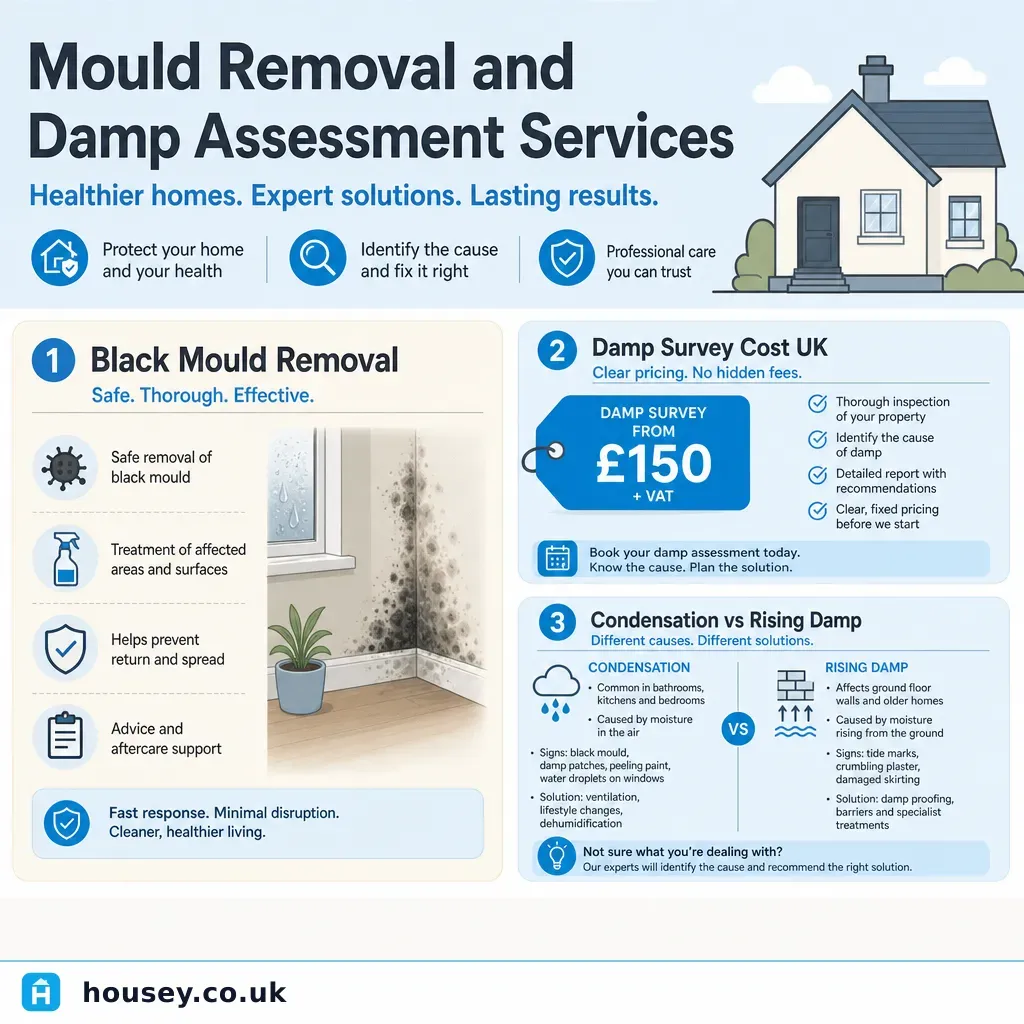
Mould Removal and Damp Assessment Services
Professional mould removal and damp assessment starts with identifying the moisture source—condensation, rising damp, or penetrating damp—before any treatment begins.
 Surveys & Inspections
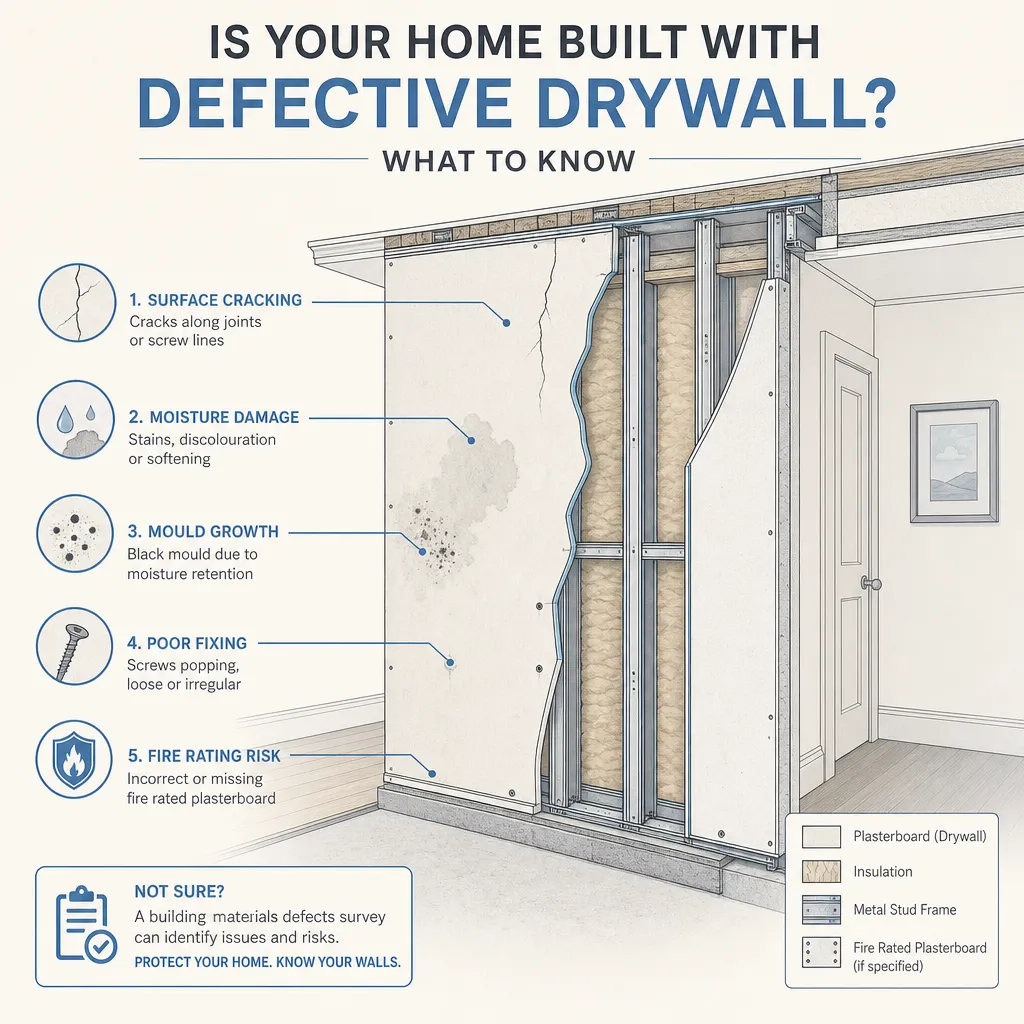
Is Your Home Built with Defective Drywall? What to Know
Contaminated Chinese drywall — as seen in US homes built 2001 to 2009 — is not a documented widespread problem in UK properties, where plasterboard is manufactured primarily to European standards.