Managing Overhanging Trees: Legal Rights, Responsibilities and Remedies
By Housey · Last reviewed 19th of May 2026
Managing Overhanging Trees: Legal Rights, Responsibilities and Remedies
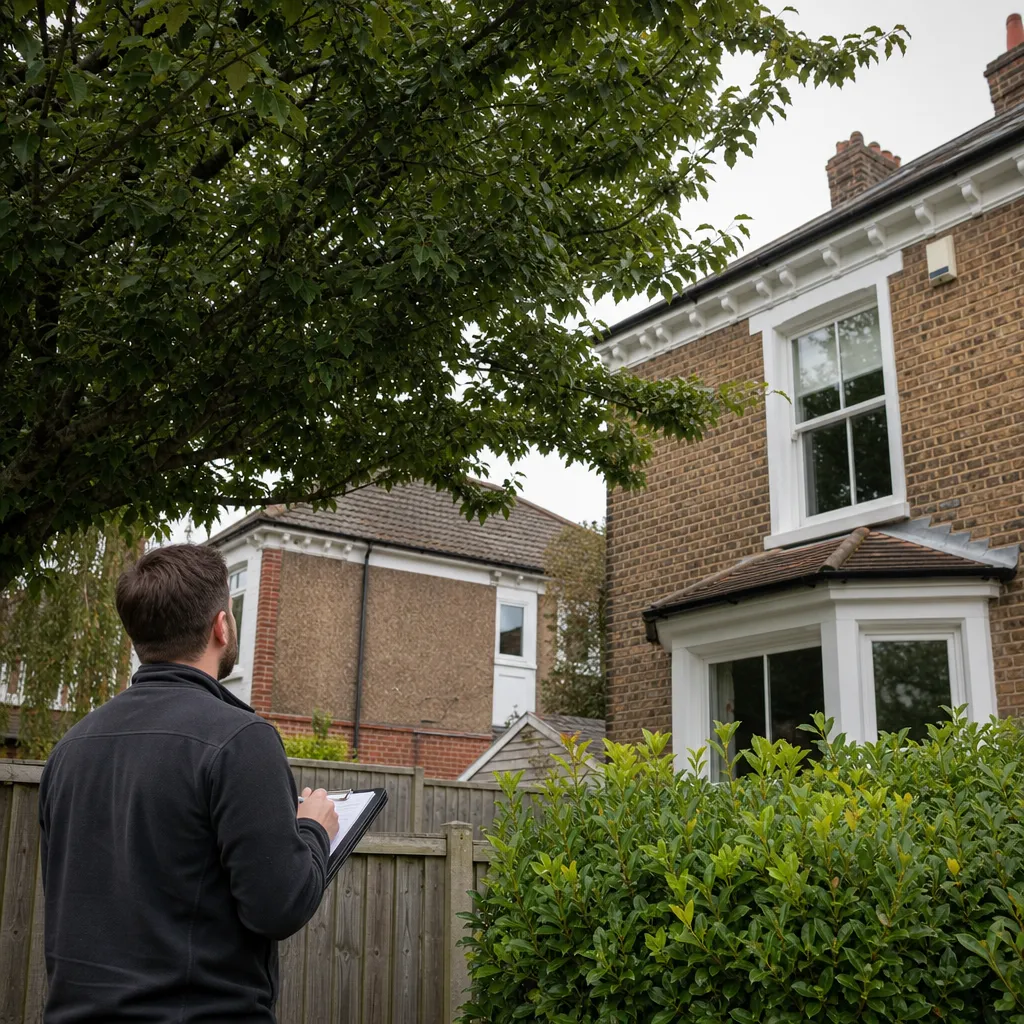
Overhanging tree branches are among the most common sources of neighbour disputes in the UK — and one of the most legally misunderstood. The interaction between common law nuisance rights, Tree Preservation Orders (TPOs), conservation area controls, and local authority powers creates a landscape where well-intentioned homeowners can inadvertently commit a criminal offence or permanently damage a valued neighbourly relationship. Whether the tree is yours or your neighbour's, understanding the legal position before you act — or before you demand that your neighbour acts — is essential.
Key points
- A tree legally belongs to the owner of the land in which it is rooted, regardless of how far its branches or roots extend across a boundary.
- You have a common law right to cut branches and roots that encroach onto your land back to the boundary line — but cuttings remain the tree owner's property and must be offered back.
- Trees subject to a Tree Preservation Order (TPO) require prior written consent from the local planning authority before any pruning or felling — a breach carries an unlimited fine on conviction.
- In a conservation area, any tree with a trunk diameter over 75mm at 1.5 metres above ground requires at least 6 weeks' written notice to the local planning authority (a Section 211 notice) before pruning or felling.
- The High Hedges provisions under Part 8 of the Anti-social Behaviour Act 2003 give councils power to intervene over hedges above 2 metres blocking light, but the process is formal, fee-bearing, and often slow.
Who owns the tree?
Ownership follows the land. A tree rooted in your neighbour's garden is their tree — even if the canopy extends several metres over your boundary. Where a trunk sits on or straddles the boundary itself, both landowners share ownership and joint responsibility for maintenance. Establishing the precise boundary position may require a formal review of title deeds, Land Registry filed plans, and physical features.
This matters because:
- Only the tree owner (or the local planning authority for a TPO tree) can authorise significant pruning or felling.
- Liability for damage caused by a falling branch typically rests with the owner if they were aware — or ought to have been aware — that the tree posed a risk and failed to act.
- Work to a tree on or straddling a shared boundary requires the agreement of both landowners.
Your right to cut back: what the law actually says
The common law doctrine of abatement gives you the right to cut back branches and roots that cross your boundary — but within clear limits:
- You may cut only back to the boundary line. You cannot lean over the fence or cut on the neighbour's side.
- Cuttings — including fruit, seeds, or timber — remain the legal property of the tree owner and must be offered back. You cannot keep, sell, or dispose of them without consent.
- You do not need the neighbour's permission to exercise this right, but notifying them in advance avoids disputes about what was cut and allows them to arrange their own contractor if preferred.
- If the tree has a TPO or is in a conservation area, this right is heavily constrained. Statutory protection overrides the common law abatement right.
There is generally no legal obligation on a tree owner to prune a tree simply because it overhangs your property, sheds leaves, or reduces sunlight. A duty to act arises only when the tree is causing or is imminently likely to cause actionable damage or nuisance.
Tree Preservation Orders and conservation areas
These two statutory regimes are the most commonly overlooked constraints — and the ones most likely to result in criminal liability.
Tree Preservation Orders (TPOs)
A TPO is made by the local planning authority to protect trees of amenity value. It can apply to a single tree, a group, an area, or a woodland.
- If a tree has a TPO, no pruning, felling, or root severing may take place without prior written consent from the local planning authority — even by the tree's own owner, even where branches overhang a neighbour's land.
- Applications for TPO consent typically take up to 8 weeks to determine.
- Carrying out work without consent is a criminal offence with an unlimited fine on conviction in the magistrates' court.
- Check for TPOs by contacting your local planning authority or searching the council's online planning portal — many publish interactive TPO maps.
- An emergency exception exists for trees posing an immediate risk to life or property, but the threshold is high. Document the danger thoroughly and notify the local planning authority immediately after any emergency work.
Conservation areas
In a designated conservation area, any tree with a trunk diameter exceeding 75mm measured at 1.5 metres above ground is subject to statutory protection:
- Give the local planning authority at least 6 weeks' written notice (a Section 211 notice under the Town and Country Planning Act 1990) before pruning or felling.
- The council may make a TPO within those 6 weeks; if it does not, you may proceed with the notified work.
- Exceptions apply only for dead, dying, or imminently dangerous trees.
- Failure to give notice is a criminal offence.
What to do when overhanging branches cause damage
If a neighbour's tree damages your property — guttering, roofing, a boundary wall, or hard landscaping — you may have a claim in private nuisance or negligence. Key questions are:
- Was the tree owner on notice of the risk? Written correspondence to the neighbour (and ideally to their insurer) establishes awareness of the danger.
- Was the damage reasonably foreseeable? A visibly diseased tree with fungal brackets at its base is treated differently from a healthy tree felled by an exceptional storm.
- Did you take reasonable steps to mitigate? Courts and insurers expect affected owners to act reasonably to limit loss.
Practical steps:
- Write to your neighbour — by letter or email — describing the issue and the risk. Keep a copy.
- Photograph the tree's condition, the encroachment, and any damage caused.
- Contact the local authority's tree officer if the tree is dangerous or may be TPO-protected.
- Commission an arboricultural report to establish the tree's condition and risk profile — this evidential record is often decisive in any subsequent dispute.
Which professional do you need?
Situation | Professional to instruct |
|---|---|
Unsure whether a tree has a TPO or is in a conservation area | Contact the local planning authority first; an arboricultural consultant can then advise formally |
Overhanging branches or roots causing active damage | Arboricultural consultant — assesses condition, risk, and remedial options |
Boundary ownership unclear — which side is the tree on? | Boundary surveyor — reviews title deeds, OS mapping, and physical evidence |
Neighbour dispute escalating toward formal legal proceedings | Specialist property solicitor |
Tree work required on or near a shared boundary | Arboricultural contractor plus boundary surveyor to agree the line before work begins |
Shared boundary wall or structure involved | Party wall surveyor — advises on obligations under the Party Wall etc. Act 1996 |
What not to assume
- "It overhangs my land, so I can do what I like with it." Your right extends only to cutting back to the boundary line. TPO or conservation area protection overrides the common law abatement right entirely.
- "My neighbour must cut it back because I asked." There is no general legal duty to prune a tree that merely overhangs a boundary or sheds leaves. A duty arises only when actionable damage is occurring or is genuinely imminent.
- "Fruit that falls in my garden is mine to keep." Under common law, fallen fruit from a neighbour's tree remains their property. Most neighbours agree informally, but there is no automatic right.
- "The council will force my neighbour to act." Councils have powers, not duties, in most tree disputes. Enforcement is discretionary, High Hedge complaints take months, and outcomes are not guaranteed.
- "The emergency exception means I can cut a dangerous tree immediately without any notice." The exception is narrow — it applies only to genuine imminence of harm. Act only to remove the immediate risk, document everything carefully, and notify the local planning authority promptly.
Important limitations
This article provides general information about tree law in England and Wales. The law in Scotland and Northern Ireland differs in certain respects. Tree Preservation Order status, conservation area boundaries, boundary positions, and ownership questions all depend on specific property and local authority facts that this guide cannot resolve. Nothing here constitutes legal advice. Where a dispute involves significant financial risk, potential criminal liability, or structural damage to a building, seek advice from a qualified professional — an arboricultural consultant, boundary surveyor, or specialist property solicitor as the situation requires.
When this becomes urgent
Seek professional advice without delay if:
- A tree is visibly leaning toward a structure, shows significant canopy dieback, has fungal brackets at its base, or has a cracked or split main stem — these are potential safety emergencies requiring urgent arboricultural inspection.
- Crack patterns appear in walls or hard surfaces running along the line of a neighbouring tree's roots — this may indicate root heave or clay shrinkage subsidence, requiring a structural engineer and arboricultural assessment.
- Your neighbour has carried out or is about to carry out significant work on a tree you believe is TPO-protected — contact the local planning authority's tree officer immediately.
- A dispute is approaching formal legal proceedings — written communications become evidence, and you should take legal advice before writing further.
What to ask a qualified professional
Before instructing an arboricultural consultant:
- Have you confirmed whether this tree has a TPO or is within a conservation area, and reviewed the local planning authority's records?
- What is your assessment of the tree's current condition and structural integrity?
- What remedial options are available — crown reduction, selective pruning, removal — and which require prior LPA consent?
- Can you produce a written report suitable for use in a dispute, insurance claim, or legal proceedings?
- Are you a member of the Arboricultural Association or another recognised professional body?
Before instructing a boundary surveyor:
- Will you review all relevant title deeds, Land Registry filed plans, and Ordnance Survey mapping?
- Can you prepare a formal boundary determination report for use in dispute resolution or legal proceedings?
- Have you dealt with boundary disputes involving trees or shared vegetation before?
When to get professional help
Tree disputes combine property law, planning law, and specialist arboricultural knowledge in ways that are difficult to navigate reliably without professional support. Always seek qualified advice if the tree has or may have a Tree Preservation Order, the property is in a conservation area, the boundary position is unclear, structural damage is occurring, or the dispute with your neighbour is becoming adversarial.
An arboricultural survey will establish the species, condition, and risk profile of the tree and is often the single most useful piece of evidence in any dispute or planning consent application. If the boundary line is genuinely uncertain, a boundary surveyor can review title deeds, Ordnance Survey data, and physical features to prepare a formal determination. Where a shared boundary wall or structure is involved, a party wall surveyor can advise on obligations under the Party Wall etc. Act 1996.
How Housey can help
Housey connects homeowners with qualified arboricultural survey specialists, boundary surveyors, and party wall surveyors across the UK. Submit your details once and receive quotes from local professionals with relevant experience — so you can resolve a tree or boundary dispute on the basis of clear evidence rather than assumption.
Frequently asked questions
Can I cut down a tree that overhangs my garden?
No. Your common law right extends only to cutting back branches and roots to the boundary line. Cutting, felling, or removing the tree — or cutting on the neighbour's side of the boundary — is trespass or criminal damage. If the tree has a Tree Preservation Order, even trimming back to the boundary may require local planning authority consent before you act.
Do I need to tell my neighbour before trimming overhanging branches?
Not legally — the common law right of abatement does not require prior notice. In practice, notifying your neighbour in writing before work begins avoids disputes about what was cut and gives them the option of arranging their own contractor for the work, which is often preferable. It also maintains the neighbourly relationship throughout the process.
Who pays if a neighbour's tree falls on my house?
Liability depends on whether the tree owner knew or ought to have known the tree was dangerous. Written notification to your neighbour about the tree's condition strengthens any future claim. Your home insurer should cover the immediate damage; recovering costs from the neighbour is a separate matter and will likely require specialist legal advice.
How do I find out if a tree has a Tree Preservation Order?
Contact your local planning authority's planning department or check their online planning portal — many councils publish interactive TPO maps. You can also submit a written enquiry and the council must respond. Your solicitor or conveyancer should check for TPOs as part of local authority searches when you purchase a property, so check your existing search documents if available.
What is a High Hedge complaint and how does it work?
Under Part 8 of the Anti-social Behaviour Act 2003, if an evergreen or semi-evergreen hedge over 2 metres is adversely affecting your enjoyment of your property, you can complain to the local council — but only after genuine attempts to resolve the matter directly. Councils charge a fee (variable by authority) and may issue a remedial notice requiring reduction. The process typically takes several months.
Sources and further reading
- Tree Preservation Orders and trees in conservation areas — GOV.UK
- Anti-social Behaviour Act 2003, Part 8 — High Hedges — legislation.gov.uk
- Town and Country Planning Act 1990, Section 211 — legislation.gov.uk
- Party Wall etc. Act 1996 — legislation.gov.uk
- Trees and hedges: your rights — Citizens Advice
- Arboricultural Association: find a consultant — Arboricultural Association
Useful next reads
 Planning & Pre-Build
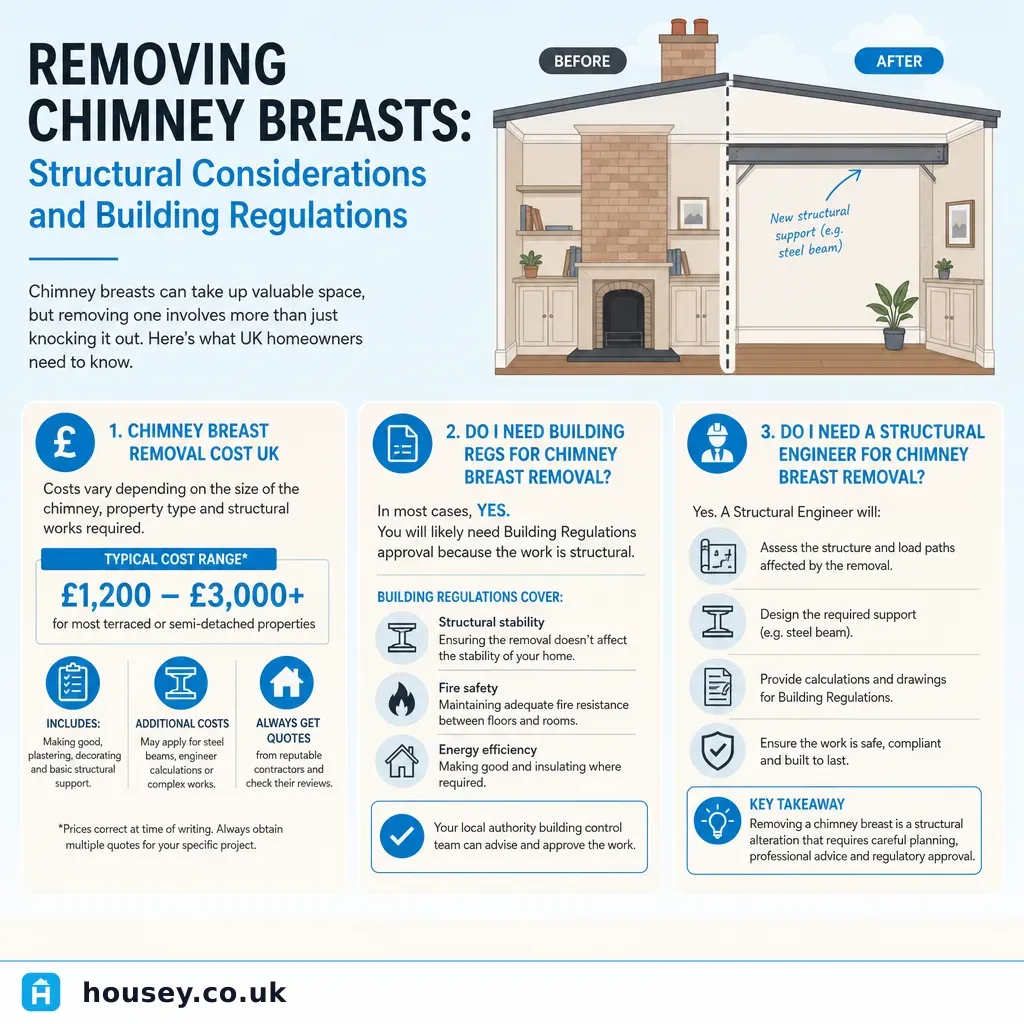
Removing Chimney Breasts: Structural Considerations and Building Regulations
Removing a chimney breast in England and Wales almost always requires building regulations approval because it is structural work.
 Planning & Pre-Build
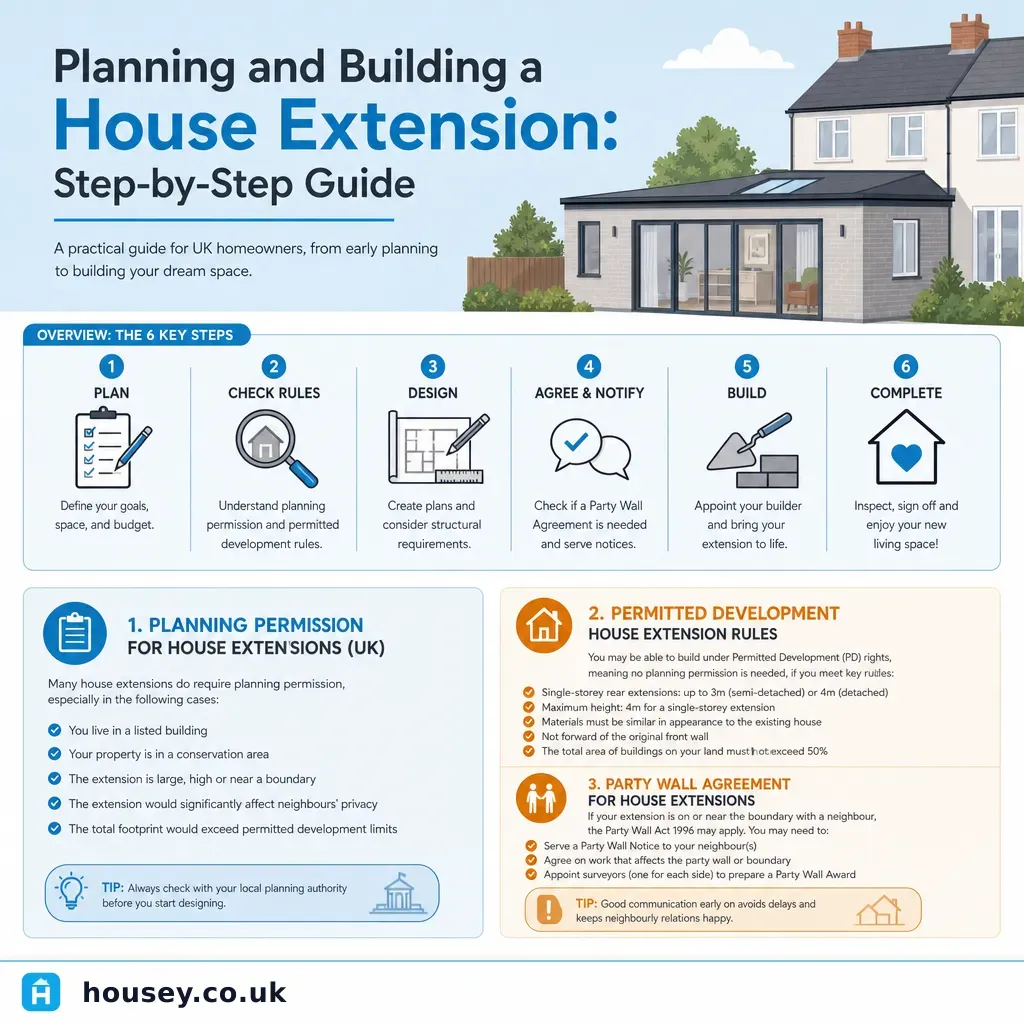
Planning and Building a House Extension: Step-by-Step Guide
A house extension in the UK usually requires either planning permission or confirmation of permitted development rights, Building Regulations approval, and — where work affects a shared wall or boundary — compliance with the Party Wall etc.
 Planning & Pre-Build
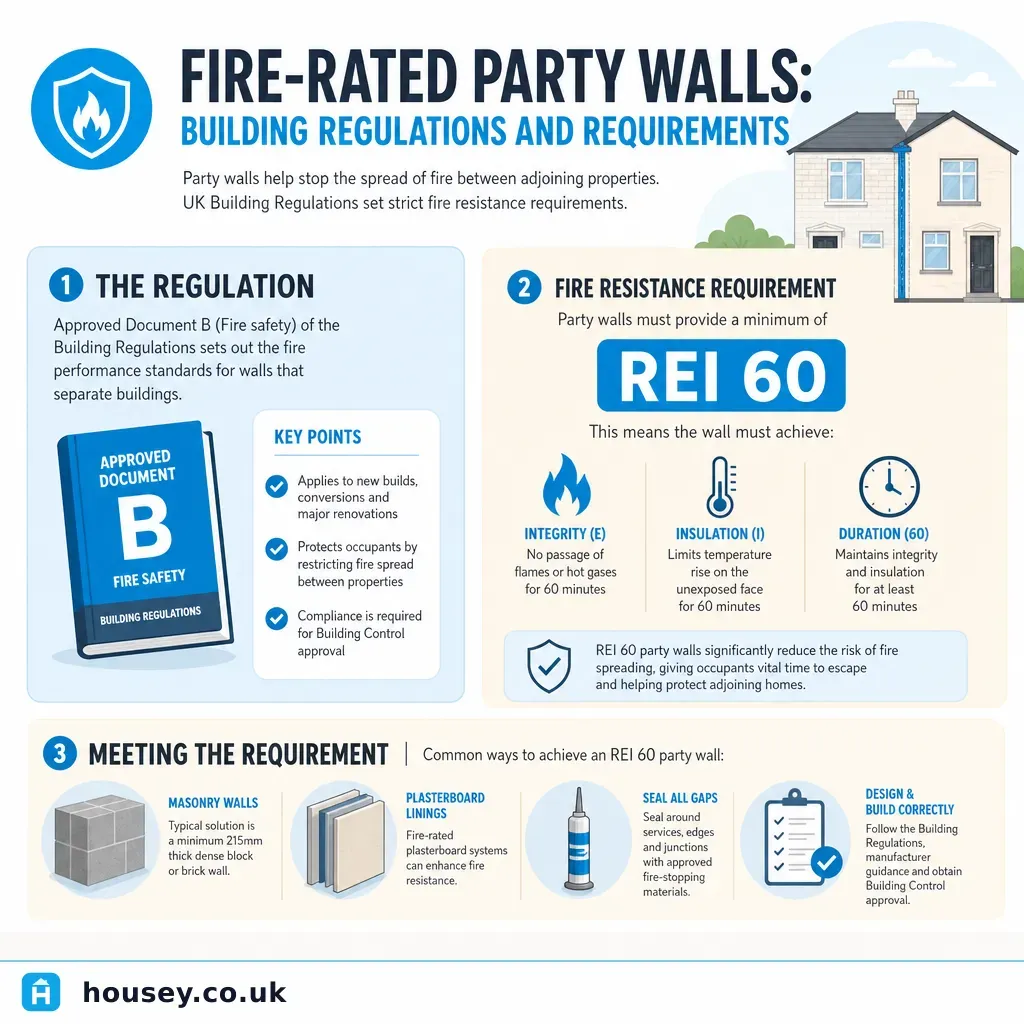
Fire-Rated Party Walls: Building Regulations and Requirements
Party walls between dwellings must achieve at least 60 minutes' fire resistance, expressed as REI 60, under Building Regulations Approved Document B.
 Planning & Pre-Build
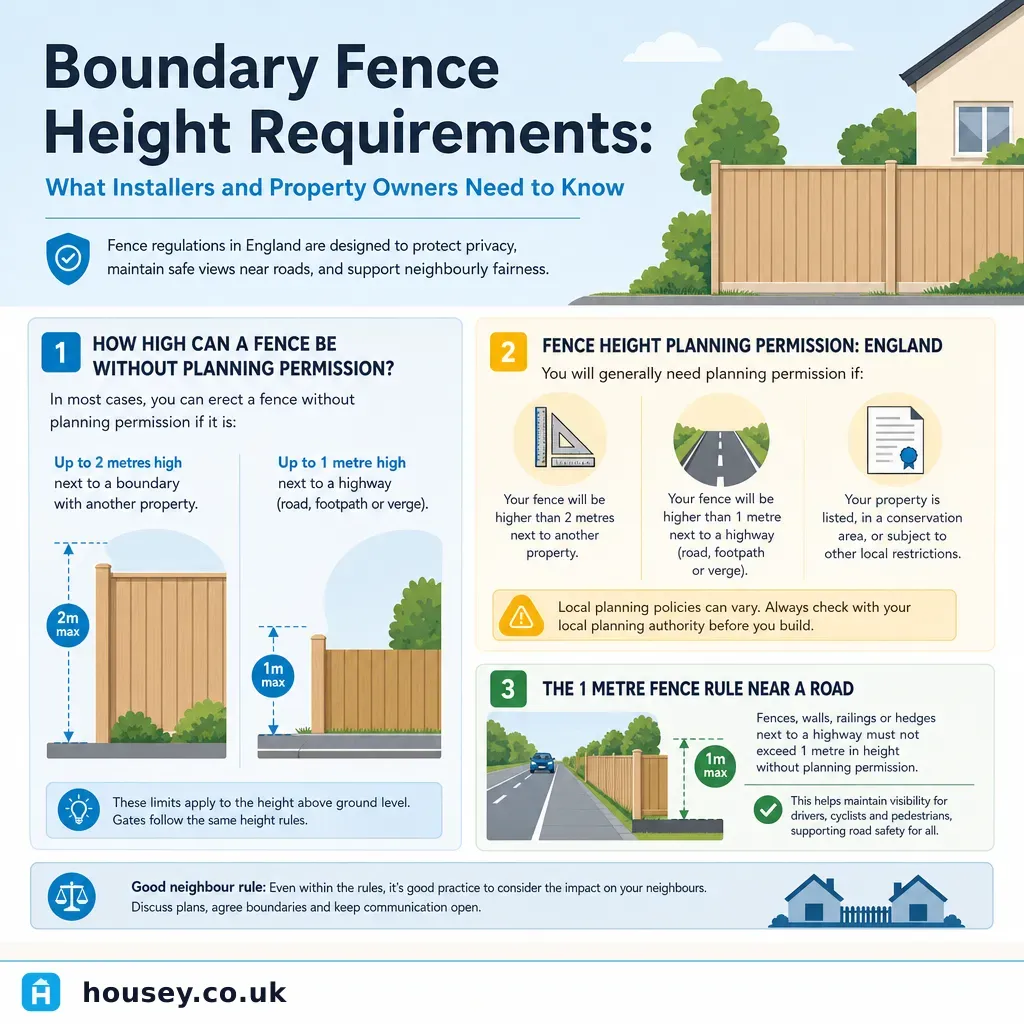
Boundary Fence Height Requirements: What Installers and Property Owners Need to Know
In England, a fence can be up to 2 metres high without planning permission, reducing to 1 metre when adjacent to a highway used by vehicles.
 Planning & Pre-Build
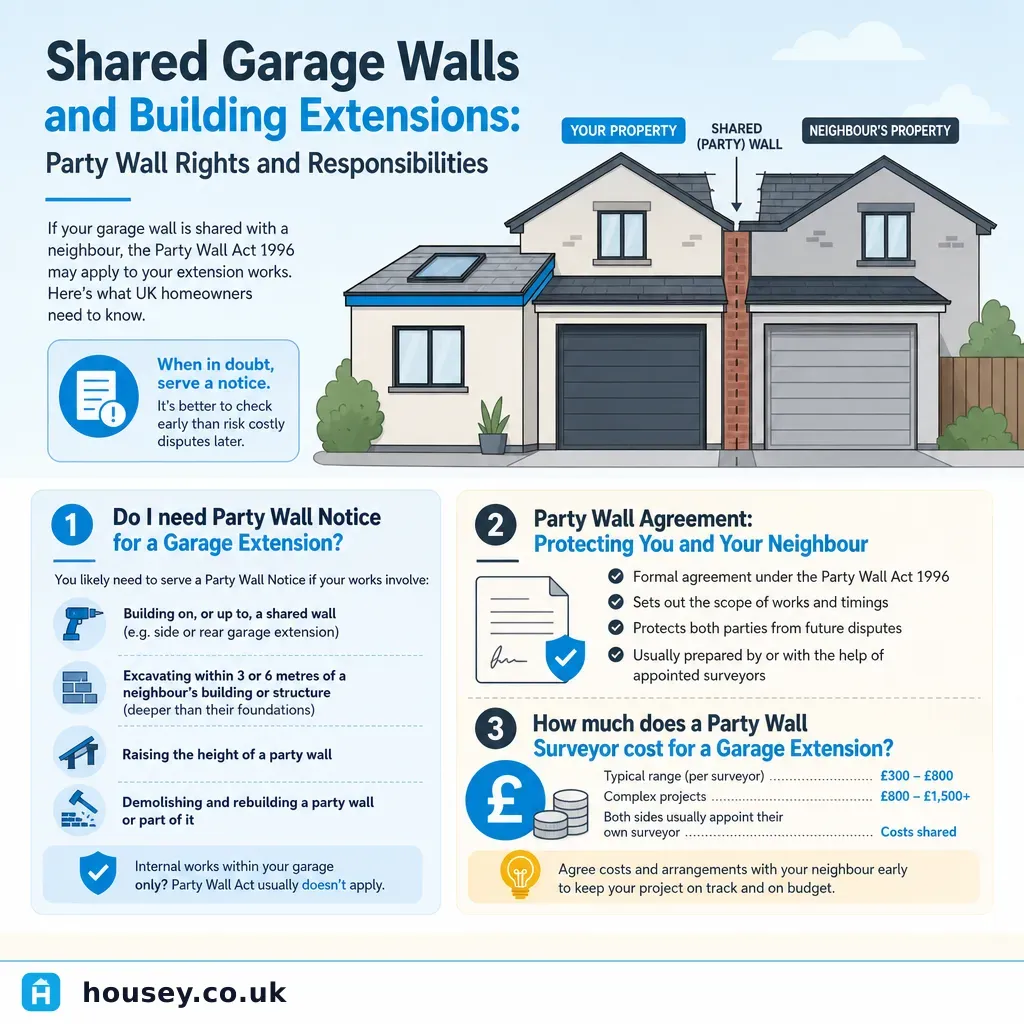
Shared Garage Walls and Building Extensions: Party Wall Rights and Responsibilities
A shared garage wall often qualifies as a party wall under the Party Wall etc.