Managing Provider Reviews: A Guide for Building Strong Relationships
By Housey · Last reviewed 24th of May 2026
Managing Provider Reviews: A Guide for Building Strong Relationships
Choosing a builder, roofer, or any contractor for home improvement work is rarely straightforward. Reviews have become one of the primary tools UK homeowners use to filter out unreliable providers — yet the way reviews work varies significantly between platforms, and not every five-star rating tells the full story. Whether you are planning an extension, a loft conversion, or a new driveway, understanding how to read and use reviews critically can save you from a costly mistake.
Key points
- The Competition and Markets Authority (CMA), under the Digital Markets, Competition and Consumers Act 2024, can take enforcement action against businesses that commission, publish, or fail to remove fake reviews.
- Checkatrade, Which? Trusted Traders, and TrustMark all verify that submitted reviews relate to actual completed work, giving them a higher baseline of reliability than unverified platforms.
- A provider's response to negative reviews is often more revealing than the negative review itself — calm, constructive replies indicate professionalism.
- Reviews older than 24 months may not reflect a contractor's current workmanship, staffing, or pricing practices.
- For projects costing more than £5,000, cross-referencing at least two independent review sources reduces the risk of acting on a manipulated sample.
How UK review platforms work — and what they verify
Not all review platforms operate the same way. Some allow anyone to post without verification; others contact reviewers to confirm a job took place before publishing feedback. The table below summarises the main platforms UK homeowners encounter when vetting tradespeople:
Platform | Verification level | Who can post | Notes |
|---|---|---|---|
Checkatrade | High — reviewer contact verification | Customers of listed tradespeople | Tradespeople pay to be listed; listing includes background and insurance checks |
Which? Trusted Traders | High — assessed businesses only | Customers of approved traders | Traders undergo independent vetting and endorsement before listing |
TrustMark | High — government-endorsed scheme | Customers of registered businesses | Government-backed; particularly relevant for energy efficiency and retrofit work |
Google Reviews | Low — Google account required | Anyone | No job-completion verification; useful for spotting volume and overall patterns |
Trustpilot | Medium — email verification available | Anyone (invited or open) | Businesses can invite customers; has a flagging system for suspicious reviews |
MyBuilder | Medium | Customers who received quotes | Reviews linked to job records on the platform |
When reviewing this table, look for platforms that require evidence the work was completed. A business with 200 Google reviews and 15 Checkatrade reviews may be genuinely well-regarded — or may have a concentrated, unverified Google presence that warrants closer inspection.
Reading between the lines: what reviews really signal
The overall star rating is the least useful number on a review page. What reveals more:
Volume and recency. A contractor with 8 reviews over 5 years carries far less weight than one with 35 reviews in the past 18 months. Consistent, recent feedback suggests a stable, active business.
Specificity. Reviews that name the job type ("replaced our flat roof in January", "built a two-storey extension in Cardiff") are far more useful than generic praise. Specific reviews are harder to fabricate and easier to assess against your own project needs.
Complaint handling. Scroll to the one- and two-star reviews. How does the contractor respond? A dismissive or aggressive reply is a red flag regardless of how good the rest of the reviews are. A measured, solution-focused response — even to an unfair complaint — signals a business that takes its reputation seriously.
Patterns of criticism. A single complaint about punctuality may be an outlier. Three complaints about the same issue within 12 months is a pattern worth noting before signing any contract.
Red flags in contractor reviews
The following signals should prompt you to look more carefully or seek an alternative provider:
- All reviews posted within a short window. A cluster of five-star reviews appearing in the same week may indicate a coordinated effort to boost a profile.
- No negative reviews whatsoever over many years. A genuine, active contractor will occasionally receive a critical review. A perfect score with high volume is statistically unusual.
- Reviews using identical or very similar phrasing. Natural reviews vary in tone, length, and vocabulary. Templated-sounding wording warrants scepticism.
- The business cannot name the reviewer or recall the job. When you ask about a specific review, a contractor should be able to broadly recall the project.
- Reviews appear on only one platform. A provider with a strong profile on a single platform but nothing verifiable elsewhere may have concentrated their presence artificially.
If you suspect a business has fake reviews, you can report concerns to the CMA or your local Trading Standards office.
What to ask a contractor about their reviews
Before committing to a contractor, use these questions to get beyond the star rating:
- Can you provide contact details for two or three previous customers I can speak to directly?
- Which review platform do you consider most representative of your work, and why?
- How do you handle situations where a customer is unhappy with the finished work?
- Have you had any formal complaints through a trade association or consumer scheme in the past three years?
- Are you a member of a recognised trade body or scheme — such as the Federation of Master Builders (FMB), National Federation of Roofing Contractors (NFRC), or NICEIC — that has its own complaints procedure?
These questions are not adversarial. A reputable contractor expects and welcomes them; a contractor who becomes defensive or evasive is worth noting.
When to get professional help
For most improvement projects, reading reviews critically is a skill you can develop yourself. Consider involving an independent professional if:
- You are commissioning high-value structural work — extensions, loft conversions, or underpinning — and cannot independently verify a contractor's track record.
- References all appear to be friends or family rather than genuine customers.
- You have already experienced problems and need independent assessment of the quality of work completed.
- A dispute has arisen and you need an independent report to support a complaint to Trading Standards or a trade association.
In such cases, a building surveyor or clerk of works can provide independent oversight of a project and its outputs.
How Housey can help
Housey connects homeowners with reviewed, vetted tradespeople across the UK. When you submit a job request, matched providers — including extension builders, roofers, and loft conversion companies — can submit competitive quotes. All providers on Housey carry reviews from completed jobs, making it easier to compare quality and track record alongside price.
Frequently asked questions
Are Checkatrade reviews verified?
Checkatrade verifies reviews by contacting the reviewer to confirm the work took place before publishing feedback. This makes it more reliable than open platforms where anyone can post. Tradespeople listed on Checkatrade also undergo background checks and insurance verification. No system is entirely fraud-proof, so cross-referencing with a second platform adds further confidence.
Can a contractor legally ask me to remove a negative review?
A contractor can ask you to reconsider a review, but under CMA guidance and the Digital Markets, Competition and Consumers Act 2024, a business cannot threaten legal action, withhold payment, or apply undue pressure to remove a genuine, honest review. If you feel pressured, report it to the platform and contact Citizens Advice or Trading Standards.
How many reviews should I look for before hiring?
There is no fixed minimum, but a pattern of 10 or more verified reviews over the past 12 to 18 months provides a more reliable picture than a handful of older ratings. For major projects such as extensions or loft conversions, look specifically for reviews mentioning your type of work rather than relying on an overall star rating.
Sources and further reading
- Competition and Markets Authority — online reviews guidance — Competition and Markets Authority
- TrustMark — government-endorsed quality scheme — TrustMark
- Which? Trusted Traders — how the scheme works — Which?
- Citizens Advice — problems with a trader — Citizens Advice
Useful next reads
 Improvement & Build
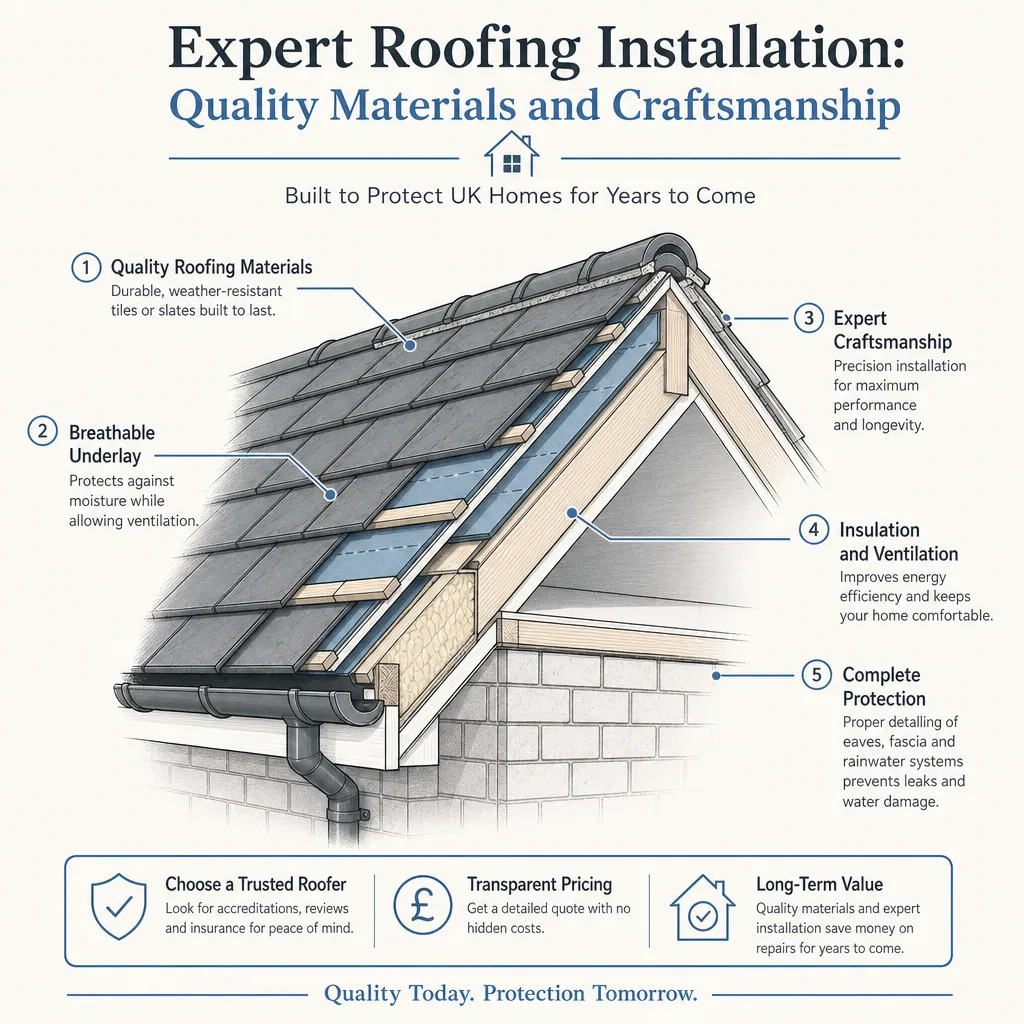
Expert Roofing Installation: Quality Materials and Craftsmanship
A quality roof installation depends on matching materials to your property type, hiring a suitably qualified roofer, and ensuring building regulations are met where required.
 Improvement & Build
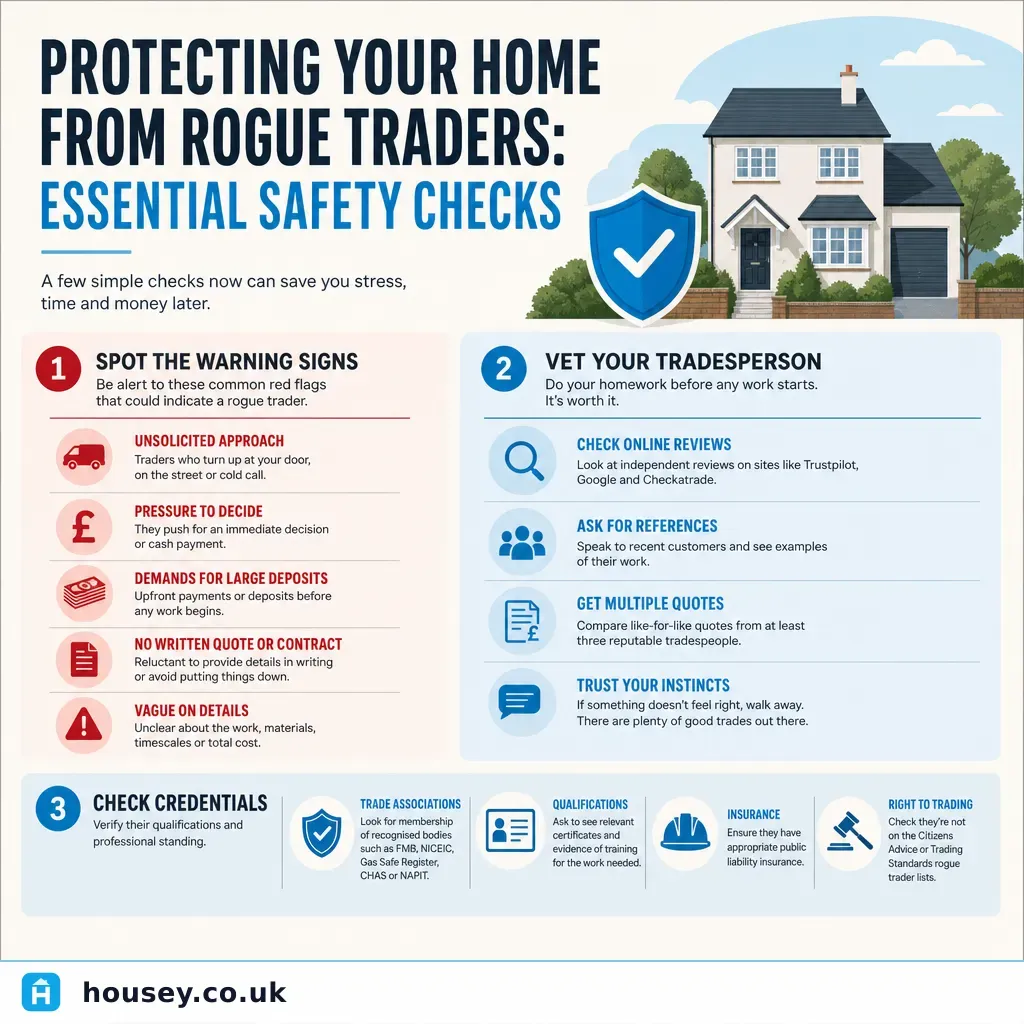
Protecting Your Home from Rogue Traders: Essential Safety Checks
Protect your home from rogue traders by verifying credentials before work starts: check for a trading address and company number, ask for references from recent local jobs, confirm any required scheme membership (Gas Safe, NICEIC, FENSA), and never pay cash in full upfront.
 Improvement & Build
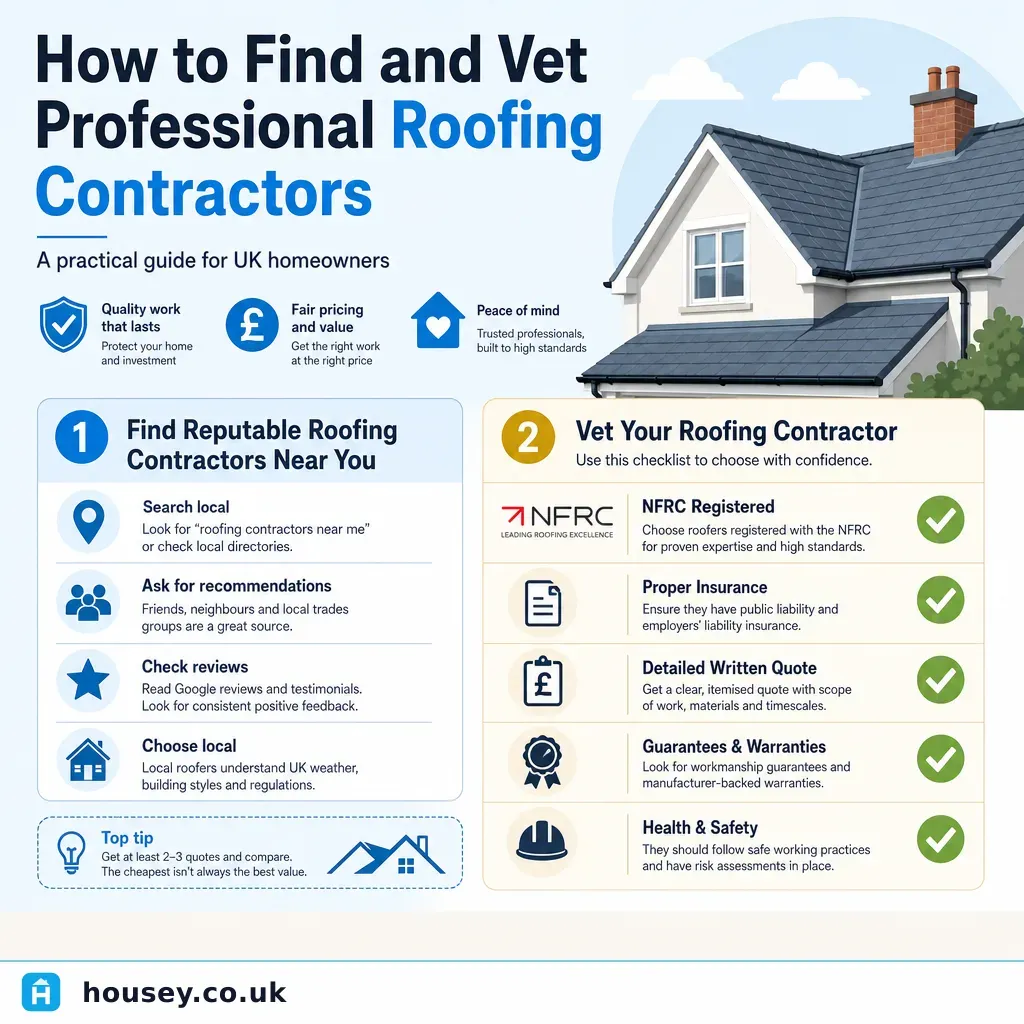
How to Find and Vet Professional Roofing Contractors
Professional roofing contractors should carry public liability insurance of at least £2m, provide a written workmanship guarantee, and hold accreditation from a recognised body such as the NFRC or the Competent Roofer scheme.
 Improvement & Build
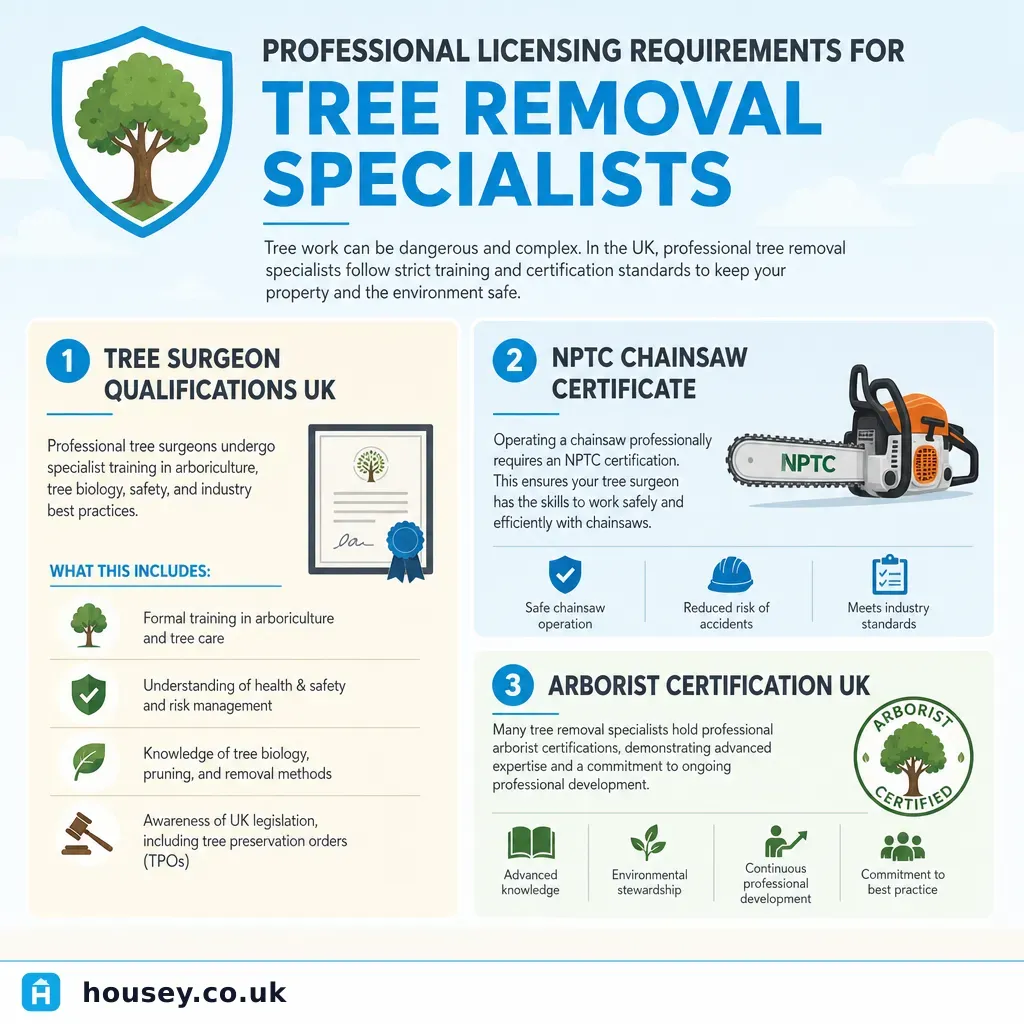
Professional Licensing Requirements for Tree Removal Specialists
Tree surgery in the UK has no single statutory licence, but chainsaw operators must hold recognised NPTC/City & Guilds certificates, and work near overhead lines requires specialist training.
 Improvement & Build
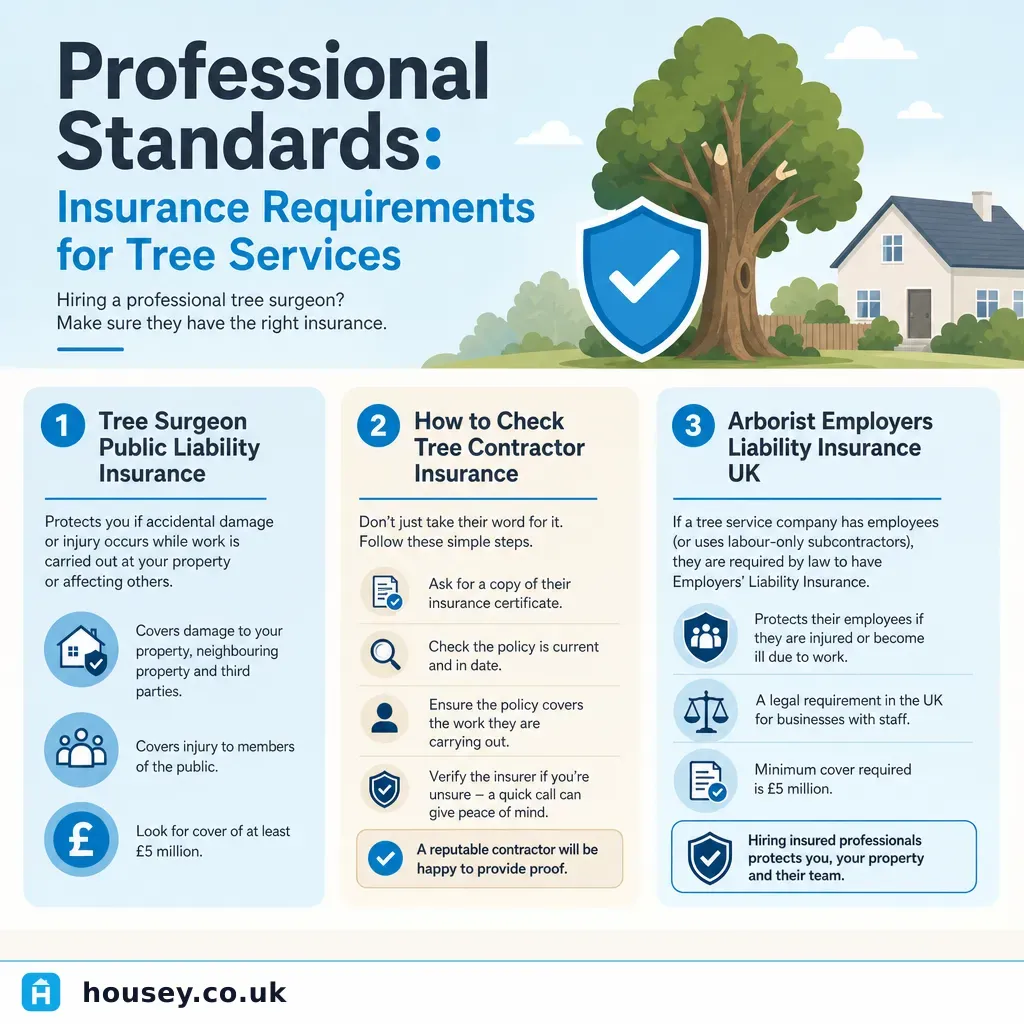
Professional Standards: Insurance Requirements for Tree Services
Reputable tree surgeons in the UK typically carry a minimum of £5 million public liability insurance and, if they employ staff, employers' liability cover of at least £5 million — a legal requirement under the Employers' Liability (Compulsory Insurance) Act 1969.