Professional Licensing Requirements for Tree Removal Specialists
By Housey · Last reviewed 31st of May 2026
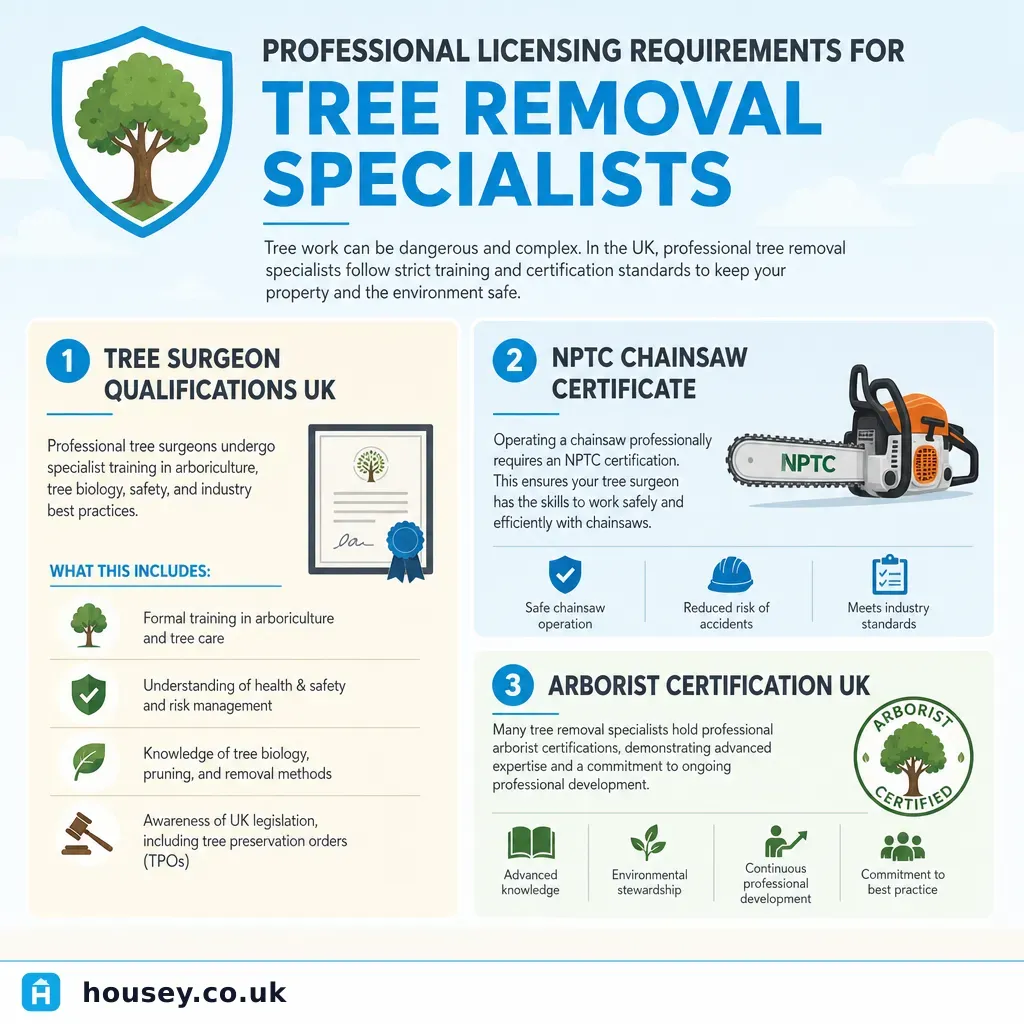
Professional Licensing Requirements for Tree Removal Specialists
Removing a tree — whether a diseased ash, an overgrown leylandii, or a storm-damaged oak — can involve chainsaws, heavy loads, working at height, and proximity to buildings, cables, and neighbouring land. Understanding what qualifications a reputable tree removal specialist should hold helps you hire safely and avoid costly or legally problematic outcomes. Unlike some trades, the regulatory landscape for tree surgery is fragmented across health and safety law, planning controls, and voluntary professional schemes, which can make it difficult to know what to look for.
Key points
- There is no single statutory licence for tree surgeons or tree removal specialists in England and Wales; however, specific operations require recognised certificates of competence.
- Chainsaw use requires a certificate of competence — typically NPTC/City & Guilds units CS30 (safe use of a chainsaw at ground level), CS31 (felling small trees), or CS38 (chainsaw use from a rope-and-harness system) — and the Health and Safety Executive makes clear that employers must ensure chainsaw operators are trained and competent.
- Working within 9 metres of overhead power lines requires specific safety training; the HSE recommends following the Electricity at Work Regulations 1989 and published industry safe-approach distances.
- Trees subject to a Tree Preservation Order (TPO) or situated in a Conservation Area cannot legally be removed without prior consent from the local planning authority — this is a constraint on the property, not the contractor.
- The Arboricultural Association (AA) Approved Contractor status and the ISA (International Society of Arboriculture) Certified Arborist credential are widely regarded as the most reliable indicators of professional competence for UK tree removal work.
Is there a licence to remove trees in the UK?
No single licence is required to work as a tree surgeon or tree removal specialist in the UK. This does not mean the sector is unregulated, however. Several overlapping frameworks govern competence, safety, and planning consent:
Operational qualifications: The Health and Safety at Work etc. Act 1974 and the Management of Health and Safety at Work Regulations 1999 require that workers are competent for the tasks they perform. For chainsaw-based tree felling and aerial dismantling, competence is typically demonstrated through NPTC (National Proficiency Tests Council) certificates of competence, delivered under the City & Guilds framework.
Professional body accreditation: The Arboricultural Association and the International Society of Arboriculture operate voluntary but widely recognised accreditation schemes that assess both individual operatives and firms against defined standards.
Planning controls: Tree Preservation Orders and Conservation Area restrictions are statutory — they require consent from the local planning authority regardless of who carries out the work and regardless of the contractor's qualifications.
Which qualifications should a tree removal specialist hold?
The table below sets out the main qualifications relevant to residential tree removal in the UK, the body that issues them, and the situations in which they apply.
Qualification | Issued by | What it covers | Relevant for |
|---|---|---|---|
CS30 Certificate of Competence | NPTC / City & Guilds | Safe use of a chainsaw at ground level | All chainsaw operators |
CS31 Certificate of Competence | NPTC / City & Guilds | Felling and processing small trees (up to approx. 380 mm diameter) | Ground-level tree felling |
CS38 Certificate of Competence | NPTC / City & Guilds | Chainsaw use from a rope-and-harness system | Aerial chainsaw dismantling |
CS41 Certificate of Competence | NPTC / City & Guilds | Accessing trees using rope and harness | Climbing and rigging operations |
AA Approved Contractor status | Arboricultural Association | Business and operative standards, site audit, insurance check | Vetted firms |
ISA Certified Arborist | International Society of Arboriculture | Individual competence examination and ongoing CPD | Individual arborists |
TrustMark registration | TrustMark | Consumer protection, insurance vetting, complaints process | Registered firms |
Decision tree: which professional do you need?
Use the following to guide your hiring decision before requesting quotes:
- Routine garden tree removal (up to approximately 5 m, ground-level felling, good access) → a contractor holding CS30 and CS31, ideally with AA Approved Contractor status.
- Large or multi-stem trees requiring aerial dismantling → a contractor holding CS38 and CS41 in addition to CS30 and CS31; confirm the firm carries adequate public liability insurance.
- Trees near buildings, cables, or boundaries → an AA Approved Contractor with specific experience in confined-space dismantling; consider instructing a consulting arborist to produce a written method statement first.
- Trees subject to a Tree Preservation Order or in a Conservation Area → apply to your local planning authority for consent before instructing any contractor; proceeding without consent is a criminal offence under the Town and Country Planning Act 1990.
- Storm-damaged or emergency tree removal → engage an AA Approved Contractor or ISA Certified Arborist; emergency circumstances do not remove the obligation for operatives to hold proper qualifications, or, where a TPO applies, to seek retrospective consent from the local authority.
How to verify a contractor's qualifications
Homeowner checklist — verifying tree removal qualifications
Before authorising any work:
What to ask before hiring a tree removal specialist
- What NPTC/City & Guilds certificates do your operatives hold, and can I see copies before work starts?
- Are you an Arboricultural Association Approved Contractor?
- Are any of the trees in question subject to a Tree Preservation Order or in a Conservation Area?
- Will you advise on or handle the planning consent process if it is required?
- What public liability insurance do you carry, and can I see the current certificate?
- Will a written method statement be produced for this job?
- How will arisings — timber, chippings, and brash — be disposed of, and is this included in the quote?
- What happens if unexpected hazards such as internal decay, fungal infection, or proximity to underground services are discovered once work is under way?
When to get professional help
Tree removal is not appropriate as a DIY task beyond minor pruning of small, low-growing trees at ground level. If the tree is more than approximately 3 metres tall, has a significant trunk diameter, leans toward a structure, or its health and stability are in any doubt, engage a qualified professional before any work proceeds.
Situations where professional involvement is essential:
- Any tree under a TPO or in a Conservation Area — removing one without consent is a criminal offence under the Town and Country Planning Act 1990.
- Trees near overhead power lines — contact your DNO before any work is planned.
- Trees showing signs of root damage, fungal fruiting bodies at the base, or instability — a consulting arborist should carry out a risk assessment before a removal contractor begins.
- Trees in close proximity to your house, boundary walls, or neighbouring property, where falling material or ground disturbance could cause significant damage.
How Housey can help
Housey helps UK homeowners find and compare qualified tree surgeons — with upfront information about qualifications and insurance so you can make a confident, informed choice before any work begins.
Frequently asked questions
Do tree surgeons need to be licensed to work in the UK?
No single statutory licence is required for tree surgeons in England and Wales. However, chainsaw operators must be competent — typically demonstrated through NPTC/City & Guilds certificates — and specific tasks such as aerial chainsaw work or operations near power lines require additional qualifications. Professional accreditation through the Arboricultural Association or ISA is voluntary but a strong indicator of competence.
What is an Arboricultural Association Approved Contractor?
It is a firm that has passed an independent site-based audit by the Arboricultural Association, demonstrating that operatives hold appropriate qualifications, equipment is properly maintained, and health and safety practices meet industry standards. Approved Contractors must also carry adequate public liability insurance and comply with the AA code of practice.
Can I remove a tree in my own garden without permission?
Usually yes, unless the tree is subject to a Tree Preservation Order or the property is in a Conservation Area. In a Conservation Area, trees above approximately 75 mm trunk diameter at 1.5 m height require six weeks' notice to the local planning authority before removal. Check with your council before any work begins — non-compliance carries criminal penalties.
What is the difference between a tree surgeon and a consulting arborist?
A tree surgeon carries out practical tree work — pruning, felling, and dismantling. A consulting arborist provides independent professional advice, risk assessments, reports for planning applications, and method statements. For complex or sensitive situations involving TPO trees, boundary disputes, or trees near new development, a consulting arborist is often needed alongside a tree surgeon.
What are the NPTC chainsaw certificates?
NPTC (National Proficiency Tests Council), now part of City & Guilds, issues recognised chainsaw certificates: CS30 (safe use of a chainsaw on the ground), CS31 (felling small trees), CS38 (chainsaw use from rope and harness), and CS41 (accessing trees by rope and harness). These are the standard competence benchmarks for chainsaw operators in UK arboriculture and forestry.
Sources and further reading
- Tree preservation orders and trees in conservation areas — GOV.UK
- Chainsaw safety in forestry and arboriculture — Health and Safety Executive
- Find an Arboricultural Association Approved Contractor — Arboricultural Association
- ISA Certified Arborist programme — International Society of Arboriculture
- Electricity at Work Regulations 1989 — legislation.gov.uk
Useful next reads
 Improvement & Build
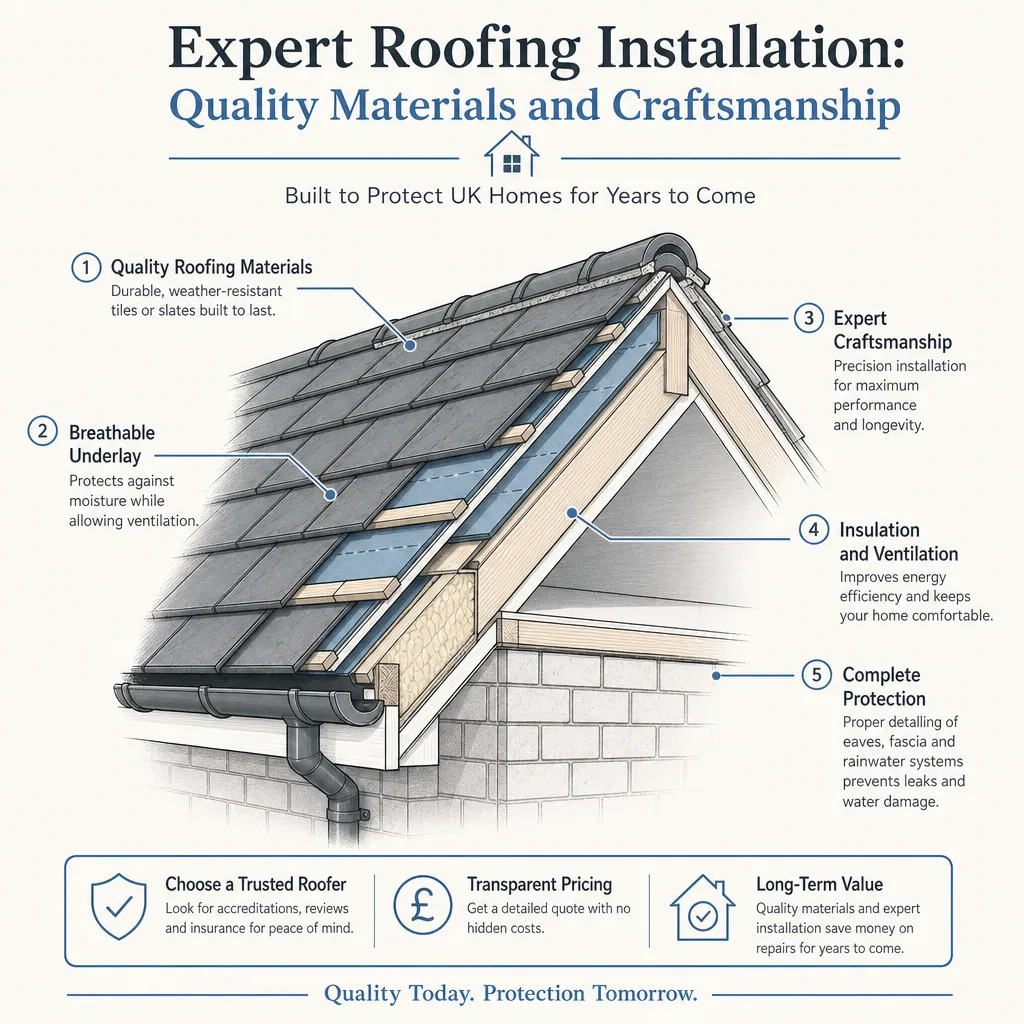
Expert Roofing Installation: Quality Materials and Craftsmanship
A quality roof installation depends on matching materials to your property type, hiring a suitably qualified roofer, and ensuring building regulations are met where required.
 Improvement & Build
Managing Provider Reviews: A Guide for Building Strong Relationships
When hiring a UK contractor, reviews can be reliable indicators of quality — but only if you read them critically.
 Improvement & Build
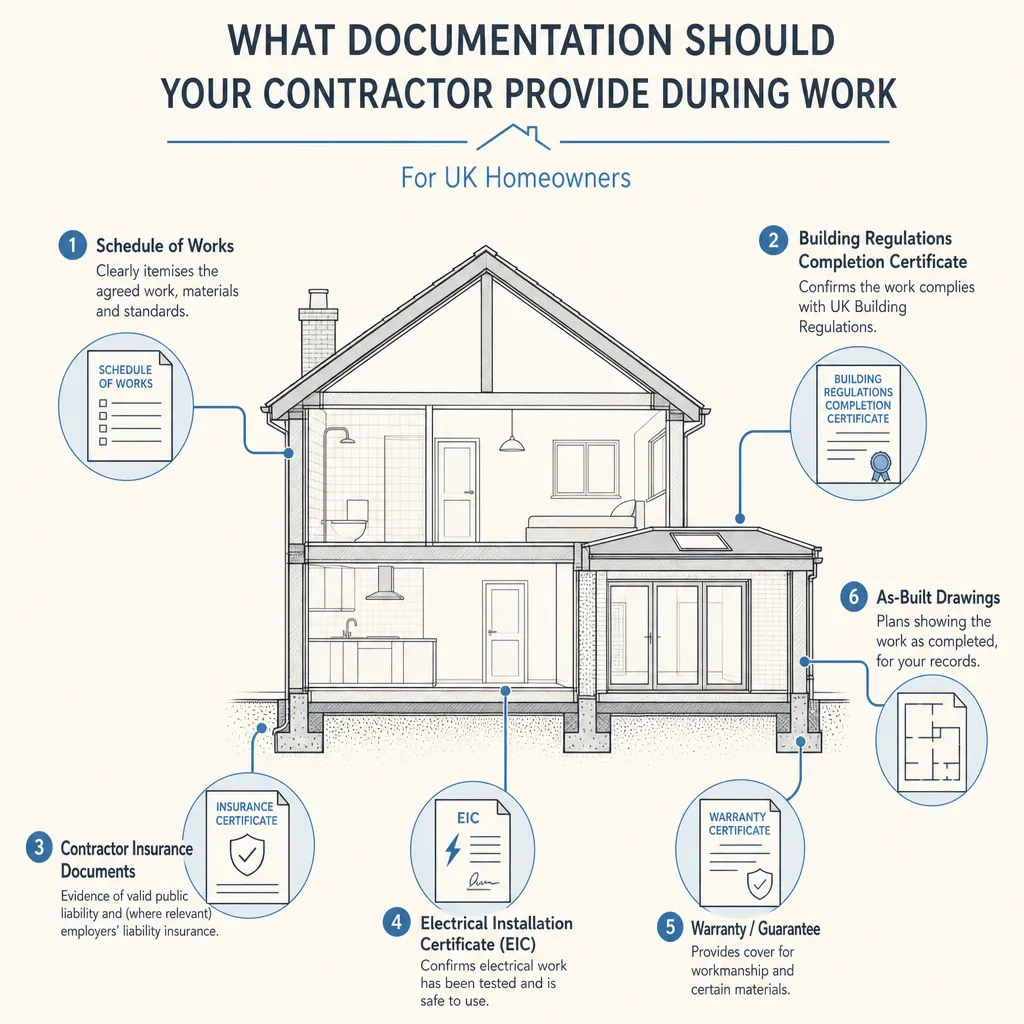
What Documentation Should Your Contractor Provide During Work
During building work, your contractor should provide a signed written contract, public liability insurance certificate, and copies of any building control application.
 Improvement & Build
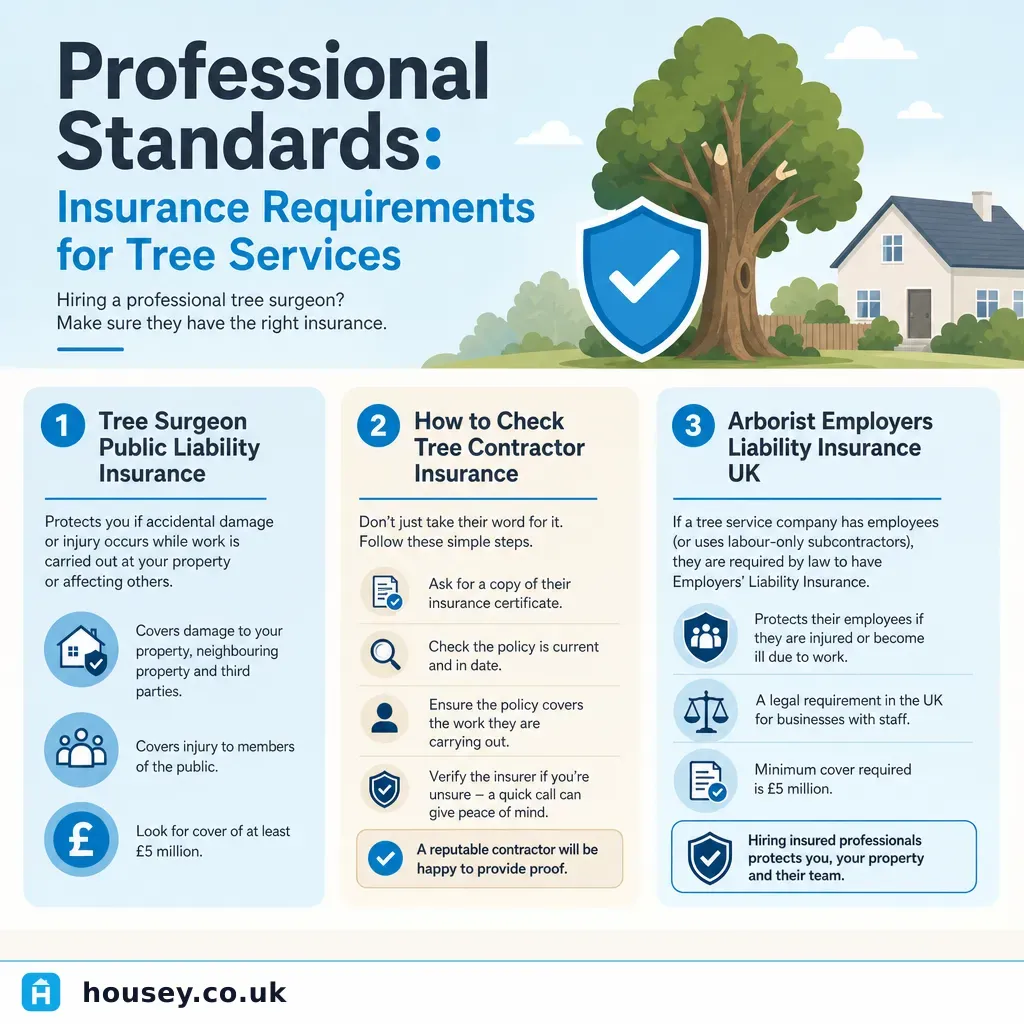
Professional Standards: Insurance Requirements for Tree Services
Reputable tree surgeons in the UK typically carry a minimum of £5 million public liability insurance and, if they employ staff, employers' liability cover of at least £5 million — a legal requirement under the Employers' Liability (Compulsory Insurance) Act 1969.
 Improvement & Build
Professional Builders: Why Licensing and Qualifications Matter
There is no universal builder's licence in the UK, but certain types of work are legally regulated — gas work requires Gas Safe registration, notifiable electrical work needs a Part P competent person, and window replacements require FENSA or Certass certification.