Protecting Your Home from Rogue Traders: Essential Safety Checks
By Housey · Last reviewed 24th of May 2026
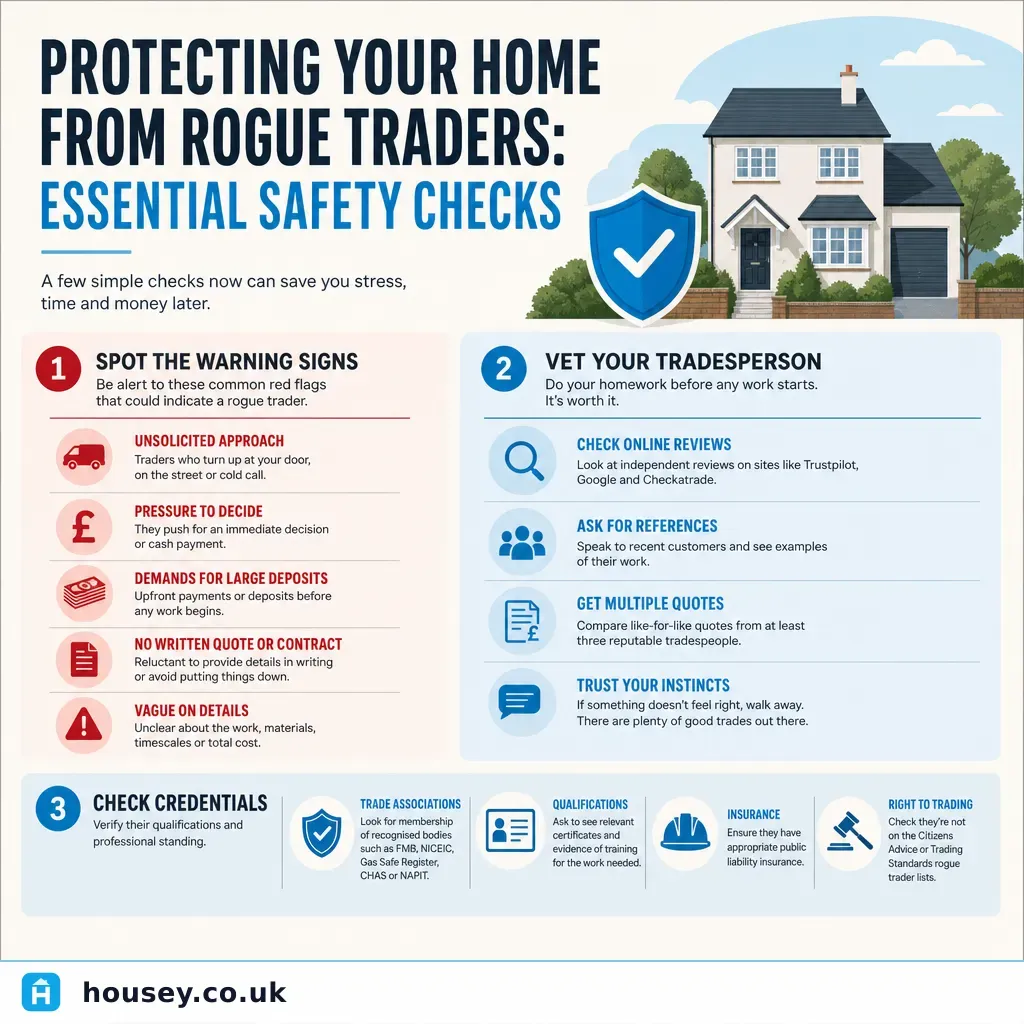
Protecting Your Home from Rogue Traders: Essential Safety Checks
Rogue traders cost UK homeowners millions of pounds each year, and home improvement work — particularly roofing, drainage, driveways, and extensions — remains one of the highest-risk areas. The problem often surfaces after work has been paid for and poorly completed, leaving homeowners facing defects, safety hazards, and no straightforward comeback. Understanding how to vet a contractor before work begins is the single most effective protection available.
Key points
- The Consumer Protection from Unfair Trading Regulations 2008 makes aggressive sales tactics, misleading claims, and pressure selling by traders a criminal offence.
- Gas work on appliances, boilers, and pipework must be carried out by a Gas Safe Register engineer — there is no legal alternative.
- The TrustMark government-endorsed quality scheme covers tradespeople in over 70 home improvement categories, including building, roofing, and drainage.
- A legitimate contractor should provide a written quote, a business address, and evidence of public liability insurance before work starts.
- Citizens Advice recommends obtaining at least three written quotes for any significant home improvement job and checking reviews on multiple platforms.
How to verify a trader's credentials before hiring
Before any contractor sets foot on your property for paid work, there are several checks you can carry out in under 30 minutes.
Company registration: Any limited company operating in the UK must be registered at Companies House. Check the company number at Companies House and confirm the registered address matches what the trader has given you. Sole traders are not required to register, but a genuine trading address, a landline number, and a VAT number (if they claim to be VAT-registered) are all verifiable.
Scheme membership: Depending on the trade, look for membership of a recognised competent-person or quality scheme:
Trade | Relevant scheme(s) | What membership means |
|---|---|---|
Gas engineers | Gas Safe Register | Legally required for gas work; check the engineer's licence card |
Electricians | NICEIC, NAPIT | Part P competent-person scheme; can self-certify electrical work |
Window and door installers | FENSA, Certass | Self-certify replacement windows and doors under Building Regulations |
Roofers, builders, general trades | TrustMark, Federation of Master Builders | Quality-checked, insured, and monitored |
Drainage contractors | WaterMark, TrustMark | Good practice standards for drain work |
Insurance: Ask for a copy of the contractor's public liability insurance certificate. Reputable traders carry at least £2 million in public liability cover. Without this, you may be liable if a third party is injured during work on your property.
References and reviews: Ask for two or three references from recent jobs within the last 12 months, ideally within your area. A trader who hesitates to provide references is worth scrutinising further.
Red flags: signs you may be dealing with a rogue trader
The following behaviours are commonly associated with rogue or dishonest traders. If you encounter more than one of these, walk away.
- Unsolicited cold-calling or doorstep approach. Legitimate busy tradespeople rarely need to cold-call. Be especially wary if they claim to be 'just working nearby' or have spotted a problem with your roof or driveway.
- Cash-only payment demanded upfront. Asking for a significant cash deposit — or full payment — before work starts, especially with pressure to pay immediately, is a major warning sign.
- No written quote. Verbal quotes are unenforceable. Any trustworthy trader will provide a written breakdown of costs.
- Vague or no business address. A mobile number and a first name alone are insufficient. Ask for a postal address and verify it.
- Pressure to decide immediately. Phrases such as 'this price is only available today' or 'I have a cancellation slot right now' are classic pressure tactics prohibited under the Consumer Protection from Unfair Trading Regulations 2008.
- No evidence of insurance. Refusal or inability to show a current insurance certificate.
- Offers to use leftover materials. While not always dishonest, this tactic can be used to justify rushed, poor-quality work.
- A quote significantly lower than all others. A price that undercuts competitors by 50% or more should prompt questions about materials, hidden costs, and whether the trader will actually complete the job.
What to ask before accepting a quote
Use this checklist when speaking to any contractor before agreeing to work:
- Are you registered with Companies House, or do you have a sole-trader VAT number?
- Are you a member of a relevant accreditation scheme — Gas Safe, NICEIC, FENSA, TrustMark, or the Federation of Master Builders?
- Can I see your current public liability insurance certificate?
- Can you provide two or three references from recent local jobs?
- What is included in this quote, and what could make the price change?
- Is VAT included?
- Will you provide a written contract or job specification?
- What are your payment terms, and do you accept bank transfer?
- What guarantee do you offer on the work, and is it backed by an insurance-backed guarantee?
Documents you should receive before and after work
Before work starts:
- Written quote with itemised costs and a clear scope of work
- Copy of current public liability insurance
- Scheme membership or registration evidence (where applicable)
After work is completed:
- Signed completion certificate (required for gas, electrical, and window installation work, and some building works)
- Any relevant Building Regulations completion certificate from the local authority or competent-person scheme
- Warranty or guarantee documentation
- Receipt or invoice
What to do if something goes wrong
If a rogue trader has already carried out substandard or incomplete work:
- Document everything. Take dated photographs and keep all written communications.
- Contact the trader in writing. Give them the opportunity to remedy the defect, citing the Consumer Rights Act 2015 — services must be carried out with reasonable care and skill.
- Report to Trading Standards. Contact your local Trading Standards office via Citizens Advice (0808 223 1133). Trading Standards can investigate and prosecute criminal behaviour.
- Report to the scheme. If the trader claimed membership of TrustMark, the Federation of Master Builders, Gas Safe, or another scheme, report to that body — they have dispute resolution processes.
- Consider legal action. For disputes up to £10,000 in England and Wales, the small claims court is available. Citizens Advice has guidance on how to proceed.
When to get professional help
Contact Trading Standards or Citizens Advice immediately if:
- A trader has taken payment and disappeared without completing work
- You suspect a trader has deliberately misrepresented qualifications or scheme membership
- You have been subjected to aggressive doorstep sales tactics or high-pressure demands
- Gas or electrical work has been carried out without certification — contact Gas Safe Register or NICEIC directly to arrange a competent inspection
How Housey can help
Housey connects homeowners with pre-vetted tradespeople across a wide range of improvement and build projects. Whether you need extension builders, roofers, drainage contractors, loft conversion companies, or window and door installers, every provider on the platform carries verified insurance and relevant accreditations. Compare multiple quotes from local professionals and make your decision without pressure.
Frequently asked questions
What can I do if a trader refuses to give me a written quote?
Walk away. Written quotes are standard practice for any legitimate tradesperson, regardless of job size. A refusal to provide one — or an insistence on verbal agreements — removes your ability to prove what was agreed if the work goes wrong, is disputed, or the trader disappears without completing the job.
Is a large upfront deposit normal?
A deposit of 25–30% of the job value is common for larger projects where materials need to be ordered in advance. Demanding 50% or more upfront — especially in cash — is unusual and carries risk. Never pay the full amount before work is completed to your satisfaction.
Does TrustMark cover all trades?
TrustMark covers over 70 categories of home improvement work. Membership requires background checks, customer satisfaction monitoring, and adherence to a code of conduct. It does not replace legally required scheme memberships such as Gas Safe for gas work, or NICEIC for electrical installations.
Can I check if a Gas Safe engineer is registered?
Yes. Visit the Gas Safe Register website and enter the engineer's registration number or business name. Every registered engineer carries a Gas Safe ID card with their photo, licence number, and the appliance categories they are qualified to work on. Always verify before allowing gas work to proceed.
What is an insurance-backed guarantee?
An insurance-backed guarantee (IBG) is a warranty that remains valid even if the contractor goes out of business. For larger projects, asking for an IBG provides an extra layer of protection beyond the trader's own workmanship guarantee. Some IBGs are offered through scheme operators such as TrustMark or the Federation of Master Builders.
Sources and further reading
- Consumer Protection from Unfair Trading Regulations 2008 — legislation.gov.uk
- Gas Safe Register: find a registered engineer — Gas Safe Register
- TrustMark: government-endorsed quality scheme — TrustMark
- Citizens Advice: problems with a trader — Citizens Advice
- Consumer Rights Act 2015 — legislation.gov.uk
- Companies House: find company information — Companies House
Useful next reads
 Improvement & Build
Identifying Problem Areas: Rogue Traders and How to Protect Your Home
Rogue traders target homeowners with unsolicited visits, pressurised quotes, and substandard or incomplete work.
 Improvement & Build
Understanding Service Guarantees: Protection for Your Home Improvement Project
Home improvement guarantees fall into three main forms: workmanship guarantees issued by the contractor, insurance-backed guarantees (IBGs) underwritten by a third party and valid even if the contractor closes, and manufacturer warranties on installed products.
 Improvement & Build
Common Roofing Scams: How to Protect Yourself and Your Property
Roofing scams most often involve unsolicited doorstep approaches, pressure to pay large deposits upfront, claims of urgent storm or structural damage, and contractors who disappear without completing work.
 Improvement & Build
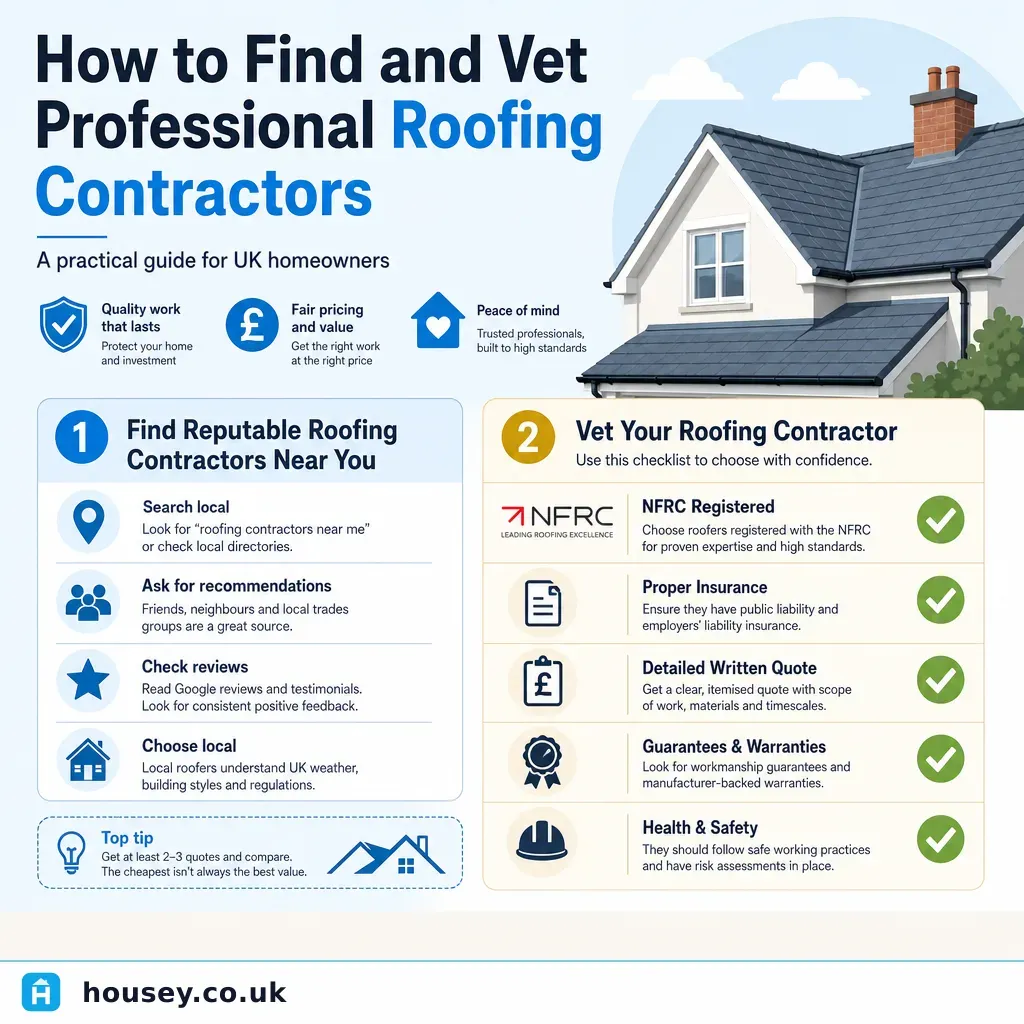
How to Find and Vet Professional Roofing Contractors
Professional roofing contractors should carry public liability insurance of at least £2m, provide a written workmanship guarantee, and hold accreditation from a recognised body such as the NFRC or the Competent Roofer scheme.
 Improvement & Build
Finding a Good Tradesperson: Selection and Vetting Guide
To find a good tradesperson, check mandatory registrations first: Gas Safe for gas work, NICEIC or NAPIT for electrical, FENSA for window and door installations.