Managing Tolerance Conflicts in Concrete Construction: Solutions
By Housey · Last reviewed 11th of May 2026
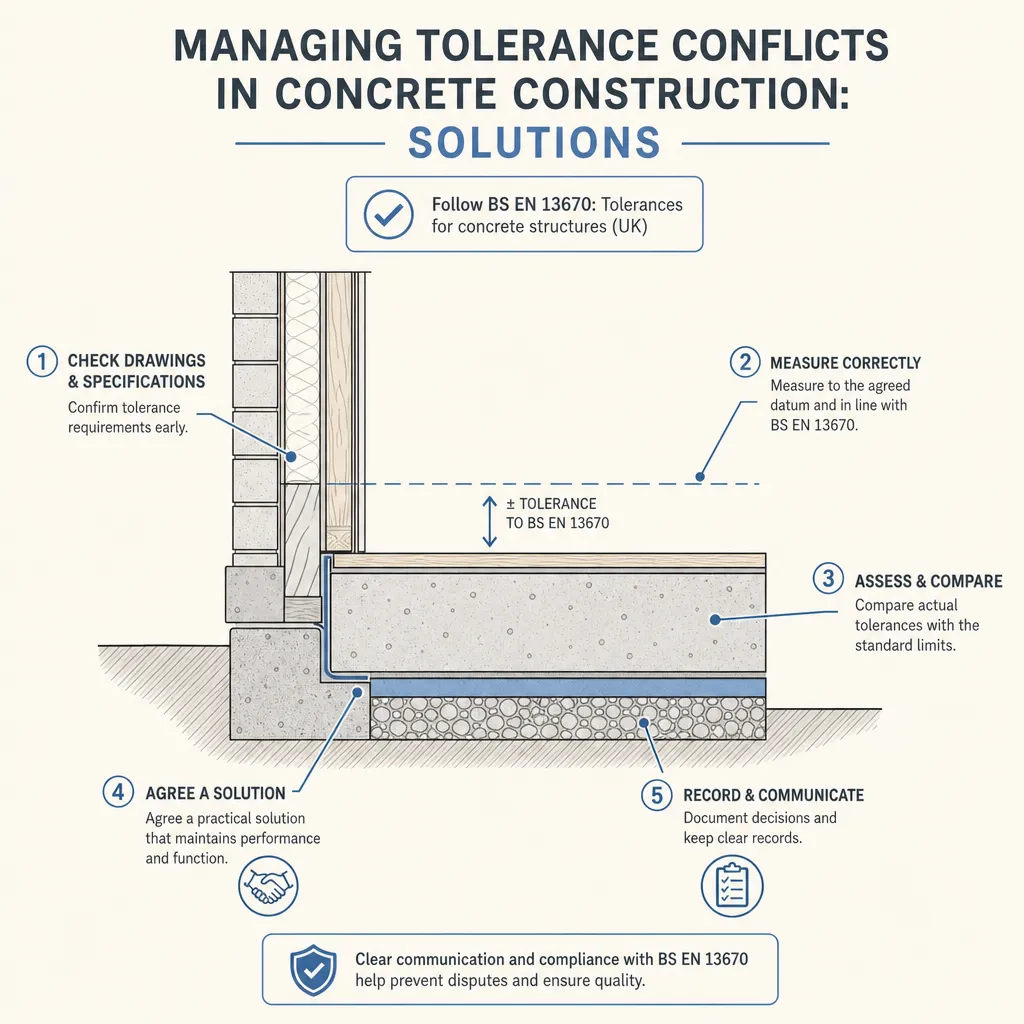
Managing Tolerance Conflicts in Concrete Construction: Solutions
Tolerance conflicts arise on most concrete construction projects — from domestic extensions with cast-in-place slabs to residential new-builds with precast elements. They become significant when a finished element falls outside the permitted deviation stated in the project specification or a referenced standard, triggering disputes between contractors, subcontractors, designers, and building control. Understanding the framework before work starts is the most effective way to manage the risk and avoid costly programme disruption.
Key points
- BS EN 13670:2009 Execution of concrete structures is the primary UK standard governing permitted deviations for cast-in-place and precast concrete, referenced in most commercial and domestic specifications.
- The permitted deviation for column or wall verticality under BS EN 13670 Annex D is typically ±15mm over a single storey height; permitted plan position deviation is also typically ±15mm for individual elements.
- NHBC Standards Chapter 2.1 sets tighter tolerance requirements for registered new-build housing, including specific limits for slab flatness and level that differ from the BS EN 13670 defaults.
- Contract documents take precedence over trade norms: if a specification tightens or relaxes the BS EN 13670 defaults, those bespoke values govern the works.
- Tolerance non-conformances that are accepted by the engineer or building control must be recorded in a formal concession note — verbal acceptance creates no contractual protection for any party.
What is a tolerance conflict and why does it matter?
A tolerance is the permitted range of deviation between the design intent shown on drawings and the as-built reality. Every physical construction process introduces some variation; tolerances define how much variation is acceptable before a defect legally exists under the contract.
Common causes of tolerance conflicts in concrete work include:
- Formwork deflecting under load, shifting wall faces or column centres.
- Reinforcement cover varying if spacers are displaced during the pour.
- Settlement of temporary works altering slab levels during casting.
- Setting-out errors accumulating across a multi-element structure.
- Design tolerances (the space allowed between adjacent elements) and execution tolerances (the accuracy of placing an element) not being reconciled during the design stage.
When the as-built position or geometry falls outside the specified tolerance, the element does not conform to the contract. Action is then required — and the route chosen has direct consequences for programme, cost, and building control sign-off.
Comparison: tolerance frameworks commonly used in UK residential projects
Framework | Applies to | Flatness / level | Verticality | Plan position | Notes |
|---|---|---|---|---|---|
BS EN 13670:2009 Annex D (Class 1) | Cast-in-place concrete, general | ±15mm over 2m | ±15mm per storey | ±15mm | Default for most domestic work |
NHBC Standards Ch. 2.1 | New-build housing (NHBC registered) | ±10mm over 1.8m | ±8mm per storey | ±10mm | Stricter than BS EN 13670 |
BS 8204-1:2020 | Concrete floor screeds | SR3: ±5mm / 2m; SR1: ±1.5mm / 2m | N/A | N/A | Floor regularity only — three surface regularity classes |
Bespoke specification | Any project | As stated | As stated | As stated | Supersedes all standards when validly issued in the contract |
Always verify which framework is referenced in your contract documents. A default standard applies only in the absence of a more specific contractual requirement.
How to resolve a tolerance conflict: step by step
Step 1 — Identify the governing specification Locate the tolerance clause in the contract drawings, specification, or building contract. Confirm whether it references BS EN 13670, NHBC Standards, BS 8204, or a bespoke table. Where the contract is silent, BS EN 13670 Class 1 is generally taken as the default for domestic concrete work.
Step 2 — Measure accurately and independently Non-conformance measurements must be taken with calibrated instruments, referenced to the agreed setting-out datum, and signed off by both parties. A clerk of works or independent surveyor should witness measurements where the deviation is disputed.
Step 3 — Assess the structural and functional impact Not all out-of-tolerance conditions carry equal consequences. A column 18mm off its plan position may have negligible structural consequence in some configurations; in others it may affect load path, connection details, or fire compartment boundaries. A structural engineer should confirm whether the deviation is:
- Structurally significant — requires remedial works or a formal redesign before the next construction phase.
- Functionally significant — affects finishes, service routes, door clearances, or fit-out.
- Cosmetic only — recordable but non-structural and non-functional.
Step 4 — Choose the resolution route
- Remedial works: the element is corrected — by chasing out, building up, or recasting. Most costly but restores full specification conformance.
- Concession / non-conformance report (NCR): the engineer formally accepts the as-built condition, recording the deviation, impact assessment, and any compensatory measures. Must be issued in writing and filed in the quality record.
- Redesign: surrounding elements are adjusted to accommodate the deviation — for example, adjusting holding-down bolt templates to match a shifted column base. Requires updated drawings formally issued for construction.
Step 5 — Close out with documentation Record the resolution in the project quality file. Building control inspectors may request evidence that non-conformances have been assessed and closed before issuing a completion or final certificate.
Decision tree: which resolution route applies?
- Structural impact confirmed → involve a structural engineer immediately; remedial works or redesign are required before further construction proceeds on affected elements.
- No structural impact, deviation within 20% above the tolerance limit → formal concession note; assess functional impact and obtain written sign-off from the engineer.
- No structural impact, deviation more than 20% above the tolerance limit → structural engineer must formally assess; remedial works are often necessary.
- Dispute with contractor over whether a deviation exists → instruct an independent surveyor to take measurements; reference only the governing specification, not trade norms.
- Building control inspector raises a concern → do not resolve verbally; obtain written advice from the inspector and provide formal NCR documentation in response.
- NHBC-registered site → contact the NHBC technical helpline; they can advise on whether the deviation triggers a formal re-inspection requirement.
What to ask a qualified professional before accepting a concrete non-conformance
If you are a homeowner or developer dealing with a tolerance conflict on a residential project, ask the following before agreeing to any resolution:
- Which standard or specification governs — BS EN 13670, NHBC Standards, or a bespoke document in the contract?
- What is the exact measured deviation, how was it measured, and who witnessed it?
- Does the deviation affect any structural element, connection, load path, or fire compartment boundary?
- Is a formal concession report required, and who has authority to sign it off?
- Will building control or NHBC accept the proposed concession, or will they require physical remedial works?
- What long-term risks, if any, does the deviation create for finishes, service routes, or adjoining elements?
- Is there a contractual mechanism for the contractor to recover costs if the tolerance conflict arose from incomplete or conflicting design information?
Red flags: when tolerance conflicts need immediate escalation
- The deviation affects a structural connection, post base, column, or bearing point — stop further construction on the affected element.
- The contractor states verbally that the deviation is acceptable without providing any written assessment or formal concession.
- Building control has already raised the issue at an inspection — do not proceed without written confirmation of an agreed resolution.
- Cumulative tolerance build-up is preventing subsequent trades from meeting their own specifications — for example, a floor screed cannot meet BS 8204 SR2 requirements because the structural slab beneath is already at the limit of its tolerance.
- The conflict was not identified until after the following phase of works had begun — early identification and documentation are critical to avoiding disproportionate remediation costs.
When to get professional help
A structural engineer should be involved whenever a tolerance conflict could affect structural integrity, load paths, or safety-critical connections. A building control consultant can advise on what documentation will satisfy inspection requirements and, on NHBC-registered sites, whether a deviation triggers a mandatory re-inspection. If the contractor is disputing the existence of a non-conformance or resisting the cost of remedial works, a construction solicitor or specialist claims consultant can advise on your contractual position.
How Housey can help
Housey can connect you with experienced building control consultants who can review tolerance documentation and advise on what evidence a building inspector will require at completion stage. Where structural impact needs formal assessment, structural engineering professionals can provide written opinions on non-conformances and recommend the most appropriate resolution route.
Frequently asked questions
Does building control automatically fail an inspection if a concrete tolerance is exceeded?
Not automatically. Building control inspectors assess compliance with Building Regulations and the contract specification, not purely against standard tolerance tables. However, if a structural element is out of tolerance and the engineer has not formally accepted it, the inspector is likely to request a written structural assessment before issuing a completion certificate.
Who is responsible for a tolerance conflict — the contractor or the designer?
It depends on the cause. If the conflict arose from an execution error — formwork deflection, setting-out mistakes — the contractor is typically responsible. If it arose from an irreconcilable conflict between design and execution tolerances, the designer may share liability. The contract terms and a formal cause assessment are needed to determine responsibility.
Can I accept a tolerance concession and still sell my house?
A formally accepted concession signed off by the structural engineer and building control, and recorded in the building file, should not prevent a sale. Undocumented non-conformances are a different matter — they may appear as a defect on a RICS Level 3 survey and could affect your buyer's mortgage offer or require remediation before exchange.
Sources and further reading
- BS EN 13670:2009 – Execution of concrete structures — BSI Group
- NHBC Standards Chapter 2.1 – Sitework — NHBC
- BS 8204-1:2020 – Screeds, bases and in situ floorings — BSI Group
- Building Regulations Approved Documents (England) — GOV.UK
- Construction (Design and Management) Regulations 2015 — legislation.gov.uk
Useful next reads
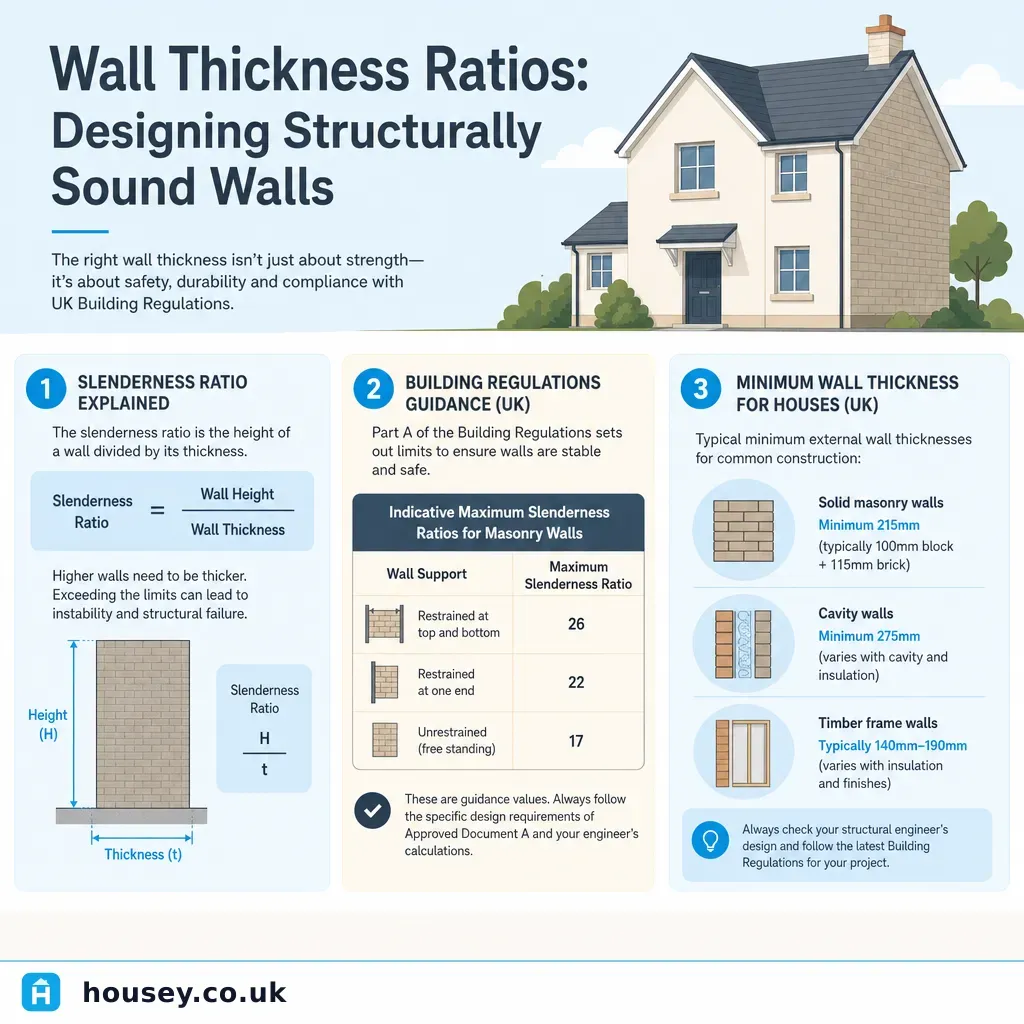 Planning & Pre-Build
Wall Thickness Ratios: Designing Structurally Sound Walls
Wall thickness ratios — particularly the slenderness ratio (effective height divided by effective thickness) — determine whether a wall can safely carry load without buckling.
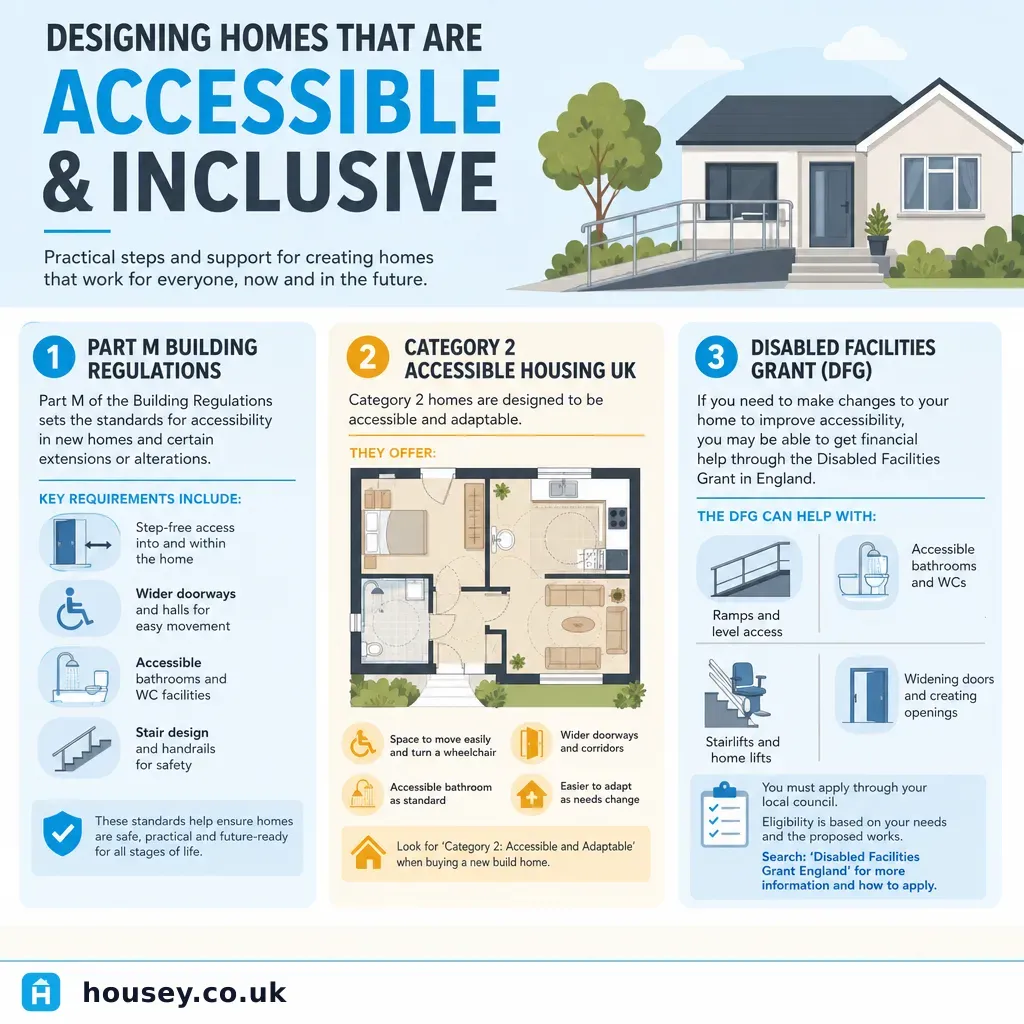 Planning & Pre-Build
Designing Homes That Are Accessible and Inclusive
Accessible home design in the UK is guided by Building Regulations Approved Document M, which sets three standards for new dwellings: Category 1 (Visitable), Category 2 (Accessible and Adaptable), and Category 3 (Wheelchair User Dwelling).
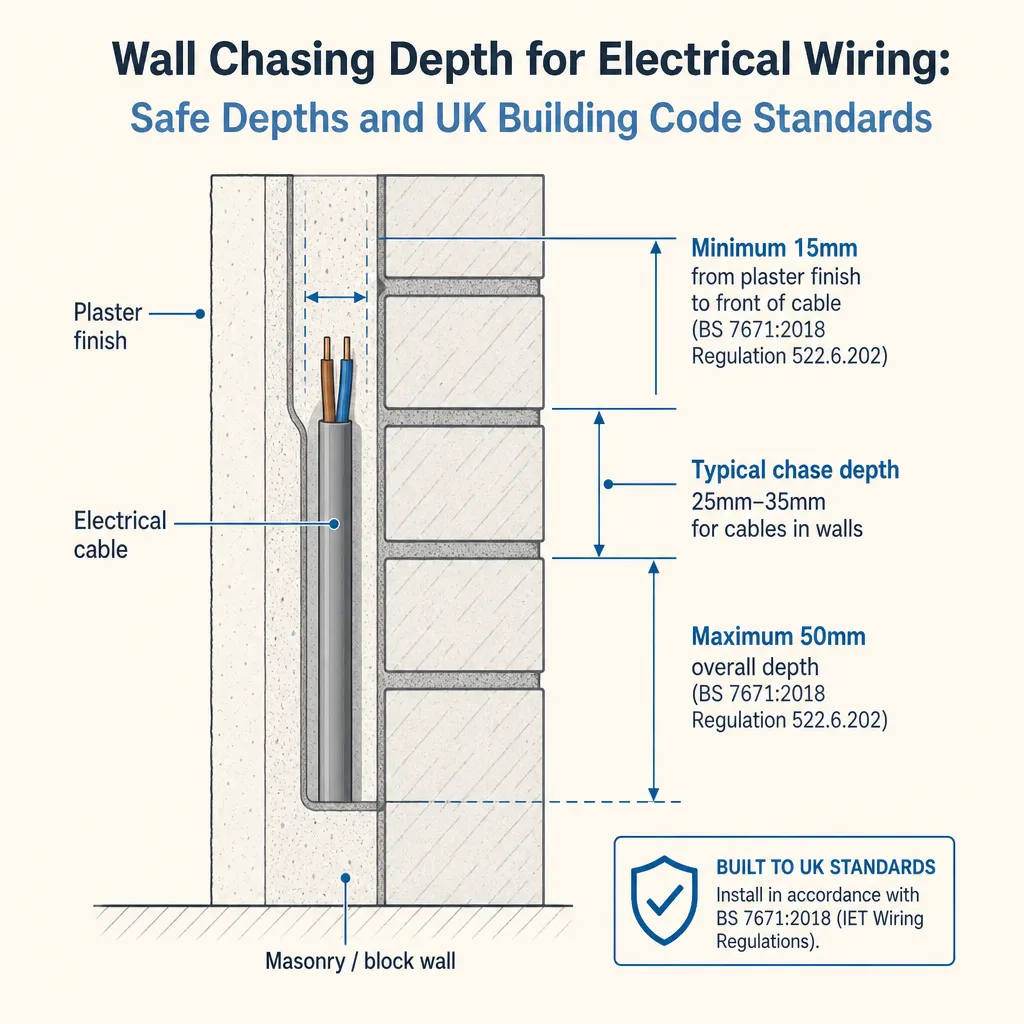 Planning & Pre-Build
Wall Chasing Depth for Electrical Wiring: Safe Depths and UK Building Code Standards
Cables chased into walls must be within BS 7671 safe zones — within 150 mm of a ceiling, floor, or corner junction — or enclosed in rigid conduit for mechanical protection.
 Planning & Pre-Build
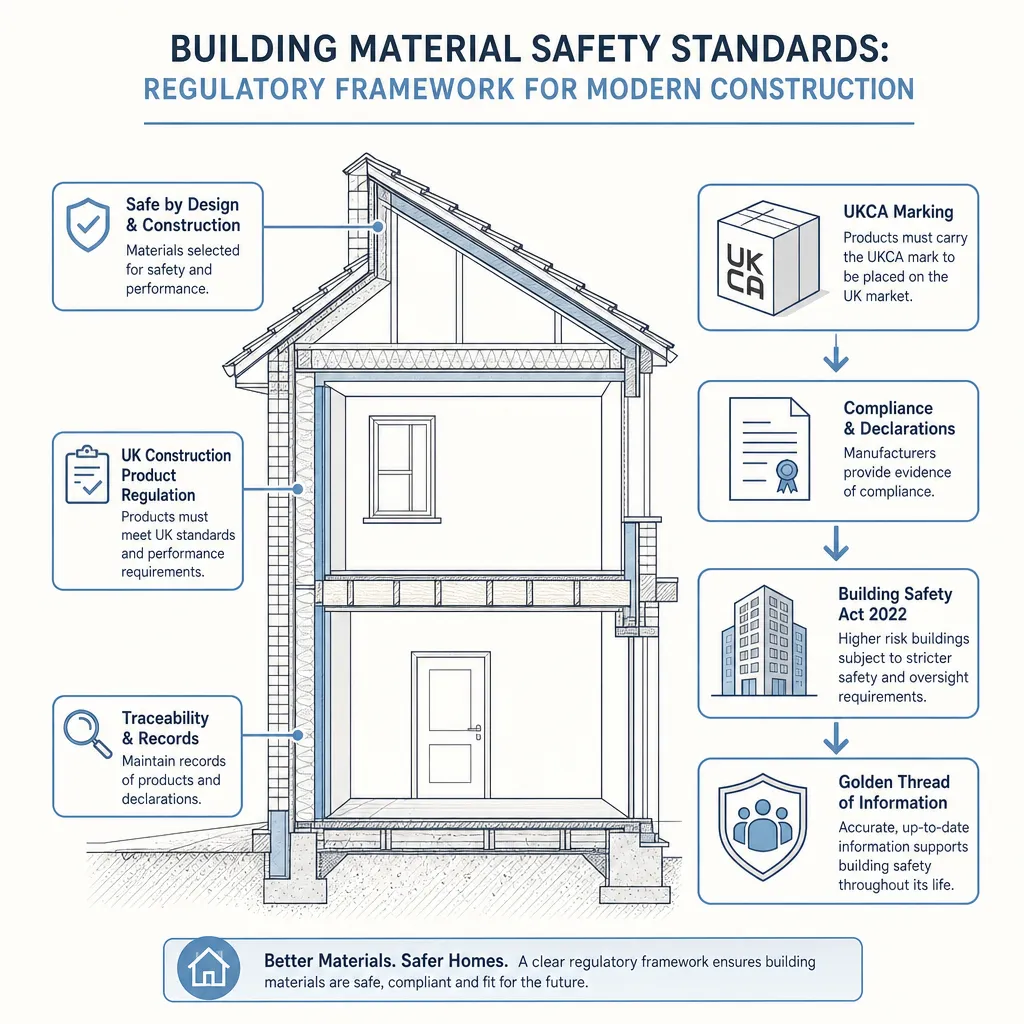
Building Material Safety Standards: Regulatory Framework for Modern Construction
UK building material safety standards are set through the Building Regulations 2010 and associated Approved Documents covering structure, fire, damp, energy, and ventilation.
 Planning & Pre-Build
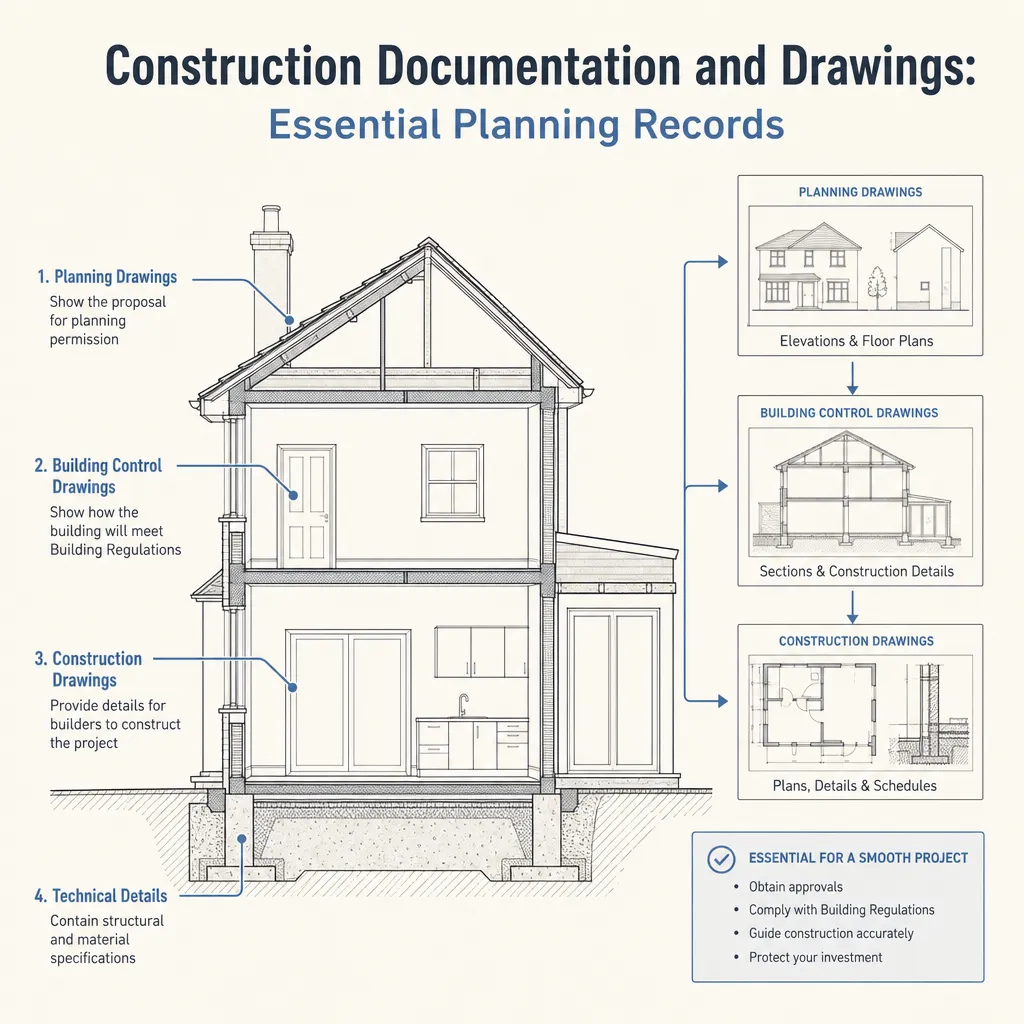
Construction Documentation and Drawings: Essential Planning Records
Construction documentation covers all drawings, specifications, and records needed to design, build, and inspect a project.