Masonry Repointing Costs and Best Practices
By Housey · Last reviewed 10th of May 2026

Masonry Repointing Costs and Best Practices
Crumbling or recessed mortar joints are one of the most common maintenance tasks facing UK homeowners, particularly those with properties built before the 1950s. Left unaddressed, deteriorated pointing allows water to penetrate the masonry, accelerating frost damage, staining, and internal damp — problems that cost far more to remedy than the repointing itself. Getting the mortar specification right is at least as important as the quality of the labour: using the wrong mix on historic brick can cause more lasting harm than doing nothing at all.
Key points
- Pre-1920s properties should use a hydraulic natural lime mortar — typically NHL 3.5 or NHL 5 — rather than ordinary Portland cement (OPC), which is too rigid for softer historic brickwork and can cause brick face spalling over time.
- Old mortar joints must be raked to a minimum depth of 15–20 mm before new mortar is applied; surface-only repointing fails within a few years and can trap moisture behind the patch.
- Repointing is typically priced at £20–£60 per m² for labour and materials (no scaffold); erecting scaffold adds £600–£1,500 or more depending on height and access constraints.
- Listed buildings require listed building consent for repointing, even for routine like-for-like maintenance — contact your local planning authority before instructing any work.
- Historic England guidance states that mortar joints should be slightly weaker than the surrounding masonry, allowing moisture to escape through joints rather than damaging the brick face.
Why mortar specification matters
The most consequential decision in any repointing project is the mortar mix. UK housing stock spans a wide range of construction eras, each with different brick strengths and original mortar compositions. A 1900 London stock brick has very different absorption and strength characteristics from a 1970s Fletton brick, and the mortar must be matched accordingly.
Mortar types comparison
Mortar type | Suited to | Not suited to | Relative compressive strength | Key notes |
|---|---|---|---|---|
Natural hydraulic lime NHL 3.5 | Pre-1919 soft brick, limestone, sandstone | Hard engineering brick, modern blockwork | Low | Standard choice for most Victorian and Edwardian properties |
Natural hydraulic lime NHL 5 | Pre-1919 medium-hard brick, exposed locations | Very soft or highly absorbent brick | Medium-low | More rain-resistant; use with caution on the softest materials |
OPC sand-cement (1:3 or 1:4) | Post-1950 hard brick, concrete block | Historic or soft brick — not recommended | High | Risk of trapping moisture and causing brick spalling on older buildings |
Specialist restoration mortar (pre-mixed) | Heritage projects, matched pointing | General new-build maintenance | Variable | Colour-matched to existing; specified by conservation officers |
Matching the colour and texture of the original mortar also matters in conservation areas. A specialist contractor can test a sample of existing mortar and formulate a close match.
What does repointing cost in the UK?
Indicative UK costs, last reviewed 2026-05-10. Figures are indicative; quotes vary by location, access, mortar specification, and the extent of deterioration.
Labour and materials (no scaffold): £20–£60 per m²
Scaffold costs (additional):
- Simple two-storey front elevation: £600–£1,200
- Complex access (narrow side return, rear elevation, conservation area restrictions on scaffold): £1,000–£2,500+
Worked scenario: A 1930s semi-detached property with a front elevation of approximately 45 m² requiring full repointing to first-floor height, accessible without scaffold, using NHL 3.5 lime mortar, would typically cost in the range of £900–£1,800 for labour and materials. The same property requiring scaffold to access the gable end could add £800–£1,400 to this total. These are indicative figures only — always obtain at least three written quotes before instructing work.
Key cost drivers
- Access: upper floors, narrow side returns, and rear elevations requiring scaffold increase the total cost significantly.
- Extent of deterioration: deeply eroded joints requiring extensive raking take longer than joints with only surface cracking.
- Mortar specification: lime mortars and pre-mixed heritage products cost more than standard sand-cement.
- Joint profile: flush, recessed, or weatherstruck profiles each require different finishing technique and time to execute correctly.
- Listed or conservation area status: matched mortars, conservation officer approval processes, and specialist contractors command a premium.
Which professional do you need?
Situation | Professional to instruct |
|---|---|
Routine repointing on a standard post-1950 brick property | Competent masonry or building contractor |
Repointing a listed building or property in a conservation area | Specialist heritage contractor with demonstrable lime mortar experience; SPAB-endorsed experience is a useful indicator |
Repointing following visible cracking or structural movement | Commission a structural engineer first — repointing alone will not address the underlying cause |
Uncertain whether cracks indicate structural movement | Structural engineer assessment before any cosmetic repair |
Project requiring building control sign-off (e.g., associated wall repairs) | Building control consultant for compliance advice |
Homeowner checklist before instructing a repointing contractor
What not to assume
Do not assume all lime mortars are interchangeable. There are several distinct types — natural hydraulic lime (NHL), non-hydraulic putty lime, and hydraulically-set bagged products — each with different setting behaviour, strength, and moisture response. Ask your contractor to specify exactly which product they will use and why it is appropriate for your brickwork.
Do not assume repointing will solve structural cracks. If joints are cracking due to foundation movement, wall tie failure, or subsidence, repointing is cosmetic and the problem will recur. Ask a structural engineer to assess any significant cracking before instructing cosmetic repair.
Do not assume building control approval is never needed. Like-for-like repointing on an unlisted property does not normally require Building Regulations approval. However, associated repair work to lintels, structural walls, or elements that affect weathertightness or structural performance may trigger a requirement — and a building control consultant can advise on whether notification is needed.
Do not assume the cheapest quote uses the correct mortar. Incorrect mortar specification is the most common cause of failed repointing. Always ask for the mortar product name or composition in writing before work begins.
Red flags to watch for
- Contractor recommends OPC sand-cement for a pre-1920s property without a specific technical justification.
- No mention of raking depth — surface-only application is a frequent shortcut with a short failure life.
- Quote does not itemise scaffold separately; it should always be a clearly stated, separate cost.
- No mention of joint profile or finish on a conservation area property, where matching the original profile may be a planning condition.
- Reluctance to provide public liability insurance certificate details on request.
- Quote submitted without the contractor visiting the property in person.
When to get professional help
For routine repointing on a post-1950 property with no signs of structural movement, a competent masonry contractor is sufficient. Seek professional specialist advice when:
- The masonry shows stepped cracks through the brickwork, diagonal cracking at openings, or bulging — these may indicate structural movement, and a structural engineer should diagnose the cause before any cosmetic repair is undertaken.
- The property is listed — engage your local planning authority and consider a contractor with verifiable heritage experience.
- You are planning repointing alongside other external works such as render removal, window replacement, or damp-proof course installation — the interaction between trades can affect moisture management within the wall.
- The building is a house in multiple occupation (HMO) — external fabric maintenance obligations apply under the Housing Health and Safety Rating System (HHSRS), and a building control consultant can advise on compliance.
How Housey can help
Housey connects you with vetted masonry contractors, structural engineers, and building control consultants across the UK. Submit your repointing job to receive up to four competitive quotes from qualified contractors verified for your postcode area.
Frequently asked questions
How often does brickwork need repointing?
This depends on the original mortar quality, exposure to weather, and the property's age. In a sheltered location with well-specified lime mortar, pointing can last 50–80 years. In an exposed location with weaker or poorly matched mortar, joints may need attention every 20–30 years. Visual inspection every five to ten years is a sensible maintenance habit for older properties.
Can I repoint brickwork myself?
For a small accessible area with a clear mortar specification, some homeowners do carry out minor repointing themselves. However, incorrect mortar choice, inadequate raking depth, or poor finishing technique can cause water ingress or brick face damage. For anything beyond a small patch, or on a listed building, instruct a qualified masonry contractor.
Do I need scaffolding for repointing?
Scaffolding is typically required for work above about 3–4 m (first-floor sill height). Working from a ladder is not safe or practical for sustained raking and pointing work. Scaffold costs should be itemised separately in any quote, and erecting scaffold on a public pavement may require a licence from the local authority.
Will repointing reduce the damp inside my house?
In many cases, yes. Water ingress through eroded mortar joints is a common cause of localised penetrating damp. Successful repointing with the correct mortar and adequate joint depth should reduce this over one to two heating seasons. However, if rising damp or condensation is also present, repointing alone will not resolve those separate problems.
Sources and further reading
- Historic England: Repointing Brick and Stone — Historic England
- Planning Practice Guidance: Listed buildings and conservation areas — GOV.UK
- Building Regulations Approved Document A: Structure — GOV.UK
- SPAB — Mortars for historic masonry — Society for the Protection of Ancient Buildings
- BRE: Defect guide — mortar failure and repointing — Building Research Establishment
Useful next reads
 Improvement & Build
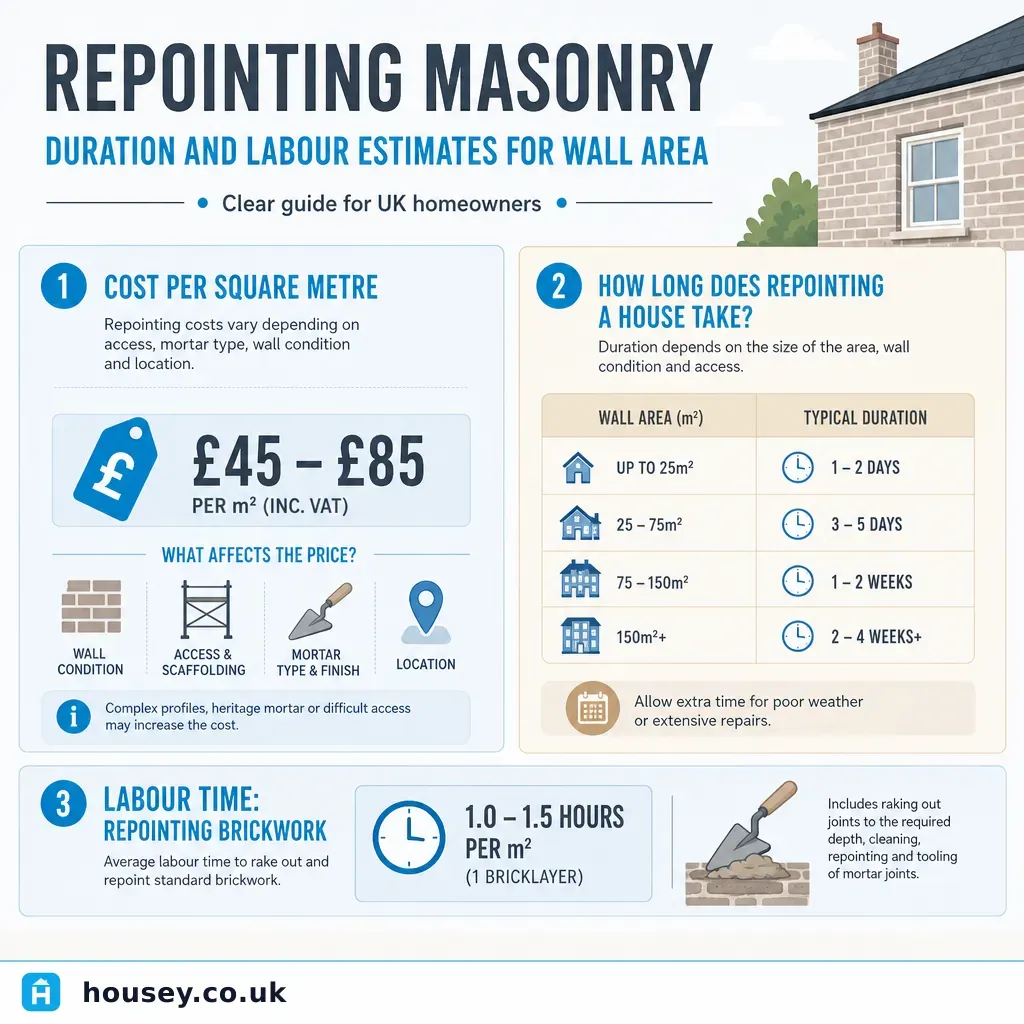
Repointing Masonry: Duration and Labour Estimates for Wall Area
A skilled bricklayer typically repoints 3–5 m² per hour when raking out and refilling joints by hand.
 Improvement & Build
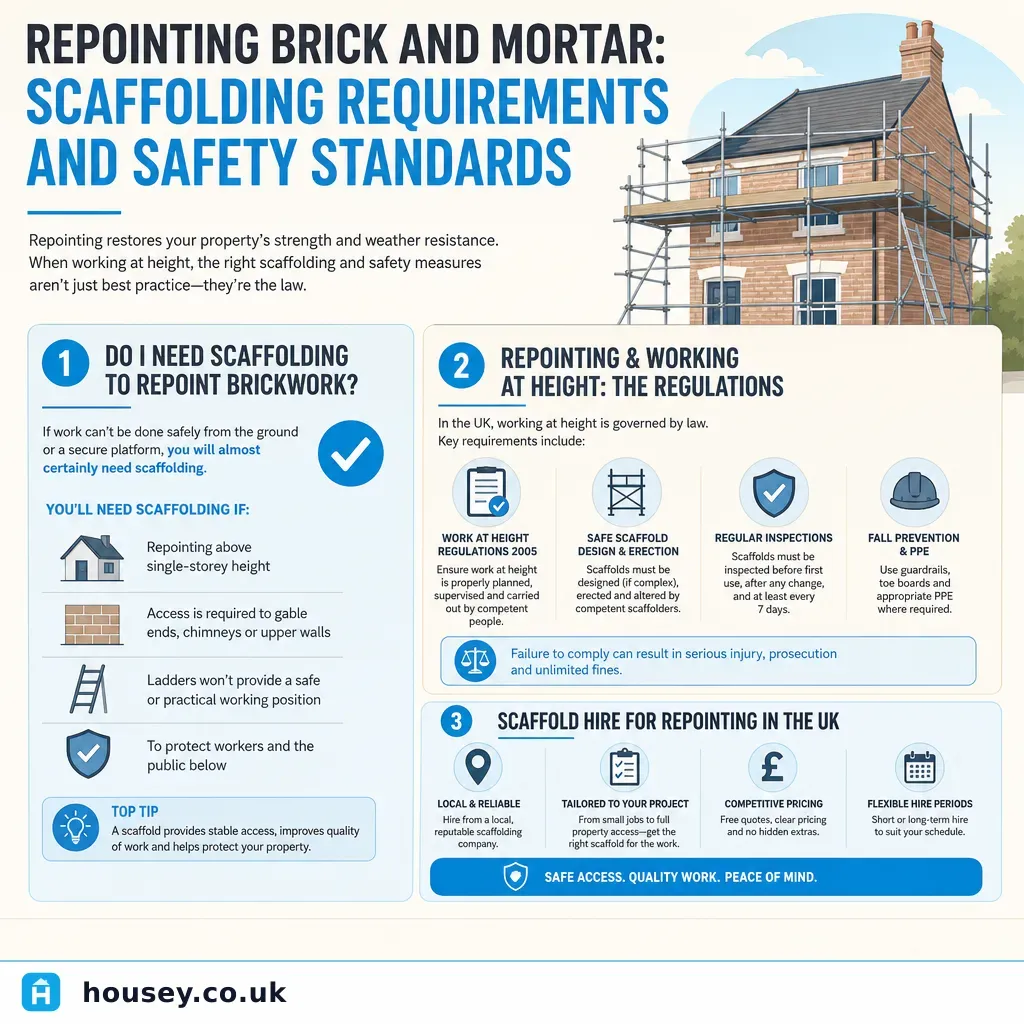
Repointing Brick and Mortar: Scaffolding Requirements and Safety Standards
Most repointing on two-storey or gable elevations requires full scaffolding under the Work at Height Regulations 2005.
 Improvement & Build
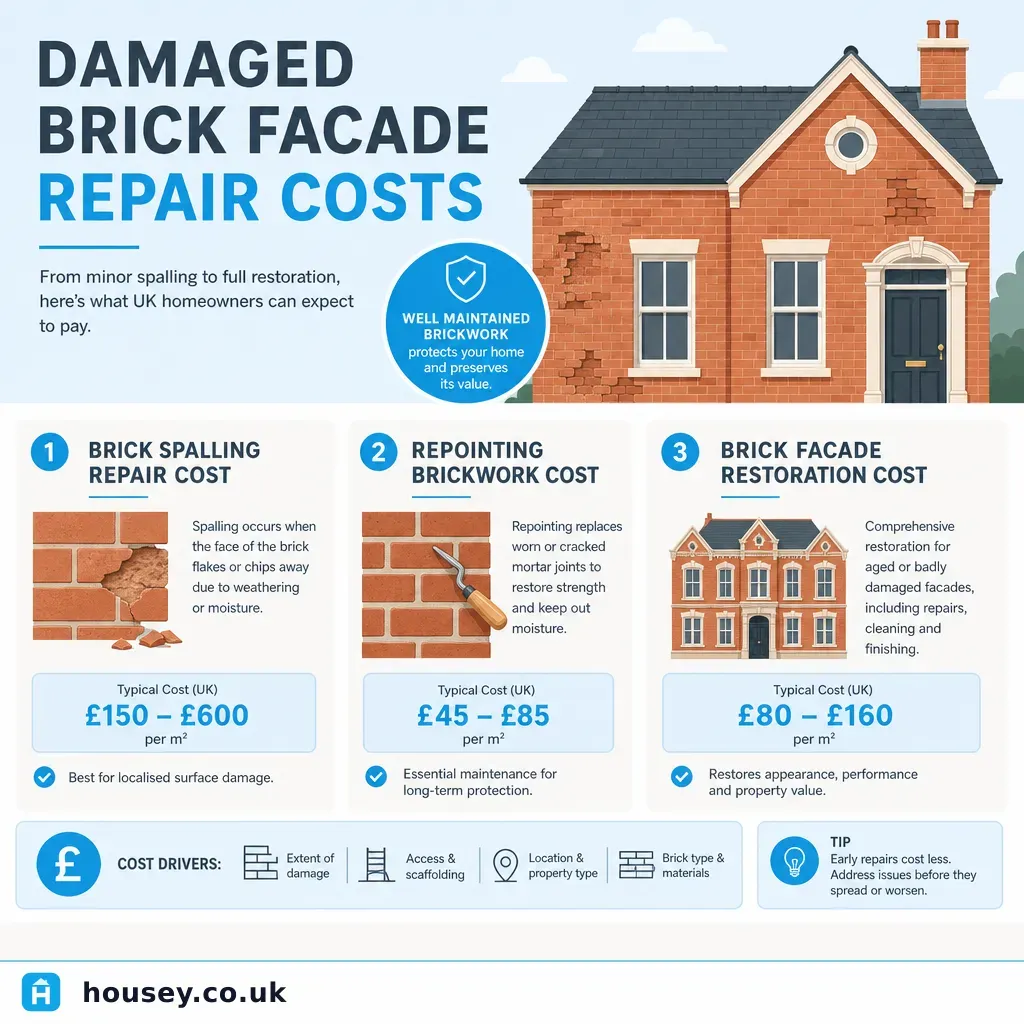
Damaged Brick Facade Repair Costs
Repairing a damaged brick facade in the UK typically involves repointing mortar joints, replacing spalled bricks, or full masonry restoration.
 Improvement & Build
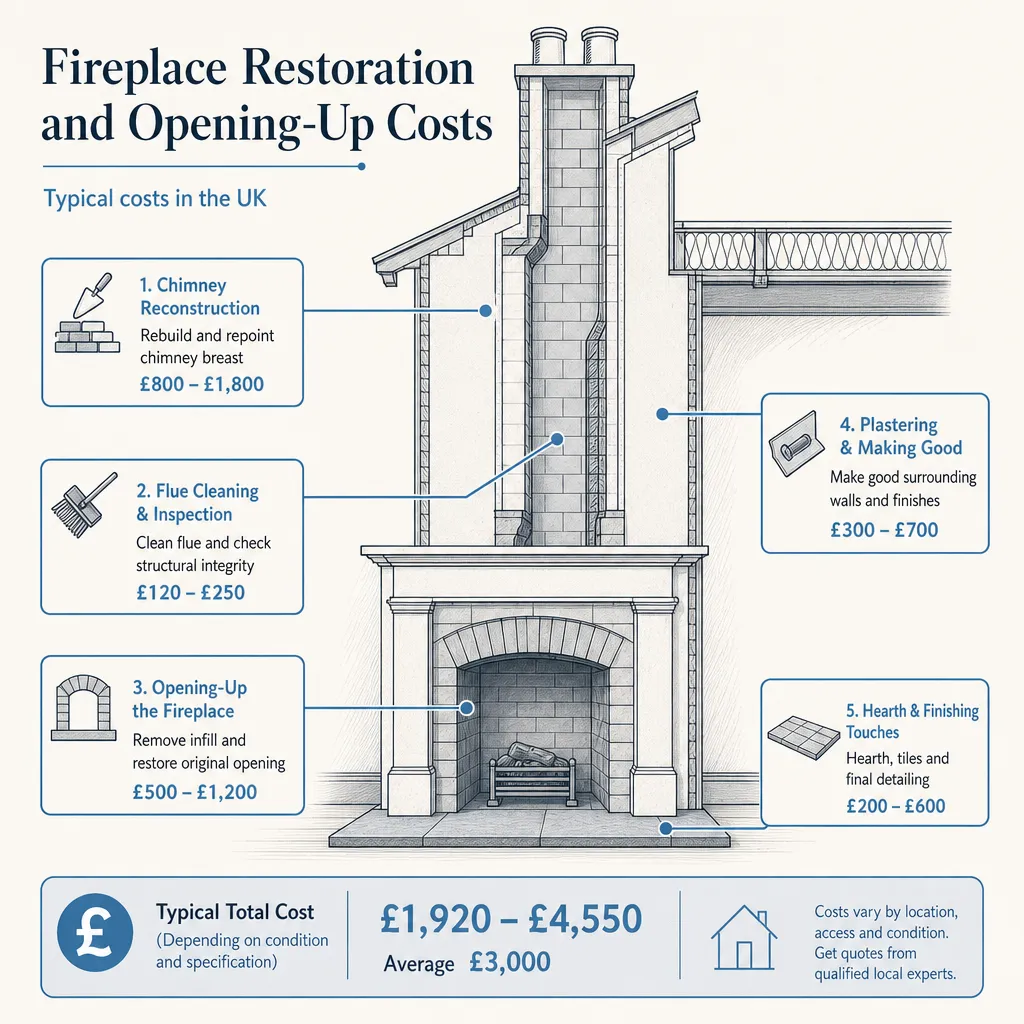
Fireplace Restoration and Opening-Up Costs
Opening up a blocked fireplace in the UK typically costs £300–£1,500 for straightforward unblocking and minor repairs, rising to £3,000–£5,000 or more if chimney lining, structural work, or period restoration is needed.
 Improvement & Build
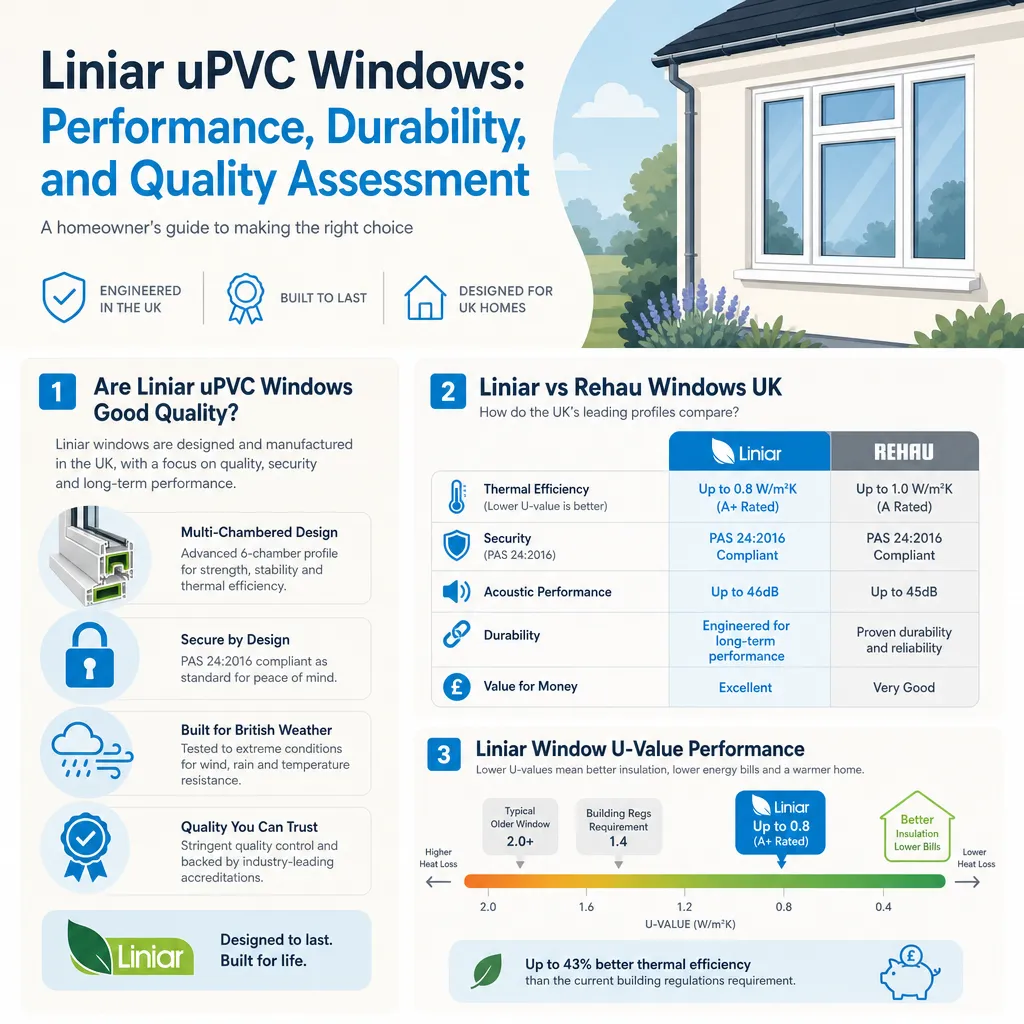
Liniar uPVC Windows: Performance, Durability, and Quality Assessment
Liniar uPVC window profiles are manufactured in the UK using multi-chambered, foamed frames.