Repointing Brick and Mortar: Scaffolding Requirements and Safety Standards
By Housey · Last reviewed 4th of May 2026
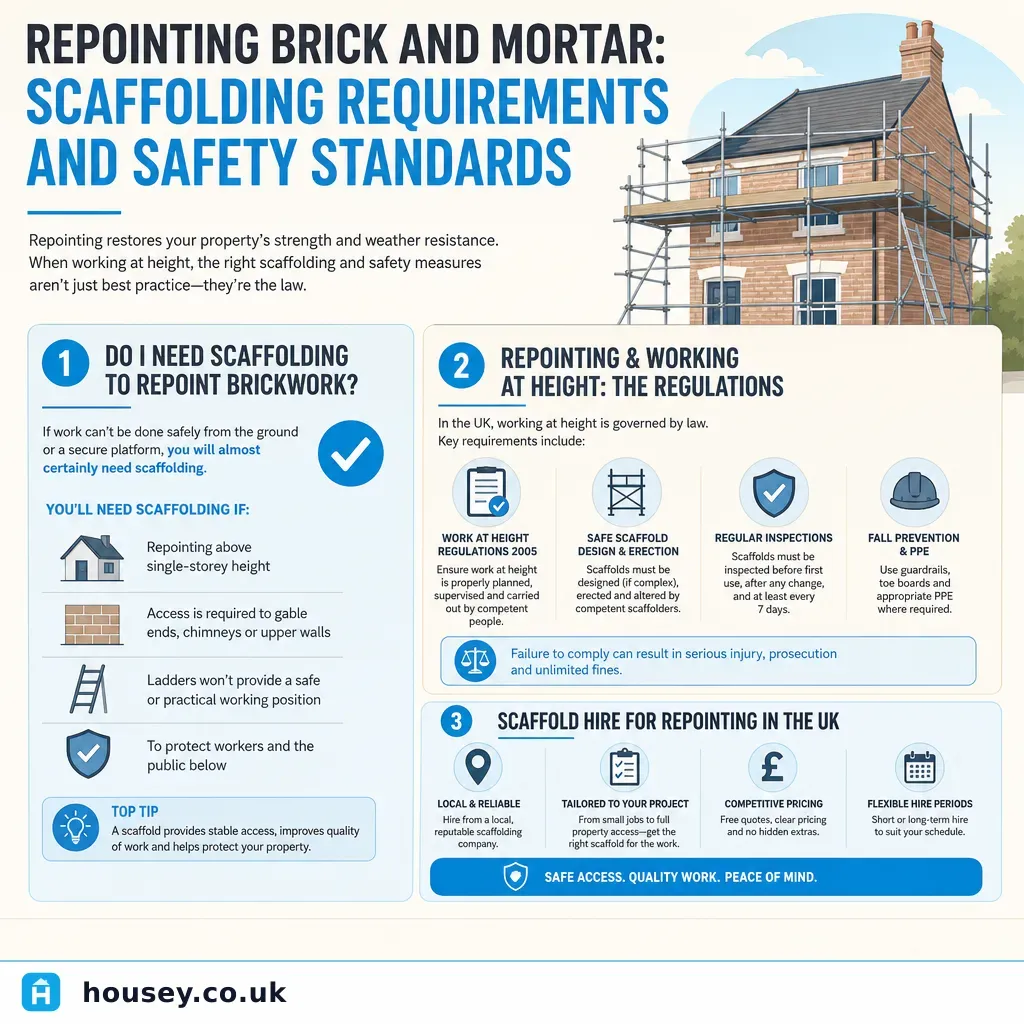
Repointing Brick and Mortar: Scaffolding Requirements and Safety Standards
Mortar joints are one of the first elements of a brick or stone property to deteriorate, and repointing is a routine part of maintaining any UK home built in brick, block, or stone. The question of how to access the work safely — particularly on two-storey or gable-end elevations — arises at every stage of appointing a contractor and reviewing a quote. Getting the access method wrong exposes workers and homeowners to serious injury risk and potential legal liability under UK health and safety law.
Key points
- The Work at Height Regulations 2005 (SI 2005/735) require any employer or self-employed person to ensure work at height is properly planned, supervised, and carried out safely — this applies to all repointing contractors operating in the UK.
- Any scaffold structure erected on a UK building site must be designed, erected, and inspected by a competent person, typically following NASC TG20:21 guidance for tube-and-fitting scaffolding.
- Mobile aluminium scaffold towers must be erected in accordance with PASMA guidance; operators should hold a PASMA certificate of competency.
- Scaffolding must be formally inspected every seven days and immediately after any event that could have affected its stability, with a written inspection record kept on site throughout the project.
- Using a ladder as the primary means of access for prolonged repointing is not compliant with the Work at Height Regulations 2005; a ladder may only be used for short-duration, low-risk tasks where a safer method is not reasonably practicable.
What is repointing and when is access equipment needed?
Repointing involves removing deteriorated mortar from the joints between bricks, blocks, or stones and replacing it with a fresh mortar mix. Signs that repointing is overdue include recessed or crumbling joints, powdering mortar, staining, and damp ingress around window reveals or cills.
Access equipment becomes necessary as soon as work moves above arm's reach from a stable ground surface. In practice this means:
- Any repointing above roughly 2.5 metres from ground level will require suitable access equipment.
- Full elevations of a two-storey UK house (typically 5–7 metres to the eaves) require either a full scaffold or a Mobile Elevating Work Platform (MEWP).
- Chimneys and parapet walls require access equipment regardless of the building's general height.
Falls from height remain the single largest cause of fatal workplace injuries in construction in Great Britain, according to HSE statistics. The Work at Height Regulations 2005 apply to all people who work at height, including self-employed subcontractors and specialist tradespeople.
Which access method is right for repointing?
The right choice depends on the height of the work, the extent of the repointing, site layout, and the duration of the project.
Access method | Best for | Not ideal for | Indicative UK cost | Key standard or certification |
|---|---|---|---|---|
Full tube-and-fitting scaffold | Whole-elevation repointing on two-storey+ buildings; projects lasting more than a few days | Restricted or very tight access sites | £800–£3,000+ depending on size and duration (indicative, last reviewed 2026-05-04) | NASC TG20:21; BS EN 12811 |
System scaffold (e.g. Kwikstage) | Medium-duration projects where faster erect and strike is beneficial | Less adaptable to complex or irregular facades | Similar to tube-and-fitting; contractor-specific | NASC guidance; BS EN 12811 |
Mobile aluminium tower (PASMA tower) | Localised repointing at low-to-medium heights; single-storey elevations | Uneven or soft ground; sustained high-level work | £60–£180 per week hire (indicative, last reviewed 2026-05-04) | PASMA guidance; BS 1139-6 |
Mobile Elevating Work Platform (MEWP) | Spot repairs; restricted sites where scaffold is impractical | Sustained full-elevation work | £150–£450 per day hire (indicative, last reviewed 2026-05-04) | IPAF operator licence required; LOLER inspection |
All cost figures are indicative UK costs, last reviewed 2026-05-04. Prices vary by region, supplier, and site conditions — always request itemised quotes.
Scaffolding inspection and legal requirements
Under the Work at Height Regulations 2005, any scaffold used for construction work must be:
- Inspected before first use — a written inspection record must be made and kept available on site.
- Inspected every seven days — a competent person must carry out and sign the inspection record.
- Inspected after any event that could have affected stability — including severe wind, heavy snow loading, or accidental impact.
- Designed and erected by a competent person — NASC membership is a widely recognised mark of scaffolding competence in the UK.
The inspection record (sometimes called a Scafftag or scaffold inspection report) must remain on site throughout the project. As a homeowner, you are entitled to ask to see the current inspection record before works continue.
NASC TG20:21 provides the standard design guidance for tube-and-fitting scaffolding. For proprietary system scaffolding, the manufacturer's erection guide takes precedence.
Do contractors need a licence for scaffolding on a public highway?
A temporary scaffold for repointing works does not usually require planning permission — it is normally covered as a Permitted Development matter for short-duration structures under the Town and Country Planning (General Permitted Development) (England) Order 2015. However:
- If the scaffold overhangs a public pavement or road, a Section 169 licence under the Highways Act 1980 is normally required from the local highway authority. Your scaffolding contractor should arrange this on your behalf.
- In conservation areas or for listed buildings, check with your local planning authority before erecting scaffold over a public highway — additional conditions may apply.
- The scaffold licence is separate from any planning or building regulations consent needed for the repointing works themselves.
Homeowner checklist before repointing begins
Use this checklist before the first scaffold board goes up and before repointing commences:
Which professional do you need?
A repointing project involving scaffold often requires more than one trade. This table summarises the key roles:
Role | What they do | Who to look for |
|---|---|---|
Scaffolding contractor | Designs, erects, inspects, and strikes the scaffold | NASC member — check the NASC online directory |
Repointing or masonry contractor | Removes deteriorated mortar and applies new mix | CSCS card holder with experience in the appropriate mortar type for the building age |
Structural engineer | Required if cracks or wall movement are suspected before repointing begins | Chartered MIStructE or FIStructE; RICS |
Damp surveyor | Required if suspected damp ingress behind mortar joints | CSSW or CSRT qualified surveyor |
Decision tree: which access method should you choose?
- Is the repointing confined to a single-storey area below 3.5m? → A PASMA-certified mobile aluminium tower or MEWP may be sufficient. Check the ground surface is level, firm, and suitable for the tower base.
- Is repointing needed across a full two-storey or gable elevation? → Full scaffold is usually the most cost-effective and compliant option for sustained work at this height.
- Is the site too narrow or restricted for full scaffold? → A MEWP may suit localised spot repairs — discuss the full scope with the contractor before committing to this approach.
- Does the chimney or roof area need attention alongside the elevation? → Full scaffold is normally required; confirm whether the design needs to extend above eaves level.
- Are you in a conservation area or working on a listed building? → Check with the local planning authority before erecting any scaffold over a public highway or footpath.
- Are cracks, bowing, or movement visible before repointing begins? → Ask a chartered surveyor or structural engineer to inspect before any access equipment is erected.
Important limitations
This article provides general information about scaffolding requirements and working-at-height legislation for repointing works in the UK. Requirements can vary depending on the property, site conditions, local authority rules, and the nature and extent of masonry defects identified. This article is not a substitute for a professional assessment of your specific building and project. Scaffold design, erection, and repointing must always be carried out by competent, appropriately insured contractors.
What to ask a qualified professional
Before instructing a scaffolding contractor or repointing specialist, ask:
- Are you a NASC member (for scaffolding), or do you hold a CSCS card with relevant masonry experience (for repointing)?
- Can you provide a written method statement and risk assessment before works begin?
- Who will carry out scaffold inspections, how frequently, and will written records be kept on site throughout?
- If the scaffold overhangs a public pavement, will you obtain the required Section 169 Highways Act licence?
- What mortar mix specification will you use, and is it appropriate for the age and construction type of this building?
- Do you hold adequate public liability insurance, and can I see the current certificate before works start?
- Have you identified any structural defects, cracking patterns, or damp concerns during your initial inspection?
When to get professional help
Always instruct a qualified scaffolding contractor for any repointing work above 2 metres — do not attempt to erect scaffold without appropriate NASC or PASMA training. Seek structural engineering or surveying advice before repointing commences if you notice any of the following:
- Stepped cracking running through brickwork or mortar joints.
- Bowing, leaning, or bulging sections of wall.
- Cracks wider than approximately 5mm, particularly if of recent origin or visibly growing.
- Spalling brickwork, detachment of the outer leaf, or visible voids in the mortar bed.
These signs may indicate structural movement that repointing alone cannot resolve and which could be worsened by working on the facade.
How Housey can help
Housey connects UK homeowners with vetted local contractors for masonry, repointing, and building improvement work. Use Housey to request quotes from multiple specialists, compare credentials and insurance, and find the right professional for your project safely and efficiently.
Frequently asked questions
Do I need scaffolding for repointing a two-storey house?
Yes, in almost all cases. Full-elevation repointing on a two-storey UK house requires sustained access at heights typically between 3.5 and 7 metres. The Work at Height Regulations 2005 require proper, inspected access equipment at these heights. Most reputable masonry contractors will insist on full scaffold for whole-elevation work rather than rely on a ladder.
Can I use a ladder for repointing brickwork?
A ladder may only be used for short-duration, low-risk repointing tasks where a safer alternative is not reasonably practicable under the Work at Height Regulations 2005. Sustained repointing from a ladder is not compliant with UK legislation and significantly increases the risk of a fall. A competent contractor will specify appropriate access equipment for the scope of work.
Who is responsible for scaffold safety on a domestic repointing project?
The scaffolding contractor is responsible for designing, erecting, and maintaining the scaffold safely. The repointing contractor is responsible for using it within its stated safe loading limits. As a domestic client on a small project your formal duties under the Construction (Design and Management) Regulations 2015 are limited, but you should always appoint competent, insured contractors and ask to see current inspection records.
How long does scaffolding typically stay up for repointing?
This depends on the extent of the works. Repointing a full elevation of a standard UK semi-detached house typically takes 2–5 working days; scaffold is often hired for 1–3 weeks to allow for setup, the repointing works, and a mortar curing period. Ask your contractor to specify the expected scaffold hire duration in the written quote before accepting it.
Will scaffolding damage my brickwork or property?
A correctly erected scaffold should not damage the property if base plates are properly positioned and protective padding is used at all contact points with the building. If damage does occur, the scaffolding contractor's public liability insurance should cover reasonable reinstatement costs. Always confirm the level of cover and ask to see the current policy schedule before works begin.
Sources and further reading
- Work at Height Regulations 2005 — legislation.gov.uk
- Working at height: a brief guide — Health and Safety Executive
- National Access and Scaffolding Confederation — NASC
- PASMA: Prefabricated Aluminium Scaffolding Manufacturers Association — PASMA
- Falls from height statistics — Health and Safety Executive
- Construction (Design and Management) Regulations 2015 — legislation.gov.uk
Useful next reads
 Improvement & Build
Masonry Repointing Costs and Best Practices
Masonry repointing in the UK typically costs £20–£60 per m² for labour and materials, with scaffold adding £600–£1,500 or more depending on height and access.
 Improvement & Build
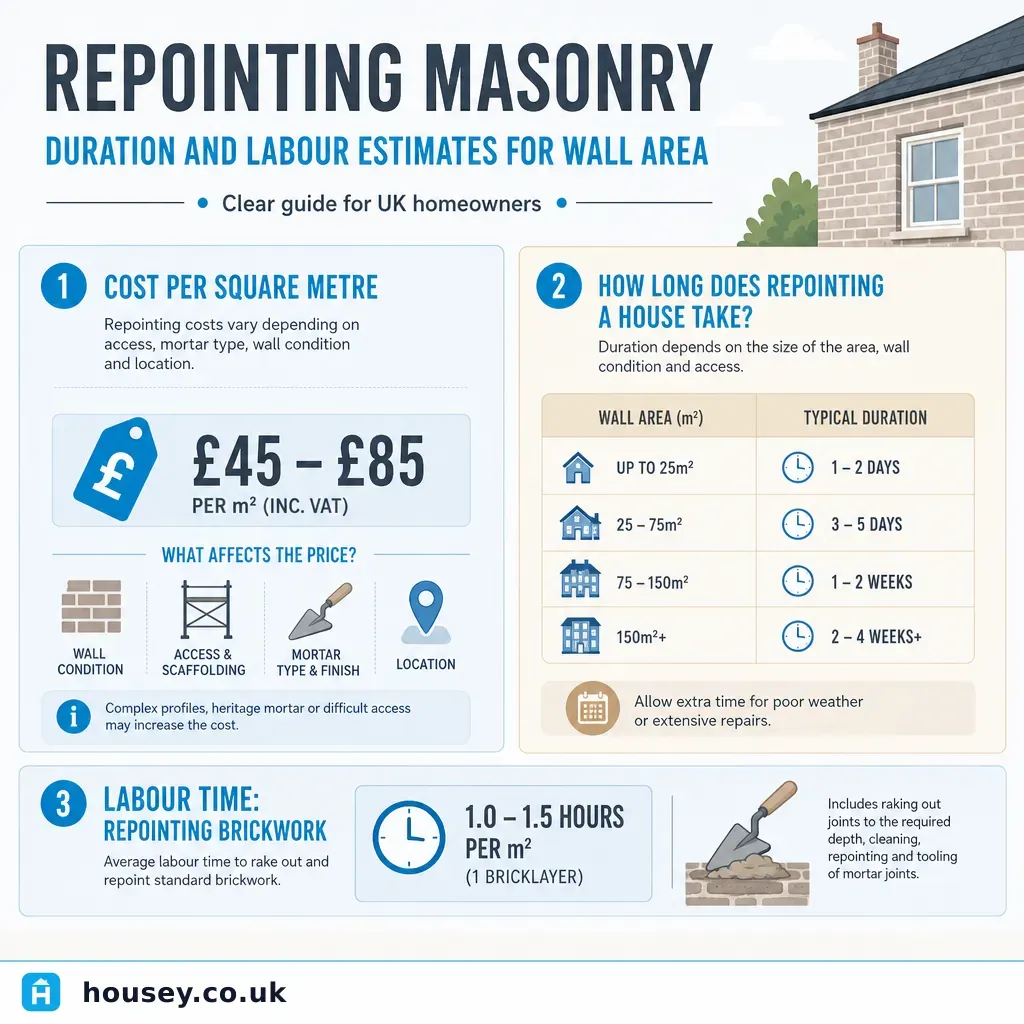
Repointing Masonry: Duration and Labour Estimates for Wall Area
A skilled bricklayer typically repoints 3–5 m² per hour when raking out and refilling joints by hand.
 Improvement & Build
Damaged Brick Facade Repair Costs
Repairing a damaged brick facade in the UK typically involves repointing mortar joints, replacing spalled bricks, or full masonry restoration.
 Improvement & Build
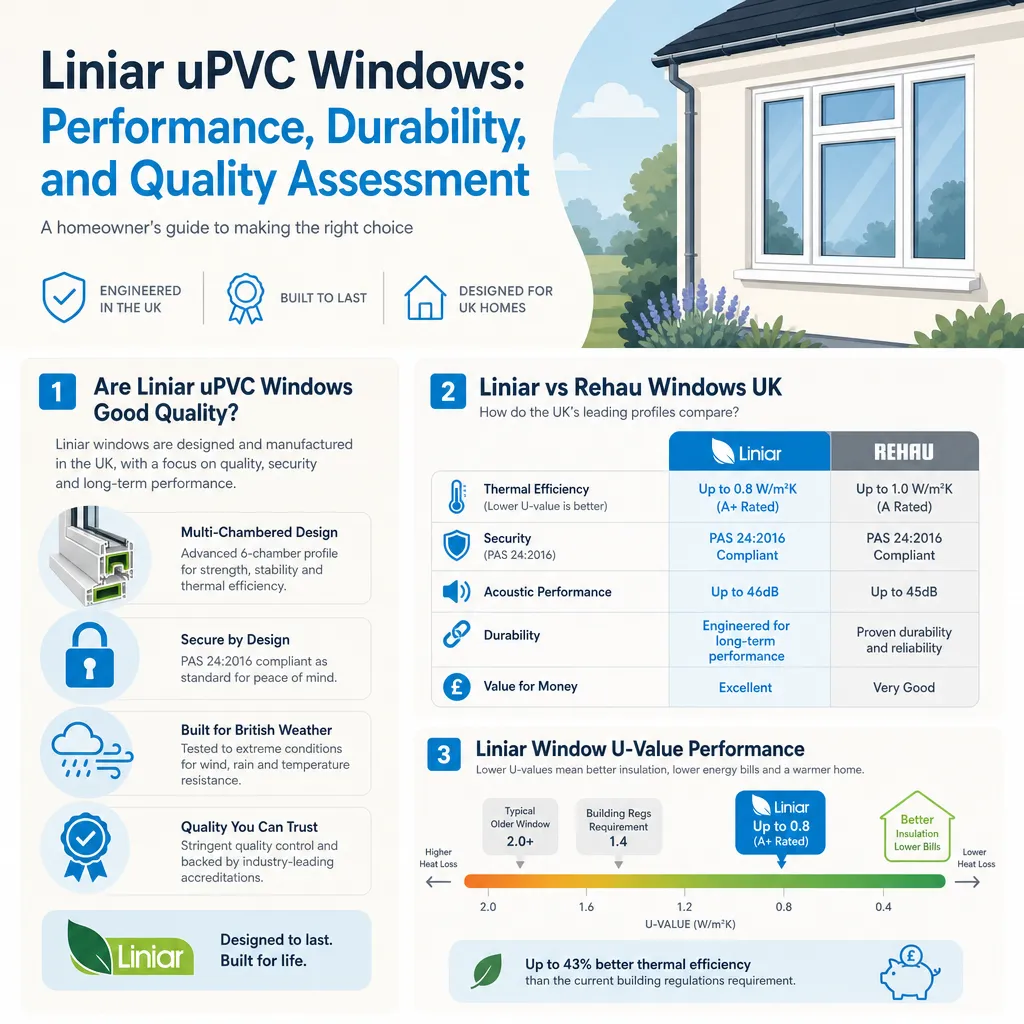
Liniar uPVC Windows: Performance, Durability, and Quality Assessment
Liniar uPVC window profiles are manufactured in the UK using multi-chambered, foamed frames.
 Improvement & Build
Garden Tap Installation with Hot and Cold Water: Plumbing Options
Adding a cold garden tap is a common DIY project, but routing hot water outdoors requires a plumber to connect to your domestic hot water system and comply with the Water Supply (Water Fittings) Regulations 1999.