Maximising Insulation Space: Advanced Roof Design Techniques for Energy Efficiency
By Housey · Last reviewed 31st of May 2026
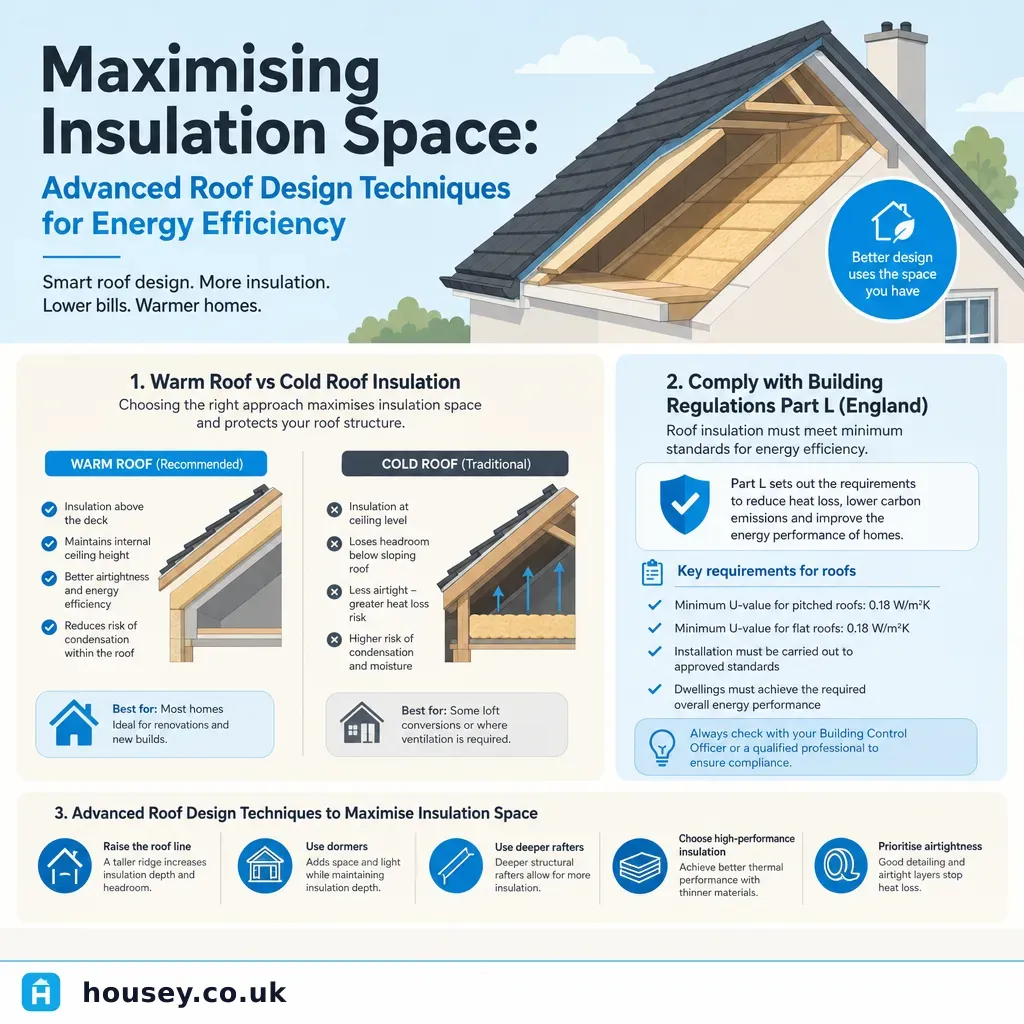
Maximising Insulation Space: Advanced Roof Design Techniques for Energy Efficiency
Roof construction decisions made at the design or refurbishment stage determine how much insulation a home can carry — and how well it performs over decades. For UK homeowners planning a new roof, loft conversion, or energy retrofit, the gap between adequate and optimal insulation depth can mean hundreds of pounds in annual heating costs and a meaningful shift in EPC rating. Building Regulations Part L, rising energy costs, and increasingly demanding retrofit funding criteria have made roof thermal performance a priority from the outset of any project.
Key points
- Building Regulations Approved Document L (2021) requires roofs in new dwellings to achieve a U-value of 0.16 W/m²K or better.
- Warm roof designs place all insulation above the structural deck, eliminating thermal bridging through rafters and removing the need for ventilation above the insulation layer.
- Raised heel trusses allow full-depth insulation to run continuously from wall plate to ridge, including at the eaves — increasing effective depth from around 100 mm to 300 mm or more.
- BS 5250:2021 (management of moisture in buildings) requires a minimum 50 mm ventilated airspace above insulation in cold roof constructions.
- PAS 2030:2019 and PAS 2035:2019 set the quality standard for retrofit insulation installed under government-funded schemes including ECO4 and the Great British Insulation Scheme (GBIS).
Warm roof versus cold roof: which configuration suits your project?
The fundamental choice in roof insulation design is whether to use a warm roof or a cold roof configuration.
In a warm roof, all insulation sits above the structural deck, so the structure itself remains at or near indoor temperature. This eliminates thermal bridging through rafters or joists and removes the need for a ventilated void above the insulation layer. Warm roofs are most commonly specified on flat and low-pitch roofs and are increasingly used on new-build pitched roofs to maximise thermal performance.
In a cold roof, insulation sits between or below the structural elements — typically between and over ceiling joists in a loft. The roof space itself is unheated and ventilated to manage moisture. Cold roofs remain the most common UK retrofit approach because loft access makes installation relatively straightforward.
Roof type | Best for | Insulation position | Ventilation required | Typical U-value achievable |
|---|---|---|---|---|
Warm roof (flat or low-pitch) | Flat roofs; new build; full re-roofs | Above structural deck, below waterproofing | None above insulation | 0.10–0.16 W/m²K |
Cold roof (pitched) | Existing accessible lofts; retrofit; cost-sensitive projects | Between and above ceiling joists | 50 mm clear airspace above (BS 5250) | 0.13–0.18 W/m²K |
Hybrid (over-rafter + between-rafter) | Complex pitched roofs; loft conversions | Between and over rafters, with VCL | Ventilation path maintained to ridge | 0.13–0.16 W/m²K |
Room-in-roof | Habitable loft conversions | Between and over rafters; VCL required | Careful detailing essential | 0.15–0.18 W/m²K |
Techniques for increasing insulation depth
Raised heel trusses
Standard trussed rafters often reduce insulation to as little as 100 mm at the eaves — well below the 270 mm recommended by the Energy Saving Trust for mineral wool. Raised heel (energy heel) trusses create additional depth at the eaves so insulation runs at full thickness across the entire ceiling plane without compression. This is increasingly standard in new-build specifications and is worth specifying at design stage for any re-roof project.
Over-rafter insulation boards
On pitched roofs undergoing a full re-roof, rigid insulation boards fixed above the existing rafter line allow substantial thickness without reducing headroom inside. This technique — sometimes called sarking insulation — works well with retained or reclaimed tiles. Counter-battens above the boards maintain the correct tile batten position. Combined with between-rafter insulation, this hybrid approach can achieve U-values approaching 0.13 W/m²K with suitable products.
Blown insulation for inaccessible voids
Where roofs have complex geometry — hip ends, valley sections, dormer cheeks — blown cellulose or mineral wool can fill voids that are impractical to insulate with batts. This technique is also used to top up cold loft insulation without disturbing existing material. A competent installer will assess access points and injection locations before quoting.
Vapour control layers
In warm and hybrid roof constructions, a correctly specified and installed vapour control layer (VCL) on the warm side of the insulation prevents moisture-laden air from inside the home migrating into the insulation layer and condensing. Detailing at junctions, eaves, and penetrations is critical — a poorly installed VCL provides little protection.
Building Regulations compliance
Any replacement roof covering on an existing building triggers a requirement to improve thermal performance where the roof currently falls below the threshold, under Regulation 23 of the Building Regulations and Approved Document L1B. The limiting fabric standard for existing pitched roofs is a U-value of 0.16 W/m²K where technically and economically feasible.
For loft conversions, Approved Document L1B requires both the new habitable roof space and any retained cold loft to meet current standards. Building control will typically require a U-value calculation demonstrating compliance, along with confirmation of insulation product lambda (λ) values and installed thickness.
Work installed under ECO4 or GBIS must be carried out by a TrustMark-registered, PAS 2030-certified contractor. Where two or more measures are installed as part of a wider retrofit project, PAS 2035 applies and a qualified Retrofit Coordinator must oversee the work, managing interactions between measures — including moisture and ventilation risk.
Homeowner checklist: before commissioning roof insulation work
Red flags: when to question a specification or quote
- The installer cannot provide a calculated U-value or a named insulation product with a stated lambda value.
- A cold roof specification makes no mention of ventilation provisions above the insulation or below the sarking felt or breather membrane.
- Over-rafter insulation is proposed without counter-battening, which can trap moisture beneath tiles.
- Blown insulation is quoted for a roof where previous water ingress, mould, or rot has not been investigated and remedied first.
- A loft conversion quote contains no reference to a vapour control layer or moisture management strategy.
- The contractor is not registered with TrustMark and cannot demonstrate PAS 2030 certification, yet is offering to apply for ECO4 funding on your behalf.
When to get professional help
Most cold loft top-ups are straightforward and can be completed quickly by a competent insulation installer. More complex projects benefit from professional input at the design stage.
Seek specialist advice if:
- You have had previous damp, mould, condensation, or timber rot in the roof space.
- The project involves a flat roof or low-pitch section where moisture risk is higher.
- The property is listed or in a conservation area — restrictions on roof materials and external appearance may apply.
- You are applying for ECO4 or GBIS funding and need to confirm whether a Retrofit Coordinator is required under PAS 2035.
- You are planning a loft conversion and need building control sign-off on thermal performance.
How Housey can help
Housey connects you with vetted insulation installers who can assess your roof type, specify the right solution, and confirm compliance with Part L and PAS 2030. For projects involving re-roofing or structural changes, Housey can also match you with experienced roofers. Submit a quote request to receive up to four competitive quotes from local professionals.
Frequently asked questions
How much insulation depth do I need in a cold loft?
The Energy Saving Trust recommends 270 mm of mineral wool for a cold loft — typically 100 mm between the joists and 170 mm across the top at 90° to the first layer. This achieves a U-value well below the 0.16 W/m²K required by Approved Document L. Loft boarding that compresses insulation is a common problem; raised boarding systems are available to maintain insulation depth while still providing usable storage space.
Does roof insulation work require planning permission?
Adding insulation to an existing roof typically does not require planning permission. However, if the work changes the external appearance of the roof — for example, over-rafter insulation that raises the ridge height — or the property is listed or in a conservation area, check with your local planning authority before starting. Loft conversions will usually require both planning permission and building control approval.
What is the difference between PAS 2030 and PAS 2035?
PAS 2030:2019 sets the installation standard for energy efficiency measures in existing buildings, governing the technical quality of the work itself. PAS 2035:2019 governs the wider retrofit process, including whole-house assessment, ventilation strategy, moisture risk, and interactions between measures. Both are required for ECO4-funded work; PAS 2035 applies whenever two or more measures are installed together under a funded scheme.
Why does ventilation matter in a cold roof?
In a cold roof, the airspace above the insulation must be ventilated to allow moisture-laden air to escape. Without adequate ventilation — BS 5250:2021 requires a minimum 50 mm free airspace — moisture from the home migrates upwards into the cooler roof space and condenses on structural timbers and the underside of the roof covering. Over time this can cause timber rot, mould growth, and structural damage to the roof.
Sources and further reading
- Approved Document L: Conservation of fuel and power — GOV.UK
- Roof and loft insulation guidance — Energy Saving Trust
- PAS 2035:2019 — Retrofitting dwellings for improved energy efficiency — BSI Group
- BS 5250: Code of practice for control of condensation in buildings — BSI Group
- ECO4 scheme guidance — GOV.UK
Useful next reads
 Energy & Retrofit
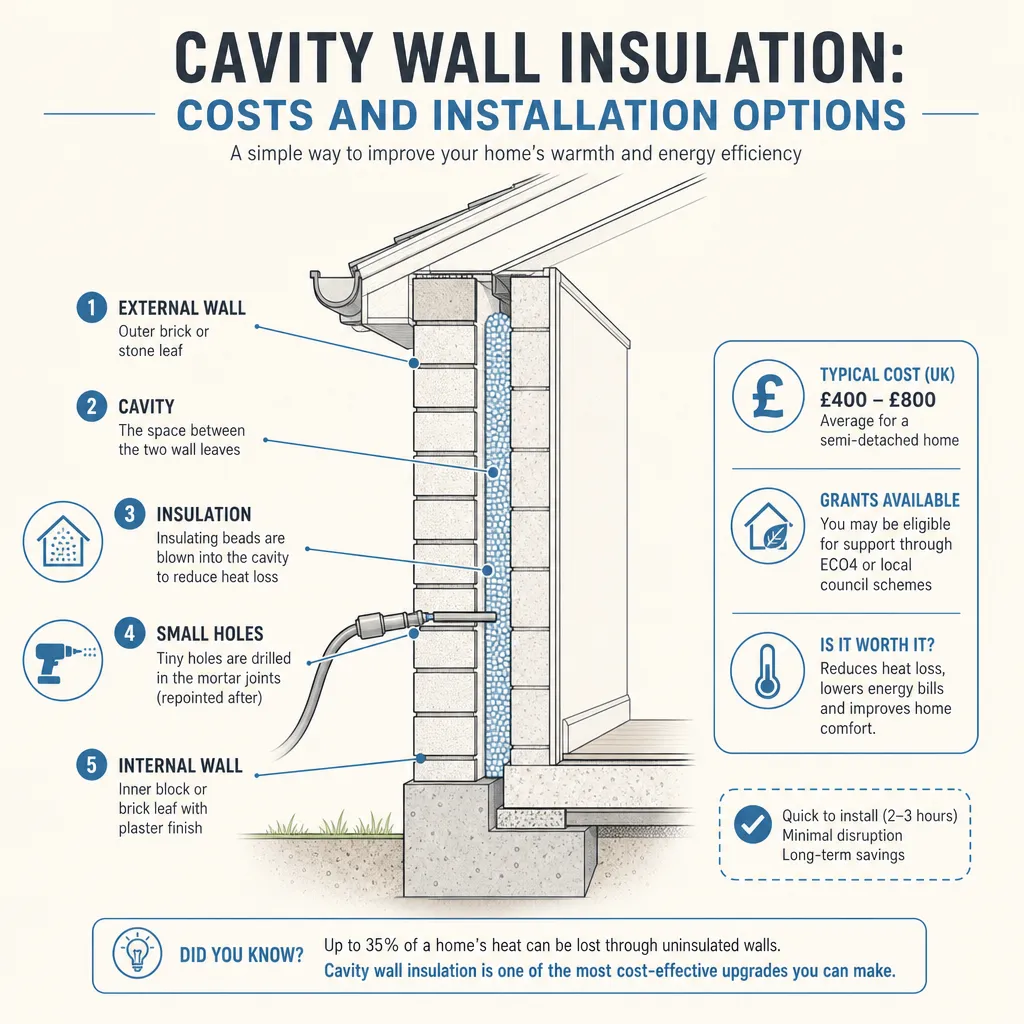
Cavity Wall Insulation: Costs and Installation Options
Cavity wall insulation typically costs £400–£1,200 for a standard UK semi-detached home, though eligible households may pay nothing under ECO4.
 Energy & Retrofit
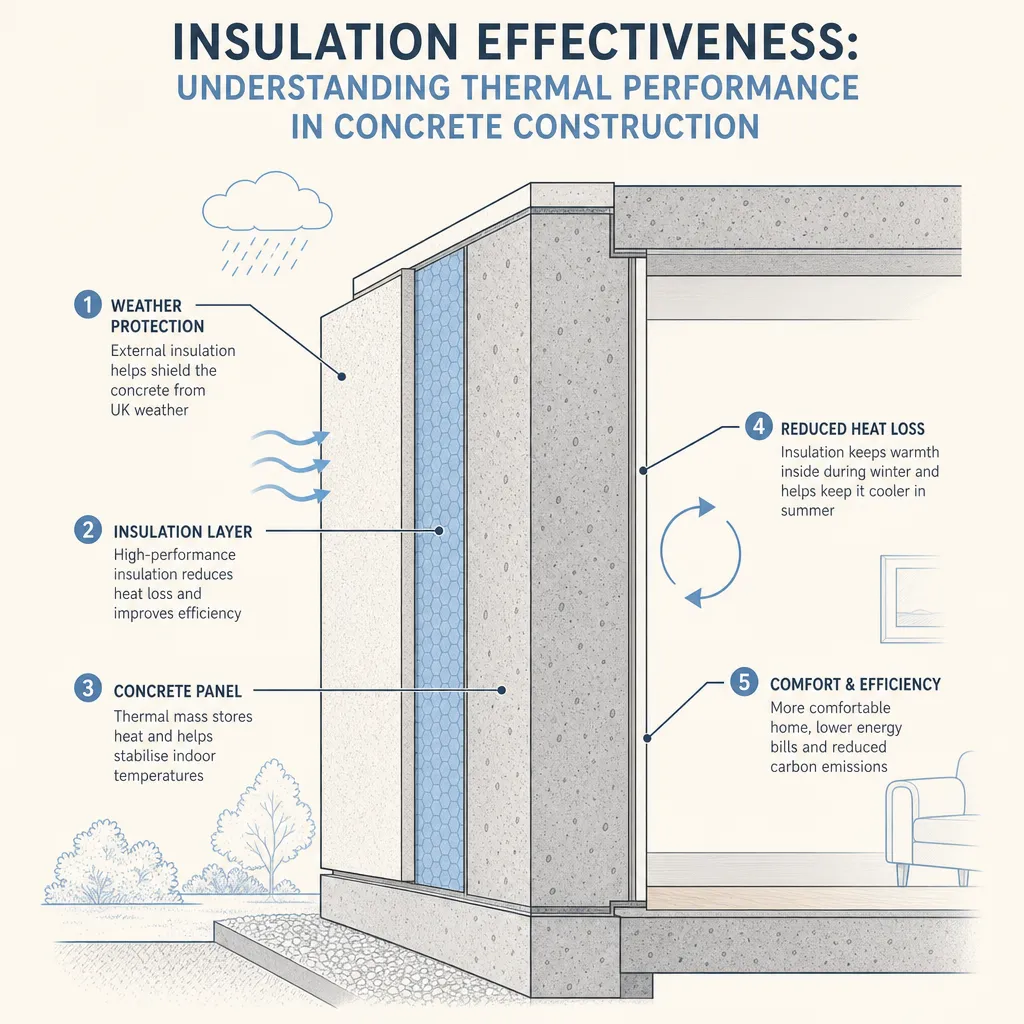
Insulation Effectiveness: Understanding Thermal Performance in Concrete Construction
Concrete is around 30–60 times more thermally conductive than mineral wool insulation.
 Energy & Retrofit
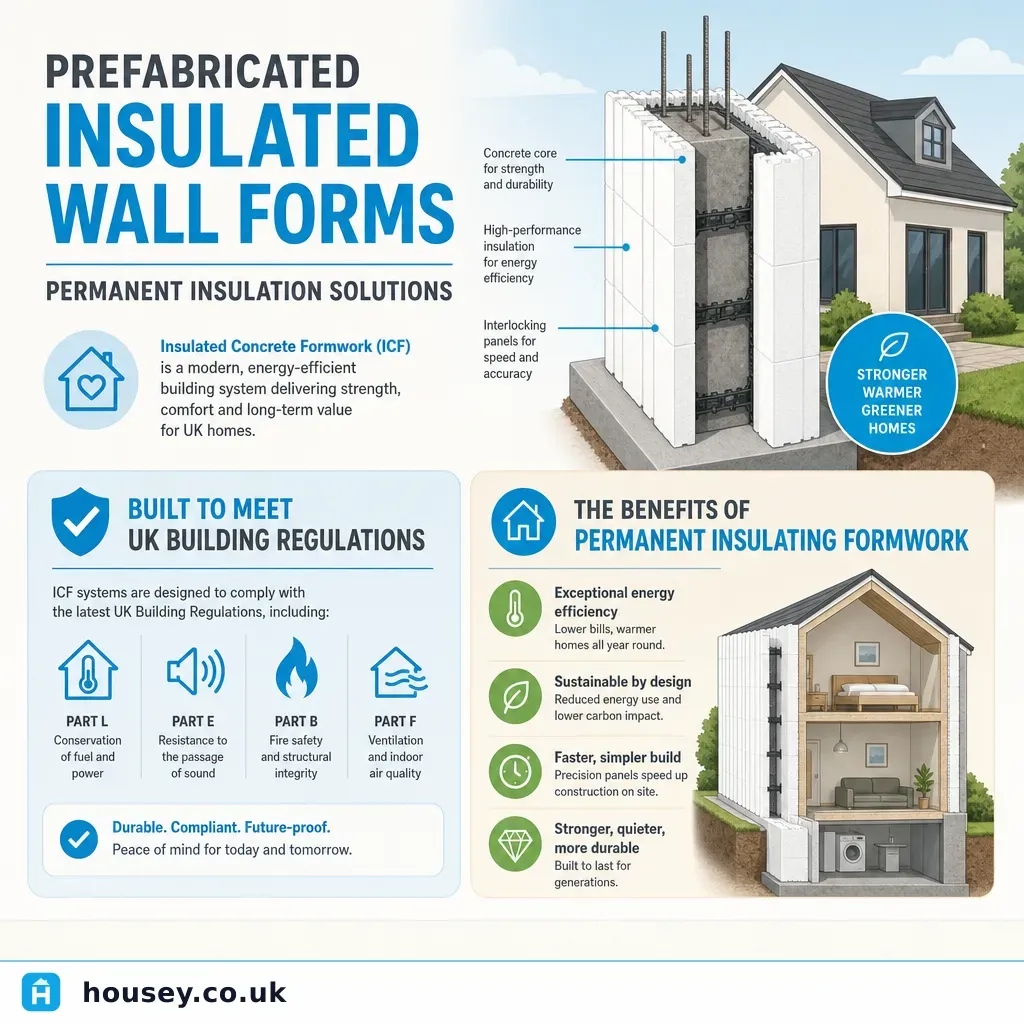
Prefabricated Insulated Wall Forms: Permanent Insulation Solutions
Prefabricated insulated wall forms — including ICF and SIPs systems — deliver high thermal performance by combining permanent insulation with structural concrete or timber in a single wall assembly.
 Energy & Retrofit
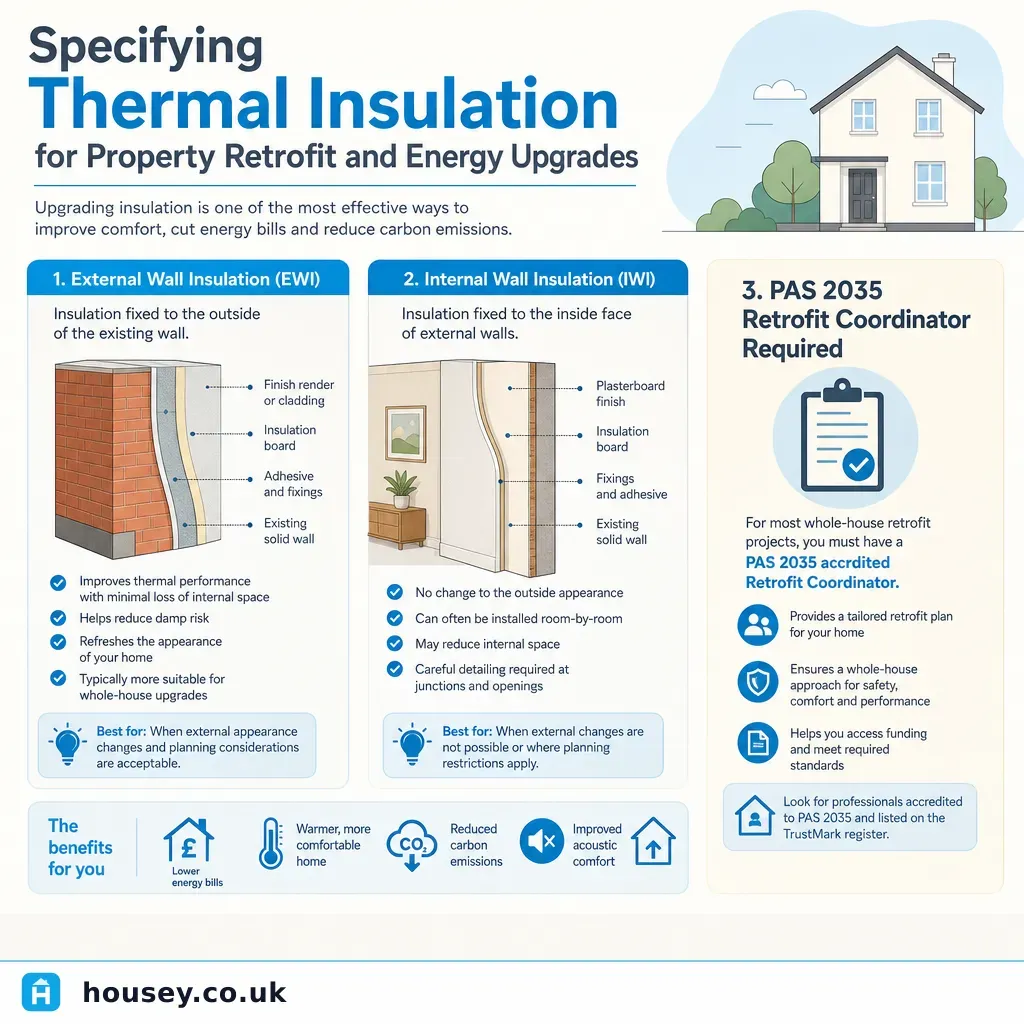
Specifying Thermal Insulation for Property Retrofit and Energy Upgrades
Specifying thermal insulation for UK retrofit requires matching the product to your property's construction, moisture conditions, and heating system.
 Energy & Retrofit
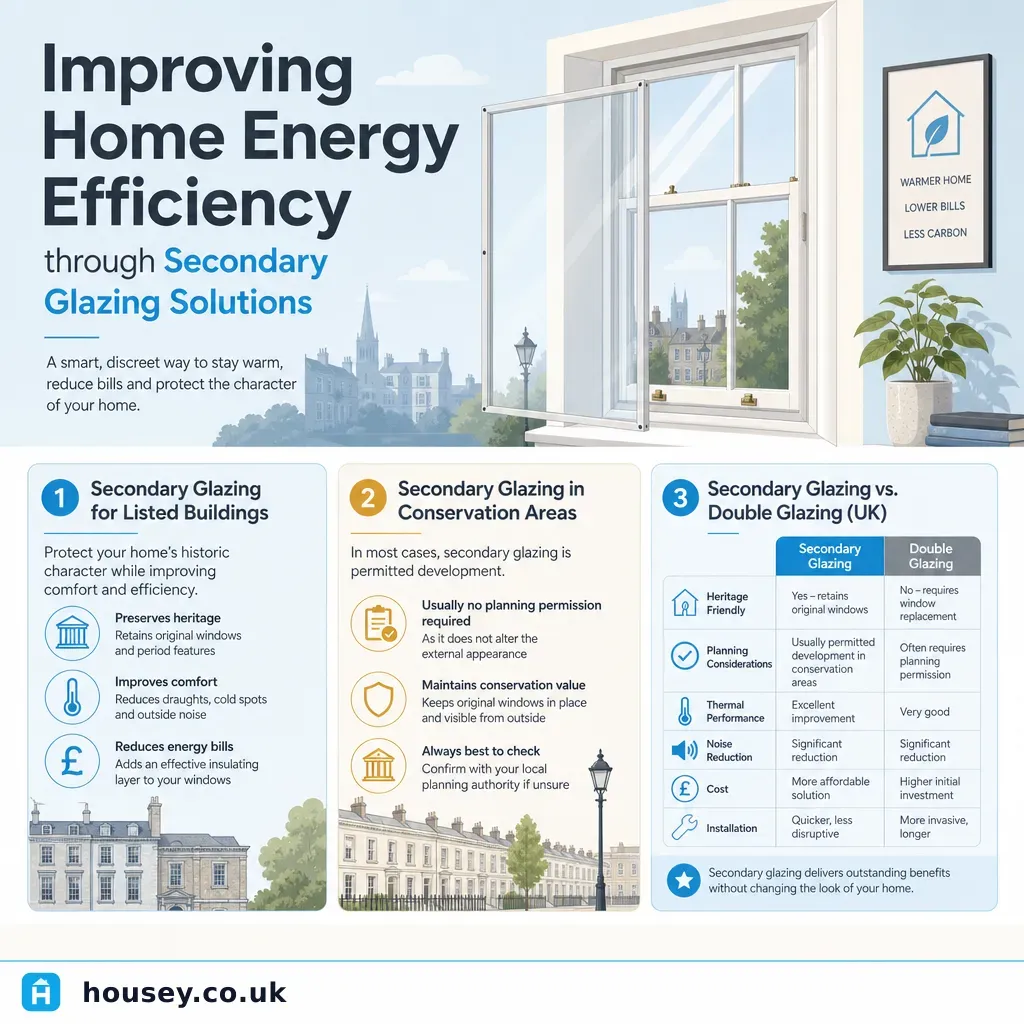
Improving Home Energy Efficiency through Secondary Glazing Solutions
Secondary glazing fits an additional pane inside your existing window reveal, reducing heat loss and noise without replacing the original frame.