Modular Extensions: A Modern Approach to Expanding Your Home
By Housey · Last reviewed 24th of May 2026
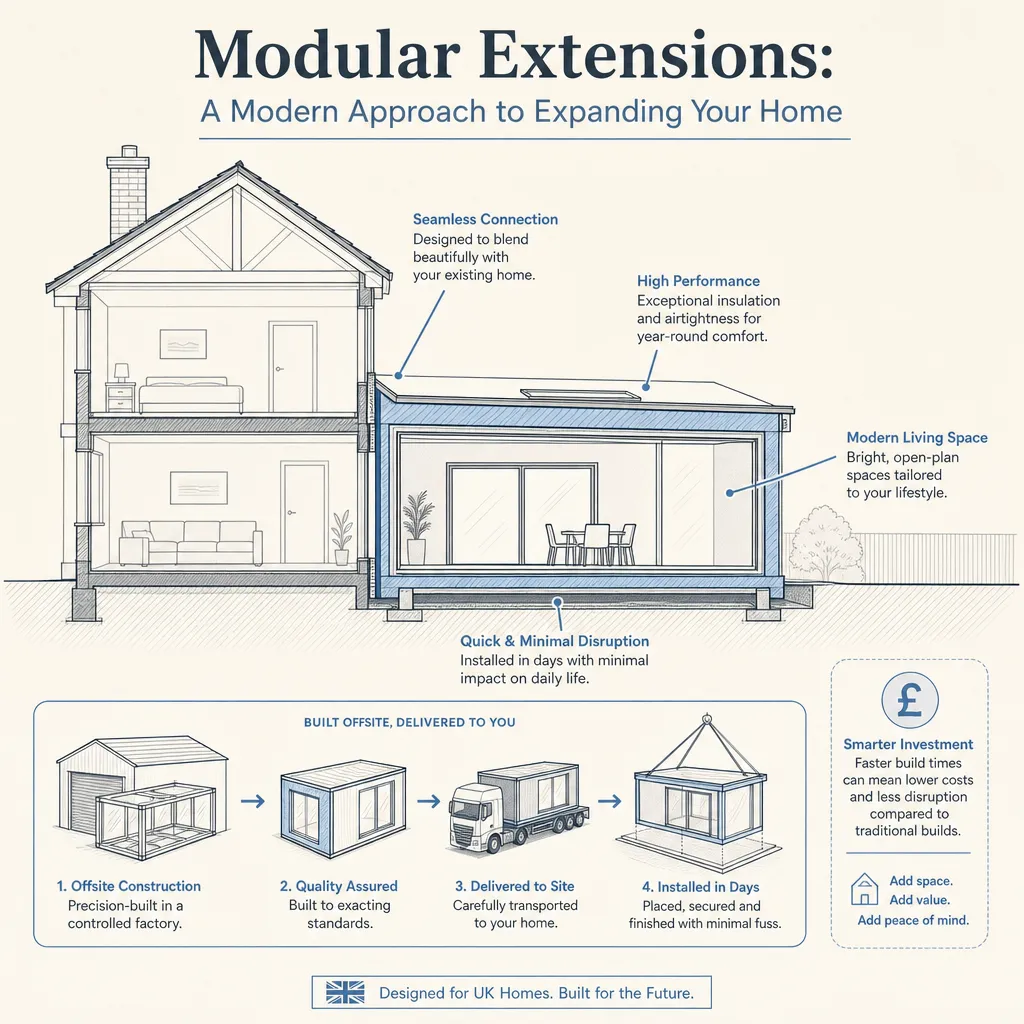
Modular Extensions: A Modern Approach to Expanding Your Home
Homeowners seeking to add space often encounter months of site disruption, unpredictable weather delays, and a build programme that stretches beyond original estimates. Modular extensions — prefabricated in a controlled factory environment and craned into position on your plot — have become a credible mainstream option for single-storey rear and side additions to Victorian terraces, 1930s semis, and post-war estates across the UK. Whether this approach suits your home depends on your site conditions, planning position, budget, and programme needs.
Key points
- Permitted development (PD) rights for single-storey rear extensions in England allow depths of up to 3 m for attached houses and 4 m for detached houses without a planning application; the neighbour consultation scheme extends these limits to 6 m and 8 m respectively via prior approval.
- On-site assembly of a modular unit typically takes 2–6 weeks, but factory lead times of 12–20 weeks mean the overall programme is usually 16–26 weeks from order to practical completion.
- Modular extensions must meet the same Building Regulations as conventional construction, including Approved Document A (structure), Part B (fire safety), and Part L, which requires a minimum wall U-value of 0.28 W/m²K.
- BOPAS (Build Offsite Property Assurance Scheme) accreditation shows that a manufacturer's system meets a recognised performance standard acceptable to most mainstream mortgage lenders; confirm your lender's requirements before committing to a product.
- VAT on a residential modular extension is normally charged at the standard rate of 20%, not the reduced 5% rate that applies to some conversion and qualifying energy-efficiency work.
What is a modular extension?
A modular extension is a volumetric or panelised structure manufactured in a factory and delivered to your property in one or more pre-built units. Volumetric modular means the room arrives as a three-dimensional box, often with insulation, internal lining, and electrical first-fix already installed. Panelised systems deliver flat structural panels for assembly on site. Both differ from traditional masonry or timber-frame construction, which is built entirely on site from raw materials.
The practical difference is where the skilled labour happens: in a factory under quality-controlled conditions, with far less exposure to weather delays and on-site trade coordination problems.
Planning permission: what applies to modular extensions?
Modular extensions are assessed under the same planning framework as conventional extensions. In England, the Town and Country Planning (General Permitted Development) (England) Order 2015 (as amended) grants automatic PD rights in certain circumstances, so you may not need a formal planning application. PD rights for a single-storey rear extension typically apply when:
- The extension projects no more than 3 m from the rear wall of an attached house (4 m for a detached house) — or up to 6 m (8 m) under the neighbour consultation scheme via a prior approval application.
- The maximum height does not exceed 4 m.
- The extension does not cover more than 50% of the curtilage around the original house.
- The property is not in a conservation area, Area of Outstanding Natural Beauty, or other designated land where PD rights are restricted.
- PD rights have not been removed by a planning condition or an Article 4 direction.
Wales, Scotland, and Northern Ireland each operate separate planning regimes with different thresholds. Always confirm your position with your local planning authority before relying on PD rights — some councils have queried edge cases involving factory-built units.
Modular vs traditional extension: a practical comparison
Feature | Modular extension | Traditional (masonry or timber frame) |
|---|---|---|
On-site construction time | 2–6 weeks (plus groundworks) | 8–20 weeks depending on size |
Overall programme | 16–26 weeks including factory lead time | 12–24 weeks from design to completion |
Site disruption | Lower once unit is delivered | Higher — sustained daily trade activity |
Design flexibility | Limited to manufacturer range or bespoke quotation | High — any shape, material, or layout |
Cost predictability | Fixed factory price; groundworks can vary | Subject to on-site variations and unknowns |
Suitability for listed buildings | Often unsuitable — appearance and reversibility concerns | More adaptable to heritage context |
Access requirements | Crane and clear road or overhead access required | Works on most plots |
Mortgage lender acceptance | Check for BOPAS or equivalent structural warranty | Generally straightforward |
Indicative comparison only. Always obtain detailed quotes and professional advice for your specific property.
Which should you choose?
- Choose modular if your site has good road and overhead access, you want to minimise on-site disruption (for example, you work from home or have young children), and your design requirement is relatively straightforward.
- Choose traditional construction if your property is listed, in a conservation area, has a complex or bespoke shape, requires non-standard materials, or if site access would make crane delivery difficult or costly.
- Ask an architectural technologist if you are unsure whether a manufacturer's range can accommodate your design, or whether your planning position supports PD or requires a full application.
- Check with your local planning authority before assuming PD rights apply — especially on corner plots, flats converted from houses, or homes in designated areas.
Building regulations compliance
Building regulations approval is mandatory for all modular extensions, just as for traditional builds. Confirm in writing whether your modular manufacturer includes building control coordination in their package. Key regulations include:
- Part A (Structure): The connection between the new and existing fabric must be structurally adequate and properly detailed.
- Part B (Fire safety): Escape routes and fire separation from habitable rooms must comply.
- Part L (Energy efficiency): Extensions must achieve a minimum wall U-value of 0.28 W/m²K and a roof U-value of 0.16 W/m²K.
- Part F (Ventilation): Adequate background ventilation is required in all new habitable rooms.
- Part P (Electrical safety): All new electrical work must be certified by a Part P-competent electrician or notified to building control.
Costs: what to budget for
Modular extension units typically cost £1,500–£3,000 per square metre for the module itself, depending on specification and manufacturer. This figure excludes:
- Foundations and groundworks: A concrete pad or strip foundation is still required — typically £3,000–£10,000 or more depending on ground conditions.
- Connection works: Structural opening through the existing wall, damp-proof continuity, and making good internal and external finishes.
- Services: Connection to existing heating, plumbing, and electrical circuits.
- Fees: Householder planning applications in England currently cost £206 (from April 2024); building control fees vary. Architectural drawings are needed for both.
Indicative UK costs, last reviewed 2026-05-24. Costs vary significantly by location, site conditions, and specification. Obtain at least three detailed quotes before committing.
When to get professional help
A modular extension involves planning law, structural connections to the existing building, and multiple regulatory approvals. Always work with qualified professionals. Seek specific advice when:
- You are uncertain whether permitted development applies to your property.
- Your property is listed, in a conservation area, or subject to restrictive covenants that could affect the design.
- Site access is restricted or there are overhead power lines or constrained plot boundaries.
- The manufacturer's groundworks specification differs from your building control body's expectations.
- You are remortgaging to fund the project and need to confirm lender requirements around BOPAS or structural warranties.
How Housey can help
Housey connects you with experienced extension builders and architectural technologists who can advise on whether a modular or traditional approach suits your property, manage any planning submissions, and oversee the build through to practical completion. Use Housey to compare quotes from vetted local professionals who know your planning authority's requirements.
Frequently asked questions
Do modular extensions add value to a house?
Well-designed, properly approved extensions — modular or traditional — typically add value, with single-storey rear extensions often recouping 50–80% of their cost in increased market value. The actual uplift depends on your local property market, the quality of finish, and whether the extension genuinely improves the home's function and layout.
How long does a modular extension take from start to finish?
Allow 16–28 weeks from initial design to a usable room. Factory lead times are typically 12–20 weeks; groundworks and on-site assembly add a further 4–8 weeks. If full planning permission is required, factor in at least another 8 weeks for the application process — often longer in busier planning authorities.
Will a modular extension affect my home insurance?
Yes. Notify your buildings insurer before and after any extension works. Most insurers require the declared rebuild cost to be updated to reflect the additional floor area. Failing to notify may affect the validity of any future claim, so confirm the revised rebuild value with your insurer on practical completion.
Do I need to serve Party Wall Act notices for a modular extension?
Possibly. If foundations for the extension are within 3 m of a neighbouring structure, or if excavation is close to a party wall, the Party Wall etc. Act 1996 requires written notices to be served on adjoining owners at least two months before work starts. Seek advice from a party wall surveyor if in doubt.
Sources and further reading
- Permitted development rights for householders — Planning Portal
- Fees for planning applications — GOV.UK
- Building Regulations Approved Documents — GOV.UK
- Build Offsite Property Assurance Scheme (BOPAS) — BOPAS
- Party Wall etc. Act 1996 guidance — GOV.UK
Useful next reads
 Improvement & Build
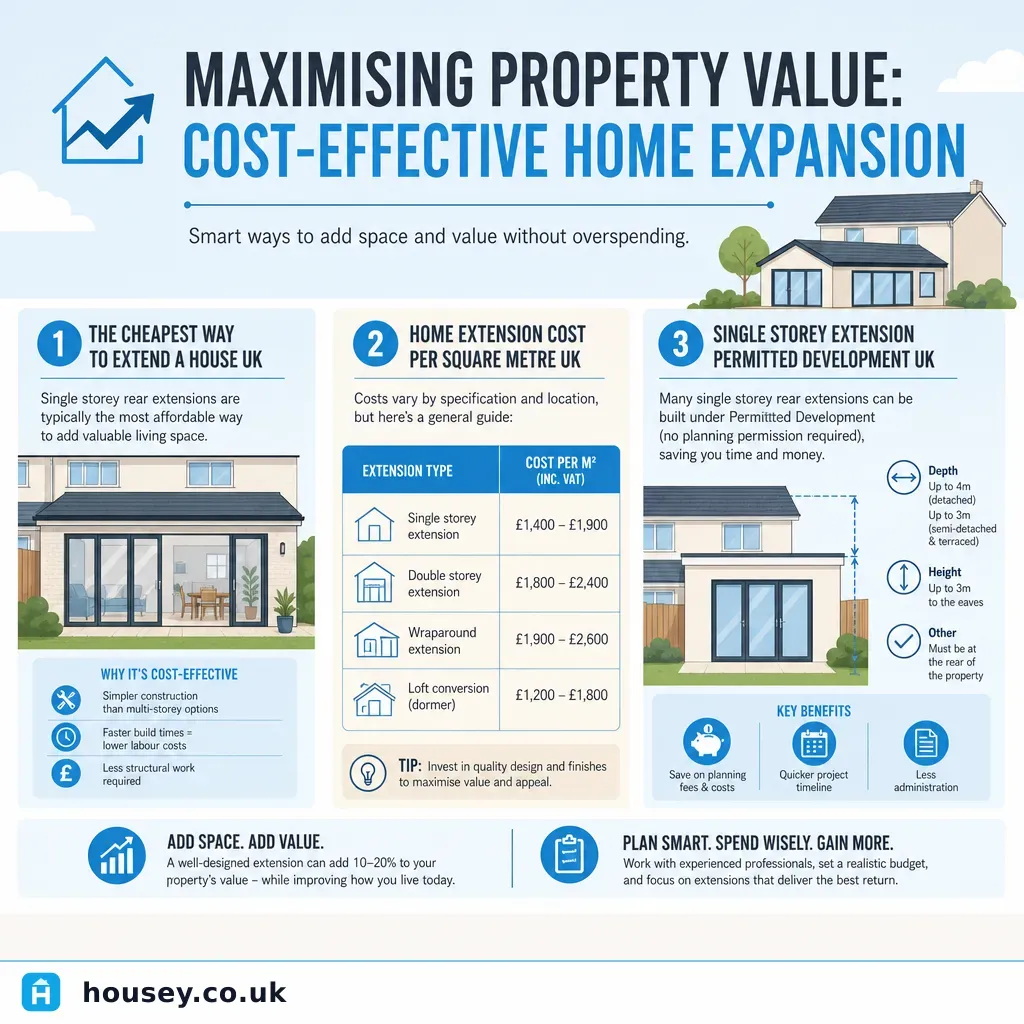
Maximising Property Value: Cost-Effective Home Expansion
A cost-effective home extension in the UK typically starts with a single-storey rear extension under permitted development, using an extension builder or design-and-build firm to control costs.
 Improvement & Build
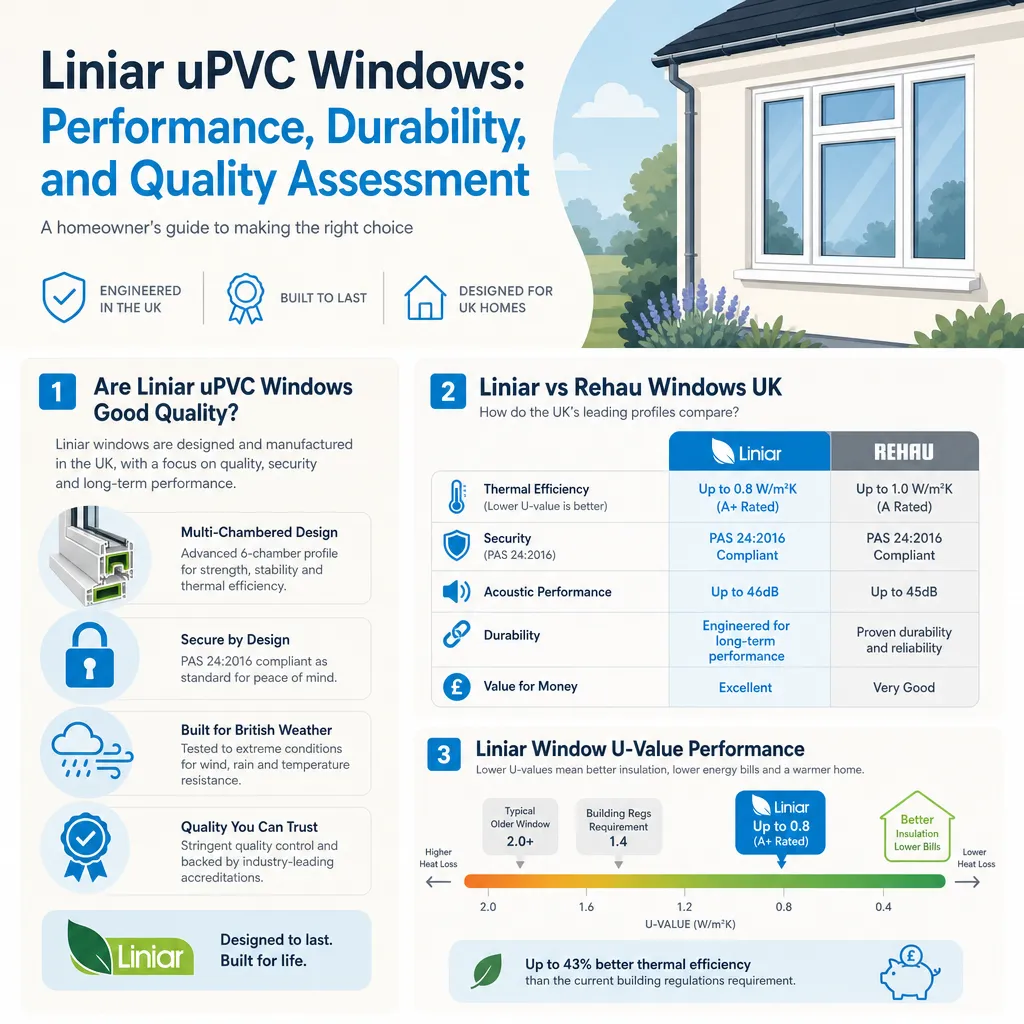
Liniar uPVC Windows: Performance, Durability, and Quality Assessment
Liniar uPVC window profiles are manufactured in the UK using multi-chambered, foamed frames.
 Improvement & Build
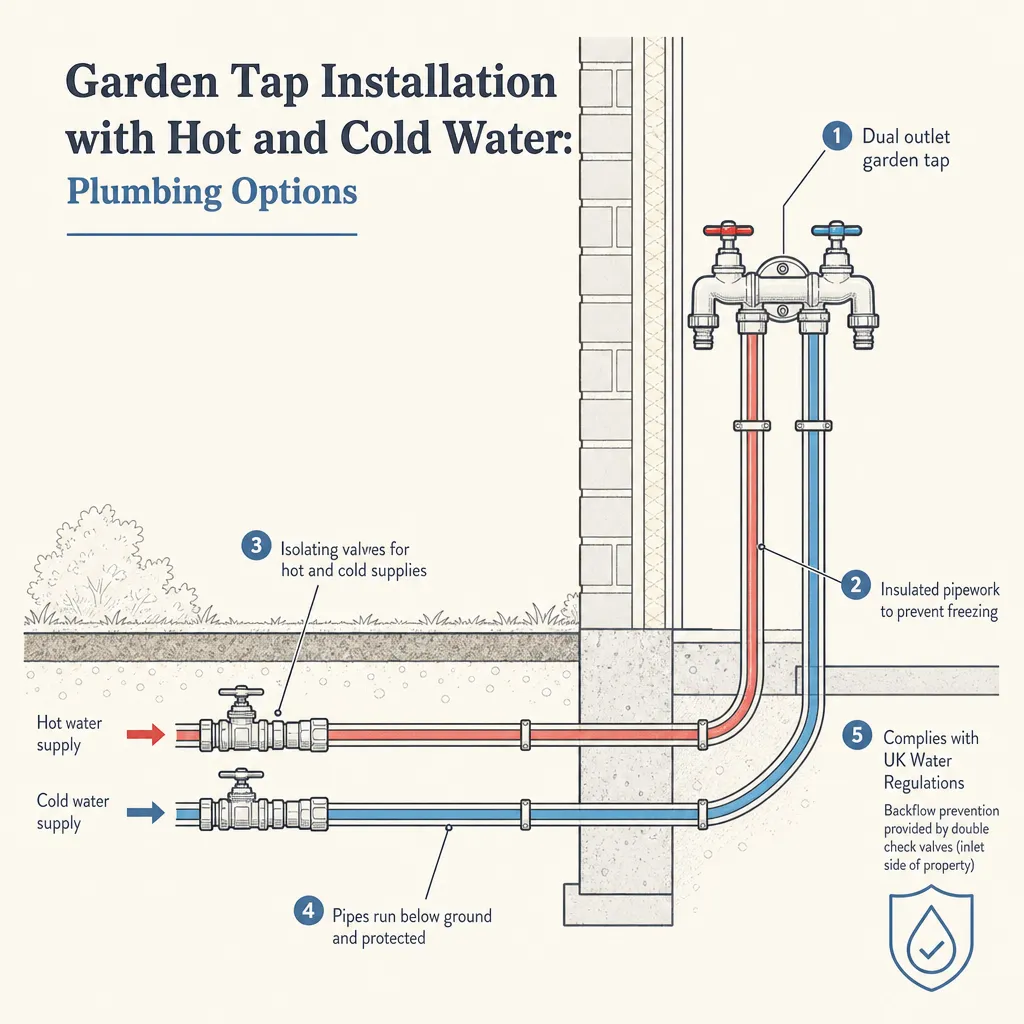
Garden Tap Installation with Hot and Cold Water: Plumbing Options
Adding a cold garden tap is a common DIY project, but routing hot water outdoors requires a plumber to connect to your domestic hot water system and comply with the Water Supply (Water Fittings) Regulations 1999.
 Improvement & Build
Sealing and Maintaining Historic Leaded Glass Windows: Preservation and Performance
Leaded glass windows are maintained using traditional linseed oil cement — not silicone or modern sealants, which prevent natural movement in the lead came.
 Improvement & Build
Greenhouse Construction: Glass Versus Polycarbonate Materials
Glass transmits around 90% of available light and lasts indefinitely if unbroken, but insulates poorly and shatters into sharp fragments.