Measured Building Survey Costs and Pricing Guide
By Housey · Last reviewed 7th of May 2026
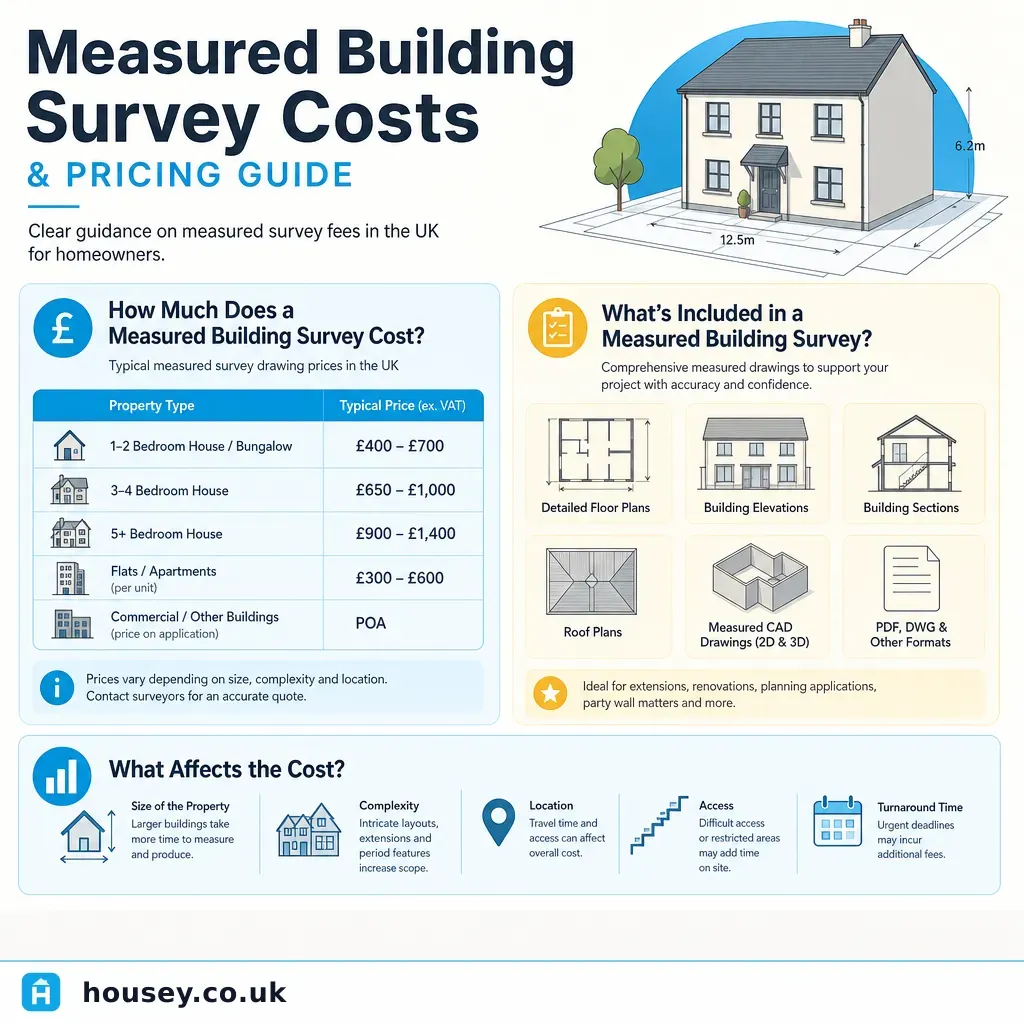
Measured Building Survey Costs and Pricing Guide
A measured building survey is usually commissioned when an architect, designer, or builder needs accurate as-built drawings before design work or construction begins. The question most commonly arises during planning applications, loft conversions, extensions, and commercial refurbishments — getting the scope and budget right at the outset avoids costly revisions later.
Key points
- Measured building survey fees typically range from £500 to £5,000+ for residential properties, varying by floor area, number of levels, and drawing types required.
- Outputs are usually 2D CAD drawings (floor plans, elevations, sections) in DWG or PDF format, or 3D point-cloud data from laser scanning.
- Laser scanning (LiDAR) produces tighter tolerances (±2–5 mm) than traditional tape surveys (±5–10 mm) and suits complex or listed buildings.
- RICS-regulated firms provide quality assurance under the RICS Professional Statement on Measured Surveys of Land, Buildings, and Utilities.
- VAT at 20% is normally charged on top of the survey fee and is not always shown in headline quotes.
What is a measured building survey?
A measured building survey records the precise dimensions of an existing building — walls, openings, floor levels, ceiling heights, roof geometry — and translates them into accurate scaled drawings. Architects use these as the starting point for extensions, conversions, planning applications, and refurbishments. The survey is purely dimensional: it is not concerned with defects, structural adequacy, or value. You might commission both a measured survey and a RICS Level 2 or Level 3 Home Survey when buying a property you plan to extend.
What affects the cost?
Floor area and number of levels: Most surveyors price primarily on gross internal area (GIA). A two-bed flat is far cheaper to survey than a four-storey Victorian townhouse.
Drawing scope: Floor plans alone cost less than a full set including elevations, sections, and roof plans. Confirm with your architect exactly what drawings they need before approaching surveyors.
Survey method: Traditional tape-and-total-station surveys suit most residential projects. 3D laser scanning is faster for large or geometrically complex buildings but has a higher up-front cost.
Access and location: Occupied buildings, loft spaces requiring scaffolding, and properties in London and the South East all add to the fee. Urgent turnaround (under one week) typically attracts a 10–25% premium.
Typical cost ranges
Indicative UK costs, last reviewed 2026-05-07. Always obtain at least three itemised quotes.
Property type | Approximate fee range | Notes |
|---|---|---|
Studio or one-bed flat (up to 50 m²) | £400–£800 | Floor plan and elevations only |
Two/three-bed house (80–120 m²) | £700–£1,500 | Plans, elevations, sections |
Four/five-bed house (150–250 m²) | £1,200–£2,500 | Full drawing set |
Small commercial unit (up to 300 m²) | £1,500–£3,500 | As-existing drawings |
Large or complex building (300 m²+) | £3,500–£8,000+ | Laser scanning often recommended |
Listed or heritage building (any size) | Add 20–50% | Extra detail; Historic England recording guidance may apply |
These figures cover the survey and drawings only — not structural, electrical, or planning drawings an architect may subsequently produce.
Laser scanning versus traditional survey
Factor | Traditional (tape and total station) | 3D laser scanning (LiDAR) |
|---|---|---|
Accuracy | ±5–10 mm typical | ±2–5 mm typical |
Speed on site | Slower for large buildings | Faster on site; more post-processing |
Best suited to | Standard domestic properties | Complex geometry, listed buildings, large commercial |
Output | 2D CAD drawings | Point cloud plus derived 2D or 3D drawings |
Cost vs traditional | — | Typically 20–60% higher |
Heritage use | Less common | Increasingly standard for listed structures |
For a straightforward two-storey semi-detached, a traditional survey is almost always sufficient. For a Victorian factory conversion or a listed manor, laser scanning often proves more economical overall when fewer revisits are needed.
What a measured survey quote should include
Before accepting a quote, confirm it clearly states:
- Gross internal area covered and number of levels included.
- Drawing types: floor plans, elevations (which faces), sections, roof plans, reflected ceiling plans.
- File formats: DWG, PDF, and/or IFC for BIM projects.
- Survey method (traditional or laser scan).
- Whether external features (drainage, outbuildings) are included.
- Number of revision rounds and delivery timescale.
- Whether VAT is included in the quoted figure.
Homeowner checklist: commissioning a measured survey
When to get professional help
A measured building survey is itself a professional service and should not be attempted as a DIY exercise for drawings used in planning or construction. Seek a qualified surveyor — rather than informal measuring — when:
- Your architect has specified drawings to a particular scale or accuracy standard.
- The project involves a listed building, where Historic England guidance on architectural recording may apply.
- The building has irregular geometry, multiple roof planes, or extensive outbuildings.
- You need BIM-ready (IFC or Revit) files for a phased or larger project.
How Housey can help
If you need accurate as-built drawings for a design or construction project, Housey connects you with RICS-regulated and experienced practices across the UK. Request and compare quotes from local providers through our measured building surveys service page.
Frequently asked questions
How long does a measured building survey take on site?
A standard three-bed house typically takes one to three hours on site for a traditional tape-and-total-station survey. Laser scanning takes thirty to sixty minutes on site, though processing the point cloud adds time in the office. Completed drawings are usually delivered within five to ten working days, depending on complexity and the firm's workload.
Do I need a measured survey before applying for planning permission?
Not always. For straightforward householder applications, your architect may include a basic measured survey within their design fee. However, accurate as-existing drawings are needed before proposed-works drawings can be produced — check with your architect whether this is already covered before commissioning a survey separately.
Can Land Registry title plans be used instead of a measured survey?
No. Land Registry title plans are based on Ordnance Survey mapping at 1:1,250 scale and are not accurate enough for architectural design, planning drawings, or construction. They show the approximate boundary of the property only, not the internal layout or precise building dimensions.
Is VAT charged on measured building survey fees?
Yes. VAT at the standard rate of 20% is normally charged by VAT-registered surveying firms. Always confirm whether a headline quote is inclusive or exclusive of VAT before instructing — on a £1,500 fee, the difference is £300.
What qualifications should a measured building surveyor hold?
Look for RICS membership (MRICS or FRICS) or Chartered Institute of Architectural Technologists membership (MCIAT or FCIAT) as a minimum indicator of competence and professional indemnity insurance. For laser-scanning projects, ask about specific experience with that method and the software used to deliver point-cloud data.
Sources and further reading
Useful next reads
 Surveys & Inspections
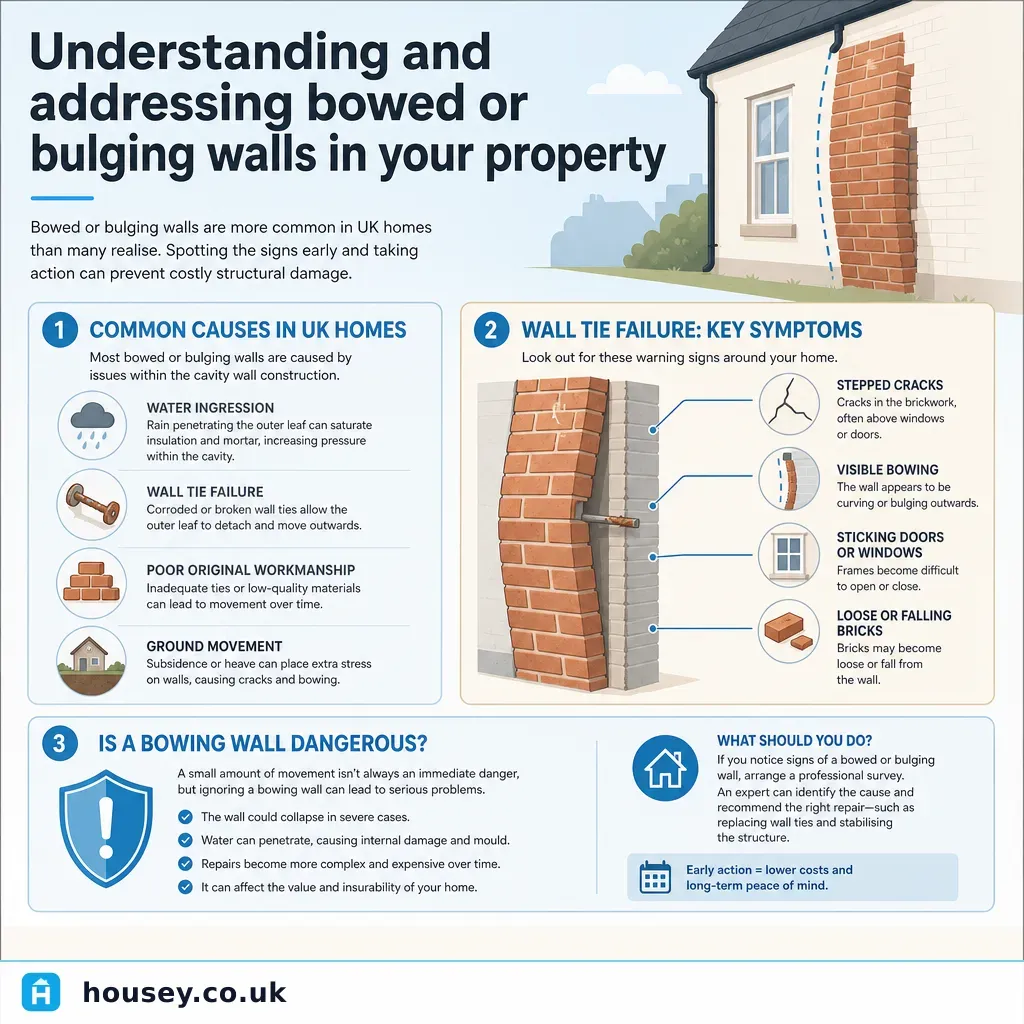
Understanding and addressing bowed or bulging walls in your property
A bowed or bulging wall may indicate wall tie failure, foundation movement, or overloading.
 Surveys & Inspections
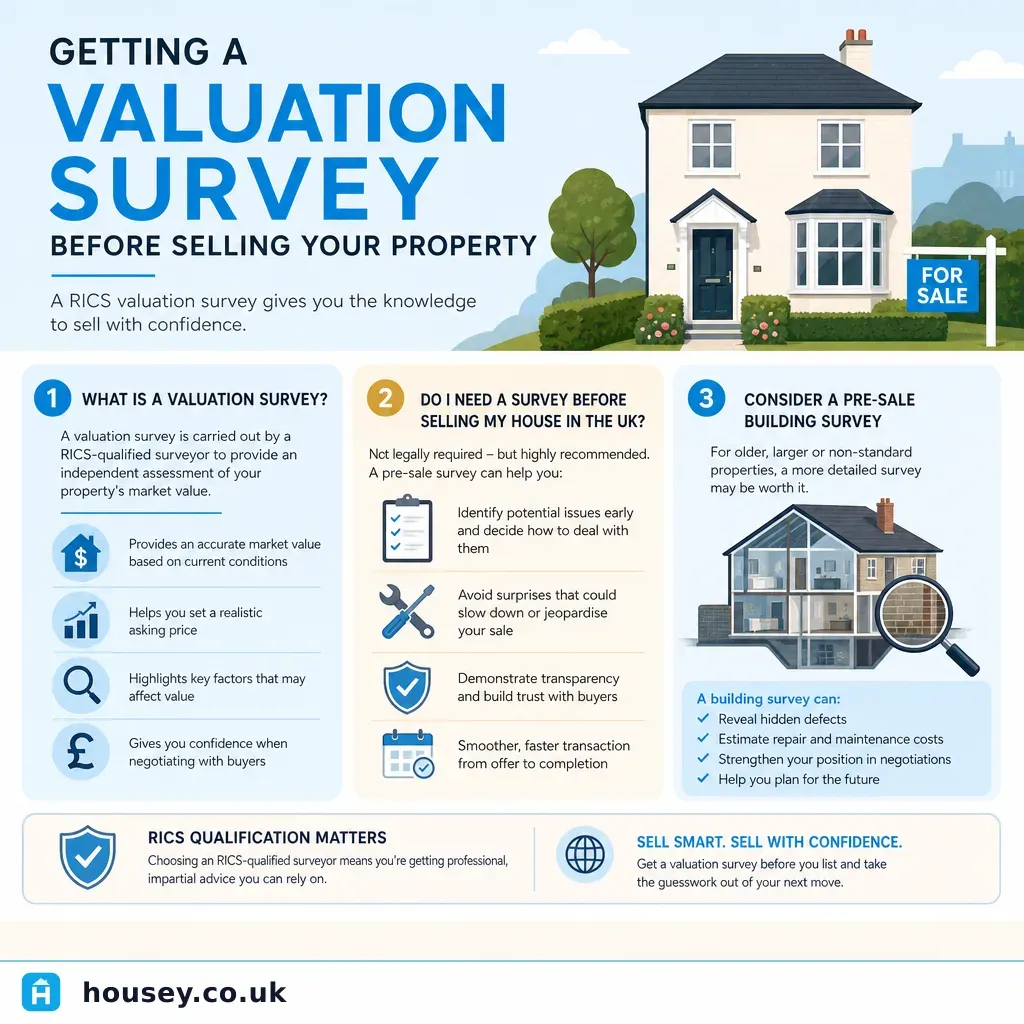
Getting a Valuation Survey Before Selling Your Property
Before selling, a free estate agent appraisal gives a market price guide, but only a RICS Red Book valuation carries formal professional standards and legal weight.
 Surveys & Inspections
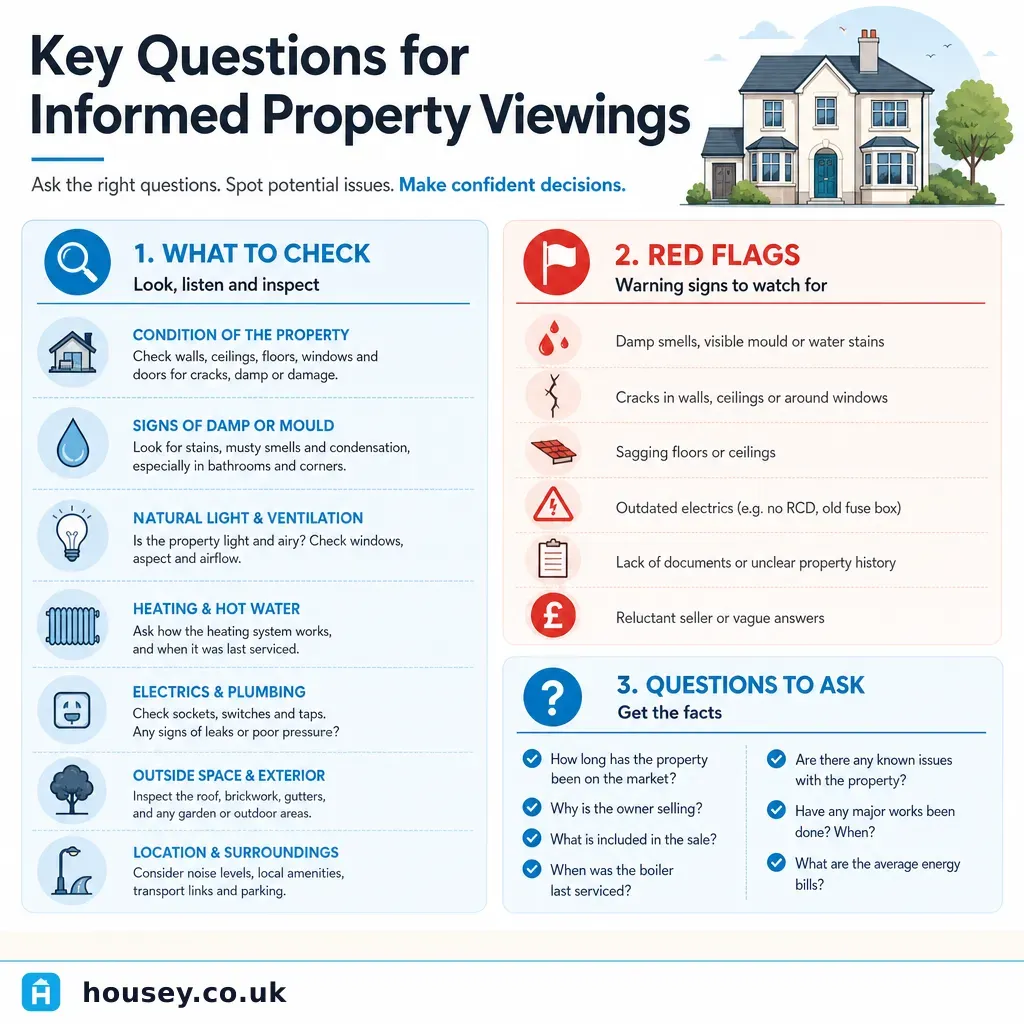
Key Questions for Informed Property Viewings
At a property viewing, ask specifically about structural movement, damp or water ingress, the age and service history of the boiler and electrics, whether any extensions obtained building regulations sign-off, and the seller's chain position.
 Surveys & Inspections
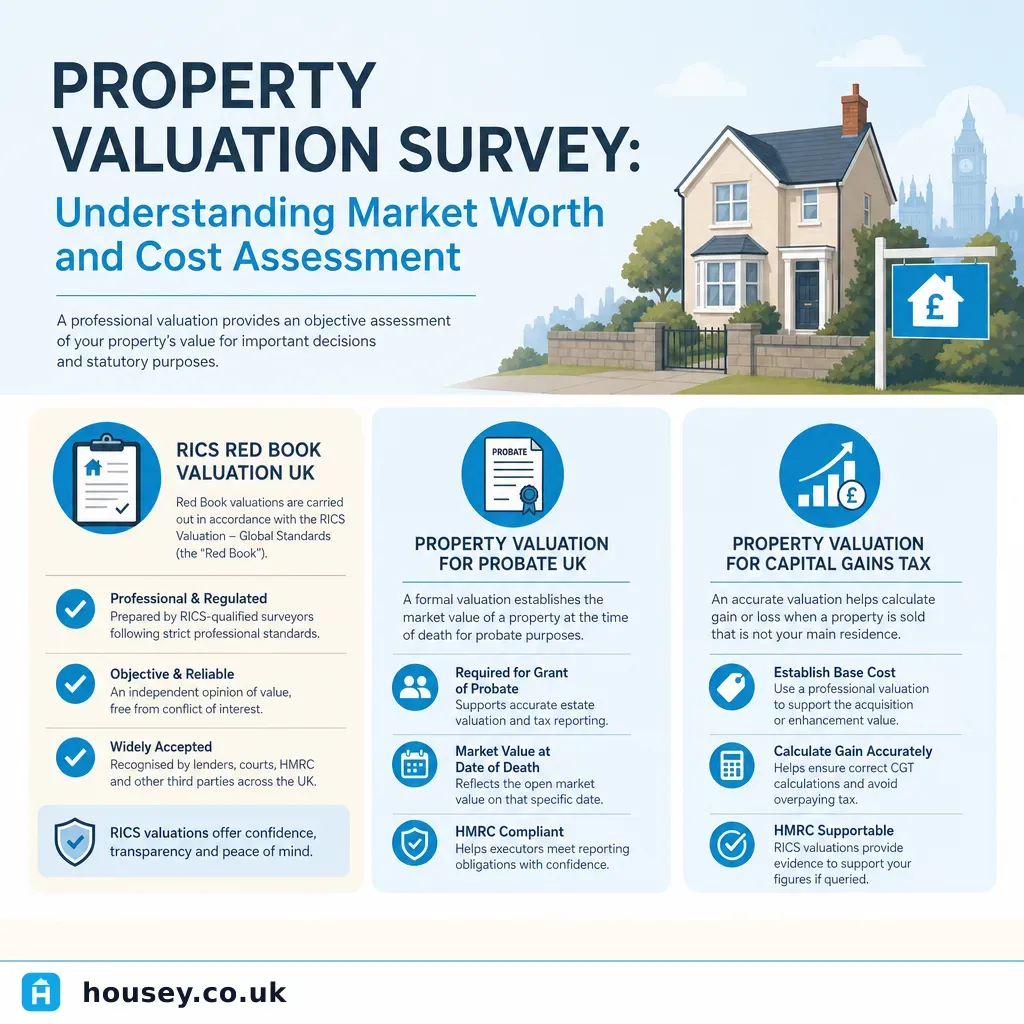
Property Valuation Survey: Understanding Market Worth and Cost Assessment
A property valuation survey establishes a property's market value at a specific date.
 Surveys & Inspections
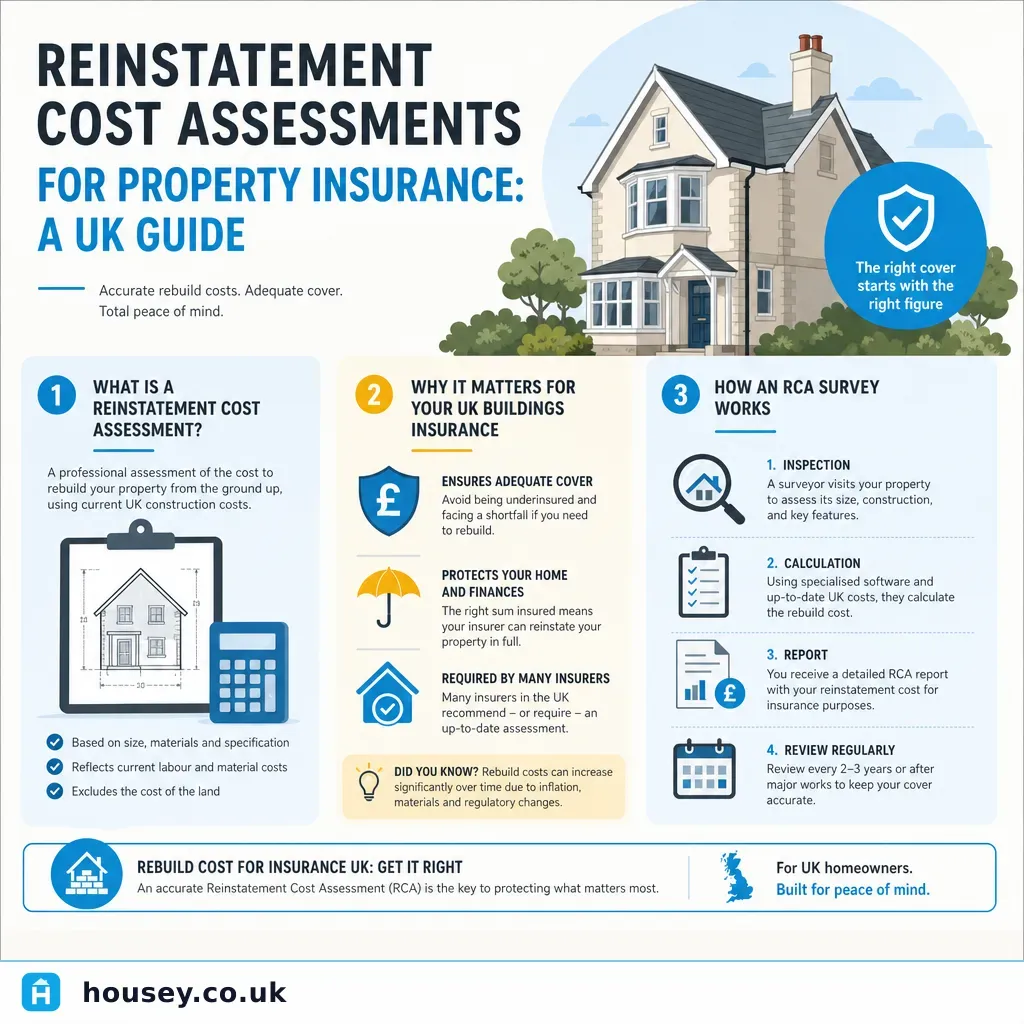
Reinstatement Cost Assessments for Property Insurance: A UK Guide
A reinstatement cost assessment (RCA) estimates what it would cost to completely rebuild your property if it were destroyed.