Metal Roofing in Cold Climates: Performance and Durability Assessment
By Housey · Last reviewed 17th of May 2026
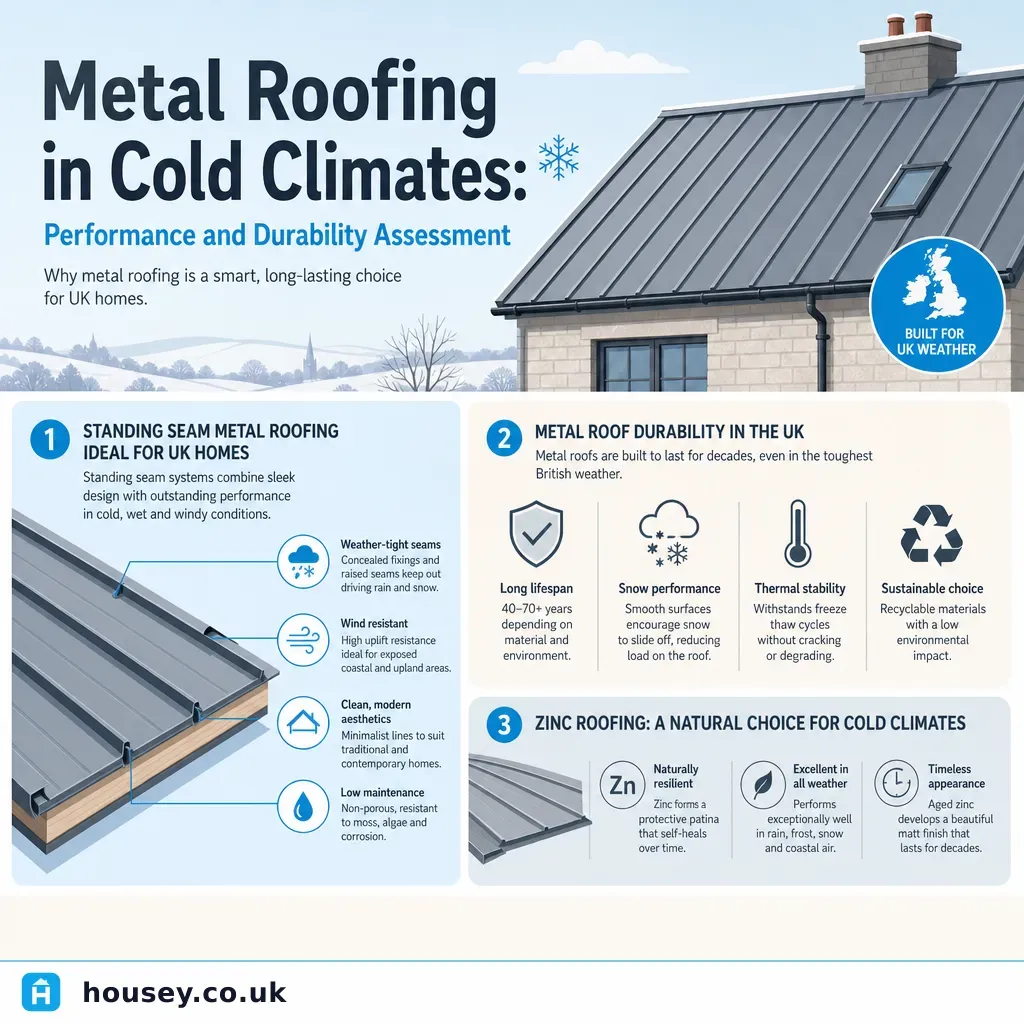
Metal Roofing in Cold Climates: Performance and Durability Assessment
The UK's combination of persistent rainfall, frost cycles, driving wind, and — in Scotland, northern England, and Wales — regular snowfall creates one of the more demanding roofing environments in northern Europe. For homeowners weighing up a metal roof, the cold and wet are rarely the whole story: thermal cycling, condensation risk, and snow load each introduce design requirements that distinguish a well-specified installation from one that will cause problems within a decade.
Key points
- Standing seam metal roofing systems use concealed sliding clips to accommodate thermal expansion and contraction, preventing panel buckling or fastener pull-through during UK temperature cycles.
- Snow load design for UK roofs must follow BS EN 1991-1-3 (Eurocode 1); smooth metal surfaces shed accumulated snow rapidly, making snow guards a safety requirement in upland and northern locations.
- Zinc, aluminium, and copper are inherently corrosion-resistant; coated steel (Colorcoat HPS200 Ultra, Corten) relies on the integrity of its protective layer — damaged edges or scratches must be treated promptly to prevent rust.
- Building Regulations Approved Document C requires a correctly detailed vapour control layer in metal roof build-ups to prevent interstitial condensation within the roof structure.
- Metal roofs typically achieve a service life of 40–70 years depending on material, installation quality, and exposure zone — significantly longer than the 20–30-year lifespan of standard concrete or clay tiles.
How metal roofing performs in cold, wet UK conditions
Metal itself does not degrade in frost — the cold-climate challenge is thermal cycling between cold nights and warmer days, combined with persistent moisture. Standing seam systems address thermal movement through concealed clips that allow panels to slide freely, preventing the buckling and fastener stress that can affect over-nailed or rigidly fixed systems after years of cycling.
Condensation is the more practical concern in UK installations. Cold metal on the underside of a roof can cause interstitial condensation if the vapour control layer is incorrectly positioned or absent. A correctly detailed warm-roof build-up — with continuous insulation above the structural deck and a vapour control layer on the warm side — is the standard approach for UK metal roofing, following NHBC Technical Standards and Building Regulations Approved Document C.
Metal roofing materials compared
Material | Typical lifespan | Corrosion resistance | Cold-climate notes |
|---|---|---|---|
Standing seam zinc | 60–80 years | Excellent — natural patina | Performs well; expansion detailing essential |
Aluminium (coated or mill finish) | 40–60 years | Excellent | Lightweight; suits extensions and retrofits |
Coated steel (Colorcoat HPS200 Ultra) | 30–50+ years | Good if coating intact | Cost-effective; verify warranty for coastal or upland zones |
Corten (weathering steel) | 40–60 years | Good after patina establishes | Not recommended within ~50 km of coastal salt air |
Standing seam copper | 80–100+ years | Excellent | Premium cost; common on listed buildings and heritage projects |
Indicative lifespans — actual performance depends on installation quality, exposure zone, and maintenance. Indicative UK costs, last reviewed 2026-05-17.
Snow and ice considerations
In upland and northern UK locations, BS EN 1991-1-3 governs snow load design. A structural engineer should confirm the roof structure can carry the appropriate snow load for the site's altitude and zone before specifying any roofing system. The smooth, low-friction surface of metal roofing sheds accumulated snow quickly — which reduces structural load but creates a hazard below. Snow guards (low-profile bars or rails fixed to the roof surface) are standard practice in snow-prone locations; they prevent sudden avalanches onto pathways, conservatories, outbuildings, or parked vehicles.
Ice damming — where heat loss through the ridge melts snow while it refreezes at the colder eaves — is less common in UK warm-roof metal installations because continuous insulation above the deck prevents heat from escaping through the roof surface. Eliminating cold bridges within the roof build-up is the principal mitigation.
Thermal performance and Building Regulations Part L
Metal has high thermal conductivity, which means the insulation layer does all the thermal work — not the metal skin. Approved Document L (2021) requires a U-value of 0.16 W/m²K or better for new-build roofs. This is readily achievable within a correctly designed metal warm-roof build-up using PIR insulation boards. For retrofit projects involving existing structures, U-value calculations should account for any existing insulation and be verified by the installer or a thermal consultant.
Rain noise
A metal roof installed directly onto rafters with no boarding, insulation, or internal finish will be noticeably loud in heavy rain. In a properly specified UK installation — with insulation above the deck, an acoustic breather membrane, and a plasterboard or timber-lined internal ceiling — rain noise is broadly comparable to a tiled roof and is rarely a practical problem for residents. Specify the full acoustic build-up in writing before accepting any quote.
Red flags to watch for
- No expansion allowance in the fixing specification: through-fixed or rigidly clipped panels will buckle after a few years of thermal cycling.
- Missing or mispositioned vapour control layer: leads to condensation within the roof structure and potential timber decay.
- No snow guards specified in upland or northern locations: creates a safety and liability risk.
- Damaged coating on coated steel systems: scratches, cut edges, or impact damage must be treated immediately to prevent rust ingress.
- Incompatible metals in contact: zinc and copper are galvanically incompatible; aluminium and copper should be separated by an isolating layer — bi-metallic corrosion significantly shortens roof life.
- No structural review for snow load: particularly important for large flat or shallow-pitch roofs in exposed zones.
When to get professional help
Any metal roof installation should be designed and installed by a contractor with documented experience in metal roofing systems. For structurally complex projects — listed buildings, large spans, or high-wind and high-snow-load sites — a structural engineer should review the design before work begins. If you are considering a metal roof as part of a wider re-roofing project, a specialist roof survey will identify underlying structural issues that need addressing first.
How Housey can help
Housey connects you with vetted local roofers experienced in metal roofing systems and specialist roof survey professionals who can assess whether your existing structure is suitable for a metal roof installation and help you compare quotes on a like-for-like basis.
What to ask a metal roofing contractor
- What expansion allowance is built into the fixing or clip system?
- Which material do you recommend for my postcode's exposure zone, and why?
- How will condensation and vapour control be handled in the roof build-up?
- Are snow guards included in the specification for my location and pitch?
- What is the manufacturer's warranty on the coating or material, and does it cover my exposure zone?
- Will you provide a U-value calculation confirming compliance with Approved Document L?
- Is VAT included, and what certification or sign-off documentation will be provided on completion?
Frequently asked questions
Are metal roofs suitable for the UK climate?
Yes, when correctly specified and installed. Standing seam zinc, aluminium, and coated steel systems are widely used across the UK, including in exposed northern and upland locations. The key requirements are correct expansion detailing, a properly installed vapour control layer, and — in snow-prone areas — adequate snow guards to prevent sudden and hazardous snow shedding.
How long does a metal roof last in the UK?
Depending on the material, a well-installed metal roof typically lasts 40–80 years. Zinc and copper systems can exceed 80 years. Coated steel generally achieves 30–50 years before recoating or replacement, depending on exposure zone and whether the protective coating remains fully intact throughout that period.
Do metal roofs make more noise in rain?
In a correctly insulated and internally lined installation, rain noise on a metal roof is broadly comparable to a tiled roof. The key factor is the acoustic build-up beneath the metal — insulation, breather membranes, and ceiling linings all contribute to sound attenuation. A poorly lined installation will be noticeably louder in heavy rain.
Sources and further reading
- Building Regulations Approved Document C — GOV.UK (moisture resistance and vapour control requirements)
- Building Regulations Approved Document L: Conservation of fuel and power — GOV.UK (U-value requirements for roofs)
- NHBC Technical Standards — NHBC (condensation and vapour control guidance)
- BS EN 1991-1-3: Actions on structures — snow loads — BSI British Standards (structural snow load design)
Useful next reads
 Improvement & Build
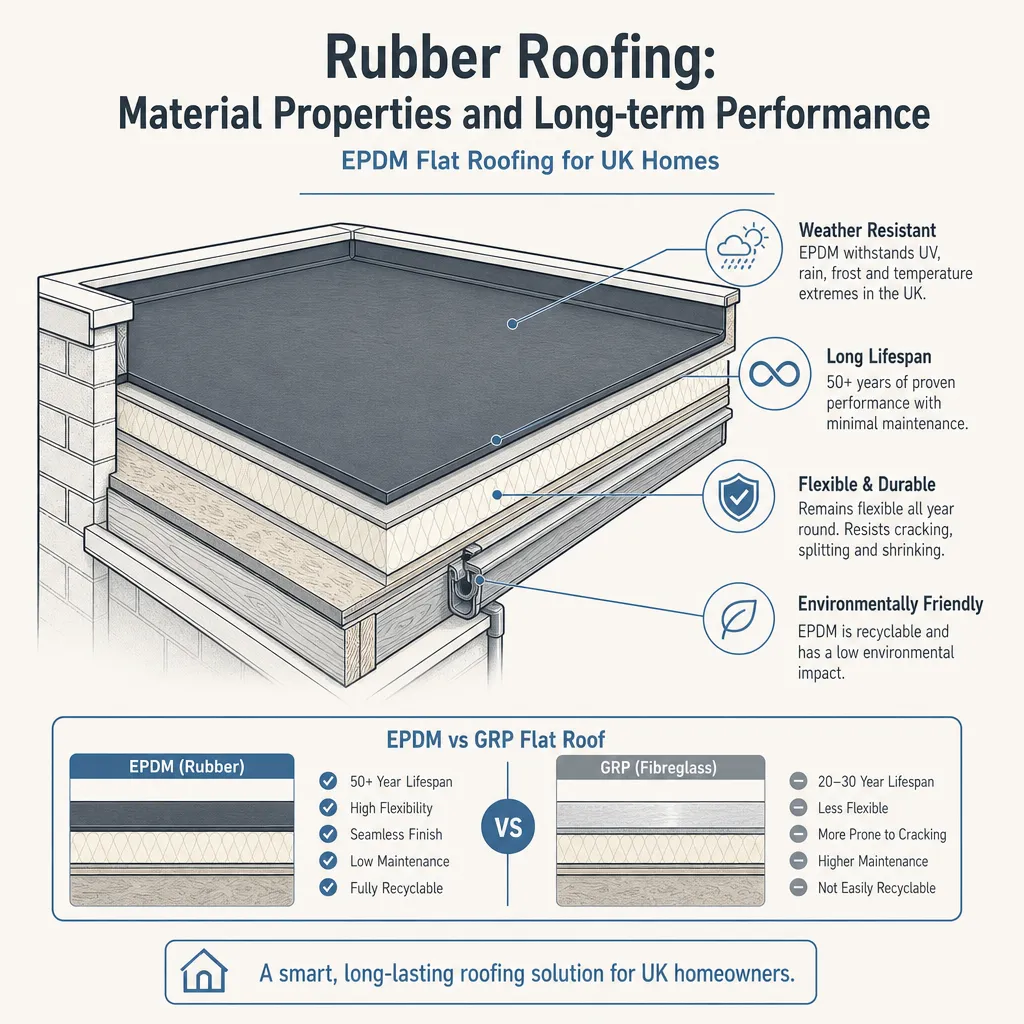
Rubber Roofing: Material Properties and Long-term Performance
EPDM rubber roofing is a synthetic rubber membrane used on UK flat roofs, available in large sheets that minimise seams.
 Improvement & Build
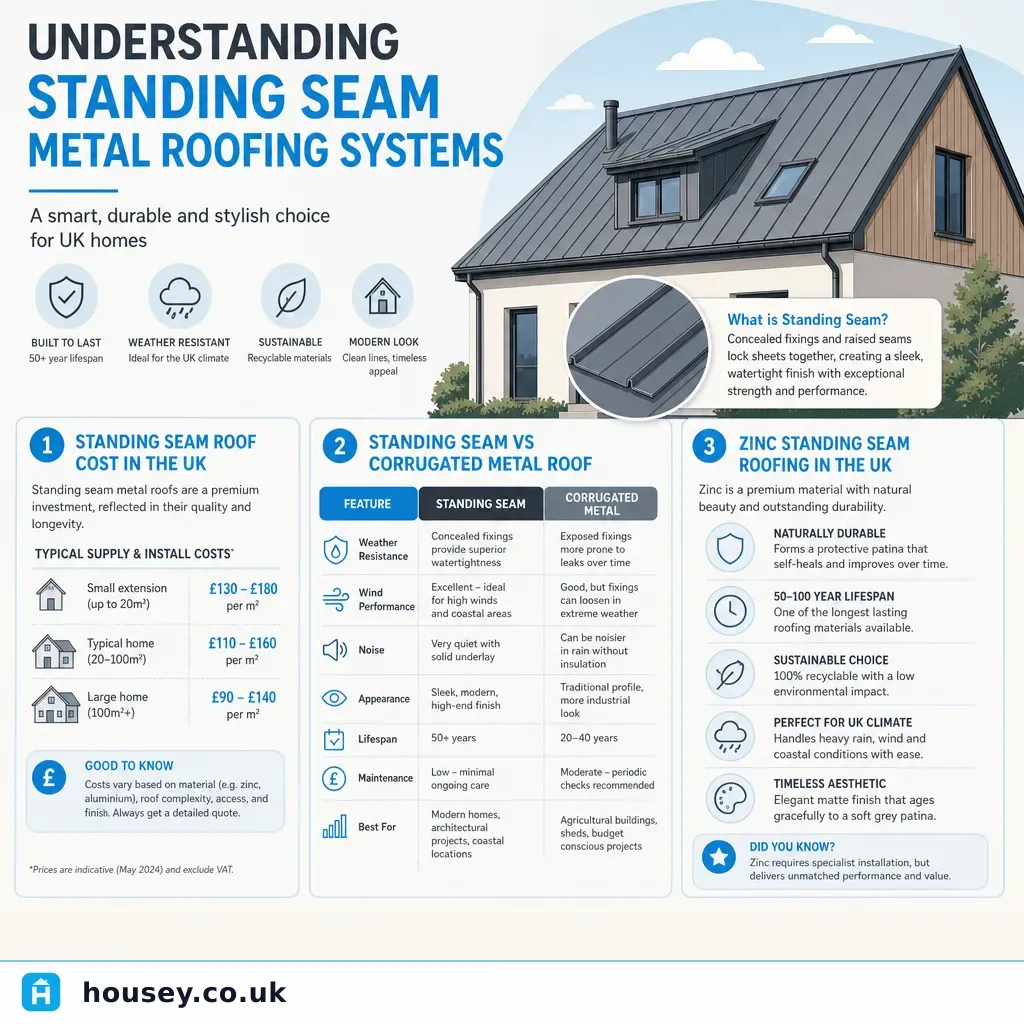
Understanding Standing Seam Metal Roofing Systems
A standing seam metal roof is built from long metal panels with raised, interlocked edges and all fixings concealed within the seams.
 Improvement & Build
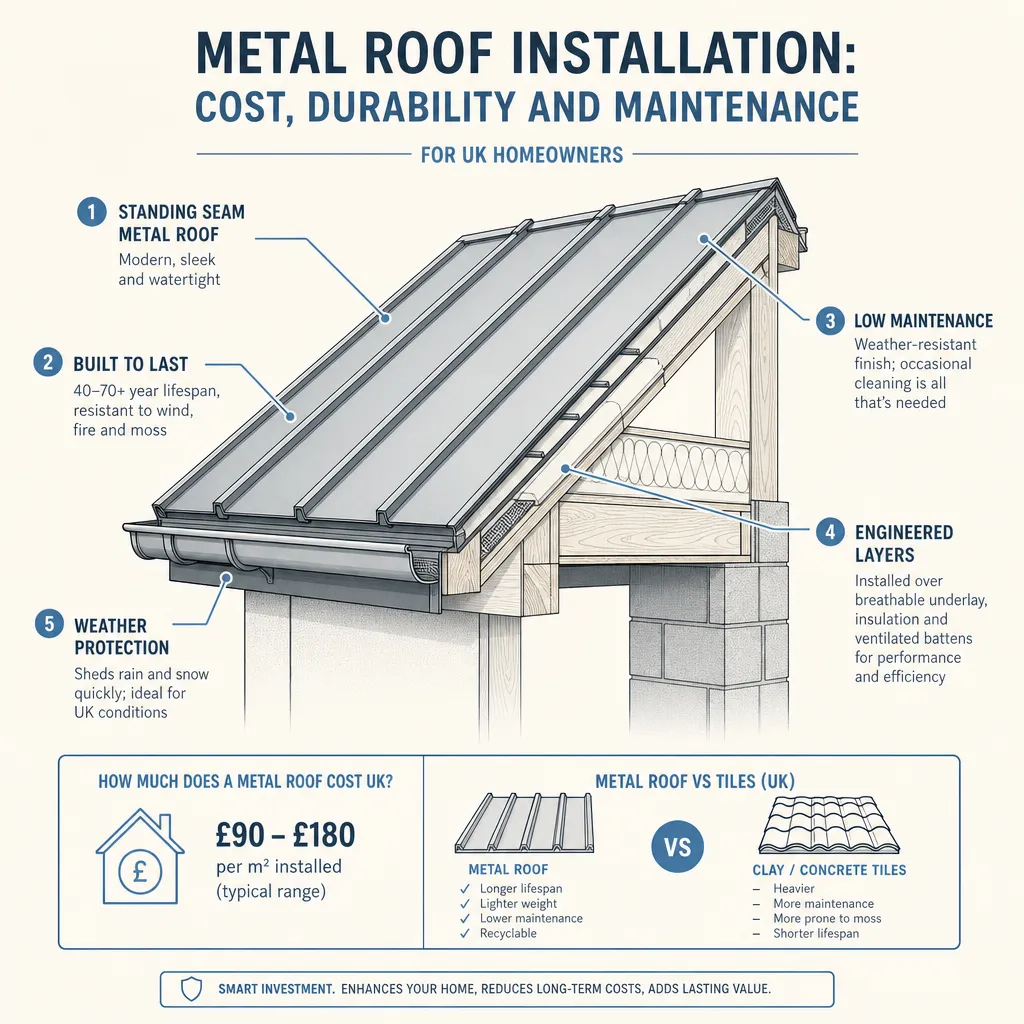
Metal Roof Installation: Cost, Durability and Maintenance
Metal roof installation in the UK typically costs £80–£250 per square metre installed, depending on material and complexity.
 Improvement & Build
Painting Rendered Exterior Walls: Best Product Selection and Application
For rendered exterior walls, choose a flexible microporous masonry paint that allows moisture vapour to escape while blocking liquid water.
 Improvement & Build
Front Door Painting: Selecting the Right Paint for Exterior Doors
For a timber front door, choose a water-based or oil-based exterior gloss or satinwood rated for outdoor use.