Modern Home Design Trends: What Today's Homeowners Really Want
By Housey · Last reviewed 30th of May 2026
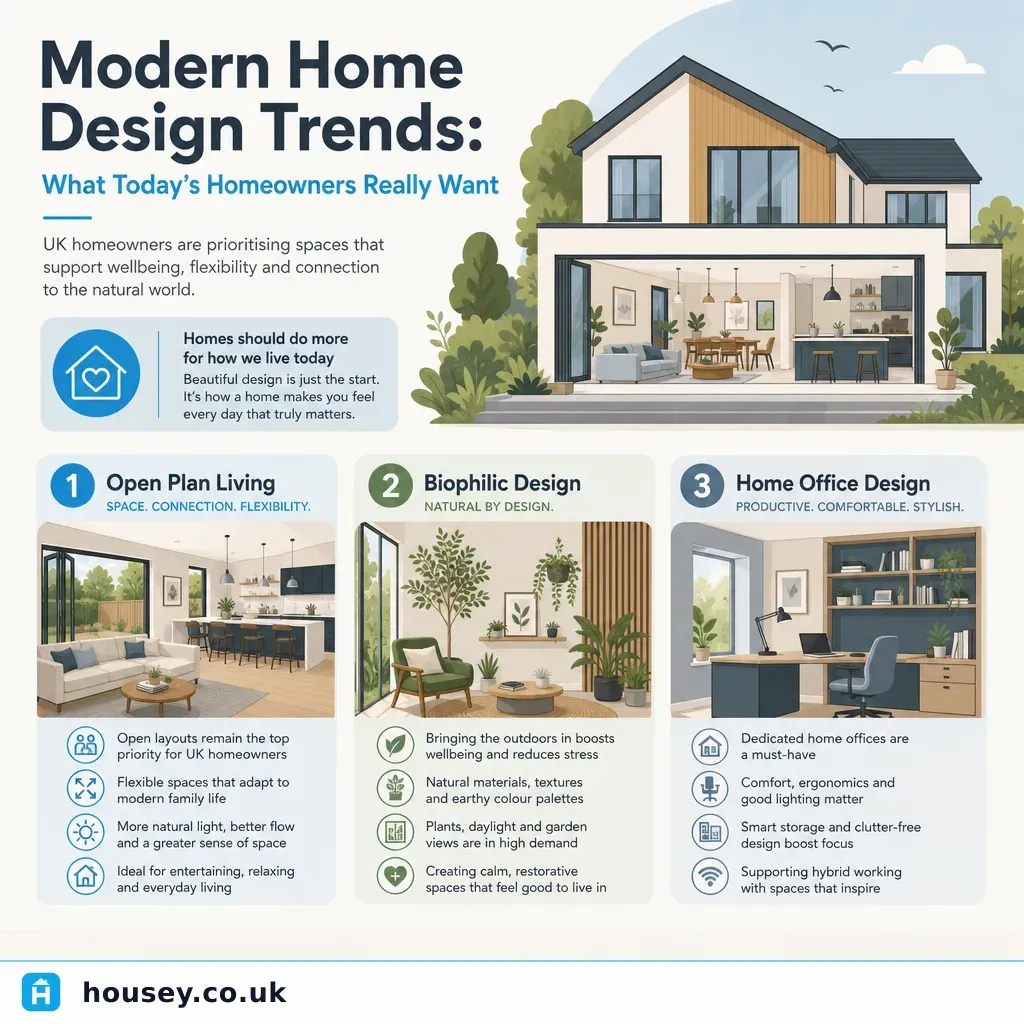
Modern Home Design Trends: What Today's Homeowners Really Want
The way UK households use their homes has changed markedly over the past decade, and those changes are now showing up consistently in residential design briefs. Whether you are planning a rear extension, a loft conversion, or a whole-house renovation, understanding what drives modern layout preferences helps you invest where it matters most — and avoid fashions that date quickly.
Key points
- Open-plan kitchen-dining-living remains the most requested layout change in UK residential extensions, but acoustic zoning within open plans is now a standard design consideration rather than an afterthought.
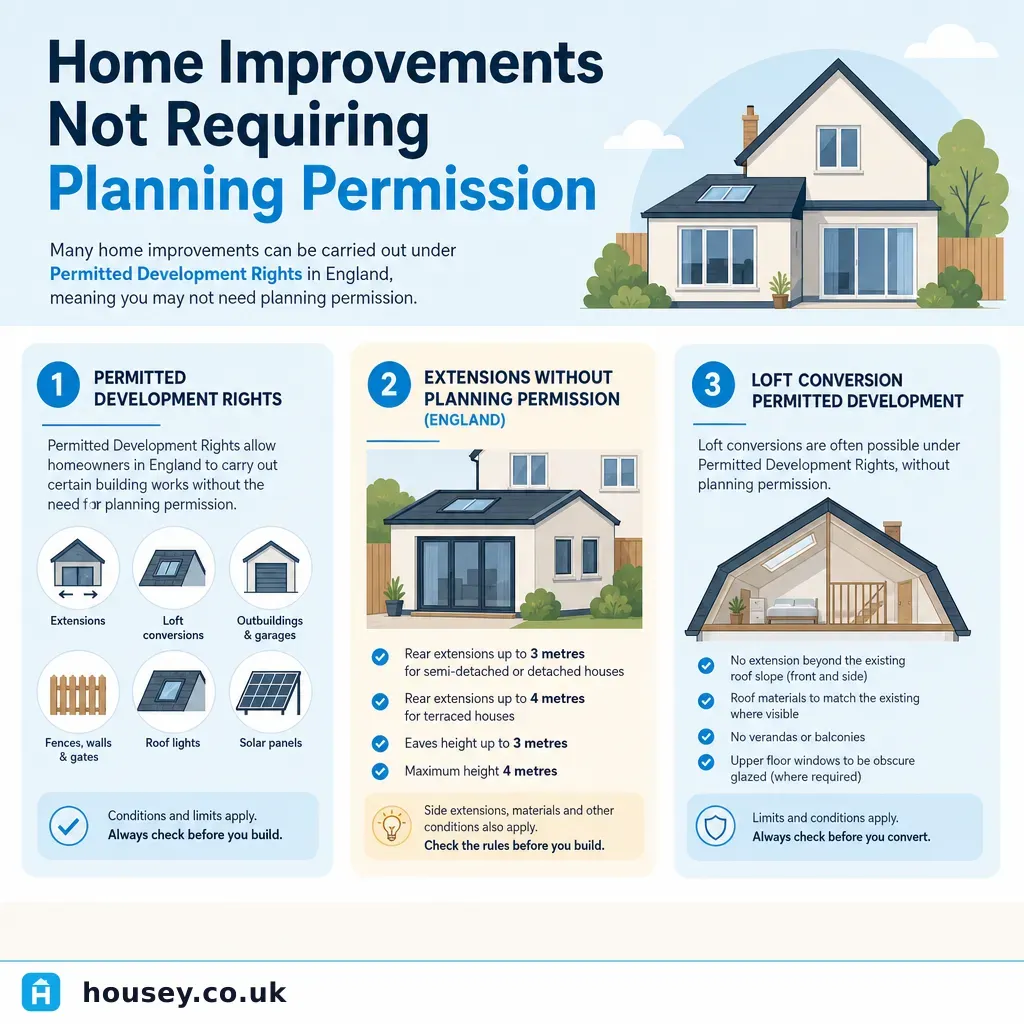
- Permitted development rights allow many single-storey rear extensions up to 4 m (detached) or 3 m (semi-detached or terraced) without full planning permission, though the prior approval process still applies.
- Part L of the Building Regulations sets minimum thermal performance standards for extensions and replacement windows; new glazing must meet a U-value of 1.4 W/m²K or better.
- The ONS reported that 44% of UK workers carried out some home working in 2022, sustaining demand for dedicated home-office space as a first-class brief requirement rather than a bolt-on afterthought.
- Biophilic design — integrating natural light, plants, materials, and garden views — has moved from luxury specification into standard briefing for RIBA-stage residential design.
Open-plan living: still popular, now more nuanced
Open-plan ground floors dominated UK residential design throughout the 2010s. The combination of kitchen, dining, and living space became the default aspiration for family homes, and it remains one of the most common reasons homeowners brief architects for rear extensions.
The picture has shifted. Post-pandemic household patterns have revealed that uninterrupted openness is not always what people want once they are living in a space full-time. Households now consistently want flexibility: the ability to close off noise, create focus zones, and separate cooking from work. The result is a more considered approach often called "broken-plan" or "zoned open-plan" design.
In practice, this means bi-fold or sliding doors between the kitchen-diner and sitting area so the space can breathe or separate as needed, a snug or study nook adjacent to the main open volume, and acoustic insulation between living and bedroom levels as working patterns in households vary.
Layout approach | Best for | Less suited to | Key design consideration |
|---|---|---|---|
Fully open-plan | Smaller footprints, sociable households, strong views to garden | Households with shift workers, young children's bedtimes, noise-sensitive occupants | Acoustic separation between ground and upper floors |
Broken-plan (partial openings) | Most family homes, Victorian terraces, 1930s semis | Very narrow or deep floor plates | Structural engineer required for beam sizing |
Cellular rooms retained | Listed buildings, period properties with original features, multigenerational households | Homes where flow and natural light are the primary concern | Permitted development implications if altering internal door openings |
Home working: design the brief, not the trend
Working from home is now a consistent part of UK life rather than an exceptional one. For residential design, this means the home office has matured from a repurposed spare room into a proper brief item with its own acoustic, lighting, and connectivity requirements.
Homeowner checklist: designing for home working
Energy, light, and biophilic design
Building Regulations Part L (Conservation of Fuel and Power) applies to extensions and, in some circumstances, to replacement windows and doors. New glazing in an extension must meet a U-value of 1.4 W/m²K or better. This directly influences how glazing-heavy contemporary designs must be specified, and heavily glazed extensions may need compensatory insulation elsewhere in the building envelope to demonstrate energy compliance.
Biophilic design has become mainstream in UK residential briefing. The practical translation for most projects includes maximising borrowed light through rooflights where a rear extension risks darkening internal hallways, specifying natural materials such as timber, clay tiles, and brick slips alongside composites, and designing clear sightlines from kitchen and living areas to the garden even on constrained urban plots.
A rooflight specified during construction adds a relatively modest premium to the build cost. Cutting through a completed roof structure retrospectively can cost £2,000–£5,000 or more (indicative UK costs, last reviewed 2026-05-30).
Sustainability as a design driver
Part L was updated in 2022 — the 2021 edition of Approved Document L came into force in England in June 2022 — and the Future Homes Standard is expected to raise minimum energy performance requirements further for new homes. Practical design responses include a fabric-first approach: maximising wall, floor, and roof insulation before specifying heating systems. For homeowners who may install a heat pump in future, designing in adequate plant-room space, correctly sized radiators, and underfloor heating zones from the outset avoids expensive retrofitting.
Part S of the Building Regulations requires EV charging infrastructure in new homes and some major renovations with on-site parking. Check whether your project triggers this requirement with your architect or building control body before submitting drawings.
When to get professional help
Most homeowners benefit from professional design input before committing to a layout, even for relatively straightforward single-storey extensions. An architect or architectural designer can identify structural constraints, planning policy implications, and missed opportunities that are difficult to spot without a measured survey and a review of the property's planning history.
Seek professional input if:
- Your project involves removing or altering a load-bearing wall or chimney stack.
- The property is in a conservation area, Article 4 Direction area, or is listed — permitted development rights are reduced or removed in all three situations.
- You want to maximise floor area within permitted development limits and need spatial design expertise to achieve it.
- You are combining works — for example, a rear extension with a loft conversion — where structural interdependencies require co-ordination.
- You want to incorporate significant glazing and need to demonstrate Part L compliance.
How Housey can help
Housey connects homeowners with qualified architecture practices for briefs ranging from initial feasibility through to full planning and contract administration. Visit our architecture services page to outline your project and receive competitive quotes from local architects.
Frequently asked questions
Do I need an architect for a single-storey extension?
You are not legally required to use an architect. However, an architect or architectural designer can help optimise the layout, ensure the design meets Building Regulations, and manage the planning process. For complex sites, conservation areas, or projects over roughly 30 m², professional design input usually pays for itself in avoiding costly errors and maximising permitted floor area.
What is biophilic design and does it add significant cost?
Biophilic design integrates natural light, materials, plants, and garden views into a building's design. When specified from the outset, most biophilic elements — rooflights, timber finishes, garden sightlines — carry minimal additional cost. Retrofitting a rooflight through a completed extension can add £2,000–£5,000 compared to specifying it during construction (indicative UK costs, last reviewed 2026-05-30).
Will an open-plan layout affect my property's value?
Open-plan layouts are generally well-regarded by UK buyers, but the impact depends on execution, property type, and local market. A poorly executed conversion that removes period character or compromises acoustic separation may not achieve the expected uplift. Discuss value goals with both a designer and a local estate agent before committing to a significant layout change.
What does Part L mean for a glazing-heavy extension?
Part L of the Building Regulations sets minimum thermal performance standards for new extensions and replacement glazing. New windows must achieve at least a U-value of 1.4 W/m²K. Heavily glazed designs may need compensatory insulation elsewhere in the building envelope to demonstrate overall compliance. An architect or energy assessor can run the calculation before you commit to a design.
Sources and further reading
- Approved Document L: Conservation of Fuel and Power — GOV.UK
- Homeworking in the UK, 2022 — Office for National Statistics
- Future Homes and Buildings Standards: 2023 consultation — GOV.UK
- RIBA Plan of Work 2020 — Royal Institute of British Architects
Useful next reads
 Planning & Pre-Build
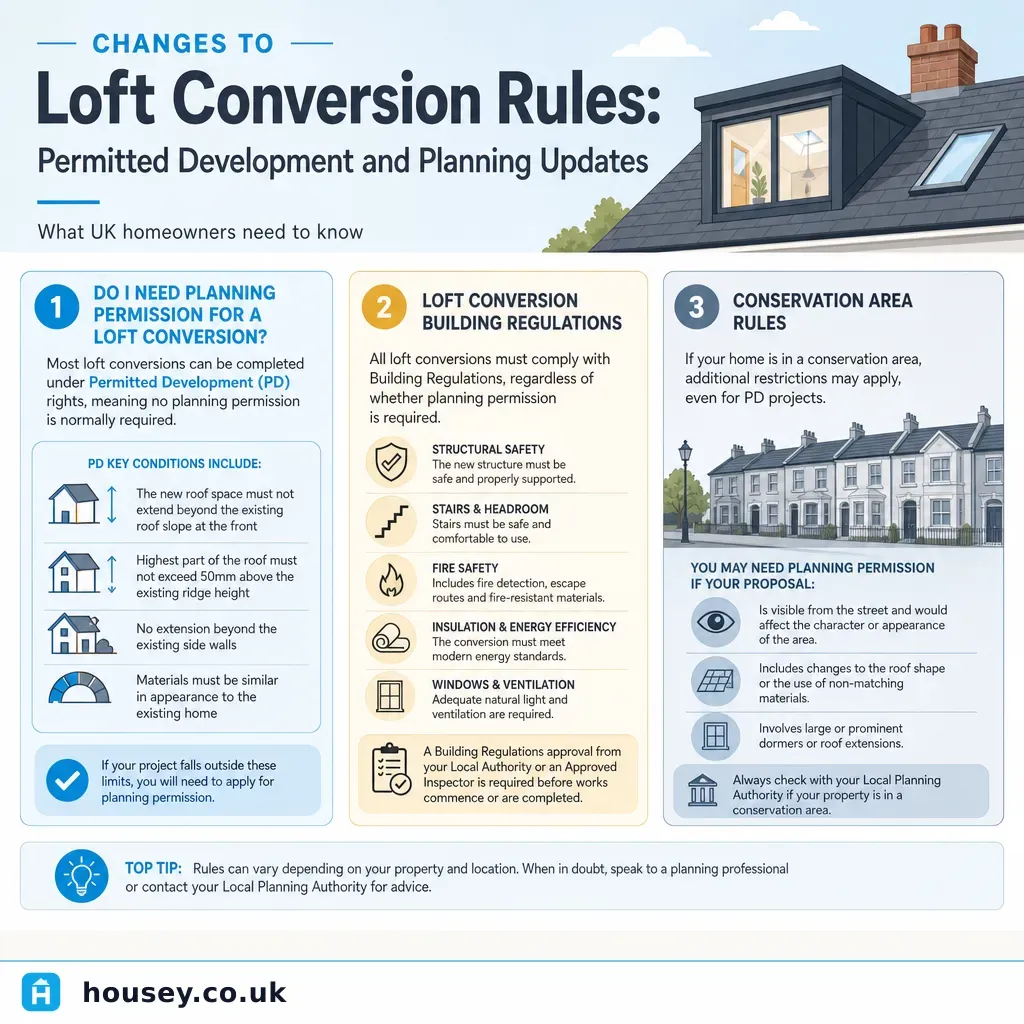
Changes to Loft Conversion Rules: Permitted Development and Planning Updates
In England, most loft conversions on standard houses qualify as Permitted Development under Class B of the GPDO 2015, allowing up to 40 cubic metres (terraced) or 50 cubic metres (detached or semi-detached) without a planning application — if conditions are met.
 Planning & Pre-Build
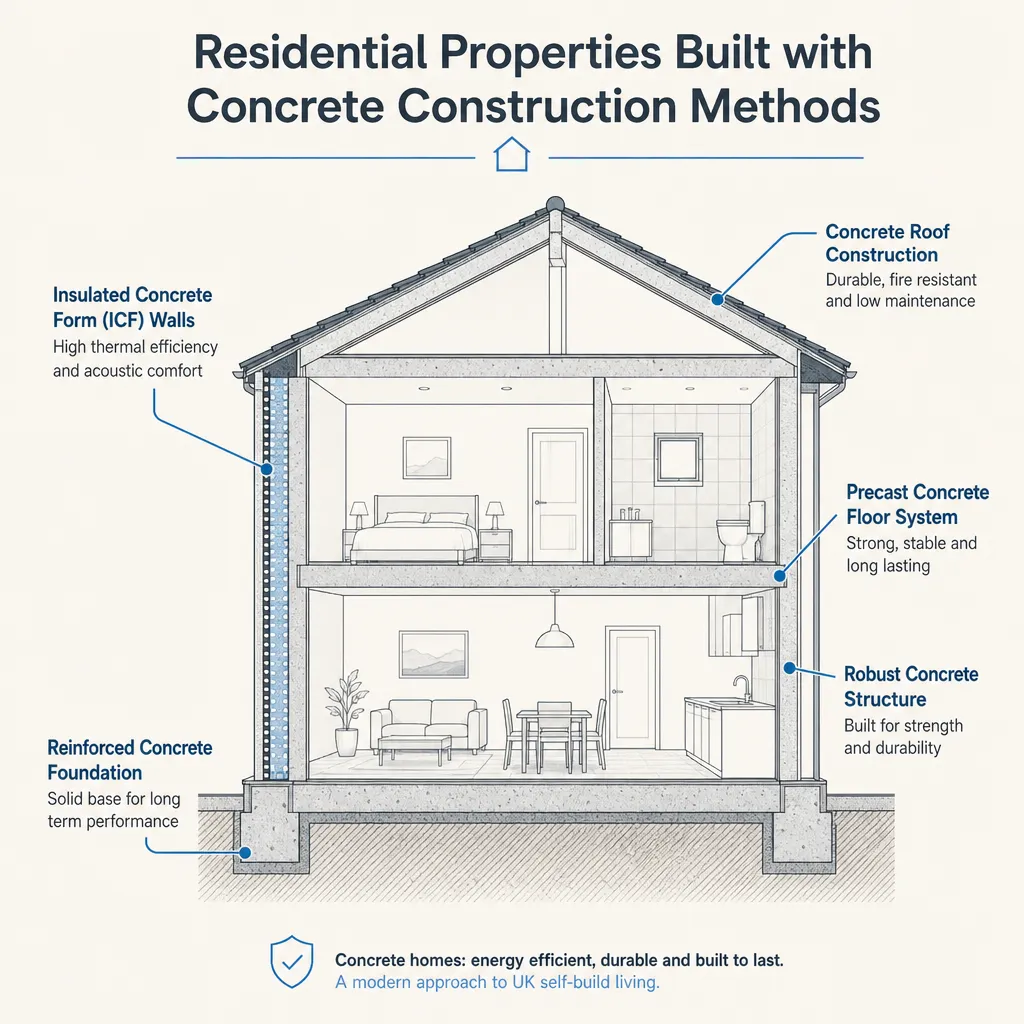
Residential Properties Built with Concrete Construction Methods
UK homes are built using several concrete methods: in-situ cast concrete, precast panel systems, insulating concrete formwork (ICF), and older non-traditional types such as Wimpey No-Fines and Laing Easiform.
 Planning & Pre-Build
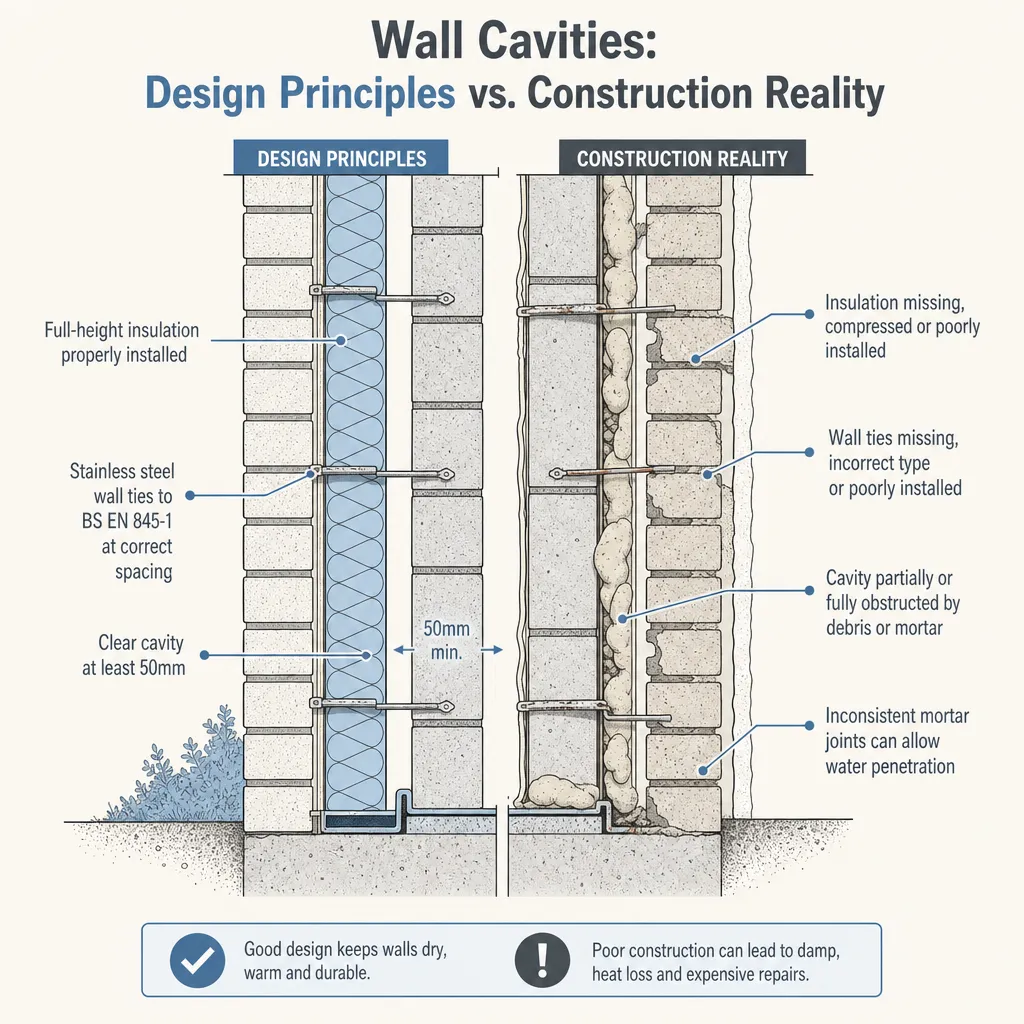
Wall Cavities: Design Principles vs. Construction Reality
A UK cavity wall is designed to resist weather, control heat loss, and structurally link two masonry leaves.
 Planning & Pre-Build
Home Improvements Not Requiring Planning Permission
Many common home improvements in England fall under Permitted Development Rights and do not require a planning application.
 Planning & Pre-Build
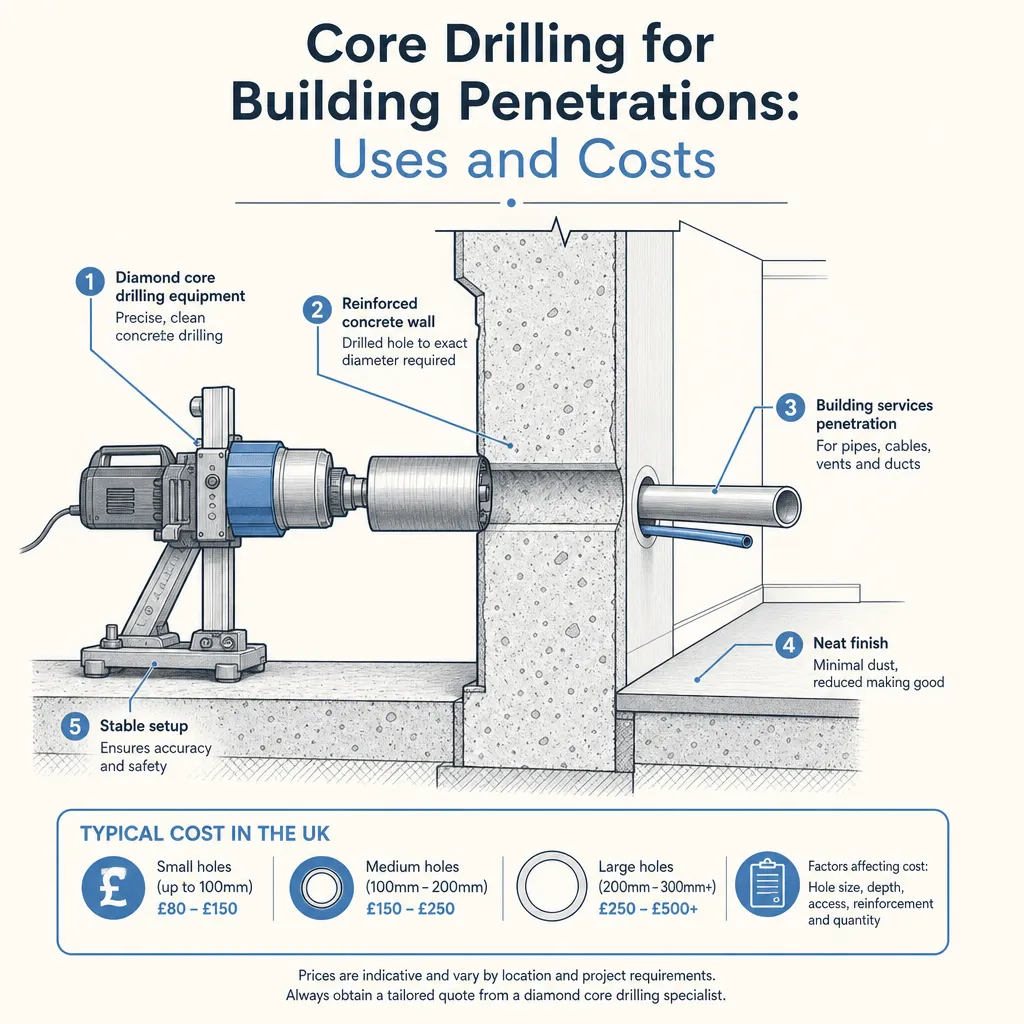
Core Drilling for Building Penetrations: Uses and Costs
Core drilling uses diamond-tipped equipment to cut clean holes through concrete, masonry, or block for pipes, ducts, cables, and building services.