Mortgage Valuation Lower Than Offer Price: What to Do
By Housey · Last reviewed 30th of May 2026
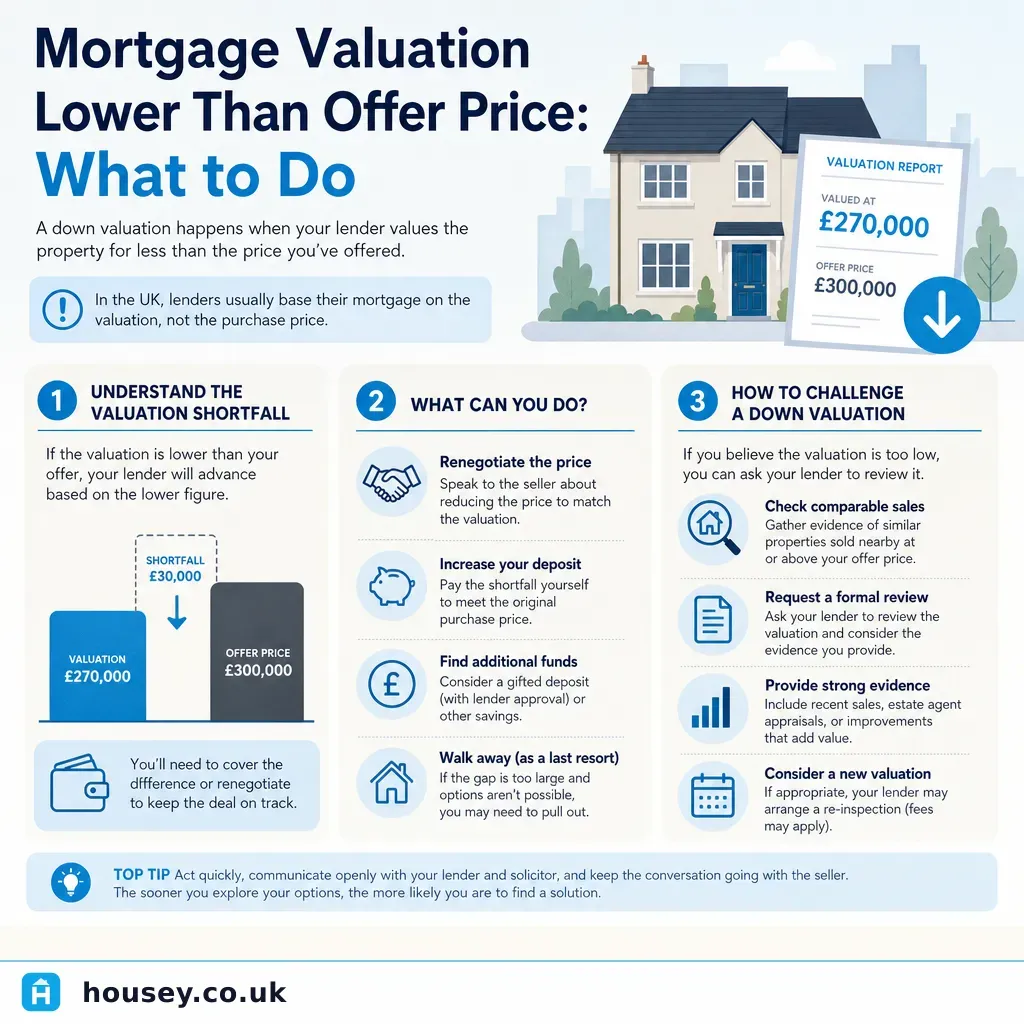
Mortgage Valuation Lower Than Offer Price: What to Do
A down valuation — when a lender's surveyor values a property below the price you have agreed with the seller — is one of the more disruptive events in a UK property purchase, and it can occur even in transactions that appear straightforward up to that point. The moment buyers receive this news, they face a time-sensitive decision that affects both the purchase and their financial planning. Understanding how the process works, what options are available, and what evidence carries weight gives you the clearest path to a resolution.
Key points
- A mortgage valuation is carried out for the lender's benefit, not the buyer's — its purpose is to protect the lender's security interest, not to assess what you should pay.
- When a down valuation occurs, the lender will only advance funds against the lower figure, creating a financing gap the buyer must cover through savings, a price reduction, or a different lender.
- A formal challenge to a down valuation must be supported by recent comparable sold prices — not asking prices — for genuinely similar properties, typically from the past three to six months.
- HM Land Registry's UK House Price Index publishes actual sold prices that can serve as comparable evidence when challenging a lender's valuation.
- Different lenders use different panel surveyors, meaning a fresh application to a new lender can produce a different valuation outcome — though there is no guarantee it will be higher.
Why lenders conduct mortgage valuations
When you apply for a mortgage, the lender instructs a surveyor to carry out a mortgage valuation on the property. This is not the same as a RICS Level 2 or Level 3 Home Survey commissioned for your benefit. The mortgage valuation has a specific, limited purpose: to satisfy the lender that, in the event of repossession and forced sale, the property would recover at least the loan amount.
As a result, mortgage valuations tend to be conservative. The surveyor prioritises recent local sold prices — not asking prices or the seller's expectations — and may apply a discount for features that could complicate a quick resale. The report belongs to the lender; some do not share it with borrowers at all.
What a down valuation means financially
The financing gap created by a down valuation is often larger than buyers expect:
Worked example — a 1970s semi-detached in the East Midlands >Agreed purchase price: £280,000Mortgage valuation: £260,000Down valuation gap: £20,000Mortgage at 90% loan-to-value: lender advances 90% x £260,000 = £234,000Original expectation at 90% LTV: 90% x £280,000 = £252,000Additional shortfall to cover from savings: £18,000 >The buyer must find an additional £18,000 on top of their original deposit plan, renegotiate the price down by £20,000, or explore other options.
Indicative UK scenario, last reviewed 2026-05-30. Actual figures depend on your specific LTV, lender policy, and agreed purchase price.
Your options after a down valuation
Option | What it involves | When it works best | Main risk |
|---|---|---|---|
Renegotiate the price | Ask the seller to reduce to the valuation figure | Seller is motivated; gap is significant | Seller refuses; chain collapses |
Bridge the gap from savings | Pay the difference in cash on top of your deposit | You have savings and still want the property | Depletes reserves; affordability shifts |
Challenge the valuation | Submit comparable sold-price evidence to the lender | Strong local comparables exist; valuation appears out of step | Challenge rejected; time lost |
Switch lenders | Apply to a different lender for a fresh valuation | Valuation seems materially wrong; broker identifies alternatives | 2–4 week delay; no guarantee of higher result |
Walk away | Withdraw from the purchase | Property is clearly overpriced; other options exhausted | Survey and legal costs lost; chain disrupted |
Renegotiating the price
This is often the cleanest resolution. A down valuation provides objective grounds for a price reduction — the seller's estate agent cannot argue with a lender's surveyor. If the seller is in a chain or motivated to complete, they may prefer to reduce the price rather than relist and restart. Any agreed change to the purchase price must be recorded formally by your solicitor or conveyancer.
Challenging the valuation
A formal challenge requires:
- Recent comparable sold prices — actual sold prices from HM Land Registry for properties of similar size, age, and condition within the same postcode or immediate area, sold within the past three to six months. Asking prices are not comparable evidence.
- A covering letter from you or your mortgage broker, submitted to the lender's valuation review or mortgage underwriting team.
- Any additional supporting information if the property has features the surveyor may have underweighted.
Challenges succeed most often when the comparables are genuinely similar — same street or adjacent streets, similar size and condition. They rarely succeed when the down valuation reflects a broader view that the property is overpriced for the area.
Switching lenders
If your challenge fails and renegotiation is not possible, applying to a different lender is worth considering. Different lenders use different panel surveyors, and valuations are not always identical. Your mortgage broker can advise which lenders have a track record of valuing similar properties more favourably in your area. Allow two to four additional weeks for a new application and valuation.
Red flags that suggest the down valuation may be correct
Before committing to a challenge or bridging the gap, consider whether the valuation may reflect genuine market risk:
- The agreed price was significantly above other comparable sold prices in the area at the time of your offer.
- The estate agent could not produce recent comparable sales evidence when you made your offer.
- The property has been listed and relisted without selling over an extended period.
- The seller's asking price was set during a rising market that has since plateaued or softened.
- Your own RICS survey has identified defects or condition issues that could deter future buyers and suppress resale value.
If several of these apply, the down valuation may be protecting you from overpaying, and accepting a price reduction to the surveyor's figure is the most financially sensible outcome.
Important limitations
This article provides general information about how down valuations work in UK residential property transactions and the options typically available to buyers. It does not constitute financial, legal, or valuation advice. Mortgage lending decisions, valuation outcomes, and negotiation strategies depend on individual circumstances, property condition, lender policy, and current market conditions. Always seek advice from a qualified, regulated mortgage broker and an experienced conveyancer for your specific situation.
What to ask a qualified professional
Before deciding how to respond to a down valuation, ask your mortgage broker or lender:
- What is the exact valuation figure, and is there a written explanation of the reasoning?
- Does the lender have a formal valuation challenge process, and what evidence do I need to submit?
- If I switch lenders, which lenders on your panel have produced more favourable valuations for similar properties in this area?
- Will switching lenders affect the mortgage rate or product I have been offered?
Ask your conveyancer:
- Does the agreed purchase price reflect recent comparable sold prices in this area?
- Is there anything in the title, planning history, or condition of the property that could have influenced the valuation?
- What are the legal and cost implications if price negotiations with the seller break down at this stage?
If you are considering commissioning an independent valuation to support a challenge, instruct a RICS-registered valuer with relevant experience in the specific property type and local area.
When to get professional help
Speak to your mortgage broker before taking any action after a down valuation — they deal with these situations regularly and understand which lenders and approaches are most likely to produce a resolution. Instruct your conveyancer immediately if the down valuation triggers a price renegotiation, as any agreed change to the purchase price must be recorded formally.
Seek additional professional guidance if:
- The down valuation is large — more than five to ten per cent below the agreed price — and the seller is unwilling to reduce.
- Your financial circumstances have changed since your original application and you are unsure whether reapplying is straightforward.
- Your own survey has identified significant defects, and you want independent advice on whether to proceed at any price.
How Housey can help
Housey can connect you with RICS-accredited surveyors offering valuation surveys across the UK. If you need an independent opinion of value — whether to support a challenge to the lender's figure or to clarify what a property is realistically worth in current market conditions — getting a qualified surveyor involved early can save money and help you negotiate from a position of knowledge.
Frequently asked questions
Why did the lender's surveyor value the property lower than my offer?
Mortgage valuations are carried out for the lender's benefit and tend to be conservative. The surveyor compares recent local sold prices rather than asking prices. Common reasons for a down valuation include limited comparable sales in the area, a seller who has set an ambitious price, or unusual property features that make direct comparison difficult. Market conditions at the time of instruction also influence the outcome.
Can I use my own surveyor's report to challenge a down valuation?
A RICS Home Survey (Level 2 or Level 3) is separate from the mortgage valuation. However, if it contains a market value opinion, you can use it alongside comparable sold-price evidence from HM Land Registry when making a formal challenge to the lender. The key is providing specific, verifiable evidence — not general market commentary or estate agent quotes.
Will switching mortgage lenders get me a higher valuation?
Possibly. Different lenders use different panel surveyors, and valuations can vary between them. Switching gives you a fresh valuation but involves a new application and a delay of two to four weeks. There is no guarantee the next valuation will be higher. Your mortgage broker can advise on which lenders are most likely to take a different view for your specific property type and location.
Am I entitled to see the mortgage valuation report?
The mortgage valuation report is prepared for the lender, not the buyer. Some lenders share it as a courtesy, but they are not legally required to do so. This is one reason buyers are encouraged to commission their own RICS Level 2 or Level 3 Home Survey — prepared in full for your benefit and providing far more detail than a standard mortgage valuation.
Sources and further reading
- UK House Price Index — sold prices — HM Land Registry / GOV.UK
- MoneyHelper: Buying a home — MoneyHelper (Money and Pensions Service)
- RICS: Find a surveyor — Royal Institution of Chartered Surveyors
- Citizens Advice: Buying a home — Citizens Advice
Useful next reads
 General property advice
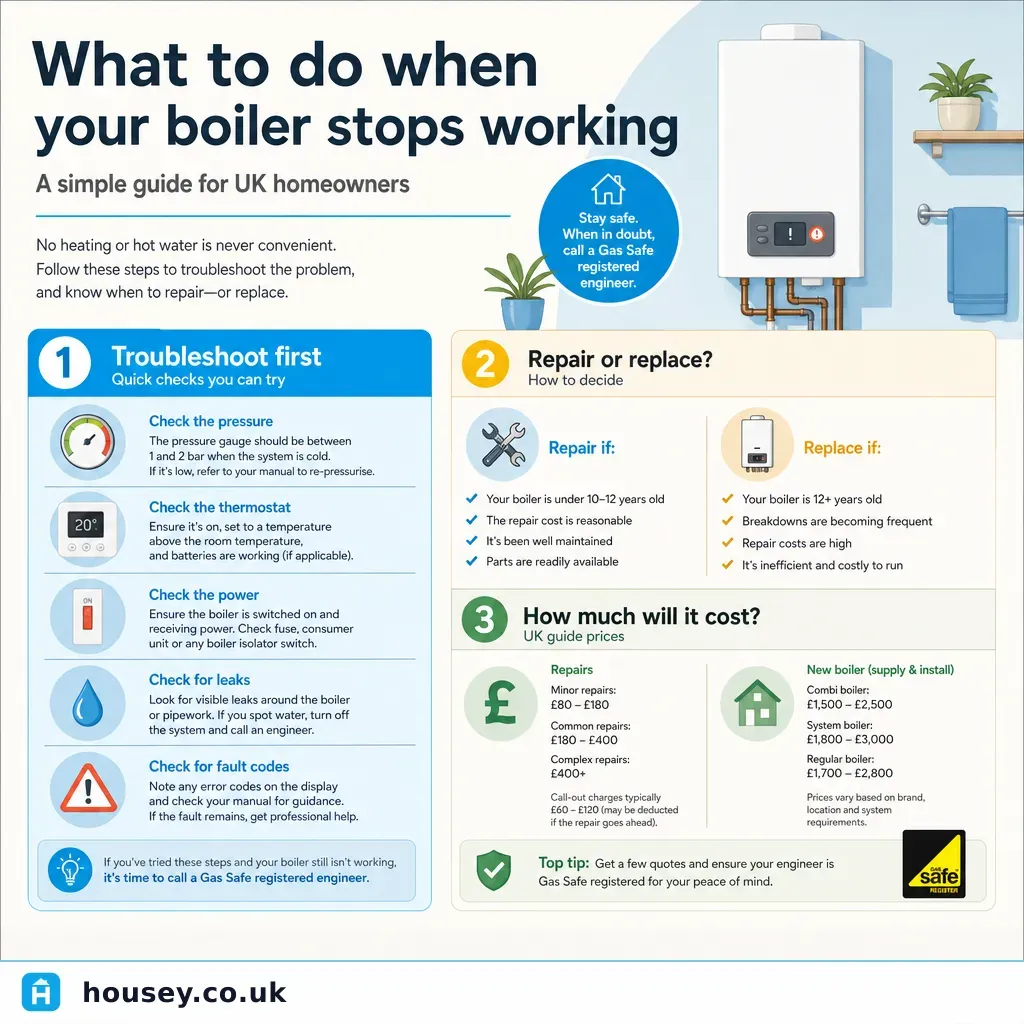
What to do when your boiler stops working
When your boiler stops working, check the pressure gauge (should read 1–1.
 General property advice
Property Market Trends: Activity Growth and Price Movements
UK property market activity is measured through completed sale registrations (HM Land Registry), lender mortgage data, and transaction volumes from HMRC.
 General property advice
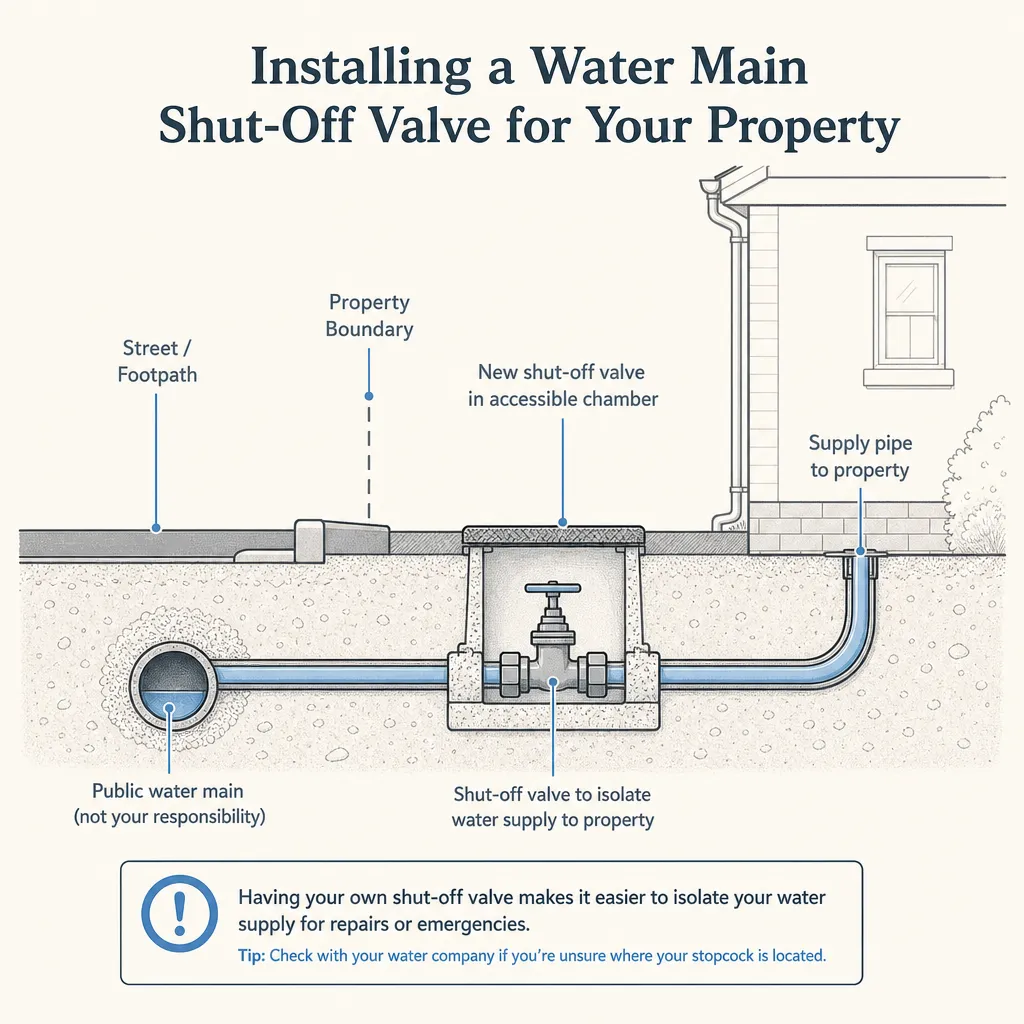
Installing a water main shut-off valve for your property
A water main shut-off valve — commonly called a stopcock — controls all water entering your home from the mains.
 General property advice
Monthly House Price Index: August Market Report and Analysis
The UK House Price Index is published monthly using completed Land Registry transaction data, meaning August figures typically reflect sales agreed months earlier.
 General property advice
Scottish Property Market: Activity and Regional Trends
Scotland's property market operates under distinct legal rules: sellers must provide a Home Report before marketing, transactions become legally binding at conclusion of missives rather than exchange of contracts, and Land and Buildings Transaction Tax replaces Stamp Duty.