Mould Survey Costs: What You Need to Know
By Housey · Last reviewed 30th of May 2026
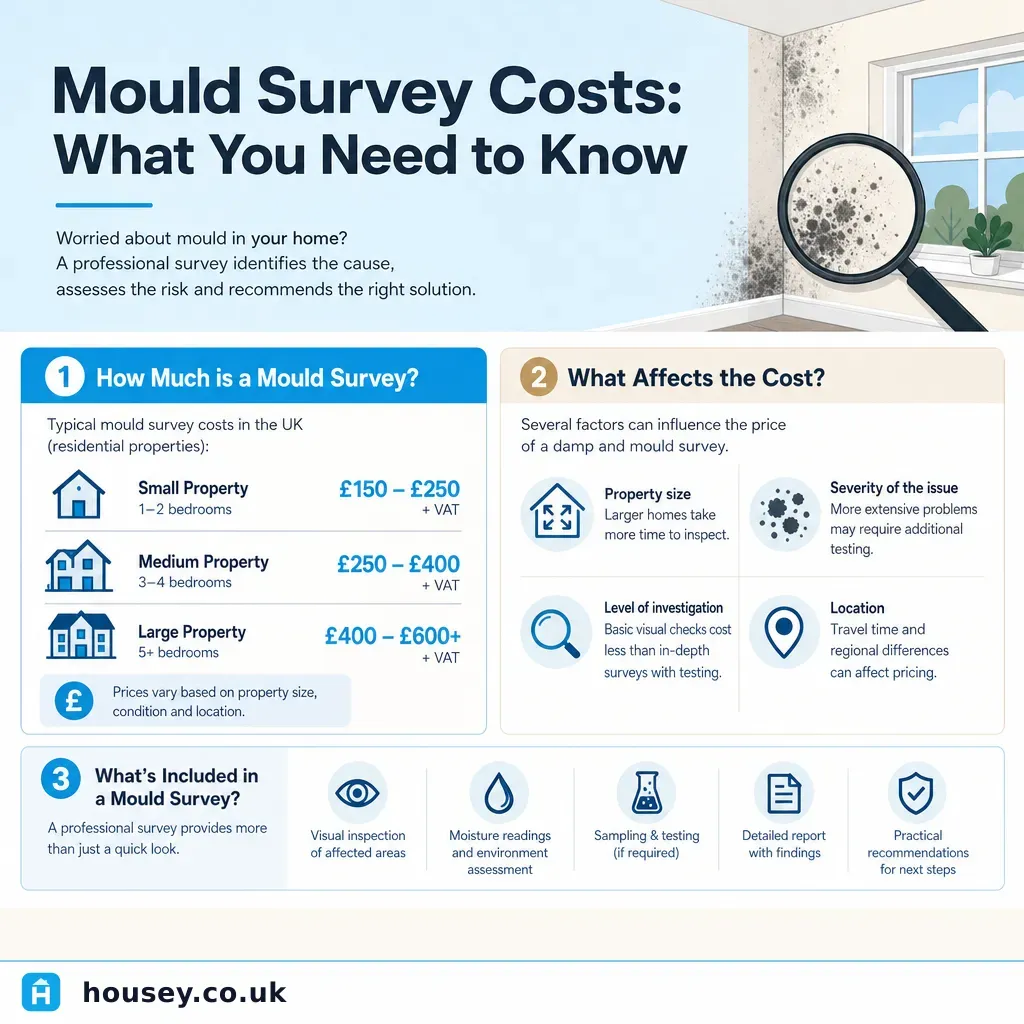
Mould Survey Costs: What You Need to Know
Mould appearing in a property — whether you are a homeowner dealing with recurring damp patches, a landlord responding to a tenant complaint, or a buyer flagging it during due diligence — prompts the same pressing question: who should investigate and what will it cost? Understanding what different types of mould and damp surveys involve, and what drives their price, helps you choose the right level of investigation rather than under- or over-spending.
Key points
- A basic visual mould inspection typically costs £150–£300; a full damp and timber survey from a qualified specialist typically costs £250–£500 for an average UK semi-detached home (Indicative UK costs, last reviewed 2026-05-30).
- Mould surveys are separate from RICS Home Surveys (Level 2 or Level 3) and from Energy Performance Certificate (EPC) assessments — they are targeted specialist inspections focused on moisture sources, fungal growth, and timber condition.
- Under the Homes (Fitness for Human Habitation) Act 2018, landlords in England must maintain properties free from conditions that pose a risk to occupants' health; persistent damp and mould growth is a recognised hazard under the Housing Health and Safety Rating System (HHSRS).
- Thermal imaging surveys — which identify cold bridging and concealed moisture behind wall or ceiling finishes — typically add £100–£200 to a standard damp inspection fee.
- The Property Care Association (PCA) accredits specialist damp and timber surveyors; instructing a PCA-member firm provides assurance of recognised technical competence and access to a formal complaints procedure.
What does a mould survey cover?
A mould survey — also called a damp survey or moisture investigation — is a targeted inspection to identify the source, extent, and cause of mould or damp within a property. Qualified inspectors use calibrated moisture meters, hygrometers, and borescope cameras, supplementing visual assessment with instrument readings.
A specialist report usually covers:
- Moisture levels in walls, floors, and ceilings using resistance or capacitance moisture meters
- Evidence of rising damp, penetrating damp, or plumbing leaks
- Condensation patterns and the adequacy of ventilation and heating
- Timber condition where mould is present, checking for wet rot and dry rot risk
- Cold bridging using thermal imaging, where instructed
The output is a written report identifying the cause and recommending remedial works, supported by photographs and moisture readings.
Types of mould survey — compared
Survey type | What it covers | Typical UK cost (2026) | Best for |
|---|---|---|---|
Visual inspection report | Surface mould, visible damp staining, basic moisture meter readings | £150–£300 | Initial assessment; straightforward condensation cases; landlord compliance records |
Full damp and timber survey | Moisture mapping, timber condition, rising damp assessment, cause analysis | £250–£500 | Pre-purchase due diligence; persistent or recurring mould; tenant complaints |
Thermal imaging survey | Cold bridging, hidden moisture behind finishes, insulation performance | £300–£600 (often combined) | Solid-wall properties; post-insulation checks; new-build defects |
Air quality / mould spore test | Airborne mould spore counts; species identification | £200–£450 | Health-related concerns; HHSRS assessments; legal disputes |
Structural damp investigation | Drainage, external envelope, roof and gutter contribution to damp | £400–£700+ | Chronic penetrating damp; Victorian or Edwardian terraces with complex defects |
Indicative UK costs, last reviewed 2026-05-30. Prices vary by region, property size, and access complexity.
What drives the cost of a mould survey?
Several factors push survey fees above or below the typical range.
Property size and age. A three-storey Victorian terrace requires more instrument readings and takes longer to survey than a 1990s flat. Solid-wall construction conceals moisture more effectively than cavity walls, often requiring additional thermal imaging to identify the full picture.
Number of affected areas. Mould confined to one bathroom is quicker to assess than damp appearing in multiple rooms across several floors.
Equipment used. Borescope cameras, thermal imaging equipment, and laboratory spore analysis all add time and cost. Some surveyors include thermal imaging in their standard fee; others charge separately.
Report specification. A brief cause-and-recommendation letter may suffice for a landlord compliance log. A full technical report with photographic evidence, moisture maps, and a remediation specification — often required for legal proceedings, insurance claims, or a Section 11 landlord complaint — takes longer and costs more.
Location. Professional survey fees in London and the South East tend to be higher than in the Midlands, the North, or Wales.
Decision tree: which type of survey do you need?
- Choose a visual inspection if mould is limited to one room, appears to be condensation-related, and you want written confirmation of the cause.
- Choose a full damp and timber survey if mould has returned after treatment, is present in multiple rooms, has been flagged in a pre-purchase RICS survey, or you are a landlord with a formal tenant complaint.
- Choose a thermal imaging survey if mould is forming behind plasterboard or wall finishes, if a recent insulation installation may be involved, or if the property has solid walls with no clear external cause.
- Choose an air quality test if a household member has a respiratory condition, if you are involved in a legal dispute about health impacts, or if a local authority HHSRS inspection has been requested.
- Instruct a structural engineer as well if mould is accompanied by active water ingress, failing render, cracked brickwork, or roof defects that a damp survey alone cannot address.
Homeowner checklist: before the surveyor arrives
- Photograph all affected areas, including close-ups and wide shots for context.
- Note when mould first appeared and whether it is seasonal (condensation peaks in winter) or persistent year-round.
- Record any recent changes: new insulation, draught-proofing, replacement windows, or altered heating and ventilation patterns.
- Check gutters, downpipes, and external render visually — obvious defects help the surveyor form a preliminary view before arriving.
- Gather any previous survey reports, building control completion certificates, or insulation installer guarantees.
- If you are a landlord, retain copies of all written tenant communications about damp.
Red flags: when a mould survey is not enough
Certain findings suggest the problem requires more than a standard survey:
- Extensive black mould covering an area greater than roughly 1 m² — professional remediation, not just diagnosis, is needed alongside the survey.
- Soft, discoloured, or crumbling timber in floor joists, roof rafters, or lintels — wet rot or dry rot treatment may be urgent.
- Mould in a recently insulated property — particularly after cavity or spray foam insulation — may indicate a moisture trap; the installer's guarantee and a PAS 2035-qualified assessor should be involved.
- Recurring mould returning within weeks of cleaning — the underlying source has not been addressed and a more thorough investigation is needed.
- Health symptoms in occupants such as persistent cough or worsening asthma — warrant escalation to an air quality specialist and GP advice in parallel.
When to get professional help
A professional survey is advisable whenever mould covers an area larger than roughly 1 m², has returned after cleaning, or has no obvious cause such as a poorly ventilated bathroom or a visible leak. For landlords, the HHSRS classifies damp and mould as a potential Category 1 hazard; a professional survey report documents that appropriate action was taken in response to a complaint.
Resist the temptation to instruct a builder or decorator to treat the surface without first diagnosing the cause. Treating condensation mould with a damp-proof course injection, for example, wastes money and leaves the real problem unresolved.
How Housey can help
Housey connects homeowners and landlords with accredited specialists across the UK. Through our damp and timber survey service, you can request quotes from qualified surveyors in your area, compare their approach and fees, and book with confidence.
Frequently asked questions
Is a mould survey the same as a damp survey?
The terms are often used interchangeably. A damp survey typically covers rising damp, penetrating damp, condensation, and timber condition. A mould survey focuses more specifically on fungal growth — its extent, cause, and, in air quality tests, species. Most specialist firms offer a combined investigation covering both.
Can a local council carry out a free mould survey?
Local authorities in England can carry out HHSRS inspections of rented properties following a formal tenant complaint. If a Category 1 hazard is identified, an improvement notice may be served on the landlord. This is not the same as a commercial damp survey, but it can prompt necessary action. Contact your local council's housing enforcement team for details.
How long does a mould survey take?
A visual inspection for a single affected room typically takes one to two hours on-site. A full damp and timber survey of a three-bedroom semi-detached home usually takes two to four hours, with the written report delivered within three to seven working days.
Who is qualified to carry out a mould survey?
Look for surveyors accredited by the Property Care Association (PCA) or the British Wood Preserving and Damp-proofing Association (BWPDA), or chartered surveyors (MRICS or FRICS) with specialist damp experience. For air quality and mould spore testing, check that the testing laboratory holds UKAS accreditation.
Will home insurance cover the cost of a mould survey?
Most standard home insurance policies exclude gradual damp and mould, treating it as a maintenance issue rather than sudden accidental damage. If mould results from a traceable insured event — such as a burst pipe — some policies may contribute to investigation costs. Check your policy schedule and contact your insurer before commissioning a survey at your own expense.
Sources and further reading
- Homes (Fitness for Human Habitation) Act 2018 — legislation.gov.uk
- Housing Health and Safety Rating System (HHSRS) guidance for landlords — GOV.UK
- Understanding and addressing the health risks of damp and mould in the home — GOV.UK / DLUHC
- Property Care Association — accredited surveyor directory — Property Care Association
Useful next reads
 Surveys & Inspections
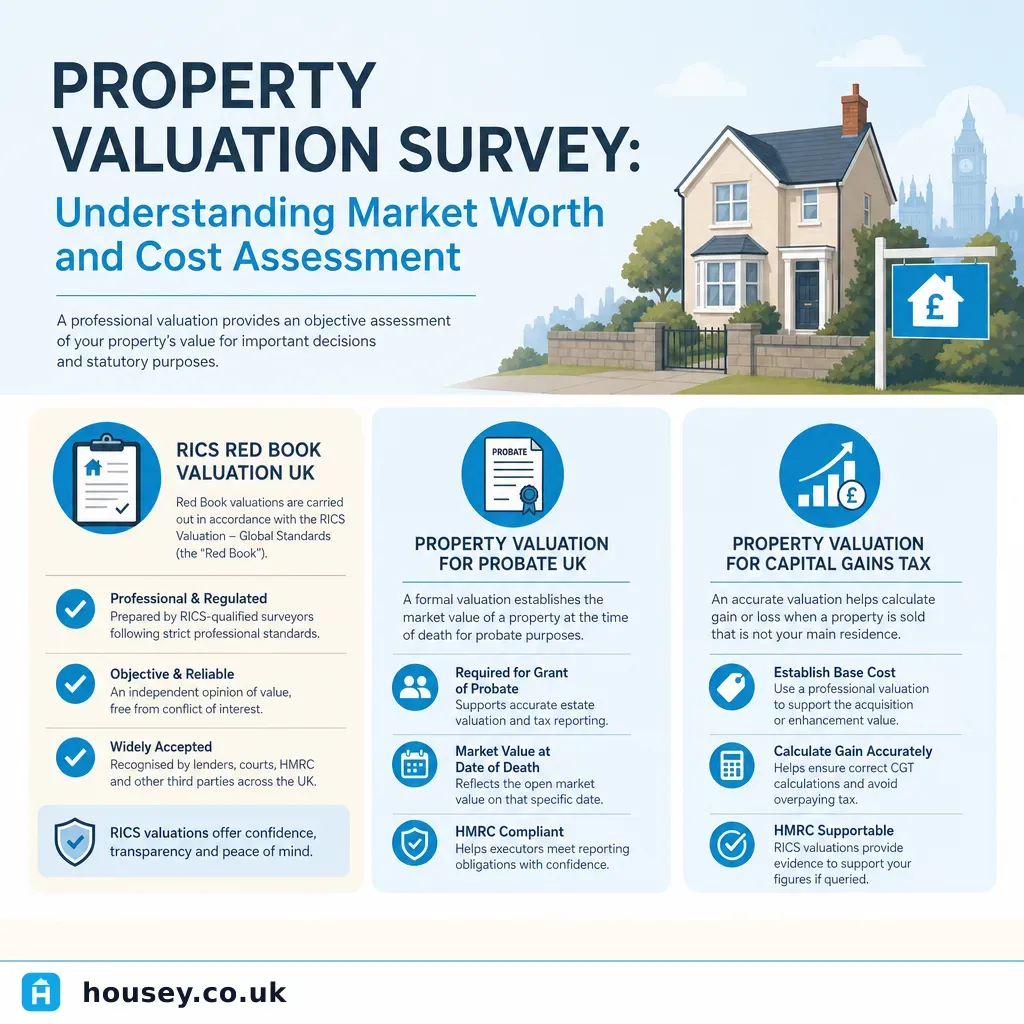
Property Valuation Survey: Understanding Market Worth and Cost Assessment
A property valuation survey establishes a property's market value at a specific date.
 Surveys & Inspections
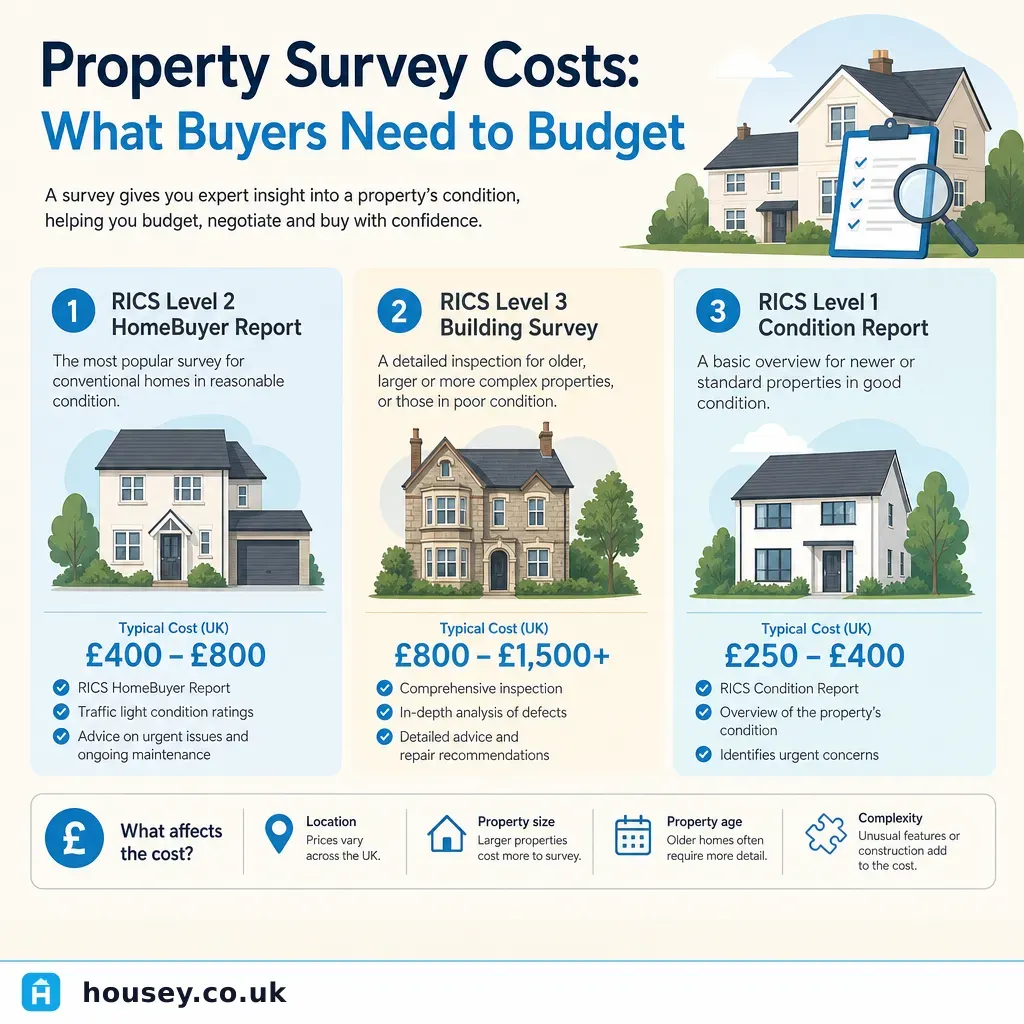
Property Survey Costs: What Buyers Need to Budget
A RICS Level 1 survey typically costs £300–£500, a Level 2 Home Survey £400–£900, and a Level 3 Building Survey £600–£1,500 or more.
 Surveys & Inspections
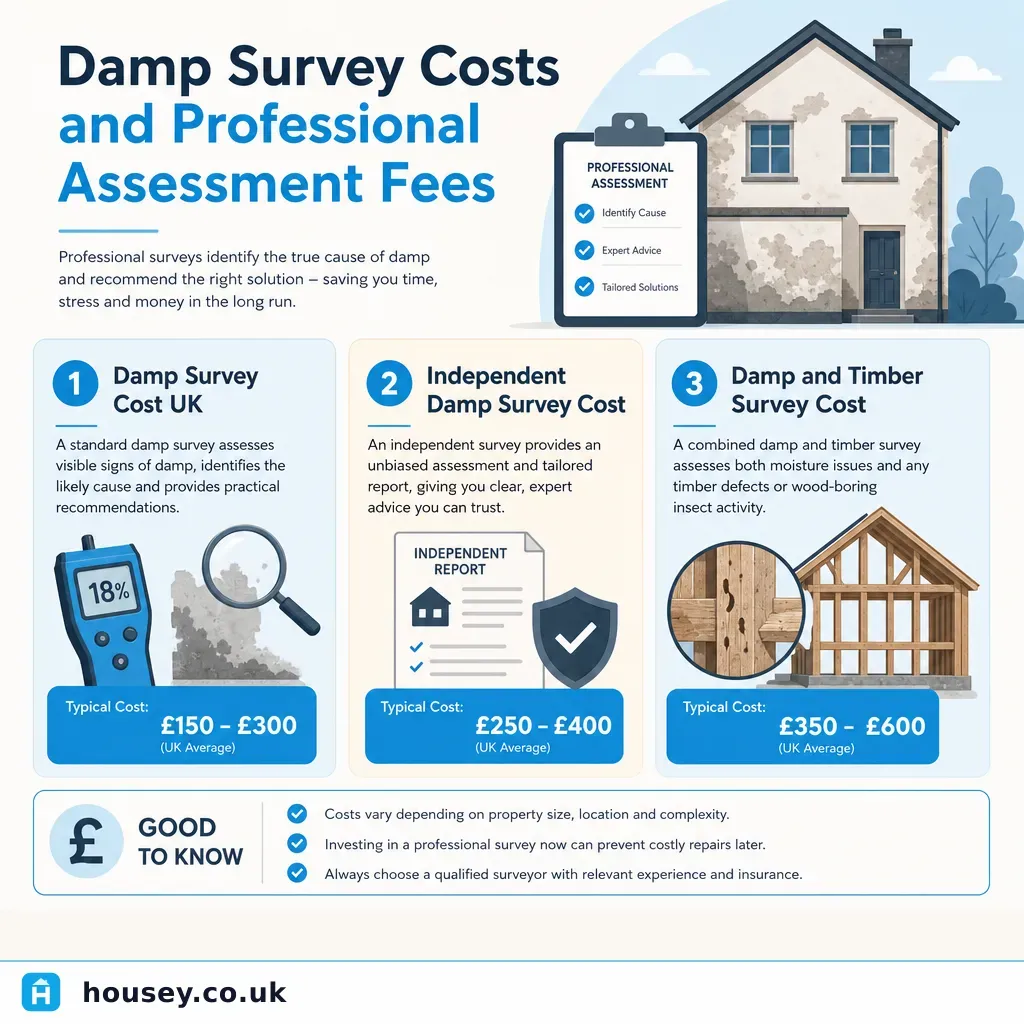
Damp Survey Costs and Professional Assessment Fees
An independent damp and timber survey in the UK typically costs between £200 and £500, depending on property size, age, and surveyor qualifications.
 Surveys & Inspections
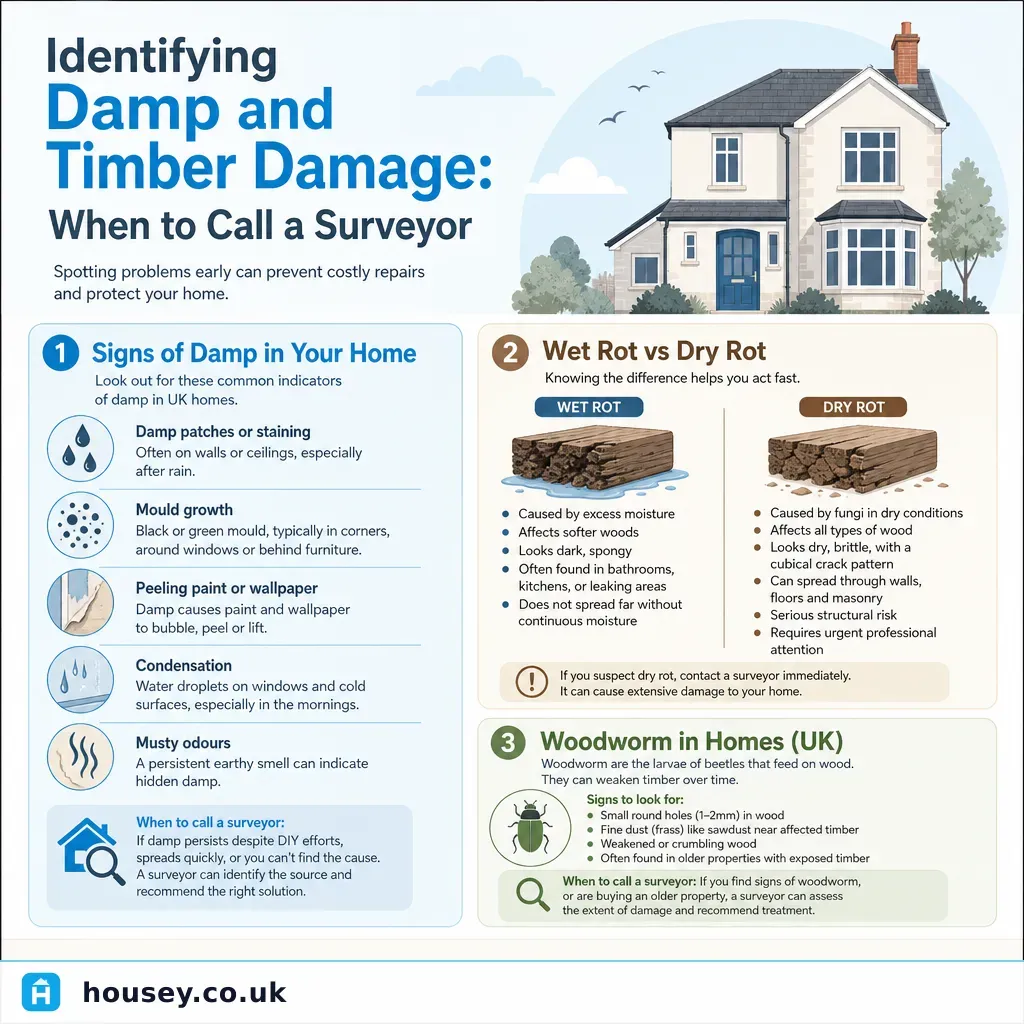
Identifying Damp and Timber Damage: When to Call a Surveyor
Damp and timber damage often appear together — damp conditions attract wood-boring insects and fungal decay.
 Surveys & Inspections
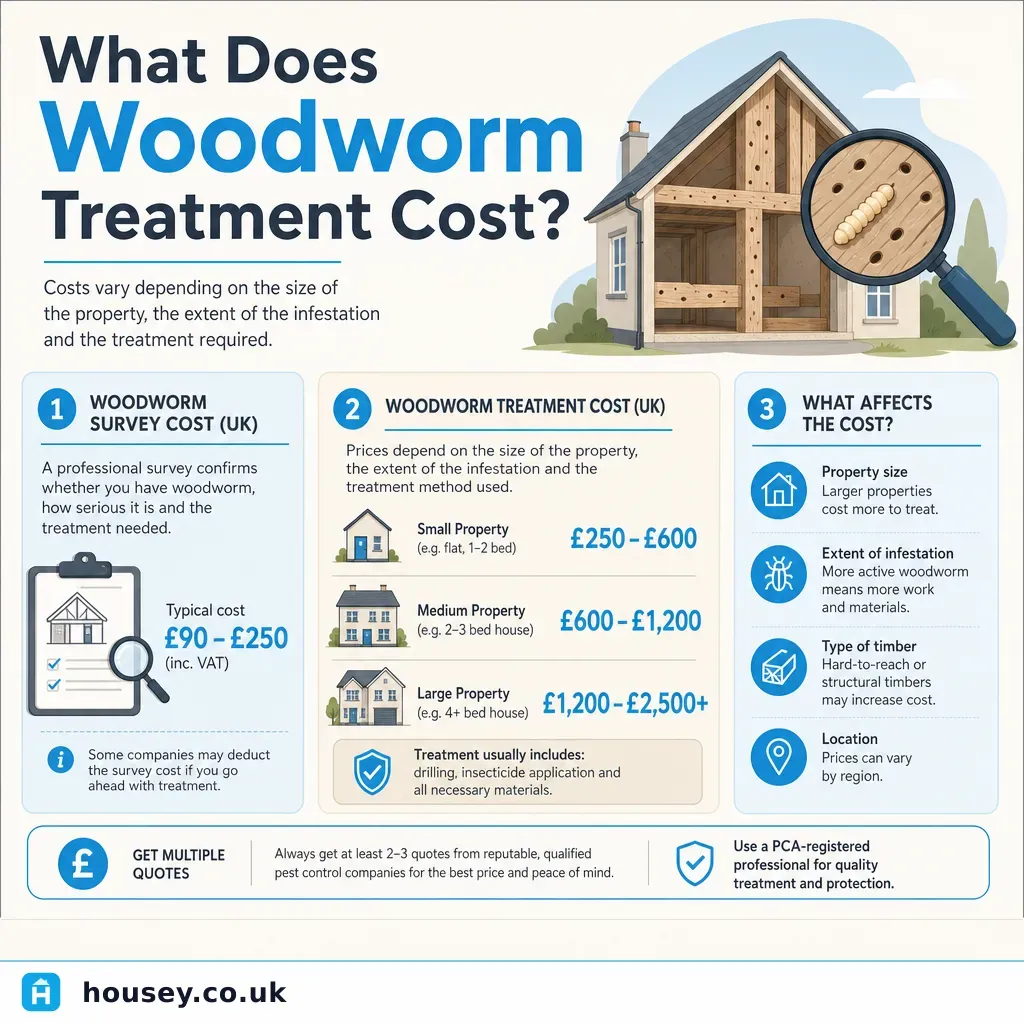
What Does Woodworm Treatment Cost?
Woodworm treatment in the UK typically costs £300–£900 for a standard three-bedroom home, depending on the extent of infestation and timbers affected.