What Does Woodworm Treatment Cost?
By Housey · Last reviewed 11th of May 2026
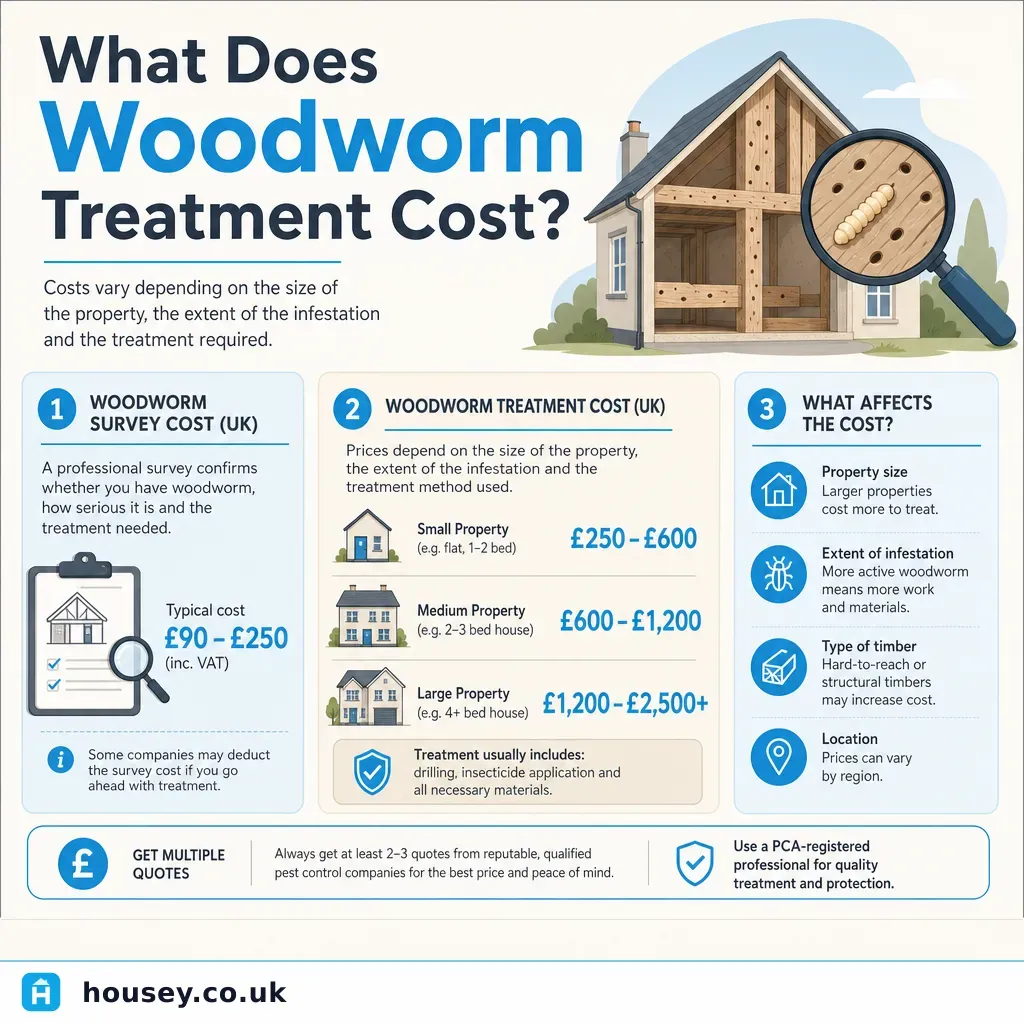
What Does Woodworm Treatment Cost?
The small round flight holes left by wood-boring beetles can appear in floorboards, roof timbers, staircases, and furniture across many UK homes — particularly those built before 1960. Their presence does not automatically mean treatment is needed, however. Costs and urgency depend on the species involved, whether the infestation is still active, and how structurally significant the affected timbers are. Getting this wrong in either direction — unnecessary treatment or ignored active infestation in load-bearing timber — can be costly.
Key points
- Professional woodworm treatment typically costs £300–£900 for a standard three-bedroom UK property, depending on the extent of infestation and timbers affected (Indicative UK costs, last reviewed 2026-05-11).
- A damp and timber survey, usually required before any treatment is instructed, typically costs £150–£400 depending on property size and surveyor (Indicative UK costs, last reviewed 2026-05-11).
- The most common UK species — the Common Furniture Beetle (Anobium punctatum) — is active from May to September; fresh frass (bore dust) beneath flight holes indicates a live infestation.
- Historic flight holes in dry, well-ventilated timber may require no treatment at all — only a qualified surveyor can confirm whether an infestation is currently active.
- Specialist timber treatment contractors in the UK should hold membership of the Property Care Association (PCA) or an equivalent recognised body.
What is woodworm and when is treatment needed?
"Woodworm" is a collective term for the larval stage of several wood-boring beetle species. In UK properties, the most commonly encountered are:
- Common Furniture Beetle (Anobium punctatum) — small 1–2 mm exit holes; affects softwood and older hardwood; most prevalent in pre-1960s homes.
- Deathwatch Beetle (Xestobium rufovillosum) — larger holes; found in old hardwood structural timbers, roof beams, and historic buildings.
- House Longhorn Beetle (Hylotrupes bajulus) — a serious structural pest in new softwood roofing timbers; most prevalent in parts of Surrey and the South East.
- Powder Post Beetle (Lyctus spp.) — fine powder-like frass; mainly affects the sapwood of new hardwoods.
Not all flight holes indicate active infestation. Old, dry holes in well-maintained, ventilated timber are often historic evidence of a long-gone beetle population. A qualified surveyor's inspection is the only reliable way to determine whether treatment is warranted.
How much does woodworm treatment cost?
The table below sets out indicative costs for the main stages of woodworm assessment and treatment. Always obtain at least two to three written quotes from PCA-member contractors.
Stage | Indicative cost | Notes |
|---|---|---|
Damp and timber survey | £150–£400 | Required before treatment; price varies by property size |
Treatment — localised area (single room) | £150–£400 | e.g., floorboards in one room |
Treatment — whole property (standard 3-bed) | £300–£900 | Includes roof space and floor voids |
Treatment — structural timbers / Deathwatch Beetle | £800–£2,500+ | Complex access; may require scaffold |
Boron consolidant for damaged timbers | Quoted separately | Stabilises weakened wood without full replacement |
Structural timber replacement (if required) | Builder quotation | Separate from treatment scope |
Indicative UK costs, last reviewed 2026-05-11. Prices vary significantly by property, species, location, and contractor.
What drives the cost of woodworm treatment?
Extent and accessibility
Localised treatment of a single room's floorboards costs considerably less than a widespread infestation across roof timbers, floor joists, and subfloor voids. Access — via a roof hatch, scaffold, or restricted crawlspace — significantly affects contractor time and equipment requirements.
Species of beetle
Common Furniture Beetle treatment is relatively straightforward. Deathwatch Beetle infestations in historic hardwood timbers are more serious, may affect structural integrity, and require specialist assessment — resulting in correspondingly higher treatment costs.
Treatment method
The two main methods used by UK professionals are:
- Permethrin-based liquid treatment — the most widely used domestic approach; an insecticide applied by spray or brush to affected timber surfaces.
- Boron-based products — lower toxicity; often used for stabilising damaged timbers or where reduced chemical exposure is preferred.
Fumigation is also used in severe or inaccessible infestations but is less common in standard domestic settings. PCA-member contractors should provide a written specification of the proposed method and product before any treatment begins.
Damp conditions
Woodworm infestations are almost always associated with elevated moisture levels — damp timber provides the conditions beetles require to complete their lifecycle. A contractor who treats woodworm without assessing and reporting on underlying damp is not addressing the root cause. Reputable contractors will survey for damp as part of the assessment.
Property size and location
A one-bedroom flat with a small roof void costs less to treat than a detached four-bedroom house with a large loft, suspended floors, and outbuildings. Rates in London and the South East are typically higher.
Decision guide: survey, treatment, or both?
- Commission a damp and timber survey if you have found flight holes but are unsure whether the infestation is active, or if you are buying a property and the homebuyer's survey has flagged timber concerns.
- Instruct treatment only after a qualified surveyor has confirmed an active infestation following full inspection — do not instruct treatment on the basis of visible holes alone.
- Request a structural assessment separately if timbers show visible strength loss, softness, or crumbling — this requires a structural or timber engineer and is outside the scope of standard woodworm treatment.
- Act before exchange if you are purchasing — instruct a specialist timber survey before completion if woodworm has been noted in any pre-purchase survey report.
What to ask a woodworm treatment contractor
- Are you a member of the Property Care Association (PCA) or equivalent professional body?
- Will you carry out a full survey before recommending treatment?
- What species do you believe is responsible, and what evidence supports that conclusion?
- Is the infestation active, and how are you determining that?
- What treatment method do you propose, and which product will be used?
- Is there an underlying damp issue that should be investigated and remedied first?
- What guarantee do you offer, and what does it cover and exclude?
- Is VAT included in the quotation?
When to get professional help
Woodworm treatment in structural timbers requires a qualified specialist — proprietary retail products are not appropriate for roof spaces, floor joists, or any load-bearing timbers. Seek professional input promptly if:
- Fresh frass and flight holes are found in structural timbers such as roof purlins, joists, or floor beams — this may indicate active infestation with structural implications.
- A homebuyer's survey has flagged woodworm or timber defects — do not proceed to exchange without a specialist timber survey.
- Timber feels soft, crumbles easily, or shows visible strength loss — a structural engineer's assessment may be needed before any treatment is instructed.
- The property is listed or in a conservation area — treatment methods and any associated repair work may require agreement with the local planning authority or conservation officer.
How Housey can help
If you have spotted flight holes or a recent survey has raised concerns about timber condition, booking a damp and timber survey is the recommended first step before any treatment is instructed. Housey connects homeowners with PCA-accredited surveyors and specialist timber treatment contractors across the UK.
Frequently asked questions
How do I tell if woodworm is active?
Active woodworm is most reliably indicated by fresh frass — fine, cream-coloured powder — found beneath or around flight holes, particularly during late spring and summer (May to September). Old, dry holes with no frass in well-ventilated, maintained timber may simply be historic activity. A qualified surveyor can confirm whether the infestation is current and whether treatment is warranted.
Does woodworm treatment come with a guarantee?
Most PCA-member contractors offer a treatment guarantee, typically ranging from 10 to 30 years, covering re-infestation by the same species in the treated area. Read the terms carefully — exclusions commonly include new infestations from untreated areas, structural damage pre-existing at treatment time, or conditions arising from damp that was not remedied.
Can I treat woodworm myself?
Proprietary woodworm fluid is available from DIY retailers and is sufficient for treating isolated pieces of furniture or small, easily accessible timber surfaces. It is not a suitable substitute for professional treatment of structural timbers, roof spaces, or floor voids, where correct access, coverage, and product application are essential. Professional treatment also provides a contractual guarantee.
Will woodworm affect my mortgage or property sale?
Active woodworm in structural timbers is treated by lenders and surveyors as a material defect that may affect mortgageability until professionally treated and certificated. A treatment guarantee from a PCA-member contractor is typically the documentation lenders require before proceeding.
Sources and further reading
- Find a PCA-member specialist — Property Care Association
- Insects and wood decay in historic buildings — Historic England
- Wood-boring insects — Health and Safety Executive
- Building Regulations Approved Document A — structure — GOV.UK
Useful next reads
 Surveys & Inspections
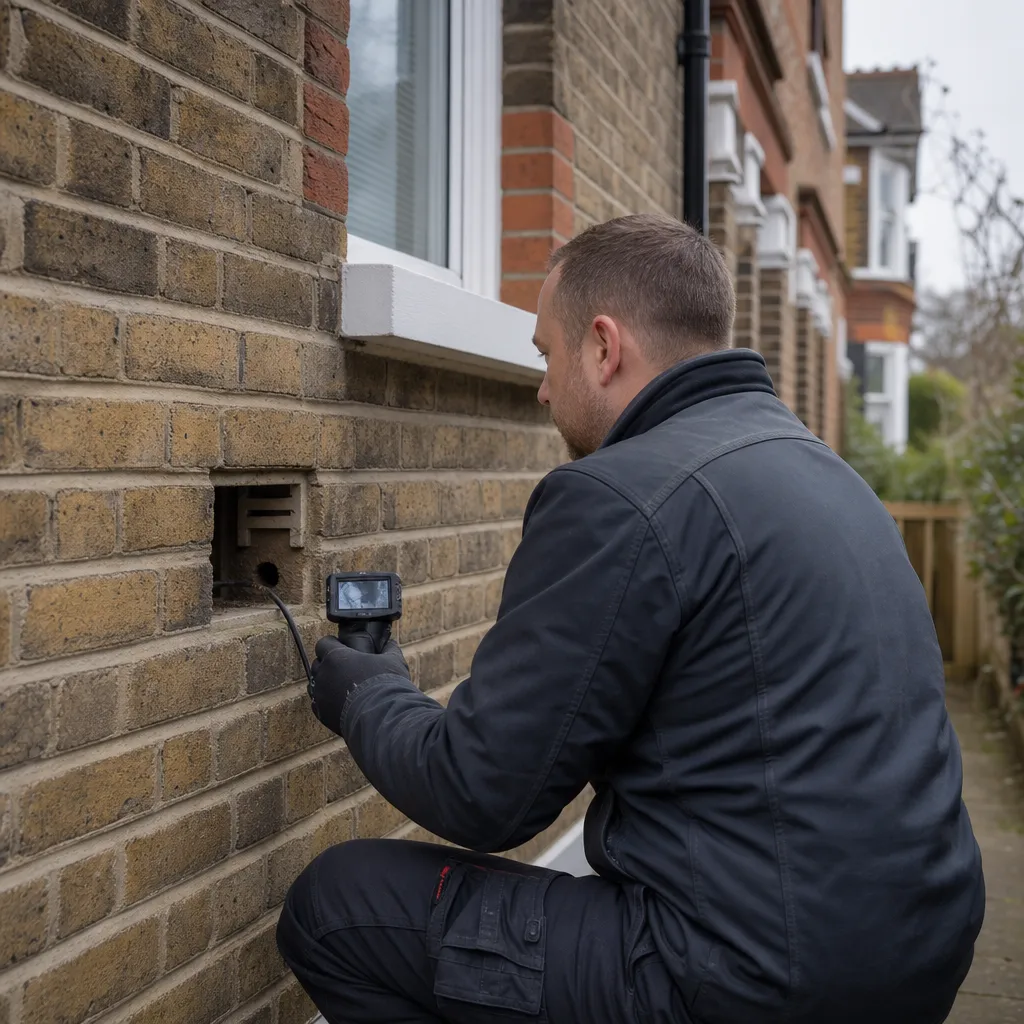
Removing Mice from Cavity Walls: Identification and Solutions
Mice in cavity walls are identified by light scratching sounds at night, small droppings near skirting boards, and gnawed materials.
 Surveys & Inspections
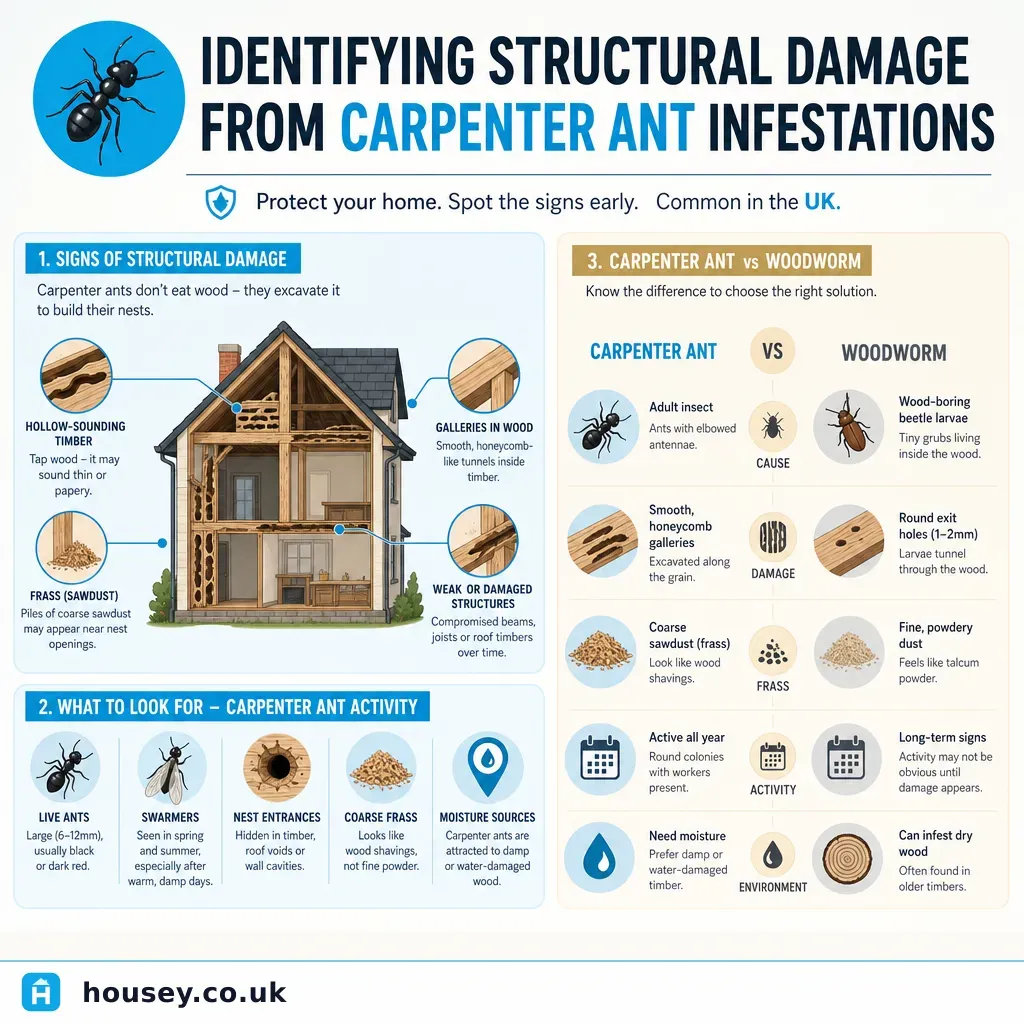
Identifying Structural Damage from Carpenter Ant Infestations
Carpenter ants excavate galleries in damp or decayed timber, leaving coarse frass and smooth, clean channels distinct from woodworm's fine bore dust and round exit holes.
 Surveys & Inspections
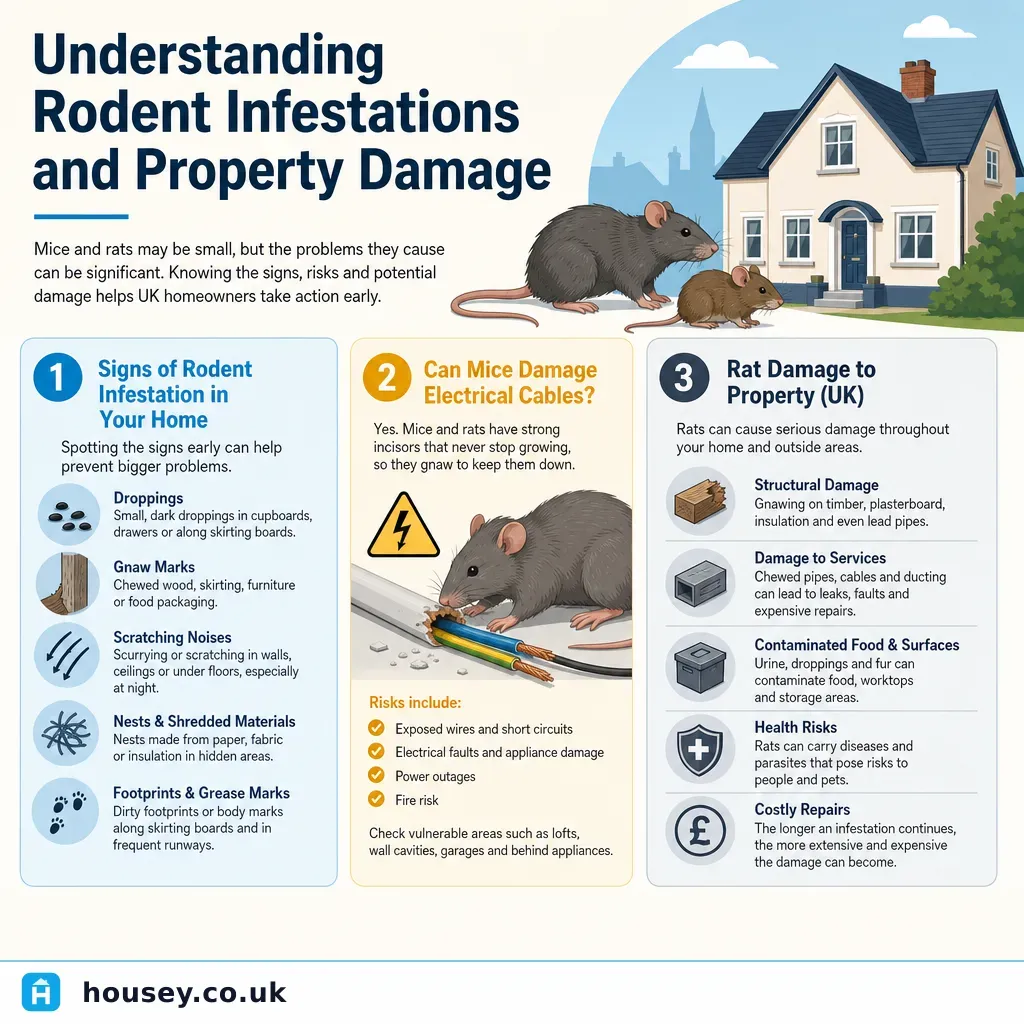
Understanding Rodent Infestations and Property Damage
Rats and mice can cause significant property damage in UK homes, including gnawed electrical cables that create fire risk, damaged pipework causing hidden leaks, and burrowing near foundations in older properties.
 Surveys & Inspections
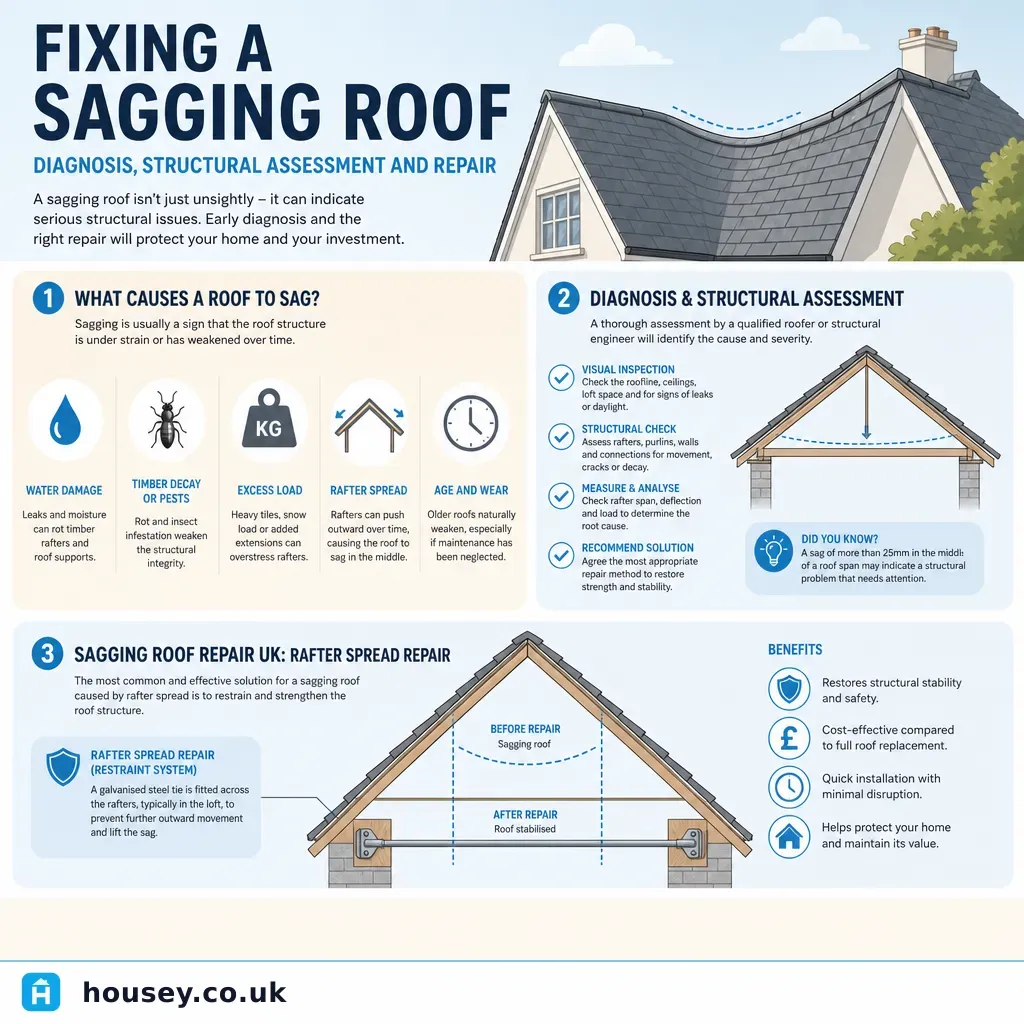
Fixing a Sagging Roof: Diagnosis, Structural Assessment and Repair
A sagging roof usually points to failed or overloaded roof timbers, rafter spread, or a compromised ridge board.
 Surveys & Inspections
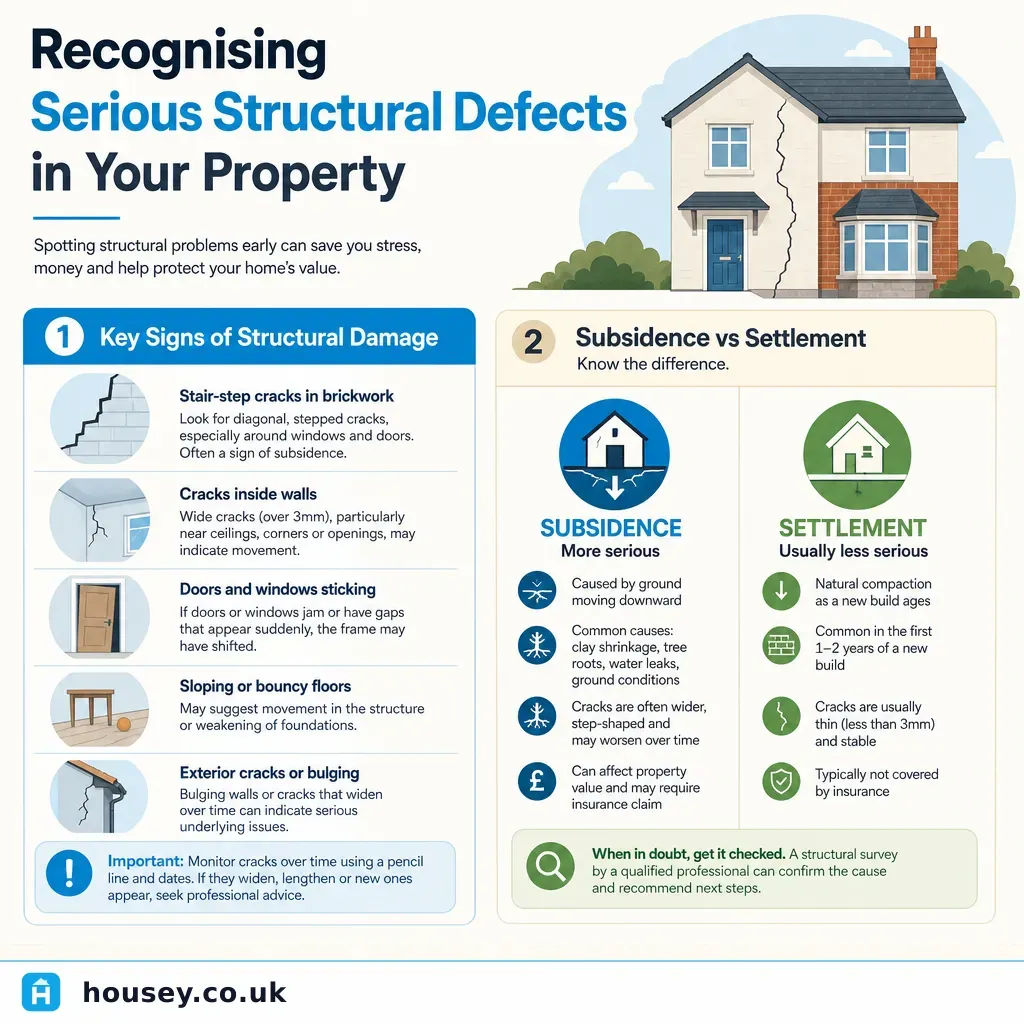
Recognising Serious Structural Defects in Your Property
Serious structural defects in UK homes include wide or diagonal cracks through brickwork, bowing or leaning walls, a sagging roof ridge, and floors or door frames notably out of level.