Movement Joints in Building Design: Planning for Structural Movement
By Housey · Last reviewed 11th of May 2026
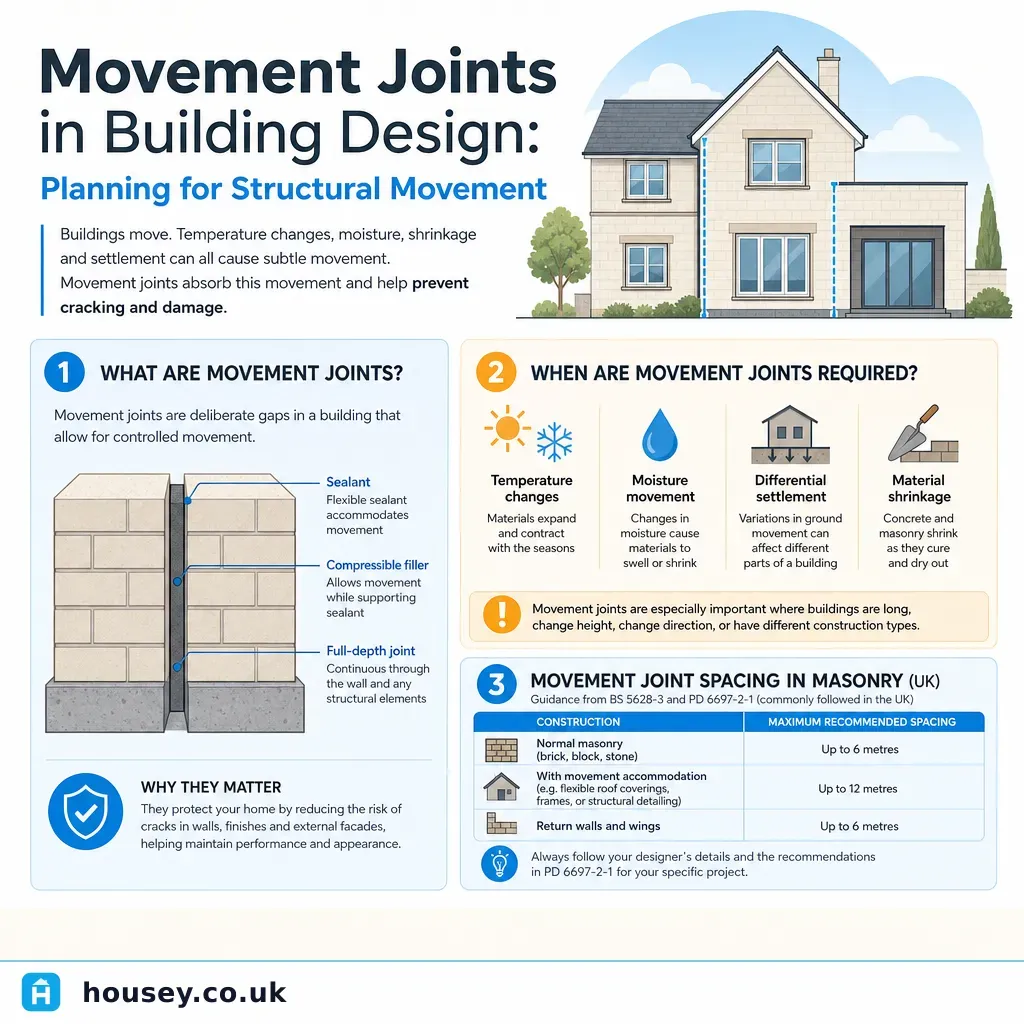
Movement Joints in Building Design: Planning for Structural Movement
All buildings move — the question is whether that movement is controlled or uncontrolled. Understanding movement joints becomes essential at the design stage of a new build, major extension, or refurbishment project, and frequently arises when a structural engineer or building control officer reviews construction drawings. For many UK homeowners and self-builders, movement joints are an invisible design element until cracking appears — at which point the cost of remediation far exceeds what correct specification at the outset would have cost.
Key points
- BS EN 1996-2:2006 (Eurocode 6, Part 2) and its UK National Annex provide the principal guidance on movement joint design in masonry structures, supplemented by BRE Digest 228 on thermal and moisture movement estimation.
- Clay brickwork expands irreversibly over time due to moisture absorption after firing — external clay brick walls typically require vertical movement joints at 6–12 m horizontal centres depending on wall configuration.
- Calcium silicate (sand-lime) brickwork and concrete blockwork behave differently from clay brick: they shrink as they cure, requiring contraction joints at approximately 6 m centres in continuous runs.
- Horizontal slip joints in the outer leaf of cavity walls above each floor level prevent compression failure caused by differential thermal and moisture movement between the inner and outer leaves.
- Blocked or incorrectly detailed movement joints are among the most frequently cited causes of diagonal cracking in UK masonry buildings, according to BRE defect analysis.
Why do buildings need movement joints?
Movement joints exist because all building materials change dimension in response to environmental and structural conditions:
- Thermal changes — most materials expand when heated and contract when cooled. Clay brick, concrete, steel, and mortar all have different coefficients of thermal expansion, so in composite construction they try to move by different amounts.
- Moisture content changes — clay bricks expand permanently as they absorb atmospheric moisture after firing (irreversible moisture expansion). Concrete, calcium silicate brick, and most cement-based products shrink as they dry after casting or laying.
- Structural load and creep — loaded masonry and concrete elements deform slowly under sustained load over time, a phenomenon known as creep.
- Differential foundation movement — where a long structure sits on soils of varying stiffness, or where different parts of a building have different foundation types, relative movement between structural sections occurs.
Without movement joints, these dimensional changes generate internal stresses. When stress exceeds the tensile strength of masonry or concrete, cracking follows — often in the recognisable stepped diagonal patterns seen at wall returns, above openings, and at junctions between old and new building.
Types of movement joint and when each is used
Joint type | Purpose | Typical filler/sealant | Typical location | Indicative spacing |
|---|---|---|---|---|
Expansion joint | Accommodates thermal expansion and clay brick moisture expansion | Compressible foam backing rod + flexible sealant | External clay brickwork, long wall runs, returns | 6–12 m in clay brick |
Contraction / control joint | Accommodates shrinkage in concrete and calcium silicate products | Debonding membrane or saw cut with sealant | Concrete slabs, calcium silicate walls | 6 m typical |
Settlement joint | Separates sections with different foundation types or loads | Full-width compressible filler through all construction | Junction between new extension and existing building | At structural transitions |
Horizontal slip joint | Allows differential movement between inner and outer masonry leaves | DPC slip layer or proprietary horizontal joint strip | Above lintels, at each floor and ceiling level in cavity walls | At every storey height |
Structural isolation joint | Separates adjacent independently founded structures | Full-width compressible filler from foundation to roof | Between structurally independent buildings | As required by engineer |
Which professional do you need?
Scenario | Professional to engage |
|---|---|
New residential build — movement joint layout across the whole structure | Structural engineer or architectural technologist to specify joint positions and details on structural drawings |
Masonry extension to an existing house | Structural engineer — particularly for settlement joint at the junction and vertical joints in new long walls |
Cracking suspected to relate to a failed or missing movement joint | Structural engineer for diagnosis; crack monitoring may be needed before repair is specified |
Repair or repointing of an existing movement joint | Specialist contractor — joint must be fully cleared and re-sealed to the original specification |
Commercial or larger multi-storey project | Chartered structural engineer (required under Building Regulations Part A) |
Homeowner checklist: movement joints for an extension or new build
Use this checklist during the design and construction stages:
What happens when movement joints are omitted or incorrectly detailed?
The consequences of missing or wrongly placed movement joints are well documented in UK building defect practice.
Diagonal stair-step cracking in external masonry — the most common consequence of missing vertical movement joints in clay brickwork. Cracks typically run diagonally through mortar joints and may mirror at wall corners or returns.
Blown render or de-bonded tile finishes — if the substrate moves and an applied finish does not, the finish cracks or debonds. This is common in render applied over masonry without vertical joints, and in floor tiles cast without saw-cut control joints in the screed.
Compression failure and outer leaf bulging — in long cavity walls without horizontal slip joints at floor levels, differential movement between inner and outer leaves can cause the outer leaf to bow, crack, or in severe cases delaminate.
Worked UK scenario: terrace extension with a missing settlement joint
A 1930s semi-detached house in the East Midlands has a lean-to kitchen extension added without a settlement joint at the junction with the original structure. The original house has deep strip foundations on shrinkable clay; the extension was built with shallower foundations. After two consecutive dry summers, seasonal clay shrinkage causes the extension to settle relative to the main house. A diagonal crack develops across the junction wall, worsening each year. A structural engineer confirms differential settlement, recommends crack monitoring, a retrofitted settlement joint, and minor underpinning to the extension. Total remediation cost exceeds £8,000 — considerably more than a correctly specified joint would have cost at the time of construction.
Important limitations
Movement joint design is a structural and architectural engineering task. The guidance in this article is general information only. The correct joint type, position, spacing, and detailing for any specific building depends on wall materials, structural form, foundation type, ground conditions, and the thermal and moisture exposure of each element. Always obtain structural drawings from a qualified engineer or architectural technologist, and ensure building control approves the details before construction commences. Rules may also vary depending on the building type, local authority, and whether the work affects a listed building or falls within a conservation area.
What to ask a qualified professional
Before appointing a structural engineer or architectural technologist to specify movement joints:
- Can you show all movement joint positions and full construction details on a drawing I can issue to my contractor?
- What joint type and sealant specification are you recommending for each element, and why?
- How should horizontal joints above lintels and at floor levels be detailed in this cavity wall construction?
- Is a settlement joint required at the junction between the new extension and the existing building?
- How should my contractor inspect and confirm joints before I request building control sign-off?
- What are the consequences of a joint being bridged with mortar during construction, and how can this be prevented?
When to get professional help
Seek professional input immediately if:
- Design drawings for a new build or extension do not show movement joint positions and details.
- Diagonal cracking in masonry, or cracking at the junction of an extension and the original building, is present or visibly worsening.
- A surveyor, building control officer, or RICS inspector has flagged missing or failed movement joints in an inspection report.
- You are about to start a continuous run of masonry exceeding 6 m without a joint position confirmed on structural drawings.
How Housey can help
Movement joint specification is an integral part of structural and architectural design. Housey connects you with the professionals who can get this right. A structural engineer will specify joint positions and details as part of structural calculations submitted for Building Regulations approval. An architectural technologist can integrate movement joint details into full construction drawings. A building control consultant can advise on compliance and review joint details as part of the Building Regulations approval process.
Frequently asked questions
Do all buildings need movement joints?
Not all buildings require every type of movement joint, but virtually all masonry buildings of significant length need at least vertical expansion or contraction joints in external walls. The need depends on wall material, wall length, the presence of returns, and structural form. A structural engineer or architectural technologist should confirm requirements — the consequences of omitting joints are far more expensive than including them correctly at the outset.
How wide should a movement joint be in brickwork?
Typical vertical movement joints in clay brickwork are 10–15 mm wide, sized to accommodate expected thermal and moisture movement over the building's design life. The exact width depends on joint spacing, wall material, and local temperature range. Too narrow a joint can close under compression and transmit damaging stress; too wide a joint may be prone to sealant failure and water ingress.
Can a movement joint be added to an existing building?
Retrofitting a movement joint into existing masonry is technically possible but complex and expensive. It typically involves saw-cutting through the masonry at the intended joint position and installing backing rod and sealant. This is only warranted where structural movement is causing recurring cracking; in most existing buildings, crack repair and monitoring is the first-line approach. Seek structural engineering advice before cutting joints into an existing structure.
Who is responsible for ensuring movement joints are built correctly?
Design responsibility typically sits with the structural engineer or architectural technologist who specified the joints. Contractual responsibility for correct execution sits with the contractor. The building owner or project manager should verify that structural drawings are provided to the contractor and that joints are inspected — and confirmed free of mortar bridging — before requesting building control sign-off.
Sources and further reading
- BS EN 1996-2:2006 Eurocode 6 — Design of masonry structures — BSI
- Approved Document A: Structure — GOV.UK
- NHBC Standards Chapter 6.1 — External masonry walls — NHBC
- BRE Digest 228 — Estimation of thermal and moisture movements and stresses — BRE Group
- Brick Development Association — movement in brickwork guidance — Brick Development Association
- Historic England — repointing and masonry repairs guidance — Historic England
Useful next reads
 Planning & Pre-Build
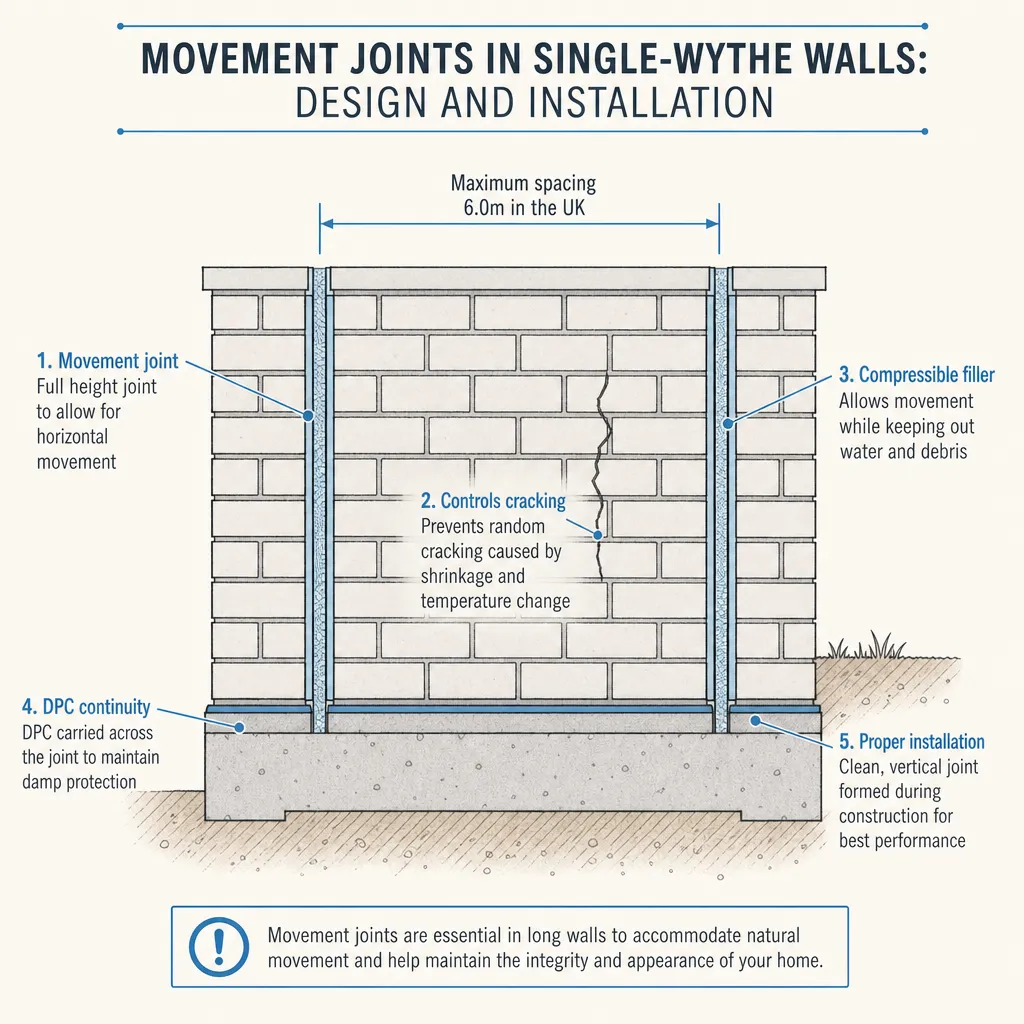
Movement Joints in Single-Wythe Walls: Design and Installation
Movement joints in single-wythe masonry walls prevent cracking caused by thermal expansion, moisture movement, and settlement.
 Planning & Pre-Build
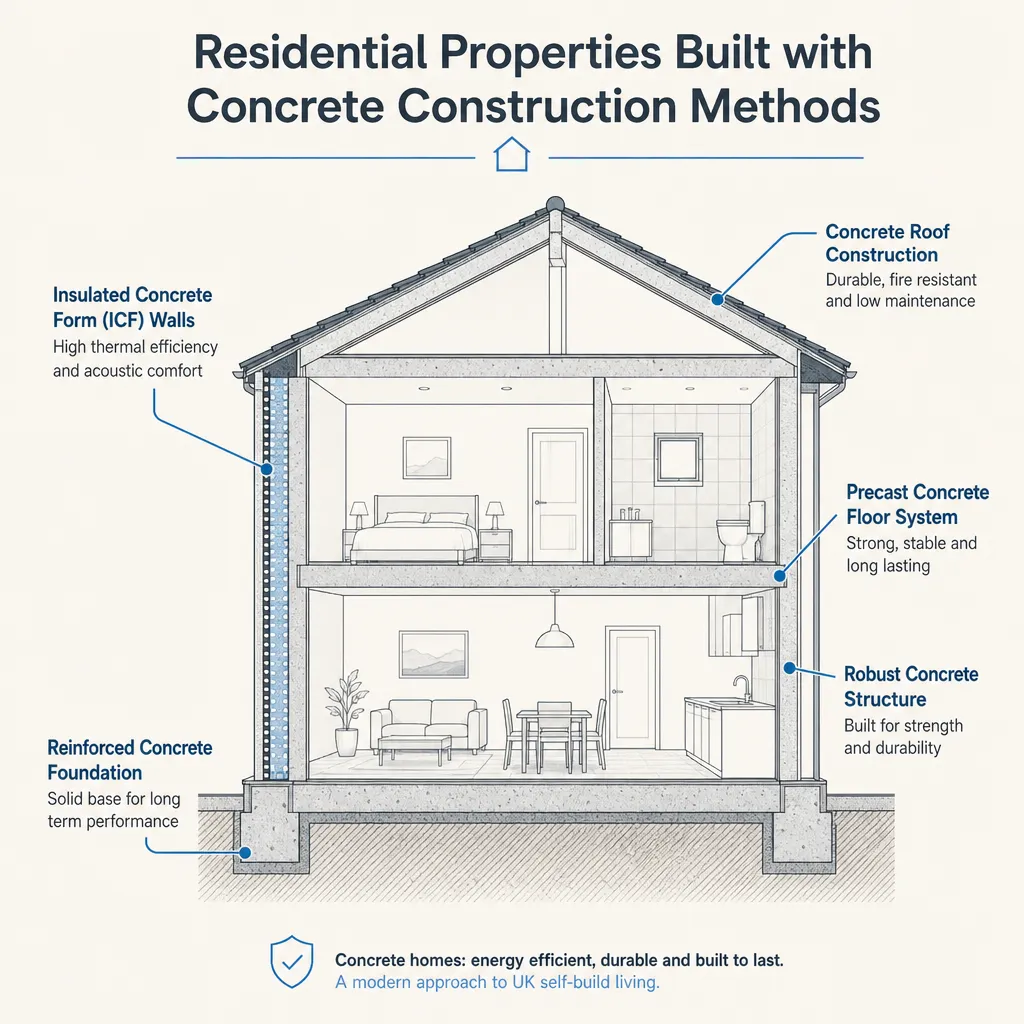
Residential Properties Built with Concrete Construction Methods
UK homes are built using several concrete methods: in-situ cast concrete, precast panel systems, insulating concrete formwork (ICF), and older non-traditional types such as Wimpey No-Fines and Laing Easiform.
 Planning & Pre-Build
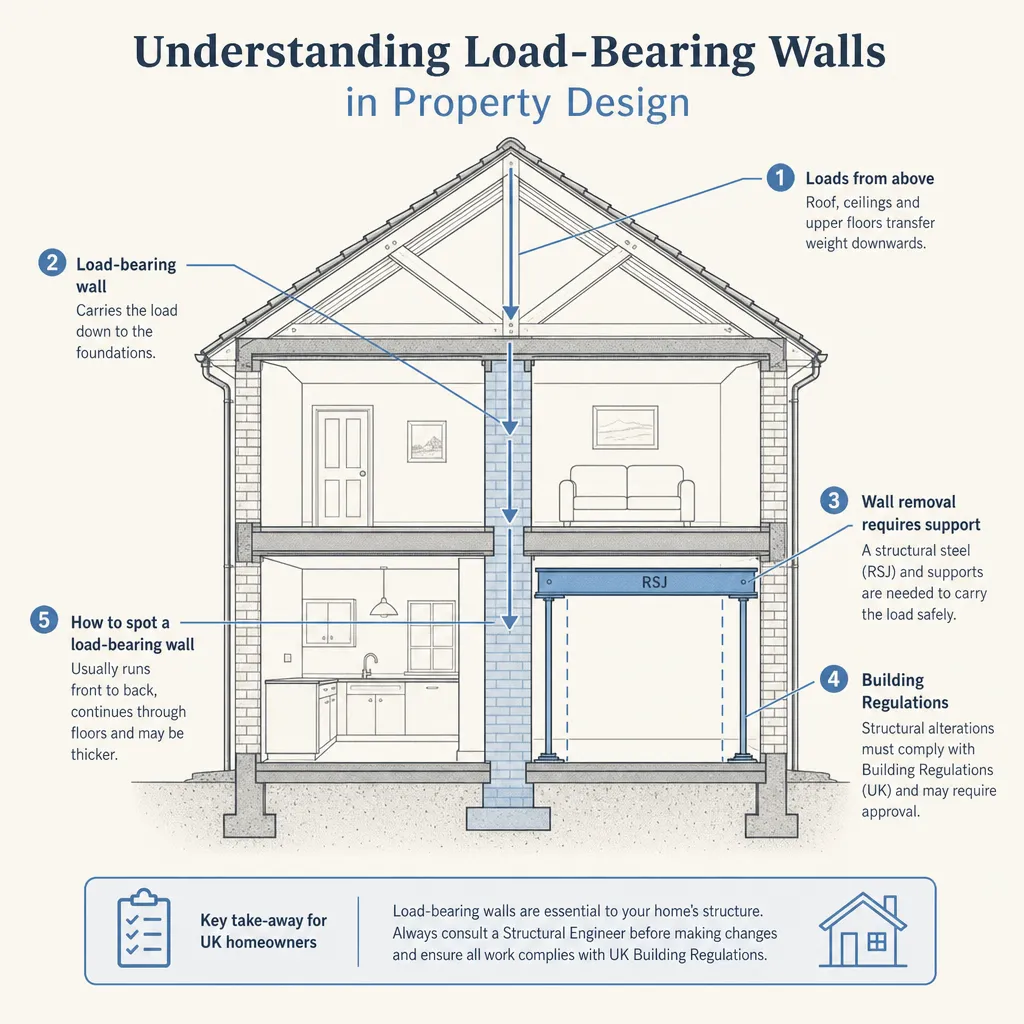
Understanding Load-Bearing Walls in Property Design
A load-bearing wall carries the weight of floors, roofs, or other walls above it down to the foundations.
 Planning & Pre-Build
Designing Homes That Are Accessible and Inclusive
Accessible home design in the UK is guided by Building Regulations Approved Document M, which sets three standards for new dwellings: Category 1 (Visitable), Category 2 (Accessible and Adaptable), and Category 3 (Wheelchair User Dwelling).
 Planning & Pre-Build
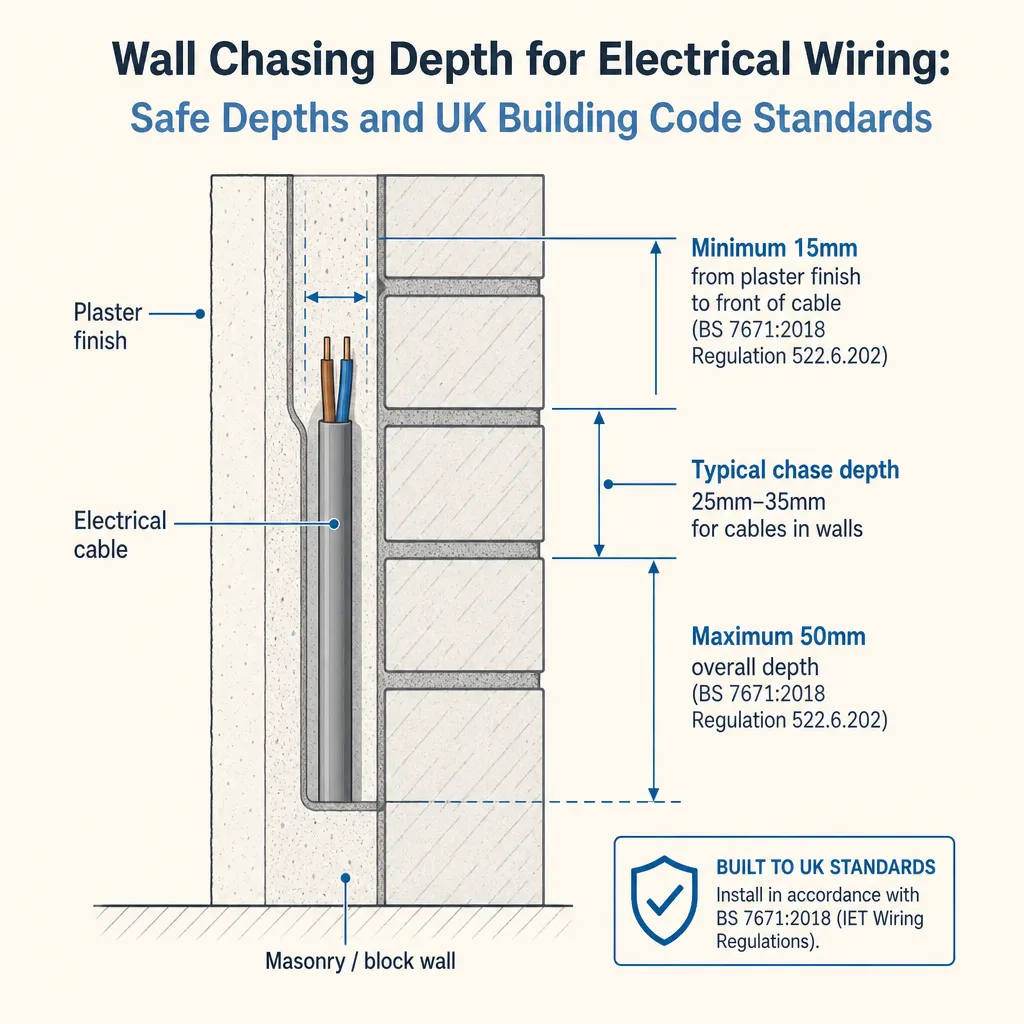
Wall Chasing Depth for Electrical Wiring: Safe Depths and UK Building Code Standards
Cables chased into walls must be within BS 7671 safe zones — within 150 mm of a ceiling, floor, or corner junction — or enclosed in rigid conduit for mechanical protection.