Moving House During Operational Closures: Your Relocation Options
By Housey · Last reviewed 18th of May 2026

Moving House During Operational Closures: Your Relocation Options
Agreeing a completion date feels like the finish line in a house purchase, but the date chosen — or the one that a chain forces upon you — may fall during periods when key services are unavailable or access is restricted. Solicitor offices close on bank holidays, CHAPS bank transfers do not process outside Bank of England business days, and managed buildings often limit goods lift access to weekday hours. Understanding these constraints well before exchange can prevent costly last-minute disruption.
Key points
- CHAPS payments — the system used by solicitors to transfer completion funds — only process on Bank of England business days. Completions cannot proceed on public bank holidays in the UK.
- England and Wales observe 8 public bank holidays per year; Scotland has 9. The CHAPS system also closes over the Christmas period, typically from Christmas Day through to 2 January.
- Removal firms generally charge higher rates for Saturday and bank holiday moves; availability on these days varies significantly and some firms do not operate at all — confirm in writing before booking.
- Leasehold flat management companies often restrict goods lift and loading bay access to weekday business hours, typically 8am–6pm Monday to Friday, and may require 48–72 hours' advance notice.
- All parties in the chain — buyer, seller, solicitors, and mortgage lender — must be operationally available on completion day; a closure affecting any single link delays funds reaching the seller.
Why bank holidays prevent completions
Bank holiday completions are not possible in England and Wales because CHAPS — the Clearing House Automated Payment System used to transfer completion funds between solicitors — only processes on Bank of England business days. When a completion date falls on a bank holiday:
- The CHAPS transfer cannot proceed.
- The seller cannot receive funds, so keys cannot legally be released.
- Any removal firm already booked and loaded will face an unexpected and potentially costly delay.
Your solicitor will normally advise moving the completion date to the nearest working day before a bank holiday period. This is particularly important when a bank holiday falls on a Monday — such as Easter Monday or the August Bank Holiday — because some buyers attempt to complete on the preceding Friday, compressing mortgage lender processing time and heightening risk across the whole chain.
How to plan around restricted periods
Avoiding the Christmas closure
The period between approximately 24 December and 2 January carries the highest operational risk of any time of year. Solicitor offices reduce capacity significantly, CHAPS closes on multiple consecutive days, and removal firms often halt operations or charge substantially higher rates. If your transaction is running into December, discuss with your solicitor whether it is safer to target completion before 20 December or to agree with all parties to wait until early January.
The August Bank Holiday peak
August Bank Holiday weekend in England and Wales — the last weekend of August — coincides with school summer holidays and peak demand for removal services. Firm availability can be limited and rates are typically higher than at other times of year. If you are planning a summer move:
- Book your removal firm as soon as exchange is confirmed — or provisionally before exchange with the firm's agreement.
- Confirm whether the company operates on bank holidays and at what rate.
- Have a fallback completion date in mind if the chain slips by a day or two.
Operational restrictions in managed and leasehold buildings
If you are moving into or out of a leasehold flat or apartment in a managed development, the building's own operational rules can matter as much as the broader calendar.
Goods lift and loading bay restrictions
Most managed apartment blocks have rules governing the use of goods lifts and loading bays during moves. These may specify:
Restriction type | Typical rule |
|---|---|
Operating hours | Weekdays 8am–6pm only |
Advance booking | 48–72 hours' notice to building management |
Moving fee | Some developments charge a lift reservation or protective-covering fee — confirm the amount with the managing agent before booking |
Weekend access | Often restricted or unavailable |
Bank holiday access | Generally not available |
Arrangements vary by development and managing agent — always confirm directly and in writing.
Breaching these rules can delay your move on the day, as building management or concierge staff may refuse removal teams access to the service lift. Check restrictions with the management company as early as possible — ideally before committing to a completion date.
What not to assume about managed buildings
- Do not assume weekends are accessible. Many management companies explicitly restrict moving activity to weekday business hours, and some require written approval for any out-of-hours access.
- Do not assume written permission can be obtained at short notice. Building management companies often require advance booking, and capacity on any given date may already be taken.
- Do not assume your solicitor will know these rules. Operational restrictions are not always disclosed during conveyancing — ask the vendor or their managing agent directly, rather than relying on enquiry responses alone.
Planning checklist for moves around operational constraints
Before setting a completion date
When provisionally booking removal services
If your completion date is constrained by the chain
When to get professional help
If your completion date has been set close to a bank holiday and you have concerns about the timeline, raise this explicitly with your solicitor. Ask them to confirm the CHAPS processing window for that date and whether your mortgage lender has any additional requirements or cut-off times.
For leasehold properties in managed buildings, your solicitor should raise access and moving restrictions with the vendor's solicitor during the pre-contract enquiries stage, so that any special permissions or fees are agreed before exchange rather than discovered on moving day.
How Housey can help
Once your completion date is confirmed, reliable house removals are essential — especially when working around narrow access windows, building management restrictions, or potential chain delays. Housey's removal partners can advise on flexible booking, storage options, and logistics for managed and leasehold buildings.
Frequently asked questions
Can I complete a house purchase on a Saturday?
No. CHAPS payments — used to transfer completion funds between solicitors — only process on Bank of England business days, which are Monday to Friday excluding public bank holidays. Saturday completions are not possible for standard residential transactions in England and Wales. If your preferred date falls on a weekend, your solicitor will advise moving to the nearest working day.
What happens if completion is delayed on the day?
If funds do not clear in time, the seller is not legally obliged to vacate until the money has been received. In practice this can mean waiting with a loaded removal lorry until late afternoon. If completion does not occur by any agreed contractual deadline, financial penalties may apply — check the contract terms with your solicitor well before the completion date.
Do removal firms operate on bank holidays?
Some do, but availability varies significantly by company and region. Expect higher rates compared with a standard weekday move. Always confirm in writing whether your chosen firm operates on the specific date — do not rely on general assumptions. Some firms close entirely over extended periods such as Christmas and Easter.
How far in advance should I book a removal firm?
For moves during peak periods — spring, summer, school holidays, and near bank holidays — book as soon as exchange is confirmed, potentially several weeks ahead. During quieter periods, one to two weeks is usually sufficient. If you are moving into or out of a managed building, allow additional time to arrange and confirm building management access permissions.
Sources and further reading
- CHAPS payment system — Bank of England
- UK bank holidays — GOV.UK
- Moving checklist — Citizens Advice
- Buying a leasehold property — Leasehold Advisory Service (LEASE)
Useful next reads
 Buying & Moving
Moving House During Temporary Restrictions: Planning Your Relocation
Moving during road works, parking restrictions, or building management rules requires advance planning.
 Buying & Moving
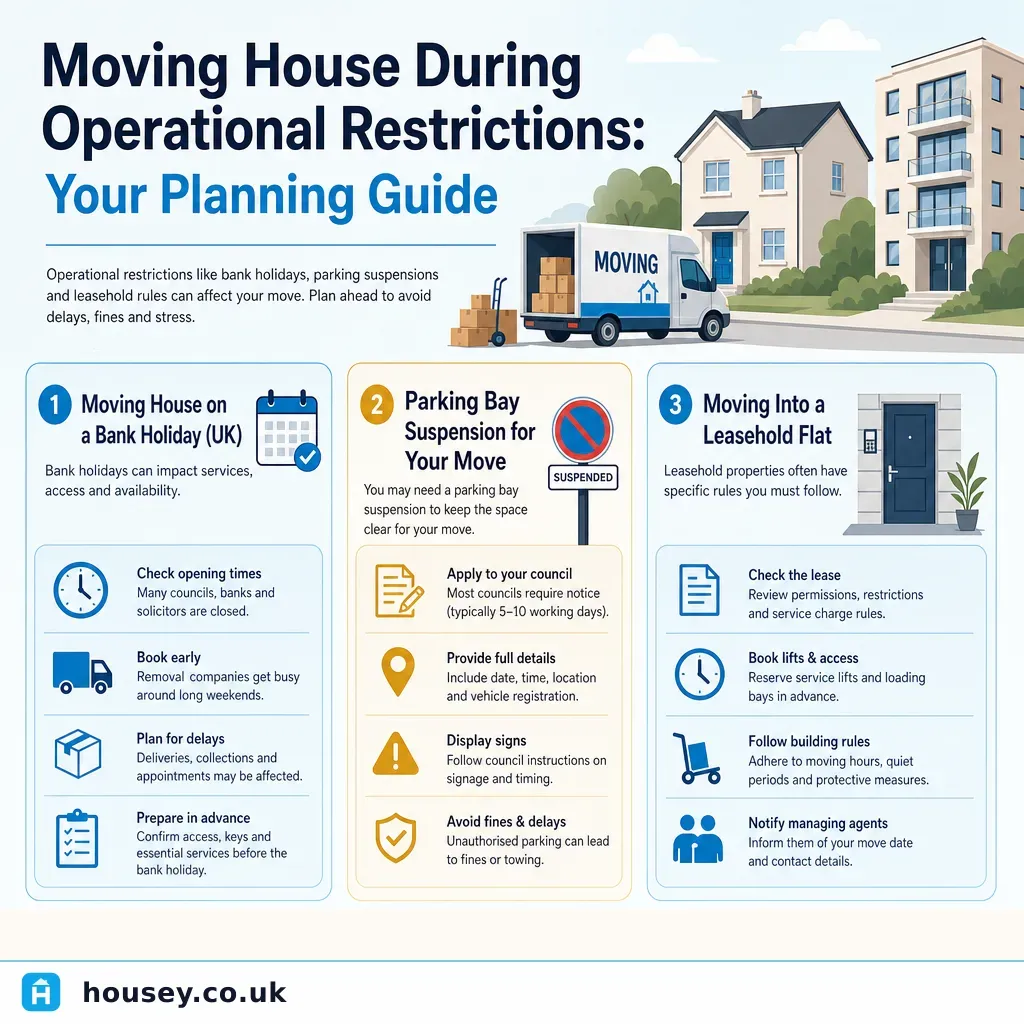
Moving House During Operational Restrictions: Your Planning Guide
Moving house during operational restrictions — such as bank holidays, peak summer demand, or leasehold building rules — requires advance planning.
 Buying & Moving
How to Plan a House Move: A Practical Guide to Residential Relocations
A UK house move goes more smoothly with planning that starts 6–8 weeks before moving day.
 Buying & Moving
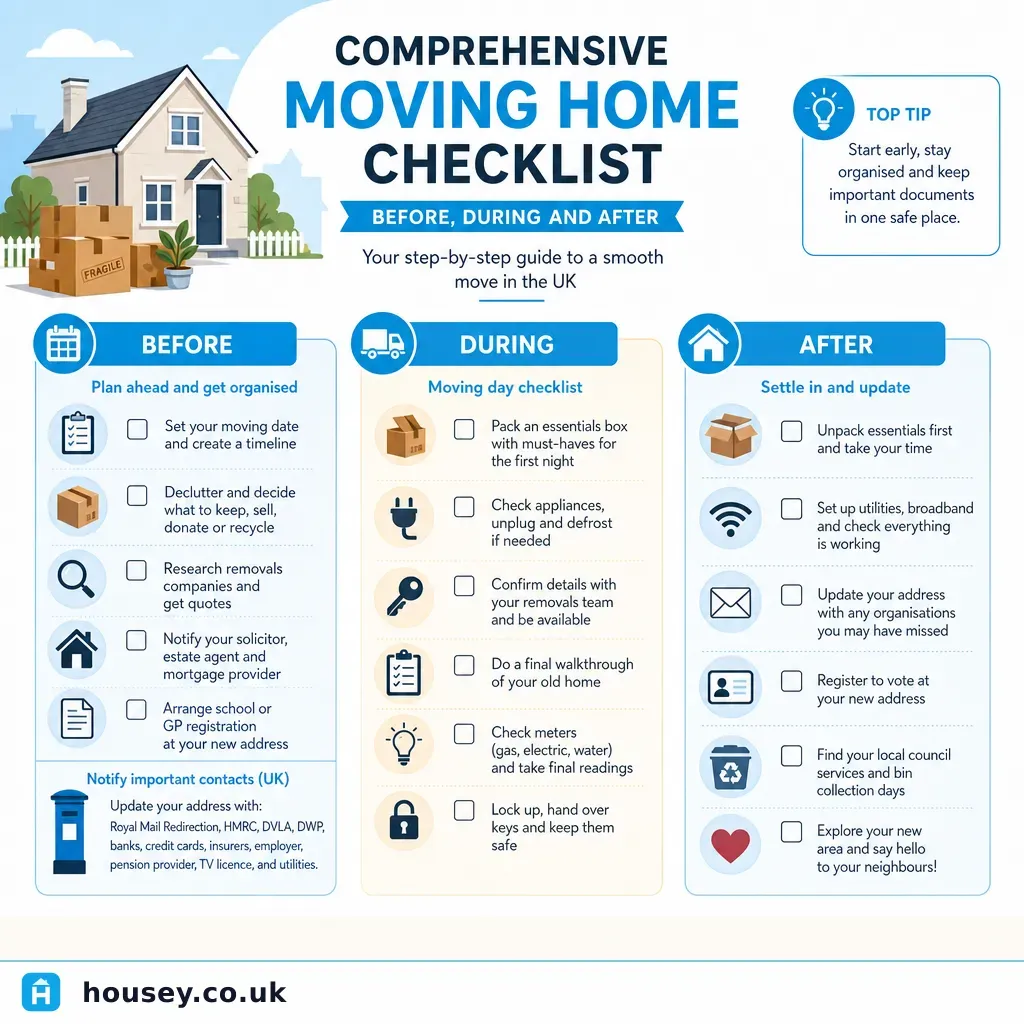
Comprehensive Moving Home Checklist: Before, During and After
Moving house in the UK involves tasks across roughly eight weeks: instructing a conveyancer and removal firm early, systematically notifying organisations of your new address, confirming buildings insurance from exchange, taking meter readings on completion day, and registering with the new council and utilities promptly.
 Buying & Moving
Professional House Removals Services: Choosing the Right Moving Company
A professional house removals company handles loading, transport, and unloading; full-service firms with BAR membership also offer deposit protection and independent dispute resolution.