Moving House During Temporary Restrictions: Planning Your Relocation
By Housey · Last reviewed 18th of May 2026

Moving House During Temporary Restrictions: Planning Your Relocation
Removal day rarely goes exactly to plan, and temporary restrictions — road works, parking suspensions, building access windows, or traffic management schemes — can add a layer of logistical challenge that catches many movers off guard. In a busy UK street or a managed block of flats, the difference between a smooth move and an expensive delay can come down to a few well-timed phone calls and a checklist made weeks in advance. Understanding what restrictions might apply to your move, and how to plan around them, can save considerable time, money, and frustration.
Key points
- Local authorities can issue Temporary Traffic Regulation Orders (TTROs) for road works, events, and safety works; these can close or restrict access to streets with relatively short notice to residents.
- Many councils require a formal parking bay suspension for removal vehicles to park legally on controlled streets; applications typically need at least 5–15 working days' notice and a fee (indicatively £50–£200 or more depending on the local authority).
- Most leasehold blocks of flats and managed residential developments restrict move-in and move-out times to weekday daytime hours, often requiring pre-booked slots through the managing agent.
- Removal lorries may be subject to weight restrictions on routes near older bridges, narrow rural lanes, or in some conservation areas — access should be checked before booking.
- Penalty charge notices, towed vehicles, and delays resulting from restriction non-compliance are not typically covered by standard removals insurance.
What types of temporary restriction can affect a house move?
Parking restrictions and suspensions
In most urban and suburban areas, on-street parking is controlled. A removal lorry cannot legally park on double yellow lines, in a residents-only bay without a permit, or at a bus stop. Your main options are:
- Parking bay suspension: Applied for from the local council, this suspends a section of road or bay temporarily for the removal vehicle. Many councils charge a fee (indicatively £50–£200 or more, varying by location and duration). Apply at least five to fifteen working days before your move date to allow processing time.
- Private driveway or off-road parking: If available at either property, confirm the removal lorry can access it safely — consider the turning circle, the surface load-bearing capacity, and overhead clearance.
- Visitor parking permits: Some councils offer these for short-stay vehicles, but they rarely cover a large removal lorry. The bay suspension route is usually required for professional removal vehicles.
Road works and TTROs
Road works in the UK are coordinated through the Street Works Register under the New Roads and Street Works Act 1991. Works can be authorised with relatively short notice. Before your move date:
- Check your local council's planned works database or the One Network planned roadworks map for streets near both properties.
- Ask your removal company whether alternative access routes have been identified if works affect your street.
- Build in a time buffer where possible — many removal companies can accommodate a 24–48 hour shift in timing with adequate notice and without significant additional cost.
Building management and managed development rules
If you are moving into or out of a leasehold flat or a managed estate, building rules often apply:
- Booking a move-in slot: Many managed buildings require you to book lift access and an entry time through the managing agent. Slots are often restricted to weekday daytime hours (for example, 8am–5pm Monday to Friday).
- Protecting communal areas: Some buildings require protective covering of lifts, corridors, and door frames during a move. Your removal company should carry appropriate materials, but confirm this in advance with both the company and the managing agent.
- Service entrance requirements: Some blocks require removals to use a service lift or service entrance rather than the main lobby. Confirm the dimensions and route with the managing agent before booking.
Weight and access restrictions
Some UK roads carry weight limits, particularly routes over older bridges, rural lanes, or streets within conservation areas. If your new or current home is on or near a restricted route, your removal company needs to know in advance. A competent firm will assess the access route before move day — do not assume this has been done without asking.
Planning checklist for your move
Which approach suits your situation?
- Moving to or from a leasehold flat or managed development: Contact the managing agent before booking your removal date — available slots may be limited, especially in larger or busier blocks.
- Moving in an urban area with controlled parking: Apply for a parking bay suspension as early as possible, and confirm in writing with your removal company who is responsible for the application.
- Moving near known road works or a major local event: Plan a contingency date or discuss alternative access routes with your removal company before committing to the move date.
- Moving to a property with a narrow or restricted approach: Ask your removal company to confirm lorry dimensions and weight compatibility with the access route before booking — a smaller vehicle or a shuttle service between a nearby parking point and the property may be needed.
- Moving at short notice: Prioritise the parking suspension application and building slot booking above all other logistics; these have the longest lead times of any practical step.
Red flags to watch for
- Your removal company has not asked about parking, access, or building rules at either property ahead of the move date.
- You cannot get a response from your managing agent about booking a move-in slot despite repeated attempts.
- Road works signs or cones have appeared on your street within the past few weeks and you have not yet investigated the expected duration or impact.
- You have not received written confirmation of your parking bay suspension at least five working days before the move.
- Your removal company has not confirmed the lorry dimensions or checked the access route for either property.
- It is unclear whether you or the removal company are responsible for applying for the parking suspension — and nobody has resolved this in writing.
When to get professional help
Most moving logistics challenges are practical rather than requiring specialist professional advice, but consider the following:
- If a Temporary Traffic Regulation Order is in force on your street and you cannot reach a resolution, contact your local council's highways department or your local councillor directly.
- If your removal company cannot access the property on the day due to an unexpected restriction, document everything — photographs, names of anyone spoken to, reference numbers — for any insurance or contractual claim.
- If you are moving as part of a property chain and a delay could affect other parties' completion dates, notify your solicitor immediately so they can manage any knock-on effect.
- If your removal company has caused damage to communal areas in a managed building, follow the building's claims process through the managing agent and retain all documentation.
How Housey can help
Housey connects homeowners with experienced, vetted house removals companies who understand the practicalities of moving in managed buildings, urban parking zones, and areas close to active road works. Getting a properly scoped removal quote — one that includes an access assessment for both properties — is the most effective way to avoid surprises on moving day.
Frequently asked questions
Who is responsible for applying for a parking bay suspension — me or my removal company?
Responsibility depends on your removal company and the terms of your booking. Some companies include parking suspension applications as part of their service; others expect the homeowner to manage it. Confirm this in writing when you book. Even if the removal company makes the application on your behalf, retain a copy of the council's approval confirmation and reference number in case of any dispute or no-show of cones on the day.
How much does a parking bay suspension cost?
Costs vary by local authority but are typically in the range of £50 to £200 or more for a standard residential suspension of one or two bays for one day. Some London boroughs charge higher rates. Contact your local council's parking or highways team for the current fee schedule and application process. Indicative UK costs, last reviewed 2026-05-18.
What if road works start on my street after I have booked the removal?
Contact your removal company immediately and discuss alternative access options or an adjustment to timing. Check the council's street works register to identify the works operator and contact them directly to understand the expected impact and duration. Road works operators are generally required to give notice to residents, though emergency or safety works can begin with very little advance warning.
Can I move on a weekend to avoid building management restrictions?
Not always — many managed blocks do not permit moves at weekends, and some restrict moves to certain weekday hours only. Always check with your managing agent before committing to a move date. If weekend moves are permitted, building management staff or a key holder may be required, which could incur an additional fee. Obtain the permitted hours and any conditions in writing before confirming your removal booking.
Sources and further reading
- One Network: planned roadworks — check planned street works near your move addresses
- New Roads and Street Works Act 1991 — legislation.gov.uk, the statutory framework for street works coordination
- Temporary traffic regulation orders — GOV.UK, guidance on how TTROs are issued and applied
- Housing — Citizens Advice — practical guidance on housing rights and renting
Useful next reads
 Buying & Moving
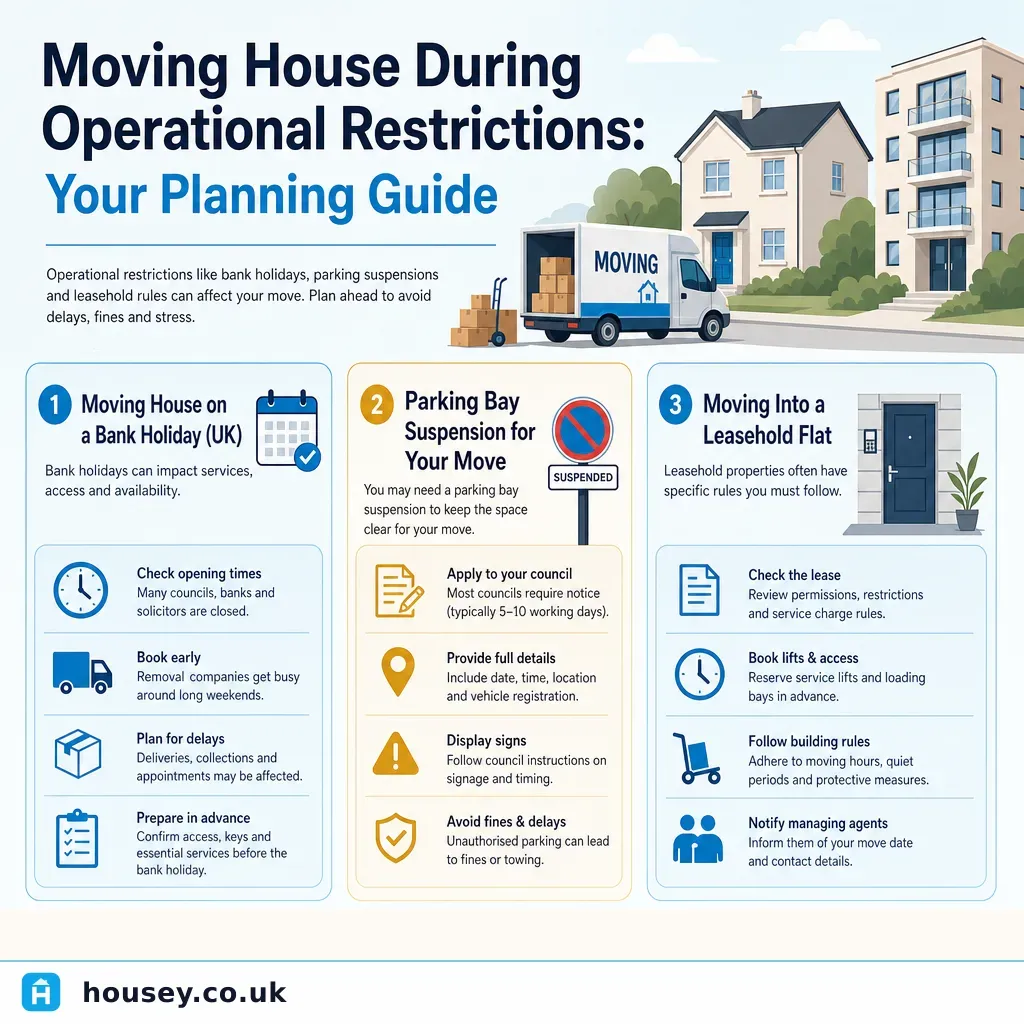
Moving House During Operational Restrictions: Your Planning Guide
Moving house during operational restrictions — such as bank holidays, peak summer demand, or leasehold building rules — requires advance planning.
 Buying & Moving
Moving House During Operational Closures: Your Relocation Options
Completions cannot proceed on bank holidays because CHAPS bank transfers only process on Bank of England business days.
 Buying & Moving
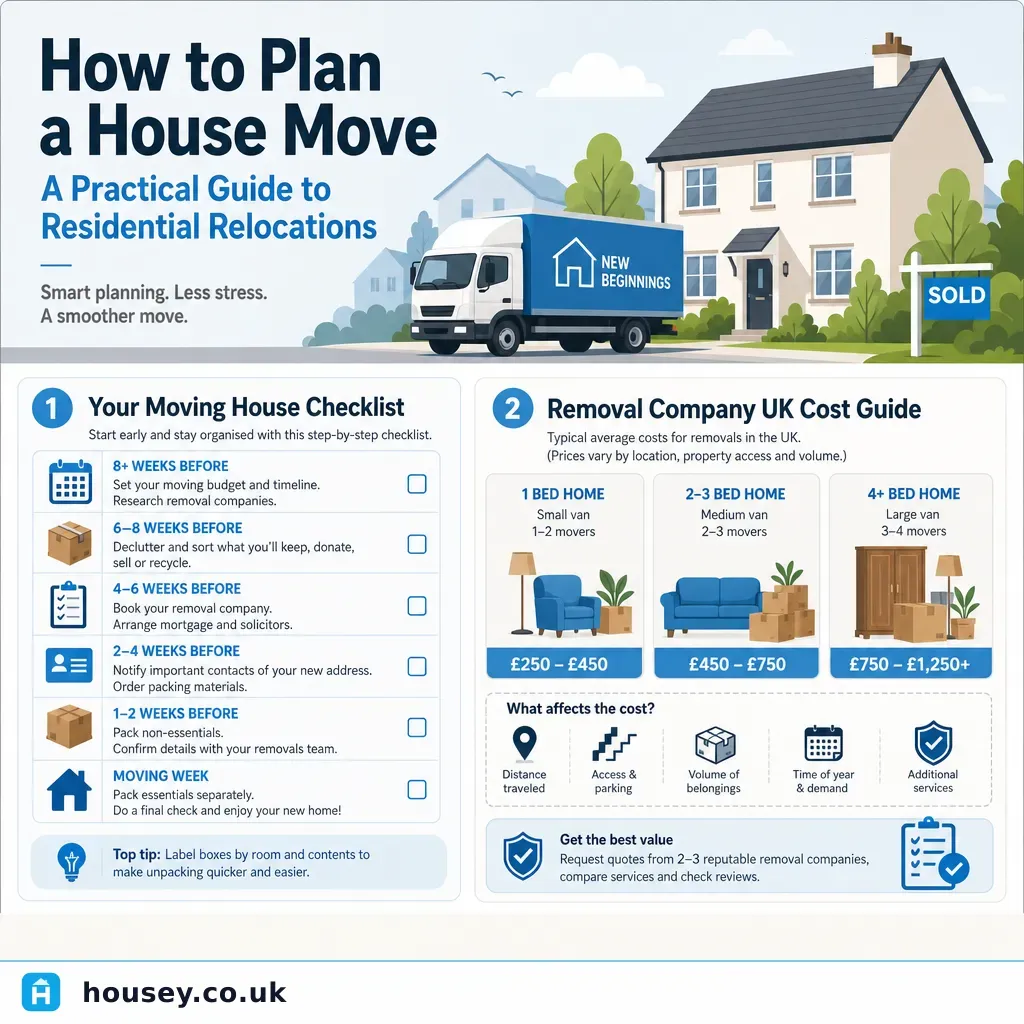
How to Plan a House Move: A Practical Guide to Residential Relocations
A UK house move goes more smoothly with planning that starts 6–8 weeks before moving day.
 Buying & Moving
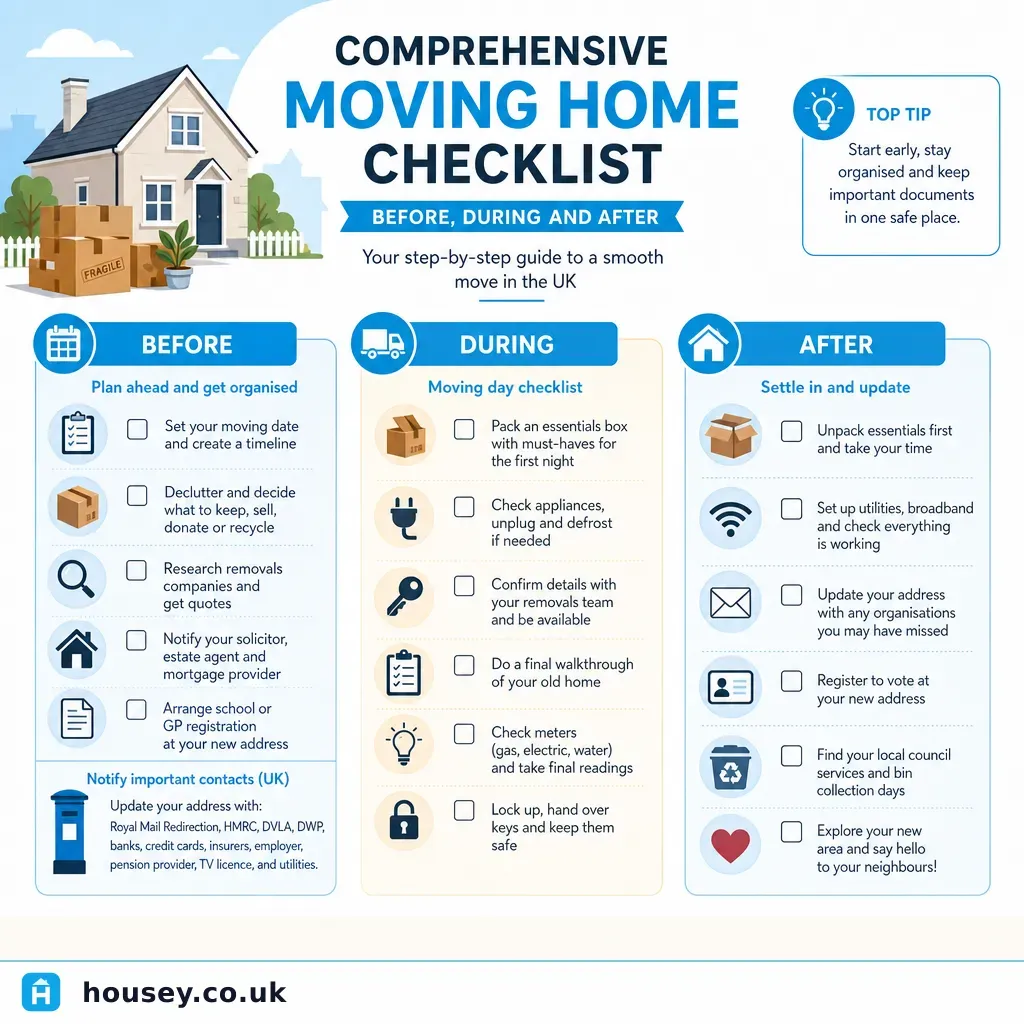
Comprehensive Moving Home Checklist: Before, During and After
Moving house in the UK involves tasks across roughly eight weeks: instructing a conveyancer and removal firm early, systematically notifying organisations of your new address, confirming buildings insurance from exchange, taking meter readings on completion day, and registering with the new council and utilities promptly.
 Buying & Moving
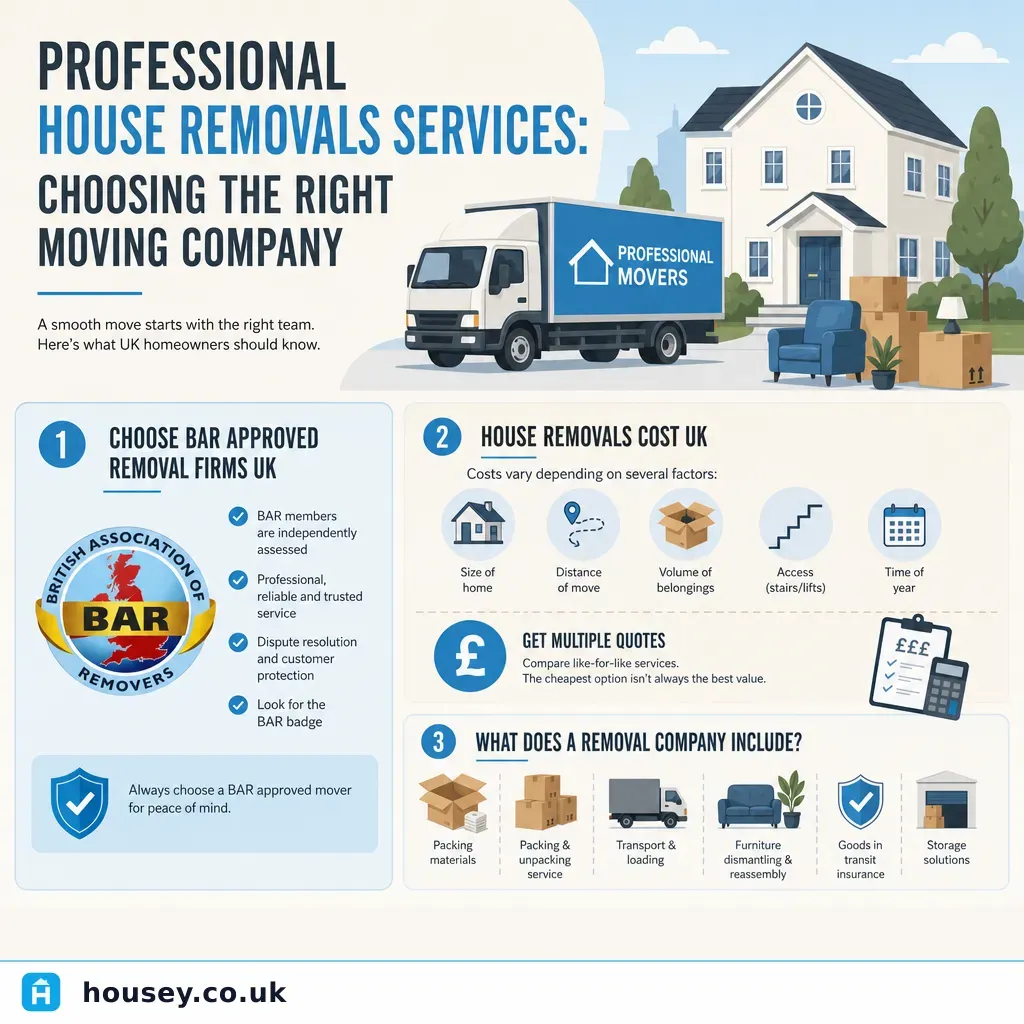
Professional House Removals Services: Choosing the Right Moving Company
A professional house removals company handles loading, transport, and unloading; full-service firms with BAR membership also offer deposit protection and independent dispute resolution.